
×
Request Free Sample ×

Kindly complete the form below to receive a free sample of this Report

* Please use a valid business email

Leading companies partner with us for data-driven Insights

clients tt-cursor
Hero Background
English
Chinese
French
Japanese
Korean
German
Spanish

Commercial Aircraft Seat Actuation Market Trends

ID: MRFR/AD/0919-HCR
110 Pages
Swapnil Palwe
February 2026

Commercial Aircraft Seat Actuation Market Size, Share, Industry Trend & Analysis Research Report Information by Actuator Type (Electro-Mechanical, Hydraulic, and Pneumatic), Seat Class (First Class, Business Class, Premium Economy Class, and Economy Class), Component (Hardware and Software), Aircraft Type (Narrow Body and Wide Body), Fit (Line-Fit and Retrofit), and Region (North America, Europe, Asia-Pacific, Middle East Africa, and Latin America) Forecast till 2035

Share:
Download PDF ×

We do not share your information with anyone. However, we may send you emails based on your report interest from time to time. You may contact us at any time to opt-out.

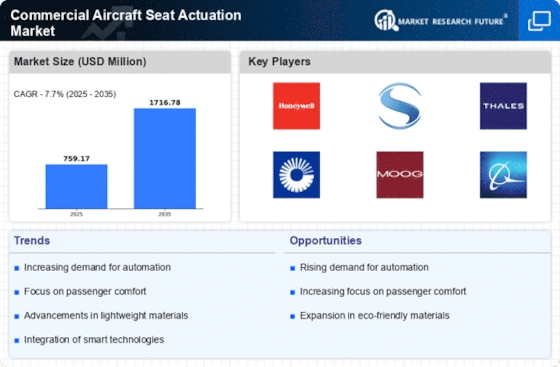
Commercial Aircraft Seat Actuation Market Infographic
Purchase Options

Market Trends

Key Emerging Trends in the Commercial Aircraft Seat Actuation Market

The Commercial Aircraft Seat Actuation market is undergoing significant transformations shaped by technological advancements and evolving passenger expectations. A noteworthy trend in this market is the increasing demand for innovative seat actuation systems that prioritize passenger comfort and optimize cabin space. Airlines are having their focus shifted towards the improvement of the in-flight experience, with seat actuation systems playing an instrumental role in sharing this objective. We are seeing an evolution from conventional manual and mechanical systems for seat adjustment to the latest electric and pneumatic mechanisms that provide smoother and more precise adjustment while maintaining the comfort.

The seat actuation systems have taken high demand parallel to the rapidly increasing need for aircars. The main engines of this expansion are the growing orders, the investment spree in high-end amenities, rise in need for seats of lightweight design and the flight boom of full-fare passengers.

In addition, the lightweight design impact is now impacting the Commercial Aircraft Seat market as well. To cut the weight of aircraft, seat actuation systems, and reduce this cost, many suppliers have shifted their attention to improve and lower the general weight of aircraft components. The manufacturers are able to produce materials with lightweight structures and have no impact on the toughness and performance. This pattern is in line with the aviation sector shift to more fuel-efficient aircraft, since they are working towards optimizing their operational economics and holding the level of passenger satisfaction at a high level.

Moreover, the market is observing a rise in the demand for customisable and tailored seating particularities. Airlines perceive the necessity to accommodate their diverse clients and re-categorise cabin classes so as to adapt to changing market dynamics. The consequence is that the adoption of modular seat designs and flexible seat actuation systems has gone up, which allows for the cabin configuration of premium seating, and optimization of the cabin space. One of the reasons why it is becoming so important is that airlines are trying to stand out from one another and to create a uniquely pleasant travel experience for their passengers.

Sustainability matters are as well reflecting into the trends of the market where Commercial Aircraft Seat Actuation is concerned. Airlines and manufacturers now begin to adopt green programmes in the materials to manufacture seat actuation system. In addition to this, researchers notice the increased use of ergonomic and health-conscious seat designs in market. As passenger well-being becomes a focal point, seat actuation systems are being developed with features that enhance comfort and support. This includes adjustable lumbar support, customizable recline angles, and other ergonomic features that contribute to a more comfortable and health-conscious seating experience for passengers.


Author
Swapnil Palwe
Team Lead - Research

With a technical background as Bachelor's in Mechanical Engineering, with MBA in Operations Management , Swapnil has 6+ years of experience in market research, consulting and analytics with the tasks of data mining, analysis, and project execution. He is the POC for our clients, for their consulting projects running under the Automotive/A&D domain. Swapnil has worked on major projects in verticals such as Aerospace & Defense, Automotive and many other domain projects. He has worked on projects for fortune 500 companies' syndicate and consulting projects along with several government projects.

Leave a Comment

FAQs

What is the projected market valuation for the Commercial Aircraft Seat Actuation Market by 2035?

<p>The projected market valuation for the Commercial Aircraft Seat Actuation Market is 1716.78 USD Million by 2035.</p>

What was the market valuation for the Commercial Aircraft Seat Actuation Market in 2024?

<p>The market valuation for the Commercial Aircraft Seat Actuation Market was 759.17 USD Million in 2024.</p>

What is the expected CAGR for the Commercial Aircraft Seat Actuation Market during the forecast period 2025 - 2035?

<p>The expected CAGR for the Commercial Aircraft Seat Actuation Market during the forecast period 2025 - 2035 is 7.7%.</p>

Which companies are considered key players in the Commercial Aircraft Seat Actuation Market?

<p>Key players in the Commercial Aircraft Seat Actuation Market include Honeywell, Safran, Thales, UTC Aerospace Systems, Moog Inc., Boeing, Rockwell Collins, Zodiac Aerospace, and Airbus.</p>

What are the different actuator types in the Commercial Aircraft Seat Actuation Market and their valuations?

<p>The actuator types include electro-mechanical, hydraulic, and pneumatic, with valuations of 688.39, 514.12, and 514.12 USD Million respectively.</p>

How does the market valuation for economy class seat actuation compare to other seat classes?

<p>The economy class seat actuation market valuation is 666.78 USD Million, which is higher than first class, premium economy, and business class valuations.</p>

What is the market valuation for narrow-body aircraft seat actuation?

<p>The market valuation for narrow-body aircraft seat actuation is projected to be between 300.0 and 700.0 USD Million.</p>

What are the projected valuations for hardware and software components in the market?

<p>The projected valuations for hardware and software components in the market are 855.56 and 861.22 USD Million respectively.</p>

What is the market valuation for business jets in the Commercial Aircraft Seat Actuation Market?

<p>The market valuation for business jets in the Commercial Aircraft Seat Actuation Market is between 59.17 and 66.78 USD Million.</p>

What is the expected market performance for the fit segment in the Commercial Aircraft Seat Actuation Market?

<p>The expected market performance for the fit segment in the Commercial Aircraft Seat Actuation Market is projected to be between 300.0 and 700.0 USD Million.</p>

Market Summary

As per Market Research Future analysis, the Commercial Aircraft Seat Actuation Market Size was estimated at 759.17 USD Million in 2024. The Commercial Aircraft Seat Actuation industry is projected to grow from 817.63 USD Million in 2025 to 1716.78 USD Million by 2035, exhibiting a compound annual growth rate (CAGR) of 7.7% during the forecast period 2025 - 2035

Key Market Trends & Highlights

The Commercial Aircraft Seat Actuation Market is poised for growth driven by technological advancements and a focus on passenger experience.

  • Technological advancements in actuation systems are enhancing the efficiency and reliability of seat mechanisms. The emphasis on passenger comfort and safety is leading to innovative designs in seat actuation technology. Sustainability initiatives are increasingly influencing the development of eco-friendly actuation systems in the aviation sector. Rising air travel demand and regulatory compliance are key drivers propelling the market, particularly in the North American and Asia-Pacific regions, with electro-mechanical systems dominating and economy class seats experiencing rapid growth.

Market Size & Forecast

2024 Market Size 759.17 (USD Million)
2035 Market Size 1716.78 (USD Million)
CAGR (2025 - 2035) 7.7%
Largest Regional Market Share in 2024 North America

Major Players

Honeywell (US), Safran (FR), Thales (FR), UTC Aerospace Systems (US), Moog Inc. (US), Boeing (US), Rockwell Collins (US), Zodiac Aerospace (FR), Airbus (FR)

Market Trends

The Commercial Aircraft Seat Actuation Market is currently experiencing a transformative phase, driven by advancements in technology and increasing passenger expectations. The integration of electric actuation systems is becoming more prevalent, as these systems offer enhanced reliability and reduced maintenance costs compared to traditional hydraulic systems. Furthermore, the growing emphasis on passenger comfort and safety is prompting manufacturers to innovate and develop more sophisticated seat actuation solutions. This trend is likely to continue as airlines seek to differentiate their services in a competitive landscape. In addition, sustainability concerns are influencing the Commercial Aircraft Seat Actuation Market. Manufacturers are exploring eco-friendly materials and energy-efficient designs to align with global environmental standards. This shift not only addresses regulatory requirements but also appeals to environmentally conscious consumers. As the market evolves, collaboration between aircraft manufacturers and seat suppliers is expected to intensify, fostering innovation and improving overall product offerings. The future of the Commercial Aircraft Seat Actuation Market appears promising, with ongoing developments poised to enhance the flying experience for passengers worldwide.

Technological Advancements in Actuation Systems

The Commercial Aircraft Seat Actuation Market is witnessing a shift towards advanced actuation technologies, particularly electric systems. These innovations provide improved performance, reduced weight, and lower energy consumption, which are crucial for modern aircraft design.

Focus on Passenger Comfort and Safety

There is a growing trend towards enhancing passenger comfort and safety within the Commercial Aircraft Seat Actuation Market. Manufacturers are developing more ergonomic seat designs and advanced actuation features that allow for greater customization and improved safety measures.

Sustainability Initiatives

Sustainability is becoming a central theme in the Commercial Aircraft Seat Actuation Market. Companies are increasingly adopting eco-friendly materials and energy-efficient technologies to meet regulatory standards and cater to the rising demand for environmentally responsible aviation solutions.

Commercial Aircraft Seat Actuation Market Market Drivers

Rising Air Travel Demand

The rising demand for air travel is a pivotal driver in the Commercial Aircraft Seat Actuation Market. As more individuals and businesses opt for air travel, airlines are expanding their fleets and upgrading existing aircraft to accommodate this growth. This expansion necessitates the incorporation of advanced seat actuation systems that enhance passenger comfort and operational efficiency. Market forecasts indicate a steady increase in air passenger traffic, which is likely to spur investments in modern seating solutions. Airlines are increasingly recognizing that the quality of seating can significantly impact customer satisfaction and loyalty. Consequently, the demand for innovative seat actuation technologies is expected to rise, positioning the Commercial Aircraft Seat Actuation Market for substantial growth in the coming years.

Sustainability Initiatives

Sustainability initiatives are increasingly influencing the Commercial Aircraft Seat Actuation Market. Airlines and manufacturers are under pressure to reduce their environmental footprint, leading to a shift towards more sustainable materials and manufacturing processes. The adoption of lightweight materials in seat actuation systems not only contributes to fuel efficiency but also aligns with broader sustainability goals. Market Research Future suggests that the demand for eco-friendly solutions is on the rise, with airlines seeking to enhance their green credentials. Additionally, the development of energy-efficient actuation systems is becoming a focal point, as these technologies can significantly lower energy consumption during operations. This growing emphasis on sustainability is likely to shape the future landscape of the Commercial Aircraft Seat Actuation Market.

Focus on Passenger Comfort and Safety

In the Commercial Aircraft Seat Actuation Market, the emphasis on passenger comfort and safety is becoming increasingly pronounced. Airlines are recognizing that enhancing the passenger experience is essential for maintaining competitiveness. As a result, there is a growing demand for seat actuation systems that provide greater adjustability and ergonomic support. Features such as reclining capabilities, lumbar support, and personalized seating configurations are being prioritized. Market data indicates that airlines investing in advanced seat actuation technologies are likely to see improved customer satisfaction ratings. Furthermore, safety regulations are becoming more stringent, necessitating the incorporation of reliable actuation systems that ensure secure seating arrangements during flight. This dual focus on comfort and safety is driving innovation and investment in the Commercial Aircraft Seat Actuation Market.

Regulatory Compliance and Safety Standards

The Commercial Aircraft Seat Actuation Market is significantly influenced by regulatory compliance and safety standards. Governments and aviation authorities worldwide are implementing stringent regulations to ensure the safety and reliability of aircraft seating systems. Compliance with these regulations is not only mandatory but also essential for manufacturers aiming to maintain market access. The increasing complexity of safety standards necessitates the development of advanced actuation systems that can meet these requirements. Market data indicates that manufacturers investing in compliance-focused innovations are likely to gain a competitive edge. Furthermore, as safety concerns continue to rise, the demand for reliable and robust seat actuation systems is expected to grow, making regulatory compliance a key driver in the Commercial Aircraft Seat Actuation Market.

Technological Advancements in Actuation Systems

The Commercial Aircraft Seat Actuation Market is experiencing a notable transformation due to rapid technological advancements. Innovations in electric actuation systems, which offer enhanced precision and reliability, are becoming increasingly prevalent. These systems are designed to improve the overall functionality of aircraft seating, allowing for more efficient adjustments and configurations. The integration of smart technologies, such as sensors and automation, is also gaining traction, enabling real-time monitoring and adjustments. According to recent data, the market for electric actuation systems is projected to grow significantly, driven by the demand for more efficient and lightweight solutions. This shift towards advanced actuation technologies not only enhances passenger experience but also contributes to operational efficiency for airlines, making it a critical driver in the Commercial Aircraft Seat Actuation Market.

Market Segment Insights

By Actuator Type: Electro-mechanical (Largest) vs. Hydraulic (Fastest-Growing)

In the Commercial Aircraft Seat Actuation Market, the actuator types are segmented into electro-mechanical, hydraulic, and pneumatic systems. The electro-mechanical segment holds the largest share of the market, favored for its reliability and precision in operation. Conversely, the hydraulic segment, while smaller, is experiencing rapid growth due to advancements in technology and increasing demand for enhanced performance in commercial aircraft seating.

Electro-mechanical (Dominant) vs. Hydraulic (Emerging)

Electro-mechanical actuators are characterized by their high efficiency, reduced maintenance requirements, and silent operation, making them the preferred choice in modern commercial aircraft seating systems. Their dominance in the market is driven by the increasing emphasis on lightweight materials and energy efficiency. On the other hand, hydraulic actuators are emerging as a competitive alternative, especially in high-performance applications where power and speed are critical. Their capability to handle heavy loads and operate in extreme conditions positions them as an attractive option for manufacturers looking to enhance the functionality of aircraft seating. As technology advances, both segments are expected to evolve, catering to the diverse needs of the aviation industry.

By Seat Class: First Class (Largest) vs. Economy Class (Fastest-Growing)

Within the Commercial Aircraft Seat Actuation Market, the seat class segment is characterized by distinct market share distributions, with first class seating leading the way in terms of value and luxury appeal. Business class follows as a substantial sector, appealing to travelers seeking enhanced comfort. Meanwhile, economy class seats, despite their lower individual price points, represent a significant portion of the overall market due to sheer passenger volume, showcasing a diverse range of actuation technologies tailored for cost efficiency and functionality.

First Class (Dominant) vs. Economy Class (Emerging)

First class seating is recognized for its luxurious and spacious design, equipped with advanced actuation systems that ensure maximum comfort and personalization. This segment predominantly caters to high-net-worth individuals and business executives, necessitating sophisticated and reliable actuation technology. Conversely, the economy class segment, while generally budget-focused, is emerging rapidly due to increasing passenger demand for travel. Innovations in actuation systems that enhance seat comfort and functionality are being developed to accommodate more passengers, thus prioritizing durability and efficiency without compromising on comfort. This blend of functionality and adaptation to market demands positions the economy class as a vital and evolving segment.

By Component: Hardware (Largest) vs. Software (Fastest-Growing)

In the Commercial Aircraft Seat Actuation Market, the component segment is primarily divided into hardware and software. Hardware represents the largest part of this segment, encompassing all the physical components made for seat actuation systems. This includes various mechanical and electronic systems that ensure the effective movement and adjustment of seats in commercial aircraft. On the other hand, software plays a crucial role too, though it accounts for a smaller share compared to hardware. It focuses on controlling the actuation systems, providing advanced functionalities for passenger comfort and safety. In recent years, the software component has been experiencing fast growth due to the increasing emphasis on digitization and automation in aviation. As airlines integrate more technology-driven solutions to enhance customer experience, the demand for advanced software that optimizes seat actuation processes is on the rise. Additionally, the need for adaptive and flexible seating configurations to meet diverse passenger needs is driving the growth of software solutions in this market, making it a vital area for future development and investment.

Component: Hardware (Dominant) vs. Software (Emerging)

Hardware remains the dominant player in the Commercial Aircraft Seat Actuation Market, characterized by its extensive range of mechanical parts and electronic control systems that are essential for effective seat operations. The reliability and durability of hardware components make them vital for flight safety and operational efficiency. Conversely, the software segment is emerging rapidly, driven by technological advancements and the growing demand for enhanced passenger experiences. Software solutions increasingly provide flexibility, enabling airlines to configure seats for comfort and space optimization. The combination of both segments is essential, as advancements in software will likely enhance hardware functionalities, leading to a more integrated and efficient seat actuation system in commercial aircraft.

By Aircraft Type: Narrow-Body (Largest) vs. Wide-Body (Fastest-Growing)

In the Commercial Aircraft Seat Actuation Market, narrow-body aircraft have emerged as the dominant segment, capturing a significant share due to their widespread use in short-haul routes. These aircraft types are essential for airline operators focused on efficiency and cost-effectiveness, thereby driving the demand for advanced seat actuation systems. On the other hand, wide-body aircraft, which are typically used for long-haul flights, are witnessing rapid growth as airlines increasingly invest in enhancing passenger comfort and optimizing seating layouts. This shift indicates a healthy competition within the segment, indicating a potential change in market dynamics in the coming years.

Narrow-Body (Dominant) vs. Wide-Body (Emerging)

Narrow-body aircraft primarily cater to regional and short-distance travel, making them the preferred choice for low-cost carriers and major airlines alike. Their market dominance is reflected in a robust demand for innovations in seat actuation systems aimed at maximizing passenger comfort while minimizing weight. In contrast, wide-body aircraft are gaining traction as airlines focus on premium services and enhancing the overall flying experience. With advancements in seat flexibility and ergonomics, the wide-body segment is positioned for significant growth, particularly as airlines adapt to changing passenger expectations and competitive pressures in the aviation market.

By Fit: OEM (Largest) vs. Aftermarket (Fastest-Growing)

The Commercial Aircraft Seat Actuation Market is segmented by fit into OEM and aftermarket categories. The OEM segment dominates the market due to its alignment with new aircraft developments and the rising demand for enhanced cabin comfort and functionality. As more airlines look to upgrade their fleets, the demand for original equipment fitted with advanced actuation systems has increased significantly, shaping the largest share of the market.

Fit: OEM (Dominant) vs. Aftermarket (Emerging)

The OEM segment is characterized by system integration into the latest aircraft models, incorporating advanced technologies to enhance passenger comfort and operational efficiency. Manufacturers collaborate closely with airline companies and aircraft manufacturers to ensure that the actuation systems comply with stringent safety and performance regulations. Conversely, the aftermarket segment, though smaller, is rapidly emerging due to the increasing need for retrofitting existing aircraft with new actuation technologies to meet evolving passenger expectations and regulatory requirements. This segment is buoyed by the rising trend of airlines seeking to improve the lifecycle of older aircraft and adapting them to better serve market demands.

Get more detailed insights about Commercial Aircraft Seat Actuation Market Research Report - Global Forecast till 2035

Regional Insights

North America : Aerospace Innovation Leader

North America is the largest market for commercial aircraft seat actuation, holding approximately 45% of the global market share. The region's growth is driven by increasing air travel demand, advancements in aerospace technology, and stringent safety regulations. The presence of major manufacturers and suppliers further fuels market expansion, with a focus on innovative solutions that enhance passenger comfort and safety. The United States is the leading country in this sector, home to key players such as Honeywell, Boeing, and UTC Aerospace Systems. The competitive landscape is characterized by significant investments in R&D and collaborations among industry leaders. Canada also plays a vital role, contributing to the market with its growing aerospace sector and partnerships with U.S. firms, ensuring a robust supply chain and technological advancements.

Europe : Regulatory Framework and Growth

Europe is the second-largest market for commercial aircraft seat actuation, accounting for around 30% of the global share. The region's growth is propelled by increasing passenger traffic, a focus on sustainable aviation, and compliance with stringent EU regulations. The European Union's initiatives to enhance aviation safety and efficiency are significant catalysts for market development, encouraging innovation and investment in advanced actuation systems. Leading countries in Europe include France, Germany, and the UK, with major players like Safran and Thales driving competition. The competitive landscape is marked by collaborations between manufacturers and airlines to develop customized solutions. The presence of regulatory bodies ensures adherence to safety standards, fostering a stable environment for market growth. The European Aviation Safety Agency plays a crucial role in shaping industry regulations and standards.

Asia-Pacific : Rapid Growth and Expansion

Asia-Pacific is witnessing rapid growth in the commercial aircraft seat actuation market, holding approximately 20% of the global share. The region's expansion is driven by increasing air travel demand, rising disposable incomes, and government investments in aviation infrastructure. Countries like China and India are leading this growth, supported by favorable regulations and a burgeoning middle class that prioritizes air travel. China is the largest market in the region, with significant contributions from local manufacturers and partnerships with global players. India is also emerging as a key player, with a growing aviation sector and increasing demand for modern aircraft. The competitive landscape is characterized by collaborations between domestic and international firms, enhancing technological capabilities and market reach. The presence of key players like Moog Inc. and Rockwell Collins further strengthens the market dynamics.

Middle East and Africa : Resource-Rich Aviation Sector

The Middle East and Africa region is gradually developing its commercial aircraft seat actuation market, accounting for about 5% of the global share. The growth is driven by increasing air travel, investments in airport infrastructure, and the region's strategic location as a global aviation hub. However, challenges such as political instability and economic fluctuations can impact market dynamics. The region is focusing on enhancing its aviation capabilities to attract more international airlines. Leading countries include the UAE and South Africa, with significant investments in aviation infrastructure and partnerships with global manufacturers. The competitive landscape is evolving, with local players emerging alongside established international firms. The presence of key players like Zodiac Aerospace and Airbus is crucial for driving innovation and meeting the growing demand for advanced actuation systems in the region.

Key Players and Competitive Insights

The Commercial Aircraft Seat Actuation Market is characterized by a dynamic competitive landscape, driven by technological advancements and increasing demand for passenger comfort. Key players such as Honeywell (US), Safran (FR), and Moog Inc. (US) are at the forefront, each adopting distinct strategies to enhance their market positioning. Honeywell (US) focuses on innovation, particularly in developing smart actuation systems that integrate seamlessly with modern aircraft designs. Meanwhile, Safran (FR) emphasizes partnerships with aircraft manufacturers to co-develop next-generation seating solutions, thereby enhancing its operational focus on collaborative innovation. Moog Inc. (US) appears to be concentrating on expanding its global footprint, particularly in emerging markets, which could potentially reshape the competitive dynamics by introducing new players into the market.

The business tactics employed by these companies reflect a trend towards localizing manufacturing and optimizing supply chains to enhance efficiency and reduce costs. The market structure is moderately fragmented, with several key players exerting influence over various segments. This fragmentation allows for a diverse range of offerings, yet the collective strength of these major companies suggests a competitive environment where innovation and strategic partnerships are paramount.

In August 2025, Honeywell (US) announced a collaboration with a leading aircraft manufacturer to develop a new line of lightweight actuation systems designed to improve fuel efficiency. This strategic move not only aligns with the industry's push towards sustainability but also positions Honeywell as a leader in innovative solutions that meet evolving regulatory standards. The implications of this partnership could be far-reaching, potentially setting new benchmarks for performance in the sector.

In September 2025, Safran (FR) unveiled its latest actuation technology at a major aerospace exhibition, showcasing advancements in electric actuation systems. This development is significant as it highlights Safran's commitment to sustainability and efficiency, responding to increasing regulatory pressures for greener aviation solutions. The introduction of this technology may enhance Safran's competitive edge, particularly among environmentally conscious airlines.

In October 2025, Moog Inc. (US) completed the acquisition of a smaller firm specializing in advanced actuation technologies. This acquisition is likely to bolster Moog's capabilities in high-performance actuation systems, allowing for greater innovation and a more robust product portfolio. Such strategic actions indicate a trend towards consolidation in the market, where larger players seek to enhance their technological capabilities through targeted acquisitions.

As of October 2025, the competitive trends in the Commercial Aircraft Seat Actuation Market are increasingly defined by digitalization, sustainability, and the integration of artificial intelligence. Strategic alliances are becoming more prevalent, as companies recognize the need to collaborate in order to innovate effectively. Looking ahead, it appears that competitive differentiation will increasingly hinge on technological advancements and supply chain reliability, rather than merely price competition. This shift suggests a future where innovation and sustainability are at the core of competitive strategies, fundamentally altering the landscape of the market.

Key Companies in the Commercial Aircraft Seat Actuation Market include

Industry Developments

  • Q2 2024: Safran signs major contract with Airbus for next-generation aircraft seat actuation systems Safran announced a multi-year contract with Airbus to supply advanced seat actuation systems for the A320neo and A350 programs, aiming to enhance passenger comfort and cabin efficiency.
  • Q2 2024: Collins Aerospace opens new manufacturing facility for aircraft seat actuation components in Singapore Collins Aerospace inaugurated a new production facility in Singapore dedicated to manufacturing precision seat actuation components for commercial aircraft, expanding its global supply chain capabilities.
  • Q3 2024: Rolls-Royce acquires minority stake in seat actuation startup Actuaero Rolls-Royce announced the acquisition of a 20% stake in Actuaero, a UK-based startup specializing in lightweight electric seat actuation systems for commercial aviation.
  • Q3 2024: Recaro Aircraft Seating secures contract with Emirates for business class seat actuation upgrade Recaro Aircraft Seating won a contract to retrofit Emirates' business class cabins with new seat actuation systems, focusing on improved reliability and passenger customization.
  • Q4 2024: Meggitt launches next-generation modular seat actuation platform for commercial jets Meggitt introduced a new modular seat actuation platform designed for rapid integration into multiple aircraft types, offering enhanced maintainability and reduced weight.
  • Q4 2024: Aerospace supplier Bühler Motor announces partnership with Boeing for electric seat actuation systems Bühler Motor entered into a strategic partnership with Boeing to co-develop electric seat actuation systems for future commercial aircraft, targeting improved energy efficiency.
  • Q1 2025: Parker Hannifin wins contract to supply seat actuation systems for United Airlines’ new fleet Parker Hannifin was awarded a contract to provide advanced seat actuation systems for United Airlines’ upcoming fleet of Boeing 787 and Airbus A321XLR aircraft.
  • Q1 2025: Faurecia announces executive appointment to lead aircraft seat actuation division Faurecia named Dr. Marie Dubois as the new head of its aircraft seat actuation division, signaling a renewed focus on innovation and global expansion.
  • Q2 2025: ITT Inc. unveils smart seat actuation system with predictive maintenance for commercial aviation ITT Inc. launched a new smart seat actuation system featuring integrated sensors and predictive maintenance capabilities, aiming to reduce downtime for airline operators.
  • Q2 2025: Diehl Aviation secures regulatory approval for new lightweight seat actuation technology Diehl Aviation received EASA certification for its latest lightweight seat actuation technology, enabling airlines to reduce cabin weight and improve fuel efficiency.
  • Q3 2025: Moog Inc. announces partnership with Embraer for next-gen seat actuation integration Moog Inc. entered a partnership with Embraer to integrate its next-generation seat actuation systems into the E2 series, focusing on enhanced passenger comfort and system reliability.
  • Q3 2025: Geven S.p.A. raises €40 million to expand aircraft seat actuation R&D Geven S.p.A., an Italian aircraft seating manufacturer, completed a €40 million funding round to accelerate research and development of advanced seat actuation technologies for commercial aircraft.

Research Methodology

The market values and forecast are derived using the Market Research Future (MRFR) research methodology, which includes secondary research, primary interviews, data triangulation, and validation from an in-house data repository and statistical modeling tools.

Secondary Research

in this process, data is collected from various secondary sources, including annual reports, SEC filings, journals, government associations, aerospace & defense magazines, white papers, corporate presentations, company websites, and paid databases.

Primary Research

In this process, both the demand- and supply-side parties are interviewed to extract facts and insights into the market forecast, production, trends, and projected market growth. Industry stakeholders such as CEOs, VPs, directors, and marketing executives across the value chain are approached to obtain key information.

Key Insights

Market Sizing, Forecast, and Analysis: Detailed coverage of the market segment and sub-segments

Regional/Country Trends and Forecast: Detailed analysis of the market in North America, Europe, Asia-Pacific, Middle East & Africa, and Latin America, along with key countries in each region

Market Dynamics Intelligence: Market drivers, opportunities, trends, restraints, Porter’s five forces, supply chain, and value chain analysis

Technology Trends, Regulatory Landscape, and Patent Analysis Outlook

Competitive Intelligence: Market share analysis, financial analysis, product benchmarking, and strategic developments including joint ventures, product launches, and mergers & acquisitions

Regional attractiveness and related growth opportunities

Future Outlook

Commercial Aircraft Seat Actuation Market Future Outlook

The Commercial Aircraft Seat Actuation Market is projected to grow at a 7.7% CAGR from 2025 to 2035, driven by technological advancements, increasing air travel demand, and enhanced passenger comfort requirements.

New opportunities lie in:

  • Development of lightweight actuation systems for fuel efficiency</p><p>Integration of smart technology for personalized seating adjustments</p><p>Expansion into emerging markets with tailored actuation solutions

By 2035, the market is expected to achieve robust growth, positioning itself as a leader in aviation comfort technology.

Market Segmentation

Commercial Aircraft Seat Actuation Market Component Outlook

  • hardware
  • software

Commercial Aircraft Seat Actuation Market Seat Class Outlook

  • first class
  • business class
  • premium economy class
  • economy class

Commercial Aircraft Seat Actuation Market Actuator Type Outlook

  • electro-mechanical
  • hydraulic
  • pneumatic

Report Scope

MARKET SIZE 2024 759.17(USD Million)
MARKET SIZE 2025 817.63(USD Million)
MARKET SIZE 2035 1716.78(USD Million)
COMPOUND ANNUAL GROWTH RATE (CAGR) 7.7% (2025 - 2035)
REPORT COVERAGE Revenue Forecast, Competitive Landscape, Growth Factors, and Trends
BASE YEAR 2024
Market Forecast Period 2025 - 2035
Historical Data 2019 - 2024
Market Forecast Units USD Million
Key Companies Profiled Honeywell (US), Safran (FR), Thales (FR), UTC Aerospace Systems (US), Moog Inc. (US), Boeing (US), Rockwell Collins (US), Zodiac Aerospace (FR), Airbus (FR)
Segments Covered Actuator Type
Key Market Opportunities Integration of advanced automation technologies enhances passenger comfort in the Commercial Aircraft Seat Actuation Market.
Key Market Dynamics Technological advancements in actuation systems drive efficiency and comfort in commercial aircraft seating solutions.
Countries Covered North America, Europe, APAC, South America, MEA

FAQs

What is the projected market valuation for the Commercial Aircraft Seat Actuation Market by 2035?

<p>The projected market valuation for the Commercial Aircraft Seat Actuation Market is 1716.78 USD Million by 2035.</p>

What was the market valuation for the Commercial Aircraft Seat Actuation Market in 2024?

<p>The market valuation for the Commercial Aircraft Seat Actuation Market was 759.17 USD Million in 2024.</p>

What is the expected CAGR for the Commercial Aircraft Seat Actuation Market during the forecast period 2025 - 2035?

<p>The expected CAGR for the Commercial Aircraft Seat Actuation Market during the forecast period 2025 - 2035 is 7.7%.</p>

Which companies are considered key players in the Commercial Aircraft Seat Actuation Market?

<p>Key players in the Commercial Aircraft Seat Actuation Market include Honeywell, Safran, Thales, UTC Aerospace Systems, Moog Inc., Boeing, Rockwell Collins, Zodiac Aerospace, and Airbus.</p>

What are the different actuator types in the Commercial Aircraft Seat Actuation Market and their valuations?

<p>The actuator types include electro-mechanical, hydraulic, and pneumatic, with valuations of 688.39, 514.12, and 514.12 USD Million respectively.</p>

How does the market valuation for economy class seat actuation compare to other seat classes?

<p>The economy class seat actuation market valuation is 666.78 USD Million, which is higher than first class, premium economy, and business class valuations.</p>

What is the market valuation for narrow-body aircraft seat actuation?

<p>The market valuation for narrow-body aircraft seat actuation is projected to be between 300.0 and 700.0 USD Million.</p>

What are the projected valuations for hardware and software components in the market?

<p>The projected valuations for hardware and software components in the market are 855.56 and 861.22 USD Million respectively.</p>

What is the market valuation for business jets in the Commercial Aircraft Seat Actuation Market?

<p>The market valuation for business jets in the Commercial Aircraft Seat Actuation Market is between 59.17 and 66.78 USD Million.</p>

What is the expected market performance for the fit segment in the Commercial Aircraft Seat Actuation Market?

<p>The expected market performance for the fit segment in the Commercial Aircraft Seat Actuation Market is projected to be between 300.0 and 700.0 USD Million.</p>

  1. SECTION I: EXECUTIVE SUMMARY AND KEY HIGHLIGHTS
    1. | 1.1 EXECUTIVE SUMMARY
    2. | | 1.1.1 Market Overview
    3. | | 1.1.2 Key Findings
    4. | | 1.1.3 Market Segmentation
    5. | | 1.1.4 Competitive Landscape
    6. | | 1.1.5 Challenges and Opportunities
    7. | | 1.1.6 Future Outlook
  2. SECTION II: SCOPING, METHODOLOGY AND MARKET STRUCTURE
    1. | 2.1 MARKET INTRODUCTION
    2. | | 2.1.1 Definition
    3. | | 2.1.2 Scope of the study
    4. | | | 2.1.2.1 Research Objective
    5. | | | 2.1.2.2 Assumption
    6. | | | 2.1.2.3 Limitations
    7. | 2.2 RESEARCH METHODOLOGY
    8. | | 2.2.1 Overview
    9. | | 2.2.2 Data Mining
    10. | | 2.2.3 Secondary Research
    11. | | 2.2.4 Primary Research
    12. | | | 2.2.4.1 Primary Interviews and Information Gathering Process
    13. | | | 2.2.4.2 Breakdown of Primary Respondents
    14. | | 2.2.5 Forecasting Model
    15. | | 2.2.6 Market Size Estimation
    16. | | | 2.2.6.1 Bottom-Up Approach
    17. | | | 2.2.6.2 Top-Down Approach
    18. | | 2.2.7 Data Triangulation
    19. | | 2.2.8 Validation
  3. SECTION III: QUALITATIVE ANALYSIS
    1. | 3.1 MARKET DYNAMICS
    2. | | 3.1.1 Overview
    3. | | 3.1.2 Drivers
    4. | | 3.1.3 Restraints
    5. | | 3.1.4 Opportunities
    6. | 3.2 MARKET FACTOR ANALYSIS
    7. | | 3.2.1 Value chain Analysis
    8. | | 3.2.2 Porter's Five Forces Analysis
    9. | | | 3.2.2.1 Bargaining Power of Suppliers
    10. | | | 3.2.2.2 Bargaining Power of Buyers
    11. | | | 3.2.2.3 Threat of New Entrants
    12. | | | 3.2.2.4 Threat of Substitutes
    13. | | | 3.2.2.5 Intensity of Rivalry
    14. | | 3.2.3 COVID-19 Impact Analysis
    15. | | | 3.2.3.1 Market Impact Analysis
    16. | | | 3.2.3.2 Regional Impact
    17. | | | 3.2.3.3 Opportunity and Threat Analysis
  4. SECTION IV: QUANTITATIVE ANALYSIS
    1. | 4.1 Aerospace & Defense, BY Actuator Type (USD Million)
    2. | | 4.1.1 electro-mechanical
    3. | | 4.1.2 hydraulic
    4. | | 4.1.3 pneumatic
    5. | 4.2 Aerospace & Defense, BY Seat Class (USD Million)
    6. | | 4.2.1 first class
    7. | | 4.2.2 business class
    8. | | 4.2.3 premium economy class
    9. | | 4.2.4 economy class
    10. | 4.3 Aerospace & Defense, BY Component (USD Million)
    11. | | 4.3.1 hardware
    12. | | 4.3.2 software
    13. | 4.4 Aerospace & Defense, BY Aircraft Type (USD Million)
    14. | 4.5 Aerospace & Defense, BY Fit (USD Million)
    15. | 4.6 Aerospace & Defense, BY Region (USD Million)
    16. | | 4.6.1 North America
    17. | | | 4.6.1.1 US
    18. | | | 4.6.1.2 Canada
    19. | | 4.6.2 Europe
    20. | | | 4.6.2.1 Germany
    21. | | | 4.6.2.2 UK
    22. | | | 4.6.2.3 France
    23. | | | 4.6.2.4 Russia
    24. | | | 4.6.2.5 Italy
    25. | | | 4.6.2.6 Spain
    26. | | | 4.6.2.7 Rest of Europe
    27. | | 4.6.3 APAC
    28. | | | 4.6.3.1 China
    29. | | | 4.6.3.2 India
    30. | | | 4.6.3.3 Japan
    31. | | | 4.6.3.4 South Korea
    32. | | | 4.6.3.5 Malaysia
    33. | | | 4.6.3.6 Thailand
    34. | | | 4.6.3.7 Indonesia
    35. | | | 4.6.3.8 Rest of APAC
    36. | | 4.6.4 South America
    37. | | | 4.6.4.1 Brazil
    38. | | | 4.6.4.2 Mexico
    39. | | | 4.6.4.3 Argentina
    40. | | | 4.6.4.4 Rest of South America
    41. | | 4.6.5 MEA
    42. | | | 4.6.5.1 GCC Countries
    43. | | | 4.6.5.2 South Africa
    44. | | | 4.6.5.3 Rest of MEA
  5. SECTION V: COMPETITIVE ANALYSIS
    1. | 5.1 Competitive Landscape
    2. | | 5.1.1 Overview
    3. | | 5.1.2 Competitive Analysis
    4. | | 5.1.3 Market share Analysis
    5. | | 5.1.4 Major Growth Strategy in the Aerospace & Defense
    6. | | 5.1.5 Competitive Benchmarking
    7. | | 5.1.6 Leading Players in Terms of Number of Developments in the Aerospace & Defense
    8. | | 5.1.7 Key developments and growth strategies
    9. | | | 5.1.7.1 New Product Launch/Service Deployment
    10. | | | 5.1.7.2 Merger & Acquisitions
    11. | | | 5.1.7.3 Joint Ventures
    12. | | 5.1.8 Major Players Financial Matrix
    13. | | | 5.1.8.1 Sales and Operating Income
    14. | | | 5.1.8.2 Major Players R&D Expenditure. 2023
    15. | 5.2 Company Profiles
    16. | | 5.2.1 Honeywell (US)
    17. | | | 5.2.1.1 Financial Overview
    18. | | | 5.2.1.2 Products Offered
    19. | | | 5.2.1.3 Key Developments
    20. | | | 5.2.1.4 SWOT Analysis
    21. | | | 5.2.1.5 Key Strategies
    22. | | 5.2.2 Safran (FR)
    23. | | | 5.2.2.1 Financial Overview
    24. | | | 5.2.2.2 Products Offered
    25. | | | 5.2.2.3 Key Developments
    26. | | | 5.2.2.4 SWOT Analysis
    27. | | | 5.2.2.5 Key Strategies
    28. | | 5.2.3 Thales (FR)
    29. | | | 5.2.3.1 Financial Overview
    30. | | | 5.2.3.2 Products Offered
    31. | | | 5.2.3.3 Key Developments
    32. | | | 5.2.3.4 SWOT Analysis
    33. | | | 5.2.3.5 Key Strategies
    34. | | 5.2.4 UTC Aerospace Systems (US)
    35. | | | 5.2.4.1 Financial Overview
    36. | | | 5.2.4.2 Products Offered
    37. | | | 5.2.4.3 Key Developments
    38. | | | 5.2.4.4 SWOT Analysis
    39. | | | 5.2.4.5 Key Strategies
    40. | | 5.2.5 Moog Inc. (US)
    41. | | | 5.2.5.1 Financial Overview
    42. | | | 5.2.5.2 Products Offered
    43. | | | 5.2.5.3 Key Developments
    44. | | | 5.2.5.4 SWOT Analysis
    45. | | | 5.2.5.5 Key Strategies
    46. | | 5.2.6 Boeing (US)
    47. | | | 5.2.6.1 Financial Overview
    48. | | | 5.2.6.2 Products Offered
    49. | | | 5.2.6.3 Key Developments
    50. | | | 5.2.6.4 SWOT Analysis
    51. | | | 5.2.6.5 Key Strategies
    52. | | 5.2.7 Rockwell Collins (US)
    53. | | | 5.2.7.1 Financial Overview
    54. | | | 5.2.7.2 Products Offered
    55. | | | 5.2.7.3 Key Developments
    56. | | | 5.2.7.4 SWOT Analysis
    57. | | | 5.2.7.5 Key Strategies
    58. | | 5.2.8 Zodiac Aerospace (FR)
    59. | | | 5.2.8.1 Financial Overview
    60. | | | 5.2.8.2 Products Offered
    61. | | | 5.2.8.3 Key Developments
    62. | | | 5.2.8.4 SWOT Analysis
    63. | | | 5.2.8.5 Key Strategies
    64. | | 5.2.9 Airbus (FR)
    65. | | | 5.2.9.1 Financial Overview
    66. | | | 5.2.9.2 Products Offered
    67. | | | 5.2.9.3 Key Developments
    68. | | | 5.2.9.4 SWOT Analysis
    69. | | | 5.2.9.5 Key Strategies
    70. | 5.3 Appendix
    71. | | 5.3.1 References
    72. | | 5.3.2 Related Reports
  6. LIST OF FIGURES
    1. | 6.1 MARKET SYNOPSIS
    2. | 6.2 NORTH AMERICA MARKET ANALYSIS
    3. | 6.3 US MARKET ANALYSIS BY ACTUATOR TYPE
    4. | 6.4 US MARKET ANALYSIS BY SEAT CLASS
    5. | 6.5 US MARKET ANALYSIS BY COMPONENT
    6. | 6.6 US MARKET ANALYSIS BY AIRCRAFT TYPE
    7. | 6.7 US MARKET ANALYSIS BY FIT
    8. | 6.8 CANADA MARKET ANALYSIS BY ACTUATOR TYPE
    9. | 6.9 CANADA MARKET ANALYSIS BY SEAT CLASS
    10. | 6.10 CANADA MARKET ANALYSIS BY COMPONENT
    11. | 6.11 CANADA MARKET ANALYSIS BY AIRCRAFT TYPE
    12. | 6.12 CANADA MARKET ANALYSIS BY FIT
    13. | 6.13 EUROPE MARKET ANALYSIS
    14. | 6.14 GERMANY MARKET ANALYSIS BY ACTUATOR TYPE
    15. | 6.15 GERMANY MARKET ANALYSIS BY SEAT CLASS
    16. | 6.16 GERMANY MARKET ANALYSIS BY COMPONENT
    17. | 6.17 GERMANY MARKET ANALYSIS BY AIRCRAFT TYPE
    18. | 6.18 GERMANY MARKET ANALYSIS BY FIT
    19. | 6.19 UK MARKET ANALYSIS BY ACTUATOR TYPE
    20. | 6.20 UK MARKET ANALYSIS BY SEAT CLASS
    21. | 6.21 UK MARKET ANALYSIS BY COMPONENT
    22. | 6.22 UK MARKET ANALYSIS BY AIRCRAFT TYPE
    23. | 6.23 UK MARKET ANALYSIS BY FIT
    24. | 6.24 FRANCE MARKET ANALYSIS BY ACTUATOR TYPE
    25. | 6.25 FRANCE MARKET ANALYSIS BY SEAT CLASS
    26. | 6.26 FRANCE MARKET ANALYSIS BY COMPONENT
    27. | 6.27 FRANCE MARKET ANALYSIS BY AIRCRAFT TYPE
    28. | 6.28 FRANCE MARKET ANALYSIS BY FIT
    29. | 6.29 RUSSIA MARKET ANALYSIS BY ACTUATOR TYPE
    30. | 6.30 RUSSIA MARKET ANALYSIS BY SEAT CLASS
    31. | 6.31 RUSSIA MARKET ANALYSIS BY COMPONENT
    32. | 6.32 RUSSIA MARKET ANALYSIS BY AIRCRAFT TYPE
    33. | 6.33 RUSSIA MARKET ANALYSIS BY FIT
    34. | 6.34 ITALY MARKET ANALYSIS BY ACTUATOR TYPE
    35. | 6.35 ITALY MARKET ANALYSIS BY SEAT CLASS
    36. | 6.36 ITALY MARKET ANALYSIS BY COMPONENT
    37. | 6.37 ITALY MARKET ANALYSIS BY AIRCRAFT TYPE
    38. | 6.38 ITALY MARKET ANALYSIS BY FIT
    39. | 6.39 SPAIN MARKET ANALYSIS BY ACTUATOR TYPE
    40. | 6.40 SPAIN MARKET ANALYSIS BY SEAT CLASS
    41. | 6.41 SPAIN MARKET ANALYSIS BY COMPONENT
    42. | 6.42 SPAIN MARKET ANALYSIS BY AIRCRAFT TYPE
    43. | 6.43 SPAIN MARKET ANALYSIS BY FIT
    44. | 6.44 REST OF EUROPE MARKET ANALYSIS BY ACTUATOR TYPE
    45. | 6.45 REST OF EUROPE MARKET ANALYSIS BY SEAT CLASS
    46. | 6.46 REST OF EUROPE MARKET ANALYSIS BY COMPONENT
    47. | 6.47 REST OF EUROPE MARKET ANALYSIS BY AIRCRAFT TYPE
    48. | 6.48 REST OF EUROPE MARKET ANALYSIS BY FIT
    49. | 6.49 APAC MARKET ANALYSIS
    50. | 6.50 CHINA MARKET ANALYSIS BY ACTUATOR TYPE
    51. | 6.51 CHINA MARKET ANALYSIS BY SEAT CLASS
    52. | 6.52 CHINA MARKET ANALYSIS BY COMPONENT
    53. | 6.53 CHINA MARKET ANALYSIS BY AIRCRAFT TYPE
    54. | 6.54 CHINA MARKET ANALYSIS BY FIT
    55. | 6.55 INDIA MARKET ANALYSIS BY ACTUATOR TYPE
    56. | 6.56 INDIA MARKET ANALYSIS BY SEAT CLASS
    57. | 6.57 INDIA MARKET ANALYSIS BY COMPONENT
    58. | 6.58 INDIA MARKET ANALYSIS BY AIRCRAFT TYPE
    59. | 6.59 INDIA MARKET ANALYSIS BY FIT
    60. | 6.60 JAPAN MARKET ANALYSIS BY ACTUATOR TYPE
    61. | 6.61 JAPAN MARKET ANALYSIS BY SEAT CLASS
    62. | 6.62 JAPAN MARKET ANALYSIS BY COMPONENT
    63. | 6.63 JAPAN MARKET ANALYSIS BY AIRCRAFT TYPE
    64. | 6.64 JAPAN MARKET ANALYSIS BY FIT
    65. | 6.65 SOUTH KOREA MARKET ANALYSIS BY ACTUATOR TYPE
    66. | 6.66 SOUTH KOREA MARKET ANALYSIS BY SEAT CLASS
    67. | 6.67 SOUTH KOREA MARKET ANALYSIS BY COMPONENT
    68. | 6.68 SOUTH KOREA MARKET ANALYSIS BY AIRCRAFT TYPE
    69. | 6.69 SOUTH KOREA MARKET ANALYSIS BY FIT
    70. | 6.70 MALAYSIA MARKET ANALYSIS BY ACTUATOR TYPE
    71. | 6.71 MALAYSIA MARKET ANALYSIS BY SEAT CLASS
    72. | 6.72 MALAYSIA MARKET ANALYSIS BY COMPONENT
    73. | 6.73 MALAYSIA MARKET ANALYSIS BY AIRCRAFT TYPE
    74. | 6.74 MALAYSIA MARKET ANALYSIS BY FIT
    75. | 6.75 THAILAND MARKET ANALYSIS BY ACTUATOR TYPE
    76. | 6.76 THAILAND MARKET ANALYSIS BY SEAT CLASS
    77. | 6.77 THAILAND MARKET ANALYSIS BY COMPONENT
    78. | 6.78 THAILAND MARKET ANALYSIS BY AIRCRAFT TYPE
    79. | 6.79 THAILAND MARKET ANALYSIS BY FIT
    80. | 6.80 INDONESIA MARKET ANALYSIS BY ACTUATOR TYPE
    81. | 6.81 INDONESIA MARKET ANALYSIS BY SEAT CLASS
    82. | 6.82 INDONESIA MARKET ANALYSIS BY COMPONENT
    83. | 6.83 INDONESIA MARKET ANALYSIS BY AIRCRAFT TYPE
    84. | 6.84 INDONESIA MARKET ANALYSIS BY FIT
    85. | 6.85 REST OF APAC MARKET ANALYSIS BY ACTUATOR TYPE
    86. | 6.86 REST OF APAC MARKET ANALYSIS BY SEAT CLASS
    87. | 6.87 REST OF APAC MARKET ANALYSIS BY COMPONENT
    88. | 6.88 REST OF APAC MARKET ANALYSIS BY AIRCRAFT TYPE
    89. | 6.89 REST OF APAC MARKET ANALYSIS BY FIT
    90. | 6.90 SOUTH AMERICA MARKET ANALYSIS
    91. | 6.91 BRAZIL MARKET ANALYSIS BY ACTUATOR TYPE
    92. | 6.92 BRAZIL MARKET ANALYSIS BY SEAT CLASS
    93. | 6.93 BRAZIL MARKET ANALYSIS BY COMPONENT
    94. | 6.94 BRAZIL MARKET ANALYSIS BY AIRCRAFT TYPE
    95. | 6.95 BRAZIL MARKET ANALYSIS BY FIT
    96. | 6.96 MEXICO MARKET ANALYSIS BY ACTUATOR TYPE
    97. | 6.97 MEXICO MARKET ANALYSIS BY SEAT CLASS
    98. | 6.98 MEXICO MARKET ANALYSIS BY COMPONENT
    99. | 6.99 MEXICO MARKET ANALYSIS BY AIRCRAFT TYPE
    100. | 6.100 MEXICO MARKET ANALYSIS BY FIT
    101. | 6.101 ARGENTINA MARKET ANALYSIS BY ACTUATOR TYPE
    102. | 6.102 ARGENTINA MARKET ANALYSIS BY SEAT CLASS
    103. | 6.103 ARGENTINA MARKET ANALYSIS BY COMPONENT
    104. | 6.104 ARGENTINA MARKET ANALYSIS BY AIRCRAFT TYPE
    105. | 6.105 ARGENTINA MARKET ANALYSIS BY FIT
    106. | 6.106 REST OF SOUTH AMERICA MARKET ANALYSIS BY ACTUATOR TYPE
    107. | 6.107 REST OF SOUTH AMERICA MARKET ANALYSIS BY SEAT CLASS
    108. | 6.108 REST OF SOUTH AMERICA MARKET ANALYSIS BY COMPONENT
    109. | 6.109 REST OF SOUTH AMERICA MARKET ANALYSIS BY AIRCRAFT TYPE
    110. | 6.110 REST OF SOUTH AMERICA MARKET ANALYSIS BY FIT
    111. | 6.111 MEA MARKET ANALYSIS
    112. | 6.112 GCC COUNTRIES MARKET ANALYSIS BY ACTUATOR TYPE
    113. | 6.113 GCC COUNTRIES MARKET ANALYSIS BY SEAT CLASS
    114. | 6.114 GCC COUNTRIES MARKET ANALYSIS BY COMPONENT
    115. | 6.115 GCC COUNTRIES MARKET ANALYSIS BY AIRCRAFT TYPE
    116. | 6.116 GCC COUNTRIES MARKET ANALYSIS BY FIT
    117. | 6.117 SOUTH AFRICA MARKET ANALYSIS BY ACTUATOR TYPE
    118. | 6.118 SOUTH AFRICA MARKET ANALYSIS BY SEAT CLASS
    119. | 6.119 SOUTH AFRICA MARKET ANALYSIS BY COMPONENT
    120. | 6.120 SOUTH AFRICA MARKET ANALYSIS BY AIRCRAFT TYPE
    121. | 6.121 SOUTH AFRICA MARKET ANALYSIS BY FIT
    122. | 6.122 REST OF MEA MARKET ANALYSIS BY ACTUATOR TYPE
    123. | 6.123 REST OF MEA MARKET ANALYSIS BY SEAT CLASS
    124. | 6.124 REST OF MEA MARKET ANALYSIS BY COMPONENT
    125. | 6.125 REST OF MEA MARKET ANALYSIS BY AIRCRAFT TYPE
    126. | 6.126 REST OF MEA MARKET ANALYSIS BY FIT
    127. | 6.127 KEY BUYING CRITERIA OF AEROSPACE & DEFENSE
    128. | 6.128 RESEARCH PROCESS OF MRFR
    129. | 6.129 DRO ANALYSIS OF AEROSPACE & DEFENSE
    130. | 6.130 DRIVERS IMPACT ANALYSIS: AEROSPACE & DEFENSE
    131. | 6.131 RESTRAINTS IMPACT ANALYSIS: AEROSPACE & DEFENSE
    132. | 6.132 SUPPLY / VALUE CHAIN: AEROSPACE & DEFENSE
    133. | 6.133 AEROSPACE & DEFENSE, BY ACTUATOR TYPE, 2024 (% SHARE)
    134. | 6.134 AEROSPACE & DEFENSE, BY ACTUATOR TYPE, 2024 TO 2035 (USD Million)
    135. | 6.135 AEROSPACE & DEFENSE, BY SEAT CLASS, 2024 (% SHARE)
    136. | 6.136 AEROSPACE & DEFENSE, BY SEAT CLASS, 2024 TO 2035 (USD Million)
    137. | 6.137 AEROSPACE & DEFENSE, BY COMPONENT, 2024 (% SHARE)
    138. | 6.138 AEROSPACE & DEFENSE, BY COMPONENT, 2024 TO 2035 (USD Million)
    139. | 6.139 AEROSPACE & DEFENSE, BY AIRCRAFT TYPE, 2024 (% SHARE)
    140. | 6.140 AEROSPACE & DEFENSE, BY AIRCRAFT TYPE, 2024 TO 2035 (USD Million)
    141. | 6.141 AEROSPACE & DEFENSE, BY FIT, 2024 (% SHARE)
    142. | 6.142 AEROSPACE & DEFENSE, BY FIT, 2024 TO 2035 (USD Million)
    143. | 6.143 BENCHMARKING OF MAJOR COMPETITORS
  7. LIST OF TABLES
    1. | 7.1 LIST OF ASSUMPTIONS
    2. | | 7.1.1
    3. | 7.2 North America MARKET SIZE ESTIMATES; FORECAST
    4. | | 7.2.1 BY ACTUATOR TYPE, 2025-2035 (USD Million)
    5. | | 7.2.2 BY SEAT CLASS, 2025-2035 (USD Million)
    6. | | 7.2.3 BY COMPONENT, 2025-2035 (USD Million)
    7. | | 7.2.4 BY AIRCRAFT TYPE, 2025-2035 (USD Million)
    8. | | 7.2.5 BY FIT, 2025-2035 (USD Million)
    9. | 7.3 US MARKET SIZE ESTIMATES; FORECAST
    10. | | 7.3.1 BY ACTUATOR TYPE, 2025-2035 (USD Million)
    11. | | 7.3.2 BY SEAT CLASS, 2025-2035 (USD Million)
    12. | | 7.3.3 BY COMPONENT, 2025-2035 (USD Million)
    13. | | 7.3.4 BY AIRCRAFT TYPE, 2025-2035 (USD Million)
    14. | | 7.3.5 BY FIT, 2025-2035 (USD Million)
    15. | 7.4 Canada MARKET SIZE ESTIMATES; FORECAST
    16. | | 7.4.1 BY ACTUATOR TYPE, 2025-2035 (USD Million)
    17. | | 7.4.2 BY SEAT CLASS, 2025-2035 (USD Million)
    18. | | 7.4.3 BY COMPONENT, 2025-2035 (USD Million)
    19. | | 7.4.4 BY AIRCRAFT TYPE, 2025-2035 (USD Million)
    20. | | 7.4.5 BY FIT, 2025-2035 (USD Million)
    21. | 7.5 Europe MARKET SIZE ESTIMATES; FORECAST
    22. | | 7.5.1 BY ACTUATOR TYPE, 2025-2035 (USD Million)
    23. | | 7.5.2 BY SEAT CLASS, 2025-2035 (USD Million)
    24. | | 7.5.3 BY COMPONENT, 2025-2035 (USD Million)
    25. | | 7.5.4 BY AIRCRAFT TYPE, 2025-2035 (USD Million)
    26. | | 7.5.5 BY FIT, 2025-2035 (USD Million)
    27. | 7.6 Germany MARKET SIZE ESTIMATES; FORECAST
    28. | | 7.6.1 BY ACTUATOR TYPE, 2025-2035 (USD Million)
    29. | | 7.6.2 BY SEAT CLASS, 2025-2035 (USD Million)
    30. | | 7.6.3 BY COMPONENT, 2025-2035 (USD Million)
    31. | | 7.6.4 BY AIRCRAFT TYPE, 2025-2035 (USD Million)
    32. | | 7.6.5 BY FIT, 2025-2035 (USD Million)
    33. | 7.7 UK MARKET SIZE ESTIMATES; FORECAST
    34. | | 7.7.1 BY ACTUATOR TYPE, 2025-2035 (USD Million)
    35. | | 7.7.2 BY SEAT CLASS, 2025-2035 (USD Million)
    36. | | 7.7.3 BY COMPONENT, 2025-2035 (USD Million)
    37. | | 7.7.4 BY AIRCRAFT TYPE, 2025-2035 (USD Million)
    38. | | 7.7.5 BY FIT, 2025-2035 (USD Million)
    39. | 7.8 France MARKET SIZE ESTIMATES; FORECAST
    40. | | 7.8.1 BY ACTUATOR TYPE, 2025-2035 (USD Million)
    41. | | 7.8.2 BY SEAT CLASS, 2025-2035 (USD Million)
    42. | | 7.8.3 BY COMPONENT, 2025-2035 (USD Million)
    43. | | 7.8.4 BY AIRCRAFT TYPE, 2025-2035 (USD Million)
    44. | | 7.8.5 BY FIT, 2025-2035 (USD Million)
    45. | 7.9 Russia MARKET SIZE ESTIMATES; FORECAST
    46. | | 7.9.1 BY ACTUATOR TYPE, 2025-2035 (USD Million)
    47. | | 7.9.2 BY SEAT CLASS, 2025-2035 (USD Million)
    48. | | 7.9.3 BY COMPONENT, 2025-2035 (USD Million)
    49. | | 7.9.4 BY AIRCRAFT TYPE, 2025-2035 (USD Million)
    50. | | 7.9.5 BY FIT, 2025-2035 (USD Million)
    51. | 7.10 Italy MARKET SIZE ESTIMATES; FORECAST
    52. | | 7.10.1 BY ACTUATOR TYPE, 2025-2035 (USD Million)
    53. | | 7.10.2 BY SEAT CLASS, 2025-2035 (USD Million)
    54. | | 7.10.3 BY COMPONENT, 2025-2035 (USD Million)
    55. | | 7.10.4 BY AIRCRAFT TYPE, 2025-2035 (USD Million)
    56. | | 7.10.5 BY FIT, 2025-2035 (USD Million)
    57. | 7.11 Spain MARKET SIZE ESTIMATES; FORECAST
    58. | | 7.11.1 BY ACTUATOR TYPE, 2025-2035 (USD Million)
    59. | | 7.11.2 BY SEAT CLASS, 2025-2035 (USD Million)
    60. | | 7.11.3 BY COMPONENT, 2025-2035 (USD Million)
    61. | | 7.11.4 BY AIRCRAFT TYPE, 2025-2035 (USD Million)
    62. | | 7.11.5 BY FIT, 2025-2035 (USD Million)
    63. | 7.12 Rest of Europe MARKET SIZE ESTIMATES; FORECAST
    64. | | 7.12.1 BY ACTUATOR TYPE, 2025-2035 (USD Million)
    65. | | 7.12.2 BY SEAT CLASS, 2025-2035 (USD Million)
    66. | | 7.12.3 BY COMPONENT, 2025-2035 (USD Million)
    67. | | 7.12.4 BY AIRCRAFT TYPE, 2025-2035 (USD Million)
    68. | | 7.12.5 BY FIT, 2025-2035 (USD Million)
    69. | 7.13 APAC MARKET SIZE ESTIMATES; FORECAST
    70. | | 7.13.1 BY ACTUATOR TYPE, 2025-2035 (USD Million)
    71. | | 7.13.2 BY SEAT CLASS, 2025-2035 (USD Million)
    72. | | 7.13.3 BY COMPONENT, 2025-2035 (USD Million)
    73. | | 7.13.4 BY AIRCRAFT TYPE, 2025-2035 (USD Million)
    74. | | 7.13.5 BY FIT, 2025-2035 (USD Million)
    75. | 7.14 China MARKET SIZE ESTIMATES; FORECAST
    76. | | 7.14.1 BY ACTUATOR TYPE, 2025-2035 (USD Million)
    77. | | 7.14.2 BY SEAT CLASS, 2025-2035 (USD Million)
    78. | | 7.14.3 BY COMPONENT, 2025-2035 (USD Million)
    79. | | 7.14.4 BY AIRCRAFT TYPE, 2025-2035 (USD Million)
    80. | | 7.14.5 BY FIT, 2025-2035 (USD Million)
    81. | 7.15 India MARKET SIZE ESTIMATES; FORECAST
    82. | | 7.15.1 BY ACTUATOR TYPE, 2025-2035 (USD Million)
    83. | | 7.15.2 BY SEAT CLASS, 2025-2035 (USD Million)
    84. | | 7.15.3 BY COMPONENT, 2025-2035 (USD Million)
    85. | | 7.15.4 BY AIRCRAFT TYPE, 2025-2035 (USD Million)
    86. | | 7.15.5 BY FIT, 2025-2035 (USD Million)
    87. | 7.16 Japan MARKET SIZE ESTIMATES; FORECAST
    88. | | 7.16.1 BY ACTUATOR TYPE, 2025-2035 (USD Million)
    89. | | 7.16.2 BY SEAT CLASS, 2025-2035 (USD Million)
    90. | | 7.16.3 BY COMPONENT, 2025-2035 (USD Million)
    91. | | 7.16.4 BY AIRCRAFT TYPE, 2025-2035 (USD Million)
    92. | | 7.16.5 BY FIT, 2025-2035 (USD Million)
    93. | 7.17 South Korea MARKET SIZE ESTIMATES; FORECAST
    94. | | 7.17.1 BY ACTUATOR TYPE, 2025-2035 (USD Million)
    95. | | 7.17.2 BY SEAT CLASS, 2025-2035 (USD Million)
    96. | | 7.17.3 BY COMPONENT, 2025-2035 (USD Million)
    97. | | 7.17.4 BY AIRCRAFT TYPE, 2025-2035 (USD Million)
    98. | | 7.17.5 BY FIT, 2025-2035 (USD Million)
    99. | 7.18 Malaysia MARKET SIZE ESTIMATES; FORECAST
    100. | | 7.18.1 BY ACTUATOR TYPE, 2025-2035 (USD Million)
    101. | | 7.18.2 BY SEAT CLASS, 2025-2035 (USD Million)
    102. | | 7.18.3 BY COMPONENT, 2025-2035 (USD Million)
    103. | | 7.18.4 BY AIRCRAFT TYPE, 2025-2035 (USD Million)
    104. | | 7.18.5 BY FIT, 2025-2035 (USD Million)
    105. | 7.19 Thailand MARKET SIZE ESTIMATES; FORECAST
    106. | | 7.19.1 BY ACTUATOR TYPE, 2025-2035 (USD Million)
    107. | | 7.19.2 BY SEAT CLASS, 2025-2035 (USD Million)
    108. | | 7.19.3 BY COMPONENT, 2025-2035 (USD Million)
    109. | | 7.19.4 BY AIRCRAFT TYPE, 2025-2035 (USD Million)
    110. | | 7.19.5 BY FIT, 2025-2035 (USD Million)
    111. | 7.20 Indonesia MARKET SIZE ESTIMATES; FORECAST
    112. | | 7.20.1 BY ACTUATOR TYPE, 2025-2035 (USD Million)
    113. | | 7.20.2 BY SEAT CLASS, 2025-2035 (USD Million)
    114. | | 7.20.3 BY COMPONENT, 2025-2035 (USD Million)
    115. | | 7.20.4 BY AIRCRAFT TYPE, 2025-2035 (USD Million)
    116. | | 7.20.5 BY FIT, 2025-2035 (USD Million)
    117. | 7.21 Rest of APAC MARKET SIZE ESTIMATES; FORECAST
    118. | | 7.21.1 BY ACTUATOR TYPE, 2025-2035 (USD Million)
    119. | | 7.21.2 BY SEAT CLASS, 2025-2035 (USD Million)
    120. | | 7.21.3 BY COMPONENT, 2025-2035 (USD Million)
    121. | | 7.21.4 BY AIRCRAFT TYPE, 2025-2035 (USD Million)
    122. | | 7.21.5 BY FIT, 2025-2035 (USD Million)
    123. | 7.22 South America MARKET SIZE ESTIMATES; FORECAST
    124. | | 7.22.1 BY ACTUATOR TYPE, 2025-2035 (USD Million)
    125. | | 7.22.2 BY SEAT CLASS, 2025-2035 (USD Million)
    126. | | 7.22.3 BY COMPONENT, 2025-2035 (USD Million)
    127. | | 7.22.4 BY AIRCRAFT TYPE, 2025-2035 (USD Million)
    128. | | 7.22.5 BY FIT, 2025-2035 (USD Million)
    129. | 7.23 Brazil MARKET SIZE ESTIMATES; FORECAST
    130. | | 7.23.1 BY ACTUATOR TYPE, 2025-2035 (USD Million)
    131. | | 7.23.2 BY SEAT CLASS, 2025-2035 (USD Million)
    132. | | 7.23.3 BY COMPONENT, 2025-2035 (USD Million)
    133. | | 7.23.4 BY AIRCRAFT TYPE, 2025-2035 (USD Million)
    134. | | 7.23.5 BY FIT, 2025-2035 (USD Million)
    135. | 7.24 Mexico MARKET SIZE ESTIMATES; FORECAST
    136. | | 7.24.1 BY ACTUATOR TYPE, 2025-2035 (USD Million)
    137. | | 7.24.2 BY SEAT CLASS, 2025-2035 (USD Million)
    138. | | 7.24.3 BY COMPONENT, 2025-2035 (USD Million)
    139. | | 7.24.4 BY AIRCRAFT TYPE, 2025-2035 (USD Million)
    140. | | 7.24.5 BY FIT, 2025-2035 (USD Million)
    141. | 7.25 Argentina MARKET SIZE ESTIMATES; FORECAST
    142. | | 7.25.1 BY ACTUATOR TYPE, 2025-2035 (USD Million)
    143. | | 7.25.2 BY SEAT CLASS, 2025-2035 (USD Million)
    144. | | 7.25.3 BY COMPONENT, 2025-2035 (USD Million)
    145. | | 7.25.4 BY AIRCRAFT TYPE, 2025-2035 (USD Million)
    146. | | 7.25.5 BY FIT, 2025-2035 (USD Million)
    147. | 7.26 Rest of South America MARKET SIZE ESTIMATES; FORECAST
    148. | | 7.26.1 BY ACTUATOR TYPE, 2025-2035 (USD Million)
    149. | | 7.26.2 BY SEAT CLASS, 2025-2035 (USD Million)
    150. | | 7.26.3 BY COMPONENT, 2025-2035 (USD Million)
    151. | | 7.26.4 BY AIRCRAFT TYPE, 2025-2035 (USD Million)
    152. | | 7.26.5 BY FIT, 2025-2035 (USD Million)
    153. | 7.27 MEA MARKET SIZE ESTIMATES; FORECAST
    154. | | 7.27.1 BY ACTUATOR TYPE, 2025-2035 (USD Million)
    155. | | 7.27.2 BY SEAT CLASS, 2025-2035 (USD Million)
    156. | | 7.27.3 BY COMPONENT, 2025-2035 (USD Million)
    157. | | 7.27.4 BY AIRCRAFT TYPE, 2025-2035 (USD Million)
    158. | | 7.27.5 BY FIT, 2025-2035 (USD Million)
    159. | 7.28 GCC Countries MARKET SIZE ESTIMATES; FORECAST
    160. | | 7.28.1 BY ACTUATOR TYPE, 2025-2035 (USD Million)
    161. | | 7.28.2 BY SEAT CLASS, 2025-2035 (USD Million)
    162. | | 7.28.3 BY COMPONENT, 2025-2035 (USD Million)
    163. | | 7.28.4 BY AIRCRAFT TYPE, 2025-2035 (USD Million)
    164. | | 7.28.5 BY FIT, 2025-2035 (USD Million)
    165. | 7.29 South Africa MARKET SIZE ESTIMATES; FORECAST
    166. | | 7.29.1 BY ACTUATOR TYPE, 2025-2035 (USD Million)
    167. | | 7.29.2 BY SEAT CLASS, 2025-2035 (USD Million)
    168. | | 7.29.3 BY COMPONENT, 2025-2035 (USD Million)
    169. | | 7.29.4 BY AIRCRAFT TYPE, 2025-2035 (USD Million)
    170. | | 7.29.5 BY FIT, 2025-2035 (USD Million)
    171. | 7.30 Rest of MEA MARKET SIZE ESTIMATES; FORECAST
    172. | | 7.30.1 BY ACTUATOR TYPE, 2025-2035 (USD Million)
    173. | | 7.30.2 BY SEAT CLASS, 2025-2035 (USD Million)
    174. | | 7.30.3 BY COMPONENT, 2025-2035 (USD Million)
    175. | | 7.30.4 BY AIRCRAFT TYPE, 2025-2035 (USD Million)
    176. | | 7.30.5 BY FIT, 2025-2035 (USD Million)
    177. | 7.31 PRODUCT LAUNCH/PRODUCT DEVELOPMENT/APPROVAL
    178. | | 7.31.1
    179. | 7.32 ACQUISITION/PARTNERSHIP
    180. | | 7.32.1

Aerospace & Defense Market Segmentation

Aerospace & Defense By Actuator Type (USD Million, 2025-2035)

  • electro-mechanical
  • hydraulic
  • pneumatic

Aerospace & Defense By Seat Class (USD Million, 2025-2035)

  • first class
  • business class
  • premium economy class
  • economy class

Aerospace & Defense By Component (USD Million, 2025-2035)

  • hardware
  • software

Aerospace & Defense By Aircraft Type (USD Million, 2025-2035)

    Aerospace & Defense By Fit (USD Million, 2025-2035)

      Infographic

      Free Sample Request

      Kindly complete the form below to receive a free sample of this Report

      Get Free Sample

      Customer Strories

      Compare Licence

      ×
      Features License Type
      Single User Multiuser License Enterprise User
      Price $4,950 $5,950 $7,250
      Maximum User Access Limit 1 User Upto 10 Users Unrestricted Access Throughout the Organization
      Free Customization
      Direct Access to Analyst
      Deliverable Format
      Platform Access
      Discount on Next Purchase 10% 15% 15%
      Printable Versions