
Request Free Sample ×

Kindly complete the form below to receive a free sample of this Report

* Please use a valid business email

Leading companies partner with us for data-driven Insights

clients tt-cursor
Hero Background
English
Chinese
French
Japanese
Korean
German
Spanish

Comic Books Market Trends

ID: MRFR/CG/9848-HCR
200 Pages
Snehal Singh
Last Updated: April 06, 2026

Comic Book Market Size, Share, Industry Trend & Analysis Research Report By Product Type (Physical Comic, Digital Comic), By End-user (Kids, Adults), By Distribution Channel (Book Stores, Comic Stores, Online Stores, Others), and By Regional (North America, Europe, South America, Asia Pacific, Middle East and Africa) - Forecast to 2035.

Share:
Download PDF ×

We do not share your information with anyone. However, we may send you emails based on your report interest from time to time. You may contact us at any time to opt-out.

Comic Books Market Infographic
Purchase Options

Market Trends

Key Emerging Trends in the Comic Books Market

The world of comic books has changed a lot because people's tastes have changed, new smart ways with electronics and how popular culture keeps developing. One big change is that comic books are becoming more varied and including everyone, with an eye on showing different people fairly in the stories. Book makers are starting to add characters from different places, looking into various views and talking about social problems. This shows a bigger push in society for everyone to be included and seen. This pattern has connected with a wider group of people, spreading the effect of comic books beyond usual groups and making for better stories that are more inviting to everyone.

Computers have really changed comic books. Now, digital platforms let people easily read and buy comics online. People now use online sites, monthly services and digital shops instead of the old printed comics. This gives them quick access to lots of stories all in one place. This digital change has not only made it easier to share comic books but also helped find smaller and unique creators. It's helping make comic book publishing more fair for everyone.

People showing renewed interest in old and special comic books is a noticeable thing happening with this business. People looking for unique versions, first showings of famous characters and important issues that have history are interested. This pattern caused a growing business for graded and real comic books, with special rating companies making old ones worth more money. Old comic book stories that remind people of the past are still loved by both long-time collectors and new fans. This helps make second hand comics a big part of how these items sell.

The market for comic books is seeing more and more blending with other kinds of media like movies, TV shows, and online streaming services. Good changes of comic book stories into big films and TV shows have shown new people to these characters. It has also made more interest in the original material used for comics. This shift has led to a new way of promoting things. Comics tell stories first and then they help make the big story from other fun activities even better.

Smaller comic books made by individuals have become important. There's been an increase in fun and different stories not from big publishers who make them. People making things on their own use places like crowdfunding and self-publishing to make their projects real. This lets them reach people directly without anyone telling them what they can do creatively.


Author
Author Profile
Snehal Singh
Manager - Research

High acumen in analyzing complex macro & micro markets with more than 6 years of work experience in the field of market research. By implementing her analytical skills in forecasting and estimation into market research reports, she has expertise in Packaging, Construction, and Equipment domains. She handles a team size of 20-25 resources and ensures smooth running of the projects, associated marketing activities, and client servicing.

Leave a Comment

FAQs

What is the current valuation of the Comic Book Market as of 2024?

<p>The Comic Book Market was valued at 8.888 USD Billion in 2024.</p>

What is the projected market valuation for the Comic Book Market in 2035?

The market is projected to reach a valuation of 28.3 USD Billion by 2035.

What is the expected CAGR for the Comic Book Market during the forecast period 2025 - 2035?

The expected CAGR for the Comic Book Market during 2025 - 2035 is 11.1%.

Which segments are included in the Comic Book Market analysis?

The market analysis includes segments such as Type, End-user, and Distribution Channel.

What were the valuations for physical and digital comics in 2024?

In 2024, physical comics were valued at 5.0 USD Billion, while digital comics were valued at 3.888 USD Billion.

How do the valuations for kids and adult comics compare in 2024?

In 2024, kids' comics were valued at 3.555 USD Billion, whereas adult comics reached 5.333 USD Billion.

What distribution channels are analyzed in the Comic Book Market?

The distribution channels analyzed include Book Stores, Comic Stores, Online Stores, and Others.

What were the valuations for different distribution channels in 2024?

In 2024, Book Stores were valued at 1.5 USD Billion, Comic Stores at 2.0 USD Billion, Online Stores at 3.0 USD Billion, and Others at 2.388 USD Billion.

Who are the key players in the Comic Book Market?

Key players in the market include Marvel Comics, DC Comics, Dark Horse Comics, and Image Comics, among others.

What trends are expected to shape the Comic Book Market from 2025 to 2035?

Trends likely to shape the market include increasing digital comic sales and a growing adult readership.

Market Summary

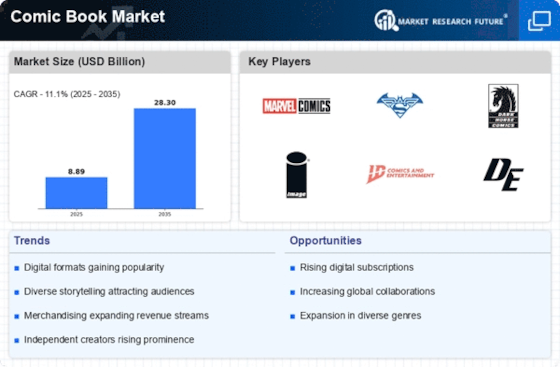
As per Market Research Future analysis, the Comic Book Market Size was estimated at 8.888 USD Billion in 2024. The Comic Book industry is projected to grow from 9.875 USD Billion in 2025 to 28.3 USD Billion by 2035, exhibiting a compound annual growth rate (CAGR) of 11.1% during the forecast period 2025 - 2035

Key Market Trends & Highlights

The Comic Book Market is experiencing a dynamic shift towards digital platforms and diverse storytelling.

  • The North American market remains the largest, driven by a robust demand for superhero narratives. Asia-Pacific is emerging as the fastest-growing region, fueled by increasing access to digital content. Physical comics continue to dominate sales, while digital comics are rapidly gaining traction among younger audiences. The rising popularity of the superhero genre and the expansion of digital platforms are key drivers of market growth.

Market Size & Forecast

2024 Market Size 8.888 (USD Billion)
2035 Market Size 28.3 (USD Billion)
CAGR (2025 - 2035) 11.1%
Largest Regional Market Share in 2024 North America

Major Players

Marvel Comics (US), DC Comics (US), Dark Horse Comics (US), Image Comics (US), IDW Publishing (US), Dynamite Entertainment (US), VIZ Media (JP), Kodansha (JP), Titan Comics (GB), BOOM! Studios (US)

Market Trends

The Comic Book Market is currently experiencing a dynamic evolution, characterized by a blend of traditional storytelling and modern technological advancements. The rise of digital platforms has transformed how audiences access and engage with comic content, allowing for a broader reach and more diverse readership. This shift appears to be fostering a new generation of creators who leverage these platforms to experiment with narrative forms and artistic styles, potentially reshaping the landscape of comic storytelling. Furthermore, the integration of multimedia elements, such as animations and interactive features, seems to enhance reader engagement, suggesting a promising future for the industry. 

In addition to technological influences, the Comic Book Market is witnessing a resurgence of interest in independent and niche titles. This trend indicates a growing appetite for unique voices and stories that diverge from mainstream offerings. As consumers increasingly seek authenticity and representation, independent publishers are likely to thrive, contributing to a more varied and inclusive market. At the same time, searches for a comic book store near me reflect continued demand for physical retail experiences, especially for enthusiasts interested in comics and collectibles. Overall, the Comic Book Market appears poised for continued growth, driven by innovation and a commitment to diverse storytelling, with communities like comics to astonish further fueling fan engagement.

Digital Transformation

The Comic Book Market is undergoing a significant digital transformation, with online platforms becoming primary venues for distribution. This shift allows creators to reach wider audiences and experiment with new formats, enhancing reader interaction and engagement.

Rise of Independent Publishers

There is a notable rise in independent publishers within the Comic Book Market, reflecting a demand for diverse narratives and unique artistic expressions. This trend suggests that consumers are increasingly valuing originality and representation in their reading choices.

Multimedia Integration

The integration of multimedia elements into comic storytelling is becoming more prevalent. This trend indicates a potential shift in how stories are told, as creators explore animations and interactive features to enrich the reader experience.

Comic Books Market Market Drivers

Expansion of Digital Platforms

The Comic Book Market is witnessing a significant transformation due to the expansion of digital platforms. With the rise of e-readers and mobile applications, consumers increasingly prefer digital formats for their comic book consumption. This shift has led to a reported increase in digital comic sales, which now account for nearly 30% of total comic book sales. Digital platforms not only provide convenience but also enable publishers to reach wider audiences, including international markets. The accessibility of digital comics may encourage new readers to explore the medium, potentially driving further growth in the Comic Book Market. As technology continues to advance, the integration of augmented reality and interactive elements in digital comics could further enhance reader engagement.

Diverse Storytelling and Representation

The Comic Book Market is evolving to embrace diverse storytelling and representation, reflecting a broader range of experiences and identities. This shift appears to resonate with readers who seek narratives that reflect their own lives or challenge traditional norms. Publishers are increasingly prioritizing inclusive characters and storylines, which may attract a wider audience. Reports indicate that comics featuring diverse protagonists have seen a significant uptick in sales, suggesting that representation plays a crucial role in consumer engagement. This trend not only enriches the storytelling landscape but also positions the Comic Book Market as a progressive medium that champions inclusivity and social awareness.

Increased Popularity of Superhero Genre

The Comic Book Market experiences a notable surge in the popularity of the superhero genre, driven by the success of blockbuster films and television adaptations. This trend appears to attract a diverse audience, including younger demographics who may not have previously engaged with comic books. The industry's revenue from superhero comics has reportedly reached approximately 1.2 billion dollars in recent years, indicating a robust demand. As superhero narratives continue to evolve, they often incorporate contemporary social issues, which resonates with readers. This alignment with current cultural dialogues may further enhance the appeal of superhero comics, suggesting a sustained growth trajectory for the Comic Book Market.

Growing Interest in Collectibles and Investment

The Comic Book Market is experiencing a growing interest in collectibles and investment-grade comics, as collectors and investors seek to capitalize on the potential value of rare issues. This trend appears to be fueled by the increasing recognition of comic books as viable investment assets, with some rare editions fetching prices in the hundreds of thousands of dollars. The market for vintage and graded comics has expanded, indicating a robust demand among collectors. This phenomenon may attract new participants to the Comic Book Market, as individuals look to diversify their investment portfolios. The intersection of nostalgia and investment potential could further drive growth in this segment of the industry.

Merchandising and Cross-Promotion Opportunities

The Comic Book Market benefits from extensive merchandising and cross-promotion opportunities, particularly with the rise of multimedia franchises. Successful comic book characters often transition into films, television shows, and merchandise, creating a synergistic effect that boosts sales across various platforms. This interconnectedness allows comic book publishers to capitalize on the popularity of their characters, potentially increasing overall revenue. For instance, merchandise sales related to popular comic book franchises have been reported to exceed 500 million dollars annually. Such cross-promotional strategies not only enhance brand visibility but also solidify the Comic Book Market's position within the broader entertainment landscape.

Market Segment Insights

By Type: Physical Comic (Largest) vs. Digital Comic (Fastest-Growing)

In the Comic Book Market, the distribution between Physical Comics and Digital Comics reflects a distinct shift in consumer preferences. Physical Comics hold the largest market share, appealing to traditional collectors and enthusiasts who value tangible copies. This segment thrives on the nostalgia associated with physical ownership, vibrant artwork, and collectible value, making it a steadfast choice among long-time fans. Digital Comics, however, are catching up rapidly, gaining attention for their convenience and cost-effectiveness. As technology advances, more readers are exploring digital formats for their accessibility and diversity.

Comic Book Medium: Physical Comic (Dominant) vs. Digital Comic (Emerging)

Physical Comics have established themselves as the dominant segment in the Comic Book Market, deeply rooted in collector culture and community engagement. They provide an immersive experience, allowing fans to enjoy the artwork in high-quality print and participate in events such as signings and conventions. On the other hand, Digital Comics are emerging as a significant player, driven by the increasing adoption of digital devices and platforms. They offer instant access to a vast library of titles, appealing to younger audiences who prioritize convenience. The growth of subscription services and innovations in digital reading experiences further bolster this segment's position, suggesting that Digital Comics are set to reshape the market landscape.

By End-user: Kids (Largest) vs. Adults (Fastest-Growing)

In the Comic Book Market, the distribution of the end-user segment reveals that kids constitute the largest group, driving significant sales and popularity within the industry. This demographic has a robust following due to engaging storylines and vibrant illustrations that capture youthful imaginations. Their interest in characters and series often stems from adaptations in other media, such as animated shows and films, creating a substantial market demand for comic books targeted at younger readers. On the other hand, the adult segment is witnessing rapid growth, fueled by rising nostalgia and an increasing appreciation for the artistry and storytelling elements of comics. Adults are not just revisiting their childhood favorites but are also exploring new series that cater to more sophisticated themes and narratives. This trend is bolstered by the expansion of comic conventions and the broader acceptance of comics as a legitimate form of literature, attracting more adult readers each year.

End-users: Kids (Dominant) vs. Adults (Emerging)

The Kids segment stands as the dominant force in the Comic Book Market, primarily due to its established connection with popular franchises and characters that resonate with young audiences. This segment benefits from a vibrant ecosystem that includes not only comic books but also related merchandise, animated shows, and films, creating a comprehensive brand presence. Conversely, the Adults segment, classified as emerging, is rapidly evolving with trends that showcase more mature themes and sophisticated storytelling. Adult readers are increasingly drawn to graphic novels and comic series that delve into complex issues, reflecting their diverse interests. This growth is also supported by a surge in community events and platforms catering to adult fans, positioning their preferences as integral to the market's future.

By Distribution Channel: Book Stores (Largest) vs. Online Stores (Fastest-Growing)

In the Comic Book Market, distribution channels play a pivotal role in reaching diverse customer bases. Book Stores currently dominate the landscape, holding the largest market share due to their established presence and ability to attract traditional comic book readers. Following closely are Comic Stores, which cater specifically to enthusiasts and collectors but do not hold a commanding share like Book Stores. Online Stores, however, are rapidly gaining traction as they offer convenience and accessibility, particularly among younger audiences. Other distribution channels also exist but contribute less significantly to the overall market dynamics. The growth trends within the distribution channels of the Comic Book Market reveal a shift towards online shopping, primarily driven by technology and changing consumer behaviors. The rise of digital platforms enables consumers to purchase comics from the comfort of their homes, leading to a surge in online sales. Furthermore, the COVID-19 pandemic has accelerated this trend, as physical stores faced closures and restrictions, prompting publishers to enhance their online presence. This dynamic underscores the importance of adapting to consumer preferences as the market evolves, signaling a promising future for online sales within the comic book distribution landscape.

Book Stores: Dominant vs. Online Stores: Emerging

Book Stores have long been the cornerstone of comic book distribution, offering a curated selection that appeals to both casual readers and avid collectors. They possess a loyal customer base, often providing personalized service and community events that foster engagement and loyalty. In contrast, Online Stores are emerging rapidly, leveraging technology to reach a broader audience. They provide immediate access to a vast range of titles and exclusives that physical stores may not stock. The convenience of online shopping, combined with competitive pricing and home delivery options, positions them well for growth. As consumer preferences shift increasingly towards digital access, Online Stores are set to play a transformative role in the comic book market, signaling a new era of distribution.

Get more detailed insights about Comic Book Market Research Report—Global Forecast till 2035

Regional Insights

The Comic Book Market witnessed substantial growth across various regions, reflecting a more dynamic landscape by 2024 and beyond. In 2024, North America held a significant position, valued at 3.56 USD Billion, partly driven by its robust entertainment infrastructure and affinity for comics.

Europe followed closely with a valuation of 2.67 USD Billion, demonstrating a rich cultural history in comic art, while Asia Pacific, valued at 1.94 USD Billion, showcased a burgeoning market driven by increasing digital consumption of comics. South America presented an emerging opportunity with a value of 0.88 USD Billion, capitalizing on its unique storytelling traditions.

The Middle East and Africa, though valued at 0.84 USD Billion, are witnessing gradual growth, attributed to a rising interest in comic adaptations. North America's majority holding reflects its dominance in the Comic Book Market, supported by extensive distribution channels and consumer engagement.

Each region contributed uniquely, driven by cultural relevance, technological advancements, and changing consumer preferences, as observed in the substantial Comic Book Market revenue trends. The collective insights underlined the significant potential and diverse opportunities that lie within the Comic Book Market segmentation across these regions.

Source Primary Research, Secondary Research, Market Research Future Database and Analyst Review

Key Players and Competitive Insights

The Comic Book Market is characterized by a diverse range of players, competing through unique storytelling styles, artistic approaches, and innovative distribution strategies. The competitive landscape is influenced by a number of prominent publishers, independent creators, and digital platforms, leading to a rich tapestry that caters to various consumer preferences. Growth in digital comics and the rising popularity of graphic novels are significant factors shaping this market, contributing to a dynamic competitive environment. Companies leverage trends such as celebrity collaborations, cross-media opportunities, and consumer engagement strategies to differentiate themselves and capture market share. Publishers focus on expanding their portfolios with niche markets in mind while adapting to changes in consumer habits and technology. Oni Press stands out in the Comic Book Market for its strong emphasis on unique narratives and character-driven stories, which resonate well with a growing audience seeking diverse content. Known for its willingness to explore unconventional themes, Oni Press has carved out a reputable space within the market, appealing to both young adults and seasoned comic book readers. The company has cultivated strong relationships with creators, allowing for a flow of innovative ideas that keep its publications fresh and engaging. This strategy not only strengthens their market presence but also fosters a loyal customer base. Additionally, Oni Press maintains a robust brand identity through representation and inclusivity, aligning with contemporary socio-cultural movements, thus cementing its relevance in the comic scene. Dynamite Entertainment holds a significant presence in the Comic Book Market, known for its licensing and partnerships with established intellectual properties that attract a wide audience. The company produces a range of titles across various genres, including superheroes, horror, and fantasy, appealing to diverse reader interests. Their strength lies in their extensive catalog of classic characters and franchises from different media forms. Through strategic mergers and acquisitions, Dynamite has expanded its capabilities, allowing for enhanced storytelling possibilities and collaborative projects that enrich its offerings. The company also emphasizes quality production and innovative marketing strategies, ensuring its titles remain prominent in an oversaturated market. With a focus on collectible editions and limited-run series, Dynamite Entertainment not only attracts enthusiasts but also fosters a robust community that thrives on continuous engagement within the comic book landscape.

Key Companies in the Comic Books Market include

Industry Developments

In order to lobby against proposed UK copyright exemptions for AI training and to promote comics as a major export within the country's ten-year industrial strategy, UK comic publishers, including DC Thomson, Rebellion Entertainment, Avery Hill, The Phoenix, and Fable, established Comic Book UK in March 2025.

In an effort to appeal to younger, mobile-native readers, DC Entertainment partnered with GlobalComix in October 2024 to adapt 400 DC, Vertigo, and Wildstorm comics into vertical-scroll formats that are suitable for smartphones.

The growing desire for both accessible digital platforms and print collector editions was emphasized by U.S. comic supporters in May 2025, with conventions and transmedia adaptations (to TV and movies) greatly increasing interest.

Penguin Random House terminated its distribution arrangement for Marvel and Dark Horse comics when Diamond Comic Distributors filed for Chapter 11 bankruptcy in June 2025 and sold its assets, excluding Diamond UK, to Universal Distribution and AdPopulum.

Additionally, in 2025, Dark Horse Comics improved worldwide distribution channels by extending its multi-year distribution agreement with Penguin Random House, which was first struck in June 2022. The trend toward digital innovation, content protection, and structural realignment by key comic book industry participants is reflected in these developments.

Future Outlook

Comic Books Market Future Outlook

The Comic Book Market is projected to grow at 11.1% CAGR from 2025 to 2035, driven by digital transformation, diverse storytelling, and expanding global audiences.

New opportunities lie in:

  • <p>Development of subscription-based digital comic platforms Collaboration with streaming services for animated adaptations Expansion into emerging markets through localized content</p>

By 2035, the Comic Book Market is poised for robust growth and increased global engagement.

Market Segmentation

Comic Books Market Type Outlook

  • Physical Comic
  • Digital Comic

Comic Books Market End-user Outlook

  • Kids
  • Adults

Comic Books Market Distribution Channel Outlook

  • Book Stores
  • Comic Stores
  • Online Stores
  • Others

Report Scope

MARKET SIZE 2024 8.888(USD Billion)
MARKET SIZE 2025 9.875(USD Billion)
MARKET SIZE 2035 28.3(USD Billion)
COMPOUND ANNUAL GROWTH RATE (CAGR) 11.1% (2025 - 2035)
REPORT COVERAGE Revenue Forecast, Competitive Landscape, Growth Factors, and Trends
BASE YEAR 2024
Market Forecast Period 2025 - 2035
Historical Data 2019 - 2024
Market Forecast Units USD Billion
Key Companies Profiled Marvel Comics (US), DC Comics (US), Dark Horse Comics (US), Image Comics (US), IDW Publishing (US), Dynamite Entertainment (US), VIZ Media (JP), Kodansha (JP), Titan Comics (GB), BOOM! Studios (US)
Segments Covered Product Type, End-user, Distribution Channel, Regional
Key Market Opportunities Integration of digital platforms enhances accessibility and engagement in the Comic Book Market.
Key Market Dynamics Rising digital platforms and shifting consumer preferences are reshaping the competitive landscape of the comic book market.
Countries Covered North America, Europe, APAC, South America, MEA

FAQs

What is the current valuation of the Comic Book Market as of 2024?

<p>The Comic Book Market was valued at 8.888 USD Billion in 2024.</p>

What is the projected market valuation for the Comic Book Market in 2035?

The market is projected to reach a valuation of 28.3 USD Billion by 2035.

What is the expected CAGR for the Comic Book Market during the forecast period 2025 - 2035?

The expected CAGR for the Comic Book Market during 2025 - 2035 is 11.1%.

Which segments are included in the Comic Book Market analysis?

The market analysis includes segments such as Type, End-user, and Distribution Channel.

What were the valuations for physical and digital comics in 2024?

In 2024, physical comics were valued at 5.0 USD Billion, while digital comics were valued at 3.888 USD Billion.

How do the valuations for kids and adult comics compare in 2024?

In 2024, kids' comics were valued at 3.555 USD Billion, whereas adult comics reached 5.333 USD Billion.

What distribution channels are analyzed in the Comic Book Market?

The distribution channels analyzed include Book Stores, Comic Stores, Online Stores, and Others.

What were the valuations for different distribution channels in 2024?

In 2024, Book Stores were valued at 1.5 USD Billion, Comic Stores at 2.0 USD Billion, Online Stores at 3.0 USD Billion, and Others at 2.388 USD Billion.

Who are the key players in the Comic Book Market?

Key players in the market include Marvel Comics, DC Comics, Dark Horse Comics, and Image Comics, among others.

What trends are expected to shape the Comic Book Market from 2025 to 2035?

Trends likely to shape the market include increasing digital comic sales and a growing adult readership.

  1. SECTION I: EXECUTIVE SUMMARY AND KEY HIGHLIGHTS |
    1. EXECUTIVE SUMMARY | |
      1. Market Overview | |
      2. Key Findings | |
      3. Market Segmentation | |
      4. Competitive Landscape | |
      5. Challenges and Opportunities | |
      6. Future Outlook 2
  2. SECTION II: SCOPING, METHODOLOGY AND MARKET STRUCTURE |
    1. MARKET INTRODUCTION | |
      1. Definition | |
      2. Scope of the study | | |
    2. RESEARCH METHODOLOGY | |
      1. Overview | |
      2. Data Mining | |
      3. Secondary Research | |
      4. Primary Research | | |
      5. Forecasting Model | |
      6. Market Size Estimation | | |
      7. Data Triangulation | |
      8. Validation 3
  3. SECTION III: QUALITATIVE ANALYSIS |
    1. MARKET DYNAMICS | |
      1. Overview | |
      2. Drivers | |
      3. Restraints | |
      4. Opportunities |
    2. MARKET FACTOR ANALYSIS | |
      1. Value chain Analysis | |
      2. Porter's Five Forces Analysis | | |
      3. COVID-19 Impact Analysis | | |
  4. SECTION IV: QUANTITATIVE ANALYSIS |
    1. Consumer and Retail, BY Type (USD Billion) | |
      1. Physical Comic | |
      2. Digital Comic |
    2. Consumer and Retail, BY End-user (USD Billion) | |
      1. Kids | |
      2. Adults |
    3. Consumer and Retail, BY Distribution Channel (USD Billion) | |
      1. Book Stores | |
      2. Comic Stores | |
      3. Online Stores | |
      4. Others |
    4. Consumer and Retail, BY Region (USD Billion) | |
      1. North America | | |
      2. Europe | | |
      3. APAC | | |
      4. South America | | |
      5. MEA | | |
  5. SECTION V: COMPETITIVE ANALYSIS |
    1. Competitive Landscape | |
      1. Overview | |
      2. Competitive Analysis | |
      3. Market share Analysis | |
      4. Major Growth Strategy in the Consumer and Retail | |
      5. Competitive Benchmarking | |
      6. Leading Players in Terms of Number of Developments in the Consumer and Retail | |
      7. Key developments and growth strategies | | |
      8. Major Players Financial Matrix | | |
    2. Company Profiles | |
      1. Marvel Comics (US) | | |
      2. DC Comics (US) | | |
      3. Dark Horse Comics (US) | | |
      4. Image Comics (US) | | |
      5. IDW Publishing (US) | | |
      6. Dynamite Entertainment (US) | | |
      7. VIZ Media (JP) | | |
      8. Kodansha (JP) | | |
      9. Titan Comics (GB) | | |
      10. BOOM! Studios (US) | | |
    3. Appendix | |
      1. References | |
      2. Related Reports 6 LIST OF FIGURES |
    4. MARKET SYNOPSIS |
    5. NORTH AMERICA MARKET ANALYSIS |
    6. US MARKET ANALYSIS BY TYPE |
    7. US MARKET ANALYSIS BY END-USER |
    8. US MARKET ANALYSIS BY DISTRIBUTION CHANNEL |
    9. CANADA MARKET ANALYSIS BY TYPE |
    10. CANADA MARKET ANALYSIS BY END-USER |
    11. CANADA MARKET ANALYSIS BY DISTRIBUTION CHANNEL |
    12. EUROPE MARKET ANALYSIS |
    13. GERMANY MARKET ANALYSIS BY TYPE |
    14. GERMANY MARKET ANALYSIS BY END-USER |
    15. GERMANY MARKET ANALYSIS BY DISTRIBUTION CHANNEL |
    16. UK MARKET ANALYSIS BY TYPE |
    17. UK MARKET ANALYSIS BY END-USER |
    18. UK MARKET ANALYSIS BY DISTRIBUTION CHANNEL |
    19. FRANCE MARKET ANALYSIS BY TYPE |
    20. FRANCE MARKET ANALYSIS BY END-USER |
    21. FRANCE MARKET ANALYSIS BY DISTRIBUTION CHANNEL |
    22. RUSSIA MARKET ANALYSIS BY TYPE |
    23. RUSSIA MARKET ANALYSIS BY END-USER |
    24. RUSSIA MARKET ANALYSIS BY DISTRIBUTION CHANNEL |
    25. ITALY MARKET ANALYSIS BY TYPE |
    26. ITALY MARKET ANALYSIS BY END-USER |
    27. ITALY MARKET ANALYSIS BY DISTRIBUTION CHANNEL |
    28. SPAIN MARKET ANALYSIS BY TYPE |
    29. SPAIN MARKET ANALYSIS BY END-USER |
    30. SPAIN MARKET ANALYSIS BY DISTRIBUTION CHANNEL |
    31. REST OF EUROPE MARKET ANALYSIS BY TYPE |
    32. REST OF EUROPE MARKET ANALYSIS BY END-USER |
    33. REST OF EUROPE MARKET ANALYSIS BY DISTRIBUTION CHANNEL |
    34. APAC MARKET ANALYSIS |
    35. CHINA MARKET ANALYSIS BY TYPE |
    36. CHINA MARKET ANALYSIS BY END-USER |
    37. CHINA MARKET ANALYSIS BY DISTRIBUTION CHANNEL |
    38. INDIA MARKET ANALYSIS BY TYPE |
    39. INDIA MARKET ANALYSIS BY END-USER |
    40. INDIA MARKET ANALYSIS BY DISTRIBUTION CHANNEL |
    41. JAPAN MARKET ANALYSIS BY TYPE |
    42. JAPAN MARKET ANALYSIS BY END-USER |
    43. JAPAN MARKET ANALYSIS BY DISTRIBUTION CHANNEL |
    44. SOUTH KOREA MARKET ANALYSIS BY TYPE |
    45. SOUTH KOREA MARKET ANALYSIS BY END-USER |
    46. SOUTH KOREA MARKET ANALYSIS BY DISTRIBUTION CHANNEL |
    47. MALAYSIA MARKET ANALYSIS BY TYPE |
    48. MALAYSIA MARKET ANALYSIS BY END-USER |
    49. MALAYSIA MARKET ANALYSIS BY DISTRIBUTION CHANNEL |
    50. THAILAND MARKET ANALYSIS BY TYPE |
    51. THAILAND MARKET ANALYSIS BY END-USER |
    52. THAILAND MARKET ANALYSIS BY DISTRIBUTION CHANNEL |
    53. INDONESIA MARKET ANALYSIS BY TYPE |
    54. INDONESIA MARKET ANALYSIS BY END-USER |
    55. INDONESIA MARKET ANALYSIS BY DISTRIBUTION CHANNEL |
    56. REST OF APAC MARKET ANALYSIS BY TYPE |
    57. REST OF APAC MARKET ANALYSIS BY END-USER |
    58. REST OF APAC MARKET ANALYSIS BY DISTRIBUTION CHANNEL |
    59. SOUTH AMERICA MARKET ANALYSIS |
    60. BRAZIL MARKET ANALYSIS BY TYPE |
    61. BRAZIL MARKET ANALYSIS BY END-USER |
    62. BRAZIL MARKET ANALYSIS BY DISTRIBUTION CHANNEL |
    63. MEXICO MARKET ANALYSIS BY TYPE |
    64. MEXICO MARKET ANALYSIS BY END-USER |
    65. MEXICO MARKET ANALYSIS BY DISTRIBUTION CHANNEL |
    66. ARGENTINA MARKET ANALYSIS BY TYPE |
    67. ARGENTINA MARKET ANALYSIS BY END-USER |
    68. ARGENTINA MARKET ANALYSIS BY DISTRIBUTION CHANNEL |
    69. REST OF SOUTH AMERICA MARKET ANALYSIS BY TYPE |
    70. REST OF SOUTH AMERICA MARKET ANALYSIS BY END-USER |
    71. REST OF SOUTH AMERICA MARKET ANALYSIS BY DISTRIBUTION CHANNEL |
    72. MEA MARKET ANALYSIS |
    73. GCC COUNTRIES MARKET ANALYSIS BY TYPE |
    74. GCC COUNTRIES MARKET ANALYSIS BY END-USER |
    75. GCC COUNTRIES MARKET ANALYSIS BY DISTRIBUTION CHANNEL |
    76. SOUTH AFRICA MARKET ANALYSIS BY TYPE |
    77. SOUTH AFRICA MARKET ANALYSIS BY END-USER |
    78. SOUTH AFRICA MARKET ANALYSIS BY DISTRIBUTION CHANNEL |
    79. REST OF MEA MARKET ANALYSIS BY TYPE |
    80. REST OF MEA MARKET ANALYSIS BY END-USER |
    81. REST OF MEA MARKET ANALYSIS BY DISTRIBUTION CHANNEL |
    82. KEY BUYING CRITERIA OF CONSUMER AND RETAIL |
    83. RESEARCH PROCESS OF MRFR |
    84. DRO ANALYSIS OF CONSUMER AND RETAIL |
    85. DRIVERS IMPACT ANALYSIS: CONSUMER AND RETAIL |
    86. RESTRAINTS IMPACT ANALYSIS: CONSUMER AND RETAIL |
    87. SUPPLY / VALUE CHAIN: CONSUMER AND RETAIL |
    88. CONSUMER AND RETAIL, BY TYPE, 2024 (% SHARE) |
    89. CONSUMER AND RETAIL, BY TYPE, 2024 TO 2035 (USD Billion) |
    90. CONSUMER AND RETAIL, BY END-USER, 2024 (% SHARE) |
    91. CONSUMER AND RETAIL, BY END-USER, 2024 TO 2035 (USD Billion) |
    92. CONSUMER AND RETAIL, BY DISTRIBUTION CHANNEL, 2024 (% SHARE) |
    93. CONSUMER AND RETAIL, BY DISTRIBUTION CHANNEL, 2024 TO 2035 (USD Billion) |
    94. BENCHMARKING OF MAJOR COMPETITORS 7 LIST OF TABLES |
    95. LIST OF ASSUMPTIONS | |
      1. |
    96. North America MARKET SIZE ESTIMATES; FORECAST | |
      1. BY TYPE, 2025-2035 (USD Billion) | |
      2. BY END-USER, 2025-2035 (USD Billion) | |
      3. BY DISTRIBUTION CHANNEL, 2025-2035 (USD Billion) |
    97. US MARKET SIZE ESTIMATES; FORECAST | |
      1. BY TYPE, 2025-2035 (USD Billion) | |
      2. BY END-USER, 2025-2035 (USD Billion) | |
      3. BY DISTRIBUTION CHANNEL, 2025-2035 (USD Billion) |
    98. Canada MARKET SIZE ESTIMATES; FORECAST | |
      1. BY TYPE, 2025-2035 (USD Billion) | |
      2. BY END-USER, 2025-2035 (USD Billion) | |
      3. BY DISTRIBUTION CHANNEL, 2025-2035 (USD Billion) |
    99. Europe MARKET SIZE ESTIMATES; FORECAST | |
      1. BY TYPE, 2025-2035 (USD Billion) | |
      2. BY END-USER, 2025-2035 (USD Billion) | |
      3. BY DISTRIBUTION CHANNEL, 2025-2035 (USD Billion) |
    100. Germany MARKET SIZE ESTIMATES; FORECAST | |
      1. BY TYPE, 2025-2035 (USD Billion) | |
      2. BY END-USER, 2025-2035 (USD Billion) | |
      3. BY DISTRIBUTION CHANNEL, 2025-2035 (USD Billion) |
    101. UK MARKET SIZE ESTIMATES; FORECAST | |
      1. BY TYPE, 2025-2035 (USD Billion) | |
      2. BY END-USER, 2025-2035 (USD Billion) | |
      3. BY DISTRIBUTION CHANNEL, 2025-2035 (USD Billion) |
    102. France MARKET SIZE ESTIMATES; FORECAST | |
      1. BY TYPE, 2025-2035 (USD Billion) | |
      2. BY END-USER, 2025-2035 (USD Billion) | |
      3. BY DISTRIBUTION CHANNEL, 2025-2035 (USD Billion) |
    103. Russia MARKET SIZE ESTIMATES; FORECAST | |
      1. BY TYPE, 2025-2035 (USD Billion) | |
      2. BY END-USER, 2025-2035 (USD Billion) | |
      3. BY DISTRIBUTION CHANNEL, 2025-2035 (USD Billion) |
    104. Italy MARKET SIZE ESTIMATES; FORECAST | |
      1. BY TYPE, 2025-2035 (USD Billion) | |
      2. BY END-USER, 2025-2035 (USD Billion) | |
      3. BY DISTRIBUTION CHANNEL, 2025-2035 (USD Billion) |
    105. Spain MARKET SIZE ESTIMATES; FORECAST | |
      1. BY TYPE, 2025-2035 (USD Billion) | |
      2. BY END-USER, 2025-2035 (USD Billion) | |
      3. BY DISTRIBUTION CHANNEL, 2025-2035 (USD Billion) |
    106. Rest of Europe MARKET SIZE ESTIMATES; FORECAST | |
      1. BY TYPE, 2025-2035 (USD Billion) | |
      2. BY END-USER, 2025-2035 (USD Billion) | |
      3. BY DISTRIBUTION CHANNEL, 2025-2035 (USD Billion) |
    107. APAC MARKET SIZE ESTIMATES; FORECAST | |
      1. BY TYPE, 2025-2035 (USD Billion) | |
      2. BY END-USER, 2025-2035 (USD Billion) | |
      3. BY DISTRIBUTION CHANNEL, 2025-2035 (USD Billion) |
    108. China MARKET SIZE ESTIMATES; FORECAST | |
      1. BY TYPE, 2025-2035 (USD Billion) | |
      2. BY END-USER, 2025-2035 (USD Billion) | |
      3. BY DISTRIBUTION CHANNEL, 2025-2035 (USD Billion) |
    109. India MARKET SIZE ESTIMATES; FORECAST | |
      1. BY TYPE, 2025-2035 (USD Billion) | |
      2. BY END-USER, 2025-2035 (USD Billion) | |
      3. BY DISTRIBUTION CHANNEL, 2025-2035 (USD Billion) |
    110. Japan MARKET SIZE ESTIMATES; FORECAST | |
      1. BY TYPE, 2025-2035 (USD Billion) | |
      2. BY END-USER, 2025-2035 (USD Billion) | |
      3. BY DISTRIBUTION CHANNEL, 2025-2035 (USD Billion) |
    111. South Korea MARKET SIZE ESTIMATES; FORECAST | |
      1. BY TYPE, 2025-2035 (USD Billion) | |
      2. BY END-USER, 2025-2035 (USD Billion) | |
      3. BY DISTRIBUTION CHANNEL, 2025-2035 (USD Billion) |
    112. Malaysia MARKET SIZE ESTIMATES; FORECAST | |
      1. BY TYPE, 2025-2035 (USD Billion) | |
      2. BY END-USER, 2025-2035 (USD Billion) | |
      3. BY DISTRIBUTION CHANNEL, 2025-2035 (USD Billion) |
    113. Thailand MARKET SIZE ESTIMATES; FORECAST | |
      1. BY TYPE, 2025-2035 (USD Billion) | |
      2. BY END-USER, 2025-2035 (USD Billion) | |
      3. BY DISTRIBUTION CHANNEL, 2025-2035 (USD Billion) |
    114. Indonesia MARKET SIZE ESTIMATES; FORECAST | |
      1. BY TYPE, 2025-2035 (USD Billion) | |
      2. BY END-USER, 2025-2035 (USD Billion) | |
      3. BY DISTRIBUTION CHANNEL, 2025-2035 (USD Billion) |
    115. Rest of APAC MARKET SIZE ESTIMATES; FORECAST | |
      1. BY TYPE, 2025-2035 (USD Billion) | |
      2. BY END-USER, 2025-2035 (USD Billion) | |
      3. BY DISTRIBUTION CHANNEL, 2025-2035 (USD Billion) |
    116. South America MARKET SIZE ESTIMATES; FORECAST | |
      1. BY TYPE, 2025-2035 (USD Billion) | |
      2. BY END-USER, 2025-2035 (USD Billion) | |
      3. BY DISTRIBUTION CHANNEL, 2025-2035 (USD Billion) |
    117. Brazil MARKET SIZE ESTIMATES; FORECAST | |
      1. BY TYPE, 2025-2035 (USD Billion) | |
      2. BY END-USER, 2025-2035 (USD Billion) | |
      3. BY DISTRIBUTION CHANNEL, 2025-2035 (USD Billion) |
    118. Mexico MARKET SIZE ESTIMATES; FORECAST | |
      1. BY TYPE, 2025-2035 (USD Billion) | |
      2. BY END-USER, 2025-2035 (USD Billion) | |
      3. BY DISTRIBUTION CHANNEL, 2025-2035 (USD Billion) |
    119. Argentina MARKET SIZE ESTIMATES; FORECAST | |
      1. BY TYPE, 2025-2035 (USD Billion) | |
      2. BY END-USER, 2025-2035 (USD Billion) | |
      3. BY DISTRIBUTION CHANNEL, 2025-2035 (USD Billion) |
    120. Rest of South America MARKET SIZE ESTIMATES; FORECAST | |
      1. BY TYPE, 2025-2035 (USD Billion) | |
      2. BY END-USER, 2025-2035 (USD Billion) | |
      3. BY DISTRIBUTION CHANNEL, 2025-2035 (USD Billion) |
    121. MEA MARKET SIZE ESTIMATES; FORECAST | |
      1. BY TYPE, 2025-2035 (USD Billion) | |
      2. BY END-USER, 2025-2035 (USD Billion) | |
      3. BY DISTRIBUTION CHANNEL, 2025-2035 (USD Billion) |
    122. GCC Countries MARKET SIZE ESTIMATES; FORECAST | |
      1. BY TYPE, 2025-2035 (USD Billion) | |
      2. BY END-USER, 2025-2035 (USD Billion) | |
      3. BY DISTRIBUTION CHANNEL, 2025-2035 (USD Billion) |
    123. South Africa MARKET SIZE ESTIMATES; FORECAST | |
      1. BY TYPE, 2025-2035 (USD Billion) | |
      2. BY END-USER, 2025-2035 (USD Billion) | |
      3. BY DISTRIBUTION CHANNEL, 2025-2035 (USD Billion) |
    124. Rest of MEA MARKET SIZE ESTIMATES; FORECAST | |
      1. BY TYPE, 2025-2035 (USD Billion) | |
      2. BY END-USER, 2025-2035 (USD Billion) | |
      3. BY DISTRIBUTION CHANNEL, 2025-2035 (USD Billion) |
    125. PRODUCT LAUNCH/PRODUCT DEVELOPMENT/APPROVAL | |
      1. |
    126. ACQUISITION/PARTNERSHIP | |

Consumer and Retail Market Segmentation

Consumer and Retail By Type (USD Billion, 2025-2035)

  • Physical Comic
  • Digital Comic

Consumer and Retail By End-user (USD Billion, 2025-2035)

  • Kids
  • Adults

Consumer and Retail By Distribution Channel (USD Billion, 2025-2035)

  • Book Stores
  • Comic Stores
  • Online Stores
  • Others
Infographic

Free Sample Request

Kindly complete the form below to receive a free sample of this Report

Get Free Sample

Customer Strories

Compare Licence

×
Features License Type
Single User Multiuser License Enterprise User
Price $4,950 $5,950 $7,250
Maximum User Access Limit 1 User Upto 10 Users Unrestricted Access Throughout the Organization
Free Customization
Direct Access to Analyst
Deliverable Format
Platform Access
Discount on Next Purchase 10% 15% 15%
Printable Versions