Request Free Sample ×

Kindly complete the form below to receive a free sample of this Report

* Please use a valid business email

Leading companies partner with us for data-driven Insights

clients tt-cursor
Hero Background
English
Chinese
French
Japanese
Korean
German
Spanish

Cold Storage Market Share

ID: MRFR/PCM/8517-HCR
111 Pages
Snehal Singh
March 2026

Cold Storage Market Research Report By Type (Refrigerated Warehouses, Industrial Freezers, Blast Freezers, Temperature-Controlled Containers), By Application (Food and Beverages, Pharmaceuticals, Chemicals, Blood and Organs), By Storage Capacity (Less than 5000 pallets, 5000 to 10000 pallets, 10000 to 20000 pallets, More than 20000 pallets), By Temperature Type (Chilled Storage, Frozen Storage, Ambient Storage) and By Regional (North America, Europe, South America, Asia Pacific, Middle East and Africa)- Forecast to 2035

Share:
Download PDF ×

We do not share your information with anyone. However, we may send you emails based on your report interest from time to time. You may contact us at any time to opt-out.

Cold Storage Market Infographic
Purchase Options

Market Share

Cold Storage Market Share Analysis

Companies want to get a bigger share of the market by specializing in temperature-controlled storage. Cold storage suppliers market themselves as experts at keeping products safe by offering state-of-the-art facilities that keep a wide range of items at exact temperatures, such as frozen, chilled, and medicinal goods. Diversifying cold chain services is a good idea. Businesses do more than just store things in cold rooms; they also ship, package, and handle goods. They can meet the changing wants of clients in fields like food and medicine by doing this. Companies that store cold things spend money on cooling systems that use less energy and are better for the environment because it helps them stand out in the market. Using cutting-edge technologies makes temperature stability better, lowers energy costs, and positions companies as leaders in sustainable cold storage solutions. Companies put their storage facilities near important transportation hubs, ports, and manufacturing sites to make the supply chain work as efficiently as possible. Cold storage facilities that are strategically placed save clients money on transportation costs and transit times, which makes them more appealing to customers. Robotics and technology can totally change how a business stands in the market. For instance, cold storage businesses buy automatic storage and retrieval systems (AS/RS) and robots to do things like picking up orders and putting them on pallets. Automation speeds up processes, lowers the cost of workers, and puts businesses at the forefront of new technology. Giving full access to the cold chain is a smart move. Companies that store food in cold places use tracking and monitoring tools that let them see the temperature at any time during shipping and storage. Focusing on energy-efficient methods is important for long-term success and market positioning. Cold storage companies use technologies that save energy, like LED lighting and insulation that uses less energy. Showing that you care about the environment attracts eco-friendly customers and grows your market share. With the rise of online shopping, cold storage companies are focused on e-commerce solutions. They offer specialized services for keeping and completing online orders of perishable goods like frozen meals and fresh fruit, which fits with the way shopping is changing and helps them gain market share. That's why cold storage companies train their employees on a regular basis to work in logistics that depend on temperature. A skilled workforce makes it easier to handle products properly, lowering the risk of temperature changes and boosting credibility. It is important for businesses to stay competitive to experiment with new technologies like modular solutions and transportable cold storage units to meet changing customer needs. Companies that adopt new cold storage solutions quickly become market leaders. Effective recall readiness and traceability systems are very important. In the event of a recall, cold storage providers set up tracking systems to make it easy to find and get rid of affected products quickly. Being ready for recalls ahead of time builds customer trust and strengthens market share positioning.


Author
Author Profile
Snehal Singh
Manager - Research

High acumen in analyzing complex macro & micro markets with more than 6 years of work experience in the field of market research. By implementing her analytical skills in forecasting and estimation into market research reports, she has expertise in Packaging, Construction, and Equipment domains. She handles a team size of 20-25 resources and ensures smooth running of the projects, associated marketing activities, and client servicing.

Leave a Comment

FAQs

What is the current valuation of the cold storage market as of 2024?

<p>The cold storage market was valued at 45.2 USD Billion in 2024.</p>

What is the projected market valuation for the cold storage sector in 2035?

<p>The cold storage market is projected to reach 75.8 USD Billion by 2035.</p>

What is the expected CAGR for the cold storage market during the forecast period 2025 - 2035?

<p>The expected CAGR for the cold storage market during the forecast period 2025 - 2035 is 4.81%.</p>

Which companies are considered key players in the cold storage market?

<p>Key players in the cold storage market include Americold Logistics, Lineage Logistics, and Preferred Freezer Services.</p>

What are the primary applications of cold storage in the market?

<p>The primary applications of cold storage include food and beverage, pharmaceuticals, and chemicals, with food and beverage valued at 30.0 USD Billion by 2035.</p>

How does the cold storage market segment by end use?

<p>The cold storage market segments by end use include retail, wholesale, food service, logistics, and manufacturing, with logistics projected to reach 16.92 USD Billion by 2035.</p>

What types of storage are prevalent in the cold storage market?

<p>Prevalent types of storage in the cold storage market include refrigerated warehouses, temperature-controlled containers, and cold rooms, with refrigerated warehouses expected to reach 25.0 USD Billion by 2035.</p>

What technologies are driving the cold storage market?

<p>Technologies driving the cold storage market include refrigeration systems, insulation technologies, and monitoring systems, with refrigeration systems projected to reach 25.0 USD Billion by 2035.</p>

How is the cold storage market structured in terms of ownership type?

<p>The cold storage market is structured by ownership type into private, public, third party, cooperative, and franchise, with private ownership expected to reach 25.0 USD Billion by 2035.</p>

What is the significance of the cold storage market for the food and beverage industry?

<p>The cold storage market plays a crucial role for the food and beverage industry, with its valuation projected to reach 30.0 USD Billion by 2035, indicating strong demand.</p>

Market Summary

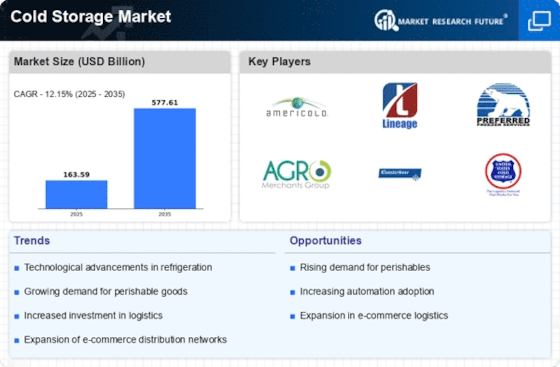
As per Market Research Future analysis, the Cold Storage Market Size was estimated at 163.59 USD Billion in 2024. The Cold Storage industry is projected to grow from 183.47 USD Billion in 2025 to 577.61 USD Billion by 2035, exhibiting a compound annual growth rate (CAGR) of 12.15% during the forecast period 2025 - 2035

Key Market Trends & Highlights

The Cold Storage Market is poised for substantial growth driven by technological advancements and increasing demand for perishable goods.

  • Technological advancements are enhancing the efficiency and capacity of cold storage facilities, particularly in North America. The rapid growth of e-commerce is significantly influencing the demand for temperature-controlled containers in the Asia-Pacific region. Sustainability initiatives are becoming increasingly important, prompting cold storage providers to adopt eco-friendly practices. Rising demand for perishable goods and the expansion of the food and beverage sector are key drivers propelling the market forward.

Market Size & Forecast

2024 Market Size 163.59 (USD Billion)
2035 Market Size 577.61 (USD Billion)
CAGR (2025 - 2035) 12.15%
Largest Regional Market Share in 2024 North America

Major Players

Americold Logistics (US), Lineage Logistics (US), Preferred Freezer Services (US), AGRO Merchants Group (US), Kloosterboer (NL), Cold Storage (SG), Interstate Warehousing (US), Wabash National Corporation (US), Burris Logistics (US)

Market Trends

The Cold Storage Market is currently experiencing a dynamic evolution, driven by various factors that influence its growth trajectory. The increasing demand for perishable goods, coupled with the rising need for efficient supply chain management, appears to be propelling the expansion of this sector. As consumers become more health-conscious, the necessity for fresh and frozen food products is likely to escalate, thereby necessitating advanced cold storage solutions. Furthermore, the growing trend of e-commerce in the food industry suggests that businesses are investing in state-of-the-art facilities to ensure product integrity during transportation and storage. In addition, sustainability initiatives are gaining traction within the cold storage market. Companies are increasingly focusing on energy-efficient technologies and environmentally friendly practices to reduce their carbon footprint. This shift not only aligns with global sustainability goals but also appeals to a consumer base that is becoming more environmentally aware. As the market continues to adapt to these changing dynamics, it is poised for further growth, with innovations in technology and infrastructure likely to play a pivotal role in shaping its future.

Technological Advancements

The Cold Storage Market is witnessing a surge in technological innovations, particularly in automation and IoT integration. These advancements enhance operational efficiency, allowing for real-time monitoring of temperature and humidity levels. Such technologies not only improve product quality but also reduce energy consumption, aligning with sustainability goals. Similar innovations are transforming the medical cold storage market, where precise temperature control is essential for vaccines, biologics, and other sensitive medical products.

E-commerce Growth

The rise of e-commerce is significantly impacting the Cold Storage Market. As online grocery shopping becomes more prevalent, businesses are compelled to invest in cold storage facilities that can accommodate the swift delivery of perishable goods. This trend indicates a shift in consumer behavior, necessitating more robust logistics solutions.

Sustainability Focus

There is a growing emphasis on sustainability within the Cold Storage Market. Companies are increasingly adopting eco-friendly practices and energy-efficient technologies to minimize environmental impact. This trend reflects a broader societal shift towards responsible consumption and aligns with regulatory pressures for greener operations.

Cold Storage Market Market Drivers

Rising Demand for Perishable Goods

The increasing consumption of perishable goods, such as fruits, vegetables, dairy products, and meat, drives the Cold Storage Market. As consumers become more health-conscious, the demand for fresh and organic products rises. According to recent data, the perishable goods segment is projected to grow at a compound annual growth rate of approximately 5.5% over the next five years. This trend necessitates efficient cold storage solutions to maintain product quality and extend shelf life. Consequently, businesses are investing in advanced cold storage facilities to meet this demand, thereby propelling the Cold Storage Market forward. The need for reliable storage options is further emphasized by the growing trend of online grocery shopping, which requires efficient logistics and distribution networks to ensure product freshness upon delivery.

Growth of the Pharmaceutical Sector

The pharmaceutical sector's growth is a key driver of the Cold Storage Market. With the increasing demand for temperature-sensitive medications and vaccines, the need for specialized cold storage facilities has surged. The pharmaceutical industry is projected to grow at a rate of approximately 5.2% annually, leading to heightened investments in cold chain logistics. This growth is particularly evident in the distribution of biologics and other temperature-sensitive products, which require stringent storage conditions. Consequently, the Cold Storage Market is likely to expand as pharmaceutical companies seek reliable storage solutions to ensure product efficacy and safety. The emphasis on maintaining the cold chain throughout the supply process underscores the critical role of cold storage in the pharmaceutical sector.

Expansion of the Food and Beverage Sector

The food and beverage sector's expansion significantly influences the Cold Storage Market. With the rise of food processing and distribution companies, the need for cold storage facilities has become paramount. The food and beverage industry is expected to witness a growth rate of around 4.8% annually, leading to increased investments in cold storage infrastructure. This growth is driven by changing consumer preferences, which favor convenience and quality. As a result, companies are increasingly adopting cold chain logistics to ensure the safe transportation and storage of temperature-sensitive products. The Cold Storage Market is thus positioned to benefit from this expansion, as businesses seek to enhance their supply chain efficiency and meet regulatory requirements for food safety.

Increasing Regulatory Standards for Food Safety

The Cold Storage Market is significantly impacted by the increasing regulatory standards for food safety. Governments and regulatory bodies worldwide are implementing stringent guidelines to ensure the safe storage and transportation of food products. Compliance with these regulations necessitates the establishment of advanced cold storage facilities that meet specific temperature and hygiene standards. As a result, businesses are compelled to invest in modern cold storage solutions to adhere to these regulations. The market is expected to grow as companies prioritize compliance and consumer safety. This trend indicates a shift towards more sophisticated cold storage technologies, which can provide traceability and transparency in the supply chain, ultimately benefiting the Cold Storage Market.

Technological Innovations in Cold Storage Solutions

Technological innovations play a crucial role in shaping the Cold Storage Market. The integration of advanced technologies, such as IoT, automation, and energy-efficient systems, enhances the efficiency and effectiveness of cold storage facilities. For instance, IoT-enabled sensors allow for real-time monitoring of temperature and humidity levels, ensuring optimal storage conditions. Furthermore, energy-efficient refrigeration systems reduce operational costs and environmental impact. The market for smart cold storage solutions is anticipated to grow significantly, with estimates suggesting a potential increase of over 6% annually. These innovations not only improve operational efficiency but also contribute to sustainability efforts within the Cold Storage Market, as companies strive to minimize their carbon footprint.

Market Segment Insights

By Application: Food and Beverage (Largest) vs. Pharmaceuticals (Fastest-Growing)

<p>The cold storage market is primarily driven by the food and beverage segment, which holds the largest share due to the continuous demand for perishable goods and frozen products. This sector includes refrigerated warehouses and facilities that ensure food safety and quality. Following closely, the pharmaceuticals segment is emerging rapidly, highlighting the critical need for temperature-controlled storage of vaccines and biologics, which is exacerbated by global health concerns.</p>

<p>Food and Beverage: Dominant vs. Pharmaceuticals: Emerging</p>

<p>The food and beverage segment is characterized by its extensive network of cold chain logistics, maintaining stringent temperature control from production to consumer delivery. This sector is heavily regulated, ensuring that perishable items are stored and transported safely. In contrast, the pharmaceuticals segment is seeing significant growth, driven by innovations in drug development and increased demand for temperature-sensitive therapies. This segment requires specialized storage solutions to manage sensitive products, making it a vital area of investment and development in the cold storage market.</p>

By End Use: Retail (Largest) vs. Food Service (Fastest-Growing)

<p>The cold storage market is predominantly driven by the retail segment, which holds the largest share due to increasing consumer demand for fresh produce and frozen foods. Retailers have amplified their focus on cold storage solutions to enhance product longevity and support a diverse inventory. Following closely is the wholesale segment, which also benefits from the rising trend of bulk purchasing and distribution efficiencies that cold storage facilities provide. Overall, the distribution among these segments indicates a competitive landscape where retailers and wholesalers play crucial roles in shaping market dynamics.</p>

<p>Retail (Dominant) vs. Food Service (Emerging)</p>

<p>The retail segment represents a dominant force in the cold storage market, characterized by its extensive infrastructure and investment in advanced refrigeration technologies. Retailers utilize cold storage facilities not only to preserve food quality but also to manage complex supply chains efficiently. On the other hand, the food service segment is emerging rapidly as businesses in this sector adapt to changing consumer preferences for dining experiences that feature fresh and frozen food options. The growth of food delivery services and a focus on convenience drive the need for enhanced cold storage capabilities, creating new opportunities for providers to cater to this dynamically evolving market.</p>

By Storage Type: Refrigerated Warehouses (Largest) vs. Temperature Controlled Containers (Fastest-Growing)

<p>The cold storage market is diverse, with segment values such as Refrigerated Warehouses, Temperature Controlled Containers, Blast Freezers, Cold Rooms, and Chilled Storage. Among these, Refrigerated Warehouses hold the largest market share due to their extensive use in food storage and logistics. Following closely, Temperature Controlled Containers are gaining traction, especially in shipping perishable goods, demonstrating their significance in the overall market distribution. Growth trends indicate that while Refrigerated Warehouses remain a critical infrastructure component, Temperature Controlled Containers are becoming increasingly vital as e-commerce and global trade expand. The demand for better preservation of food quality and safety is driving growth in the Blast Freezers and Cold Rooms segments as well, with consumer awareness influencing operational shifts in these facilities for improved efficiency and compliance with safety standards.</p>

<p>Refrigerated Warehouses (Dominant) vs. Temperature Controlled Containers (Emerging)</p>

<p>Refrigerated Warehouses are pivotal in the cold storage market, primarily focused on bulk storage of perishable goods. They offer vast space and advanced infrastructure, ensuring optimal temperature control to prolong the shelf life of food items. In contrast, Temperature Controlled Containers are emerging as essential tools for the transport of temperature-sensitive products, particularly in logistics and supply chains. They are equipped with modern technology to maintain desired temperatures during transit, making them increasingly favored in international shipping. This segment benefits from innovations in insulation and tracking technology, which enhances the reliability and efficiency of transporting perishable goods across long distances.</p>

By Technology: Refrigeration Systems (Largest) vs. Automation Solutions (Fastest-Growing)

<p>The cold storage market's technology segment is diversified, with refrigeration systems holding the largest share. These systems are critical for maintaining optimal temperature conditions within storage facilities. Insulation technologies also play a significant role, enhancing energy efficiency by reducing temperature fluctuations, which complements the performance of refrigeration systems. Monitoring and energy management systems support the overall operation, ensuring compliance and reducing wastage. Together, these technologies form the backbone of cold storage infrastructure, underscoring their importance in logistics and supply chain management. Growth trends indicate a robust demand for automation solutions, driven by the need for efficiency and real-time data in cold storage operations. Companies are increasingly investing in smart technologies, including IoT-enabled monitoring systems that provide insights into temperature control and system performance. This shift towards automation and smart management contributes to improved operational efficiency, aligning with sustainability goals and regulatory compliance in the cold storage market.</p>

<p>Refrigeration Systems: Dominant vs. Automation Solutions: Emerging</p>

<p>Refrigeration systems are the cornerstone of cold storage facilities, essential for preserving perishable goods. Their dominant position is attributed to advancements in compressor technologies, leading to greater energy efficiency and reliability. In contrast, automation solutions are emerging as a crucial player, driven by the increasing trend toward smart warehouses. These solutions streamline operations through automated temperature monitoring and control, enhancing product safety and operational analytics. While refrigeration systems focus on maintaining optimal conditions, automation solutions complement these systems by optimizing workflow and reducing human error. The interplay between these technologies ensures a more resilient cold storage environment, catering to the evolving demands of the supply chain.</p>

By Ownership Type: Private (Largest) vs. Third Party (Fastest-Growing)

<p>In the cold storage market, ownership type plays a crucial role in determining operational dynamics and market reach. Among the various ownership types, the private segment holds the largest share, driven by robust investments and a focus on personalized customer service. Public ownership follows, often backed by significant government regulations and standards, while the third-party segment is rapidly gaining traction as businesses opt for outsourcing their storage needs. Cooperative and franchise models collectively represent a smaller portion of the market, catering to niche demands and specialized services.</p>

<p>Ownership Type: Private (Dominant) vs. Third Party (Emerging)</p>

<p>The private ownership segment in the cold storage market is characterized by privately held companies that maintain a strong control over their operations and customer relationships. These entities leverage their resources to provide customized services, which fosters client loyalty and allows for the flexibility to adapt to market needs. In contrast, the third-party ownership segment is emerging rapidly, characterized by logistics firms that offer shared storage services to various clients. This model is appealing for its cost efficiencies and scalability, enabling businesses to reduce overhead. As companies increasingly focus on outsourcing logistics to enhance productivity and reduce capital expenditure, the third-party segment continues to grow in significance, marking a shift in market strategy for many businesses.</p>

Get more detailed insights about Cold Storage Market Research Report—Global Forecast till 2035

Regional Insights

North America : Market Leader in Cold Storage Market

North America is the largest market for cold storage, accounting for approximately 45% of the global share. The growth is driven by the increasing demand for perishable goods, advancements in technology, and stringent food safety regulations. The U.S. is the primary contributor, followed by Canada, as both countries enhance their cold chain logistics to meet consumer needs and regulatory standards. The competitive landscape is robust, featuring key players like Americold Logistics, Lineage Logistics, and Preferred Freezer Services. These companies are investing in innovative technologies and expanding their facilities to improve efficiency. The presence of a well-established infrastructure and a growing e-commerce sector further supports market growth, making North America a pivotal region in the cold storage industry.

Europe : Emerging Cold Storage Market Hub

Europe is witnessing significant growth in the cold storage market, holding approximately 30% of the global share. The demand is fueled by the increasing focus on sustainability, food safety regulations, and the rise of online grocery shopping. Germany and the UK are the largest markets, with Germany leading due to its advanced logistics infrastructure and stringent food safety laws. The competitive landscape includes key players like Kloosterboer and AGRO Merchants Group, who are adapting to changing consumer preferences and regulatory requirements. The European market is characterized by a strong emphasis on energy-efficient solutions and sustainable practices, which are becoming essential for compliance and competitiveness in the region. The integration of technology in cold storage operations is also on the rise, enhancing efficiency and reducing waste.

Asia-Pacific : Rapidly Growing Market Potential

Asia-Pacific is rapidly emerging as a significant player in the cold storage market, accounting for about 20% of the global share. The growth is driven by urbanization, rising disposable incomes, and an increasing demand for perishable goods. China and India are the largest markets, with China leading due to its vast population and expanding e-commerce sector, while India follows closely with its growing food processing industry. The competitive landscape is evolving, with key players like Cold Storage Market (SG) and Interstate Warehousing making substantial investments in infrastructure and technology. The region is witnessing a surge in cold storage facilities to meet the growing demand for fresh produce and pharmaceuticals. Additionally, government initiatives aimed at improving food supply chains are further propelling market growth, making Asia-Pacific a focal point for cold storage investments.

Middle East and Africa : Emerging Market with Challenges

The Middle East and Africa region is gradually developing its cold storage market, holding around 5% of the global share. The growth is primarily driven by the increasing demand for perishable goods, particularly in the food and pharmaceutical sectors. Countries like South Africa and the UAE are leading the market, focusing on enhancing their cold chain logistics to meet international standards and consumer expectations. The competitive landscape is characterized by a mix of local and international players, with companies investing in modern cold storage facilities to improve efficiency. However, challenges such as inadequate infrastructure and regulatory hurdles remain. Despite these challenges, the region presents significant growth opportunities, particularly as governments prioritize food security and invest in logistics infrastructure to support the cold storage market.

Key Players and Competitive Insights

The Cold Storage Market is witnessing considerable growth driven by increasing demand for perishable goods, changes in food consumption patterns, and advancements in temperature-sensitive logistics. As the market expands, companies are positioning themselves strategically to capture market share and enhance their competitive edge. Key players in this sector are focusing on scaling their operational capabilities, incorporating advanced technologies, and optimizing supply chains to navigate the competitive landscape effectively. The growing trend towards e-commerce and the rise of online grocery shopping are influencing the dynamics of cold storage facilities, necessitating an adaptive and innovative approach to meet consumer demands. Companies with extensive network connections, efficient cold chain management, and robust infrastructure are likely to thrive as the market continues to evolve. Nordfrost has established itself as a significant player in the Cold Storage Market through its robust infrastructure and extensive logistics network. The company is recognized for providing efficient cold storage solutions tailored to changing market demands. Its strategic placement of facilities enables it to cater effectively to diverse client needs, enhancing its competitive position. Nordfrost's strengths stem from its commitment to innovation and investment in advanced refrigeration technologies, which ensure optimal storage conditions for a wide range of temperature-sensitive products. Furthermore, the company emphasizes sustainability in its operations, positioning itself as not just a service provider but a responsible player in the market. This focus on quality service and operational efficiency gives Nordfrost a strong foothold in the highly competitive cold storage industry. Falcon Cold Storage Market, another noteworthy entity in the Cold Storage Market, offers a range of services designed to meet the growing demand for reliable cold storage solutions. The company's product portfolio includes temperature-controlled warehousing, ice manufacturing, and logistics support, all crucial for businesses in food distribution and other temperature-sensitive sectors. Falcon Cold Storage Market is known for its strategic expansions and partnerships that enhance its market presence, solidifying its role as a key player in the industry. The company has been actively engaged in mergers and acquisitions to bolster its capabilities, enabling it to increase its service offerings and expand its geographical reach. With a commitment to state-of-the-art technology and customized solutions, Falcon Cold Storage Market positions itself as a leader in the cold storage domain, reinforcing its strengths through continuous innovation and customer-centric approaches.

Key Companies in the Cold Storage Market include

Industry Developments

  • Q2 2024: Lineage Logistics opens new cold storage facility in Texas to expand U.S. footprint Lineage Logistics, a leading temperature-controlled logistics provider, announced the opening of a new state-of-the-art cold storage facility in Texas, increasing its capacity to serve food and pharmaceutical customers in the region.
  • Q2 2024: Americold Realty Trust Announces $400 Million Acquisition of Agro Merchants Group Americold Realty Trust completed the acquisition of Agro Merchants Group for $400 million, expanding its global cold storage network and strengthening its position in the European and North American markets.
  • Q3 2024: NewCold secures $150 million in funding to build automated cold storage warehouse in Illinois NewCold, a global cold storage logistics company, raised $150 million in a funding round to construct a fully automated cold storage warehouse in Illinois, aiming to meet rising demand from food manufacturers.
  • Q3 2024: Lineage Logistics and Maersk announce strategic partnership to enhance global cold chain solutions Lineage Logistics and Maersk entered into a strategic partnership to integrate their cold chain logistics services, aiming to provide end-to-end temperature-controlled solutions for global food and pharmaceutical supply chains.
  • Q4 2024: Americold Realty Trust appoints new CEO to drive next phase of growth Americold Realty Trust announced the appointment of a new Chief Executive Officer, signaling a leadership transition as the company focuses on expanding its cold storage infrastructure and digital capabilities.
  • Q4 2024: Preferred Freezer Services opens largest cold storage facility in Southeast Asia Preferred Freezer Services inaugurated its largest cold storage facility in Southeast Asia, designed to support the region's growing demand for temperature-controlled logistics in food and pharmaceutical sectors.
  • Q1 2025: Americold Realty Trust announces $250 million investment in new cold storage facilities across the U.S. Americold Realty Trust revealed plans to invest $250 million in the construction of new cold storage facilities in key U.S. markets, aiming to increase capacity and improve service for food producers and retailers.
  • Q1 2025: Lineage Logistics acquires cold storage operator in Brazil to expand Latin American presence Lineage Logistics acquired a major cold storage operator in Brazil, marking its entry into the Latin American market and expanding its global network of temperature-controlled facilities.
  • Q2 2025: NewCold announces partnership with Walmart for dedicated cold storage distribution center NewCold entered into a partnership with Walmart to develop and operate a dedicated cold storage distribution center, supporting Walmart's supply chain for perishable goods in the U.S.
  • Q2 2025: Lineage Logistics raises $500 million in new funding to accelerate global expansion Lineage Logistics secured $500 million in new funding to support its global expansion strategy, including the development of new cold storage facilities and technology upgrades.
  • Q3 2025: Americold Realty Trust completes IPO on London Stock Exchange Americold Realty Trust successfully completed its initial public offering (IPO) on the London Stock Exchange, raising capital to fund further expansion of its cold storage infrastructure.
  • Q3 2025: Preferred Freezer Services wins major contract to provide cold storage for COVID-19 vaccine distribution Preferred Freezer Services secured a significant contract to provide cold storage and logistics support for the distribution of COVID-19 vaccines across multiple countries.

Future Outlook

Cold Storage Market Future Outlook

The Cold Storage Market is projected to grow at a 12.15% CAGR from 2025 to 2035, driven by increasing demand for perishable goods and advancements in technology.

New opportunities lie in:

  • <p>Expansion of automated cold storage facilities Integration of IoT for real-time temperature monitoring Development of sustainable refrigeration solutions</p>

By 2035, the Cold Storage Market is expected to be robust, driven by innovation and increased demand.

Market Segmentation

Cold Storage Market Type Outlook

  • Refrigerated Warehouses
  • Industrial Freezers
  • Blast Freezers
  • Temperature-Controlled Containers

Cold Storage Market Application Outlook

  • Food and Beverages
  • Pharmaceuticals
  • Chemicals
  • Blood and Organs

Cold Storage Market Storage Capacity Outlook

  • Less than 5000 pallets
  • 5000 to 10000 pallets
  • 10000 to 20000 pallets
  • More than 20000 pallets

Cold Storage Market Temperature Type Outlook

  • Chilled Storage
  • Frozen Storage
  • Ambient Storage

Report Scope

MARKET SIZE 2024 163.59(USD Billion)
MARKET SIZE 2025 183.47(USD Billion)
MARKET SIZE 2035 577.61(USD Billion)
COMPOUND ANNUAL GROWTH RATE (CAGR) 12.15% (2025 - 2035)
REPORT COVERAGE Revenue Forecast, Competitive Landscape, Growth Factors, and Trends
BASE YEAR 2024
Market Forecast Period 2025 - 2035
Historical Data 2019 - 2024
Market Forecast Units USD Billion
Key Companies Profiled Americold Logistics (US), Lineage Logistics (US), Preferred Freezer Services (US), AGRO Merchants Group (US), Kloosterboer (NL), Cold Storage (SG), Interstate Warehousing (US), Wabash National Corporation (US), Burris Logistics (US)
Segments Covered Type, Application, Storage Capacity, Temperature Type, Regional
Key Market Opportunities Integration of advanced automation and IoT technologies enhances efficiency in the Cold Storage Market.
Key Market Dynamics Rising demand for temperature-sensitive products drives innovation and investment in cold storage infrastructure and technology.
Countries Covered North America, Europe, APAC, South America, MEA

FAQs

What is the current valuation of the cold storage market as of 2024?

<p>The cold storage market was valued at 45.2 USD Billion in 2024.</p>

What is the projected market valuation for the cold storage sector in 2035?

<p>The cold storage market is projected to reach 75.8 USD Billion by 2035.</p>

What is the expected CAGR for the cold storage market during the forecast period 2025 - 2035?

<p>The expected CAGR for the cold storage market during the forecast period 2025 - 2035 is 4.81%.</p>

Which companies are considered key players in the cold storage market?

<p>Key players in the cold storage market include Americold Logistics, Lineage Logistics, and Preferred Freezer Services.</p>

What are the primary applications of cold storage in the market?

<p>The primary applications of cold storage include food and beverage, pharmaceuticals, and chemicals, with food and beverage valued at 30.0 USD Billion by 2035.</p>

How does the cold storage market segment by end use?

<p>The cold storage market segments by end use include retail, wholesale, food service, logistics, and manufacturing, with logistics projected to reach 16.92 USD Billion by 2035.</p>

What types of storage are prevalent in the cold storage market?

<p>Prevalent types of storage in the cold storage market include refrigerated warehouses, temperature-controlled containers, and cold rooms, with refrigerated warehouses expected to reach 25.0 USD Billion by 2035.</p>

What technologies are driving the cold storage market?

<p>Technologies driving the cold storage market include refrigeration systems, insulation technologies, and monitoring systems, with refrigeration systems projected to reach 25.0 USD Billion by 2035.</p>

How is the cold storage market structured in terms of ownership type?

<p>The cold storage market is structured by ownership type into private, public, third party, cooperative, and franchise, with private ownership expected to reach 25.0 USD Billion by 2035.</p>

What is the significance of the cold storage market for the food and beverage industry?

<p>The cold storage market plays a crucial role for the food and beverage industry, with its valuation projected to reach 30.0 USD Billion by 2035, indicating strong demand.</p>

  1. SECTION I: EXECUTIVE SUMMARY AND KEY HIGHLIGHTS
    1. | 1.1 EXECUTIVE SUMMARY
    2. | | 1.1.1 Market Overview
    3. | | 1.1.2 Key Findings
    4. | | 1.1.3 Market Segmentation
    5. | | 1.1.4 Competitive Landscape
    6. | | 1.1.5 Challenges and Opportunities
    7. | | 1.1.6 Future Outlook
  2. SECTION II: SCOPING, METHODOLOGY AND MARKET STRUCTURE
    1. | 2.1 MARKET INTRODUCTION
    2. | | 2.1.1 Definition
    3. | | 2.1.2 Scope of the study
    4. | | | 2.1.2.1 Research Objective
    5. | | | 2.1.2.2 Assumption
    6. | | | 2.1.2.3 Limitations
    7. | 2.2 RESEARCH METHODOLOGY
    8. | | 2.2.1 Overview
    9. | | 2.2.2 Data Mining
    10. | | 2.2.3 Secondary Research
    11. | | 2.2.4 Primary Research
    12. | | | 2.2.4.1 Primary Interviews and Information Gathering Process
    13. | | | 2.2.4.2 Breakdown of Primary Respondents
    14. | | 2.2.5 Forecasting Model
    15. | | 2.2.6 Market Size Estimation
    16. | | | 2.2.6.1 Bottom-Up Approach
    17. | | | 2.2.6.2 Top-Down Approach
    18. | | 2.2.7 Data Triangulation
    19. | | 2.2.8 Validation
  3. SECTION III: QUALITATIVE ANALYSIS
    1. | 3.1 MARKET DYNAMICS
    2. | | 3.1.1 Overview
    3. | | 3.1.2 Drivers
    4. | | 3.1.3 Restraints
    5. | | 3.1.4 Opportunities
    6. | 3.2 MARKET FACTOR ANALYSIS
    7. | | 3.2.1 Value chain Analysis
    8. | | 3.2.2 Porter's Five Forces Analysis
    9. | | | 3.2.2.1 Bargaining Power of Suppliers
    10. | | | 3.2.2.2 Bargaining Power of Buyers
    11. | | | 3.2.2.3 Threat of New Entrants
    12. | | | 3.2.2.4 Threat of Substitutes
    13. | | | 3.2.2.5 Intensity of Rivalry
    14. | | 3.2.3 COVID-19 Impact Analysis
    15. | | | 3.2.3.1 Market Impact Analysis
    16. | | | 3.2.3.2 Regional Impact
    17. | | | 3.2.3.3 Opportunity and Threat Analysis
  4. SECTION IV: QUANTITATIVE ANALYSIS
    1. | 4.1 Packaging & Transport, BY Application (USD Billion)
    2. | | 4.1.1 Food and Beverage
    3. | | 4.1.2 Pharmaceuticals
    4. | | 4.1.3 Chemicals
    5. | | 4.1.4 Floral
    6. | | 4.1.5 Electronics
    7. | 4.2 Packaging & Transport, BY End Use (USD Billion)
    8. | | 4.2.1 Retail
    9. | | 4.2.2 Wholesale
    10. | | 4.2.3 Food Service
    11. | | 4.2.4 Logistics
    12. | | 4.2.5 Manufacturing
    13. | 4.3 Packaging & Transport, BY Storage Type (USD Billion)
    14. | | 4.3.1 Refrigerated Warehouses
    15. | | 4.3.2 Temperature Controlled Containers
    16. | | 4.3.3 Blast Freezers
    17. | | 4.3.4 Cold Rooms
    18. | | 4.3.5 Chilled Storage
    19. | 4.4 Packaging & Transport, BY Technology (USD Billion)
    20. | | 4.4.1 Refrigeration Systems
    21. | | 4.4.2 Insulation Technologies
    22. | | 4.4.3 Monitoring Systems
    23. | | 4.4.4 Energy Management Systems
    24. | | 4.4.5 Automation Solutions
    25. | 4.5 Packaging & Transport, BY Ownership Type (USD Billion)
    26. | | 4.5.1 Private
    27. | | 4.5.2 Public
    28. | | 4.5.3 Third Party
    29. | | 4.5.4 Cooperative
    30. | | 4.5.5 Franchise
    31. | 4.6 Packaging & Transport, BY Region (USD Billion)
    32. | | 4.6.1 North America
    33. | | | 4.6.1.1 US
    34. | | | 4.6.1.2 Canada
    35. | | 4.6.2 Europe
    36. | | | 4.6.2.1 Germany
    37. | | | 4.6.2.2 UK
    38. | | | 4.6.2.3 France
    39. | | | 4.6.2.4 Russia
    40. | | | 4.6.2.5 Italy
    41. | | | 4.6.2.6 Spain
    42. | | | 4.6.2.7 Rest of Europe
    43. | | 4.6.3 APAC
    44. | | | 4.6.3.1 China
    45. | | | 4.6.3.2 India
    46. | | | 4.6.3.3 Japan
    47. | | | 4.6.3.4 South Korea
    48. | | | 4.6.3.5 Malaysia
    49. | | | 4.6.3.6 Thailand
    50. | | | 4.6.3.7 Indonesia
    51. | | | 4.6.3.8 Rest of APAC
    52. | | 4.6.4 South America
    53. | | | 4.6.4.1 Brazil
    54. | | | 4.6.4.2 Mexico
    55. | | | 4.6.4.3 Argentina
    56. | | | 4.6.4.4 Rest of South America
    57. | | 4.6.5 MEA
    58. | | | 4.6.5.1 GCC Countries
    59. | | | 4.6.5.2 South Africa
    60. | | | 4.6.5.3 Rest of MEA
  5. SECTION V: COMPETITIVE ANALYSIS
    1. | 5.1 Competitive Landscape
    2. | | 5.1.1 Overview
    3. | | 5.1.2 Competitive Analysis
    4. | | 5.1.3 Market share Analysis
    5. | | 5.1.4 Major Growth Strategy in the Packaging & Transport
    6. | | 5.1.5 Competitive Benchmarking
    7. | | 5.1.6 Leading Players in Terms of Number of Developments in the Packaging & Transport
    8. | | 5.1.7 Key developments and growth strategies
    9. | | | 5.1.7.1 New Product Launch/Service Deployment
    10. | | | 5.1.7.2 Merger & Acquisitions
    11. | | | 5.1.7.3 Joint Ventures
    12. | | 5.1.8 Major Players Financial Matrix
    13. | | | 5.1.8.1 Sales and Operating Income
    14. | | | 5.1.8.2 Major Players R&D Expenditure. 2023
    15. | 5.2 Company Profiles
    16. | | 5.2.1 Americold Logistics (US)
    17. | | | 5.2.1.1 Financial Overview
    18. | | | 5.2.1.2 Products Offered
    19. | | | 5.2.1.3 Key Developments
    20. | | | 5.2.1.4 SWOT Analysis
    21. | | | 5.2.1.5 Key Strategies
    22. | | 5.2.2 Lineage Logistics (US)
    23. | | | 5.2.2.1 Financial Overview
    24. | | | 5.2.2.2 Products Offered
    25. | | | 5.2.2.3 Key Developments
    26. | | | 5.2.2.4 SWOT Analysis
    27. | | | 5.2.2.5 Key Strategies
    28. | | 5.2.3 Preferred Freezer Services (US)
    29. | | | 5.2.3.1 Financial Overview
    30. | | | 5.2.3.2 Products Offered
    31. | | | 5.2.3.3 Key Developments
    32. | | | 5.2.3.4 SWOT Analysis
    33. | | | 5.2.3.5 Key Strategies
    34. | | 5.2.4 AGRO Merchants Group (US)
    35. | | | 5.2.4.1 Financial Overview
    36. | | | 5.2.4.2 Products Offered
    37. | | | 5.2.4.3 Key Developments
    38. | | | 5.2.4.4 SWOT Analysis
    39. | | | 5.2.4.5 Key Strategies
    40. | | 5.2.5 Kloosterboer (NL)
    41. | | | 5.2.5.1 Financial Overview
    42. | | | 5.2.5.2 Products Offered
    43. | | | 5.2.5.3 Key Developments
    44. | | | 5.2.5.4 SWOT Analysis
    45. | | | 5.2.5.5 Key Strategies
    46. | | 5.2.6 Cold Storage Logistics (AU)
    47. | | | 5.2.6.1 Financial Overview
    48. | | | 5.2.6.2 Products Offered
    49. | | | 5.2.6.3 Key Developments
    50. | | | 5.2.6.4 SWOT Analysis
    51. | | | 5.2.6.5 Key Strategies
    52. | | 5.2.7 Wabash National Corporation (US)
    53. | | | 5.2.7.1 Financial Overview
    54. | | | 5.2.7.2 Products Offered
    55. | | | 5.2.7.3 Key Developments
    56. | | | 5.2.7.4 SWOT Analysis
    57. | | | 5.2.7.5 Key Strategies
    58. | | 5.2.8 Interstate Warehousing (US)
    59. | | | 5.2.8.1 Financial Overview
    60. | | | 5.2.8.2 Products Offered
    61. | | | 5.2.8.3 Key Developments
    62. | | | 5.2.8.4 SWOT Analysis
    63. | | | 5.2.8.5 Key Strategies
    64. | | 5.2.9 Burris Logistics (US)
    65. | | | 5.2.9.1 Financial Overview
    66. | | | 5.2.9.2 Products Offered
    67. | | | 5.2.9.3 Key Developments
    68. | | | 5.2.9.4 SWOT Analysis
    69. | | | 5.2.9.5 Key Strategies
    70. | 5.3 Appendix
    71. | | 5.3.1 References
    72. | | 5.3.2 Related Reports
  6. LIST OF FIGURES
    1. | 6.1 MARKET SYNOPSIS
    2. | 6.2 NORTH AMERICA MARKET ANALYSIS
    3. | 6.3 US MARKET ANALYSIS BY APPLICATION
    4. | 6.4 US MARKET ANALYSIS BY END USE
    5. | 6.5 US MARKET ANALYSIS BY STORAGE TYPE
    6. | 6.6 US MARKET ANALYSIS BY TECHNOLOGY
    7. | 6.7 US MARKET ANALYSIS BY OWNERSHIP TYPE
    8. | 6.8 CANADA MARKET ANALYSIS BY APPLICATION
    9. | 6.9 CANADA MARKET ANALYSIS BY END USE
    10. | 6.10 CANADA MARKET ANALYSIS BY STORAGE TYPE
    11. | 6.11 CANADA MARKET ANALYSIS BY TECHNOLOGY
    12. | 6.12 CANADA MARKET ANALYSIS BY OWNERSHIP TYPE
    13. | 6.13 EUROPE MARKET ANALYSIS
    14. | 6.14 GERMANY MARKET ANALYSIS BY APPLICATION
    15. | 6.15 GERMANY MARKET ANALYSIS BY END USE
    16. | 6.16 GERMANY MARKET ANALYSIS BY STORAGE TYPE
    17. | 6.17 GERMANY MARKET ANALYSIS BY TECHNOLOGY
    18. | 6.18 GERMANY MARKET ANALYSIS BY OWNERSHIP TYPE
    19. | 6.19 UK MARKET ANALYSIS BY APPLICATION
    20. | 6.20 UK MARKET ANALYSIS BY END USE
    21. | 6.21 UK MARKET ANALYSIS BY STORAGE TYPE
    22. | 6.22 UK MARKET ANALYSIS BY TECHNOLOGY
    23. | 6.23 UK MARKET ANALYSIS BY OWNERSHIP TYPE
    24. | 6.24 FRANCE MARKET ANALYSIS BY APPLICATION
    25. | 6.25 FRANCE MARKET ANALYSIS BY END USE
    26. | 6.26 FRANCE MARKET ANALYSIS BY STORAGE TYPE
    27. | 6.27 FRANCE MARKET ANALYSIS BY TECHNOLOGY
    28. | 6.28 FRANCE MARKET ANALYSIS BY OWNERSHIP TYPE
    29. | 6.29 RUSSIA MARKET ANALYSIS BY APPLICATION
    30. | 6.30 RUSSIA MARKET ANALYSIS BY END USE
    31. | 6.31 RUSSIA MARKET ANALYSIS BY STORAGE TYPE
    32. | 6.32 RUSSIA MARKET ANALYSIS BY TECHNOLOGY
    33. | 6.33 RUSSIA MARKET ANALYSIS BY OWNERSHIP TYPE
    34. | 6.34 ITALY MARKET ANALYSIS BY APPLICATION
    35. | 6.35 ITALY MARKET ANALYSIS BY END USE
    36. | 6.36 ITALY MARKET ANALYSIS BY STORAGE TYPE
    37. | 6.37 ITALY MARKET ANALYSIS BY TECHNOLOGY
    38. | 6.38 ITALY MARKET ANALYSIS BY OWNERSHIP TYPE
    39. | 6.39 SPAIN MARKET ANALYSIS BY APPLICATION
    40. | 6.40 SPAIN MARKET ANALYSIS BY END USE
    41. | 6.41 SPAIN MARKET ANALYSIS BY STORAGE TYPE
    42. | 6.42 SPAIN MARKET ANALYSIS BY TECHNOLOGY
    43. | 6.43 SPAIN MARKET ANALYSIS BY OWNERSHIP TYPE
    44. | 6.44 REST OF EUROPE MARKET ANALYSIS BY APPLICATION
    45. | 6.45 REST OF EUROPE MARKET ANALYSIS BY END USE
    46. | 6.46 REST OF EUROPE MARKET ANALYSIS BY STORAGE TYPE
    47. | 6.47 REST OF EUROPE MARKET ANALYSIS BY TECHNOLOGY
    48. | 6.48 REST OF EUROPE MARKET ANALYSIS BY OWNERSHIP TYPE
    49. | 6.49 APAC MARKET ANALYSIS
    50. | 6.50 CHINA MARKET ANALYSIS BY APPLICATION
    51. | 6.51 CHINA MARKET ANALYSIS BY END USE
    52. | 6.52 CHINA MARKET ANALYSIS BY STORAGE TYPE
    53. | 6.53 CHINA MARKET ANALYSIS BY TECHNOLOGY
    54. | 6.54 CHINA MARKET ANALYSIS BY OWNERSHIP TYPE
    55. | 6.55 INDIA MARKET ANALYSIS BY APPLICATION
    56. | 6.56 INDIA MARKET ANALYSIS BY END USE
    57. | 6.57 INDIA MARKET ANALYSIS BY STORAGE TYPE
    58. | 6.58 INDIA MARKET ANALYSIS BY TECHNOLOGY
    59. | 6.59 INDIA MARKET ANALYSIS BY OWNERSHIP TYPE
    60. | 6.60 JAPAN MARKET ANALYSIS BY APPLICATION
    61. | 6.61 JAPAN MARKET ANALYSIS BY END USE
    62. | 6.62 JAPAN MARKET ANALYSIS BY STORAGE TYPE
    63. | 6.63 JAPAN MARKET ANALYSIS BY TECHNOLOGY
    64. | 6.64 JAPAN MARKET ANALYSIS BY OWNERSHIP TYPE
    65. | 6.65 SOUTH KOREA MARKET ANALYSIS BY APPLICATION
    66. | 6.66 SOUTH KOREA MARKET ANALYSIS BY END USE
    67. | 6.67 SOUTH KOREA MARKET ANALYSIS BY STORAGE TYPE
    68. | 6.68 SOUTH KOREA MARKET ANALYSIS BY TECHNOLOGY
    69. | 6.69 SOUTH KOREA MARKET ANALYSIS BY OWNERSHIP TYPE
    70. | 6.70 MALAYSIA MARKET ANALYSIS BY APPLICATION
    71. | 6.71 MALAYSIA MARKET ANALYSIS BY END USE
    72. | 6.72 MALAYSIA MARKET ANALYSIS BY STORAGE TYPE
    73. | 6.73 MALAYSIA MARKET ANALYSIS BY TECHNOLOGY
    74. | 6.74 MALAYSIA MARKET ANALYSIS BY OWNERSHIP TYPE
    75. | 6.75 THAILAND MARKET ANALYSIS BY APPLICATION
    76. | 6.76 THAILAND MARKET ANALYSIS BY END USE
    77. | 6.77 THAILAND MARKET ANALYSIS BY STORAGE TYPE
    78. | 6.78 THAILAND MARKET ANALYSIS BY TECHNOLOGY
    79. | 6.79 THAILAND MARKET ANALYSIS BY OWNERSHIP TYPE
    80. | 6.80 INDONESIA MARKET ANALYSIS BY APPLICATION
    81. | 6.81 INDONESIA MARKET ANALYSIS BY END USE
    82. | 6.82 INDONESIA MARKET ANALYSIS BY STORAGE TYPE
    83. | 6.83 INDONESIA MARKET ANALYSIS BY TECHNOLOGY
    84. | 6.84 INDONESIA MARKET ANALYSIS BY OWNERSHIP TYPE
    85. | 6.85 REST OF APAC MARKET ANALYSIS BY APPLICATION
    86. | 6.86 REST OF APAC MARKET ANALYSIS BY END USE
    87. | 6.87 REST OF APAC MARKET ANALYSIS BY STORAGE TYPE
    88. | 6.88 REST OF APAC MARKET ANALYSIS BY TECHNOLOGY
    89. | 6.89 REST OF APAC MARKET ANALYSIS BY OWNERSHIP TYPE
    90. | 6.90 SOUTH AMERICA MARKET ANALYSIS
    91. | 6.91 BRAZIL MARKET ANALYSIS BY APPLICATION
    92. | 6.92 BRAZIL MARKET ANALYSIS BY END USE
    93. | 6.93 BRAZIL MARKET ANALYSIS BY STORAGE TYPE
    94. | 6.94 BRAZIL MARKET ANALYSIS BY TECHNOLOGY
    95. | 6.95 BRAZIL MARKET ANALYSIS BY OWNERSHIP TYPE
    96. | 6.96 MEXICO MARKET ANALYSIS BY APPLICATION
    97. | 6.97 MEXICO MARKET ANALYSIS BY END USE
    98. | 6.98 MEXICO MARKET ANALYSIS BY STORAGE TYPE
    99. | 6.99 MEXICO MARKET ANALYSIS BY TECHNOLOGY
    100. | 6.100 MEXICO MARKET ANALYSIS BY OWNERSHIP TYPE
    101. | 6.101 ARGENTINA MARKET ANALYSIS BY APPLICATION
    102. | 6.102 ARGENTINA MARKET ANALYSIS BY END USE
    103. | 6.103 ARGENTINA MARKET ANALYSIS BY STORAGE TYPE
    104. | 6.104 ARGENTINA MARKET ANALYSIS BY TECHNOLOGY
    105. | 6.105 ARGENTINA MARKET ANALYSIS BY OWNERSHIP TYPE
    106. | 6.106 REST OF SOUTH AMERICA MARKET ANALYSIS BY APPLICATION
    107. | 6.107 REST OF SOUTH AMERICA MARKET ANALYSIS BY END USE
    108. | 6.108 REST OF SOUTH AMERICA MARKET ANALYSIS BY STORAGE TYPE
    109. | 6.109 REST OF SOUTH AMERICA MARKET ANALYSIS BY TECHNOLOGY
    110. | 6.110 REST OF SOUTH AMERICA MARKET ANALYSIS BY OWNERSHIP TYPE
    111. | 6.111 MEA MARKET ANALYSIS
    112. | 6.112 GCC COUNTRIES MARKET ANALYSIS BY APPLICATION
    113. | 6.113 GCC COUNTRIES MARKET ANALYSIS BY END USE
    114. | 6.114 GCC COUNTRIES MARKET ANALYSIS BY STORAGE TYPE
    115. | 6.115 GCC COUNTRIES MARKET ANALYSIS BY TECHNOLOGY
    116. | 6.116 GCC COUNTRIES MARKET ANALYSIS BY OWNERSHIP TYPE
    117. | 6.117 SOUTH AFRICA MARKET ANALYSIS BY APPLICATION
    118. | 6.118 SOUTH AFRICA MARKET ANALYSIS BY END USE
    119. | 6.119 SOUTH AFRICA MARKET ANALYSIS BY STORAGE TYPE
    120. | 6.120 SOUTH AFRICA MARKET ANALYSIS BY TECHNOLOGY
    121. | 6.121 SOUTH AFRICA MARKET ANALYSIS BY OWNERSHIP TYPE
    122. | 6.122 REST OF MEA MARKET ANALYSIS BY APPLICATION
    123. | 6.123 REST OF MEA MARKET ANALYSIS BY END USE
    124. | 6.124 REST OF MEA MARKET ANALYSIS BY STORAGE TYPE
    125. | 6.125 REST OF MEA MARKET ANALYSIS BY TECHNOLOGY
    126. | 6.126 REST OF MEA MARKET ANALYSIS BY OWNERSHIP TYPE
    127. | 6.127 KEY BUYING CRITERIA OF PACKAGING & TRANSPORT
    128. | 6.128 RESEARCH PROCESS OF MRFR
    129. | 6.129 DRO ANALYSIS OF PACKAGING & TRANSPORT
    130. | 6.130 DRIVERS IMPACT ANALYSIS: PACKAGING & TRANSPORT
    131. | 6.131 RESTRAINTS IMPACT ANALYSIS: PACKAGING & TRANSPORT
    132. | 6.132 SUPPLY / VALUE CHAIN: PACKAGING & TRANSPORT
    133. | 6.133 PACKAGING & TRANSPORT, BY APPLICATION, 2024 (% SHARE)
    134. | 6.134 PACKAGING & TRANSPORT, BY APPLICATION, 2024 TO 2035 (USD Billion)
    135. | 6.135 PACKAGING & TRANSPORT, BY END USE, 2024 (% SHARE)
    136. | 6.136 PACKAGING & TRANSPORT, BY END USE, 2024 TO 2035 (USD Billion)
    137. | 6.137 PACKAGING & TRANSPORT, BY STORAGE TYPE, 2024 (% SHARE)
    138. | 6.138 PACKAGING & TRANSPORT, BY STORAGE TYPE, 2024 TO 2035 (USD Billion)
    139. | 6.139 PACKAGING & TRANSPORT, BY TECHNOLOGY, 2024 (% SHARE)
    140. | 6.140 PACKAGING & TRANSPORT, BY TECHNOLOGY, 2024 TO 2035 (USD Billion)
    141. | 6.141 PACKAGING & TRANSPORT, BY OWNERSHIP TYPE, 2024 (% SHARE)
    142. | 6.142 PACKAGING & TRANSPORT, BY OWNERSHIP TYPE, 2024 TO 2035 (USD Billion)
    143. | 6.143 BENCHMARKING OF MAJOR COMPETITORS
  7. LIST OF TABLES
    1. | 7.1 LIST OF ASSUMPTIONS
    2. | | 7.1.1
    3. | 7.2 North America MARKET SIZE ESTIMATES; FORECAST
    4. | | 7.2.1 BY APPLICATION, 2025-2035 (USD Billion)
    5. | | 7.2.2 BY END USE, 2025-2035 (USD Billion)
    6. | | 7.2.3 BY STORAGE TYPE, 2025-2035 (USD Billion)
    7. | | 7.2.4 BY TECHNOLOGY, 2025-2035 (USD Billion)
    8. | | 7.2.5 BY OWNERSHIP TYPE, 2025-2035 (USD Billion)
    9. | 7.3 US MARKET SIZE ESTIMATES; FORECAST
    10. | | 7.3.1 BY APPLICATION, 2025-2035 (USD Billion)
    11. | | 7.3.2 BY END USE, 2025-2035 (USD Billion)
    12. | | 7.3.3 BY STORAGE TYPE, 2025-2035 (USD Billion)
    13. | | 7.3.4 BY TECHNOLOGY, 2025-2035 (USD Billion)
    14. | | 7.3.5 BY OWNERSHIP TYPE, 2025-2035 (USD Billion)
    15. | 7.4 Canada MARKET SIZE ESTIMATES; FORECAST
    16. | | 7.4.1 BY APPLICATION, 2025-2035 (USD Billion)
    17. | | 7.4.2 BY END USE, 2025-2035 (USD Billion)
    18. | | 7.4.3 BY STORAGE TYPE, 2025-2035 (USD Billion)
    19. | | 7.4.4 BY TECHNOLOGY, 2025-2035 (USD Billion)
    20. | | 7.4.5 BY OWNERSHIP TYPE, 2025-2035 (USD Billion)
    21. | 7.5 Europe MARKET SIZE ESTIMATES; FORECAST
    22. | | 7.5.1 BY APPLICATION, 2025-2035 (USD Billion)
    23. | | 7.5.2 BY END USE, 2025-2035 (USD Billion)
    24. | | 7.5.3 BY STORAGE TYPE, 2025-2035 (USD Billion)
    25. | | 7.5.4 BY TECHNOLOGY, 2025-2035 (USD Billion)
    26. | | 7.5.5 BY OWNERSHIP TYPE, 2025-2035 (USD Billion)
    27. | 7.6 Germany MARKET SIZE ESTIMATES; FORECAST
    28. | | 7.6.1 BY APPLICATION, 2025-2035 (USD Billion)
    29. | | 7.6.2 BY END USE, 2025-2035 (USD Billion)
    30. | | 7.6.3 BY STORAGE TYPE, 2025-2035 (USD Billion)
    31. | | 7.6.4 BY TECHNOLOGY, 2025-2035 (USD Billion)
    32. | | 7.6.5 BY OWNERSHIP TYPE, 2025-2035 (USD Billion)
    33. | 7.7 UK MARKET SIZE ESTIMATES; FORECAST
    34. | | 7.7.1 BY APPLICATION, 2025-2035 (USD Billion)
    35. | | 7.7.2 BY END USE, 2025-2035 (USD Billion)
    36. | | 7.7.3 BY STORAGE TYPE, 2025-2035 (USD Billion)
    37. | | 7.7.4 BY TECHNOLOGY, 2025-2035 (USD Billion)
    38. | | 7.7.5 BY OWNERSHIP TYPE, 2025-2035 (USD Billion)
    39. | 7.8 France MARKET SIZE ESTIMATES; FORECAST
    40. | | 7.8.1 BY APPLICATION, 2025-2035 (USD Billion)
    41. | | 7.8.2 BY END USE, 2025-2035 (USD Billion)
    42. | | 7.8.3 BY STORAGE TYPE, 2025-2035 (USD Billion)
    43. | | 7.8.4 BY TECHNOLOGY, 2025-2035 (USD Billion)
    44. | | 7.8.5 BY OWNERSHIP TYPE, 2025-2035 (USD Billion)
    45. | 7.9 Russia MARKET SIZE ESTIMATES; FORECAST
    46. | | 7.9.1 BY APPLICATION, 2025-2035 (USD Billion)
    47. | | 7.9.2 BY END USE, 2025-2035 (USD Billion)
    48. | | 7.9.3 BY STORAGE TYPE, 2025-2035 (USD Billion)
    49. | | 7.9.4 BY TECHNOLOGY, 2025-2035 (USD Billion)
    50. | | 7.9.5 BY OWNERSHIP TYPE, 2025-2035 (USD Billion)
    51. | 7.10 Italy MARKET SIZE ESTIMATES; FORECAST
    52. | | 7.10.1 BY APPLICATION, 2025-2035 (USD Billion)
    53. | | 7.10.2 BY END USE, 2025-2035 (USD Billion)
    54. | | 7.10.3 BY STORAGE TYPE, 2025-2035 (USD Billion)
    55. | | 7.10.4 BY TECHNOLOGY, 2025-2035 (USD Billion)
    56. | | 7.10.5 BY OWNERSHIP TYPE, 2025-2035 (USD Billion)
    57. | 7.11 Spain MARKET SIZE ESTIMATES; FORECAST
    58. | | 7.11.1 BY APPLICATION, 2025-2035 (USD Billion)
    59. | | 7.11.2 BY END USE, 2025-2035 (USD Billion)
    60. | | 7.11.3 BY STORAGE TYPE, 2025-2035 (USD Billion)
    61. | | 7.11.4 BY TECHNOLOGY, 2025-2035 (USD Billion)
    62. | | 7.11.5 BY OWNERSHIP TYPE, 2025-2035 (USD Billion)
    63. | 7.12 Rest of Europe MARKET SIZE ESTIMATES; FORECAST
    64. | | 7.12.1 BY APPLICATION, 2025-2035 (USD Billion)
    65. | | 7.12.2 BY END USE, 2025-2035 (USD Billion)
    66. | | 7.12.3 BY STORAGE TYPE, 2025-2035 (USD Billion)
    67. | | 7.12.4 BY TECHNOLOGY, 2025-2035 (USD Billion)
    68. | | 7.12.5 BY OWNERSHIP TYPE, 2025-2035 (USD Billion)
    69. | 7.13 APAC MARKET SIZE ESTIMATES; FORECAST
    70. | | 7.13.1 BY APPLICATION, 2025-2035 (USD Billion)
    71. | | 7.13.2 BY END USE, 2025-2035 (USD Billion)
    72. | | 7.13.3 BY STORAGE TYPE, 2025-2035 (USD Billion)
    73. | | 7.13.4 BY TECHNOLOGY, 2025-2035 (USD Billion)
    74. | | 7.13.5 BY OWNERSHIP TYPE, 2025-2035 (USD Billion)
    75. | 7.14 China MARKET SIZE ESTIMATES; FORECAST
    76. | | 7.14.1 BY APPLICATION, 2025-2035 (USD Billion)
    77. | | 7.14.2 BY END USE, 2025-2035 (USD Billion)
    78. | | 7.14.3 BY STORAGE TYPE, 2025-2035 (USD Billion)
    79. | | 7.14.4 BY TECHNOLOGY, 2025-2035 (USD Billion)
    80. | | 7.14.5 BY OWNERSHIP TYPE, 2025-2035 (USD Billion)
    81. | 7.15 India MARKET SIZE ESTIMATES; FORECAST
    82. | | 7.15.1 BY APPLICATION, 2025-2035 (USD Billion)
    83. | | 7.15.2 BY END USE, 2025-2035 (USD Billion)
    84. | | 7.15.3 BY STORAGE TYPE, 2025-2035 (USD Billion)
    85. | | 7.15.4 BY TECHNOLOGY, 2025-2035 (USD Billion)
    86. | | 7.15.5 BY OWNERSHIP TYPE, 2025-2035 (USD Billion)
    87. | 7.16 Japan MARKET SIZE ESTIMATES; FORECAST
    88. | | 7.16.1 BY APPLICATION, 2025-2035 (USD Billion)
    89. | | 7.16.2 BY END USE, 2025-2035 (USD Billion)
    90. | | 7.16.3 BY STORAGE TYPE, 2025-2035 (USD Billion)
    91. | | 7.16.4 BY TECHNOLOGY, 2025-2035 (USD Billion)
    92. | | 7.16.5 BY OWNERSHIP TYPE, 2025-2035 (USD Billion)
    93. | 7.17 South Korea MARKET SIZE ESTIMATES; FORECAST
    94. | | 7.17.1 BY APPLICATION, 2025-2035 (USD Billion)
    95. | | 7.17.2 BY END USE, 2025-2035 (USD Billion)
    96. | | 7.17.3 BY STORAGE TYPE, 2025-2035 (USD Billion)
    97. | | 7.17.4 BY TECHNOLOGY, 2025-2035 (USD Billion)
    98. | | 7.17.5 BY OWNERSHIP TYPE, 2025-2035 (USD Billion)
    99. | 7.18 Malaysia MARKET SIZE ESTIMATES; FORECAST
    100. | | 7.18.1 BY APPLICATION, 2025-2035 (USD Billion)
    101. | | 7.18.2 BY END USE, 2025-2035 (USD Billion)
    102. | | 7.18.3 BY STORAGE TYPE, 2025-2035 (USD Billion)
    103. | | 7.18.4 BY TECHNOLOGY, 2025-2035 (USD Billion)
    104. | | 7.18.5 BY OWNERSHIP TYPE, 2025-2035 (USD Billion)
    105. | 7.19 Thailand MARKET SIZE ESTIMATES; FORECAST
    106. | | 7.19.1 BY APPLICATION, 2025-2035 (USD Billion)
    107. | | 7.19.2 BY END USE, 2025-2035 (USD Billion)
    108. | | 7.19.3 BY STORAGE TYPE, 2025-2035 (USD Billion)
    109. | | 7.19.4 BY TECHNOLOGY, 2025-2035 (USD Billion)
    110. | | 7.19.5 BY OWNERSHIP TYPE, 2025-2035 (USD Billion)
    111. | 7.20 Indonesia MARKET SIZE ESTIMATES; FORECAST
    112. | | 7.20.1 BY APPLICATION, 2025-2035 (USD Billion)
    113. | | 7.20.2 BY END USE, 2025-2035 (USD Billion)
    114. | | 7.20.3 BY STORAGE TYPE, 2025-2035 (USD Billion)
    115. | | 7.20.4 BY TECHNOLOGY, 2025-2035 (USD Billion)
    116. | | 7.20.5 BY OWNERSHIP TYPE, 2025-2035 (USD Billion)
    117. | 7.21 Rest of APAC MARKET SIZE ESTIMATES; FORECAST
    118. | | 7.21.1 BY APPLICATION, 2025-2035 (USD Billion)
    119. | | 7.21.2 BY END USE, 2025-2035 (USD Billion)
    120. | | 7.21.3 BY STORAGE TYPE, 2025-2035 (USD Billion)
    121. | | 7.21.4 BY TECHNOLOGY, 2025-2035 (USD Billion)
    122. | | 7.21.5 BY OWNERSHIP TYPE, 2025-2035 (USD Billion)
    123. | 7.22 South America MARKET SIZE ESTIMATES; FORECAST
    124. | | 7.22.1 BY APPLICATION, 2025-2035 (USD Billion)
    125. | | 7.22.2 BY END USE, 2025-2035 (USD Billion)
    126. | | 7.22.3 BY STORAGE TYPE, 2025-2035 (USD Billion)
    127. | | 7.22.4 BY TECHNOLOGY, 2025-2035 (USD Billion)
    128. | | 7.22.5 BY OWNERSHIP TYPE, 2025-2035 (USD Billion)
    129. | 7.23 Brazil MARKET SIZE ESTIMATES; FORECAST
    130. | | 7.23.1 BY APPLICATION, 2025-2035 (USD Billion)
    131. | | 7.23.2 BY END USE, 2025-2035 (USD Billion)
    132. | | 7.23.3 BY STORAGE TYPE, 2025-2035 (USD Billion)
    133. | | 7.23.4 BY TECHNOLOGY, 2025-2035 (USD Billion)
    134. | | 7.23.5 BY OWNERSHIP TYPE, 2025-2035 (USD Billion)
    135. | 7.24 Mexico MARKET SIZE ESTIMATES; FORECAST
    136. | | 7.24.1 BY APPLICATION, 2025-2035 (USD Billion)
    137. | | 7.24.2 BY END USE, 2025-2035 (USD Billion)
    138. | | 7.24.3 BY STORAGE TYPE, 2025-2035 (USD Billion)
    139. | | 7.24.4 BY TECHNOLOGY, 2025-2035 (USD Billion)
    140. | | 7.24.5 BY OWNERSHIP TYPE, 2025-2035 (USD Billion)
    141. | 7.25 Argentina MARKET SIZE ESTIMATES; FORECAST
    142. | | 7.25.1 BY APPLICATION, 2025-2035 (USD Billion)
    143. | | 7.25.2 BY END USE, 2025-2035 (USD Billion)
    144. | | 7.25.3 BY STORAGE TYPE, 2025-2035 (USD Billion)
    145. | | 7.25.4 BY TECHNOLOGY, 2025-2035 (USD Billion)
    146. | | 7.25.5 BY OWNERSHIP TYPE, 2025-2035 (USD Billion)
    147. | 7.26 Rest of South America MARKET SIZE ESTIMATES; FORECAST
    148. | | 7.26.1 BY APPLICATION, 2025-2035 (USD Billion)
    149. | | 7.26.2 BY END USE, 2025-2035 (USD Billion)
    150. | | 7.26.3 BY STORAGE TYPE, 2025-2035 (USD Billion)
    151. | | 7.26.4 BY TECHNOLOGY, 2025-2035 (USD Billion)
    152. | | 7.26.5 BY OWNERSHIP TYPE, 2025-2035 (USD Billion)
    153. | 7.27 MEA MARKET SIZE ESTIMATES; FORECAST
    154. | | 7.27.1 BY APPLICATION, 2025-2035 (USD Billion)
    155. | | 7.27.2 BY END USE, 2025-2035 (USD Billion)
    156. | | 7.27.3 BY STORAGE TYPE, 2025-2035 (USD Billion)
    157. | | 7.27.4 BY TECHNOLOGY, 2025-2035 (USD Billion)
    158. | | 7.27.5 BY OWNERSHIP TYPE, 2025-2035 (USD Billion)
    159. | 7.28 GCC Countries MARKET SIZE ESTIMATES; FORECAST
    160. | | 7.28.1 BY APPLICATION, 2025-2035 (USD Billion)
    161. | | 7.28.2 BY END USE, 2025-2035 (USD Billion)
    162. | | 7.28.3 BY STORAGE TYPE, 2025-2035 (USD Billion)
    163. | | 7.28.4 BY TECHNOLOGY, 2025-2035 (USD Billion)
    164. | | 7.28.5 BY OWNERSHIP TYPE, 2025-2035 (USD Billion)
    165. | 7.29 South Africa MARKET SIZE ESTIMATES; FORECAST
    166. | | 7.29.1 BY APPLICATION, 2025-2035 (USD Billion)
    167. | | 7.29.2 BY END USE, 2025-2035 (USD Billion)
    168. | | 7.29.3 BY STORAGE TYPE, 2025-2035 (USD Billion)
    169. | | 7.29.4 BY TECHNOLOGY, 2025-2035 (USD Billion)
    170. | | 7.29.5 BY OWNERSHIP TYPE, 2025-2035 (USD Billion)
    171. | 7.30 Rest of MEA MARKET SIZE ESTIMATES; FORECAST
    172. | | 7.30.1 BY APPLICATION, 2025-2035 (USD Billion)
    173. | | 7.30.2 BY END USE, 2025-2035 (USD Billion)
    174. | | 7.30.3 BY STORAGE TYPE, 2025-2035 (USD Billion)
    175. | | 7.30.4 BY TECHNOLOGY, 2025-2035 (USD Billion)
    176. | | 7.30.5 BY OWNERSHIP TYPE, 2025-2035 (USD Billion)
    177. | 7.31 PRODUCT LAUNCH/PRODUCT DEVELOPMENT/APPROVAL
    178. | | 7.31.1
    179. | 7.32 ACQUISITION/PARTNERSHIP
    180. | | 7.32.1

Packaging & Transport Market Segmentation

Packaging & Transport By Application (USD Billion, 2025-2035)

  • Food and Beverage
  • Pharmaceuticals
  • Chemicals
  • Floral
  • Electronics

Packaging & Transport By End Use (USD Billion, 2025-2035)

  • Retail
  • Wholesale
  • Food Service
  • Logistics
  • Manufacturing

Packaging & Transport By Storage Type (USD Billion, 2025-2035)

  • Refrigerated Warehouses
  • Temperature Controlled Containers
  • Blast Freezers
  • Cold Rooms
  • Chilled Storage

Packaging & Transport By Technology (USD Billion, 2025-2035)

  • Refrigeration Systems
  • Insulation Technologies
  • Monitoring Systems
  • Energy Management Systems
  • Automation Solutions

Packaging & Transport By Ownership Type (USD Billion, 2025-2035)

  • Private
  • Public
  • Third Party
  • Cooperative
  • Franchise
Infographic

Free Sample Request

Kindly complete the form below to receive a free sample of this Report

Get Free Sample

Customer Strories

Compare Licence

×
Features License Type
Single User Multiuser License Enterprise User
Price $4,950 $5,950 $7,250
Maximum User Access Limit 1 User Upto 10 Users Unrestricted Access Throughout the Organization
Free Customization
Direct Access to Analyst
Deliverable Format
Platform Access
Discount on Next Purchase 10% 15% 15%
Printable Versions