Coalescing Agents Market

ID: MRFR/CnM/6071-HCR
111 Pages
Chitranshi Jaiswal
Last Updated: June 07, 2026
Coalescing Agents Market Size, Share & Industry Analysis Research Report Information by Type (Hydrophilic, Hydrophobic), Application (Paints & Coatings, Adhesive & Sealants, Personal Care Ingredients), Region (North America, Asia Pacific, Latin America, Middle East & Africa) — Forecast till 2035
Download PDF ×

We do not share your information with anyone. However, we may send you emails based on your report interest from time to time. You may contact us at any time to opt-out.

  1. 1 Market Overview |
    1. 1.1 Study Assumptions & Market Definition |
    2. 1.2 Scope of the Study |
    3. 1.3 Research Methodology
  2. 2 Market Summary & Key Takeaways
  3. 3 Market Dynamics |
    1. 3.1 Market Drivers Analysis | |
      1. 3.1.1 Tightening VOC Regulations | |
      2. 3.1.2 Waterborne Coatings Transition | |
      3. 3.1.3 Asia-Pacific Construction Boom | |
      4. 3.1.4 Personal Care Emulsion Growth | |
      5. 3.1.5 Automotive OEM Refinish Demand | |
      6. 3.1.6 Green-Building Certification Expansion | |
      7. 3.1.7 Low-Temperature Cure Innovation |
    2. 3.2 Market Restraints Analysis | |
      1. 3.2.1 Glycol-Ether Feedstock Price Volatility | |
      2. 3.2.2 Regulatory Complexity Across Jurisdictions | |
      3. 3.2.3 Competition from Reactive Coalescents | |
      4. 3.2.4 Slow Adoption in Solvent-Legacy Markets | |
      5. 3.2.5 Supply-Chain Concentration Risk |
    3. 3.3 Market Opportunity Analysis | |
      1. 3.3.1 Zero-VOC Coalescent Platform Development | |
      2. 3.3.2 Emerging Market Waterborne Conversion | |
      3. 3.3.3 Personal Care and Cosmetics Diversification | |
      4. 3.3.4 Digital Formulation Platforms and Data Monetization | |
      5. 3.3.5 Cold-Climate Coating Solutions |
    4. 3.4 Industry Value Chain Analysis |
    5. 3.5 Porter's Five Forces Analysis
  4. 4 Global Coalescing Agents Market Size & Forecast (2021–2035) |
    1. 4.1 Historical Market Size (2021–2025) |
    2. 4.2 Current & Forecast Market Size (2026–2035) |
    3. 4.3 Market Size by Revenue (USD Billion) |
    4. 4.4 Year-over-Year Growth Analysis
  5. 5 Segmentation Analysis |
    1. 5.1 By Type | |
      1. 5.1.1 Hydrophilic | |
      2. 5.1.2 Hydrophobic |
    2. 5.2 By Chemistry | |
      1. 5.2.1 Esters | |
      2. 5.2.2 Ketones | |
      3. 5.2.3 Alcohols | |
      4. 5.2.4 Diols and Glycol-Ethers | |
      5. 5.2.5 Other Chemistries |
    3. 5.3 By Application | |
      1. 5.3.1 Paints and Coatings | |
      2. 5.3.2 Adhesives and Sealants | |
      3. 5.3.3 Inks | |
      4. 5.3.4 Personal Care | |
      5. 5.3.5 Other Applications
  6. 6 Regional Analysis |
    1. 6.1 North America | |
      1. 6.1.1 United States | |
      2. 6.1.2 Canada | |
      3. 6.1.3 Mexico |
    2. 6.2 Europe | |
      1. 6.2.1 Germany | |
      2. 6.2.2 United Kingdom | |
      3. 6.2.3 France | |
      4. 6.2.4 Italy | |
      5. 6.2.5 Spain | |
      6. 6.2.6 Nordic Countries | |
      7. 6.2.7 Russia | |
      8. 6.2.8 Rest of Europe |
    3. 6.3 Asia-Pacific | |
      1. 6.3.1 China | |
      2. 6.3.2 India | |
      3. 6.3.3 Japan | |
      4. 6.3.4 South Korea | |
      5. 6.3.5 ASEAN | |
      6. 6.3.6 Rest of Asia-Pacific |
    4. 6.4 South America | |
      1. 6.4.1 Brazil | |
      2. 6.4.2 Argentina | |
      3. 6.4.3 Rest of South America |
    5. 6.5 Middle East & Africa | |
      1. 6.5.1 Saudi Arabia | |
      2. 6.5.2 UAE | |
      3. 6.5.3 South Africa | |
      4. 6.5.4 Egypt | |
      5. 6.5.5 Rest of MEA
  7. 7 Competitive Landscape |
    1. 7.1 Market Share Analysis (2025) |
    2. 7.2 Competitive Benchmarking Matrix |
    3. 7.3 Company Profiles | |
      1. 7.3.1 Eastman Chemical Company | |
      2. 7.3.2 Dow Inc. | |
      3. 7.3.3 BASF SE | |
      4. 7.3.4 Evonik Industries | |
      5. 7.3.5 Arkema S.A. | |
      6. 7.3.6 Celanese Corporation | |
      7. 7.3.7 Oxea GmbH (OQ Chemicals) | |
      8. 7.3.8 Emerald Kalama Chemical | |
      9. 7.3.9 KH Neochem Co., Ltd. | |
      10. 7.3.10 Symrise AG
  8. 8 Future Outlook & Strategic Recommendations (2026–2035) |
    1. 8.1 Sustainability-Driven Reformulation Wave |
    2. 8.2 AI-Optimized Coating Formulation |
    3. 8.3 Regulatory Harmonization and Global Standards |
    4. 8.4 Convergence of Coatings and Personal Care Technologies
  9. 9 Recent Developments & News
  10. 10 Frequently Asked Questions (FAQs)
  11. 11 Report Scope & Methodology |
    1. 11.1 Study Period & Base Year |
    2. 11.2 Data Sources & Citations |
    3. 11.3 Abbreviations
  12. 1 LIST OF TABLES |
  13. TABLE 1 Global Coalescing Agents Market Size & Forecast, by Revenue (USD Billion), 2021–2035 |
  14. TABLE 2 Global Coalescing Agents Market – Year-over-Year Growth Analysis, 2021–2035 |
  15. TABLE 3 Market Driver Impact Analysis – Coalescing Agents Market |
  16. TABLE 4 Market Restraint Impact Analysis – Coalescing Agents Market |
  17. TABLE 5 Regional Market Share Summary – Coalescing Agents Market, 2025 |
  18. TABLE 6 North America Coalescing Agents Market Size, by Country, 2021–2035 (USD Billion) |
  19. TABLE 7 Europe Coalescing Agents Market Size, by Country, 2021–2035 (USD Billion) |
  20. TABLE 8 Asia-Pacific Coalescing Agents Market Size, by Country, 2021–2035 (USD Billion) |
  21. TABLE 9 South America Coalescing Agents Market Size, by Country, 2021–2035 (USD Billion) |
  22. TABLE 10 Middle East & Africa Coalescing Agents Market Size, by Country, 2021–2035 (USD Billion) |
  23. TABLE 11 Global Coalescing Agents Market Size, by Type, 2021–2035 (USD Billion) |
  24. TABLE 12 Global Coalescing Agents Market Size, by Chemistry, 2021–2035 (USD Billion) |
  25. TABLE 13 Global Coalescing Agents Market Size, by Application, 2021–2035 (USD Billion) |
  26. TABLE 14 Competitive Benchmarking Matrix – Coalescing Agents Market, 2025 |
  27. TABLE 15 Company Profiles – Key Players, Coalescing Agents Market |
  28. TABLE 16 Recent Developments & Strategic Announcements, 2023–2025 |
  29. TABLE 17 Report Scope & Methodology Summary |
  30. TABLE 18 Detailed Sources and Citations
  31. 2 LIST OF FIGURES |
  32. FIGURE 1 Coalescing Agents Market Dynamics – Drivers, Restraints, and Opportunities |
  33. FIGURE 2 Industry Value Chain Analysis – Coalescing Agents Market |
  34. FIGURE 3 Porter's Five Forces Analysis – Coalescing Agents Market |
  35. FIGURE 4 Global Coalescing Agents Market Size Trend (USD Billion), 2021–2035 |
  36. FIGURE 5 Coalescing Agents Market Share, by Type, 2025 |
  37. FIGURE 6 Coalescing Agents Market Share, by Chemistry, 2025 |
  38. FIGURE 7 Coalescing Agents Market Share, by Application, 2025 |
  39. FIGURE 8 Coalescing Agents Market Share, by Region, 2025 |
  40. FIGURE 9 Competitive Landscape Positioning Chart – Coalescing Agents Market, 2025

Segmentation Quick Reference

DimensionSub-SegmentsDominant SegmentFastest Growing Segment
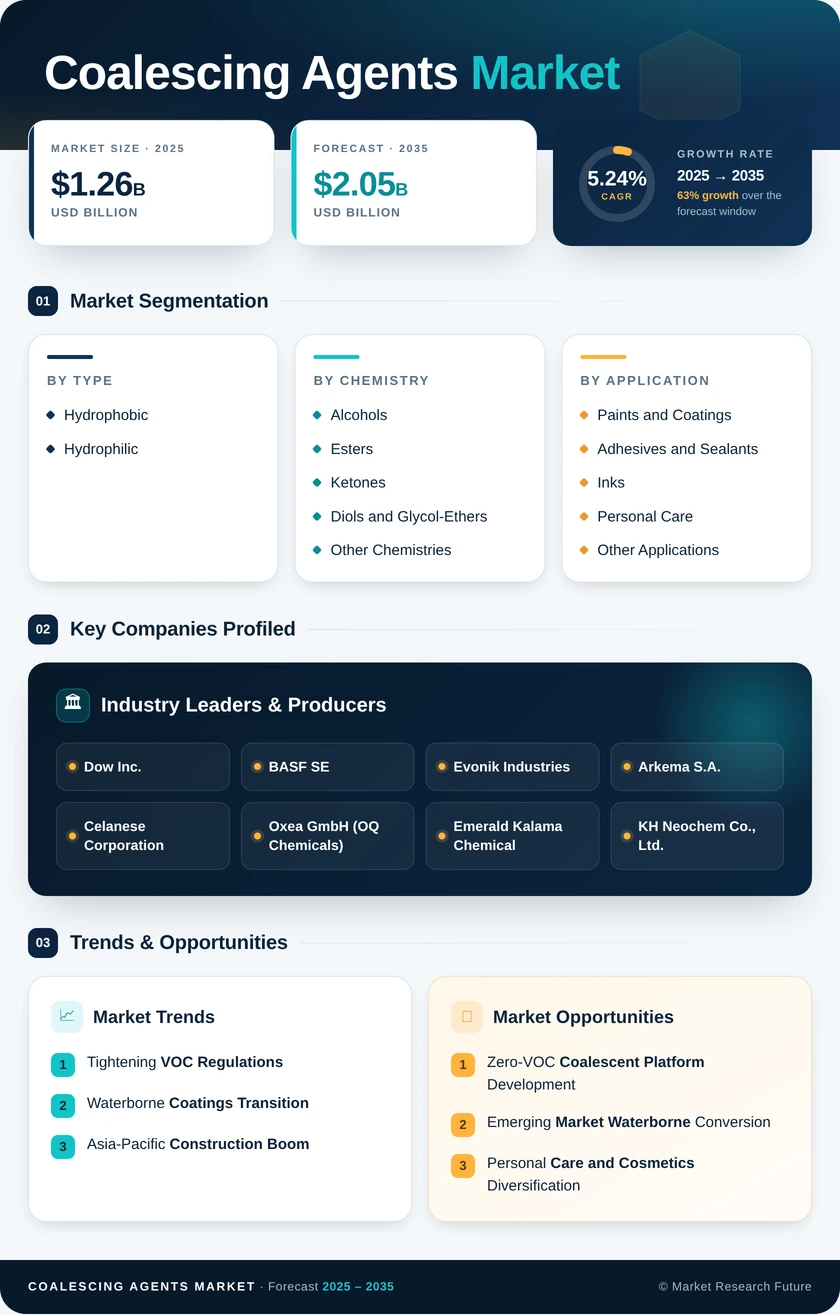
By TypeHydrophilic, HydrophobicHydrophobic (64.3% share, 2025)Hydrophilic (5.93% CAGR)
By ChemistryEsters, Ketones, Alcohols, Diols and Glycol-Ethers, Other ChemistriesAlcohols (USD 0.55B, 2025)Esters (5.75% CAGR)
By ApplicationPaints and Coatings, Adhesives and Sealants, Inks, Personal Care, Other ApplicationsPaints and Coatings (49.1% share, 2025)Personal Care (6.15% CAGR)
By GeographyAsia-Pacific, North America, Europe, South America, Middle East & AfricaAsia-Pacific (41.0% share, 2025)Asia-Pacific (5.71% CAGR)


Market Segmentation Overview

By Type

Sub-SegmentKey Trend
HydrophilicGrowing demand in personal care emulsions and clean-beauty reformulations; improved shelf stability in high-pH latex systems
HydrophobicContinued dominance in acrylic and vinyl-acrylic latex dispersions for architectural and industrial paints


Hydrophobic coalescents remain the default choice for conventional waterborne coatings, while hydrophilic grades are carving out high-growth niches in personal care and specialty adhesive applications driven by regulatory pressure for lower-emission formulations.

By Chemistry

Sub-SegmentKey Trend
EstersFastest growth driven by low-odor, low-VOC performance in architectural coatings
KetonesStable demand in industrial protective coatings requiring fast evaporation rates
AlcoholsLargest segment anchored by Texanol and glycol-ether derivatives as industry-standard coalescents
Diols and Glycol-EthersHigh-performance niche for automotive and aerospace coating applications
Other ChemistriesEmerging bio-based and hybrid chemistries targeting zero-VOC certification


Alcohols maintain volume leadership due to decades of formulation optimization, but esters are gaining share as regulators worldwide tighten VOC thresholds and formulators prioritize low-odor performance.

By Application

Sub-SegmentKey Trend
Paints and CoatingsDominant application; architectural segment drives volume, automotive refinish drives value
Adhesives and SealantsWaterborne conversion in construction sealants expanding coalescent use
InksPackaging ink reformulation for food-contact compliance increasing demand
Personal CareFastest-growing segment; clean-beauty trends drive adoption of cosmetics-grade coalescents
Other ApplicationsTextile finishing, leather treatment, and specialty emulsions


Paints and coatings account for nearly half of global coalescent consumption, but personal care represents the most dynamic growth frontier as cosmetics and skincare brands reformulate away from traditional solvent-based systems.

By Geography

Sub-SegmentKey Trend
Asia-PacificLargest and fastest-growing region; China and India drive volume through construction and urbanization
North AmericaRegulatory-led demand from EPA VOC mandates; premium pricing for low-VOC grades
EuropeMature market with strong innovation in bio-based and reactive coalescents
South AmericaEarly-stage waterborne conversion; Brazil dominates regional consumption
Middle East & AfricaInfrastructure mega-projects in Saudi Arabia and UAE creating new demand corridors


Asia-Pacific's combination of scale, feedstock economics, and accelerating regulatory adoption positions it as the center of gravity for global coalescent demand through 2035.