
Request Free Sample ×

Kindly complete the form below to receive a free sample of this Report

* Please use a valid business email

Leading companies partner with us for data-driven Insights

clients tt-cursor
Hero Background
English
Chinese
French
Japanese
Korean
German
Spanish

Cloud Content Delivery Network Market Analysis

ID: MRFR/ICT/3441-HCR
100 Pages
Aarti Dhapte
March 2026

Cloud Content Delivery Network Market Research Report By Delivery Type (Streaming, Web Performance, Broadcasting, Software Distribution), By Deployment Model (Public Cloud, Private Cloud, Hybrid Cloud), By Service Type (Video Streaming, API Acceleration, Website Acceleration, Security Services), By End Use Industry (Media and Entertainment, E-commerce, Gaming, Healthcare, Education) and By Regional (North America, Europe, South America, Asia Pacific, Middle East and Africa) - Forecast to 2035

Share:
Download PDF ×

We do not share your information with anyone. However, we may send you emails based on your report interest from time to time. You may contact us at any time to opt-out.

Cloud Content Delivery Network Market Infographic
Purchase Options

Market Analysis

In-depth Analysis of Cloud Content Delivery Network Market Industry Landscape

The Cloud Content Delivery Network (CDN) market has turned into a foundation inside the automated scene, in a widespread sense changing how content is conveyed and gotten to over the web. The market factors of the CDN space are set apart through a conjunction of mechanical progressions, expanding internet entrance, and the developing demand for constant and brief content material shipping. One of the key drivers pushing the market forward is the elevating reception of cloud-based total administrations throughout distinct businesses. The international idea of the net has made CDN administrations essential for companies planning to touch a one-of-a-kind and geologically scattered crowd. CDN suppliers decisively bring a network of servers across diverse locales, making certain that content material is conveyed from the nearest area server to the end clients. This diminishes dormancy as well as improves the overall pace and unwavering quality of content material delivery. The market is seeing a flood of popularity for multi-CDN arrangements, in which agencies affect the administrations of several CDN suppliers to ensure overt repetitiveness, restrict non-public time, and improve content material transport across unique locales. Security is an important fear in the automated time, and CDN providers are aware of the developing hazard scene. The market elements mirror an accelerated highlight on sporting sturdy protection efforts to shield in opposition to DDoS attacks, information breaks, and different virtual dangers. CDN suppliers are incorporating progressed protection highlights, like Web Application Firewalls (WAFs) and encryption conventions, to bolster their foundation and guard the sensitive records of corporations and give up customers. Besides, the CDN market is seeing a shift closer to extra adaptable and versatile valuing trends. As groups take a stab at fee enhancement and scalability, CDN providers are adjusting their estimating designs to oblige fluctuating necessities and usage designs. Membership-based total trends, pay-extra-only costs stand-up alternatives, and layered estimating plans are obtaining occurrence, permitting agencies to regulate their CDN fees with their true utilization and necessities.


Author
Author Profile
Aarti Dhapte
AVP - Research

A consulting professional focused on helping businesses navigate complex markets through structured research and strategic insights. I partner with clients to solve high-impact business problems across market entry strategy, competitive intelligence, and opportunity assessment. Over the course of my experience, I have led and contributed to 100+ market research and consulting engagements, delivering insights across multiple industries and geographies, and supporting strategic decisions linked to $500M+ market opportunities. My core expertise lies in building robust market sizing, forecasting, and commercial models (top-down and bottom-up), alongside deep-dive competitive and industry analysis. I have played a key role in shaping go-to-market strategies, investment cases, and growth roadmaps, enabling clients to make confident, data-backed decisions in dynamic markets.

Leave a Comment

FAQs

What is the projected market valuation of the Cloud Content Delivery Network Market by 2035?

<p>The projected market valuation for the Cloud Content Delivery Network Market is 52.25 USD Billion by 2035.</p>

What was the market valuation of the Cloud Content Delivery Network Market in 2024?

<p>The overall market valuation was 12.4 USD Billion in 2024.</p>

What is the expected CAGR for the Cloud Content Delivery Network Market during the forecast period 2025 - 2035?

<p>The expected CAGR for the Cloud Content Delivery Network Market during the forecast period 2025 - 2035 is 13.97%.</p>

Which companies are considered key players in the Cloud Content Delivery Network Market?

<p>Key players in the market include Akamai Technologies, Amazon Web Services, Cloudflare, Microsoft Azure, Google Cloud, Fastly, Limelight Networks, StackPath, and CDN77.</p>

What are the main segments of the Cloud Content Delivery Network Market?

<p>The main segments include Delivery Type, Deployment Model, Service Type, and End Use Industry.</p>

What is the valuation range for the Streaming segment in the Cloud Content Delivery Network Market?

<p>The Streaming segment is valued between 3.5 and 15.0 USD Billion.</p>

How does the Public Cloud segment compare to the Private Cloud segment in terms of valuation?

<p>The Public Cloud segment has a valuation range of 5.0 to 21.0 USD Billion, whereas the Private Cloud segment ranges from 3.0 to 12.0 USD Billion.</p>

What is the valuation range for Video Streaming services within the Cloud Content Delivery Network Market?

<p>The valuation range for Video Streaming services is between 4.96 and 21.25 USD Billion.</p>

Which end-use industry has the highest valuation in the Cloud Content Delivery Network Market?

<p>The Media and Entertainment industry has the highest valuation, ranging from 3.5 to 15.0 USD Billion.</p>

What is the projected valuation for the Software Distribution segment by 2035?

<p>The Software Distribution segment is projected to reach a valuation of 15.25 USD Billion by 2035.</p>

Market Summary

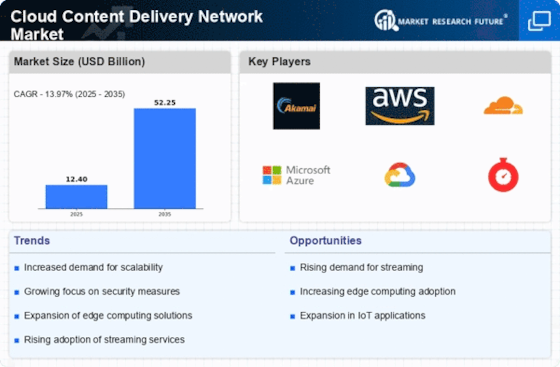
As per Market Research Future analysis, the Cloud Content Delivery Network Market Size was estimated at 12.4 USD Billion in 2024. The Cloud Content Delivery Network industry is projected to grow from 14.13 USD Billion in 2025 to 52.25 USD Billion by 2035, exhibiting a compound annual growth rate (CAGR) of 13.97% during the forecast period 2025 - 2035

Key Market Trends & Highlights

The Cloud Content Delivery Network Market is experiencing robust growth driven by technological advancements and evolving consumer demands.

  • The market is witnessing increased demand for low latency solutions, particularly in North America, which remains the largest market. Integration of AI and machine learning technologies is becoming a pivotal trend, enhancing service delivery and operational efficiency. Enhanced security measures are gaining prominence as organizations prioritize data protection in both the streaming and software distribution segments. Rising demand for streaming services and the expansion of e-commerce platforms are key drivers propelling market growth, especially in the Asia-Pacific region.

Market Size & Forecast

2024 Market Size 12.4 (USD Billion)
2035 Market Size 52.25 (USD Billion)
CAGR (2025 - 2035) 13.97%
Largest Regional Market Share in 2024 North America

Major Players

Akamai Technologies (US), Amazon Web Services (US), Cloudflare (US), Microsoft Azure (US), Google Cloud (US), Fastly (US), Limelight Networks (US), StackPath (US), CDN77 (GB)

Market Trends

The Cloud Content Delivery Network Market is currently experiencing a transformative phase, driven by the increasing demand for efficient content distribution and enhanced user experiences. As organizations continue to migrate to cloud-based solutions, the necessity for robust and scalable content delivery systems becomes paramount. This market appears to be characterized by a growing emphasis on reducing latency and improving load times, which are critical for maintaining user engagement and satisfaction. Furthermore, the rise of streaming services and online gaming is likely to further propel the need for advanced content delivery solutions, as these sectors require seamless and uninterrupted access to high-quality content. In addition, the Cloud Content Delivery Network Market seems to be influenced by the ongoing advancements in technology, particularly in areas such as artificial intelligence and machine learning. These innovations may enable more personalized content delivery, optimizing the user experience based on individual preferences and behaviors. Moreover, the increasing focus on security and data privacy is prompting organizations to seek CDN solutions that offer enhanced protection against cyber threats. As the market evolves, it is expected that providers will continue to innovate, offering more sophisticated and tailored solutions to meet the diverse needs of businesses across various industries.

Increased Demand for Low Latency Solutions

The Cloud Content Delivery Network Market is witnessing a heightened demand for low latency solutions. As users expect instantaneous access to content, organizations are prioritizing technologies that minimize delays in content delivery. This trend is particularly evident in sectors such as e-commerce and online gaming, where even slight delays can lead to significant user dissatisfaction.

Integration of AI and Machine Learning

The integration of artificial intelligence and machine learning into content delivery networks is becoming increasingly prevalent. These technologies enable more efficient data processing and personalized content recommendations, enhancing user engagement. As businesses seek to leverage data analytics, the role of AI in optimizing content delivery strategies is likely to expand.

Focus on Enhanced Security Measures

With the rise in cyber threats, there is a growing emphasis on security within the Cloud Content Delivery Network Market. Organizations are actively seeking CDN solutions that provide robust security features, such as DDoS protection and secure token authentication. This trend reflects a broader commitment to safeguarding user data and maintaining trust in digital platforms.

Cloud Content Delivery Network Market Market Drivers

Emergence of Edge Computing

The Cloud Content Delivery Network Market is being shaped by the emergence of edge computing, which enhances data processing capabilities closer to the end-user. This technological advancement reduces latency and improves the overall user experience. As organizations increasingly adopt edge computing strategies, the demand for CDNs that can support these initiatives is expected to rise. In 2025, the edge computing market is anticipated to reach around 20 billion USD, indicating a growing trend towards decentralized data processing. This shift presents a significant opportunity for the Cloud Content Delivery Network Market to innovate and provide solutions that align with the evolving needs of businesses.

Expansion of E-commerce Platforms

The Cloud Content Delivery Network Market is significantly influenced by the rapid expansion of e-commerce platforms. As online shopping continues to gain traction, businesses are increasingly reliant on CDNs to deliver content swiftly and efficiently. In 2025, e-commerce sales are expected to surpass 5 trillion USD, underscoring the critical role of CDNs in supporting these platforms. By leveraging CDN technology, e-commerce companies can enhance website performance, reduce load times, and improve user experiences. This growing reliance on CDNs positions the Cloud Content Delivery Network Market for substantial growth as businesses strive to optimize their online presence.

Increased Adoption of Cloud Services

The Cloud Content Delivery Network Market is witnessing a significant uptick in the adoption of cloud services across various sectors. Organizations are increasingly migrating their operations to the cloud, driven by the need for scalability, flexibility, and cost-effectiveness. In 2025, the cloud services market is projected to reach approximately 600 billion USD, highlighting the growing reliance on cloud-based solutions. This shift necessitates the integration of CDNs to ensure efficient content delivery and optimal performance. As businesses embrace cloud technologies, the Cloud Content Delivery Network Market is likely to experience accelerated growth, driven by the demand for enhanced content delivery solutions.

Rising Demand for Streaming Services

The Cloud Content Delivery Network Market is experiencing a notable surge in demand for streaming services. As consumers increasingly favor on-demand video content, the need for efficient content delivery solutions becomes paramount. In 2025, the market for video streaming is projected to reach approximately 100 billion USD, indicating a robust growth trajectory. This trend compels content providers to adopt advanced CDN solutions to ensure seamless streaming experiences. Consequently, the Cloud Content Delivery Network Market is poised to benefit from this escalating demand, as providers seek to enhance their service offerings and maintain competitive advantages.

Growing Focus on Data Privacy Regulations

The Cloud Content Delivery Network Market is increasingly influenced by the growing focus on data privacy regulations. As governments worldwide implement stricter data protection laws, organizations are compelled to adopt solutions that ensure compliance. This trend drives the demand for CDNs that offer enhanced security features and data protection capabilities. In 2025, the global market for data privacy solutions is projected to exceed 10 billion USD, reflecting the heightened awareness surrounding data security. Consequently, the Cloud Content Delivery Network Market is likely to see increased investment in security-focused CDN solutions, as businesses prioritize compliance and consumer trust.

Market Segment Insights

By Delivery Type: Streaming (Largest) vs. Software Distribution (Fastest-Growing)

In the Cloud Content Delivery Network Market, the 'Delivery Type' segment showcases a diverse array of services, primarily dominated by streaming, which accounts for a significant portion of the market share. Streaming services benefit from the increasing demand for real-time media consumption, enabling users to access high-quality video and audio content without delays. Web performance and broadcasting also command notable shares, while software distribution steadily gains traction among enterprises striving for efficient software delivery across networks. As companies continue to invest in digital infrastructure, growth trends within the Delivery Type segment reflect evolving consumer behaviors and technological advancements. Streaming is poised to grow, driven by the rise of over-the-top (OTT) platforms and a surge in mobile video consumption. Meanwhile, software distribution is accelerating rapidly due to the shift towards cloud-based applications, necessitating reliable and fast delivery methods that align with modern business needs.

Streaming (Dominant) vs. Broadcasting (Emerging)

Streaming remains the dominant force within the Delivery Type segment, propelled by its ability to deliver content instantaneously to audiences worldwide. The demand for high-definition streaming has spurred investments in enhanced CDN infrastructures to ensure smooth delivery of videos and reduce latency. In contrast, broadcasting is emerging as a vital player, leveraging traditional media alongside digital platforms to reach broader audiences. While it may not match streaming's popularity, it plays a crucial role for specific applications such as live events and news transmission. The synergy between broadcasting and streaming technologies could further elevate the Broadcasting segment, blending real-time interactions with on-demand capabilities to cater to a variety of consumer preferences.

By Deployment Model: Public Cloud (Largest) vs. Hybrid Cloud (Fastest-Growing)

In the Cloud Content Delivery Network Market (CDN) market, the deployment model segment is prominently characterized by the dominance of Public Cloud services, which continue to capture a significant share of the market. Public Cloud solutions are preferred by many organizations for their scalability, cost-effectiveness, and ease of use, making them an attractive option for businesses of all sizes. Private Cloud and Hybrid Cloud models, while not as widely adopted, play crucial roles in specific scenarios, catering to organizations with unique security and compliance requirements.

Public Cloud (Dominant) vs. Hybrid Cloud (Emerging)

The Public Cloud deployment model stands out for its extensive reach and appeal to a diverse range of users due to its affordability and flexibility. It allows companies to quickly deploy content to global audiences without significant upfront infrastructure investments. Conversely, the Hybrid Cloud model is gaining traction as businesses seek to leverage the best of both worlds, integrating on-premises infrastructure with <a href="https://www.marketresearchfuture.com/reports/public-cloud-market-2291">Public Cloud capabilities</a>. This model is particularly favored by enterprises that need to maintain sensitive data within a Private Cloud while utilizing Public Cloud resources for less critical workloads, making it a versatile and strategic choice for modern digital demands.

By Service Type: Video Streaming (Largest) vs. Security Services (Fastest-Growing)

In the Cloud Content Delivery Network Market, Video Streaming holds the largest market share due to the ongoing demand for high-quality streaming services across various platforms. The surge in online content consumption and the shift towards cloud-based solutions have propelled this segment to dominate market dynamics. In contrast, the Security Services segment is witnessing rapid growth as businesses increasingly prioritize cybersecurity solutions amidst rising threats. This emphasis on protecting digital assets has helped elevate the significance of Security Services in the CDN landscape.

Service Types: Video Streaming (Dominant) vs. API Acceleration (Emerging)

Video Streaming is characterized by its established infrastructure and widespread adoption, enabling seamless content delivery to a diverse audience. It has become a dominant player in the CDN space, thanks to partnerships with major streaming platforms and consistent technological advancements. Conversely, API Acceleration is emerging as a critical service type, driven by the rising need for faster content integration and real-time data exchange. This segment is gaining traction as more enterprises leverage APIs to enhance user experiences and streamline operations, indicating a shift in focus towards improving application performance and user interaction.

By End Use Industry: Media and Entertainment (Largest) vs. E-commerce (Fastest-Growing)

The Cloud Content Delivery Network Market exhibits a varied distribution across its end-use industries, with Media and Entertainment commanding the largest share. This segment benefits from the soaring demand for streaming services and high-quality content delivery. E-commerce, while currently smaller, is rapidly gaining traction as digital shopping grows, highlighting the diverse landscape of cloud CDN applications.

Media and Entertainment: Dominant vs. E-commerce: Emerging

The Media and Entertainment segment stands out as the dominant player in the Cloud Content Delivery Network Market, driven by the expansion of streaming platforms and the increasing consumption of digital media. Its reliance on high-speed, reliable content delivery is critical for video-on-demand services, gaming, and live broadcasts. In contrast, E-commerce represents an emerging segment, spurred by the shift in consumer shopping habits towards online platforms. This surge necessitates robust CDNs to manage traffic spikes during promotions and ensure a seamless shopping experience.

Get more detailed insights about Cloud Content Delivery Network Market Research Report - Forecast to 2035

Regional Insights

The Cloud Content Delivery Network Market is projected to achieve significant growth across various regions in the coming years, In particular, North America dominates the market with a valuation of 4.5 USD Billion in 2023, expected to grow to 15.5 USD Billion by 2032, reflecting its majority holding due to the high adoption of cloud technologies and strong infrastructure investments.

Europe follows with a valuation of 2.5 USD Billion in 2023 and an anticipated growth to 8.0 USD Billion by 2032, driven by an increasing focus on digital transformation and enhanced user engagement.The APAC region shows a significant upward trend, starting at 2.8 USD Billion in 2023 and projected to reach 9.5 USD Billion by 2032, largely fueled by rapid digitization and expanding internet connectivity. South America has a smaller market position with a valuation of 0.8 USD Billion in 2023, set to rise to 2.6 USD Billion by 2032, highlighting emerging opportunities for growth.

Meanwhile, the MEA market, albeit the least dominant with 0.3 USD Billion in 2023, is expected to grow to 1.7 USD Billion by 2032 as the region gradually embraces cloud technologies to overcome various operational challenges.Market trends indicate a robust demand for enhanced content delivery solutions, driven by the proliferation of video streaming and online gaming, which presents growth opportunities across all regions, each contributing uniquely to the Cloud Content Delivery Network Market statistics and data.

Fig 3: Cloud Content Delivery Network Market Regional Insights

Key Players and Competitive Insights

The Cloud Content Delivery Network Market is characterized by a rapidly evolving landscape driven by the increasing demand for efficient and scalable content delivery solutions. As digital content consumption continues to rise, businesses are increasingly relying on CDN services to enhance their performance, improve user experiences and manage the growing data traffic. Competitive insights into this market reveal a diverse range of players, each bringing unique advantages and innovations to the table. These companies compete on various fronts, including service differentiation, geographical reach, technological advancements, and customer service capabilities.As user expectations rise and new technologies emerge, understanding the competitive dynamics of this market becomes crucial for stakeholders looking to optimize their strategies within this space.Fastly stands out in the Cloud Content Delivery Network Market due to its commitment to delivering real-time data and high-speed performance without compromising on security. The company has carved a niche by offering highly customizable solutions that cater specifically to developers and enterprises with unique content delivery needs. Fastly's architecture enables low-latency content delivery, making it ideal for dynamic and interactive applications.Its emphasis on edge computing allows customers to deploy applications closer to their users, thereby reducing load times and improving overall user experience. Fastly's focus on innovation also highlights its strong suite of features, such as Instant Purge technology and real-time analytics, providing clients with granular control over their content delivery processes.The blend of these strengths allows Fastly to maintain a competitive edge and solidify its position in the cloud content delivery ecosystem.Akamai Technologies is recognized as a formidable player within the Cloud Content Delivery Network Market, leveraging its extensive network infrastructure to provide comprehensive solutions that enhance the delivery of digital content across various domains. With a global footprint that spans numerous data centers, Akamai excels in optimizing content delivery at an impressive scale. The company's robust capabilities in security, combined with intelligent routing technologies, ensure that users receive content reliably and swiftly.Akamai's strengths lie in its ability to serve a broad spectrum of industries, including media, e-commerce, and software, positioning it effectively for varied customer needs. Furthermore, Akamai’s commitment to innovation drives continual enhancements to its offerings, leveraging advanced technologies such as machine learning and artificial intelligence to further optimize performance and security measures. This positions Akamai as a leader capable of addressing the complex demands of the ever-evolving digital environment.

Key Companies in the Cloud Content Delivery Network Market include

Industry Developments

The Cloud Content Delivery Network Market has recently witnessed significant advancements and consolidations. Fastly has been enhancing its network performance and expanding its edge cloud functionality to better support real-time data delivery. Akamai Technologies continues to strengthen its security offerings while experiencing growth in media delivery services. Amazon Web Services and Google Cloud are aggressively competing for market share, with both companies consistently upgrading their infrastructures and service offerings. Verizon has been investing in smart edge technology to optimize content delivery, while Cloudflare is expanding its global presence and enhancing security features.

In a notable merger, Microsoft announced its intent to acquire a cloud content delivery startup to bolster its Azure platform, further intensifying the competitive landscape. Recent trends indicate that the market valuation for companies such as Alibaba Cloud, IBM, DigitalOcean, and Limelight Networks is on an upward trajectory, spurred by increasing demand for faster and more secure content delivery solutions. These developments underscore the growing importance of CDN services in optimizing user experiences and supporting a plethora of digital applications across various industries.

With the overarching growth in online content consumption, the Cloud Content Delivery Network Market is poised for continued expansion and innovation.

Future Outlook

Cloud Content Delivery Network Market Future Outlook

The Cloud Content Delivery Network Market is projected to grow at a 13.97% CAGR from 2025 to 2035, driven by increasing demand for low-latency content delivery and enhanced security features.

New opportunities lie in:

  • Expansion into edge computing services for real-time data processing.</p><p>Development of AI-driven analytics tools for performance optimization.</p><p>Partnerships with IoT providers to enhance content delivery for smart devices.

By 2035, the market is expected to be robust, driven by innovation and strategic partnerships.

Market Segmentation

Cloud Content Delivery Network Market Service Type Outlook

  • Video Streaming
  • API Acceleration
  • Website Acceleration
  • Security Services

Cloud Content Delivery Network Market Delivery Type Outlook

  • Streaming
  • Web Performance
  • Broadcasting
  • Software Distribution

Cloud Content Delivery Network Market Deployment Model Outlook

  • Public Cloud
  • Private Cloud
  • Hybrid Cloud

Cloud Content Delivery Network Market End Use Industry Outlook

  • Media and Entertainment
  • E-commerce
  • Gaming
  • Healthcare
  • Education

Report Scope

MARKET SIZE 2024 12.4(USD Billion)
MARKET SIZE 2025 14.13(USD Billion)
MARKET SIZE 2035 52.25(USD Billion)
COMPOUND ANNUAL GROWTH RATE (CAGR) 13.97% (2025 - 2035)
REPORT COVERAGE Revenue Forecast, Competitive Landscape, Growth Factors, and Trends
BASE YEAR 2024
Market Forecast Period 2025 - 2035
Historical Data 2019 - 2024
Market Forecast Units USD Billion
Key Companies Profiled Akamai Technologies (US), Amazon Web Services (US), Cloudflare (US), Microsoft Azure (US), Google Cloud (US), Fastly (US), Limelight Networks (US), StackPath (US), CDN77 (GB)
Segments Covered Delivery Type, Deployment Model, Service Type, End Use Industry, Regional
Key Market Opportunities Integration of edge computing enhances performance and scalability in the Cloud Content Delivery Network Market.
Key Market Dynamics Rising demand for low-latency content delivery drives innovation and competition in the Cloud Content Delivery Network market.
Countries Covered North America, Europe, APAC, South America, MEA

FAQs

What is the projected market valuation of the Cloud Content Delivery Network Market by 2035?

<p>The projected market valuation for the Cloud Content Delivery Network Market is 52.25 USD Billion by 2035.</p>

What was the market valuation of the Cloud Content Delivery Network Market in 2024?

<p>The overall market valuation was 12.4 USD Billion in 2024.</p>

What is the expected CAGR for the Cloud Content Delivery Network Market during the forecast period 2025 - 2035?

<p>The expected CAGR for the Cloud Content Delivery Network Market during the forecast period 2025 - 2035 is 13.97%.</p>

Which companies are considered key players in the Cloud Content Delivery Network Market?

<p>Key players in the market include Akamai Technologies, Amazon Web Services, Cloudflare, Microsoft Azure, Google Cloud, Fastly, Limelight Networks, StackPath, and CDN77.</p>

What are the main segments of the Cloud Content Delivery Network Market?

<p>The main segments include Delivery Type, Deployment Model, Service Type, and End Use Industry.</p>

What is the valuation range for the Streaming segment in the Cloud Content Delivery Network Market?

<p>The Streaming segment is valued between 3.5 and 15.0 USD Billion.</p>

How does the Public Cloud segment compare to the Private Cloud segment in terms of valuation?

<p>The Public Cloud segment has a valuation range of 5.0 to 21.0 USD Billion, whereas the Private Cloud segment ranges from 3.0 to 12.0 USD Billion.</p>

What is the valuation range for Video Streaming services within the Cloud Content Delivery Network Market?

<p>The valuation range for Video Streaming services is between 4.96 and 21.25 USD Billion.</p>

Which end-use industry has the highest valuation in the Cloud Content Delivery Network Market?

<p>The Media and Entertainment industry has the highest valuation, ranging from 3.5 to 15.0 USD Billion.</p>

What is the projected valuation for the Software Distribution segment by 2035?

<p>The Software Distribution segment is projected to reach a valuation of 15.25 USD Billion by 2035.</p>

  1. SECTION I: EXECUTIVE SUMMARY AND KEY HIGHLIGHTS
    1. | 1.1 EXECUTIVE SUMMARY
    2. | | 1.1.1 Market Overview
    3. | | 1.1.2 Key Findings
    4. | | 1.1.3 Market Segmentation
    5. | | 1.1.4 Competitive Landscape
    6. | | 1.1.5 Challenges and Opportunities
    7. | | 1.1.6 Future Outlook
  2. SECTION II: SCOPING, METHODOLOGY AND MARKET STRUCTURE
    1. | 2.1 MARKET INTRODUCTION
    2. | | 2.1.1 Definition
    3. | | 2.1.2 Scope of the study
    4. | | | 2.1.2.1 Research Objective
    5. | | | 2.1.2.2 Assumption
    6. | | | 2.1.2.3 Limitations
    7. | 2.2 RESEARCH METHODOLOGY
    8. | | 2.2.1 Overview
    9. | | 2.2.2 Data Mining
    10. | | 2.2.3 Secondary Research
    11. | | 2.2.4 Primary Research
    12. | | | 2.2.4.1 Primary Interviews and Information Gathering Process
    13. | | | 2.2.4.2 Breakdown of Primary Respondents
    14. | | 2.2.5 Forecasting Model
    15. | | 2.2.6 Market Size Estimation
    16. | | | 2.2.6.1 Bottom-Up Approach
    17. | | | 2.2.6.2 Top-Down Approach
    18. | | 2.2.7 Data Triangulation
    19. | | 2.2.8 Validation
  3. SECTION III: QUALITATIVE ANALYSIS
    1. | 3.1 MARKET DYNAMICS
    2. | | 3.1.1 Overview
    3. | | 3.1.2 Drivers
    4. | | 3.1.3 Restraints
    5. | | 3.1.4 Opportunities
    6. | 3.2 MARKET FACTOR ANALYSIS
    7. | | 3.2.1 Value chain Analysis
    8. | | 3.2.2 Porter's Five Forces Analysis
    9. | | | 3.2.2.1 Bargaining Power of Suppliers
    10. | | | 3.2.2.2 Bargaining Power of Buyers
    11. | | | 3.2.2.3 Threat of New Entrants
    12. | | | 3.2.2.4 Threat of Substitutes
    13. | | | 3.2.2.5 Intensity of Rivalry
    14. | | 3.2.3 COVID-19 Impact Analysis
    15. | | | 3.2.3.1 Market Impact Analysis
    16. | | | 3.2.3.2 Regional Impact
    17. | | | 3.2.3.3 Opportunity and Threat Analysis
  4. SECTION IV: QUANTITATIVE ANALYSIS
    1. | 4.1 Information and Communications Technology, BY Delivery Type (USD Billion)
    2. | | 4.1.1 Streaming
    3. | | 4.1.2 Web Performance
    4. | | 4.1.3 Broadcasting
    5. | | 4.1.4 Software Distribution
    6. | 4.2 Information and Communications Technology, BY Deployment Model (USD Billion)
    7. | | 4.2.1 Public Cloud
    8. | | 4.2.2 Private Cloud
    9. | | 4.2.3 Hybrid Cloud
    10. | 4.3 Information and Communications Technology, BY Service Type (USD Billion)
    11. | | 4.3.1 Video Streaming
    12. | | 4.3.2 API Acceleration
    13. | | 4.3.3 Website Acceleration
    14. | | 4.3.4 Security Services
    15. | 4.4 Information and Communications Technology, BY End Use Industry (USD Billion)
    16. | | 4.4.1 Media and Entertainment
    17. | | 4.4.2 E-commerce
    18. | | 4.4.3 Gaming
    19. | | 4.4.4 Healthcare
    20. | | 4.4.5 Education
    21. | 4.5 Information and Communications Technology, BY Region (USD Billion)
    22. | | 4.5.1 North America
    23. | | | 4.5.1.1 US
    24. | | | 4.5.1.2 Canada
    25. | | 4.5.2 Europe
    26. | | | 4.5.2.1 Germany
    27. | | | 4.5.2.2 UK
    28. | | | 4.5.2.3 France
    29. | | | 4.5.2.4 Russia
    30. | | | 4.5.2.5 Italy
    31. | | | 4.5.2.6 Spain
    32. | | | 4.5.2.7 Rest of Europe
    33. | | 4.5.3 APAC
    34. | | | 4.5.3.1 China
    35. | | | 4.5.3.2 India
    36. | | | 4.5.3.3 Japan
    37. | | | 4.5.3.4 South Korea
    38. | | | 4.5.3.5 Malaysia
    39. | | | 4.5.3.6 Thailand
    40. | | | 4.5.3.7 Indonesia
    41. | | | 4.5.3.8 Rest of APAC
    42. | | 4.5.4 South America
    43. | | | 4.5.4.1 Brazil
    44. | | | 4.5.4.2 Mexico
    45. | | | 4.5.4.3 Argentina
    46. | | | 4.5.4.4 Rest of South America
    47. | | 4.5.5 MEA
    48. | | | 4.5.5.1 GCC Countries
    49. | | | 4.5.5.2 South Africa
    50. | | | 4.5.5.3 Rest of MEA
  5. SECTION V: COMPETITIVE ANALYSIS
    1. | 5.1 Competitive Landscape
    2. | | 5.1.1 Overview
    3. | | 5.1.2 Competitive Analysis
    4. | | 5.1.3 Market share Analysis
    5. | | 5.1.4 Major Growth Strategy in the Information and Communications Technology
    6. | | 5.1.5 Competitive Benchmarking
    7. | | 5.1.6 Leading Players in Terms of Number of Developments in the Information and Communications Technology
    8. | | 5.1.7 Key developments and growth strategies
    9. | | | 5.1.7.1 New Product Launch/Service Deployment
    10. | | | 5.1.7.2 Merger & Acquisitions
    11. | | | 5.1.7.3 Joint Ventures
    12. | | 5.1.8 Major Players Financial Matrix
    13. | | | 5.1.8.1 Sales and Operating Income
    14. | | | 5.1.8.2 Major Players R&D Expenditure. 2023
    15. | 5.2 Company Profiles
    16. | | 5.2.1 Akamai Technologies (US)
    17. | | | 5.2.1.1 Financial Overview
    18. | | | 5.2.1.2 Products Offered
    19. | | | 5.2.1.3 Key Developments
    20. | | | 5.2.1.4 SWOT Analysis
    21. | | | 5.2.1.5 Key Strategies
    22. | | 5.2.2 Amazon Web Services (US)
    23. | | | 5.2.2.1 Financial Overview
    24. | | | 5.2.2.2 Products Offered
    25. | | | 5.2.2.3 Key Developments
    26. | | | 5.2.2.4 SWOT Analysis
    27. | | | 5.2.2.5 Key Strategies
    28. | | 5.2.3 Cloudflare (US)
    29. | | | 5.2.3.1 Financial Overview
    30. | | | 5.2.3.2 Products Offered
    31. | | | 5.2.3.3 Key Developments
    32. | | | 5.2.3.4 SWOT Analysis
    33. | | | 5.2.3.5 Key Strategies
    34. | | 5.2.4 Microsoft Azure (US)
    35. | | | 5.2.4.1 Financial Overview
    36. | | | 5.2.4.2 Products Offered
    37. | | | 5.2.4.3 Key Developments
    38. | | | 5.2.4.4 SWOT Analysis
    39. | | | 5.2.4.5 Key Strategies
    40. | | 5.2.5 Google Cloud (US)
    41. | | | 5.2.5.1 Financial Overview
    42. | | | 5.2.5.2 Products Offered
    43. | | | 5.2.5.3 Key Developments
    44. | | | 5.2.5.4 SWOT Analysis
    45. | | | 5.2.5.5 Key Strategies
    46. | | 5.2.6 Fastly (US)
    47. | | | 5.2.6.1 Financial Overview
    48. | | | 5.2.6.2 Products Offered
    49. | | | 5.2.6.3 Key Developments
    50. | | | 5.2.6.4 SWOT Analysis
    51. | | | 5.2.6.5 Key Strategies
    52. | | 5.2.7 Limelight Networks (US)
    53. | | | 5.2.7.1 Financial Overview
    54. | | | 5.2.7.2 Products Offered
    55. | | | 5.2.7.3 Key Developments
    56. | | | 5.2.7.4 SWOT Analysis
    57. | | | 5.2.7.5 Key Strategies
    58. | | 5.2.8 StackPath (US)
    59. | | | 5.2.8.1 Financial Overview
    60. | | | 5.2.8.2 Products Offered
    61. | | | 5.2.8.3 Key Developments
    62. | | | 5.2.8.4 SWOT Analysis
    63. | | | 5.2.8.5 Key Strategies
    64. | | 5.2.9 CDN77 (GB)
    65. | | | 5.2.9.1 Financial Overview
    66. | | | 5.2.9.2 Products Offered
    67. | | | 5.2.9.3 Key Developments
    68. | | | 5.2.9.4 SWOT Analysis
    69. | | | 5.2.9.5 Key Strategies
    70. | 5.3 Appendix
    71. | | 5.3.1 References
    72. | | 5.3.2 Related Reports
  6. LIST OF FIGURES
    1. | 6.1 MARKET SYNOPSIS
    2. | 6.2 NORTH AMERICA MARKET ANALYSIS
    3. | 6.3 US MARKET ANALYSIS BY DELIVERY TYPE
    4. | 6.4 US MARKET ANALYSIS BY DEPLOYMENT MODEL
    5. | 6.5 US MARKET ANALYSIS BY SERVICE TYPE
    6. | 6.6 US MARKET ANALYSIS BY END USE INDUSTRY
    7. | 6.7 CANADA MARKET ANALYSIS BY DELIVERY TYPE
    8. | 6.8 CANADA MARKET ANALYSIS BY DEPLOYMENT MODEL
    9. | 6.9 CANADA MARKET ANALYSIS BY SERVICE TYPE
    10. | 6.10 CANADA MARKET ANALYSIS BY END USE INDUSTRY
    11. | 6.11 EUROPE MARKET ANALYSIS
    12. | 6.12 GERMANY MARKET ANALYSIS BY DELIVERY TYPE
    13. | 6.13 GERMANY MARKET ANALYSIS BY DEPLOYMENT MODEL
    14. | 6.14 GERMANY MARKET ANALYSIS BY SERVICE TYPE
    15. | 6.15 GERMANY MARKET ANALYSIS BY END USE INDUSTRY
    16. | 6.16 UK MARKET ANALYSIS BY DELIVERY TYPE
    17. | 6.17 UK MARKET ANALYSIS BY DEPLOYMENT MODEL
    18. | 6.18 UK MARKET ANALYSIS BY SERVICE TYPE
    19. | 6.19 UK MARKET ANALYSIS BY END USE INDUSTRY
    20. | 6.20 FRANCE MARKET ANALYSIS BY DELIVERY TYPE
    21. | 6.21 FRANCE MARKET ANALYSIS BY DEPLOYMENT MODEL
    22. | 6.22 FRANCE MARKET ANALYSIS BY SERVICE TYPE
    23. | 6.23 FRANCE MARKET ANALYSIS BY END USE INDUSTRY
    24. | 6.24 RUSSIA MARKET ANALYSIS BY DELIVERY TYPE
    25. | 6.25 RUSSIA MARKET ANALYSIS BY DEPLOYMENT MODEL
    26. | 6.26 RUSSIA MARKET ANALYSIS BY SERVICE TYPE
    27. | 6.27 RUSSIA MARKET ANALYSIS BY END USE INDUSTRY
    28. | 6.28 ITALY MARKET ANALYSIS BY DELIVERY TYPE
    29. | 6.29 ITALY MARKET ANALYSIS BY DEPLOYMENT MODEL
    30. | 6.30 ITALY MARKET ANALYSIS BY SERVICE TYPE
    31. | 6.31 ITALY MARKET ANALYSIS BY END USE INDUSTRY
    32. | 6.32 SPAIN MARKET ANALYSIS BY DELIVERY TYPE
    33. | 6.33 SPAIN MARKET ANALYSIS BY DEPLOYMENT MODEL
    34. | 6.34 SPAIN MARKET ANALYSIS BY SERVICE TYPE
    35. | 6.35 SPAIN MARKET ANALYSIS BY END USE INDUSTRY
    36. | 6.36 REST OF EUROPE MARKET ANALYSIS BY DELIVERY TYPE
    37. | 6.37 REST OF EUROPE MARKET ANALYSIS BY DEPLOYMENT MODEL
    38. | 6.38 REST OF EUROPE MARKET ANALYSIS BY SERVICE TYPE
    39. | 6.39 REST OF EUROPE MARKET ANALYSIS BY END USE INDUSTRY
    40. | 6.40 APAC MARKET ANALYSIS
    41. | 6.41 CHINA MARKET ANALYSIS BY DELIVERY TYPE
    42. | 6.42 CHINA MARKET ANALYSIS BY DEPLOYMENT MODEL
    43. | 6.43 CHINA MARKET ANALYSIS BY SERVICE TYPE
    44. | 6.44 CHINA MARKET ANALYSIS BY END USE INDUSTRY
    45. | 6.45 INDIA MARKET ANALYSIS BY DELIVERY TYPE
    46. | 6.46 INDIA MARKET ANALYSIS BY DEPLOYMENT MODEL
    47. | 6.47 INDIA MARKET ANALYSIS BY SERVICE TYPE
    48. | 6.48 INDIA MARKET ANALYSIS BY END USE INDUSTRY
    49. | 6.49 JAPAN MARKET ANALYSIS BY DELIVERY TYPE
    50. | 6.50 JAPAN MARKET ANALYSIS BY DEPLOYMENT MODEL
    51. | 6.51 JAPAN MARKET ANALYSIS BY SERVICE TYPE
    52. | 6.52 JAPAN MARKET ANALYSIS BY END USE INDUSTRY
    53. | 6.53 SOUTH KOREA MARKET ANALYSIS BY DELIVERY TYPE
    54. | 6.54 SOUTH KOREA MARKET ANALYSIS BY DEPLOYMENT MODEL
    55. | 6.55 SOUTH KOREA MARKET ANALYSIS BY SERVICE TYPE
    56. | 6.56 SOUTH KOREA MARKET ANALYSIS BY END USE INDUSTRY
    57. | 6.57 MALAYSIA MARKET ANALYSIS BY DELIVERY TYPE
    58. | 6.58 MALAYSIA MARKET ANALYSIS BY DEPLOYMENT MODEL
    59. | 6.59 MALAYSIA MARKET ANALYSIS BY SERVICE TYPE
    60. | 6.60 MALAYSIA MARKET ANALYSIS BY END USE INDUSTRY
    61. | 6.61 THAILAND MARKET ANALYSIS BY DELIVERY TYPE
    62. | 6.62 THAILAND MARKET ANALYSIS BY DEPLOYMENT MODEL
    63. | 6.63 THAILAND MARKET ANALYSIS BY SERVICE TYPE
    64. | 6.64 THAILAND MARKET ANALYSIS BY END USE INDUSTRY
    65. | 6.65 INDONESIA MARKET ANALYSIS BY DELIVERY TYPE
    66. | 6.66 INDONESIA MARKET ANALYSIS BY DEPLOYMENT MODEL
    67. | 6.67 INDONESIA MARKET ANALYSIS BY SERVICE TYPE
    68. | 6.68 INDONESIA MARKET ANALYSIS BY END USE INDUSTRY
    69. | 6.69 REST OF APAC MARKET ANALYSIS BY DELIVERY TYPE
    70. | 6.70 REST OF APAC MARKET ANALYSIS BY DEPLOYMENT MODEL
    71. | 6.71 REST OF APAC MARKET ANALYSIS BY SERVICE TYPE
    72. | 6.72 REST OF APAC MARKET ANALYSIS BY END USE INDUSTRY
    73. | 6.73 SOUTH AMERICA MARKET ANALYSIS
    74. | 6.74 BRAZIL MARKET ANALYSIS BY DELIVERY TYPE
    75. | 6.75 BRAZIL MARKET ANALYSIS BY DEPLOYMENT MODEL
    76. | 6.76 BRAZIL MARKET ANALYSIS BY SERVICE TYPE
    77. | 6.77 BRAZIL MARKET ANALYSIS BY END USE INDUSTRY
    78. | 6.78 MEXICO MARKET ANALYSIS BY DELIVERY TYPE
    79. | 6.79 MEXICO MARKET ANALYSIS BY DEPLOYMENT MODEL
    80. | 6.80 MEXICO MARKET ANALYSIS BY SERVICE TYPE
    81. | 6.81 MEXICO MARKET ANALYSIS BY END USE INDUSTRY
    82. | 6.82 ARGENTINA MARKET ANALYSIS BY DELIVERY TYPE
    83. | 6.83 ARGENTINA MARKET ANALYSIS BY DEPLOYMENT MODEL
    84. | 6.84 ARGENTINA MARKET ANALYSIS BY SERVICE TYPE
    85. | 6.85 ARGENTINA MARKET ANALYSIS BY END USE INDUSTRY
    86. | 6.86 REST OF SOUTH AMERICA MARKET ANALYSIS BY DELIVERY TYPE
    87. | 6.87 REST OF SOUTH AMERICA MARKET ANALYSIS BY DEPLOYMENT MODEL
    88. | 6.88 REST OF SOUTH AMERICA MARKET ANALYSIS BY SERVICE TYPE
    89. | 6.89 REST OF SOUTH AMERICA MARKET ANALYSIS BY END USE INDUSTRY
    90. | 6.90 MEA MARKET ANALYSIS
    91. | 6.91 GCC COUNTRIES MARKET ANALYSIS BY DELIVERY TYPE
    92. | 6.92 GCC COUNTRIES MARKET ANALYSIS BY DEPLOYMENT MODEL
    93. | 6.93 GCC COUNTRIES MARKET ANALYSIS BY SERVICE TYPE
    94. | 6.94 GCC COUNTRIES MARKET ANALYSIS BY END USE INDUSTRY
    95. | 6.95 SOUTH AFRICA MARKET ANALYSIS BY DELIVERY TYPE
    96. | 6.96 SOUTH AFRICA MARKET ANALYSIS BY DEPLOYMENT MODEL
    97. | 6.97 SOUTH AFRICA MARKET ANALYSIS BY SERVICE TYPE
    98. | 6.98 SOUTH AFRICA MARKET ANALYSIS BY END USE INDUSTRY
    99. | 6.99 REST OF MEA MARKET ANALYSIS BY DELIVERY TYPE
    100. | 6.100 REST OF MEA MARKET ANALYSIS BY DEPLOYMENT MODEL
    101. | 6.101 REST OF MEA MARKET ANALYSIS BY SERVICE TYPE
    102. | 6.102 REST OF MEA MARKET ANALYSIS BY END USE INDUSTRY
    103. | 6.103 KEY BUYING CRITERIA OF INFORMATION AND COMMUNICATIONS TECHNOLOGY
    104. | 6.104 RESEARCH PROCESS OF MRFR
    105. | 6.105 DRO ANALYSIS OF INFORMATION AND COMMUNICATIONS TECHNOLOGY
    106. | 6.106 DRIVERS IMPACT ANALYSIS: INFORMATION AND COMMUNICATIONS TECHNOLOGY
    107. | 6.107 RESTRAINTS IMPACT ANALYSIS: INFORMATION AND COMMUNICATIONS TECHNOLOGY
    108. | 6.108 SUPPLY / VALUE CHAIN: INFORMATION AND COMMUNICATIONS TECHNOLOGY
    109. | 6.109 INFORMATION AND COMMUNICATIONS TECHNOLOGY, BY DELIVERY TYPE, 2024 (% SHARE)
    110. | 6.110 INFORMATION AND COMMUNICATIONS TECHNOLOGY, BY DELIVERY TYPE, 2024 TO 2035 (USD Billion)
    111. | 6.111 INFORMATION AND COMMUNICATIONS TECHNOLOGY, BY DEPLOYMENT MODEL, 2024 (% SHARE)
    112. | 6.112 INFORMATION AND COMMUNICATIONS TECHNOLOGY, BY DEPLOYMENT MODEL, 2024 TO 2035 (USD Billion)
    113. | 6.113 INFORMATION AND COMMUNICATIONS TECHNOLOGY, BY SERVICE TYPE, 2024 (% SHARE)
    114. | 6.114 INFORMATION AND COMMUNICATIONS TECHNOLOGY, BY SERVICE TYPE, 2024 TO 2035 (USD Billion)
    115. | 6.115 INFORMATION AND COMMUNICATIONS TECHNOLOGY, BY END USE INDUSTRY, 2024 (% SHARE)
    116. | 6.116 INFORMATION AND COMMUNICATIONS TECHNOLOGY, BY END USE INDUSTRY, 2024 TO 2035 (USD Billion)
    117. | 6.117 BENCHMARKING OF MAJOR COMPETITORS
  7. LIST OF TABLES
    1. | 7.1 LIST OF ASSUMPTIONS
    2. | | 7.1.1
    3. | 7.2 North America MARKET SIZE ESTIMATES; FORECAST
    4. | | 7.2.1 BY DELIVERY TYPE, 2025-2035 (USD Billion)
    5. | | 7.2.2 BY DEPLOYMENT MODEL, 2025-2035 (USD Billion)
    6. | | 7.2.3 BY SERVICE TYPE, 2025-2035 (USD Billion)
    7. | | 7.2.4 BY END USE INDUSTRY, 2025-2035 (USD Billion)
    8. | 7.3 US MARKET SIZE ESTIMATES; FORECAST
    9. | | 7.3.1 BY DELIVERY TYPE, 2025-2035 (USD Billion)
    10. | | 7.3.2 BY DEPLOYMENT MODEL, 2025-2035 (USD Billion)
    11. | | 7.3.3 BY SERVICE TYPE, 2025-2035 (USD Billion)
    12. | | 7.3.4 BY END USE INDUSTRY, 2025-2035 (USD Billion)
    13. | 7.4 Canada MARKET SIZE ESTIMATES; FORECAST
    14. | | 7.4.1 BY DELIVERY TYPE, 2025-2035 (USD Billion)
    15. | | 7.4.2 BY DEPLOYMENT MODEL, 2025-2035 (USD Billion)
    16. | | 7.4.3 BY SERVICE TYPE, 2025-2035 (USD Billion)
    17. | | 7.4.4 BY END USE INDUSTRY, 2025-2035 (USD Billion)
    18. | 7.5 Europe MARKET SIZE ESTIMATES; FORECAST
    19. | | 7.5.1 BY DELIVERY TYPE, 2025-2035 (USD Billion)
    20. | | 7.5.2 BY DEPLOYMENT MODEL, 2025-2035 (USD Billion)
    21. | | 7.5.3 BY SERVICE TYPE, 2025-2035 (USD Billion)
    22. | | 7.5.4 BY END USE INDUSTRY, 2025-2035 (USD Billion)
    23. | 7.6 Germany MARKET SIZE ESTIMATES; FORECAST
    24. | | 7.6.1 BY DELIVERY TYPE, 2025-2035 (USD Billion)
    25. | | 7.6.2 BY DEPLOYMENT MODEL, 2025-2035 (USD Billion)
    26. | | 7.6.3 BY SERVICE TYPE, 2025-2035 (USD Billion)
    27. | | 7.6.4 BY END USE INDUSTRY, 2025-2035 (USD Billion)
    28. | 7.7 UK MARKET SIZE ESTIMATES; FORECAST
    29. | | 7.7.1 BY DELIVERY TYPE, 2025-2035 (USD Billion)
    30. | | 7.7.2 BY DEPLOYMENT MODEL, 2025-2035 (USD Billion)
    31. | | 7.7.3 BY SERVICE TYPE, 2025-2035 (USD Billion)
    32. | | 7.7.4 BY END USE INDUSTRY, 2025-2035 (USD Billion)
    33. | 7.8 France MARKET SIZE ESTIMATES; FORECAST
    34. | | 7.8.1 BY DELIVERY TYPE, 2025-2035 (USD Billion)
    35. | | 7.8.2 BY DEPLOYMENT MODEL, 2025-2035 (USD Billion)
    36. | | 7.8.3 BY SERVICE TYPE, 2025-2035 (USD Billion)
    37. | | 7.8.4 BY END USE INDUSTRY, 2025-2035 (USD Billion)
    38. | 7.9 Russia MARKET SIZE ESTIMATES; FORECAST
    39. | | 7.9.1 BY DELIVERY TYPE, 2025-2035 (USD Billion)
    40. | | 7.9.2 BY DEPLOYMENT MODEL, 2025-2035 (USD Billion)
    41. | | 7.9.3 BY SERVICE TYPE, 2025-2035 (USD Billion)
    42. | | 7.9.4 BY END USE INDUSTRY, 2025-2035 (USD Billion)
    43. | 7.10 Italy MARKET SIZE ESTIMATES; FORECAST
    44. | | 7.10.1 BY DELIVERY TYPE, 2025-2035 (USD Billion)
    45. | | 7.10.2 BY DEPLOYMENT MODEL, 2025-2035 (USD Billion)
    46. | | 7.10.3 BY SERVICE TYPE, 2025-2035 (USD Billion)
    47. | | 7.10.4 BY END USE INDUSTRY, 2025-2035 (USD Billion)
    48. | 7.11 Spain MARKET SIZE ESTIMATES; FORECAST
    49. | | 7.11.1 BY DELIVERY TYPE, 2025-2035 (USD Billion)
    50. | | 7.11.2 BY DEPLOYMENT MODEL, 2025-2035 (USD Billion)
    51. | | 7.11.3 BY SERVICE TYPE, 2025-2035 (USD Billion)
    52. | | 7.11.4 BY END USE INDUSTRY, 2025-2035 (USD Billion)
    53. | 7.12 Rest of Europe MARKET SIZE ESTIMATES; FORECAST
    54. | | 7.12.1 BY DELIVERY TYPE, 2025-2035 (USD Billion)
    55. | | 7.12.2 BY DEPLOYMENT MODEL, 2025-2035 (USD Billion)
    56. | | 7.12.3 BY SERVICE TYPE, 2025-2035 (USD Billion)
    57. | | 7.12.4 BY END USE INDUSTRY, 2025-2035 (USD Billion)
    58. | 7.13 APAC MARKET SIZE ESTIMATES; FORECAST
    59. | | 7.13.1 BY DELIVERY TYPE, 2025-2035 (USD Billion)
    60. | | 7.13.2 BY DEPLOYMENT MODEL, 2025-2035 (USD Billion)
    61. | | 7.13.3 BY SERVICE TYPE, 2025-2035 (USD Billion)
    62. | | 7.13.4 BY END USE INDUSTRY, 2025-2035 (USD Billion)
    63. | 7.14 China MARKET SIZE ESTIMATES; FORECAST
    64. | | 7.14.1 BY DELIVERY TYPE, 2025-2035 (USD Billion)
    65. | | 7.14.2 BY DEPLOYMENT MODEL, 2025-2035 (USD Billion)
    66. | | 7.14.3 BY SERVICE TYPE, 2025-2035 (USD Billion)
    67. | | 7.14.4 BY END USE INDUSTRY, 2025-2035 (USD Billion)
    68. | 7.15 India MARKET SIZE ESTIMATES; FORECAST
    69. | | 7.15.1 BY DELIVERY TYPE, 2025-2035 (USD Billion)
    70. | | 7.15.2 BY DEPLOYMENT MODEL, 2025-2035 (USD Billion)
    71. | | 7.15.3 BY SERVICE TYPE, 2025-2035 (USD Billion)
    72. | | 7.15.4 BY END USE INDUSTRY, 2025-2035 (USD Billion)
    73. | 7.16 Japan MARKET SIZE ESTIMATES; FORECAST
    74. | | 7.16.1 BY DELIVERY TYPE, 2025-2035 (USD Billion)
    75. | | 7.16.2 BY DEPLOYMENT MODEL, 2025-2035 (USD Billion)
    76. | | 7.16.3 BY SERVICE TYPE, 2025-2035 (USD Billion)
    77. | | 7.16.4 BY END USE INDUSTRY, 2025-2035 (USD Billion)
    78. | 7.17 South Korea MARKET SIZE ESTIMATES; FORECAST
    79. | | 7.17.1 BY DELIVERY TYPE, 2025-2035 (USD Billion)
    80. | | 7.17.2 BY DEPLOYMENT MODEL, 2025-2035 (USD Billion)
    81. | | 7.17.3 BY SERVICE TYPE, 2025-2035 (USD Billion)
    82. | | 7.17.4 BY END USE INDUSTRY, 2025-2035 (USD Billion)
    83. | 7.18 Malaysia MARKET SIZE ESTIMATES; FORECAST
    84. | | 7.18.1 BY DELIVERY TYPE, 2025-2035 (USD Billion)
    85. | | 7.18.2 BY DEPLOYMENT MODEL, 2025-2035 (USD Billion)
    86. | | 7.18.3 BY SERVICE TYPE, 2025-2035 (USD Billion)
    87. | | 7.18.4 BY END USE INDUSTRY, 2025-2035 (USD Billion)
    88. | 7.19 Thailand MARKET SIZE ESTIMATES; FORECAST
    89. | | 7.19.1 BY DELIVERY TYPE, 2025-2035 (USD Billion)
    90. | | 7.19.2 BY DEPLOYMENT MODEL, 2025-2035 (USD Billion)
    91. | | 7.19.3 BY SERVICE TYPE, 2025-2035 (USD Billion)
    92. | | 7.19.4 BY END USE INDUSTRY, 2025-2035 (USD Billion)
    93. | 7.20 Indonesia MARKET SIZE ESTIMATES; FORECAST
    94. | | 7.20.1 BY DELIVERY TYPE, 2025-2035 (USD Billion)
    95. | | 7.20.2 BY DEPLOYMENT MODEL, 2025-2035 (USD Billion)
    96. | | 7.20.3 BY SERVICE TYPE, 2025-2035 (USD Billion)
    97. | | 7.20.4 BY END USE INDUSTRY, 2025-2035 (USD Billion)
    98. | 7.21 Rest of APAC MARKET SIZE ESTIMATES; FORECAST
    99. | | 7.21.1 BY DELIVERY TYPE, 2025-2035 (USD Billion)
    100. | | 7.21.2 BY DEPLOYMENT MODEL, 2025-2035 (USD Billion)
    101. | | 7.21.3 BY SERVICE TYPE, 2025-2035 (USD Billion)
    102. | | 7.21.4 BY END USE INDUSTRY, 2025-2035 (USD Billion)
    103. | 7.22 South America MARKET SIZE ESTIMATES; FORECAST
    104. | | 7.22.1 BY DELIVERY TYPE, 2025-2035 (USD Billion)
    105. | | 7.22.2 BY DEPLOYMENT MODEL, 2025-2035 (USD Billion)
    106. | | 7.22.3 BY SERVICE TYPE, 2025-2035 (USD Billion)
    107. | | 7.22.4 BY END USE INDUSTRY, 2025-2035 (USD Billion)
    108. | 7.23 Brazil MARKET SIZE ESTIMATES; FORECAST
    109. | | 7.23.1 BY DELIVERY TYPE, 2025-2035 (USD Billion)
    110. | | 7.23.2 BY DEPLOYMENT MODEL, 2025-2035 (USD Billion)
    111. | | 7.23.3 BY SERVICE TYPE, 2025-2035 (USD Billion)
    112. | | 7.23.4 BY END USE INDUSTRY, 2025-2035 (USD Billion)
    113. | 7.24 Mexico MARKET SIZE ESTIMATES; FORECAST
    114. | | 7.24.1 BY DELIVERY TYPE, 2025-2035 (USD Billion)
    115. | | 7.24.2 BY DEPLOYMENT MODEL, 2025-2035 (USD Billion)
    116. | | 7.24.3 BY SERVICE TYPE, 2025-2035 (USD Billion)
    117. | | 7.24.4 BY END USE INDUSTRY, 2025-2035 (USD Billion)
    118. | 7.25 Argentina MARKET SIZE ESTIMATES; FORECAST
    119. | | 7.25.1 BY DELIVERY TYPE, 2025-2035 (USD Billion)
    120. | | 7.25.2 BY DEPLOYMENT MODEL, 2025-2035 (USD Billion)
    121. | | 7.25.3 BY SERVICE TYPE, 2025-2035 (USD Billion)
    122. | | 7.25.4 BY END USE INDUSTRY, 2025-2035 (USD Billion)
    123. | 7.26 Rest of South America MARKET SIZE ESTIMATES; FORECAST
    124. | | 7.26.1 BY DELIVERY TYPE, 2025-2035 (USD Billion)
    125. | | 7.26.2 BY DEPLOYMENT MODEL, 2025-2035 (USD Billion)
    126. | | 7.26.3 BY SERVICE TYPE, 2025-2035 (USD Billion)
    127. | | 7.26.4 BY END USE INDUSTRY, 2025-2035 (USD Billion)
    128. | 7.27 MEA MARKET SIZE ESTIMATES; FORECAST
    129. | | 7.27.1 BY DELIVERY TYPE, 2025-2035 (USD Billion)
    130. | | 7.27.2 BY DEPLOYMENT MODEL, 2025-2035 (USD Billion)
    131. | | 7.27.3 BY SERVICE TYPE, 2025-2035 (USD Billion)
    132. | | 7.27.4 BY END USE INDUSTRY, 2025-2035 (USD Billion)
    133. | 7.28 GCC Countries MARKET SIZE ESTIMATES; FORECAST
    134. | | 7.28.1 BY DELIVERY TYPE, 2025-2035 (USD Billion)
    135. | | 7.28.2 BY DEPLOYMENT MODEL, 2025-2035 (USD Billion)
    136. | | 7.28.3 BY SERVICE TYPE, 2025-2035 (USD Billion)
    137. | | 7.28.4 BY END USE INDUSTRY, 2025-2035 (USD Billion)
    138. | 7.29 South Africa MARKET SIZE ESTIMATES; FORECAST
    139. | | 7.29.1 BY DELIVERY TYPE, 2025-2035 (USD Billion)
    140. | | 7.29.2 BY DEPLOYMENT MODEL, 2025-2035 (USD Billion)
    141. | | 7.29.3 BY SERVICE TYPE, 2025-2035 (USD Billion)
    142. | | 7.29.4 BY END USE INDUSTRY, 2025-2035 (USD Billion)
    143. | 7.30 Rest of MEA MARKET SIZE ESTIMATES; FORECAST
    144. | | 7.30.1 BY DELIVERY TYPE, 2025-2035 (USD Billion)
    145. | | 7.30.2 BY DEPLOYMENT MODEL, 2025-2035 (USD Billion)
    146. | | 7.30.3 BY SERVICE TYPE, 2025-2035 (USD Billion)
    147. | | 7.30.4 BY END USE INDUSTRY, 2025-2035 (USD Billion)
    148. | 7.31 PRODUCT LAUNCH/PRODUCT DEVELOPMENT/APPROVAL
    149. | | 7.31.1
    150. | 7.32 ACQUISITION/PARTNERSHIP
    151. | | 7.32.1

Information and Communications Technology Market Segmentation

Information and Communications Technology By Delivery Type (USD Billion, 2025-2035)

  • Streaming
  • Web Performance
  • Broadcasting
  • Software Distribution

Information and Communications Technology By Deployment Model (USD Billion, 2025-2035)

  • Public Cloud
  • Private Cloud
  • Hybrid Cloud

Information and Communications Technology By Service Type (USD Billion, 2025-2035)

  • Video Streaming
  • API Acceleration
  • Website Acceleration
  • Security Services

Information and Communications Technology By End Use Industry (USD Billion, 2025-2035)

  • Media and Entertainment
  • E-commerce
  • Gaming
  • Healthcare
  • Education
Infographic

Free Sample Request

Kindly complete the form below to receive a free sample of this Report

Get Free Sample

Customer Strories

Compare Licence

×
Features License Type
Single User Multiuser License Enterprise User
Price $4,950 $5,950 $7,250
Maximum User Access Limit 1 User Upto 10 Users Unrestricted Access Throughout the Organization
Free Customization
Direct Access to Analyst
Deliverable Format
Platform Access
Discount on Next Purchase 10% 15% 15%
Printable Versions