Request Free Sample ×

Kindly complete the form below to receive a free sample of this Report

* Please use a valid business email

Leading companies partner with us for data-driven Insights

clients tt-cursor
Hero Background
English
Chinese
French
Japanese
Korean
German
Spanish

Chelating Resin Market Analysis

ID: MRFR/CnM/0345-HCR
125 Pages
Priya Nagrale
April 2026

Chelating Resins Market Research Report Information By Functional Group (Iminodiacetate, Polyamine, Glucamine, Thiourea, Amino Phosphate Acid, Sulphydryl, Fluoride Selective, Aminomethyl Phosphoric, and Others), by Application (Water Treatment, Mining & Metallurgy, Pharmaceuticals, Food & Beverages, And Others), and Region (Asia-Pacific, North America, Europe, Latin America, and Middle East and Africa) - Forecast till 2035

Share:
Download PDF ×

We do not share your information with anyone. However, we may send you emails based on your report interest from time to time. You may contact us at any time to opt-out.

Chelating Resin Market Infographic
Purchase Options

Market Analysis

In-depth Analysis of Chelating Resin Market Industry Landscape

Many variables effect Chelating Resins market growth and development. These aspects are in medicine, metal recovery, and water treatment. From removing heavy metals in water treatment to simplifying metal separation in industry, chelating resins are crucial. The market is evolving because environmental safety and water quality are becoming increasingly essential. Many water treatment facilities remove copper, lead, and mercury via chelating resins. This prevents pollution and enforces environmental laws. Business greatly impacts the Chelating Resins industry. Plastics are used to recover precious metals from wastewater, such as industrial and mine wastes. Chelating resins improve metal collection, increasing the market. Rare earth metals are needed in more areas like technology and green energy. Government regulations and environmental concerns drive the Chelating Resins market. Water quality and environmental regulations impact chelating resin selection and usage. The sector is attracting increased attention for metal ions' environmental impact. To address environmental issues, chelating resins have become more effective and selective. Cost-effectiveness influences the Chelating Resins industry. Industries are seeking for cheap solutions to purify water and gather metals without losing performance, and producers are striving to establish a balance between cost and performance. Makers and consumers benefit from this cost-effective strategy since it generates new ideas and market rivalry. World economic trends effect chelating resins markets. The economy affects mining, construction, and industrial activity, which affects chelating resin demand. Because these resins are essential for purifying water and recovering metals, they ease economic uncertainties and keep the market thriving. Technology constantly transforms the Chelating Resins industry. Research and development are creating plastic mixes with enhanced metal-binding, selection, and stability. Technology developments match end users' evolving demands and make manufacturers more competitive, allowing chelating resins to be used in new and increasing industries. How chelating resins are utilized in the pharmaceutical industry affects the market. These resins purify and separate pharmaceuticals, making them high-quality. Healthcare advances and rising demand for pharmaceuticals are increasing the pharmaceutical sector. This keeps chelating resin demand high. Collaborations coupled with partnerships in the Chelating Resins sector affect the growth. Partnerships between plastic producers, water treatment companies, and end users exchange information, inspire new ideas, and establish quality standards as the industry evolves. These agreements boost competition and ensure the production of new, better chelating plastic goods.

Author
Author Profile
Priya Nagrale
Senior Research Analyst

With an experience of over five years in market research industry (Chemicals & Materials domain), I gather and analyze market data from diverse sources to produce results, which are then presented back to a client. Also, provide recommendations based on the findings. As a Senior Research Analyst, I perform quality checks (QC) for market estimations, QC for reports, and handle queries and work extensively on client customizations. Also, handle the responsibilities of client proposals, report planning, report finalization, and execution

Leave a Comment

FAQs

What is the projected market valuation of the Chelating Resins Market by 2035?

<p>The Chelating Resins Market is projected to reach approximately 903.11 USD Million by 2035.</p>

What was the market valuation of Chelating Resins in 2024?

<p>In 2024, the Chelating Resins Market was valued at 522.42 USD Million.</p>

What is the expected CAGR for the Chelating Resins Market during the forecast period 2025 - 2035?

<p>The expected CAGR for the Chelating Resins Market during the forecast period 2025 - 2035 is 5.1%.</p>

Which application segment holds the highest valuation in the Chelating Resins Market?

<p>The Water Treatment application segment holds the highest valuation, ranging from 150.0 to 250.0 USD Million.</p>

What are the key players in the Chelating Resins Market?

<p>Key players in the Chelating Resins Market include Dow Chemical, BASF, Lanxess, and Mitsubishi Chemical.</p>

How does the Iminodiacetate segment perform in terms of market valuation?

<p>The Iminodiacetate segment has a market valuation ranging from 80.0 to 140.0 USD Million.</p>

What is the projected growth trend for the Mining & Metallurgy application segment?

The Mining &amp; Metallurgy application segment is projected to have a valuation between 120.0 and 200.0 USD Million.

What is the valuation range for the Aminomethyl Phosphoric segment?

The Aminomethyl Phosphoric segment has a valuation range of 15.0 to 30.0 USD Million.

Which company is a notable player in the Chelating Resins Market focused on scientific applications?

Thermo Fisher Scientific is a notable player in the Chelating Resins Market, particularly in scientific applications.

What is the valuation range for the Others segment in the By Application category?

The Others segment in the By Application category has a valuation range of 72.42 to 173.11 USD Million.

Market Summary

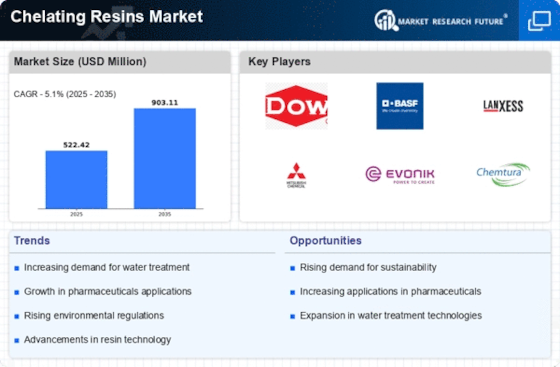
As per Market Research Future analysis, the Chelating Resins Market Size was estimated at 522.42 USD Million in 2024. The Chelating Resins industry is projected to grow from USD 549.07 Million in 2025 to USD 903.11 Million by 2035, exhibiting a compound annual growth rate (CAGR) of 5.1% during the forecast period 2025 - 2035

Key Market Trends & Highlights

The Chelating Resins Market is poised for growth driven by sustainability and technological advancements.

  • North America remains the largest market for chelating resins, reflecting a robust demand across various applications.
  • The Asia-Pacific region is emerging as the fastest-growing market, fueled by increasing industrialization and urbanization.
  • Iminodiacetate resins dominate the market, while polyamine resins are witnessing rapid growth due to their versatility.
  • Rising demand in water treatment and expanding applications in pharmaceuticals are key drivers of market expansion.

Market Size & Forecast

2024 Market Size 522.42 (USD Million)
2035 Market Size 903.11 (USD Million)
CAGR (2025 - 2035) 5.1%
Largest Regional Market Share in 2024 Asia Pacific

Major Players

Dow Chemical (US), BASF (DE), Lanxess (DE), Mitsubishi Chemical (JP), Evonik Industries (DE), Chemtura (US), SABIC (SA), ResinTech (US), Thermo Fisher Scientific (US)

Market Trends

The Chelating Resins Market is currently experiencing a notable transformation, driven by increasing demand across various industries such as water treatment, pharmaceuticals, and food processing. These resins, known for their ability to bind metal ions, are becoming essential in applications that require the removal of heavy metals and other contaminants. As environmental regulations tighten, industries are seeking effective solutions to manage waste and ensure compliance, which further propels the adoption of chelating resins. Additionally, advancements in resin technology are enhancing performance characteristics, making these materials more efficient and versatile. Moreover, the growing awareness of sustainability is influencing purchasing decisions, as companies aim to reduce their ecological footprint. The Chelating Resins Market appears poised for growth, with innovations in formulation and application methods likely to expand its reach. As industries evolve, the need for reliable and effective chelating agents will remain a priority, suggesting a robust future for this market segment. The interplay between regulatory pressures and technological advancements may shape the trajectory of the Chelating Resins Market in the coming years, indicating a dynamic landscape for stakeholders.

Sustainability Initiatives

The emphasis on sustainable practices is increasingly shaping the Chelating Resins Market. Companies are prioritizing eco-friendly solutions, leading to the development of biodegradable and recyclable resins. This trend reflects a broader commitment to environmental stewardship, as industries seek to minimize their impact on natural resources.

Technological Advancements

Innovations in resin technology are enhancing the performance and efficiency of chelating agents. New formulations are being developed to improve selectivity and binding capacity, which may lead to broader applications across various sectors. This trend indicates a shift towards more specialized and effective solutions.

Regulatory Compliance

Stricter environmental regulations are driving the demand for chelating resins in industries such as water treatment and waste management. Companies are increasingly required to adopt effective methods for contaminant removal, positioning chelating resins as vital components in achieving compliance and ensuring public health.

Chelating Resin Market Market Drivers

Rising Demand in Water Treatment

The Chelating Resins Market is experiencing a notable increase in demand due to the growing need for effective water treatment solutions. As industries and municipalities seek to address water quality issues, chelating resins are becoming essential for removing heavy metals and other contaminants. The market for water treatment chemicals, including chelating agents, is projected to reach USD 50 billion by 2026, indicating a robust growth trajectory. This trend is driven by stricter regulations on water quality and the need for sustainable practices in water management. Consequently, the Chelating Resins Market is poised to benefit from this rising demand, as these resins play a critical role in enhancing the efficiency of water purification processes.

Expanding Applications in Pharmaceuticals

The Chelating Resins Market is witnessing an expansion in applications within the pharmaceutical sector. Chelating resins are utilized for drug formulation, particularly in the removal of metal impurities that can affect drug efficacy and safety. The pharmaceutical industry is projected to grow at a CAGR of 5.5% through 2027, which suggests a corresponding increase in the demand for high-purity chelating resins. As pharmaceutical companies prioritize quality control and regulatory compliance, the role of chelating resins becomes increasingly vital. This trend indicates that the Chelating Resins Market will likely see sustained growth as it aligns with the evolving needs of the pharmaceutical sector.

Technological Innovations in Resin Production

The Chelating Resins Market is benefiting from technological innovations that enhance the production and performance of chelating resins. Advances in polymer chemistry and manufacturing processes are leading to the development of more efficient and effective chelating agents. For instance, the introduction of high-capacity resins has improved the ability to capture and remove metal ions from various solutions. This innovation is particularly relevant in sectors such as mining and metallurgy, where the demand for efficient metal recovery processes is increasing. As these technologies continue to evolve, the Chelating Resins Market is expected to experience growth driven by enhanced product offerings and improved operational efficiencies.

Regulatory Drivers and Compliance Requirements

The Chelating Resins Market is significantly shaped by regulatory drivers and compliance requirements across various sectors. Governments and regulatory bodies are implementing stringent guidelines to control the use of hazardous substances, particularly in industries such as water treatment and pharmaceuticals. Compliance with these regulations often necessitates the use of chelating resins to ensure the safe removal of toxic metals and contaminants. As a result, the market for chelating resins is likely to expand as companies invest in compliant solutions to meet these regulatory standards. This trend underscores the importance of chelating resins in facilitating adherence to environmental and safety regulations, thereby driving growth in the Chelating Resins Market.

Increased Focus on Environmental Sustainability

The Chelating Resins Market is significantly influenced by the heightened focus on environmental sustainability. As industries strive to minimize their ecological footprint, the demand for eco-friendly chelating agents is on the rise. Many companies are transitioning to biodegradable and less toxic alternatives, which is reshaping the market landscape. The global market for green chemicals, which includes sustainable chelating agents, is expected to reach USD 150 billion by 2025. This shift towards sustainability not only enhances the reputation of companies but also aligns with consumer preferences for environmentally responsible products. Thus, the Chelating Resins Market is likely to thrive as it adapts to these changing dynamics.

Market Segment Insights

By Functional Group: Iminodiacetate (Largest) vs. Polyamine (Fastest-Growing)

In the Chelating Resins Market, the functional groups exhibit varied market share distributions, with Iminodiacetate emerging as the largest segment. This group is favored for its efficiency in metal ion extraction across various industries. Other notable segments include Polyamine, Glucamine, and Aminomethyl Phosphoric, which collectively contribute to the growth dynamics of the market. Meanwhile, segments like Thiourea and Sulphydryl are also gaining traction due to their unique functional properties, catering to specialized applications in different sectors. Growth trends in the Chelating Resins Market are influenced by increasing demand for environmentally friendly and effective metal ion removal solutions. The Polyamine segment, in particular, is witnessing rapid growth, driven by its versatility in applications ranging from wastewater management to food processing. As industries focus on sustainability, the adoption of less toxic chelating agents is accelerating, thereby propelling segments like Glucamine and Amino Phosphate Acid into emerging roles within the market.

Iminodiacetate (Dominant) vs. Polyamine (Emerging)

Iminodiacetate is currently the dominant functional group in the Chelating Resins Market, prized for its high binding affinity for various metal ions, making it crucial in applications such as water treatment and mineral recovery. Its effectiveness and efficiency in metal extraction make it a preferred choice across a range of industrial applications. Conversely, the Polyamine group is considered an emerging player in this market. While it is not as established as Iminodiacetate, its growth trajectory is impressive due to its adaptable nature in different chemical environments. Polyamine is increasingly being utilized in innovative applications, leading to a growing recognition of its potential, particularly in sectors focused on sustainable practices. This contrast highlights the traditional dominance of Iminodiacetate alongside the rapid evolution of Polyamine in the competitive landscape.

By Application: Water Treatment (Largest) vs. Mining & Metallurgy (Fastest-Growing)

In the Chelating Resins Market, the application segment is primarily dominated by Water Treatment, which holds the largest share due to its widespread usage in various purification processes. The demand for effective water treatment solutions continues to rise, driven by increasing concerns over water quality and the need for sustainable practices. Following closely, Mining & Metallurgy has emerged as a significant sector, leveraging chelating resins for metal recovery and processing, reflecting an expanding market presence.

Water Treatment: Dominant vs. Mining & Metallurgy: Emerging

Water Treatment stands out as the dominant application for chelating resins, utilized in processes such as ion exchange and heavy metal removal. This segment benefits from stringent regulatory standards regarding water pollution and the growing need for clean water supply. Conversely, Mining & Metallurgy represents an emerging application, where chelating resins play a crucial role in mining processes for extracting valuable metals. The sector is witnessing rapid growth, fueled by advancements in extraction technologies and increasing mining activities globally.

Get more detailed insights about Chelating Resins Market Research Report - Forecast Till 2035

Regional Insights

North America : Innovation and Demand Growth

North America is the largest market for chelating resins, holding approximately 40% of the global market share. The growth is driven by increasing demand in water treatment, pharmaceuticals, and agriculture. Regulatory support for environmental sustainability and water quality improvement further catalyzes market expansion. The U.S. and Canada are the primary contributors, with significant investments in R&D and manufacturing capabilities. The competitive landscape is characterized by the presence of major players such as Dow Chemical, BASF, and Thermo Fisher Scientific. These companies leverage advanced technologies to enhance product performance and meet stringent regulatory requirements. The focus on innovation and sustainability is shaping the market dynamics, with a growing emphasis on eco-friendly chelating agents that align with environmental regulations.

Europe : Regulatory Framework and Innovation

Europe is the second-largest market for chelating resins, accounting for approximately 30% of the global market share. The region's growth is propelled by stringent environmental regulations and a strong focus on sustainable practices. Countries like Germany and France are leading the charge, with increasing investments in water treatment and industrial applications driving demand for chelating agents. The competitive landscape in Europe is robust, featuring key players such as BASF and Lanxess. These companies are actively involved in research and development to innovate new products that comply with EU regulations. The presence of a well-established chemical industry and a commitment to sustainability further enhance the market's growth potential. The European Chemicals Agency emphasizes the importance of safe chemical management, which influences market trends.

Asia-Pacific : Emerging Market Potential

Asia-Pacific is witnessing rapid growth in the chelating resins market, holding approximately 25% of the global market share. The region's expansion is driven by increasing industrialization, urbanization, and rising demand for water treatment solutions. Countries like China and India are at the forefront, with significant investments in infrastructure and environmental management, which are key growth drivers for the market. The competitive landscape is evolving, with local and international players vying for market share. Companies such as Mitsubishi Chemical and Evonik Industries are focusing on expanding their product portfolios to cater to diverse applications. The region's growing awareness of environmental issues and regulatory frameworks is further propelling the demand for innovative chelating solutions that meet local standards, enhancing market dynamics.

Middle East and Africa : Resource-Rich Opportunities

The Middle East and Africa region is emerging as a significant market for chelating resins, accounting for approximately 5% of the global market share. The growth is primarily driven by increasing industrial activities, particularly in oil and gas, and the need for effective water treatment solutions. Countries like Saudi Arabia and South Africa are leading the market, supported by government initiatives aimed at improving water quality and industrial efficiency. The competitive landscape is characterized by a mix of local and international players, with companies like SABIC and ResinTech making notable contributions. The region's focus on sustainable development and environmental regulations is shaping market trends, encouraging investments in innovative chelating technologies. As industries evolve, the demand for high-performance chelating agents is expected to rise, further enhancing market opportunities.

Key Players and Competitive Insights

The Chelating Resins Market is currently characterized by a dynamic competitive landscape, driven by increasing demand across various sectors such as water treatment, pharmaceuticals, and agriculture. Key players are actively engaging in strategies that emphasize innovation, regional expansion, and sustainability. Companies like Dow Chemical (US) and BASF (DE) are focusing on enhancing their product portfolios through research and development, while Lanxess (DE) is pursuing strategic partnerships to bolster its market presence. These collective efforts not only enhance their competitive positioning but also contribute to a more robust market environment, where differentiation is increasingly based on technological advancements and sustainability initiatives.

In terms of business tactics, companies are localizing manufacturing to reduce lead times and optimize supply chains, which appears to be a critical factor in maintaining competitiveness. The Chelating Resins Market is moderately fragmented, with several players vying for market share. However, the influence of major companies is substantial, as they set industry standards and drive innovation. This competitive structure suggests that while there is room for smaller players, the dominance of established firms is likely to shape market dynamics significantly.

In August 2025, Dow Chemical (US) announced the launch of a new line of biodegradable chelating agents aimed at reducing environmental impact. This strategic move not only aligns with global sustainability trends but also positions Dow as a leader in eco-friendly solutions within the chelating resins sector. The introduction of these products is expected to attract environmentally conscious consumers and industries, thereby enhancing Dow's market share.

Similarly, in September 2025, BASF (DE) revealed a partnership with a leading water treatment company to develop advanced chelating resins specifically designed for industrial applications. This collaboration is indicative of BASF's commitment to innovation and its strategic focus on addressing the growing demand for efficient water treatment solutions. By leveraging its technological expertise, BASF is likely to strengthen its competitive edge in the market.

Moreover, in July 2025, Lanxess (DE) expanded its production capacity for chelating resins in response to rising global demand. This expansion not only reflects Lanxess's proactive approach to market opportunities but also underscores the importance of scalability in maintaining competitive advantage. By increasing its output, Lanxess is well-positioned to meet the needs of various industries, thereby solidifying its market position.

As of October 2025, the Chelating Resins Market is witnessing trends that emphasize digitalization, sustainability, and the integration of artificial intelligence in production processes. Strategic alliances are becoming increasingly vital, as companies seek to pool resources and expertise to navigate the complexities of the market. Looking ahead, competitive differentiation is expected to evolve, with a pronounced shift from price-based competition to a focus on innovation, technological advancements, and supply chain reliability. This transition suggests that companies that prioritize these aspects will likely emerge as leaders in the Chelating Resins Market.

Key Companies in the Chelating Resin Market include

Industry Developments

Aug 2021

SARS-Cov-2, the virus that causes COVID-19, has been detected using a new sample preparation method developed by the National Institutes of Health. The approach avoids removing the virus's genetic RNA content, making sample purification potentially easier and saving time and money during testing. The technique was developed in collaboration by researchers from the NIH Clinical Center (CC), the National Eye Institute, and the NIDCR. Chelex 100 resin, a chelating compound developed by the lab supply company Bio-Rad, was used to preserve SARS-CoV-2 RNA in samples for detection by RT-qPCR.

Report Overview 

The Chelating Resin Market Outlook shows a comprehensive market value chain analysis. It will assist the market for better products and provide a detailed understanding of the competency of each factor involved in the market. The market's attractiveness is provided in the report to measure the potential value of the market, which also implies the business strategies of the market with the latest growth opportunity. The report on the Chelating Resin Market also classifies the market into several segments based on products application and usage. The segments provide detail of the market estimation with the region-wise research.

Primary and secondary research methodology is used in the market to determine the estimation of the market growth in the forecast period. Many sources are used while the research and the information predicted in the market report will improve the market stage globally and will have a positive impact on the Chelating Resin Market.

Key industrial segments 

By Functional Group

  • Iminodiacetate
  • Polyamine
  • Glucamine
  • Thiourea
  • Amino Phosphate Acid
  • Sulphydryl
  • Fluoride Selective
  • Aminomethyl Phosphoric
  • Others

By Application

  • Water Treatment
  • Mining & Metallurgy
  • Pharmaceuticals
  • Food & Beverages
  • Others

Future Outlook

Chelating Resin Market Future Outlook

The Chelating Resins Market is projected to grow at a 5.1% CAGR from 2025 to 2035, driven by increasing demand in water treatment, pharmaceuticals, and agriculture.

New opportunities lie in:

  • Development of specialized chelating resins for heavy metal removal in industrial wastewater.
  • Expansion into emerging markets with tailored product offerings for local industries.
  • Investment in R&D for innovative applications in biomedicine and food processing.

By 2035, the Chelating Resins Market is expected to achieve robust growth, reflecting evolving industry needs.

Market Segmentation

Chelating Resin Market Application Outlook

  • Water Treatment
  • Mining & Metallurgy
  • Pharmaceuticals
  • Food & Beverages
  • Others

Chelating Resin Market Functional Group Outlook

  • Iminodiacetate
  • Polyamine
  • Glucamine
  • Thiourea
  • Amino Phosphate Acid
  • Sulphydryl
  • Fluoride Selective
  • Aminomethyl Phosphoric
  • Others

Report Scope

MARKET SIZE 2024 522.42(USD Million)
MARKET SIZE 2025 549.07(USD Million)
MARKET SIZE 2035 903.11(USD Million)
COMPOUND ANNUAL GROWTH RATE (CAGR) 5.1% (2025 - 2035)
REPORT COVERAGE Revenue Forecast, Competitive Landscape, Growth Factors, and Trends
BASE YEAR 2024
Market Forecast Period 2025 - 2035
Historical Data 2019 - 2024
Market Forecast Units USD Million
Key Companies Profiled Dow Chemical (US), BASF (DE), Lanxess (DE), Mitsubishi Chemical (JP), Evonik Industries (DE), Chemtura (US), SABIC (SA), ResinTech (US), Thermo Fisher Scientific (US)
Segments Covered Functional Group, Application
Key Market Opportunities Growing demand for sustainable water treatment solutions drives innovation in the Chelating Resins Market.
Key Market Dynamics Rising demand for sustainable solutions drives innovation and competition in the chelating resins market.
Countries Covered North America, Europe, APAC, South America, MEA

FAQs

What is the projected market valuation of the Chelating Resins Market by 2035?

<p>The Chelating Resins Market is projected to reach approximately 903.11 USD Million by 2035.</p>

What was the market valuation of Chelating Resins in 2024?

<p>In 2024, the Chelating Resins Market was valued at 522.42 USD Million.</p>

What is the expected CAGR for the Chelating Resins Market during the forecast period 2025 - 2035?

<p>The expected CAGR for the Chelating Resins Market during the forecast period 2025 - 2035 is 5.1%.</p>

Which application segment holds the highest valuation in the Chelating Resins Market?

<p>The Water Treatment application segment holds the highest valuation, ranging from 150.0 to 250.0 USD Million.</p>

What are the key players in the Chelating Resins Market?

<p>Key players in the Chelating Resins Market include Dow Chemical, BASF, Lanxess, and Mitsubishi Chemical.</p>

How does the Iminodiacetate segment perform in terms of market valuation?

<p>The Iminodiacetate segment has a market valuation ranging from 80.0 to 140.0 USD Million.</p>

What is the projected growth trend for the Mining & Metallurgy application segment?

The Mining &amp; Metallurgy application segment is projected to have a valuation between 120.0 and 200.0 USD Million.

What is the valuation range for the Aminomethyl Phosphoric segment?

The Aminomethyl Phosphoric segment has a valuation range of 15.0 to 30.0 USD Million.

Which company is a notable player in the Chelating Resins Market focused on scientific applications?

Thermo Fisher Scientific is a notable player in the Chelating Resins Market, particularly in scientific applications.

What is the valuation range for the Others segment in the By Application category?

The Others segment in the By Application category has a valuation range of 72.42 to 173.11 USD Million.

  1. SECTION I: EXECUTIVE SUMMARY AND KEY HIGHLIGHTS
    1. | 1.1 EXECUTIVE SUMMARY
    2. | | 1.1.1 Market Overview
    3. | | 1.1.2 Key Findings
    4. | | 1.1.3 Market Segmentation
    5. | | 1.1.4 Competitive Landscape
    6. | | 1.1.5 Challenges and Opportunities
    7. | | 1.1.6 Future Outlook
  2. SECTION II: SCOPING, METHODOLOGY AND MARKET STRUCTURE
    1. | 2.1 MARKET INTRODUCTION
    2. | | 2.1.1 Definition
    3. | | 2.1.2 Scope of the study
    4. | | | 2.1.2.1 Research Objective
    5. | | | 2.1.2.2 Assumption
    6. | | | 2.1.2.3 Limitations
    7. | 2.2 RESEARCH METHODOLOGY
    8. | | 2.2.1 Overview
    9. | | 2.2.2 Data Mining
    10. | | 2.2.3 Secondary Research
    11. | | 2.2.4 Primary Research
    12. | | | 2.2.4.1 Primary Interviews and Information Gathering Process
    13. | | | 2.2.4.2 Breakdown of Primary Respondents
    14. | | 2.2.5 Forecasting Model
    15. | | 2.2.6 Market Size Estimation
    16. | | | 2.2.6.1 Bottom-Up Approach
    17. | | | 2.2.6.2 Top-Down Approach
    18. | | 2.2.7 Data Triangulation
    19. | | 2.2.8 Validation
  3. SECTION III: QUALITATIVE ANALYSIS
    1. | 3.1 MARKET DYNAMICS
    2. | | 3.1.1 Overview
    3. | | 3.1.2 Drivers
    4. | | 3.1.3 Restraints
    5. | | 3.1.4 Opportunities
    6. | 3.2 MARKET FACTOR ANALYSIS
    7. | | 3.2.1 Value chain Analysis
    8. | | 3.2.2 Porter's Five Forces Analysis
    9. | | | 3.2.2.1 Bargaining Power of Suppliers
    10. | | | 3.2.2.2 Bargaining Power of Buyers
    11. | | | 3.2.2.3 Threat of New Entrants
    12. | | | 3.2.2.4 Threat of Substitutes
    13. | | | 3.2.2.5 Intensity of Rivalry
    14. | | 3.2.3 COVID-19 Impact Analysis
    15. | | | 3.2.3.1 Market Impact Analysis
    16. | | | 3.2.3.2 Regional Impact
    17. | | | 3.2.3.3 Opportunity and Threat Analysis
  4. SECTION IV: QUANTITATIVE ANALYSIS
    1. | 4.1 Chemicals and Materials, BY Functional Group (USD Million)
    2. | | 4.1.1 Iminodiacetate
    3. | | 4.1.2 Polyamine
    4. | | 4.1.3 Glucamine
    5. | | 4.1.4 Thiourea
    6. | | 4.1.5 Amino Phosphate Acid
    7. | | 4.1.6 Sulphydryl
    8. | | 4.1.7 Fluoride Selective
    9. | | 4.1.8 Aminomethyl Phosphoric
    10. | | 4.1.9 Others
    11. | 4.2 Chemicals and Materials, BY Application (USD Million)
    12. | | 4.2.1 Water Treatment
    13. | | 4.2.2 Mining & Metallurgy
    14. | | 4.2.3 Pharmaceuticals
    15. | | 4.2.4 Food & Beverages
    16. | | 4.2.5 Others
    17. | 4.3 Chemicals and Materials, BY Region (USD Million)
    18. | | 4.3.1 North America
    19. | | | 4.3.1.1 US
    20. | | | 4.3.1.2 Canada
    21. | | 4.3.2 Europe
    22. | | | 4.3.2.1 Germany
    23. | | | 4.3.2.2 UK
    24. | | | 4.3.2.3 France
    25. | | | 4.3.2.4 Russia
    26. | | | 4.3.2.5 Italy
    27. | | | 4.3.2.6 Spain
    28. | | | 4.3.2.7 Rest of Europe
    29. | | 4.3.3 APAC
    30. | | | 4.3.3.1 China
    31. | | | 4.3.3.2 India
    32. | | | 4.3.3.3 Japan
    33. | | | 4.3.3.4 South Korea
    34. | | | 4.3.3.5 Malaysia
    35. | | | 4.3.3.6 Thailand
    36. | | | 4.3.3.7 Indonesia
    37. | | | 4.3.3.8 Rest of APAC
    38. | | 4.3.4 South America
    39. | | | 4.3.4.1 Brazil
    40. | | | 4.3.4.2 Mexico
    41. | | | 4.3.4.3 Argentina
    42. | | | 4.3.4.4 Rest of South America
    43. | | 4.3.5 MEA
    44. | | | 4.3.5.1 GCC Countries
    45. | | | 4.3.5.2 South Africa
    46. | | | 4.3.5.3 Rest of MEA
  5. SECTION V: COMPETITIVE ANALYSIS
    1. | 5.1 Competitive Landscape
    2. | | 5.1.1 Overview
    3. | | 5.1.2 Competitive Analysis
    4. | | 5.1.3 Market share Analysis
    5. | | 5.1.4 Major Growth Strategy in the Chemicals and Materials
    6. | | 5.1.5 Competitive Benchmarking
    7. | | 5.1.6 Leading Players in Terms of Number of Developments in the Chemicals and Materials
    8. | | 5.1.7 Key developments and growth strategies
    9. | | | 5.1.7.1 New Product Launch/Service Deployment
    10. | | | 5.1.7.2 Merger & Acquisitions
    11. | | | 5.1.7.3 Joint Ventures
    12. | | 5.1.8 Major Players Financial Matrix
    13. | | | 5.1.8.1 Sales and Operating Income
    14. | | | 5.1.8.2 Major Players R&D Expenditure. 2023
    15. | 5.2 Company Profiles
    16. | | 5.2.1 Dow Chemical (US)
    17. | | | 5.2.1.1 Financial Overview
    18. | | | 5.2.1.2 Products Offered
    19. | | | 5.2.1.3 Key Developments
    20. | | | 5.2.1.4 SWOT Analysis
    21. | | | 5.2.1.5 Key Strategies
    22. | | 5.2.2 BASF (DE)
    23. | | | 5.2.2.1 Financial Overview
    24. | | | 5.2.2.2 Products Offered
    25. | | | 5.2.2.3 Key Developments
    26. | | | 5.2.2.4 SWOT Analysis
    27. | | | 5.2.2.5 Key Strategies
    28. | | 5.2.3 Lanxess (DE)
    29. | | | 5.2.3.1 Financial Overview
    30. | | | 5.2.3.2 Products Offered
    31. | | | 5.2.3.3 Key Developments
    32. | | | 5.2.3.4 SWOT Analysis
    33. | | | 5.2.3.5 Key Strategies
    34. | | 5.2.4 Mitsubishi Chemical (JP)
    35. | | | 5.2.4.1 Financial Overview
    36. | | | 5.2.4.2 Products Offered
    37. | | | 5.2.4.3 Key Developments
    38. | | | 5.2.4.4 SWOT Analysis
    39. | | | 5.2.4.5 Key Strategies
    40. | | 5.2.5 Evonik Industries (DE)
    41. | | | 5.2.5.1 Financial Overview
    42. | | | 5.2.5.2 Products Offered
    43. | | | 5.2.5.3 Key Developments
    44. | | | 5.2.5.4 SWOT Analysis
    45. | | | 5.2.5.5 Key Strategies
    46. | | 5.2.6 Chemtura (US)
    47. | | | 5.2.6.1 Financial Overview
    48. | | | 5.2.6.2 Products Offered
    49. | | | 5.2.6.3 Key Developments
    50. | | | 5.2.6.4 SWOT Analysis
    51. | | | 5.2.6.5 Key Strategies
    52. | | 5.2.7 SABIC (SA)
    53. | | | 5.2.7.1 Financial Overview
    54. | | | 5.2.7.2 Products Offered
    55. | | | 5.2.7.3 Key Developments
    56. | | | 5.2.7.4 SWOT Analysis
    57. | | | 5.2.7.5 Key Strategies
    58. | | 5.2.8 ResinTech (US)
    59. | | | 5.2.8.1 Financial Overview
    60. | | | 5.2.8.2 Products Offered
    61. | | | 5.2.8.3 Key Developments
    62. | | | 5.2.8.4 SWOT Analysis
    63. | | | 5.2.8.5 Key Strategies
    64. | | 5.2.9 Thermo Fisher Scientific (US)
    65. | | | 5.2.9.1 Financial Overview
    66. | | | 5.2.9.2 Products Offered
    67. | | | 5.2.9.3 Key Developments
    68. | | | 5.2.9.4 SWOT Analysis
    69. | | | 5.2.9.5 Key Strategies
    70. | 5.3 Appendix
    71. | | 5.3.1 References
    72. | | 5.3.2 Related Reports
  6. LIST OF FIGURES
    1. | 6.1 MARKET SYNOPSIS
    2. | 6.2 NORTH AMERICA MARKET ANALYSIS
    3. | 6.3 US MARKET ANALYSIS BY FUNCTIONAL GROUP
    4. | 6.4 US MARKET ANALYSIS BY APPLICATION
    5. | 6.5 CANADA MARKET ANALYSIS BY FUNCTIONAL GROUP
    6. | 6.6 CANADA MARKET ANALYSIS BY APPLICATION
    7. | 6.7 EUROPE MARKET ANALYSIS
    8. | 6.8 GERMANY MARKET ANALYSIS BY FUNCTIONAL GROUP
    9. | 6.9 GERMANY MARKET ANALYSIS BY APPLICATION
    10. | 6.10 UK MARKET ANALYSIS BY FUNCTIONAL GROUP
    11. | 6.11 UK MARKET ANALYSIS BY APPLICATION
    12. | 6.12 FRANCE MARKET ANALYSIS BY FUNCTIONAL GROUP
    13. | 6.13 FRANCE MARKET ANALYSIS BY APPLICATION
    14. | 6.14 RUSSIA MARKET ANALYSIS BY FUNCTIONAL GROUP
    15. | 6.15 RUSSIA MARKET ANALYSIS BY APPLICATION
    16. | 6.16 ITALY MARKET ANALYSIS BY FUNCTIONAL GROUP
    17. | 6.17 ITALY MARKET ANALYSIS BY APPLICATION
    18. | 6.18 SPAIN MARKET ANALYSIS BY FUNCTIONAL GROUP
    19. | 6.19 SPAIN MARKET ANALYSIS BY APPLICATION
    20. | 6.20 REST OF EUROPE MARKET ANALYSIS BY FUNCTIONAL GROUP
    21. | 6.21 REST OF EUROPE MARKET ANALYSIS BY APPLICATION
    22. | 6.22 APAC MARKET ANALYSIS
    23. | 6.23 CHINA MARKET ANALYSIS BY FUNCTIONAL GROUP
    24. | 6.24 CHINA MARKET ANALYSIS BY APPLICATION
    25. | 6.25 INDIA MARKET ANALYSIS BY FUNCTIONAL GROUP
    26. | 6.26 INDIA MARKET ANALYSIS BY APPLICATION
    27. | 6.27 JAPAN MARKET ANALYSIS BY FUNCTIONAL GROUP
    28. | 6.28 JAPAN MARKET ANALYSIS BY APPLICATION
    29. | 6.29 SOUTH KOREA MARKET ANALYSIS BY FUNCTIONAL GROUP
    30. | 6.30 SOUTH KOREA MARKET ANALYSIS BY APPLICATION
    31. | 6.31 MALAYSIA MARKET ANALYSIS BY FUNCTIONAL GROUP
    32. | 6.32 MALAYSIA MARKET ANALYSIS BY APPLICATION
    33. | 6.33 THAILAND MARKET ANALYSIS BY FUNCTIONAL GROUP
    34. | 6.34 THAILAND MARKET ANALYSIS BY APPLICATION
    35. | 6.35 INDONESIA MARKET ANALYSIS BY FUNCTIONAL GROUP
    36. | 6.36 INDONESIA MARKET ANALYSIS BY APPLICATION
    37. | 6.37 REST OF APAC MARKET ANALYSIS BY FUNCTIONAL GROUP
    38. | 6.38 REST OF APAC MARKET ANALYSIS BY APPLICATION
    39. | 6.39 SOUTH AMERICA MARKET ANALYSIS
    40. | 6.40 BRAZIL MARKET ANALYSIS BY FUNCTIONAL GROUP
    41. | 6.41 BRAZIL MARKET ANALYSIS BY APPLICATION
    42. | 6.42 MEXICO MARKET ANALYSIS BY FUNCTIONAL GROUP
    43. | 6.43 MEXICO MARKET ANALYSIS BY APPLICATION
    44. | 6.44 ARGENTINA MARKET ANALYSIS BY FUNCTIONAL GROUP
    45. | 6.45 ARGENTINA MARKET ANALYSIS BY APPLICATION
    46. | 6.46 REST OF SOUTH AMERICA MARKET ANALYSIS BY FUNCTIONAL GROUP
    47. | 6.47 REST OF SOUTH AMERICA MARKET ANALYSIS BY APPLICATION
    48. | 6.48 MEA MARKET ANALYSIS
    49. | 6.49 GCC COUNTRIES MARKET ANALYSIS BY FUNCTIONAL GROUP
    50. | 6.50 GCC COUNTRIES MARKET ANALYSIS BY APPLICATION
    51. | 6.51 SOUTH AFRICA MARKET ANALYSIS BY FUNCTIONAL GROUP
    52. | 6.52 SOUTH AFRICA MARKET ANALYSIS BY APPLICATION
    53. | 6.53 REST OF MEA MARKET ANALYSIS BY FUNCTIONAL GROUP
    54. | 6.54 REST OF MEA MARKET ANALYSIS BY APPLICATION
    55. | 6.55 KEY BUYING CRITERIA OF CHEMICALS AND MATERIALS
    56. | 6.56 RESEARCH PROCESS OF MRFR
    57. | 6.57 DRO ANALYSIS OF CHEMICALS AND MATERIALS
    58. | 6.58 DRIVERS IMPACT ANALYSIS: CHEMICALS AND MATERIALS
    59. | 6.59 RESTRAINTS IMPACT ANALYSIS: CHEMICALS AND MATERIALS
    60. | 6.60 SUPPLY / VALUE CHAIN: CHEMICALS AND MATERIALS
    61. | 6.61 CHEMICALS AND MATERIALS, BY FUNCTIONAL GROUP, 2024 (% SHARE)
    62. | 6.62 CHEMICALS AND MATERIALS, BY FUNCTIONAL GROUP, 2024 TO 2035 (USD Million)
    63. | 6.63 CHEMICALS AND MATERIALS, BY APPLICATION, 2024 (% SHARE)
    64. | 6.64 CHEMICALS AND MATERIALS, BY APPLICATION, 2024 TO 2035 (USD Million)
    65. | 6.65 BENCHMARKING OF MAJOR COMPETITORS
  7. LIST OF TABLES
    1. | 7.1 LIST OF ASSUMPTIONS
    2. | | 7.1.1
    3. | 7.2 North America MARKET SIZE ESTIMATES; FORECAST
    4. | | 7.2.1 BY FUNCTIONAL GROUP, 2025-2035 (USD Million)
    5. | | 7.2.2 BY APPLICATION, 2025-2035 (USD Million)
    6. | 7.3 US MARKET SIZE ESTIMATES; FORECAST
    7. | | 7.3.1 BY FUNCTIONAL GROUP, 2025-2035 (USD Million)
    8. | | 7.3.2 BY APPLICATION, 2025-2035 (USD Million)
    9. | 7.4 Canada MARKET SIZE ESTIMATES; FORECAST
    10. | | 7.4.1 BY FUNCTIONAL GROUP, 2025-2035 (USD Million)
    11. | | 7.4.2 BY APPLICATION, 2025-2035 (USD Million)
    12. | 7.5 Europe MARKET SIZE ESTIMATES; FORECAST
    13. | | 7.5.1 BY FUNCTIONAL GROUP, 2025-2035 (USD Million)
    14. | | 7.5.2 BY APPLICATION, 2025-2035 (USD Million)
    15. | 7.6 Germany MARKET SIZE ESTIMATES; FORECAST
    16. | | 7.6.1 BY FUNCTIONAL GROUP, 2025-2035 (USD Million)
    17. | | 7.6.2 BY APPLICATION, 2025-2035 (USD Million)
    18. | 7.7 UK MARKET SIZE ESTIMATES; FORECAST
    19. | | 7.7.1 BY FUNCTIONAL GROUP, 2025-2035 (USD Million)
    20. | | 7.7.2 BY APPLICATION, 2025-2035 (USD Million)
    21. | 7.8 France MARKET SIZE ESTIMATES; FORECAST
    22. | | 7.8.1 BY FUNCTIONAL GROUP, 2025-2035 (USD Million)
    23. | | 7.8.2 BY APPLICATION, 2025-2035 (USD Million)
    24. | 7.9 Russia MARKET SIZE ESTIMATES; FORECAST
    25. | | 7.9.1 BY FUNCTIONAL GROUP, 2025-2035 (USD Million)
    26. | | 7.9.2 BY APPLICATION, 2025-2035 (USD Million)
    27. | 7.10 Italy MARKET SIZE ESTIMATES; FORECAST
    28. | | 7.10.1 BY FUNCTIONAL GROUP, 2025-2035 (USD Million)
    29. | | 7.10.2 BY APPLICATION, 2025-2035 (USD Million)
    30. | 7.11 Spain MARKET SIZE ESTIMATES; FORECAST
    31. | | 7.11.1 BY FUNCTIONAL GROUP, 2025-2035 (USD Million)
    32. | | 7.11.2 BY APPLICATION, 2025-2035 (USD Million)
    33. | 7.12 Rest of Europe MARKET SIZE ESTIMATES; FORECAST
    34. | | 7.12.1 BY FUNCTIONAL GROUP, 2025-2035 (USD Million)
    35. | | 7.12.2 BY APPLICATION, 2025-2035 (USD Million)
    36. | 7.13 APAC MARKET SIZE ESTIMATES; FORECAST
    37. | | 7.13.1 BY FUNCTIONAL GROUP, 2025-2035 (USD Million)
    38. | | 7.13.2 BY APPLICATION, 2025-2035 (USD Million)
    39. | 7.14 China MARKET SIZE ESTIMATES; FORECAST
    40. | | 7.14.1 BY FUNCTIONAL GROUP, 2025-2035 (USD Million)
    41. | | 7.14.2 BY APPLICATION, 2025-2035 (USD Million)
    42. | 7.15 India MARKET SIZE ESTIMATES; FORECAST
    43. | | 7.15.1 BY FUNCTIONAL GROUP, 2025-2035 (USD Million)
    44. | | 7.15.2 BY APPLICATION, 2025-2035 (USD Million)
    45. | 7.16 Japan MARKET SIZE ESTIMATES; FORECAST
    46. | | 7.16.1 BY FUNCTIONAL GROUP, 2025-2035 (USD Million)
    47. | | 7.16.2 BY APPLICATION, 2025-2035 (USD Million)
    48. | 7.17 South Korea MARKET SIZE ESTIMATES; FORECAST
    49. | | 7.17.1 BY FUNCTIONAL GROUP, 2025-2035 (USD Million)
    50. | | 7.17.2 BY APPLICATION, 2025-2035 (USD Million)
    51. | 7.18 Malaysia MARKET SIZE ESTIMATES; FORECAST
    52. | | 7.18.1 BY FUNCTIONAL GROUP, 2025-2035 (USD Million)
    53. | | 7.18.2 BY APPLICATION, 2025-2035 (USD Million)
    54. | 7.19 Thailand MARKET SIZE ESTIMATES; FORECAST
    55. | | 7.19.1 BY FUNCTIONAL GROUP, 2025-2035 (USD Million)
    56. | | 7.19.2 BY APPLICATION, 2025-2035 (USD Million)
    57. | 7.20 Indonesia MARKET SIZE ESTIMATES; FORECAST
    58. | | 7.20.1 BY FUNCTIONAL GROUP, 2025-2035 (USD Million)
    59. | | 7.20.2 BY APPLICATION, 2025-2035 (USD Million)
    60. | 7.21 Rest of APAC MARKET SIZE ESTIMATES; FORECAST
    61. | | 7.21.1 BY FUNCTIONAL GROUP, 2025-2035 (USD Million)
    62. | | 7.21.2 BY APPLICATION, 2025-2035 (USD Million)
    63. | 7.22 South America MARKET SIZE ESTIMATES; FORECAST
    64. | | 7.22.1 BY FUNCTIONAL GROUP, 2025-2035 (USD Million)
    65. | | 7.22.2 BY APPLICATION, 2025-2035 (USD Million)
    66. | 7.23 Brazil MARKET SIZE ESTIMATES; FORECAST
    67. | | 7.23.1 BY FUNCTIONAL GROUP, 2025-2035 (USD Million)
    68. | | 7.23.2 BY APPLICATION, 2025-2035 (USD Million)
    69. | 7.24 Mexico MARKET SIZE ESTIMATES; FORECAST
    70. | | 7.24.1 BY FUNCTIONAL GROUP, 2025-2035 (USD Million)
    71. | | 7.24.2 BY APPLICATION, 2025-2035 (USD Million)
    72. | 7.25 Argentina MARKET SIZE ESTIMATES; FORECAST
    73. | | 7.25.1 BY FUNCTIONAL GROUP, 2025-2035 (USD Million)
    74. | | 7.25.2 BY APPLICATION, 2025-2035 (USD Million)
    75. | 7.26 Rest of South America MARKET SIZE ESTIMATES; FORECAST
    76. | | 7.26.1 BY FUNCTIONAL GROUP, 2025-2035 (USD Million)
    77. | | 7.26.2 BY APPLICATION, 2025-2035 (USD Million)
    78. | 7.27 MEA MARKET SIZE ESTIMATES; FORECAST
    79. | | 7.27.1 BY FUNCTIONAL GROUP, 2025-2035 (USD Million)
    80. | | 7.27.2 BY APPLICATION, 2025-2035 (USD Million)
    81. | 7.28 GCC Countries MARKET SIZE ESTIMATES; FORECAST
    82. | | 7.28.1 BY FUNCTIONAL GROUP, 2025-2035 (USD Million)
    83. | | 7.28.2 BY APPLICATION, 2025-2035 (USD Million)
    84. | 7.29 South Africa MARKET SIZE ESTIMATES; FORECAST
    85. | | 7.29.1 BY FUNCTIONAL GROUP, 2025-2035 (USD Million)
    86. | | 7.29.2 BY APPLICATION, 2025-2035 (USD Million)
    87. | 7.30 Rest of MEA MARKET SIZE ESTIMATES; FORECAST
    88. | | 7.30.1 BY FUNCTIONAL GROUP, 2025-2035 (USD Million)
    89. | | 7.30.2 BY APPLICATION, 2025-2035 (USD Million)
    90. | 7.31 PRODUCT LAUNCH/PRODUCT DEVELOPMENT/APPROVAL
    91. | | 7.31.1
    92. | 7.32 ACQUISITION/PARTNERSHIP
    93. | | 7.32.1

Chemicals and Materials Market Segmentation

Chemicals and Materials By Functional Group (USD Million, 2025-2035)

  • Iminodiacetate
  • Polyamine
  • Glucamine
  • Thiourea
  • Amino Phosphate Acid
  • Sulphydryl
  • Fluoride Selective
  • Aminomethyl Phosphoric
  • Others

Chemicals and Materials By Application (USD Million, 2025-2035)

  • Water Treatment
  • Mining & Metallurgy
  • Pharmaceuticals
  • Food & Beverages
  • Others
Infographic

Free Sample Request

Kindly complete the form below to receive a free sample of this Report

Get Free Sample

Customer Strories

Compare Licence

×
Features License Type
Single User Multiuser License Enterprise User
Price $4,950 $5,950 $7,250
Maximum User Access Limit 1 User Upto 10 Users Unrestricted Access Throughout the Organization
Free Customization
Direct Access to Analyst
Deliverable Format
Platform Access
Discount on Next Purchase 10% 15% 15%
Printable Versions
%>