Request Free Sample ×

Kindly complete the form below to receive a free sample of this Report

* Please use a valid business email

Leading companies partner with us for data-driven Insights

clients tt-cursor
Hero Background
English
Chinese
French
Japanese
Korean
German
Spanish

Cerebral Vascular Stent Market Share

ID: MRFR/MED/7675-HCR
120 Pages
Satyendra Maurya
Last Updated: April 06, 2026

Cerebral Vascular Stent Market Research Report Information by Product (Tantalum, Stainless Steel, Nitinol), End User (Hospital and Ambulatory Surgery Centers) and Region (North America, Europe, Asia-Pacific, and Rest of the World) - Forecast till 2035

Share:
Download PDF ×

We do not share your information with anyone. However, we may send you emails based on your report interest from time to time. You may contact us at any time to opt-out.

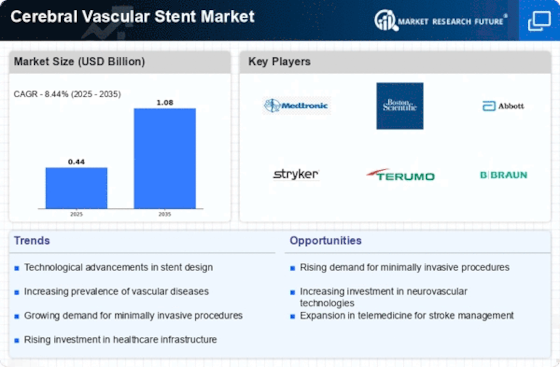
Cerebral Vascular Stent Market Infographic
Purchase Options

Market Share

Cerebral Vascular Stent Market Share Analysis

The Cerebral Vascular Stent market is essential to the medical device industry since it treats cerebrovascular diseases. More people are having strokes and aneurysms, thus market participants are employing different methods to remain ahead.

Market share is a company's share of industry sales. Cerebral Vascular Stent companies are striving for market share to lead and establish trends. To compete, companies invest much in R&D. New stent design, materials, and implantation procedures attract doctors and patients, increasing market share. Some companies call this "cost leadership." By using economies of scale and optimising production, they can offer low prices that healthcare providers will like, helping them gain market share. Market leaders employ global approaches to enter new markets. Companies can gain market share by opening in cerebrovascular disease hotspots. Collaboration with study groups, healthcare institutes, or similar enterprises can be wise. Partnerships make sharing resources, knowledge, and market insights simpler, helping a firm compete. Healthcare staff must follow tight regulatory requirements and prioritize quality assurance to earn patient confidence. Stent manufacturers with good performance and safety are more likely to dominate the market. Marketing and branding must strive to develop market trust and awareness. Companies train medical professionals, attend medical conferences, and undertake targeted advertising efforts to boost their brand image and market share. Companies are developing customizable patient solutions. Stents that may be customized for each patient might increase market share. Monitoring a product's performance after release is crucial. Healthcare companies that aggressively solicit and use consumer and employee input may swiftly adjust, retaining and expanding market share. Pricing is a major market share determinant. Companies may employ discounts or service packages to gain market share. Teaching doctors about brain vascular stent advantages and proper usage is crucial. Companies that invest in training and teaching tools develop the market and gain share.

Author
Author Profile
Satyendra Maurya
Research Analyst

An accomplished research analyst with high proficiency in market forecasting, data visualization, competitive benchmarking, and others. He holds a pronounced track record in research and consulting projects for sectors such as life sciences, medical devices, and healthcare IT. His capabilities in qualitative and quantitative analysis have resulted in positive client outcomes. Working on niche market trends, opportunities, sales, and forecasted value is part of his skill set.

Leave a Comment

FAQs

What is the current valuation of the Cerebral Vascular Stent Market?

<p>As of 2024, the Cerebral Vascular Stent Market was valued at 0.4446 USD Billion.</p>

What is the projected market size for the Cerebral Vascular Stent Market in 2035?

<p>The market is projected to reach 1.084 USD Billion by 2035.</p>

What is the expected CAGR for the Cerebral Vascular Stent Market from 2025 to 2035?

<p>The expected CAGR during the forecast period 2025 - 2035 is 8.44%.</p>

Which companies are the key players in the Cerebral Vascular Stent Market?

<p>Key players include Medtronic, Boston Scientific, Abbott Laboratories, Stryker Corporation, Terumo Corporation, B. Braun Melsungen AG, Johnson & Johnson, and MicroPort Scientific Corporation.</p>

What are the main types of materials used in cerebral vascular stents?

The primary materials include Tantalum, Stainless Steel, and Nitinol, with projected valuations of 0.3208 USD Billion for Tantalum and Stainless Steel, and 0.4434 USD Billion for Nitinol by 2035.

What are the primary end-user segments for cerebral vascular stents?

The main end-user segments are Hospitals and Ambulatory Surgical Centers, with projected valuations of 0.6468 USD Billion and 0.4372 USD Billion respectively by 2035.

How has the market for cerebral vascular stents evolved since 2024?

Since 2024, the market has shown a growth trajectory, moving from 0.4446 USD Billion towards a projected 1.084 USD Billion by 2035.

What factors are driving growth in the Cerebral Vascular Stent Market?

Growth appears to be driven by advancements in technology, increasing prevalence of vascular diseases, and the expanding capabilities of key players.

How do the market valuations for different materials compare?

Nitinol is projected to have the highest valuation at 0.4434 USD Billion, followed by Tantalum and Stainless Steel, each at 0.3208 USD Billion by 2035.

What role do hospitals play in the Cerebral Vascular Stent Market?

Hospitals are a significant end-user segment, expected to account for a valuation of 0.6468 USD Billion by 2035.

Market Summary

As per Market Research Future analysis, the Cerebral Vascular Stent Market Size was estimated at 0.4446 USD Billion in 2024. The Cerebral Vascular Stent industry is projected to grow from USD 0.4821 Billion in 2025 to USD 1.084 Billion by 2035, exhibiting a compound annual growth rate (CAGR) of 8.44% during the forecast period 2025 - 2035

Key Market Trends & Highlights

The Cerebral Vascular Stent Market is poised for growth driven by technological advancements and increasing healthcare needs.

  • Technological advancements in stent design are enhancing the efficacy and safety of cerebral vascular interventions. North America remains the largest market, while the Asia-Pacific region is emerging as the fastest-growing area for cerebral vascular stents. Nitinol stents dominate the market, whereas Tantalum stents are witnessing rapid growth due to their unique properties. The rising incidence of cerebrovascular diseases and growing investment in healthcare infrastructure are key drivers propelling market expansion.

Market Size & Forecast

2024 Market Size 0.4446 (USD Billion)
2035 Market Size 1.084 (USD Billion)
CAGR (2025 - 2035) 8.44%
Largest Regional Market Share in 2024 North America

Major Players

Medtronic (US), Boston Scientific (US), Abbott Laboratories (US), Stryker Corporation (US), Terumo Corporation (JP), B. Braun Melsungen AG (DE), Johnson &amp; Johnson (US), MicroPort Scientific Corporation (CN)

Market Trends

The Cerebral Vascular Stent Market is currently experiencing notable advancements driven by technological innovations and an increasing prevalence of cerebrovascular diseases. The integration of advanced materials and design improvements in stent manufacturing appears to enhance the efficacy and safety of these devices. Furthermore, the growing awareness regarding the benefits of minimally invasive procedures is likely to propel the adoption of cerebral vascular stents among healthcare providers. As a result, the market is poised for substantial growth, reflecting a shift towards more effective treatment options for patients suffering from conditions such as aneurysms and stenosis. In addition, the regulatory landscape surrounding medical devices is evolving, which may influence the market dynamics. Regulatory bodies are increasingly focusing on ensuring the safety and effectiveness of cerebral vascular stents, potentially leading to more stringent approval processes. This could create challenges for manufacturers but also encourages innovation and quality improvements. Overall, the Cerebral Vascular Stent Market seems to be on a trajectory of growth, driven by technological advancements, increasing patient awareness, and a supportive regulatory environment.

Technological Advancements

Recent innovations in stent design and materials are enhancing the performance and safety of cerebral vascular stents. These advancements may lead to improved patient outcomes and increased adoption rates.

Rising Incidence of Cerebrovascular Diseases

The growing prevalence of conditions such as stroke and aneurysms is driving demand for cerebral vascular stents. This trend suggests a need for effective treatment options, thereby expanding the market.

Regulatory Changes

Evolving regulations regarding medical devices are impacting the Cerebral Vascular Stent Market. Stricter approval processes may challenge manufacturers but also promote higher standards and innovation.

Cerebral Vascular Stent Market Market Drivers

Regulatory Changes and Approvals

The Cerebral Vascular Stent Market is also shaped by evolving regulatory changes and approvals that facilitate the introduction of new products. Regulatory bodies are increasingly streamlining the approval process for innovative stent technologies, which encourages manufacturers to bring their products to market more efficiently. This trend is particularly evident in regions where regulatory frameworks are adapting to accommodate advancements in medical technology. For instance, the introduction of expedited pathways for breakthrough devices has the potential to accelerate the availability of novel stents. As a result, the market is likely to witness a surge in new product launches, enhancing competition and providing healthcare professionals with a broader range of treatment options. This dynamic environment may ultimately lead to improved patient outcomes and increased market penetration.

Increasing Awareness and Education

The Cerebral Vascular Stent Market is experiencing growth due to increasing awareness and education regarding cerebrovascular health. Public health campaigns and educational initiatives are playing a crucial role in informing individuals about the risks associated with cerebrovascular diseases and the importance of early intervention. As awareness levels rise, more patients are seeking medical attention for symptoms related to strokes and aneurysms, leading to a higher demand for stenting procedures. Additionally, healthcare professionals are being trained to recognize and manage these conditions effectively, further driving the need for cerebral vascular stents. This heightened awareness not only contributes to early diagnosis and treatment but also fosters a more informed patient population that is likely to advocate for advanced medical solutions, thereby positively impacting market growth.

Technological Advancements in Stent Design

The Cerebral Vascular Stent Market is experiencing a notable transformation due to rapid technological advancements in stent design and materials. Innovations such as bioresorbable stents and drug-eluting stents are gaining traction, as they offer improved biocompatibility and reduced risk of restenosis. The introduction of advanced imaging techniques, such as intravascular ultrasound and optical coherence tomography, enhances the precision of stent placement, thereby improving patient outcomes. According to recent data, the market for cerebral vascular stents is projected to grow at a compound annual growth rate of approximately 7.5% over the next five years, driven by these technological innovations. As manufacturers continue to invest in research and development, the potential for enhanced stent performance and patient safety appears promising.

Rising Incidence of Cerebrovascular Diseases

The Cerebral Vascular Stent Market is significantly influenced by the rising incidence of cerebrovascular diseases, including strokes and aneurysms. As the global population ages, the prevalence of these conditions is expected to increase, leading to a higher demand for effective treatment options. Data indicates that stroke is one of the leading causes of death and disability worldwide, with millions affected annually. This alarming trend necessitates the use of cerebral vascular stents to restore blood artery and prevent further complications. Consequently, healthcare providers are increasingly adopting stenting procedures, which is likely to propel market growth. The increasing awareness of cerebrovascular health and the importance of timely intervention further underscores the need for advanced stenting solutions in the market.

Growing Investment in Healthcare Infrastructure

The Cerebral Vascular Stent Market is benefiting from the growing investment in healthcare infrastructure across various regions. Governments and private entities are increasingly allocating resources to enhance healthcare facilities, particularly in developing nations. This investment is aimed at improving access to advanced medical technologies, including cerebral vascular stents. Enhanced healthcare infrastructure not only facilitates the availability of stenting procedures but also promotes awareness and education regarding cerebrovascular diseases. As hospitals and clinics upgrade their facilities and acquire state-of-the-art equipment, the demand for cerebral vascular stents is expected to rise. Furthermore, the establishment of specialized stroke centers is likely to contribute to the growth of the market, as these centers focus on providing timely and effective interventions for patients suffering from cerebrovascular conditions.


Market Segment Insights

By Type: Nitinol (Largest) vs. Tantalum (Fastest-Growing)

In the Cerebral Vascular Stent Market, Nitinol holds the largest market share due to its unique flexibility and biocompatibility, making it the preferred choice among neurosurgeons. Stainless steel, while strong and durable, has seen a decline in preference as newer materials have emerged. Tantalum is gaining traction, particularly for its excellent radiopacity and corrosion resistance, which enhances visibility during procedures, allowing for a more accurate deployment of stents. As the demand for advanced vascular therapies increases, growth trends indicate a shift towards materials that offer superior clinical outcomes. Tantalum, although currently a smaller segment, is experiencing rapid growth driven by increasing procedural adoption and advancements in stent technology. The ongoing research and development in this space are likely to further expand its market presence.

Nitinol (Dominant) vs. Tantalum (Emerging)

Nitinol, a nickel-titanium alloy, is known for its exceptional elasticity and shape memory characteristics, making it ideal for cerebral vascular stents. Its dominance in the market can be attributed to its ability to conform to vessel diameters and its biocompatibility, which minimizes the risk of thrombosis. On the other hand, Tantalum is emerging as a notable competitor, gaining favor for its unique properties, including high radio-opacity that enables improved visualization during imaging procedures. While Tantalum stents are still underutilized, their potential for fewer complications and improved patient outcomes is driving research into their broader application. As technological advancements continue, both materials are poised for impactful roles in the evolving landscape of the Cerebral Vascular Stent Market.

By End User: Hospitals (Largest) vs. Ambulatory Surgical Centers (Fastest-Growing)

In the Cerebral Vascular Stent Market, hospitals hold the largest share as end users due to their comprehensive infrastructure for complex procedures and post-operative care. They are well-equipped with the required technology and skilled personnel to handle a significant volume of stent implantation surgeries. As a result, hospitals remain a key contributor to the market, leveraging their established patient base and extensive resources to provide timely interventions.

End Users: Hospitals (Dominant) vs. Ambulatory Surgical Centers (Emerging)

Hospitals are considered the dominant end user in the Cerebral Vascular Stent Market primarily due to their ability to provide advanced medical care and support for critically ill patients. They can perform intricate procedures, maintain robust patient management systems, and enhance surgical outcomes. Conversely, Ambulatory Surgical Centers are emerging rapidly, driven by their efficiency, reduced hospitalization times, and a growing trend towards outpatient care. These centers are focusing on minimally invasive techniques and patient convenience, appealing to a broader patient demographic seeking effective and quicker treatment options.

Get more detailed insights about Cerebral Vascular Stent Market Research Report - Forecast till 2035

Regional Insights

North America : Market Leader in Innovation

North America is the largest market for cerebral vascular stents, accounting for approximately 45% of the global market share. The region's growth is driven by advanced healthcare infrastructure, increasing prevalence of cerebrovascular diseases, and significant investments in medical technology. Regulatory support from agencies like the FDA further catalyzes innovation and market expansion, ensuring that new products meet stringent safety and efficacy standards. The United States is the primary contributor to this market, with key players such as Medtronic, Boston Scientific, and Abbott Laboratories leading the competitive landscape. These companies are continuously innovating, focusing on developing advanced stent technologies that enhance patient outcomes. The presence of a robust healthcare system and high patient awareness also contribute to the region's market strength.

Europe : Emerging Market with Growth Potential

Europe is witnessing significant growth in the cerebral vascular stent market, holding approximately 30% of the global share. The region benefits from a well-established healthcare system, increasing investments in medical research, and a rising incidence of neurological disorders. Regulatory bodies like the European Medicines Agency (EMA) are actively promoting the development of innovative stent technologies, which is expected to further boost market growth in the coming years. Leading countries in this region include Germany, France, and the UK, where companies like B. Braun Melsungen AG and Terumo Corporation are prominent players. The competitive landscape is characterized by a mix of established firms and emerging startups, all striving to introduce advanced solutions. Collaborative efforts between healthcare providers and manufacturers are also enhancing the market's growth trajectory.

Asia-Pacific : Rapidly Growing Healthcare Sector

The Asia-Pacific region is rapidly emerging as a significant player in the cerebral vascular stent market, accounting for approximately 20% of the global share. Factors driving this growth include rising healthcare expenditures, increasing awareness of cerebrovascular diseases, and a growing aging population. Additionally, supportive government initiatives aimed at improving healthcare access and quality are expected to further stimulate market demand in the coming years. Countries like China and Japan are at the forefront of this growth, with key players such as MicroPort Scientific Corporation and Terumo Corporation leading the market. The competitive landscape is evolving, with both local and international companies vying for market share. Innovations in stent technology and strategic partnerships are common strategies employed to enhance product offerings and meet the growing demand.

Middle East and Africa : Untapped Market Potential

The Middle East and Africa (MEA) region represents an untapped market for cerebral vascular stents, holding approximately 5% of the global market share. The growth in this region is primarily driven by increasing healthcare investments, rising awareness of cerebrovascular diseases, and improving healthcare infrastructure. Governments are focusing on enhancing medical facilities and access to advanced treatments, which is expected to catalyze market growth in the near future. Countries like South Africa and the UAE are leading the way in adopting advanced medical technologies, with a growing presence of international players. The competitive landscape is characterized by a mix of local and global companies, all aiming to capture the emerging opportunities in this market. Collaborations and partnerships are becoming increasingly common as stakeholders seek to enhance their market presence and improve patient outcomes.

Key Players and Competitive Insights

The Cerebral Vascular Stent Market is characterized by a dynamic competitive landscape, driven by technological advancements and an increasing prevalence of cerebrovascular diseases. Key players such as Medtronic (US), Boston Scientific (US), and Abbott Laboratories (US) are at the forefront, each adopting distinct strategies to enhance their market presence. Medtronic (US) focuses on innovation, particularly in developing next-generation stents that incorporate advanced materials and designs aimed at improving patient outcomes. Meanwhile, Boston Scientific (US) emphasizes strategic partnerships and collaborations to expand its product portfolio and market reach, while Abbott Laboratories (US) is investing heavily in digital transformation initiatives to streamline operations and enhance customer engagement. Collectively, these strategies contribute to a competitive environment that is increasingly centered around innovation and technological advancement.

In terms of business tactics, companies are localizing manufacturing and optimizing supply chains to enhance efficiency and reduce costs. The market structure appears moderately fragmented, with several key players exerting significant influence. This fragmentation allows for a variety of competitive strategies, as companies seek to differentiate themselves through unique product offerings and enhanced service capabilities.

In August 2025, Medtronic (US) announced the launch of its latest cerebral stent, which utilizes a novel bioresorbable polymer technology designed to reduce the risk of thrombosis. This strategic move not only positions Medtronic as a leader in innovation but also addresses growing concerns regarding long-term complications associated with traditional stents. The introduction of this product is likely to enhance Medtronic's competitive edge in the market, appealing to both healthcare providers and patients seeking safer alternatives.

In September 2025, Boston Scientific (US) entered into a partnership with a leading telehealth provider to integrate remote monitoring capabilities into its stent offerings. This collaboration aims to enhance patient management post-procedure, potentially improving outcomes and reducing hospital readmissions. By leveraging telehealth technology, Boston Scientific is not only expanding its service offerings but also aligning with current trends towards digital health solutions, which could significantly influence patient care in the cerebral vascular space.

In July 2025, Abbott Laboratories (US) completed the acquisition of a smaller medical device company specializing in advanced imaging technologies for vascular procedures. This acquisition is strategically important as it allows Abbott to enhance its product portfolio and integrate cutting-edge imaging capabilities into its stent systems. Such advancements are likely to improve procedural accuracy and patient outcomes, thereby strengthening Abbott's position in the competitive landscape.

As of October 2025, the Cerebral Vascular Stent Market is witnessing trends that emphasize digitalization, sustainability, and the integration of artificial intelligence in product development and patient management. Strategic alliances are increasingly shaping the competitive landscape, enabling companies to pool resources and expertise to drive innovation. Looking ahead, it appears that competitive differentiation will evolve from traditional price-based competition to a focus on technological innovation, enhanced patient outcomes, and supply chain reliability, reflecting a broader shift in the healthcare industry towards value-based care.

Key Companies in the Cerebral Vascular Stent Market include

Industry Developments

  • In August 2020, Stryker (US) announced that its brain aneurysm stent called Neuroform Atlas receivedFDA approval for posterior circulation use for treating brain aneurysm
  • In August 2020, Synchron (US) announced that that the company received Breakthrough Device designation for Stentrode from the FDA, which is a stent with brain-computer interphase capabilities
  • In March 2020, FDA recalled all Medtronic(Ireland) brain stent products called Pipeline Flex stent citing the products have the potential to fracture during the implantation procedure
  • In December 2019, MicroVention, Inc. (US) received FDA approval for FRED System, a stent system for treatingbrain aneurysm.
  • In May 2019, Stryker(US) announced the FDA approval of its brain aneurysm stent system called Neuroform Atlas
  • In December 2019, MicroVention, Inc.’s (US) FRED® System, a stent system for treating brain aneurysm got approved by FDA

Future Outlook

Cerebral Vascular Stent Market Future Outlook

The Cerebral Vascular Stent Market is projected to grow at an 8.44% CAGR from 2025 to 2035, driven by technological advancements, increasing prevalence of vascular diseases, and rising healthcare expenditure.

New opportunities lie in:

  • Development of bioresorbable stents for enhanced patient outcomes.</p><p>Expansion into emerging markets with tailored product offerings.</p><p>Investment in telemedicine platforms for remote patient monitoring and follow-up.

By 2035, the market is expected to achieve substantial growth, reflecting advancements and increased demand.

Market Segmentation

Cerebral Vascular Stent Market Type Outlook

  • Tantalum
  • Stainless steel
  • Nitinol

Cerebral Vascular Stent Market End User Outlook

  • Hospitals
  • Ambulatory Surgical Centers

Report Scope

MARKET SIZE 2024 0.4446(USD Billion)
MARKET SIZE 2025 0.4821(USD Billion)
MARKET SIZE 2035 1.084(USD Billion)
COMPOUND ANNUAL GROWTH RATE (CAGR) 8.44% (2025 - 2035)
REPORT COVERAGE Revenue Forecast, Competitive Landscape, Growth Factors, and Trends
BASE YEAR 2024
Market Forecast Period 2025 - 2035
Historical Data 2019 - 2024
Market Forecast Units USD Billion
Key Companies Profiled Medtronic (US), Boston Scientific (US), Abbott Laboratories (US), Stryker Corporation (US), Terumo Corporation (JP), B. Braun Melsungen AG (DE), Johnson & Johnson (US), MicroPort Scientific Corporation (CN)
Segments Covered Product
Key Market Opportunities Advancements in biocompatible materials enhance efficacy in the Cerebral Vascular Stent Market.
Key Market Dynamics Technological advancements and regulatory changes are reshaping the competitive landscape of the cerebral vascular stent market.
Countries Covered North America, Europe, APAC, South America, MEA

FAQs

What is the current valuation of the Cerebral Vascular Stent Market?

<p>As of 2024, the Cerebral Vascular Stent Market was valued at 0.4446 USD Billion.</p>

What is the projected market size for the Cerebral Vascular Stent Market in 2035?

<p>The market is projected to reach 1.084 USD Billion by 2035.</p>

What is the expected CAGR for the Cerebral Vascular Stent Market from 2025 to 2035?

<p>The expected CAGR during the forecast period 2025 - 2035 is 8.44%.</p>

Which companies are the key players in the Cerebral Vascular Stent Market?

<p>Key players include Medtronic, Boston Scientific, Abbott Laboratories, Stryker Corporation, Terumo Corporation, B. Braun Melsungen AG, Johnson & Johnson, and MicroPort Scientific Corporation.</p>

What are the main types of materials used in cerebral vascular stents?

The primary materials include Tantalum, Stainless Steel, and Nitinol, with projected valuations of 0.3208 USD Billion for Tantalum and Stainless Steel, and 0.4434 USD Billion for Nitinol by 2035.

What are the primary end-user segments for cerebral vascular stents?

The main end-user segments are Hospitals and Ambulatory Surgical Centers, with projected valuations of 0.6468 USD Billion and 0.4372 USD Billion respectively by 2035.

How has the market for cerebral vascular stents evolved since 2024?

Since 2024, the market has shown a growth trajectory, moving from 0.4446 USD Billion towards a projected 1.084 USD Billion by 2035.

What factors are driving growth in the Cerebral Vascular Stent Market?

Growth appears to be driven by advancements in technology, increasing prevalence of vascular diseases, and the expanding capabilities of key players.

How do the market valuations for different materials compare?

Nitinol is projected to have the highest valuation at 0.4434 USD Billion, followed by Tantalum and Stainless Steel, each at 0.3208 USD Billion by 2035.

What role do hospitals play in the Cerebral Vascular Stent Market?

Hospitals are a significant end-user segment, expected to account for a valuation of 0.6468 USD Billion by 2035.

  1. SECTION I: EXECUTIVE SUMMARY AND KEY HIGHLIGHTS
    1. | 1.1 EXECUTIVE SUMMARY
    2. | | 1.1.1 Market Overview
    3. | | 1.1.2 Key Findings
    4. | | 1.1.3 Market Segmentation
    5. | | 1.1.4 Competitive Landscape
    6. | | 1.1.5 Challenges and Opportunities
    7. | | 1.1.6 Future Outlook
  2. SECTION II: SCOPING, METHODOLOGY AND MARKET STRUCTURE
    1. | 2.1 MARKET INTRODUCTION
    2. | | 2.1.1 Definition
    3. | | 2.1.2 Scope of the study
    4. | | | 2.1.2.1 Research Objective
    5. | | | 2.1.2.2 Assumption
    6. | | | 2.1.2.3 Limitations
    7. | 2.2 RESEARCH METHODOLOGY
    8. | | 2.2.1 Overview
    9. | | 2.2.2 Data Mining
    10. | | 2.2.3 Secondary Research
    11. | | 2.2.4 Primary Research
    12. | | | 2.2.4.1 Primary Interviews and Information Gathering Process
    13. | | | 2.2.4.2 Breakdown of Primary Respondents
    14. | | 2.2.5 Forecasting Model
    15. | | 2.2.6 Market Size Estimation
    16. | | | 2.2.6.1 Bottom-Up Approach
    17. | | | 2.2.6.2 Top-Down Approach
    18. | | 2.2.7 Data Triangulation
    19. | | 2.2.8 Validation
  3. SECTION III: QUALITATIVE ANALYSIS
    1. | 3.1 MARKET DYNAMICS
    2. | | 3.1.1 Overview
    3. | | 3.1.2 Drivers
    4. | | 3.1.3 Restraints
    5. | | 3.1.4 Opportunities
    6. | 3.2 MARKET FACTOR ANALYSIS
    7. | | 3.2.1 Value chain Analysis
    8. | | 3.2.2 Porter's Five Forces Analysis
    9. | | | 3.2.2.1 Bargaining Power of Suppliers
    10. | | | 3.2.2.2 Bargaining Power of Buyers
    11. | | | 3.2.2.3 Threat of New Entrants
    12. | | | 3.2.2.4 Threat of Substitutes
    13. | | | 3.2.2.5 Intensity of Rivalry
    14. | | 3.2.3 COVID-19 Impact Analysis
    15. | | | 3.2.3.1 Market Impact Analysis
    16. | | | 3.2.3.2 Regional Impact
    17. | | | 3.2.3.3 Opportunity and Threat Analysis
  4. SECTION IV: QUANTITATIVE ANALYSIS
    1. | 4.1 Healthcare, BY Type (USD Billion)
    2. | | 4.1.1 Tantalum
    3. | | 4.1.2 Stainless steel
    4. | | 4.1.3 Nitinol
    5. | 4.2 Healthcare, BY End User (USD Billion)
    6. | | 4.2.1 Hospitals
    7. | | 4.2.2 Ambulatory Surgical Centers
    8. | 4.3 Healthcare, BY Region (USD Billion)
    9. | | 4.3.1 North America
    10. | | | 4.3.1.1 US
    11. | | | 4.3.1.2 Canada
    12. | | 4.3.2 Europe
    13. | | | 4.3.2.1 Germany
    14. | | | 4.3.2.2 UK
    15. | | | 4.3.2.3 France
    16. | | | 4.3.2.4 Russia
    17. | | | 4.3.2.5 Italy
    18. | | | 4.3.2.6 Spain
    19. | | | 4.3.2.7 Rest of Europe
    20. | | 4.3.3 APAC
    21. | | | 4.3.3.1 China
    22. | | | 4.3.3.2 India
    23. | | | 4.3.3.3 Japan
    24. | | | 4.3.3.4 South Korea
    25. | | | 4.3.3.5 Malaysia
    26. | | | 4.3.3.6 Thailand
    27. | | | 4.3.3.7 Indonesia
    28. | | | 4.3.3.8 Rest of APAC
    29. | | 4.3.4 South America
    30. | | | 4.3.4.1 Brazil
    31. | | | 4.3.4.2 Mexico
    32. | | | 4.3.4.3 Argentina
    33. | | | 4.3.4.4 Rest of South America
    34. | | 4.3.5 MEA
    35. | | | 4.3.5.1 GCC Countries
    36. | | | 4.3.5.2 South Africa
    37. | | | 4.3.5.3 Rest of MEA
  5. SECTION V: COMPETITIVE ANALYSIS
    1. | 5.1 Competitive Landscape
    2. | | 5.1.1 Overview
    3. | | 5.1.2 Competitive Analysis
    4. | | 5.1.3 Market share Analysis
    5. | | 5.1.4 Major Growth Strategy in the Healthcare
    6. | | 5.1.5 Competitive Benchmarking
    7. | | 5.1.6 Leading Players in Terms of Number of Developments in the Healthcare
    8. | | 5.1.7 Key developments and growth strategies
    9. | | | 5.1.7.1 New Product Launch/Service Deployment
    10. | | | 5.1.7.2 Merger & Acquisitions
    11. | | | 5.1.7.3 Joint Ventures
    12. | | 5.1.8 Major Players Financial Matrix
    13. | | | 5.1.8.1 Sales and Operating Income
    14. | | | 5.1.8.2 Major Players R&D Expenditure. 2023
    15. | 5.2 Company Profiles
    16. | | 5.2.1 Medtronic (US)
    17. | | | 5.2.1.1 Financial Overview
    18. | | | 5.2.1.2 Products Offered
    19. | | | 5.2.1.3 Key Developments
    20. | | | 5.2.1.4 SWOT Analysis
    21. | | | 5.2.1.5 Key Strategies
    22. | | 5.2.2 Boston Scientific (US)
    23. | | | 5.2.2.1 Financial Overview
    24. | | | 5.2.2.2 Products Offered
    25. | | | 5.2.2.3 Key Developments
    26. | | | 5.2.2.4 SWOT Analysis
    27. | | | 5.2.2.5 Key Strategies
    28. | | 5.2.3 Abbott Laboratories (US)
    29. | | | 5.2.3.1 Financial Overview
    30. | | | 5.2.3.2 Products Offered
    31. | | | 5.2.3.3 Key Developments
    32. | | | 5.2.3.4 SWOT Analysis
    33. | | | 5.2.3.5 Key Strategies
    34. | | 5.2.4 Stryker Corporation (US)
    35. | | | 5.2.4.1 Financial Overview
    36. | | | 5.2.4.2 Products Offered
    37. | | | 5.2.4.3 Key Developments
    38. | | | 5.2.4.4 SWOT Analysis
    39. | | | 5.2.4.5 Key Strategies
    40. | | 5.2.5 Terumo Corporation (JP)
    41. | | | 5.2.5.1 Financial Overview
    42. | | | 5.2.5.2 Products Offered
    43. | | | 5.2.5.3 Key Developments
    44. | | | 5.2.5.4 SWOT Analysis
    45. | | | 5.2.5.5 Key Strategies
    46. | | 5.2.6 B. Braun Melsungen AG (DE)
    47. | | | 5.2.6.1 Financial Overview
    48. | | | 5.2.6.2 Products Offered
    49. | | | 5.2.6.3 Key Developments
    50. | | | 5.2.6.4 SWOT Analysis
    51. | | | 5.2.6.5 Key Strategies
    52. | | 5.2.7 Johnson & Johnson (US)
    53. | | | 5.2.7.1 Financial Overview
    54. | | | 5.2.7.2 Products Offered
    55. | | | 5.2.7.3 Key Developments
    56. | | | 5.2.7.4 SWOT Analysis
    57. | | | 5.2.7.5 Key Strategies
    58. | | 5.2.8 MicroPort Scientific Corporation (CN)
    59. | | | 5.2.8.1 Financial Overview
    60. | | | 5.2.8.2 Products Offered
    61. | | | 5.2.8.3 Key Developments
    62. | | | 5.2.8.4 SWOT Analysis
    63. | | | 5.2.8.5 Key Strategies
    64. | 5.3 Appendix
    65. | | 5.3.1 References
    66. | | 5.3.2 Related Reports
  6. LIST OF FIGURES
    1. | 6.1 MARKET SYNOPSIS
    2. | 6.2 NORTH AMERICA MARKET ANALYSIS
    3. | 6.3 US MARKET ANALYSIS BY TYPE
    4. | 6.4 US MARKET ANALYSIS BY END USER
    5. | 6.5 CANADA MARKET ANALYSIS BY TYPE
    6. | 6.6 CANADA MARKET ANALYSIS BY END USER
    7. | 6.7 EUROPE MARKET ANALYSIS
    8. | 6.8 GERMANY MARKET ANALYSIS BY TYPE
    9. | 6.9 GERMANY MARKET ANALYSIS BY END USER
    10. | 6.10 UK MARKET ANALYSIS BY TYPE
    11. | 6.11 UK MARKET ANALYSIS BY END USER
    12. | 6.12 FRANCE MARKET ANALYSIS BY TYPE
    13. | 6.13 FRANCE MARKET ANALYSIS BY END USER
    14. | 6.14 RUSSIA MARKET ANALYSIS BY TYPE
    15. | 6.15 RUSSIA MARKET ANALYSIS BY END USER
    16. | 6.16 ITALY MARKET ANALYSIS BY TYPE
    17. | 6.17 ITALY MARKET ANALYSIS BY END USER
    18. | 6.18 SPAIN MARKET ANALYSIS BY TYPE
    19. | 6.19 SPAIN MARKET ANALYSIS BY END USER
    20. | 6.20 REST OF EUROPE MARKET ANALYSIS BY TYPE
    21. | 6.21 REST OF EUROPE MARKET ANALYSIS BY END USER
    22. | 6.22 APAC MARKET ANALYSIS
    23. | 6.23 CHINA MARKET ANALYSIS BY TYPE
    24. | 6.24 CHINA MARKET ANALYSIS BY END USER
    25. | 6.25 INDIA MARKET ANALYSIS BY TYPE
    26. | 6.26 INDIA MARKET ANALYSIS BY END USER
    27. | 6.27 JAPAN MARKET ANALYSIS BY TYPE
    28. | 6.28 JAPAN MARKET ANALYSIS BY END USER
    29. | 6.29 SOUTH KOREA MARKET ANALYSIS BY TYPE
    30. | 6.30 SOUTH KOREA MARKET ANALYSIS BY END USER
    31. | 6.31 MALAYSIA MARKET ANALYSIS BY TYPE
    32. | 6.32 MALAYSIA MARKET ANALYSIS BY END USER
    33. | 6.33 THAILAND MARKET ANALYSIS BY TYPE
    34. | 6.34 THAILAND MARKET ANALYSIS BY END USER
    35. | 6.35 INDONESIA MARKET ANALYSIS BY TYPE
    36. | 6.36 INDONESIA MARKET ANALYSIS BY END USER
    37. | 6.37 REST OF APAC MARKET ANALYSIS BY TYPE
    38. | 6.38 REST OF APAC MARKET ANALYSIS BY END USER
    39. | 6.39 SOUTH AMERICA MARKET ANALYSIS
    40. | 6.40 BRAZIL MARKET ANALYSIS BY TYPE
    41. | 6.41 BRAZIL MARKET ANALYSIS BY END USER
    42. | 6.42 MEXICO MARKET ANALYSIS BY TYPE
    43. | 6.43 MEXICO MARKET ANALYSIS BY END USER
    44. | 6.44 ARGENTINA MARKET ANALYSIS BY TYPE
    45. | 6.45 ARGENTINA MARKET ANALYSIS BY END USER
    46. | 6.46 REST OF SOUTH AMERICA MARKET ANALYSIS BY TYPE
    47. | 6.47 REST OF SOUTH AMERICA MARKET ANALYSIS BY END USER
    48. | 6.48 MEA MARKET ANALYSIS
    49. | 6.49 GCC COUNTRIES MARKET ANALYSIS BY TYPE
    50. | 6.50 GCC COUNTRIES MARKET ANALYSIS BY END USER
    51. | 6.51 SOUTH AFRICA MARKET ANALYSIS BY TYPE
    52. | 6.52 SOUTH AFRICA MARKET ANALYSIS BY END USER
    53. | 6.53 REST OF MEA MARKET ANALYSIS BY TYPE
    54. | 6.54 REST OF MEA MARKET ANALYSIS BY END USER
    55. | 6.55 KEY BUYING CRITERIA OF HEALTHCARE
    56. | 6.56 RESEARCH PROCESS OF MRFR
    57. | 6.57 DRO ANALYSIS OF HEALTHCARE
    58. | 6.58 DRIVERS IMPACT ANALYSIS: HEALTHCARE
    59. | 6.59 RESTRAINTS IMPACT ANALYSIS: HEALTHCARE
    60. | 6.60 SUPPLY / VALUE CHAIN: HEALTHCARE
    61. | 6.61 HEALTHCARE, BY TYPE, 2024 (% SHARE)
    62. | 6.62 HEALTHCARE, BY TYPE, 2024 TO 2035 (USD Billion)
    63. | 6.63 HEALTHCARE, BY END USER, 2024 (% SHARE)
    64. | 6.64 HEALTHCARE, BY END USER, 2024 TO 2035 (USD Billion)
    65. | 6.65 BENCHMARKING OF MAJOR COMPETITORS
  7. LIST OF TABLES
    1. | 7.1 LIST OF ASSUMPTIONS
    2. | | 7.1.1
    3. | 7.2 North America MARKET SIZE ESTIMATES; FORECAST
    4. | | 7.2.1 BY TYPE, 2025-2035 (USD Billion)
    5. | | 7.2.2 BY END USER, 2025-2035 (USD Billion)
    6. | 7.3 US MARKET SIZE ESTIMATES; FORECAST
    7. | | 7.3.1 BY TYPE, 2025-2035 (USD Billion)
    8. | | 7.3.2 BY END USER, 2025-2035 (USD Billion)
    9. | 7.4 Canada MARKET SIZE ESTIMATES; FORECAST
    10. | | 7.4.1 BY TYPE, 2025-2035 (USD Billion)
    11. | | 7.4.2 BY END USER, 2025-2035 (USD Billion)
    12. | 7.5 Europe MARKET SIZE ESTIMATES; FORECAST
    13. | | 7.5.1 BY TYPE, 2025-2035 (USD Billion)
    14. | | 7.5.2 BY END USER, 2025-2035 (USD Billion)
    15. | 7.6 Germany MARKET SIZE ESTIMATES; FORECAST
    16. | | 7.6.1 BY TYPE, 2025-2035 (USD Billion)
    17. | | 7.6.2 BY END USER, 2025-2035 (USD Billion)
    18. | 7.7 UK MARKET SIZE ESTIMATES; FORECAST
    19. | | 7.7.1 BY TYPE, 2025-2035 (USD Billion)
    20. | | 7.7.2 BY END USER, 2025-2035 (USD Billion)
    21. | 7.8 France MARKET SIZE ESTIMATES; FORECAST
    22. | | 7.8.1 BY TYPE, 2025-2035 (USD Billion)
    23. | | 7.8.2 BY END USER, 2025-2035 (USD Billion)
    24. | 7.9 Russia MARKET SIZE ESTIMATES; FORECAST
    25. | | 7.9.1 BY TYPE, 2025-2035 (USD Billion)
    26. | | 7.9.2 BY END USER, 2025-2035 (USD Billion)
    27. | 7.10 Italy MARKET SIZE ESTIMATES; FORECAST
    28. | | 7.10.1 BY TYPE, 2025-2035 (USD Billion)
    29. | | 7.10.2 BY END USER, 2025-2035 (USD Billion)
    30. | 7.11 Spain MARKET SIZE ESTIMATES; FORECAST
    31. | | 7.11.1 BY TYPE, 2025-2035 (USD Billion)
    32. | | 7.11.2 BY END USER, 2025-2035 (USD Billion)
    33. | 7.12 Rest of Europe MARKET SIZE ESTIMATES; FORECAST
    34. | | 7.12.1 BY TYPE, 2025-2035 (USD Billion)
    35. | | 7.12.2 BY END USER, 2025-2035 (USD Billion)
    36. | 7.13 APAC MARKET SIZE ESTIMATES; FORECAST
    37. | | 7.13.1 BY TYPE, 2025-2035 (USD Billion)
    38. | | 7.13.2 BY END USER, 2025-2035 (USD Billion)
    39. | 7.14 China MARKET SIZE ESTIMATES; FORECAST
    40. | | 7.14.1 BY TYPE, 2025-2035 (USD Billion)
    41. | | 7.14.2 BY END USER, 2025-2035 (USD Billion)
    42. | 7.15 India MARKET SIZE ESTIMATES; FORECAST
    43. | | 7.15.1 BY TYPE, 2025-2035 (USD Billion)
    44. | | 7.15.2 BY END USER, 2025-2035 (USD Billion)
    45. | 7.16 Japan MARKET SIZE ESTIMATES; FORECAST
    46. | | 7.16.1 BY TYPE, 2025-2035 (USD Billion)
    47. | | 7.16.2 BY END USER, 2025-2035 (USD Billion)
    48. | 7.17 South Korea MARKET SIZE ESTIMATES; FORECAST
    49. | | 7.17.1 BY TYPE, 2025-2035 (USD Billion)
    50. | | 7.17.2 BY END USER, 2025-2035 (USD Billion)
    51. | 7.18 Malaysia MARKET SIZE ESTIMATES; FORECAST
    52. | | 7.18.1 BY TYPE, 2025-2035 (USD Billion)
    53. | | 7.18.2 BY END USER, 2025-2035 (USD Billion)
    54. | 7.19 Thailand MARKET SIZE ESTIMATES; FORECAST
    55. | | 7.19.1 BY TYPE, 2025-2035 (USD Billion)
    56. | | 7.19.2 BY END USER, 2025-2035 (USD Billion)
    57. | 7.20 Indonesia MARKET SIZE ESTIMATES; FORECAST
    58. | | 7.20.1 BY TYPE, 2025-2035 (USD Billion)
    59. | | 7.20.2 BY END USER, 2025-2035 (USD Billion)
    60. | 7.21 Rest of APAC MARKET SIZE ESTIMATES; FORECAST
    61. | | 7.21.1 BY TYPE, 2025-2035 (USD Billion)
    62. | | 7.21.2 BY END USER, 2025-2035 (USD Billion)
    63. | 7.22 South America MARKET SIZE ESTIMATES; FORECAST
    64. | | 7.22.1 BY TYPE, 2025-2035 (USD Billion)
    65. | | 7.22.2 BY END USER, 2025-2035 (USD Billion)
    66. | 7.23 Brazil MARKET SIZE ESTIMATES; FORECAST
    67. | | 7.23.1 BY TYPE, 2025-2035 (USD Billion)
    68. | | 7.23.2 BY END USER, 2025-2035 (USD Billion)
    69. | 7.24 Mexico MARKET SIZE ESTIMATES; FORECAST
    70. | | 7.24.1 BY TYPE, 2025-2035 (USD Billion)
    71. | | 7.24.2 BY END USER, 2025-2035 (USD Billion)
    72. | 7.25 Argentina MARKET SIZE ESTIMATES; FORECAST
    73. | | 7.25.1 BY TYPE, 2025-2035 (USD Billion)
    74. | | 7.25.2 BY END USER, 2025-2035 (USD Billion)
    75. | 7.26 Rest of South America MARKET SIZE ESTIMATES; FORECAST
    76. | | 7.26.1 BY TYPE, 2025-2035 (USD Billion)
    77. | | 7.26.2 BY END USER, 2025-2035 (USD Billion)
    78. | 7.27 MEA MARKET SIZE ESTIMATES; FORECAST
    79. | | 7.27.1 BY TYPE, 2025-2035 (USD Billion)
    80. | | 7.27.2 BY END USER, 2025-2035 (USD Billion)
    81. | 7.28 GCC Countries MARKET SIZE ESTIMATES; FORECAST
    82. | | 7.28.1 BY TYPE, 2025-2035 (USD Billion)
    83. | | 7.28.2 BY END USER, 2025-2035 (USD Billion)
    84. | 7.29 South Africa MARKET SIZE ESTIMATES; FORECAST
    85. | | 7.29.1 BY TYPE, 2025-2035 (USD Billion)
    86. | | 7.29.2 BY END USER, 2025-2035 (USD Billion)
    87. | 7.30 Rest of MEA MARKET SIZE ESTIMATES; FORECAST
    88. | | 7.30.1 BY TYPE, 2025-2035 (USD Billion)
    89. | | 7.30.2 BY END USER, 2025-2035 (USD Billion)
    90. | 7.31 PRODUCT LAUNCH/PRODUCT DEVELOPMENT/APPROVAL
    91. | | 7.31.1
    92. | 7.32 ACQUISITION/PARTNERSHIP
    93. | | 7.32.1

Healthcare Market Segmentation

Healthcare By Type (USD Billion, 2025-2035)

  • Tantalum
  • Stainless steel
  • Nitinol

Healthcare By End User (USD Billion, 2025-2035)

  • Hospitals
  • Ambulatory Surgical Centers
Infographic

Free Sample Request

Kindly complete the form below to receive a free sample of this Report

Get Free Sample

Customer Strories

Compare Licence

×
Features License Type
Single User Multiuser License Enterprise User
Price $4,950 $5,950 $7,250
Maximum User Access Limit 1 User Upto 10 Users Unrestricted Access Throughout the Organization
Free Customization
Direct Access to Analyst
Deliverable Format
Platform Access
Discount on Next Purchase 10% 15% 15%
Printable Versions