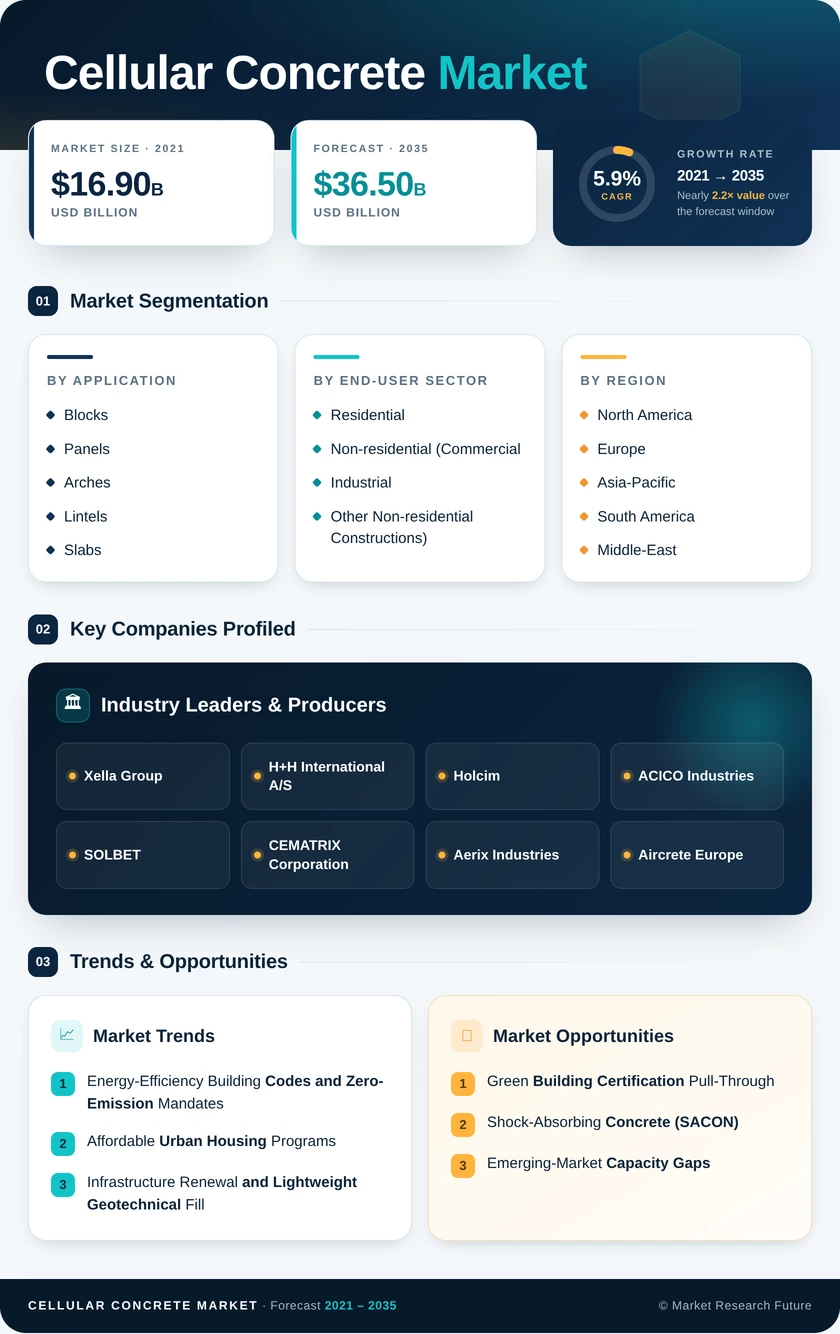
Cellular Concrete Market (2026 - 2035)

ID: MRFR/PCM/3886-HCR 100 Pages Pradeep Nandi Last Updated: October 23, 2026
Cellular Concrete Market Research Report Information By Application (Blocks, Panels, Arches, Lintels, Slabs, Thermal and Sound Insulation in Floors, Walls, Roofs, Filling of Voids, Cracks, and Cavities, Dike Protections, Mooring Lines, and Ports, Construction of Floating Structures, Protection of Communication Lines and Pipes, Foundations and Backfills in Construction of Roads, Bridges, Tunnels, and Underground Railways, and Other Applications), By End-User Sector (Residential, Non-Residential, Commercial, Industrial, and Other Non-Residential Constructions), And By Region (North America, Europe, Asia-Pacific, and Rest of the World) – Market Forecast Till 2035.
Cellular Concrete Market
Market Size
Forecast Period2026-2035
CAGR (2026-2035)5.9%
2025 Market SizeUSD 20.6 Billion
2035 Market SizeUSD 36.5 Billion
Key Players
Xella Group
H+H International A/S
Holcim
ACICO Industries
SOLBET
CEMATRIX Corporation
Opportunities
  • Green Building Certification Pull-Through
  • Shock-Absorbing Concrete (SACON)
  • Emerging-Market Capacity Gaps
  1. 1 Market Summary | |
  2. 2 Key Report Takeaways | |
    1. 2.1 By Application | |
    2. 2.2 By End-user Sector | |
    3. 2.3 By Region | |
  3. 3 Market Size and Forecast (2021–2035) | |
  4. 4 Driver Impact Analysis | |
    1. 4.1 Energy-Efficiency Building Codes and Zero-Emission Mandates | |
    2. 4.2 Affordable Urban Housing Programs | |
    3. 4.3 Infrastructure Renewal and Lightweight Geotechnical Fill | |
    4. 4.4 Construction Labor Productivity Gains | |
    5. 4.5 Cement-Sector Decarbonization and Embodied-Carbon Rules | |
    6. 4.6 Fire and Seismic Performance Requirements | |
  5. 5 Restraints Impact Analysis | |
    1. 5.1 Availability of Substitutes | |
    2. 5.2 Issues with Foam Liquid Concentrates | |
    3. 5.3 Lower Compressive Strength and Design Perception | |
    4. 5.4 Energy and Cement Cost Volatility | |
    5. 5.5 High Autoclave Plant Capital Costs | |
  6. 6 Opportunities | |
    1. 6.1 Green Building Certification Pull-Through | |
    2. 6.2 Shock-Absorbing Concrete (SACON) | |
    3. 6.3 Emerging-Market Capacity Gaps | |
    4. 6.4 Data-Driven Batching and Performance-as-a-Service Models | |
    5. 6.5 Offsite and Modular Construction | |
  7. 7 Regional Market Share and Country-Level Analysis | |
    1. 7.1 North America | | |
      1. 7.1.1 United States | | |
      2. 7.1.2 Canada | | |
      3. 7.1.3 Mexico | |
    2. 7.2 Europe | | |
      1. 7.2.1 Germany | | |
      2. 7.2.2 United Kingdom | | |
      3. 7.2.3 Italy | | |
      4. 7.2.4 France | | |
      5. 7.2.5 Nordic Countries | | |
      6. 7.2.6 Russia | | |
      7. 7.2.7 Rest of Europe | |
    3. 7.3 Asia-Pacific | | |
      1. 7.3.1 China | | |
      2. 7.3.2 India | | |
      3. 7.3.3 Japan | | |
      4. 7.3.4 South Korea | | |
      5. 7.3.5 ASEAN Countries | | |
      6. 7.3.6 Australia and New Zealand | | |
      7. 7.3.7 Rest of Asia-Pacific | |
    4. 7.4 South America | | |
      1. 7.4.1 Brazil | | |
      2. 7.4.2 Argentina | | |
      3. 7.4.3 Rest of South America | |
    5. 7.5 Middle East and Africa | | |
      1. 7.5.1 Saudi Arabia | | |
      2. 7.5.2 South Africa | | |
      3. 7.5.3 Rest of Middle East and Africa | |
  8. 8 Future Outlook (2026–2035) | |
    1. 8.1 Digital Batching and Automated Quality Control | |
    2. 8.2 Low-Carbon Binders and Circular Inputs | |
    3. 8.3 Offsite, Modular, and Panelized Construction | |
    4. 8.4 Climate Resilience and Infrastructure Renewal | |
  9. 9 Segmentation Analysis | |
    1. 9.1 By Application | | |
      1. 9.1.1 Blocks, Panels, Arches, Lintels, Slabs | | |
      2. 9.1.2 Thermal and Sound Insulation in Floors, Walls, Roofs | | |
      3. 9.1.3 Filling of Voids, Cracks, and Cavities | | |
      4. 9.1.4 Dike Protections, Mooring Lines, and Ports, Construction of Floating Structures | | |
      5. 9.1.5 Protection of Communication Lines and Pipes | | |
      6. 9.1.6 Foundations and Backfills in Construction of Roads, Bridges, Tunnels, and Underground Railways | | |
      7. 9.1.7 Other Applications | |
    2. 9.2 By End-user Sector | | |
      1. 9.2.1 Residential | | |
      2. 9.2.2 Non-residential | |
  10. 10 Competitive Landscape | |
  11. 11 Recent News & Developments | |
  12. 12 Report Scope and Methodology | |
  13. 13 Detailed Sources and Citations | |
  14. 14 Frequently Asked Questions (FAQs) | | LIST OF TABLES | |
  15. TABLE 1 Global Cellular Concrete Market Size & Forecast, by Revenue (USD Billion), 2021–2035 | |
  16. TABLE 2 Global Cellular Concrete Market – Year-over-Year Growth Analysis, 2021–2035 | |
  17. TABLE 3 Driver Impact Analysis – Global Cellular Concrete Market | |
  18. TABLE 4 Restraints Impact Analysis – Global Cellular Concrete Market | |
  19. TABLE 5 Global Cellular Concrete Market, by Region, 2025 | |
  20. TABLE 6 North America Cellular Concrete Market, by Country, 2025 | |
  21. TABLE 7 Europe Cellular Concrete Market, by Country, 2025 | |
  22. TABLE 8 Asia-Pacific Cellular Concrete Market, by Country, 2025 | |
  23. TABLE 9 South America Cellular Concrete Market, by Country, 2025 | |
  24. TABLE 10 Middle East and Africa Cellular Concrete Market, by Country, 2025 | |
  25. TABLE 11 Global Cellular Concrete Market, by Application, 2025 | |
  26. TABLE 12 Global Cellular Concrete Market, by End-user Sector, 2025 | |
  27. TABLE 13 Competitive Benchmarking Matrix – Global Cellular Concrete Market | |
  28. TABLE 14 Report Scope and Methodology | |
  29. TABLE 15 Detailed Sources and Citations | | LIST OF FIGURES | |
  30. FIGURE 1 Market Dynamics – Drivers, Restraints, and Opportunities | |
  31. FIGURE 2 Cellular Concrete Value Chain Analysis | |
  32. FIGURE 3 Porter's Five Forces Analysis | |
  33. FIGURE 4 Global Cellular Concrete Market Size Trend, 2021–2035 (USD Billion) | |
  34. FIGURE 5 Global Cellular Concrete Market Share, by Application, 2025 (%) | |
  35. FIGURE 6 Global Cellular Concrete Market Share, by End-user Sector, 2025 (%) | |
  36. FIGURE 7 Global Cellular Concrete Market Share, by Region, 2025 (%) | |
  37. FIGURE 8 Competitive Landscape – Estimated Revenue Share Ranges of Key Players

Segmentation Quick Reference

DimensionSub-SegmentsDominant SegmentFastest Growing Segment
By ApplicationBlocks, Panels, Arches, Lintels, Slabs; Thermal and Sound Insulation in Floors, Walls, Roofs; Filling of Voids, Cracks, and Cavities; Dike Protections, Mooring Lines, and Ports, Construction of Floating Structures; Protection of Communication Lines and Pipes; Foundations and Backfills in Construction of Roads, Bridges, Tunnels, and Underground Railways; Other ApplicationsBlocks, Panels, Arches, Lintels, Slabs (41.6% share)Foundations and Backfills in Construction of Roads, Bridges, Tunnels, and Underground Railways (7.3% CAGR)
By End-user SectorResidential; Non-residential (Commercial, Industrial, Other Non-residential Constructions)Residential (57.2% share)Commercial (6.4% CAGR)
By RegionNorth America; Europe; Asia-Pacific; South America; Middle-East and AfricaAsia-Pacific (52.4% share)Asia-Pacific (52.4% share)

Market Segmentation Overview

By Application

Sub-SegmentKey Trend
Blocks, Panels, Arches, Lintels, SlabsLarge-format autoclaved units and thin-bed mortar systems speed wall erection.
Thermal and Sound Insulation in Floors, Walls, RoofsRoof screeds and floor fills adopted to meet envelope and acoustic codes.
Filling of Voids, Cracks, and CavitiesPipe, tank, and mine void abandonment specified by utilities and regulators
Dike Protections, Mooring Lines, and Ports, Construction of Floating StructuresCoastal resilience and port expansion projects use low-density marine fill.
Protection of Communication Lines and PipesFiber and utility trench protection grows with network rollouts.
Foundations and Backfills in Construction of Roads, Bridges, Tunnels, and Underground RailwaysMetro rail and soft-soil embankments drive lightweight fill specifications.
Other ApplicationsArresting systems, sports surfaces, and specialty fills open niche channels.

Blocks, Panels, Arches, Lintels, Slabs lead this dimension because autoclaved walling is entrenched in European and Asian housing codes, where single-leaf thermal performance replaces clay brick. Foundations and Backfills in Construction of Roads, Bridges, Tunnels, and Underground Railways grows fastest, since highway and metro agencies need settlement-tolerant fill over weak subgrades. Filling of Voids, Cracks, and Cavities follows as utilities decommission aging pipe networks.

By End-user Sector

Sub-SegmentKey Trend
ResidentialSocial housing programs favor lighter blocks that reduce foundation costs
Non-residentialDiversifying demand across offices, warehouses, and public buildings
CommercialFire-rated partitions and faster fit-outs in offices, retail, and hotels
IndustrialInsulated floors and walls for logistics warehouses and manufacturing plants
Other Non-residential ConstructionsSchools and hospitals adopt non-combustible, acoustically efficient walls.

Residential remains the largest end user because government housing schemes in India, Brazil, and Saudi Arabia buy block systems at scale for their lower structural loads. Commercial grows fastest within Non-residential, as developers value non-combustible partitions and quicker interior fit-out. Industrial buyers add steady volume through insulated warehouse floors linked to logistics expansion.


Download PDF ×

We do not share your information with anyone. However, we may send you emails based on your report interest from time to time. You may contact us at any time to opt-out.