Ceiling Tiles Market (2026 - 2035)

ID: MRFR/PCM/3349-HCR 100 Pages Tejas Chaudhary Last Updated: November 12, 2026
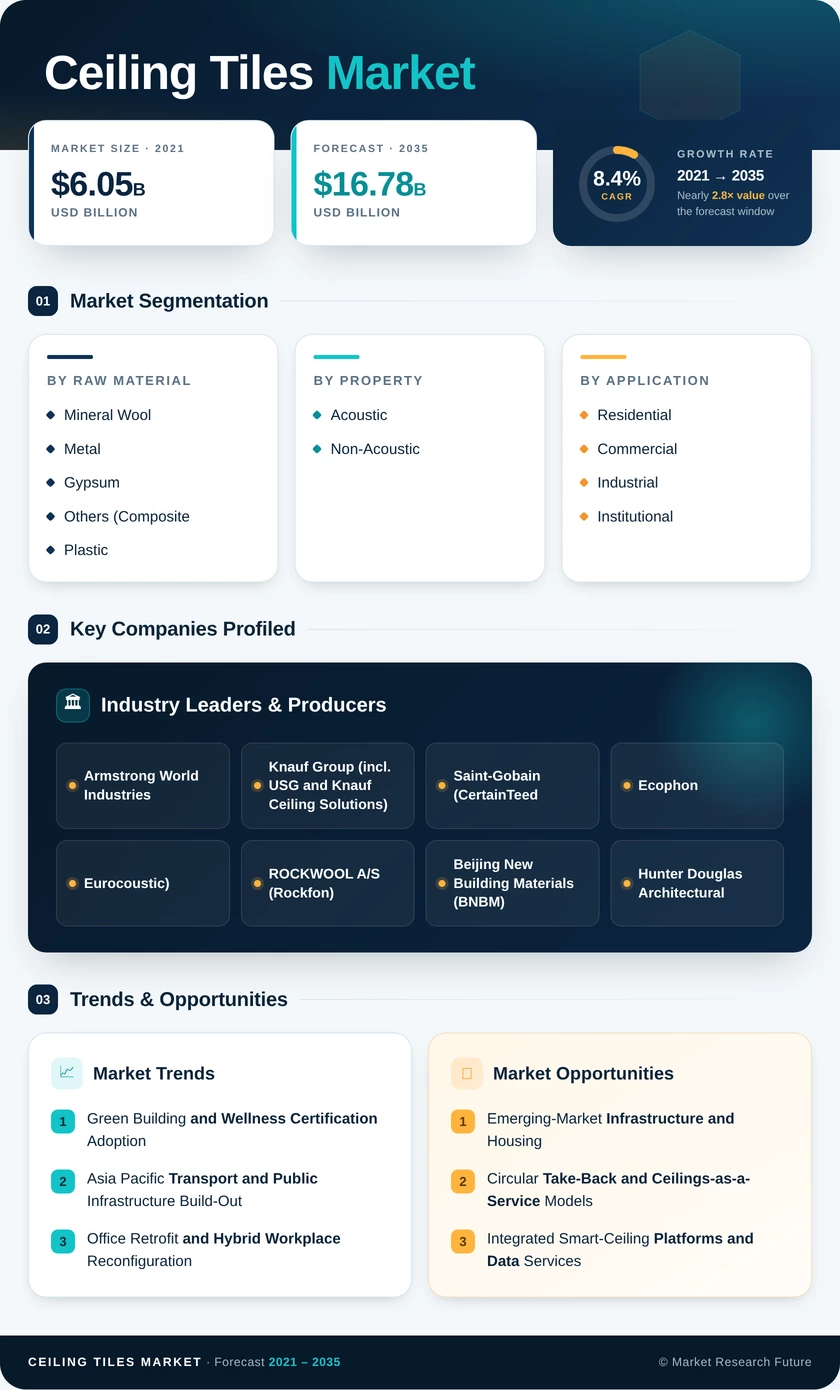
Ceiling Tiles Market Research Report Information By Raw Material (Mineral Wool, Metal, Gypsum, and Others (Composite, Plastic, and Wood)), By Property (Acoustic and Non-Acoustic), By Application (Commercial, Residential, Industrial, and Institutional), And By Region (North America, Europe, Asia-Pacific, and Rest of the World) – Market Forecast Till 2035.
Ceiling Tiles Market
Market Size
Forecast Period2026-2035
CAGR (2026-2035)8.4%
2025 Market SizeUSD 7.49 billion
2035 Market SizeUSD 16.78 billion
Key Players
Armstrong World Industries
Knauf Group
Saint-Gobain (CertainTeed
Ecophon
Eurocoustic)
ROCKWOOL A/S
Opportunities
  • Emerging-Market Infrastructure and Housing
  • Circular Take-Back and Ceilings-as-a-Service Models
  • Integrated Smart-Ceiling Platforms and Data Services
  1. 1 Market Summary | |
  2. 2 Key Report Takeaways | |
    1. 2.1 By Raw Material | |
    2. 2.2 By Property | |
    3. 2.3 By Application | |
    4. 2.4 By Region | |
  3. 3 Market Size and Forecast (2021–2035) | |
    1. 3.1 Historical Market Size (2021–2025) | |
    2. 3.2 Forecast Market Size (2026–2035) | |
    3. 3.3 Year-over-Year Growth Analysis | |
  4. 4 Driver Impact Analysis | |
    1. 4.1 Green Building and Wellness Certification Adoption | |
    2. 4.2 Asia Pacific Transport and Public Infrastructure Build-Out | |
    3. 4.3 Office Retrofit and Hybrid Workplace Reconfiguration | |
    4. 4.4 Affordable Urban Housing Programs | |
    5. 4.5 Stricter Fire-Safety Codes and Product Regulation | |
    6. 4.6 Healthcare and Education Facility Expansion | |
    7. 4.7 Low-Embodied-Carbon and Recycled-Content Products | |
  5. 5 Restraints Impact Analysis | |
    1. 5.1 Raw Material and Energy Cost Volatility | |
    2. 5.2 Commercial Construction Cyclicality and Office Vacancy | |
    3. 5.3 Exposed and Open-Plenum Ceiling Design Trend | |
    4. 5.4 Low-Cost Plaster and Board Alternatives | |
    5. 5.5 Installer Labor Shortages | |
  6. 6 Opportunities | |
    1. 6.1 Emerging-Market Infrastructure and Housing | |
    2. 6.2 Circular Take-Back and Ceilings-as-a-Service Models | |
    3. 6.3 Integrated Smart-Ceiling Platforms and Data Services | |
    4. 6.4 Healthcare, Cleanroom and Life-Science Facilities | |
    5. 6.5 Low-Carbon Product Lines for Public Procurement | |
  7. 7 Regional Market Share and Country-Level Analysis | |
    1. 7.1 North America | | |
      1. 7.1.1 United States | | |
      2. 7.1.2 Canada | | |
      3. 7.1.3 Mexico | |
    2. 7.2 Europe | | |
      1. 7.2.1 Germany | | |
      2. 7.2.2 United Kingdom | | |
      3. 7.2.3 France | | |
      4. 7.2.4 Italy | | |
      5. 7.2.5 Spain | | |
      6. 7.2.6 Nordics | | |
      7. 7.2.7 Rest of Europe | |
    3. 7.3 Asia Pacific | | |
      1. 7.3.1 China | | |
      2. 7.3.2 India | | |
      3. 7.3.3 Japan | | |
      4. 7.3.4 South Korea | | |
      5. 7.3.5 ASEAN Countries | | |
      6. 7.3.6 Rest of Asia Pacific | |
    4. 7.4 South America | | |
      1. 7.4.1 Brazil | | |
      2. 7.4.2 Argentina | | |
      3. 7.4.3 Rest of South America | |
    5. 7.5 Middle East and Africa | | |
      1. 7.5.1 Saudi Arabia | | |
      2. 7.5.2 United Arab Emirates | | |
      3. 7.5.3 South Africa | | |
      4. 7.5.4 Nigeria | | |
      5. 7.5.5 Rest of Middle East and Africa | |
  8. 8 Future Outlook (2026–2035) | |
    1. 8.1 Decarbonization and Embodied-Carbon Accounting | |
    2. 8.2 Smart Buildings and Ceiling-Integrated Systems | |
    3. 8.3 Urbanization and Asia Pacific Scale | |
    4. 8.4 Circularity and Digital Product Information | |
  9. 9 Segmentation Analysis | |
    1. 9.1 By Raw Material | | |
      1. 9.1.1 Mineral Wool | | |
      2. 9.1.2 Metal | | |
      3. 9.1.3 Gypsum | | |
      4. 9.1.4 Others (Composite, Plastic and Wood) | |
    2. 9.2 By Property | | |
      1. 9.2.1 Acoustic | | |
      2. 9.2.2 Non-Acoustic | |
    3. 9.3 By Application | | |
      1. 9.3.1 Residential | | |
      2. 9.3.2 Commercial | | |
      3. 9.3.3 Industrial | | |
      4. 9.3.4 Institutional | |
  10. 10 Competitive Landscape | |
    1. 10.1 Market Concentration Analysis | |
    2. 10.2 Competitive Benchmarking Matrix | |
    3. 10.3 Company Profiles | | |
      1. 10.3.1 Armstrong World Industries | | |
      2. 10.3.2 Knauf Group | | |
      3. 10.3.3 Saint-Gobain | | |
      4. 10.3.4 ROCKWOOL A/S | | |
      5. 10.3.5 Beijing New Building Materials | | |
      6. 10.3.6 Hunter Douglas Architectural | | |
      7. 10.3.7 SAS International | | |
      8. 10.3.8 Odenwald Faserplattenwerk | | |
      9. 10.3.9 Daiken Corporation | | |
      10. 10.3.10 Shandong Huamei Building Materials | | |
      11. 10.3.11 Techno Ceiling Products | |
  11. 11 Recent News & Developments | |
  12. 12 Report Scope and Methodology | |
  13. 13 Detailed Sources and Citations | |
  14. 14 Frequently Asked Questions (FAQs) | | LIST OF TABLES | |
  15. TABLE 1 Global Market Size & Forecast, by Revenue (USD billion), 2021–2035 | |
  16. TABLE 2 Year-over-Year Growth Analysis, 2021–2035 | |
  17. TABLE 3 Driver Impact Analysis | |
  18. TABLE 4 Restraints Impact Analysis | |
  19. TABLE 5 Regional Summary, by Region, 2025 | |
  20. TABLE 6 North America, by Country, 2025 | |
  21. TABLE 7 Europe, by Country, 2025 | |
  22. TABLE 8 Asia Pacific, by Country, 2025 | |
  23. TABLE 9 South America, by Country, 2025 | |
  24. TABLE 10 Middle East and Africa, by Country, 2025 | |
  25. TABLE 11 Global Market, by Raw Material, 2025 | |
  26. TABLE 12 Global Market, by Property, 2025 | |
  27. TABLE 13 Global Market, by Application, 2025 | |
  28. TABLE 14 Competitive Benchmarking Matrix, 2025 | |
  29. TABLE 15 Report Scope and Methodology | |
  30. TABLE 16 Detailed Sources and Citations | | LIST OF FIGURES | |
  31. FIGURE 1 Market Dynamics Overview (Drivers, Restraints, Opportunities) | |
  32. FIGURE 2 Industry Value Chain Analysis | |
  33. FIGURE 3 Porter's Five Forces Analysis | |
  34. FIGURE 4 Global Market Size Trend, 2021–2035 (USD billion) | |
  35. FIGURE 5 Market Share, by Raw Material, 2025 | |
  36. FIGURE 6 Market Share, by Property, 2025 | |
  37. FIGURE 7 Market Share, by Application, 2025 | |
  38. FIGURE 8 Regional Market Share, 2025 | |
  39. FIGURE 9 Regional Growth Comparison, 2026–2035 | |
  40. FIGURE 10 Competitive Landscape Positioning Matrix, 2025 | |
  41. FIGURE 11 Estimated Revenue Share Ranges of Key Players, 2025

Segmentation Quick Reference

DimensionSub-SegmentsDominant SegmentFastest Growing Segment
By Raw MaterialMineral Wool, Metal, Gypsum, Others (Composite, Plastic and Wood)Mineral Wool (38.2% share)Metal (8.5% CAGR)
By PropertyAcoustic, Non-AcousticAcoustic (61.4% share)Non-Acoustic (8.7% CAGR)
By ApplicationResidential, Commercial, Industrial, InstitutionalCommercial (65.6% share)Residential (9.0% CAGR)
By RegionNorth America, Europe, Asia Pacific, South America, Middle East and AfricaNorth America (34.2% share)Asia Pacific (9.6% CAGR)

Market Segmentation Overview

By Raw Material

Sub-SegmentKey Trend
Mineral WoolLow-carbon binders and recycled content for certified retrofits
MetalAluminum panels with A1 fire ratings for airports and metros
GypsumFast-install boards for affordable housing
Others (Composite, Plastic and Wood)PVC for wet areas and wood for premium interiors

Mineral Wool leads because it delivers acoustic absorption, insulation and fire resistance in a single tile, which suits office and school retrofits in North America and Europe. Metal grows fastest as transit and aviation projects demand non-combustible, humidity-tolerant surfaces. Gypsum holds volume in housing, while plastic and wood options serve wet areas and design-led spaces.

By Property

Sub-SegmentKey Trend
AcousticHigher NRC targets driven by WELL and hybrid workplace design
Non-AcousticAntimicrobial films and moisture barriers in multifunctional tiles

Acoustic tiles lead as speech privacy and reverberation control become certification criteria in offices, classrooms and hospitals. Non-Acoustic tiles grow faster because residential and light-industrial buyers value hygiene, moisture resistance and design flexibility over sound absorption. Multifunctional products are blurring the line between the two categories.

By Application

Sub-SegmentKey Trend
ResidentialQuick-install gypsum and PVC in government housing schemes
CommercialOffice refresh cycles and fire-code-driven specifications
IndustrialDurable metal and PVC tiles for warehouses and food plants
InstitutionalFire-safe acoustic assemblies for schools and hospitals

Commercial buildings lead because offices, hospitals and retail spaces carry the strictest fire and acoustic specifications and refresh ceilings on 12–15 year cycles. Residential grows fastest as India's PMAY-Urban 2.0 and North American single-family construction adopt fast-install systems. Industrial and Institutional demand remains steady, shaped by durability and safety requirements, respectively.


Download PDF ×

We do not share your information with anyone. However, we may send you emails based on your report interest from time to time. You may contact us at any time to opt-out.