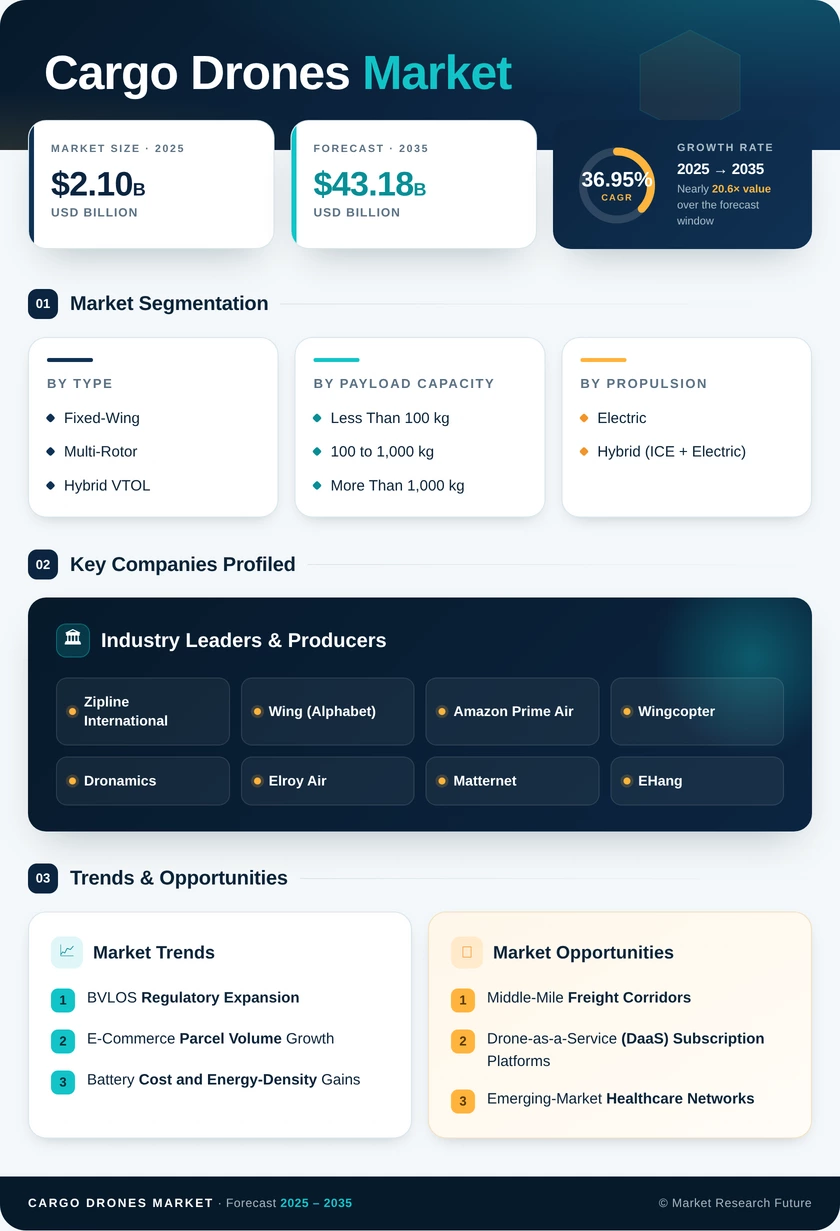
Cargo Drones Market

ID: MRFR/AD/9926-HCR
111 Pages
Abbas Raut
Last Updated: June 11, 2026
Cargo Drone Market Size, Share, Industry Trend & Analysis Research Report: By Drone Type (Fixed-Wing, Multi-Rotor, Hybrid VTOL), By Payload Capacity (Less Than 100 kg, 100 to 1,000 kg, More Than 1,000 kg), By Propulsion (Electric, Hybrid (ICE + Electric)), By Operating Range (VLOS, BVLOS), By End-Use Industry (Retail & E-Commerce, Healthcare & Medical, Agriculture, Industrial & Energy) - Forecast to 2035.
Download PDF ×

We do not share your information with anyone. However, we may send you emails based on your report interest from time to time. You may contact us at any time to opt-out.

  1. 1 Market Overview |
    1. 1.1 Study Assumptions & Market Definition |
    2. 1.2 Scope of the Study |
    3. 1.3 Research Methodology
  2. 2 Market Summary & Key Takeaways
  3. 3 Market Dynamics |
    1. 3.1 Market Drivers Analysis | |
      1. 3.1.1 BVLOS Regulatory Expansion | |
      2. 3.1.2 E-Commerce Parcel Volume Growth | |
      3. 3.1.3 Battery Cost and Energy-Density Gains | |
      4. 3.1.4 Medical and Humanitarian Logistics | |
      5. 3.1.5 AI-Enabled Autonomous Flight Management | |
      6. 3.1.6 Government Drone-Industry Subsidies | |
      7. 3.1.7 Urban Air Mobility Infrastructure Build-Out |
    2. 3.2 Market Restraints Analysis | |
      1. 3.2.1 Fragmented Airspace Regulations | |
      2. 3.2.2 Lithium Supply-Chain Volatility | |
      3. 3.2.3 Aviation Insurance Gaps | |
      4. 3.2.4 Public Acceptance & Noise Concerns | |
      5. 3.2.5 Cybersecurity Risks for Autonomous Fleet Management |
    3. 3.3 Market Opportunity Analysis | |
      1. 3.3.1 Middle-Mile Freight Corridors | |
      2. 3.3.2 Drone-as-a-Service Subscription Platforms | |
      3. 3.3.3 Emerging-Market Healthcare Networks | |
      4. 3.3.4 Data Monetization via Flight Analytics | |
      5. 3.3.5 Hydrogen-Powered Long-Range Platforms |
    4. 3.4 Industry Value Chain Analysis |
    5. 3.5 Porter's Five Forces Analysis
  4. 4 Global Cargo Drones Market Size & Forecast (2021–2035) |
    1. 4.1 Historical Market Size (2021–2025) |
    2. 4.2 Current & Forecast Market Size (2026–2035) |
    3. 4.3 Market Size by Revenue (USD Billion) |
    4. 4.4 Year-over-Year Growth Analysis
  5. 5 Segmentation Analysis |
    1. 5.1 By Drone Type | |
      1. 5.1.1 Fixed-Wing | |
      2. 5.1.2 Multi-Rotor | |
      3. 5.1.3 Hybrid VTOL |
    2. 5.2 By Payload Capacity | |
      1. 5.2.1 Less Than 100 kg | |
      2. 5.2.2 100 to 1,000 kg | |
      3. 5.2.3 More Than 1,000 kg |
    3. 5.3 By Propulsion | |
      1. 5.3.1 Electric | |
      2. 5.3.2 Hybrid (ICE + Electric) |
    4. 5.4 By Operating Range | |
      1. 5.4.1 VLOS (Visual Line of Sight) | |
      2. 5.4.2 BVLOS (Beyond Visual Line of Sight) |
    5. 5.5 By End-Use Industry | |
      1. 5.5.1 Retail & E-Commerce | |
      2. 5.5.2 Healthcare & Medical | |
      3. 5.5.3 Agriculture | |
      4. 5.5.4 Industrial & Energy
  6. 6 Regional Analysis |
    1. 6.1 North America | |
      1. 6.1.1 United States | |
      2. 6.1.2 Canada | |
      3. 6.1.3 Mexico |
    2. 6.2 Europe | |
      1. 6.2.1 Germany | |
      2. 6.2.2 United Kingdom | |
      3. 6.2.3 France | |
      4. 6.2.4 Italy | |
      5. 6.2.5 Spain | |
      6. 6.2.6 Nordic Countries | |
      7. 6.2.7 Russia | |
      8. 6.2.8 Rest of Europe |
    3. 6.3 Asia-Pacific | |
      1. 6.3.1 China | |
      2. 6.3.2 India | |
      3. 6.3.3 Japan | |
      4. 6.3.4 South Korea | |
      5. 6.3.5 ASEAN | |
      6. 6.3.6 Rest of Asia-Pacific |
    4. 6.4 South America | |
      1. 6.4.1 Brazil | |
      2. 6.4.2 Argentina | |
      3. 6.4.3 Rest of South America |
    5. 6.5 Middle East & Africa | |
      1. 6.5.1 Saudi Arabia | |
      2. 6.5.2 UAE | |
      3. 6.5.3 South Africa | |
      4. 6.5.4 Egypt | |
      5. 6.5.5 Rest of MEA
  7. 7 Competitive Landscape |
    1. 7.1 Market Share Analysis (2025) |
    2. 7.2 Competitive Benchmarking Matrix |
    3. 7.3 Company Profiles | |
      1. 7.3.1 Zipline International | |
      2. 7.3.2 Wing (Alphabet) | |
      3. 7.3.3 Amazon Prime Air | |
      4. 7.3.4 Wingcopter | |
      5. 7.3.5 Dronamics | |
      6. 7.3.6 Elroy Air | |
      7. 7.3.7 Matternet | |
      8. 7.3.8 EHang | |
      9. 7.3.9 Manna Aero | |
      10. 7.3.10 Joby Aviation
  8. 8 Future Outlook & Strategic Recommendations (2026–2035) |
    1. 8.1 AI-Enabled Autonomous Fleet Operations |
    2. 8.2 Platform Economics and DaaS Models |
    3. 8.3 Hydrogen and Next-Generation Propulsion |
    4. 8.4 ESG Reporting and Carbon-Credit Integration
  9. 9 Recent Developments & News
  10. 10 Frequently Asked Questions (FAQs)
  11. 11 Report Scope & Methodology |
    1. 11.1 Study Period & Base Year |
    2. 11.2 Data Sources & Citations |
    3. 11.3 Abbreviations
  12. 12 LIST OF TABLES |
  13. TABLE 1 Global Cargo Drones Market Size & Forecast, by Revenue (USD Billion), 2021–2035 |
  14. TABLE 2 Global Cargo Drones Market — Year-over-Year Growth Analysis, 2021–2035 |
  15. TABLE 3 Market Driver Impact Analysis — Cargo Drones Market, 2026–2035 |
  16. TABLE 4 Market Restraint Impact Analysis — Cargo Drones Market, 2026–2035 |
  17. TABLE 5 Regional Market Summary — Cargo Drones Market, 2025 |
  18. TABLE 6 North America Cargo Drones Market, by Country, 2021–2035 |
  19. TABLE 7 Europe Cargo Drones Market, by Country, 2021–2035 |
  20. TABLE 8 Asia-Pacific Cargo Drones Market, by Country, 2021–2035 |
  21. TABLE 9 South America Cargo Drones Market, by Country, 2021–2035 |
  22. TABLE 10 Middle East & Africa Cargo Drones Market, by Country, 2021–2035 |
  23. TABLE 11 Cargo Drones Market Size, by Drone Type, 2021–2035 (USD Billion) |
  24. TABLE 12 Cargo Drones Market Size, by Payload Capacity, 2021–2035 (USD Billion) |
  25. TABLE 13 Cargo Drones Market Size, by Propulsion, 2021–2035 (USD Billion) |
  26. TABLE 14 Cargo Drones Market Size, by Operating Range, 2021–2035 (USD Billion) |
  27. TABLE 15 Cargo Drones Market Size, by End-Use Industry, 2021–2035 (USD Billion) |
  28. TABLE 16 Competitive Benchmarking Matrix — Global Cargo Drones Market, 2025 |
  29. TABLE 17 Company Profiles — Key Players, Global Cargo Drones Market |
  30. TABLE 18 Recent Developments & Strategic Announcements, 2024–2025 |
  31. TABLE 19 Report Scope & Methodology Summary |
  32. TABLE 20 Detailed Sources and Citations
  33. 13 LIST OF FIGURES |
  34. FIGURE 1 Global Cargo Drones Market Dynamics — Drivers, Restraints, and Opportunities |
  35. FIGURE 2 Industry Value Chain — Cargo Drones Market |
  36. FIGURE 3 Porter's Five Forces Analysis — Cargo Drones Market |
  37. FIGURE 4 Global Cargo Drones Market Size Trend & Forecast (USD Billion), 2021–2035 |
  38. FIGURE 5 Cargo Drones Market Share, by Drone Type, 2024 (%) |
  39. FIGURE 6 Cargo Drones Market Share, by Payload Capacity, 2024 (%) |
  40. FIGURE 7 Cargo Drones Market Share, by Propulsion, 2024 (%) |
  41. FIGURE 8 Cargo Drones Market Share, by Operating Range, 2024 (%) |
  42. FIGURE 9 Cargo Drones Market Share, by End-Use Industry, 2024 (%) |
  43. FIGURE 10 Cargo Drones Market Share, by Region, 2025 (%) |
  44. FIGURE 11 North America Cargo Drones Market — Country Share, 2025 (%) |
  45. FIGURE 12 Europe Cargo Drones Market — Country Share, 2025 (%) |
  46. FIGURE 13 Asia-Pacific Cargo Drones Market — Country Share, 2025 (%) |
  47. FIGURE 14 South America Cargo Drones Market — Country Share, 2025 (%) |
  48. FIGURE 15 Middle East & Africa Cargo Drones Market — Country Share, 2025 (%) |
  49. FIGURE 16 Competitive Landscape — Revenue Share Distribution, 2025 (%)

Segmentation Quick Reference

DimensionSub-SegmentsDominant SegmentFastest Growing Segment
Drone TypeFixed-Wing, Multi-Rotor, Hybrid VTOLMulti-RotorHybrid VTOL
Payload CapacityLess Than 100 kg, 100 to 1,000 kg, More Than 1,000 kgLess Than 100 kgMore Than 1,000 kg
PropulsionElectric, Hybrid (ICE + Electric)ElectricHybrid (ICE + Electric)
Operating RangeVLOS, BVLOSVLOSBVLOS
End-Use IndustryRetail & E-Commerce, Healthcare & Medical, Agriculture, Industrial & EnergyRetail & E-CommerceHealthcare & Medical


Market Segmentation Overview

By Drone Type

Sub-SegmentKey Trend
Fixed-WingGaining traction for long-range inter-hub cargo corridors exceeding 200 km; Dronamics Black Swan leads the category.
Multi-RotorDominant platform for urban last-mile delivery; low CapEx and vertical-launch capability sustain leadership.
Hybrid VTOLFastest-growing type combining vertical takeoff with fixed-wing cruise efficiency; Wingcopter 198 is the commercial benchmark


Multi-rotor drones remain the workhorse of the cargo drones market due to their simplicity and urban compatibility, while hybrid VTOL platforms are rapidly closing the gap by offering range and speed advantages that open middle-mile and suburban delivery corridors previously inaccessible to pure rotorcraft.

By Payload Capacity

Sub-SegmentKey Trend
Less Than 100 kgServes the highest-volume segment — small-parcel e-commerce, pharmacy delivery, and food delivery
100 to 1,000 kgEmerging category for industrial spare parts and inter-warehouse logistics transfers
More Than 1,000 kgFrontier heavy-lift segment targeting regional freight routes; Elroy Air Chaparral leads development


The sub-100 kg category generates the majority of sortie volume and revenue in the cargo drones market, but the over-1,000 kg segment is attracting outsized investment as freight forwarders explore drone alternatives to short-haul trucking.

By Propulsion

Sub-SegmentKey Trend
ElectricDominant propulsion choice; declining battery costs and zero-emission mandates reinforce leadership
Hybrid (ICE + Electric)Favored for extended-range missions exceeding 100 km where pure-electric endurance is insufficient


Electric propulsion captures the majority share due to operational simplicity and favorable emission profiles, while hybrid systems address the endurance gap for medium-range and heavy-payload operations in the cargo drones market.

By Operating Range

Sub-SegmentKey Trend
VLOSRegulatory default in most jurisdictions; dominates current commercial operations
BVLOSFastest-growing range category; each BVLOS waiver expands serviceable area by 10×


The transition from VLOS to BVLOS operations represents the single most impactful regulatory shift for the cargo drones market, enabling metropolitan-scale autonomous logistics networks.

By End-Use Industry

Sub-SegmentKey Trend
Retail & E-CommerceLargest revenue contributor; driven by same-day and sub-hour delivery expectations
Healthcare & MedicalFastest-growing end-use; cold-chain integrity and emergency delivery create durable demand
AgricultureNiche but growing; input delivery to remote farms reduces ground-transport dependency
Industrial & EnergySpare-parts delivery to offshore platforms and remote mining sites accelerates adoption


Retail and e-commerce remain the revenue anchor, but healthcare logistics is closing the gap as autonomous drone delivery systems prove their value in time-critical medical supply chains across developing and developed markets alike.