Request Free Sample ×

Kindly complete the form below to receive a free sample of this Report

* Please use a valid business email

Leading companies partner with us for data-driven Insights

clients tt-cursor
Hero Background
English
Chinese
French
Japanese
Korean
German
Spanish

Cardiopulmonary Disease Diagnostics Treatment Market Analysis

ID: MRFR/Pharma/4929-HCR
85 Pages
Rahul Gotadki
Last Updated: April 06, 2026

Cardiopulmonary Disease Diagnostics and Treatment Market Research Report Information By Disease Type (Cardiovascular and Respiratory Diseases), By Type (Diagnosis-Electrocardiogram and Treatment -Medication), By End-Users (Diagnostic Centers and Hospitals), and By Region (North America, Europe, Asia-Pacific, And Rest Of The World) –Market Forecast Till 2035

Share:
Download PDF ×

We do not share your information with anyone. However, we may send you emails based on your report interest from time to time. You may contact us at any time to opt-out.

Cardiopulmonary Disease Diagnostics Treatment Market Infographic
Purchase Options

Market Analysis

In-depth Analysis of Cardiopulmonary Disease Diagnostics Treatment Market Industry Landscape

Cardiopulmonary disease diagnostics and treatment market dynamics are complex; they encapsulate a milieu that has been influenced by various factors that affect cardiac and respiratory health. Cardiopulmonary diseases are conditions involving the heart as well as lungs, which present major impediments and opportunities within the healthcare industry. Disease prevalence, diagnostic advancements, treatment modalities, technological innovations, and economic considerations are among some of the factors affecting the market.

Cardiopulmonary diseases’ prevalence is at the core of shaping market dynamics. Cardiovascular and respiratory conditions constitute leading causes of morbidity and mortality worldwide affecting a large number of patients. The market prioritizes accurate diagnoses tools for this reason to rapidly respond to varying occurrence rates among other heart-lung disorders.

Diagnostic improvements have an impact on market dynamics especially since early-stage detection is critical in managing illnesses effectively. Echocardiography, stress testing, pulmonary function tests (PFTs) (spirometry), CT scans and MRI among others contribute more towards understanding cardio-respiratory conditions through diagnostic imaging technologies. Continuous diagnostic tool enhancements keep improving markets that assist practitioners to individualize patient management plans reliant on meticulous assessments of cardiovascular as well as respiratory functions.

For treatment modalities for cardiopulmonary diseases there is a wide scope ranging from lifestyle adjustments and medications to interventional procedures or surgeries. Pharmaceuticals include drugs targeting cardiovascular risk factors; medications given to respiratory patients such as bronchodilators; antiplatelet agents for reducing stroke risks in some patients with certain heart problems. The market is affected by ongoing research seeking novel therapeutic approaches like gene therapies or personalized medicines that will make treatments more effective thus saving lives better.

Innovations in technology regarding medical devices including interventions significantly influence the direction taken by markets. Technology changes in minimally invasive techniques, cardiac catheterization procedures (otherwise known as angiograms) also invention of implantable devices such as pacemakers and defibrillators have progressed the management of cardiopulmonary diseases. The market responds to these advances by use of cutting-edge technologies, promoting better procedures and ensuring that the overall care provided for people with cardiovascular and respiratory conditions is improved.

Economic issues like healthcare spending, reimbursement policies and patient access to care influence market dynamics. The cost of diagnostic tests, medications or medical interventions may affect affordability as well as access to treatment options for diagnosing and treating heart-lung diseases. This means that pharmaceuticals firms, health institutions among others must take into account economic factors before developing any product related to cardiopulmonary health.

Public health initiatives and awareness campaigns play a role in the market dynamics by encouraging preventive measures against cardiorespiratory diseases and early detection. Increasing awareness about lifestyle choices impacting on heart-lung health, regular check-ups/screenings are important can be helpful towards improving outcomes in patients with lung diseases. To this end, the market supports education efforts as well as campaigns aimed at prioritizing population-based strategies on heart-respiratory issues.


Author
Author Profile
Rahul Gotadki
Research Manager

He holds an experience of about 9+ years in Market Research and Business Consulting, working under the spectrum of Life Sciences and Healthcare domains. Rahul conceptualizes and implements a scalable business strategy and provides strategic leadership to the clients. His expertise lies in market estimation, competitive intelligence, pipeline analysis, customer assessment, etc.

Leave a Comment

FAQs

What is the projected market valuation for the Cardiopulmonary Disease Diagnostics and Treatment Market in 2035?

<p>The projected market valuation for 2035 is 4.708 USD Billion.</p>

What was the market valuation for the Cardiopulmonary Disease Diagnostics and Treatment Market in 2024?

<p>The overall market valuation was 2.49 USD Billion in 2024.</p>

What is the expected CAGR for the Cardiopulmonary Disease Diagnostics and Treatment Market from 2025 to 2035?

<p>The expected CAGR during the forecast period 2025 - 2035 is 5.96%.</p>

Which companies are considered key players in the Cardiopulmonary Disease Diagnostics and Treatment Market?

<p>Key players include Philips, Siemens Healthineers, GE Healthcare, Roche, Abbott Laboratories, Boehringer Ingelheim, Medtronic, Baxter International, and Cardinal Health.</p>

What are the projected values for cardiovascular disease diagnostics and treatment by 2035?

<p>The projected value for cardiovascular disease diagnostics and treatment is expected to reach 2.308 USD Billion by 2035.</p>

How much is the respiratory diseases segment expected to grow by 2035?

<p>The respiratory diseases segment is projected to grow to 2.4 USD Billion by 2035.</p>

What is the expected market size for electrocardiogram diagnostics in 2035?

The expected market size for electrocardiogram diagnostics is projected to be 1.8 USD Billion by 2035.

What is the anticipated growth for medication treatment in the Cardiopulmonary Disease market by 2035?

The anticipated growth for medication treatment is expected to reach 2.908 USD Billion by 2035.

Which end-user segment is projected to have the highest market value by 2035?

The hospitals segment is projected to have the highest market value, reaching 3.316 USD Billion by 2035.

What is the expected market value for diagnostic centers in 2035?

The expected market value for diagnostic centers is projected to be 1.392 USD Billion by 2035.

Market Summary

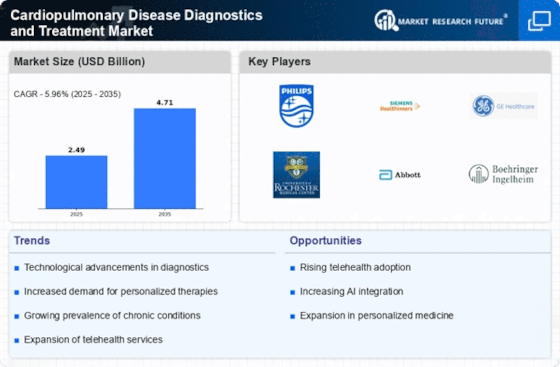
As per Market Research Future analysis, the Cardiopulmonary Disease Diagnostics and Treatment Market was estimated at 2.49 USD Billion in 2024. The market is projected to grow from 2.638 USD Billion in 2025 to 4.708 USD Billion by 2035, exhibiting a compound annual growth rate (CAGR) of 5.96% during the forecast period 2025 - 2035

Key Market Trends & Highlights

The Cardiopulmonary Disease Diagnostics and Treatment Market is experiencing a transformative shift driven by technological advancements and a focus on personalized care.

  • Technological advancements in diagnostics are enhancing the accuracy and efficiency of cardiopulmonary disease detection.
  • There is a notable shift towards personalized medicine, tailoring treatments to individual patient profiles in North America.
  • Preventive care is gaining traction, with increased awareness and education on cardiopulmonary health influencing patient behaviors in Asia-Pacific.
  • The rising prevalence of cardiopulmonary diseases and regulatory support for innovative treatments are key drivers propelling market growth.

Market Size & Forecast

2024 Market Size 2.49 (USD Billion)
2035 Market Size 4.708 (USD Billion)
CAGR (2025 - 2035) 5.96%
Largest Regional Market Share in 2024 North America

Major Players

Philips (NL), Siemens Healthineers (DE), GE Healthcare (US), Roche (CH), Abbott Laboratories (US), Boehringer Ingelheim (DE), Medtronic (US), Baxter International (US), Cardinal Health (US)

Market Trends

The Cardiopulmonary Disease Diagnostics and Treatment Market is currently experiencing a transformative phase, driven by advancements in technology and an increasing awareness of cardiopulmonary conditions. Innovations in diagnostic tools, such as imaging techniques and biomarker identification, are enhancing the accuracy of disease detection. Furthermore, the integration of artificial intelligence in diagnostic processes appears to streamline workflows and improve patient outcomes. As healthcare systems evolve, there is a growing emphasis on personalized treatment approaches, which may lead to more effective management of cardiopulmonary diseases. In addition to technological advancements, the Cardiopulmonary Disease Diagnostics and Treatment Market is influenced by demographic shifts and changing lifestyle factors. An aging population, coupled with rising incidences of risk factors such as obesity and sedentary behavior, suggests a heightened demand for both diagnostic and therapeutic solutions. Healthcare providers are increasingly focusing on preventive measures and early intervention strategies, which could potentially reshape the landscape of cardiopulmonary care. Overall, the market seems poised for growth, with ongoing research and development efforts likely to yield new therapies and diagnostic modalities in the near future.

Technological Advancements in Diagnostics

Recent innovations in diagnostic technologies are revolutionizing the Cardiopulmonary Disease Diagnostics and Treatment Market. Enhanced imaging techniques and the use of biomarkers are improving the precision of disease identification, allowing for earlier and more accurate diagnoses.

Shift Towards Personalized Medicine

The market is witnessing a notable shift towards personalized medicine, where treatment plans are tailored to individual patient profiles. This approach is expected to enhance treatment efficacy and patient satisfaction, as therapies become more aligned with specific patient needs.

Increased Focus on Preventive Care

There is a growing emphasis on preventive care within the Cardiopulmonary Disease Diagnostics and Treatment Market. Healthcare providers are prioritizing early intervention strategies and lifestyle modifications to mitigate the risk of developing cardiopulmonary diseases.

Cardiopulmonary Disease Diagnostics Treatment Market Market Drivers

Regulatory Support for Innovative Treatments

Regulatory bodies are increasingly supporting the development of innovative treatments within the Cardiopulmonary Disease Diagnostics and Treatment Market. Initiatives aimed at expediting the approval process for new therapies and diagnostic tools are becoming more common. This regulatory environment encourages pharmaceutical and biotechnology companies to invest in research and development, leading to the introduction of novel treatment options for cardiopulmonary diseases. For instance, recent policies have facilitated faster access to breakthrough therapies, which could significantly improve patient outcomes. As these innovations enter the market, they are likely to attract attention from healthcare providers and patients alike, thereby driving demand for advanced diagnostic and treatment solutions. This supportive regulatory landscape is expected to play a pivotal role in shaping the future of the market.

Rising Prevalence of Cardiopulmonary Diseases

The increasing incidence of cardiopulmonary diseases is a primary driver for the Cardiopulmonary Disease Diagnostics and Treatment Market. Conditions such as chronic obstructive pulmonary disease (COPD) and heart failure are becoming more prevalent, largely due to aging populations and lifestyle factors. According to recent data, it is estimated that by 2025, the number of individuals suffering from these diseases could reach unprecedented levels, necessitating advanced diagnostic and treatment solutions. This surge in patient numbers is likely to stimulate demand for innovative diagnostic tools and therapeutic options, thereby propelling market growth. Furthermore, the economic burden associated with these diseases underscores the urgent need for effective management strategies, which could further enhance the market landscape.

Technological Innovations in Diagnostic Tools

Technological advancements are revolutionizing the Cardiopulmonary Disease Diagnostics and Treatment Market. Innovations such as artificial intelligence, machine learning, and advanced imaging techniques are enhancing the accuracy and efficiency of diagnostics. For instance, AI-driven algorithms can analyze imaging data with remarkable precision, leading to earlier detection of cardiopulmonary conditions. The market for diagnostic imaging is projected to grow significantly, with estimates suggesting a compound annual growth rate of over 7% in the coming years. These advancements not only improve patient outcomes but also streamline healthcare processes, making them more cost-effective. As healthcare providers increasingly adopt these technologies, the demand for sophisticated diagnostic tools is expected to rise, further driving market expansion.

Growing Investment in Healthcare Infrastructure

Investment in healthcare infrastructure is a crucial factor influencing the Cardiopulmonary Disease Diagnostics and Treatment Market. Governments and private entities are allocating substantial resources to enhance healthcare facilities, particularly in developing regions. This investment is aimed at improving access to diagnostic and treatment services for cardiopulmonary diseases. For example, the establishment of specialized cardiopulmonary care centers is on the rise, which is likely to facilitate better patient management and outcomes. Additionally, the integration of telemedicine and remote monitoring technologies is becoming more prevalent, allowing for timely interventions and follow-ups. As healthcare systems evolve, the demand for comprehensive cardiopulmonary diagnostics and treatment solutions is expected to grow, thereby propelling market dynamics.

Increased Awareness and Education on Cardiopulmonary Health

The heightened awareness regarding cardiopulmonary health is significantly impacting the Cardiopulmonary Disease Diagnostics and Treatment Market. Public health campaigns and educational initiatives are informing individuals about the risks associated with cardiopulmonary diseases, leading to earlier diagnosis and treatment. This awareness is fostering a proactive approach to health management, encouraging individuals to seek medical advice and undergo regular screenings. As a result, healthcare providers are witnessing an uptick in patient consultations for cardiopulmonary issues. Moreover, the emphasis on lifestyle modifications and preventive measures is likely to drive demand for diagnostic services, as individuals become more engaged in their health. This trend is expected to contribute positively to market growth in the coming years.

Market Segment Insights

By Disease Type: Cardiovascular (Largest) vs. Respiratory Diseases (Fastest-Growing)

<p>Within the Cardiopulmonary Disease Diagnostics and Treatment Market, the distribution of market share is notably skewed towards Cardiovascular diseases, representing the largest segment. This segment benefits from a broad range of diagnostic and treatment options that cater to an aging population predisposed to heart-related conditions. Conversely, Respiratory Diseases are emerging as a significant area of focus, illustrating a dynamic shift as awareness and diagnosis of respiratory conditions increase, particularly in the wake of global health challenges.</p>

<p>Cardiovascular (Dominant) vs. Respiratory Diseases (Emerging)</p>

<p>The Cardiovascular segment maintains a dominant position in the market through a wealth of established diagnostic tools and treatment methodologies, catering to heart diseases such as coronary artery disease and heart failure. The treatment landscape is continuously evolving with advanced technologies and therapies, ensuring that this segment remains at the forefront of market interests. On the other hand, the Respiratory Diseases segment is marked as emerging, driven by rising incidences of chronic illnesses such as COPD and asthma. Innovations in diagnostic imaging and <a href="https://www.marketresearchfuture.com/reports/home-healthcare-market-2030" target="_blank" title="home healthcare">home healthcare</a> solutions are propelling this segment's growth, responding to increased public health awareness and the need for proactive management of respiratory conditions.</p>

By Type: Electrocardiogram (Largest) vs. Medication (Fastest-Growing)

<p>In the Cardiopulmonary Disease Diagnostics and Treatment Market, the distribution of market share among the diagnosis and treatment segments is characterized by the dominance of electrocardiograms (ECGs), which hold the largest portion of the diagnostics sector. ECGs are widely utilized for their effectiveness in identifying heart abnormalities and arrhythmias, making them essential in the diagnostic process. In contrast, the treatment segment experiences rapid growth through medication, which is increasingly recognized for its role in managing cardiopulmonary conditions effectively. As healthcare providers focus on personalized medicine, this dual utilization further emphasizes the significance of both sectors.</p>

<p>Diagnosis - Electrocardiogram (Dominant) vs. Treatment - Medication (Emerging)</p>

<p>Electrocardiograms represent the dominant diagnostic tool within the cardiopulmonary disease field due to their non-invasive nature and widespread accessibility. They are crucial for rapid assessment and monitoring of various heart conditions, positioning them as a critical element in patient care. Conversely, medication as a treatment modality is emerging rapidly, driven by advances in pharmacology and an increase in clinical trials focused on innovative therapies. This segment benefits from the growing trend towards individualized treatment regimens, addressing specific patient needs and conditions. The convergence of these segments is leading to integrated care models that enhance patient outcomes, signifying a pivotal shift in approach within the cardiopulmonary disease market.</p>

By End-User: Hospitals (Largest) vs. Diagnostic Centers (Fastest-Growing)

<p>In the Cardiopulmonary Disease Diagnostics and Treatment Market, hospitals represent the largest segment, being the primary healthcare facilities providing comprehensive services for diagnosing and treating cardiopulmonary conditions. They dominate the market due to their established infrastructure, access to advanced diagnostic technologies, and a wide array of treatment options available for patients. Diagnostic centers, while smaller in market share, are swiftly gaining traction, thanks to their specialized services and increased patient preferences for convenience and faster access to diagnostic evaluations.</p>

<p>Hospitals (Dominant) vs. Diagnostic Centers (Emerging)</p>

<p>Hospitals serve as the dominant players in the cardiopulmonary disease diagnostics and treatment landscape, as they cater to a larger patient population with critical needs for invasive and non-invasive procedures. They offer a multidisciplinary approach, integrating cardiology, pulmonology, and radiology for comprehensive patient management. Conversely, diagnostic centers are emerging as efficient alternatives, appealing to patients seeking rapid and specific diagnostic services. These centers are characterized by their focus on advanced imaging techniques and a streamlined workflow, enabling quicker turnaround times for test results. Their growth is driven by rising outpatient diagnostic demands and innovations that enhance accuracy and patient experience.</p>

Get more detailed insights about Cardiopulmonary Disease Diagnostics and Treatment Market Research Report – Forecast to 2035

Regional Insights

North America : Leading Innovation and Demand

North America is the largest market for cardiopulmonary disease diagnostics and treatment, holding approximately 40% of the global market share. Key growth drivers include advanced healthcare infrastructure, increasing prevalence of cardiopulmonary diseases, and significant investments in research and development. Regulatory support from agencies like the FDA further catalyzes innovation and adoption of new technologies, enhancing patient outcomes and driving market expansion. The United States is the primary contributor to this market, followed by Canada. Major players such as GE Healthcare, Abbott Laboratories, and Medtronic are headquartered in this region, fostering a competitive landscape characterized by continuous innovation. The presence of leading healthcare institutions and a focus on personalized medicine are pivotal in shaping market dynamics, ensuring that North America remains at the forefront of cardiopulmonary diagnostics and treatment solutions.

Europe : Regulatory Framework and Growth

Europe is the second-largest market for cardiopulmonary disease diagnostics and treatment, accounting for approximately 30% of the global market share. The region benefits from stringent regulatory frameworks that ensure high-quality standards in medical devices and treatments. Increasing awareness of cardiopulmonary diseases and a growing aging population are significant demand drivers. The European Union's initiatives to enhance healthcare access and innovation further support market growth. Germany, France, and the UK are the leading countries in this market, with a strong presence of key players like Siemens Healthineers and Roche. The competitive landscape is marked by collaborations between healthcare providers and technology firms, focusing on developing advanced diagnostic tools and treatment options. The emphasis on preventive healthcare and early diagnosis is shaping the future of cardiopulmonary care in Europe.

Asia-Pacific : Rapid Growth and Opportunities

The Asia-Pacific region is witnessing rapid growth in the cardiopulmonary disease diagnostics and treatment market, holding approximately 20% of the global market share. Key growth drivers include increasing healthcare expenditure, rising awareness of cardiopulmonary diseases, and a growing population. Government initiatives aimed at improving healthcare infrastructure and access to advanced medical technologies are also significant catalysts for market expansion. China, Japan, and India are the leading countries in this region, with a burgeoning demand for innovative diagnostic and treatment solutions. The competitive landscape is evolving, with both local and international players striving to capture market share. Companies like Philips and Baxter International are actively investing in research and development to introduce cutting-edge technologies tailored to the unique needs of the Asia-Pacific population.

Middle East and Africa : Emerging Markets and Challenges

The Middle East and Africa (MEA) region is gradually emerging in the cardiopulmonary disease diagnostics and treatment market, holding approximately 10% of the global market share. Key growth drivers include increasing healthcare investments, rising prevalence of cardiopulmonary diseases, and a focus on improving healthcare infrastructure. However, challenges such as economic disparities and limited access to advanced medical technologies persist, impacting overall market growth. Countries like South Africa, UAE, and Saudi Arabia are leading the market in this region, with a growing number of healthcare facilities adopting advanced diagnostic tools. The competitive landscape is characterized by a mix of local and international players, with companies seeking to expand their footprint through partnerships and collaborations. The emphasis on improving healthcare access and quality is crucial for the future growth of the cardiopulmonary market in MEA.

Key Players and Competitive Insights

Leading market players are largely investing in research and development to expand their product lines, which will help the cardiopulmonary disease diagnostics and treatment market grow even more. The launch of new products, larger-scale mergers and acquisitions, contractual agreements, and collaboration with other organizations are significant market developments in which market participants engage to increase their  presence. The cardiopulmonary disease diagnostics and treatment industry must provide affordable products to expand and thrive in a more competitive and challenging market environment.One of the major business strategies manufacturers use in the  cardiopulmonary disease diagnostics and treatment industry to increase market sector and benefits customers is local manufacturing to lower operational costs. In recent years, the cardiopulmonary disease diagnostics and treatment industry has stipulated some of the most important medicinal benefits.  Major players in the cardiopulmonary disease diagnostics and treatment industry, including Cosmed Medical, Cardinal Health, GE Healthcare, Schiller AG, Koninklijke Philips N.V., and others, are funding operations for research and development to boost market demand.Medtronic plc is a medical device firm based in the United States. The operational and executive headquarters of the corporation are in Minneapolis, Minnesota, and the legal headquarters are in Ireland. Medtronic PLC creates medical products that are both therapeutic and diagnostic. Products for bradycardia pacing, tachyarrhythmia management, atrial fibrillation management, heart failure management, heart valve replacement, malignant and non-malignant pain, and movement disorders are among the company's mainstays.

In October Medtronic plc received FDA approval for expanded labeling of a cardiac lead that taps into the heart's natural electrical system, providing needed therapy while avoiding complications associated with traditional pacing methods, such as cardiomyopathy. Medtronic was the first and only firm to approve conduction system pacing therapy.GSK plc, formerly GlaxoSmithKline plc, is a multinational pharmaceutical and biotechnology corporation based in London, England. GSK is one of the major pharmaceutical firms in terms of total sales. The company has clout in various therapeutic areas, including respiratory, cancer, antiviral drugs, and vaccines. GSK employs joint ventures to develop scale in some industries, such as HIV.

In April GlaxoSmithKline Pharmaceuticals Limited introduced Trelegy Ellipta (fluticasone furoate/umeclidinium/vilanterol), the first single-inhaler triple treatment (SITT) in India for Chronic Obstructive Pulmonary Disease (COPD) patients on a once-daily basis.Drugs Controller General of India approved the medicine as a maintenance treatment to prevent and relieve Chronic Obstructive Pulmonary Disease symptoms in patients aged 18 and above.

Key Companies in the Cardiopulmonary Disease Diagnostics Treatment Market include

Industry Developments

February 2021 Remo Care Solutions has created a new AI-based remote monitoring gadget for cardiac patients that analyses the patient's cardiovascular status in real-time. Patients can easily use this lightweight wireless device in their rooms or ICU. During a Covid pandemic, the technology allows patients to avoid physically seeing doctors, allowing doctors to diagnose disease through remote monitoring.

April 2021 Phoenix Cardiac Devices has received regulatory CE mark certification for their BACE (basal annuloplasty of the cardiac externally) device, which will be used to treat functional mitral regurgitation.  Compared to other devices that treat mitral regurgitation by replacing or repairing the mitral valve, the BACE device is unique.

Future Outlook

Cardiopulmonary Disease Diagnostics Treatment Market Future Outlook

The Cardiopulmonary Disease Diagnostics and Treatment Market is projected to grow at a 5.96% CAGR from 2025 to 2035, driven by technological advancements, increasing prevalence, and rising healthcare expenditure.

New opportunities lie in:

  • Development of AI-driven diagnostic tools for early detection
  • Expansion of telehealth services for <a href="https://www.marketresearchfuture.com/reports/remote-patient-monitoring-market-10905" target="_blank" title="remote patient monitoring">remote patient monitoring</a>
  • Investment in personalized treatment plans leveraging genetic data

By 2035, the market is expected to be robust, driven by innovation and increased demand.

Market Segmentation

Cardiopulmonary Disease Diagnostics Treatment Market Type Outlook

  • Diagnosis - Electrocardiogram
  • Treatment - Medication

Cardiopulmonary Disease Diagnostics Treatment Market End-User Outlook

  • Diagnostic Centers
  • Hospitals

Cardiopulmonary Disease Diagnostics Treatment Market Disease Type Outlook

  • Cardiovascular
  • Respiratory Diseases

Report Scope

MARKET SIZE 2024 2.49(USD Billion)
MARKET SIZE 2025 2.638(USD Billion)
MARKET SIZE 2035 4.708(USD Billion)
COMPOUND ANNUAL GROWTH RATE (CAGR) 5.96% (2025 - 2035)
REPORT COVERAGE Revenue Forecast, Competitive Landscape, Growth Factors, and Trends
BASE YEAR 2024
Market Forecast Period 2025 - 2035
Historical Data 2019 - 2024
Market Forecast Units USD Billion
Key Companies Profiled Philips (NL), Siemens Healthineers (DE), GE Healthcare (US), Roche (CH), Abbott Laboratories (US), Boehringer Ingelheim (DE), Medtronic (US), Baxter International (US), Cardinal Health (US)
Segments Covered Disease Type, Type, End-Users, Region
Key Market Opportunities Integration of artificial intelligence in diagnostics enhances accuracy and efficiency in the Cardiopulmonary Disease Diagnostics and Treatment Market.
Key Market Dynamics Technological advancements and regulatory changes drive innovation in cardiopulmonary disease diagnostics and treatment solutions.
Countries Covered North America, Europe, APAC, South America, MEA

FAQs

What is the projected market valuation for the Cardiopulmonary Disease Diagnostics and Treatment Market in 2035?

<p>The projected market valuation for 2035 is 4.708 USD Billion.</p>

What was the market valuation for the Cardiopulmonary Disease Diagnostics and Treatment Market in 2024?

<p>The overall market valuation was 2.49 USD Billion in 2024.</p>

What is the expected CAGR for the Cardiopulmonary Disease Diagnostics and Treatment Market from 2025 to 2035?

<p>The expected CAGR during the forecast period 2025 - 2035 is 5.96%.</p>

Which companies are considered key players in the Cardiopulmonary Disease Diagnostics and Treatment Market?

<p>Key players include Philips, Siemens Healthineers, GE Healthcare, Roche, Abbott Laboratories, Boehringer Ingelheim, Medtronic, Baxter International, and Cardinal Health.</p>

What are the projected values for cardiovascular disease diagnostics and treatment by 2035?

<p>The projected value for cardiovascular disease diagnostics and treatment is expected to reach 2.308 USD Billion by 2035.</p>

How much is the respiratory diseases segment expected to grow by 2035?

<p>The respiratory diseases segment is projected to grow to 2.4 USD Billion by 2035.</p>

What is the expected market size for electrocardiogram diagnostics in 2035?

The expected market size for electrocardiogram diagnostics is projected to be 1.8 USD Billion by 2035.

What is the anticipated growth for medication treatment in the Cardiopulmonary Disease market by 2035?

The anticipated growth for medication treatment is expected to reach 2.908 USD Billion by 2035.

Which end-user segment is projected to have the highest market value by 2035?

The hospitals segment is projected to have the highest market value, reaching 3.316 USD Billion by 2035.

What is the expected market value for diagnostic centers in 2035?

The expected market value for diagnostic centers is projected to be 1.392 USD Billion by 2035.

  1. SECTION I: EXECUTIVE SUMMARY AND KEY HIGHLIGHTS
    1. | 1.1 EXECUTIVE SUMMARY
    2. | | 1.1.1 Market Overview
    3. | | 1.1.2 Key Findings
    4. | | 1.1.3 Market Segmentation
    5. | | 1.1.4 Competitive Landscape
    6. | | 1.1.5 Challenges and Opportunities
    7. | | 1.1.6 Future Outlook
  2. SECTION II: SCOPING, METHODOLOGY AND MARKET STRUCTURE
    1. | 2.1 MARKET INTRODUCTION
    2. | | 2.1.1 Definition
    3. | | 2.1.2 Scope of the study
    4. | | | 2.1.2.1 Research Objective
    5. | | | 2.1.2.2 Assumption
    6. | | | 2.1.2.3 Limitations
    7. | 2.2 RESEARCH METHODOLOGY
    8. | | 2.2.1 Overview
    9. | | 2.2.2 Data Mining
    10. | | 2.2.3 Secondary Research
    11. | | 2.2.4 Primary Research
    12. | | | 2.2.4.1 Primary Interviews and Information Gathering Process
    13. | | | 2.2.4.2 Breakdown of Primary Respondents
    14. | | 2.2.5 Forecasting Model
    15. | | 2.2.6 Market Size Estimation
    16. | | | 2.2.6.1 Bottom-Up Approach
    17. | | | 2.2.6.2 Top-Down Approach
    18. | | 2.2.7 Data Triangulation
    19. | | 2.2.8 Validation
  3. SECTION III: QUALITATIVE ANALYSIS
    1. | 3.1 MARKET DYNAMICS
    2. | | 3.1.1 Overview
    3. | | 3.1.2 Drivers
    4. | | 3.1.3 Restraints
    5. | | 3.1.4 Opportunities
    6. | 3.2 MARKET FACTOR ANALYSIS
    7. | | 3.2.1 Value chain Analysis
    8. | | 3.2.2 Porter's Five Forces Analysis
    9. | | | 3.2.2.1 Bargaining Power of Suppliers
    10. | | | 3.2.2.2 Bargaining Power of Buyers
    11. | | | 3.2.2.3 Threat of New Entrants
    12. | | | 3.2.2.4 Threat of Substitutes
    13. | | | 3.2.2.5 Intensity of Rivalry
    14. | | 3.2.3 COVID-19 Impact Analysis
    15. | | | 3.2.3.1 Market Impact Analysis
    16. | | | 3.2.3.2 Regional Impact
    17. | | | 3.2.3.3 Opportunity and Threat Analysis
  4. SECTION IV: QUANTITATIVE ANALYSIS
    1. | 4.1 Healthcare, BY Disease Type (USD Billion)
    2. | | 4.1.1 Cardiovascular
    3. | | 4.1.2 Respiratory Diseases
    4. | 4.2 Healthcare, BY Type (USD Billion)
    5. | | 4.2.1 Diagnosis - Electrocardiogram
    6. | | 4.2.2 Treatment - Medication
    7. | 4.3 Healthcare, BY End-User (USD Billion)
    8. | | 4.3.1 Diagnostic Centers
    9. | | 4.3.2 Hospitals
    10. | 4.4 Healthcare, BY Region (USD Billion)
    11. | | 4.4.1 North America
    12. | | | 4.4.1.1 US
    13. | | | 4.4.1.2 Canada
    14. | | 4.4.2 Europe
    15. | | | 4.4.2.1 Germany
    16. | | | 4.4.2.2 UK
    17. | | | 4.4.2.3 France
    18. | | | 4.4.2.4 Russia
    19. | | | 4.4.2.5 Italy
    20. | | | 4.4.2.6 Spain
    21. | | | 4.4.2.7 Rest of Europe
    22. | | 4.4.3 APAC
    23. | | | 4.4.3.1 China
    24. | | | 4.4.3.2 India
    25. | | | 4.4.3.3 Japan
    26. | | | 4.4.3.4 South Korea
    27. | | | 4.4.3.5 Malaysia
    28. | | | 4.4.3.6 Thailand
    29. | | | 4.4.3.7 Indonesia
    30. | | | 4.4.3.8 Rest of APAC
    31. | | 4.4.4 South America
    32. | | | 4.4.4.1 Brazil
    33. | | | 4.4.4.2 Mexico
    34. | | | 4.4.4.3 Argentina
    35. | | | 4.4.4.4 Rest of South America
    36. | | 4.4.5 MEA
    37. | | | 4.4.5.1 GCC Countries
    38. | | | 4.4.5.2 South Africa
    39. | | | 4.4.5.3 Rest of MEA
  5. SECTION V: COMPETITIVE ANALYSIS
    1. | 5.1 Competitive Landscape
    2. | | 5.1.1 Overview
    3. | | 5.1.2 Competitive Analysis
    4. | | 5.1.3 Market share Analysis
    5. | | 5.1.4 Major Growth Strategy in the Healthcare
    6. | | 5.1.5 Competitive Benchmarking
    7. | | 5.1.6 Leading Players in Terms of Number of Developments in the Healthcare
    8. | | 5.1.7 Key developments and growth strategies
    9. | | | 5.1.7.1 New Product Launch/Service Deployment
    10. | | | 5.1.7.2 Merger & Acquisitions
    11. | | | 5.1.7.3 Joint Ventures
    12. | | 5.1.8 Major Players Financial Matrix
    13. | | | 5.1.8.1 Sales and Operating Income
    14. | | | 5.1.8.2 Major Players R&D Expenditure. 2023
    15. | 5.2 Company Profiles
    16. | | 5.2.1 Philips (NL)
    17. | | | 5.2.1.1 Financial Overview
    18. | | | 5.2.1.2 Products Offered
    19. | | | 5.2.1.3 Key Developments
    20. | | | 5.2.1.4 SWOT Analysis
    21. | | | 5.2.1.5 Key Strategies
    22. | | 5.2.2 Siemens Healthineers (DE)
    23. | | | 5.2.2.1 Financial Overview
    24. | | | 5.2.2.2 Products Offered
    25. | | | 5.2.2.3 Key Developments
    26. | | | 5.2.2.4 SWOT Analysis
    27. | | | 5.2.2.5 Key Strategies
    28. | | 5.2.3 GE Healthcare (US)
    29. | | | 5.2.3.1 Financial Overview
    30. | | | 5.2.3.2 Products Offered
    31. | | | 5.2.3.3 Key Developments
    32. | | | 5.2.3.4 SWOT Analysis
    33. | | | 5.2.3.5 Key Strategies
    34. | | 5.2.4 Roche (CH)
    35. | | | 5.2.4.1 Financial Overview
    36. | | | 5.2.4.2 Products Offered
    37. | | | 5.2.4.3 Key Developments
    38. | | | 5.2.4.4 SWOT Analysis
    39. | | | 5.2.4.5 Key Strategies
    40. | | 5.2.5 Abbott Laboratories (US)
    41. | | | 5.2.5.1 Financial Overview
    42. | | | 5.2.5.2 Products Offered
    43. | | | 5.2.5.3 Key Developments
    44. | | | 5.2.5.4 SWOT Analysis
    45. | | | 5.2.5.5 Key Strategies
    46. | | 5.2.6 Boehringer Ingelheim (DE)
    47. | | | 5.2.6.1 Financial Overview
    48. | | | 5.2.6.2 Products Offered
    49. | | | 5.2.6.3 Key Developments
    50. | | | 5.2.6.4 SWOT Analysis
    51. | | | 5.2.6.5 Key Strategies
    52. | | 5.2.7 Medtronic (US)
    53. | | | 5.2.7.1 Financial Overview
    54. | | | 5.2.7.2 Products Offered
    55. | | | 5.2.7.3 Key Developments
    56. | | | 5.2.7.4 SWOT Analysis
    57. | | | 5.2.7.5 Key Strategies
    58. | | 5.2.8 Baxter International (US)
    59. | | | 5.2.8.1 Financial Overview
    60. | | | 5.2.8.2 Products Offered
    61. | | | 5.2.8.3 Key Developments
    62. | | | 5.2.8.4 SWOT Analysis
    63. | | | 5.2.8.5 Key Strategies
    64. | | 5.2.9 Cardinal Health (US)
    65. | | | 5.2.9.1 Financial Overview
    66. | | | 5.2.9.2 Products Offered
    67. | | | 5.2.9.3 Key Developments
    68. | | | 5.2.9.4 SWOT Analysis
    69. | | | 5.2.9.5 Key Strategies
    70. | 5.3 Appendix
    71. | | 5.3.1 References
    72. | | 5.3.2 Related Reports
  6. LIST OF FIGURES
    1. | 6.1 MARKET SYNOPSIS
    2. | 6.2 NORTH AMERICA MARKET ANALYSIS
    3. | 6.3 US MARKET ANALYSIS BY DISEASE TYPE
    4. | 6.4 US MARKET ANALYSIS BY TYPE
    5. | 6.5 US MARKET ANALYSIS BY END-USER
    6. | 6.6 CANADA MARKET ANALYSIS BY DISEASE TYPE
    7. | 6.7 CANADA MARKET ANALYSIS BY TYPE
    8. | 6.8 CANADA MARKET ANALYSIS BY END-USER
    9. | 6.9 EUROPE MARKET ANALYSIS
    10. | 6.10 GERMANY MARKET ANALYSIS BY DISEASE TYPE
    11. | 6.11 GERMANY MARKET ANALYSIS BY TYPE
    12. | 6.12 GERMANY MARKET ANALYSIS BY END-USER
    13. | 6.13 UK MARKET ANALYSIS BY DISEASE TYPE
    14. | 6.14 UK MARKET ANALYSIS BY TYPE
    15. | 6.15 UK MARKET ANALYSIS BY END-USER
    16. | 6.16 FRANCE MARKET ANALYSIS BY DISEASE TYPE
    17. | 6.17 FRANCE MARKET ANALYSIS BY TYPE
    18. | 6.18 FRANCE MARKET ANALYSIS BY END-USER
    19. | 6.19 RUSSIA MARKET ANALYSIS BY DISEASE TYPE
    20. | 6.20 RUSSIA MARKET ANALYSIS BY TYPE
    21. | 6.21 RUSSIA MARKET ANALYSIS BY END-USER
    22. | 6.22 ITALY MARKET ANALYSIS BY DISEASE TYPE
    23. | 6.23 ITALY MARKET ANALYSIS BY TYPE
    24. | 6.24 ITALY MARKET ANALYSIS BY END-USER
    25. | 6.25 SPAIN MARKET ANALYSIS BY DISEASE TYPE
    26. | 6.26 SPAIN MARKET ANALYSIS BY TYPE
    27. | 6.27 SPAIN MARKET ANALYSIS BY END-USER
    28. | 6.28 REST OF EUROPE MARKET ANALYSIS BY DISEASE TYPE
    29. | 6.29 REST OF EUROPE MARKET ANALYSIS BY TYPE
    30. | 6.30 REST OF EUROPE MARKET ANALYSIS BY END-USER
    31. | 6.31 APAC MARKET ANALYSIS
    32. | 6.32 CHINA MARKET ANALYSIS BY DISEASE TYPE
    33. | 6.33 CHINA MARKET ANALYSIS BY TYPE
    34. | 6.34 CHINA MARKET ANALYSIS BY END-USER
    35. | 6.35 INDIA MARKET ANALYSIS BY DISEASE TYPE
    36. | 6.36 INDIA MARKET ANALYSIS BY TYPE
    37. | 6.37 INDIA MARKET ANALYSIS BY END-USER
    38. | 6.38 JAPAN MARKET ANALYSIS BY DISEASE TYPE
    39. | 6.39 JAPAN MARKET ANALYSIS BY TYPE
    40. | 6.40 JAPAN MARKET ANALYSIS BY END-USER
    41. | 6.41 SOUTH KOREA MARKET ANALYSIS BY DISEASE TYPE
    42. | 6.42 SOUTH KOREA MARKET ANALYSIS BY TYPE
    43. | 6.43 SOUTH KOREA MARKET ANALYSIS BY END-USER
    44. | 6.44 MALAYSIA MARKET ANALYSIS BY DISEASE TYPE
    45. | 6.45 MALAYSIA MARKET ANALYSIS BY TYPE
    46. | 6.46 MALAYSIA MARKET ANALYSIS BY END-USER
    47. | 6.47 THAILAND MARKET ANALYSIS BY DISEASE TYPE
    48. | 6.48 THAILAND MARKET ANALYSIS BY TYPE
    49. | 6.49 THAILAND MARKET ANALYSIS BY END-USER
    50. | 6.50 INDONESIA MARKET ANALYSIS BY DISEASE TYPE
    51. | 6.51 INDONESIA MARKET ANALYSIS BY TYPE
    52. | 6.52 INDONESIA MARKET ANALYSIS BY END-USER
    53. | 6.53 REST OF APAC MARKET ANALYSIS BY DISEASE TYPE
    54. | 6.54 REST OF APAC MARKET ANALYSIS BY TYPE
    55. | 6.55 REST OF APAC MARKET ANALYSIS BY END-USER
    56. | 6.56 SOUTH AMERICA MARKET ANALYSIS
    57. | 6.57 BRAZIL MARKET ANALYSIS BY DISEASE TYPE
    58. | 6.58 BRAZIL MARKET ANALYSIS BY TYPE
    59. | 6.59 BRAZIL MARKET ANALYSIS BY END-USER
    60. | 6.60 MEXICO MARKET ANALYSIS BY DISEASE TYPE
    61. | 6.61 MEXICO MARKET ANALYSIS BY TYPE
    62. | 6.62 MEXICO MARKET ANALYSIS BY END-USER
    63. | 6.63 ARGENTINA MARKET ANALYSIS BY DISEASE TYPE
    64. | 6.64 ARGENTINA MARKET ANALYSIS BY TYPE
    65. | 6.65 ARGENTINA MARKET ANALYSIS BY END-USER
    66. | 6.66 REST OF SOUTH AMERICA MARKET ANALYSIS BY DISEASE TYPE
    67. | 6.67 REST OF SOUTH AMERICA MARKET ANALYSIS BY TYPE
    68. | 6.68 REST OF SOUTH AMERICA MARKET ANALYSIS BY END-USER
    69. | 6.69 MEA MARKET ANALYSIS
    70. | 6.70 GCC COUNTRIES MARKET ANALYSIS BY DISEASE TYPE
    71. | 6.71 GCC COUNTRIES MARKET ANALYSIS BY TYPE
    72. | 6.72 GCC COUNTRIES MARKET ANALYSIS BY END-USER
    73. | 6.73 SOUTH AFRICA MARKET ANALYSIS BY DISEASE TYPE
    74. | 6.74 SOUTH AFRICA MARKET ANALYSIS BY TYPE
    75. | 6.75 SOUTH AFRICA MARKET ANALYSIS BY END-USER
    76. | 6.76 REST OF MEA MARKET ANALYSIS BY DISEASE TYPE
    77. | 6.77 REST OF MEA MARKET ANALYSIS BY TYPE
    78. | 6.78 REST OF MEA MARKET ANALYSIS BY END-USER
    79. | 6.79 KEY BUYING CRITERIA OF HEALTHCARE
    80. | 6.80 RESEARCH PROCESS OF MRFR
    81. | 6.81 DRO ANALYSIS OF HEALTHCARE
    82. | 6.82 DRIVERS IMPACT ANALYSIS: HEALTHCARE
    83. | 6.83 RESTRAINTS IMPACT ANALYSIS: HEALTHCARE
    84. | 6.84 SUPPLY / VALUE CHAIN: HEALTHCARE
    85. | 6.85 HEALTHCARE, BY DISEASE TYPE, 2024 (% SHARE)
    86. | 6.86 HEALTHCARE, BY DISEASE TYPE, 2024 TO 2035 (USD Billion)
    87. | 6.87 HEALTHCARE, BY TYPE, 2024 (% SHARE)
    88. | 6.88 HEALTHCARE, BY TYPE, 2024 TO 2035 (USD Billion)
    89. | 6.89 HEALTHCARE, BY END-USER, 2024 (% SHARE)
    90. | 6.90 HEALTHCARE, BY END-USER, 2024 TO 2035 (USD Billion)
    91. | 6.91 BENCHMARKING OF MAJOR COMPETITORS
  7. LIST OF TABLES
    1. | 7.1 LIST OF ASSUMPTIONS
    2. | | 7.1.1
    3. | 7.2 North America MARKET SIZE ESTIMATES; FORECAST
    4. | | 7.2.1 BY DISEASE TYPE, 2025-2035 (USD Billion)
    5. | | 7.2.2 BY TYPE, 2025-2035 (USD Billion)
    6. | | 7.2.3 BY END-USER, 2025-2035 (USD Billion)
    7. | 7.3 US MARKET SIZE ESTIMATES; FORECAST
    8. | | 7.3.1 BY DISEASE TYPE, 2025-2035 (USD Billion)
    9. | | 7.3.2 BY TYPE, 2025-2035 (USD Billion)
    10. | | 7.3.3 BY END-USER, 2025-2035 (USD Billion)
    11. | 7.4 Canada MARKET SIZE ESTIMATES; FORECAST
    12. | | 7.4.1 BY DISEASE TYPE, 2025-2035 (USD Billion)
    13. | | 7.4.2 BY TYPE, 2025-2035 (USD Billion)
    14. | | 7.4.3 BY END-USER, 2025-2035 (USD Billion)
    15. | 7.5 Europe MARKET SIZE ESTIMATES; FORECAST
    16. | | 7.5.1 BY DISEASE TYPE, 2025-2035 (USD Billion)
    17. | | 7.5.2 BY TYPE, 2025-2035 (USD Billion)
    18. | | 7.5.3 BY END-USER, 2025-2035 (USD Billion)
    19. | 7.6 Germany MARKET SIZE ESTIMATES; FORECAST
    20. | | 7.6.1 BY DISEASE TYPE, 2025-2035 (USD Billion)
    21. | | 7.6.2 BY TYPE, 2025-2035 (USD Billion)
    22. | | 7.6.3 BY END-USER, 2025-2035 (USD Billion)
    23. | 7.7 UK MARKET SIZE ESTIMATES; FORECAST
    24. | | 7.7.1 BY DISEASE TYPE, 2025-2035 (USD Billion)
    25. | | 7.7.2 BY TYPE, 2025-2035 (USD Billion)
    26. | | 7.7.3 BY END-USER, 2025-2035 (USD Billion)
    27. | 7.8 France MARKET SIZE ESTIMATES; FORECAST
    28. | | 7.8.1 BY DISEASE TYPE, 2025-2035 (USD Billion)
    29. | | 7.8.2 BY TYPE, 2025-2035 (USD Billion)
    30. | | 7.8.3 BY END-USER, 2025-2035 (USD Billion)
    31. | 7.9 Russia MARKET SIZE ESTIMATES; FORECAST
    32. | | 7.9.1 BY DISEASE TYPE, 2025-2035 (USD Billion)
    33. | | 7.9.2 BY TYPE, 2025-2035 (USD Billion)
    34. | | 7.9.3 BY END-USER, 2025-2035 (USD Billion)
    35. | 7.10 Italy MARKET SIZE ESTIMATES; FORECAST
    36. | | 7.10.1 BY DISEASE TYPE, 2025-2035 (USD Billion)
    37. | | 7.10.2 BY TYPE, 2025-2035 (USD Billion)
    38. | | 7.10.3 BY END-USER, 2025-2035 (USD Billion)
    39. | 7.11 Spain MARKET SIZE ESTIMATES; FORECAST
    40. | | 7.11.1 BY DISEASE TYPE, 2025-2035 (USD Billion)
    41. | | 7.11.2 BY TYPE, 2025-2035 (USD Billion)
    42. | | 7.11.3 BY END-USER, 2025-2035 (USD Billion)
    43. | 7.12 Rest of Europe MARKET SIZE ESTIMATES; FORECAST
    44. | | 7.12.1 BY DISEASE TYPE, 2025-2035 (USD Billion)
    45. | | 7.12.2 BY TYPE, 2025-2035 (USD Billion)
    46. | | 7.12.3 BY END-USER, 2025-2035 (USD Billion)
    47. | 7.13 APAC MARKET SIZE ESTIMATES; FORECAST
    48. | | 7.13.1 BY DISEASE TYPE, 2025-2035 (USD Billion)
    49. | | 7.13.2 BY TYPE, 2025-2035 (USD Billion)
    50. | | 7.13.3 BY END-USER, 2025-2035 (USD Billion)
    51. | 7.14 China MARKET SIZE ESTIMATES; FORECAST
    52. | | 7.14.1 BY DISEASE TYPE, 2025-2035 (USD Billion)
    53. | | 7.14.2 BY TYPE, 2025-2035 (USD Billion)
    54. | | 7.14.3 BY END-USER, 2025-2035 (USD Billion)
    55. | 7.15 India MARKET SIZE ESTIMATES; FORECAST
    56. | | 7.15.1 BY DISEASE TYPE, 2025-2035 (USD Billion)
    57. | | 7.15.2 BY TYPE, 2025-2035 (USD Billion)
    58. | | 7.15.3 BY END-USER, 2025-2035 (USD Billion)
    59. | 7.16 Japan MARKET SIZE ESTIMATES; FORECAST
    60. | | 7.16.1 BY DISEASE TYPE, 2025-2035 (USD Billion)
    61. | | 7.16.2 BY TYPE, 2025-2035 (USD Billion)
    62. | | 7.16.3 BY END-USER, 2025-2035 (USD Billion)
    63. | 7.17 South Korea MARKET SIZE ESTIMATES; FORECAST
    64. | | 7.17.1 BY DISEASE TYPE, 2025-2035 (USD Billion)
    65. | | 7.17.2 BY TYPE, 2025-2035 (USD Billion)
    66. | | 7.17.3 BY END-USER, 2025-2035 (USD Billion)
    67. | 7.18 Malaysia MARKET SIZE ESTIMATES; FORECAST
    68. | | 7.18.1 BY DISEASE TYPE, 2025-2035 (USD Billion)
    69. | | 7.18.2 BY TYPE, 2025-2035 (USD Billion)
    70. | | 7.18.3 BY END-USER, 2025-2035 (USD Billion)
    71. | 7.19 Thailand MARKET SIZE ESTIMATES; FORECAST
    72. | | 7.19.1 BY DISEASE TYPE, 2025-2035 (USD Billion)
    73. | | 7.19.2 BY TYPE, 2025-2035 (USD Billion)
    74. | | 7.19.3 BY END-USER, 2025-2035 (USD Billion)
    75. | 7.20 Indonesia MARKET SIZE ESTIMATES; FORECAST
    76. | | 7.20.1 BY DISEASE TYPE, 2025-2035 (USD Billion)
    77. | | 7.20.2 BY TYPE, 2025-2035 (USD Billion)
    78. | | 7.20.3 BY END-USER, 2025-2035 (USD Billion)
    79. | 7.21 Rest of APAC MARKET SIZE ESTIMATES; FORECAST
    80. | | 7.21.1 BY DISEASE TYPE, 2025-2035 (USD Billion)
    81. | | 7.21.2 BY TYPE, 2025-2035 (USD Billion)
    82. | | 7.21.3 BY END-USER, 2025-2035 (USD Billion)
    83. | 7.22 South America MARKET SIZE ESTIMATES; FORECAST
    84. | | 7.22.1 BY DISEASE TYPE, 2025-2035 (USD Billion)
    85. | | 7.22.2 BY TYPE, 2025-2035 (USD Billion)
    86. | | 7.22.3 BY END-USER, 2025-2035 (USD Billion)
    87. | 7.23 Brazil MARKET SIZE ESTIMATES; FORECAST
    88. | | 7.23.1 BY DISEASE TYPE, 2025-2035 (USD Billion)
    89. | | 7.23.2 BY TYPE, 2025-2035 (USD Billion)
    90. | | 7.23.3 BY END-USER, 2025-2035 (USD Billion)
    91. | 7.24 Mexico MARKET SIZE ESTIMATES; FORECAST
    92. | | 7.24.1 BY DISEASE TYPE, 2025-2035 (USD Billion)
    93. | | 7.24.2 BY TYPE, 2025-2035 (USD Billion)
    94. | | 7.24.3 BY END-USER, 2025-2035 (USD Billion)
    95. | 7.25 Argentina MARKET SIZE ESTIMATES; FORECAST
    96. | | 7.25.1 BY DISEASE TYPE, 2025-2035 (USD Billion)
    97. | | 7.25.2 BY TYPE, 2025-2035 (USD Billion)
    98. | | 7.25.3 BY END-USER, 2025-2035 (USD Billion)
    99. | 7.26 Rest of South America MARKET SIZE ESTIMATES; FORECAST
    100. | | 7.26.1 BY DISEASE TYPE, 2025-2035 (USD Billion)
    101. | | 7.26.2 BY TYPE, 2025-2035 (USD Billion)
    102. | | 7.26.3 BY END-USER, 2025-2035 (USD Billion)
    103. | 7.27 MEA MARKET SIZE ESTIMATES; FORECAST
    104. | | 7.27.1 BY DISEASE TYPE, 2025-2035 (USD Billion)
    105. | | 7.27.2 BY TYPE, 2025-2035 (USD Billion)
    106. | | 7.27.3 BY END-USER, 2025-2035 (USD Billion)
    107. | 7.28 GCC Countries MARKET SIZE ESTIMATES; FORECAST
    108. | | 7.28.1 BY DISEASE TYPE, 2025-2035 (USD Billion)
    109. | | 7.28.2 BY TYPE, 2025-2035 (USD Billion)
    110. | | 7.28.3 BY END-USER, 2025-2035 (USD Billion)
    111. | 7.29 South Africa MARKET SIZE ESTIMATES; FORECAST
    112. | | 7.29.1 BY DISEASE TYPE, 2025-2035 (USD Billion)
    113. | | 7.29.2 BY TYPE, 2025-2035 (USD Billion)
    114. | | 7.29.3 BY END-USER, 2025-2035 (USD Billion)
    115. | 7.30 Rest of MEA MARKET SIZE ESTIMATES; FORECAST
    116. | | 7.30.1 BY DISEASE TYPE, 2025-2035 (USD Billion)
    117. | | 7.30.2 BY TYPE, 2025-2035 (USD Billion)
    118. | | 7.30.3 BY END-USER, 2025-2035 (USD Billion)
    119. | 7.31 PRODUCT LAUNCH/PRODUCT DEVELOPMENT/APPROVAL
    120. | | 7.31.1
    121. | 7.32 ACQUISITION/PARTNERSHIP
    122. | | 7.32.1

Healthcare Market Segmentation

Healthcare By Disease Type (USD Billion, 2025-2035)

  • Cardiovascular
  • Respiratory Diseases

Healthcare By Type (USD Billion, 2025-2035)

  • Diagnosis - Electrocardiogram
  • Treatment - Medication

Healthcare By End-User (USD Billion, 2025-2035)

  • Diagnostic Centers
  • Hospitals
Infographic

Free Sample Request

Kindly complete the form below to receive a free sample of this Report

Get Free Sample

Customer Strories

Compare Licence

×
Features License Type
Single User Multiuser License Enterprise User
Price $4,950 $5,950 $7,250
Maximum User Access Limit 1 User Upto 10 Users Unrestricted Access Throughout the Organization
Free Customization
Direct Access to Analyst
Deliverable Format
Platform Access
Discount on Next Purchase 10% 15% 15%
Printable Versions