Request Free Sample ×

Kindly complete the form below to receive a free sample of this Report

* Please use a valid business email

Leading companies partner with us for data-driven Insights

clients tt-cursor
Hero Background
English
Chinese
French
Japanese
Korean
German
Spanish

Bone Growth Stimulator Market Size

ID: MRFR/MED/5497-HCR
200 Pages
Rahul Gotadki
April 2026

Bone Growth Stimulator Market Research Report: Size, Share, Trend Analysis By Types (Electrical Bone Growth Stimulators, Ultrasonic Bone Growth Stimulators, Magnetic Field Bone Growth Stimulators), By Applications (Fracture Healing, Spinal Fusion, Osteogenesis, Non-union Bone Fractures), By End Use (Hospitals, Orthopedic Clinics, Home Care), By Material (Bioactive Glass, Polymeric Biomaterials, Ceramic Biomaterials) - Growth Outlook & Industry Forecast Till 2035

Share:
Download PDF ×

We do not share your information with anyone. However, we may send you emails based on your report interest from time to time. You may contact us at any time to opt-out.

Bone Growth Stimulator Market Infographic
Purchase Options

Bone Growth Stimulator Size

Bone Growth Stimulator Market Growth Projections and Opportunities

It was estimated that Bone Growth Stimulator market size would grow to USD 1.3 Bbillion by 2032 at a CAGR of 5.6% over the course of the prognosis period 2023-2032. The bone growth stimulator market is affected by many different variables, which eventually determine the market’s growth trends and business scenario. The main motivation is the trend to develop more common musculoskeletal disorders with no exclusive treatment available.

The role of the technology in stimulator market is not less than that of the bone. The innovation which increases the convenience essentially has a great impact on expanding the options of the stimulators, specifically the portable ones which patients can comfortably use. These smart technologies support and speed up bone growth just like advanced features make the implant devices more programmable, biocompatible, and the ability to show real-time monitoring all these contribute in the adoption of smart bone growth stimulators in orthopedic practices.

Regulation is one of the most important factors that contributes to the way the market of bone stimulators (BGSs) is operating. In order manufacturers to give their medical devices legitimacy and effectiveness, they require highly reliable regulatory standards and approvals to be implemented.To ensure the practicality of what are advertised, the most favourable option is to put their product through programmes that meet rigorous safety and effectiveness standards. Full electronic drug compliance with regulatory requirements not only establishes the reliability of our bone growth stimulators, but also induces the confidence of healthcare professionals and patients to the use of the device, thus creating the market.

Economic determinants in health market functions such as healthcare expenditure and reimbursement policies are all important and they all have influence on market dynamics. The topic of reimbursement regulations and coverage are integral in the design of bone growth stimulators inclusion into clinical routine. From an economic perspective, the affordability of these stimulators becomes a factor in whether the patients will indeed access the device and the adoption by the providers as part of the health care services provisions, especially in regions where cost has been considered the most in health decision-making.

Geographical variances impact the industry to different areas with different regions encountering unique obstacles and goals in the care for the orthopedic issues. To what extent musculoskeletal problems area present, the healthcare infrastructure, and the target patients' demographics differ from region to region, impacting therefore the demand towards a kind of bone growth stimulators, would increase or decrease at disparate levels. The manufacturers, therefore, customize their strategic moves to meet the distinct needs and regulations of specific markets that companies engage in.

The competitive environment precipitates new technology innovations and enlargement of markets for the bone growth stimulator products. The contribution of the major players, Strategy collaboration, markets share distribution will be the determinant of product development and the commercialization process. Healthy competition spurs in the introduction of more advanced stimulators, standardized designs, and improved therapeutic diseases-related protocols which give the orthopedic practitioners a wider range of treatment in their disposal.
Bone Growth Stimulator Market Size Graph
Author
Author Profile
Rahul Gotadki
Research Manager

He holds an experience of about 9+ years in Market Research and Business Consulting, working under the spectrum of Life Sciences and Healthcare domains. Rahul conceptualizes and implements a scalable business strategy and provides strategic leadership to the clients. His expertise lies in market estimation, competitive intelligence, pipeline analysis, customer assessment, etc.

Leave a Comment

FAQs

What is the projected market valuation of the Bone Growth Stimulator Market by 2035?

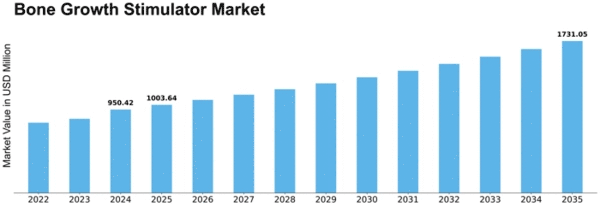
<p>The projected market valuation for the Bone Growth Stimulator Market is 1731.05 USD Million by 2035.</p>

Which companies are considered key players in the Bone Growth Stimulator Market?

<p>Key players in the Bone Growth Stimulator Market include Medtronic, Stryker, Zimmer Biomet, DePuy Synthes, Orthofix, Bioventus, Amedica Corporation, and MediTech.</p>

What was the overall market valuation of the Bone Growth Stimulator Market in 2024?

<p>The overall market valuation of the Bone Growth Stimulator Market was 950.42 USD Million in 2024.</p>

What is the expected CAGR for the Bone Growth Stimulator Market during the forecast period 2025 - 2035?

<p>The expected CAGR for the Bone Growth Stimulator Market during the forecast period 2025 - 2035 is 5.6%.</p>

How does the market valuation for Spinal Fusion compare to Non-union Fractures in 2025?

<p>In 2025, the market valuation for Spinal Fusion is projected to be between 250.0 and 450.0 USD Million, whereas Non-union Fractures is expected to range from 150.0 to 300.0 USD Million.</p>

What are the primary applications of Bone Growth Stimulators?

<p>Primary applications of Bone Growth Stimulators include Non-union Fractures, Spinal Fusion, Osteoporosis, Bone Regeneration, and Dental Applications.</p>

Which end-use segment is expected to have the highest market valuation in 2025?

<p>In 2025, the Hospitals segment is expected to have the highest market valuation, ranging from 300.0 to 550.0 USD Million.</p>

What types of Bone Growth Stimulators are available in the market?

<p>Available types of Bone Growth Stimulators include Electrical, Ultrasound, Magnetic Field, and Combination Bone Growth Stimulators.</p>

What is the market valuation range for Adult Patients in the Bone Growth Stimulator Market?

<p>The market valuation range for Adult Patients in the Bone Growth Stimulator Market is projected to be between 380.17 and 693.42 USD Million.</p>

How does the market for Geriatric Patients compare to that of Pediatric Patients?

<p>In 2025, the market valuation for Geriatric Patients is expected to range from 285.13 to 513.21 USD Million, while Pediatric Patients is projected to be between 95.04 and 173.1 USD Million.</p>

Market Summary

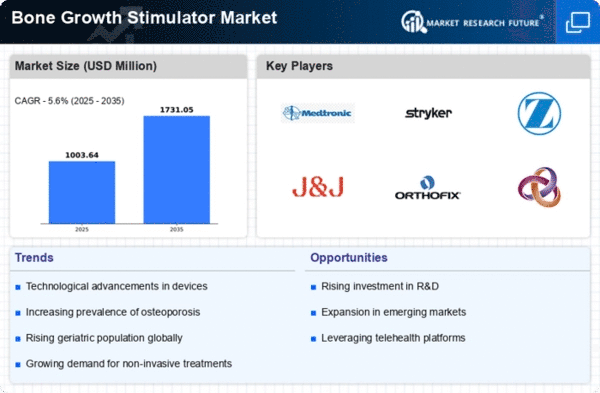
As per MRFR analysis, the Bone Growth Stimulator Market Size was estimated at 950.42 USD Million in 2024. The Bone Growth Stimulator industry is projected to grow from 1003.66 in 2025 to 1731.05 by 2035, exhibiting a compound annual growth rate (CAGR) of 5.6% during the forecast period 2026 - 2035.

Key Market Trends & Highlights

The Bone Growth Stimulator Market is poised for substantial growth driven by technological advancements and increasing awareness.

  • Technological advancements are enhancing the efficacy and usability of bone growth stimulators, particularly in North America. The integration of digital health solutions is becoming increasingly prevalent, facilitating remote monitoring and patient engagement. Spinal fusion remains the largest segment, while non-union fractures are emerging as the fastest-growing segment in the market. Rising incidence of bone disorders and increased investment in healthcare infrastructure are key drivers propelling market expansion.

Market Size & Forecast

2024 Market Size 950.42 (USD Million)
2035 Market Size 1731.05 (USD Million)
CAGR (2025 - 2035) 5.6%
Largest Regional Market Share in 2024 North America

Major Players

<p><a title="Medtronic" href="https://www.medtronic.com/en-us/l/patients/treatments-therapies/bone-grafting-spine-orthopaedic/bone-graft-options/growth-factors.html" target="_blank" rel="noopener">Medtronic</a> (US), Stryker (US), Zimmer Biomet (US), DePuy Synthes (US), Orthofix Medical (US), Bioventus (US), Amedica Corporation (US), MediTech (US)</p>

Market Trends

The Bone Growth Stimulator Market is currently experiencing a notable evolution, driven by advancements in technology and an increasing awareness of non-invasive treatment options. The bone growth stimulators market appears to be expanding as healthcare professionals and patients alike recognize the benefits of these devices in promoting bone healing and regeneration. This growth is likely influenced by a rising incidence of orthopedic conditions and an aging population, which may necessitate innovative solutions for effective treatment. Furthermore, the integration of smart technologies into bone growth stimulators suggests a shift towards more personalized and efficient patient care, potentially enhancing treatment outcomes.

In addition, the regulatory landscape surrounding medical devices is evolving, which could impact the Bone Growth Stimulator Market. Regulatory bodies are increasingly focused on ensuring safety and efficacy prompting greater attention to factors such as bone growth stimulator side effects during product development and approval.,. However, this could also encourage manufacturers to invest in research and development, fostering innovation within the sector. As the market continues to mature, collaboration between stakeholders, including manufacturers, healthcare providers, and regulatory agencies, may play a crucial role in shaping the future of bone growth stimulation therapies. Overall, the Bone Growth Stimulator Market seems poised for growth, with various factors contributing to its development and potential expansion in the coming years.

Technological Advancements

The integration of advanced technologies into bone growth stimulators is transforming treatment methodologies. Innovations such as smart sensors and mobile applications are enhancing patient monitoring and engagement, potentially leading to improved healing outcomes through more precise and consistent use of the bone growth stimulator machine in both clinical and home-care settings.. across different types of bone growth stimulators such as electrical, ultrasonic, and electromagnetic systems.

Increased Awareness and Acceptance

There appears to be a growing awareness among both healthcare providers and patients regarding the benefits of bone growth stimulators. This heightened acceptance is likely to drive demand, as more individuals seek non-invasive alternatives for bone healing. Educational initiatives and marketing efforts may further contribute to this trend, promoting the advantages of these devices.

Integration of Digital Health Solutions

The integration of digital health technologies into the Bone Growth Stimulator Market is emerging as a significant trend. The potential for remote monitoring and data analytics could enhance treatment personalization and patient engagement. This shift towards digital solutions may not only improve clinical outcomes but also streamline the management of bone healing processes.

Bone Growth Stimulator Market Market Drivers

Growing Geriatric Population

The Global Bone Growth Stimulator Market Industry is significantly influenced by the growing geriatric population worldwide. As individuals age, they become more susceptible to bone-related issues, necessitating effective treatment solutions. The increasing life expectancy and the corresponding rise in the elderly demographic are expected to drive demand for bone growth stimulators. This trend is particularly evident in developed nations, where healthcare systems are adapting to cater to the needs of older adults. The market's stability, projected at 1.76 USD Billion by 2024, indicates the long-term potential of addressing the needs of this demographic through innovative bone growth therapies.

Market Trends and Projections

The Global Bone Growth Stimulator Market Industry is characterized by a steady growth trajectory, with projections indicating a market value of 1.76 USD Billion by 2035. The compound annual growth rate (CAGR) for the period from 2025 to 2035 is expected to remain at 0.0%, suggesting a stabilization in market dynamics. This trend may reflect a maturation of the market as key players consolidate their positions and focus on enhancing product offerings rather than expanding aggressively. The market's stability could also indicate a shift towards more sustainable practices and long-term strategies in the development of bone growth stimulators.

Increasing Incidence of Bone Disorders

The Global Bone Growth Stimulator Market Industry is experiencing growth due to the rising prevalence of bone disorders such as osteoporosis and fractures. As populations age, the incidence of these conditions is expected to rise, leading to an increased demand for effective treatment options. For instance, osteoporosis affects millions globally, with a significant portion of the elderly population at risk. This demographic shift is likely to drive the market, as healthcare providers seek innovative solutions to enhance bone healing and regeneration. The market is projected to reach 1.76 USD Billion by 2024, reflecting the urgent need for advanced bone growth stimulators.

Government Support and Regulatory Approvals

Government support and favorable regulatory environments are crucial drivers for the Global Bone Growth Stimulator Market Industry. Many countries are implementing policies to promote the development and adoption of advanced medical technologies, including bone growth stimulators. Regulatory bodies are streamlining approval processes for innovative devices, which facilitates quicker market entry. This supportive framework encourages manufacturers to invest in research and development, leading to a wider range of products available to consumers. As a result, the market is poised for growth, with projections indicating a stable market value of 1.76 USD Billion by 2035, reflecting the positive impact of these initiatives.

Technological Advancements in Bone Growth Stimulators

Technological innovations are playing a pivotal role in the Global Bone Growth Stimulator Market Industry. Recent advancements in ultrasound and electrical stimulation technologies have led to the development of more effective and user-friendly devices. These innovations not only improve patient compliance but also enhance treatment outcomes. For example, portable and non-invasive stimulators are gaining traction, allowing patients to undergo treatment in the comfort of their homes. As these technologies evolve, they are expected to attract more investment and research, further propelling the market forward. The anticipated market value of 1.76 USD Billion by 2035 underscores the potential impact of these advancements.

Rising Awareness and Acceptance of Bone Growth Therapies

The Global Bone Growth Stimulator Market Industry benefits from increasing awareness and acceptance of bone growth therapies among both patients and healthcare providers. Educational initiatives and marketing campaigns have highlighted the efficacy of bone stimulators in promoting healing and reducing recovery times. As patients become more informed about their treatment options, they are more likely to seek out these therapies. Additionally, healthcare professionals are increasingly recommending bone growth stimulators as part of comprehensive treatment plans. This growing acceptance is likely to contribute to sustained market growth, as evidenced by the steady demand for these devices in clinical settings.

Market Segment Insights

By Application: Spinal Fusion (Largest) vs. Non-union Fractures (Fastest-Growing)

<p>The Bone Growth Stimulator Market showcases a diverse distribution of applications such as Non-union Fractures, Spinal Fusion, Osteoporosis, Bone Regeneration, and Dental Applications. Among these, Spinal Fusion has established itself as the largest segment, driven by the rising incidence of spinal surgeries and the widespread adoption of clinically proven solutions such as the DJO bone stimulator, which is commonly used to support postoperative bone healing.. Non-union Fractures represent a significant portion as well, with a growing share, reflecting the need for effective treatments in complex fracture cases that lack proper healing. Current trends indicate that the fastest-growing application, Non-union Fractures, is gaining traction due to advancements in bone growth technologies and increasing awareness about non-invasive solutions. Factors such as the aging population, higher incidence rates of bone-related disorders, and the rise in sports injuries contribute to the expansion of various segments, particularly those addressing urgent clinical needs such as spinal fusion and non-union conditions.</p>

<p>Spinal Fusion (Dominant) vs. Non-union Fractures (Emerging)</p>

<p><a title="Spinal fusion" href="https://www.marketresearchfuture.com/reports/spinal-fusion-market-19208" target="_blank" rel="noopener">Spinal fusion</a> remains the dominant application in the Bone Growth Stimulator Market, accounting for a major share due to the high prevalence of spinal disorders and the essential role of bone stimulators in enhancing fusion success rates. Meanwhile, non-union fractures are emerging as a critical application area, exhibiting rapid growth driven by a growing focus on improving patient outcomes and reducing recovery times. Both segments underscore the versatility of bone growth stimulators in treating various orthopedic challenges, albeit with differing maturity levels and market dynamics.</p>

By End Use: Hospitals (Largest) vs. Orthopedic Clinics (Fastest-Growing)

<p>In the Bone Growth Stimulator Market, hospitals represent the largest end-use segment, capturing a significant share due to their comprehensive orthopedic departments and advanced facilities. They offer a wide range of treatments for bone-related ailments, leading to a high demand for bone growth stimulators. Meanwhile, orthopedic clinics are gaining traction and are recognized as the fastest-growing segment, driven by rising patient preferences for specialized treatment and outpatient care. These clinics are seeing increased footfall as they provide tailored therapeutic solutions.</p>

<p>Hospitals (Dominant) vs. Orthopedic Clinics (Emerging)</p>

<p>Hospitals play a dominant role in the Bone Growth Stimulator Market as they have the infrastructure to support complex orthopedic procedures, integrating diverse technologies and specialists to optimize treatment outcomes. Their access to advanced equipment and multidisciplinary teams enhances patient care, making them the preferred choice for serious cases. On the other hand, orthopedic clinics are emerging as significant players, especially as more patients seek specialized, less invasive, and cost-effective solutions. With the trend of outpatient care on the rise, these clinics cater to growing patient populations seeking personalized treatment, positioning themselves as a vital piece of the healthcare landscape.</p>

By Product Type: Electrical Bone Growth Stimulators (Largest) vs. Ultrasound Bone Growth Stimulators (Fastest-Growing)

<p>In the Bone Growth Stimulator Market, Electrical Bone Growth Stimulators hold a significant share, emerging as the largest segment due to widespread acceptance in orthopedic practices. The growing incidence of bone-related disorders and advancements in electrical stimulation technology contribute to this dominance. In contrast, Ultrasound Bone Growth Stimulators, though currently smaller in share, are catching up rapidly, driven by innovative treatment options and the increasing focus on non-invasive therapies. Looking ahead, the market is witnessing a notable shift toward Ultrasound Bone Growth Stimulators, attributed to their effectiveness and patient-friendly application methods. This segment benefits from enhanced research initiatives and favorable regulatory approvals, positioning it as the fastest-growing category. As healthcare providers prioritize patient-centric solutions, the adoption rate for ultrasound technology is expected to accelerate, further enhancing its market footprint.</p>

<p>Product Type: Electrical Bone Growth Stimulators (Dominant) vs. Ultrasound Bone Growth Stimulators (Emerging)</p>

<p>Electrical Bone Growth Stimulators are characterized by their ability to deliver controlled electrical currents, promoting bone healing and regeneration, making them a trusted choice in clinical settings. Their established efficiency and track record solidify their position as the dominant product type in the market. On the other hand, Ultrasound Bone Growth Stimulators, which use low-intensity ultrasound to aid in bone healing, are rapidly emerging due to their non-invasive nature and increasing clinical validation. As healthcare trends shift towards less invasive treatment options, ultrasound stimulators are witnessing an uptick in adoption across various healthcare settings, thereby positioning themselves as a formidable player in the market.</p>

By Technology: Pulsed Electromagnetic Field Therapy (Largest) vs. Low-Intensity Pulsed Ultrasound (Fastest-Growing)

<p>The Bone Growth Stimulator Market is segmented into four key technologies: Pulsed Electromagnetic Field Therapy (PEMF), Low-Intensity Pulsed Ultrasound (LIPUS), Capacitive Coupling, and Inductive Coupling. Among these, PEMF holds the largest share due to its widespread adoption and established efficacy in enhancing bone healing processes. On the other hand, LIPUS is emerging as the fastest-growing segment, driven by technological advancements and increasing clinical acceptance, which cater to a broad range of orthopedic applications.</p>

<p>Technology: PEMF (Dominant) vs. LIPUS (Emerging)</p>

<p>Pulsed Electromagnetic Field Therapy (PEMF) remains the dominant technology in the Bone Growth Stimulator Market, known for its ability to significantly enhance cellular activity and promote osteogenesis. Its effectiveness in treating non-union fractures and other orthopedic conditions positions it as the preferred choice among healthcare professionals. Conversely, Low-Intensity Pulsed Ultrasound (LIPUS) is being recognized as an emerging technology with its gentle but effective approach to stimulate bone healing. It is increasingly favored for its minimal side effects and ease of use in outpatient settings, making it a popular option for patients recovering from various musculoskeletal injuries. As research continues to support its efficacy, LIPUS is poised for rapid adoption in clinical practices.</p>

By Patient Demographics: Adult Patients (Largest) vs. Pediatric Patients (Fastest-Growing)

<p>In the Bone Growth Stimulator Market, the patient demographics reveal that Adult Patients account for the largest share, driven by the prevalence of bone-related conditions among this age group. Geriatric Patients also hold a significant market share, influenced by age-associated bone fragility. Conversely, Pediatric Patients represent the fastest-growing segment, as advancements in technology and increased awareness around childhood orthopedic health propel demand. Athletes, while niche, add a dynamic aspect to the market with their specific rehabilitation needs.</p>

<p>Pediatric Patients (Emerging) vs. Geriatric Patients (Dominant)</p>

<p>The Pediatric Patients segment in the Bone Growth Stimulator Market has emerged as an area of increasing focus, characterized by a surge in demand for specialized treatment options that cater to young patients with growth-related conditions. Innovations in product design and increased clinical guidelines for treating bone issues in children further support this growing segment. On the other hand, Geriatric Patients remain the dominant segment, primarily due to the higher incidence of osteoporosis and fractures among older adults, highlighting the necessity for effective treatment solutions. Both segments showcase unique needs; while pediatric treatment emphasizes safety and efficacy, geriatric care prioritizes accessibility and convenience, reflecting their respective market dynamics.</p>

Get more detailed insights about Bone Growth Stimulator Market Research Report – Forecast till 2035

Regional Insights

North America : Market Leader in Innovation

North America continues to lead the Bone Growth Stimulator market, holding a significant share of 475.21M in 2024. The region's growth is driven by increasing incidences of orthopedic disorders, advancements in technology, and supportive regulatory frameworks. The demand for non-invasive treatment options is also rising, further propelling market expansion. Regulatory bodies are actively promoting innovations that enhance patient outcomes, contributing to a robust market environment. The competitive landscape in North America is characterized by the presence of major players such as Medtronic, Stryker, and Zimmer Biomet. These companies are investing heavily in research and development to introduce advanced products that cater to the evolving needs of healthcare providers. The U.S. remains the largest market, supported by a well-established healthcare infrastructure and a high prevalence of bone-related conditions. This competitive edge is expected to sustain growth in the coming years.

Europe : Emerging Market with Growth Potential

Europe's Bone Growth Stimulator market is valued at 275.13M, reflecting a growing demand for innovative orthopedic solutions. The region is witnessing an increase in surgical procedures and a rising elderly population, which are key drivers of market growth. Regulatory bodies are focusing on enhancing patient safety and efficacy of treatments, which is expected to further stimulate market demand. The integration of advanced technologies in medical devices is also a significant catalyst for growth in this sector. Leading countries in Europe include Germany, France, and the UK, where the presence of established healthcare systems supports market expansion. The competitive landscape features key players like DePuy Synthes and Orthofix Medical, who are actively involved in product development and strategic partnerships. The European market is characterized by a mix of established companies and emerging startups, fostering innovation and competition in the Bone Growth Stimulator sector.

Asia-Pacific : Rapidly Growing Market Segment

The Asia-Pacific Bone Growth Stimulator market, valued at 150.0M, is experiencing rapid growth driven by increasing healthcare expenditure and a rising prevalence of orthopedic conditions. The region's expanding middle class is leading to higher demand for advanced medical technologies. Additionally, government initiatives aimed at improving healthcare infrastructure are expected to further boost market growth. Regulatory frameworks are evolving to accommodate innovative treatment options, enhancing market dynamics. Countries like Japan, China, and India are at the forefront of this growth, with significant investments in healthcare technology. The competitive landscape is becoming increasingly dynamic, with both local and international players vying for market share. Companies such as Bioventus and Amedica Corporation are focusing on expanding their product offerings and enhancing distribution networks to capture the growing demand in this region.

Middle East and Africa : Emerging Market with Challenges

The Middle East and Africa Bone Growth Stimulator market is valued at 50.08M, presenting unique growth opportunities amidst various challenges. The region is witnessing an increase in orthopedic surgeries due to rising road accidents and sports injuries. However, limited healthcare infrastructure and regulatory hurdles can impede market growth. Governments are increasingly recognizing the need for improved healthcare services, which is expected to drive demand for advanced medical devices in the coming years. Countries like South Africa and the UAE are leading the market, supported by investments in healthcare infrastructure and technology. The competitive landscape is characterized by a mix of local and international players, with companies focusing on strategic partnerships to enhance their market presence. The region's potential for growth is significant, but addressing regulatory and infrastructural challenges will be crucial for sustained market development.

Key Players and Competitive Insights

The Bone Growth Stimulator Market is characterized by a dynamic competitive landscape, driven by technological advancements and an increasing prevalence of orthopedic conditions. Key players such as Medtronic (US), Stryker (US), and Zimmer Biomet (US) are at the forefront, focusing on innovation and strategic partnerships to enhance their market positions. Medtronic (US) emphasizes the integration of advanced technologies into its product offerings, while Stryker (US) is known for its aggressive acquisition strategy, which aims to expand its portfolio and market reach. Zimmer Biomet (US) is concentrating on regional expansion, particularly in emerging markets, thereby shaping a competitive environment that is increasingly collaborative and innovation-driven. In terms of business tactics, companies are localizing manufacturing to reduce costs and optimize supply chains, which is crucial in a moderately fragmented market. The collective influence of these key players is significant, as they not only compete on product efficacy but also on operational efficiency and customer engagement strategies. This competitive structure allows for a diverse range of products and services, catering to various segments within the market. In November 2025, Medtronic (US) announced a partnership with a leading AI firm to develop predictive analytics tools for bone healing processes. This strategic move is likely to enhance patient outcomes by providing personalized treatment plans, thereby reinforcing Medtronic's commitment to innovation in the Bone Growth Stimulator Market. The integration of AI into their offerings may also streamline operational efficiencies, positioning the company favorably against competitors. In October 2025, Stryker (US) completed the acquisition of a smaller biotech firm specializing in regenerative medicine. This acquisition is expected to bolster Stryker's product line and enhance its capabilities in developing next-generation bone growth stimulators. By integrating advanced regenerative technologies, Stryker aims to differentiate itself in a crowded market, potentially leading to improved patient outcomes and increased market share. In September 2025, Zimmer Biomet (US) launched a new line of bone growth stimulators that utilize bioelectrical stimulation technology. This innovative approach is anticipated to set a new standard in the market, as it offers a non-invasive solution for enhancing bone healing. The launch reflects Zimmer Biomet's strategic focus on innovation and its commitment to addressing unmet medical needs, which could significantly impact its competitive positioning. As of December 2025, the Bone Growth Stimulator Market is witnessing trends such as digitalization, sustainability, and the integration of AI technologies. Strategic alliances are increasingly shaping the competitive landscape, as companies recognize the value of collaboration in driving innovation. Looking ahead, competitive differentiation is likely to evolve from traditional price-based competition to a focus on technological advancements, product innovation, and supply chain reliability. This shift underscores the importance of agility and responsiveness in meeting the changing demands of healthcare providers and patients alike.

Key Companies in the Bone Growth Stimulator Market include

Industry Developments

The Bone Growth Stimulator Market has seen significant developments recently, with companies like CureDiva, Zimmer Biomet, Smith and Nephew, Davol Inc, BoneSupport, MediCor Health Sciences, Arthrex, Acelity, Orthofix International, Johnson and Johnson, Stryker, Samadi Group, Regeneron Pharmaceuticals, Medtronic, and Bioventus leading innovations.

Notable trends include a rise in the adoption of non-invasive treatment options, resulting in heightened market interest. The market valuation has witnessed substantial growth, positively impacting industry dynamics, driven by increasing incidences of orthopedic disorders and the aging population.

Significant events over the past couple of years include advancements in technology for better efficacy in bone healing reported as of April 2022. In terms of corporate activity, there was a merger announced in September 2023 between Zimmer Biomet and a smaller tech firm specializing in bone healing technologies, further consolidating their presence in the market. The competitive environment remains robust as these companies invest in Research and Development to enhance product offerings, which is supporting an upward trajectory in the market, alongside a growing focus on regulatory approvals for innovative devices to meet evolving patient needs.

Future Outlook

Bone Growth Stimulator Market Future Outlook

<p>The Bone Growth Stimulator Market is projected to grow at a 5.6% CAGR from 2025 to 2035, driven by technological advancements, increasing orthopedic procedures, and rising awareness of non-invasive treatment options.</p>

New opportunities lie in:

  • <p>Development of portable, user-friendly bone growth stimulators for home use. Strategic partnerships with orthopedic clinics for integrated treatment solutions. Expansion into emerging markets with tailored marketing strategies.</p>

<p>By 2035, the Bone Growth Stimulator Market is expected to achieve substantial growth and innovation.</p>

Market Segmentation

Bone Growth Stimulator Market End Use Outlook

  • Hospitals
  • Orthopedic clinics
  • Rehabilitation centers
  • Home care settings

Bone Growth Stimulator Market Technology Outlook

  • Pulsed electromagnetic field
  • Low-intensity pulsed ultrasound
  • Direct current stimulation
  • Capacitive coupling

Bone Growth Stimulator Market Application Outlook

  • Non-union fractures
  • Spinal fusion
  • Osteoporosis
  • Bone defects
  • Dental applications

Bone Growth Stimulator Market Patient Type Outlook

  • Pediatric
  • Adult
  • Geriatric
  • Athletic

Bone Growth Stimulator Market Product Type Outlook

  • Electrical stimulators
  • Ultrasound stimulators
  • Magnetic stimulators
  • Combination stimulators

Report Scope

MARKET SIZE 2024 950.42(USD Million)
MARKET SIZE 2025 1003.66(USD Million)
MARKET SIZE 2035 1731.05(USD Million)
COMPOUND ANNUAL GROWTH RATE (CAGR) 5.6% (2025 - 2035)
REPORT COVERAGE Revenue Forecast, Competitive Landscape, Growth Factors, and Trends
BASE YEAR 2024
Market Forecast Period 2026 - 2035
Historical Data 2019 - 2024
Market Forecast Units USD Million
Key Companies Profiled Medtronic (US), Stryker (US), Zimmer Biomet (US), DePuy Synthes (US), Orthofix Medical (US), Bioventus (US), Amedica Corporation (US), MediTech (US)
Segments Covered Application, End Use, Product Type, Technology, Patient Type
Key Market Opportunities Advancements in non-invasive technologies enhance patient compliance in the Bone Growth Stimulator Market.
Key Market Dynamics Technological advancements and regulatory changes drive innovation and competition in the Bone Growth Stimulator Market.
Countries Covered North America, Europe, APAC, South America, MEA

FAQs

What is the projected market valuation of the Bone Growth Stimulator Market by 2035?

<p>The projected market valuation for the Bone Growth Stimulator Market is 1731.05 USD Million by 2035.</p>

Which companies are considered key players in the Bone Growth Stimulator Market?

<p>Key players in the Bone Growth Stimulator Market include Medtronic, Stryker, Zimmer Biomet, DePuy Synthes, Orthofix, Bioventus, Amedica Corporation, and MediTech.</p>

What was the overall market valuation of the Bone Growth Stimulator Market in 2024?

<p>The overall market valuation of the Bone Growth Stimulator Market was 950.42 USD Million in 2024.</p>

What is the expected CAGR for the Bone Growth Stimulator Market during the forecast period 2025 - 2035?

<p>The expected CAGR for the Bone Growth Stimulator Market during the forecast period 2025 - 2035 is 5.6%.</p>

How does the market valuation for Spinal Fusion compare to Non-union Fractures in 2025?

<p>In 2025, the market valuation for Spinal Fusion is projected to be between 250.0 and 450.0 USD Million, whereas Non-union Fractures is expected to range from 150.0 to 300.0 USD Million.</p>

What are the primary applications of Bone Growth Stimulators?

<p>Primary applications of Bone Growth Stimulators include Non-union Fractures, Spinal Fusion, Osteoporosis, Bone Regeneration, and Dental Applications.</p>

Which end-use segment is expected to have the highest market valuation in 2025?

<p>In 2025, the Hospitals segment is expected to have the highest market valuation, ranging from 300.0 to 550.0 USD Million.</p>

What types of Bone Growth Stimulators are available in the market?

<p>Available types of Bone Growth Stimulators include Electrical, Ultrasound, Magnetic Field, and Combination Bone Growth Stimulators.</p>

What is the market valuation range for Adult Patients in the Bone Growth Stimulator Market?

<p>The market valuation range for Adult Patients in the Bone Growth Stimulator Market is projected to be between 380.17 and 693.42 USD Million.</p>

How does the market for Geriatric Patients compare to that of Pediatric Patients?

<p>In 2025, the market valuation for Geriatric Patients is expected to range from 285.13 to 513.21 USD Million, while Pediatric Patients is projected to be between 95.04 and 173.1 USD Million.</p>

  1. SECTION I: EXECUTIVE SUMMARY AND KEY HIGHLIGHTS
    1. | 1.1 EXECUTIVE SUMMARY
    2. | | 1.1.1 Market Overview
    3. | | 1.1.2 Key Findings
    4. | | 1.1.3 Market Segmentation
    5. | | 1.1.4 Competitive Landscape
    6. | | 1.1.5 Challenges and Opportunities
    7. | | 1.1.6 Future Outlook
  2. SECTION II: SCOPING, METHODOLOGY AND MARKET STRUCTURE
    1. | 2.1 MARKET INTRODUCTION
    2. | | 2.1.1 Definition
    3. | | 2.1.2 Scope of the study
    4. | | | 2.1.2.1 Research Objective
    5. | | | 2.1.2.2 Assumption
    6. | | | 2.1.2.3 Limitations
    7. | 2.2 RESEARCH METHODOLOGY
    8. | | 2.2.1 Overview
    9. | | 2.2.2 Data Mining
    10. | | 2.2.3 Secondary Research
    11. | | 2.2.4 Primary Research
    12. | | | 2.2.4.1 Primary Interviews and Information Gathering Process
    13. | | | 2.2.4.2 Breakdown of Primary Respondents
    14. | | 2.2.5 Forecasting Model
    15. | | 2.2.6 Market Size Estimation
    16. | | | 2.2.6.1 Bottom-Up Approach
    17. | | | 2.2.6.2 Top-Down Approach
    18. | | 2.2.7 Data Triangulation
    19. | | 2.2.8 Validation
  3. SECTION III: QUALITATIVE ANALYSIS
    1. | 3.1 MARKET DYNAMICS
    2. | | 3.1.1 Overview
    3. | | 3.1.2 Drivers
    4. | | 3.1.3 Restraints
    5. | | 3.1.4 Opportunities
    6. | 3.2 MARKET FACTOR ANALYSIS
    7. | | 3.2.1 Value chain Analysis
    8. | | 3.2.2 Porter's Five Forces Analysis
    9. | | | 3.2.2.1 Bargaining Power of Suppliers
    10. | | | 3.2.2.2 Bargaining Power of Buyers
    11. | | | 3.2.2.3 Threat of New Entrants
    12. | | | 3.2.2.4 Threat of Substitutes
    13. | | | 3.2.2.5 Intensity of Rivalry
    14. | | 3.2.3 COVID-19 Impact Analysis
    15. | | | 3.2.3.1 Market Impact Analysis
    16. | | | 3.2.3.2 Regional Impact
    17. | | | 3.2.3.3 Opportunity and Threat Analysis
  4. SECTION IV: QUANTITATIVE ANALYSIS
    1. | 4.1 Healthcare, BY Application (USD Million)
    2. | | 4.1.1 Non-union Fractures
    3. | | 4.1.2 Spinal Fusion
    4. | | 4.1.3 Osteoporosis
    5. | | 4.1.4 Bone Regeneration
    6. | | 4.1.5 Dental Applications
    7. | 4.2 Healthcare, BY End Use (USD Million)
    8. | | 4.2.1 Hospitals
    9. | | 4.2.2 Orthopedic Clinics
    10. | | 4.2.3 Rehabilitation Centers
    11. | | 4.2.4 Home Care Settings
    12. | 4.3 Healthcare, BY Product Type (USD Million)
    13. | | 4.3.1 Electrical Bone Growth Stimulators
    14. | | 4.3.2 Ultrasound Bone Growth Stimulators
    15. | | 4.3.3 Magnetic Field Bone Growth Stimulators
    16. | | 4.3.4 Combination Bone Growth Stimulators
    17. | 4.4 Healthcare, BY Technology (USD Million)
    18. | | 4.4.1 Pulsed Electromagnetic Field Therapy
    19. | | 4.4.2 Low-Intensity Pulsed Ultrasound
    20. | | 4.4.3 Capacitive Coupling
    21. | | 4.4.4 Inductive Coupling
    22. | 4.5 Healthcare, BY Patient Demographics (USD Million)
    23. | | 4.5.1 Pediatric Patients
    24. | | 4.5.2 Adult Patients
    25. | | 4.5.3 Geriatric Patients
    26. | | 4.5.4 Athletes
    27. | 4.6 Healthcare, BY Region (USD Million)
    28. | | 4.6.1 North America
    29. | | | 4.6.1.1 US
    30. | | | 4.6.1.2 Canada
    31. | | 4.6.2 Europe
    32. | | | 4.6.2.1 Germany
    33. | | | 4.6.2.2 UK
    34. | | | 4.6.2.3 France
    35. | | | 4.6.2.4 Russia
    36. | | | 4.6.2.5 Italy
    37. | | | 4.6.2.6 Spain
    38. | | | 4.6.2.7 Rest of Europe
    39. | | 4.6.3 APAC
    40. | | | 4.6.3.1 China
    41. | | | 4.6.3.2 India
    42. | | | 4.6.3.3 Japan
    43. | | | 4.6.3.4 South Korea
    44. | | | 4.6.3.5 Malaysia
    45. | | | 4.6.3.6 Thailand
    46. | | | 4.6.3.7 Indonesia
    47. | | | 4.6.3.8 Rest of APAC
    48. | | 4.6.4 South America
    49. | | | 4.6.4.1 Brazil
    50. | | | 4.6.4.2 Mexico
    51. | | | 4.6.4.3 Argentina
    52. | | | 4.6.4.4 Rest of South America
    53. | | 4.6.5 MEA
    54. | | | 4.6.5.1 GCC Countries
    55. | | | 4.6.5.2 South Africa
    56. | | | 4.6.5.3 Rest of MEA
  5. SECTION V: COMPETITIVE ANALYSIS
    1. | 5.1 Competitive Landscape
    2. | | 5.1.1 Overview
    3. | | 5.1.2 Competitive Analysis
    4. | | 5.1.3 Market share Analysis
    5. | | 5.1.4 Major Growth Strategy in the Healthcare
    6. | | 5.1.5 Competitive Benchmarking
    7. | | 5.1.6 Leading Players in Terms of Number of Developments in the Healthcare
    8. | | 5.1.7 Key developments and growth strategies
    9. | | | 5.1.7.1 New Product Launch/Service Deployment
    10. | | | 5.1.7.2 Merger & Acquisitions
    11. | | | 5.1.7.3 Joint Ventures
    12. | | 5.1.8 Major Players Financial Matrix
    13. | | | 5.1.8.1 Sales and Operating Income
    14. | | | 5.1.8.2 Major Players R&D Expenditure. 2023
    15. | 5.2 Company Profiles
    16. | | 5.2.1 Medtronic (US)
    17. | | | 5.2.1.1 Financial Overview
    18. | | | 5.2.1.2 Products Offered
    19. | | | 5.2.1.3 Key Developments
    20. | | | 5.2.1.4 SWOT Analysis
    21. | | | 5.2.1.5 Key Strategies
    22. | | 5.2.2 Stryker (US)
    23. | | | 5.2.2.1 Financial Overview
    24. | | | 5.2.2.2 Products Offered
    25. | | | 5.2.2.3 Key Developments
    26. | | | 5.2.2.4 SWOT Analysis
    27. | | | 5.2.2.5 Key Strategies
    28. | | 5.2.3 Zimmer Biomet (US)
    29. | | | 5.2.3.1 Financial Overview
    30. | | | 5.2.3.2 Products Offered
    31. | | | 5.2.3.3 Key Developments
    32. | | | 5.2.3.4 SWOT Analysis
    33. | | | 5.2.3.5 Key Strategies
    34. | | 5.2.4 DePuy Synthes (US)
    35. | | | 5.2.4.1 Financial Overview
    36. | | | 5.2.4.2 Products Offered
    37. | | | 5.2.4.3 Key Developments
    38. | | | 5.2.4.4 SWOT Analysis
    39. | | | 5.2.4.5 Key Strategies
    40. | | 5.2.5 Orthofix (US)
    41. | | | 5.2.5.1 Financial Overview
    42. | | | 5.2.5.2 Products Offered
    43. | | | 5.2.5.3 Key Developments
    44. | | | 5.2.5.4 SWOT Analysis
    45. | | | 5.2.5.5 Key Strategies
    46. | | 5.2.6 Bioventus (US)
    47. | | | 5.2.6.1 Financial Overview
    48. | | | 5.2.6.2 Products Offered
    49. | | | 5.2.6.3 Key Developments
    50. | | | 5.2.6.4 SWOT Analysis
    51. | | | 5.2.6.5 Key Strategies
    52. | | 5.2.7 Amedica Corporation (US)
    53. | | | 5.2.7.1 Financial Overview
    54. | | | 5.2.7.2 Products Offered
    55. | | | 5.2.7.3 Key Developments
    56. | | | 5.2.7.4 SWOT Analysis
    57. | | | 5.2.7.5 Key Strategies
    58. | | 5.2.8 MediTech (US)
    59. | | | 5.2.8.1 Financial Overview
    60. | | | 5.2.8.2 Products Offered
    61. | | | 5.2.8.3 Key Developments
    62. | | | 5.2.8.4 SWOT Analysis
    63. | | | 5.2.8.5 Key Strategies
    64. | 5.3 Appendix
    65. | | 5.3.1 References
    66. | | 5.3.2 Related Reports
  6. LIST OF FIGURES
    1. | 6.1 MARKET SYNOPSIS
    2. | 6.2 NORTH AMERICA MARKET ANALYSIS
    3. | 6.3 US MARKET ANALYSIS BY APPLICATION
    4. | 6.4 US MARKET ANALYSIS BY END USE
    5. | 6.5 US MARKET ANALYSIS BY PRODUCT TYPE
    6. | 6.6 US MARKET ANALYSIS BY TECHNOLOGY
    7. | 6.7 US MARKET ANALYSIS BY PATIENT DEMOGRAPHICS
    8. | 6.8 CANADA MARKET ANALYSIS BY APPLICATION
    9. | 6.9 CANADA MARKET ANALYSIS BY END USE
    10. | 6.10 CANADA MARKET ANALYSIS BY PRODUCT TYPE
    11. | 6.11 CANADA MARKET ANALYSIS BY TECHNOLOGY
    12. | 6.12 CANADA MARKET ANALYSIS BY PATIENT DEMOGRAPHICS
    13. | 6.13 EUROPE MARKET ANALYSIS
    14. | 6.14 GERMANY MARKET ANALYSIS BY APPLICATION
    15. | 6.15 GERMANY MARKET ANALYSIS BY END USE
    16. | 6.16 GERMANY MARKET ANALYSIS BY PRODUCT TYPE
    17. | 6.17 GERMANY MARKET ANALYSIS BY TECHNOLOGY
    18. | 6.18 GERMANY MARKET ANALYSIS BY PATIENT DEMOGRAPHICS
    19. | 6.19 UK MARKET ANALYSIS BY APPLICATION
    20. | 6.20 UK MARKET ANALYSIS BY END USE
    21. | 6.21 UK MARKET ANALYSIS BY PRODUCT TYPE
    22. | 6.22 UK MARKET ANALYSIS BY TECHNOLOGY
    23. | 6.23 UK MARKET ANALYSIS BY PATIENT DEMOGRAPHICS
    24. | 6.24 FRANCE MARKET ANALYSIS BY APPLICATION
    25. | 6.25 FRANCE MARKET ANALYSIS BY END USE
    26. | 6.26 FRANCE MARKET ANALYSIS BY PRODUCT TYPE
    27. | 6.27 FRANCE MARKET ANALYSIS BY TECHNOLOGY
    28. | 6.28 FRANCE MARKET ANALYSIS BY PATIENT DEMOGRAPHICS
    29. | 6.29 RUSSIA MARKET ANALYSIS BY APPLICATION
    30. | 6.30 RUSSIA MARKET ANALYSIS BY END USE
    31. | 6.31 RUSSIA MARKET ANALYSIS BY PRODUCT TYPE
    32. | 6.32 RUSSIA MARKET ANALYSIS BY TECHNOLOGY
    33. | 6.33 RUSSIA MARKET ANALYSIS BY PATIENT DEMOGRAPHICS
    34. | 6.34 ITALY MARKET ANALYSIS BY APPLICATION
    35. | 6.35 ITALY MARKET ANALYSIS BY END USE
    36. | 6.36 ITALY MARKET ANALYSIS BY PRODUCT TYPE
    37. | 6.37 ITALY MARKET ANALYSIS BY TECHNOLOGY
    38. | 6.38 ITALY MARKET ANALYSIS BY PATIENT DEMOGRAPHICS
    39. | 6.39 SPAIN MARKET ANALYSIS BY APPLICATION
    40. | 6.40 SPAIN MARKET ANALYSIS BY END USE
    41. | 6.41 SPAIN MARKET ANALYSIS BY PRODUCT TYPE
    42. | 6.42 SPAIN MARKET ANALYSIS BY TECHNOLOGY
    43. | 6.43 SPAIN MARKET ANALYSIS BY PATIENT DEMOGRAPHICS
    44. | 6.44 REST OF EUROPE MARKET ANALYSIS BY APPLICATION
    45. | 6.45 REST OF EUROPE MARKET ANALYSIS BY END USE
    46. | 6.46 REST OF EUROPE MARKET ANALYSIS BY PRODUCT TYPE
    47. | 6.47 REST OF EUROPE MARKET ANALYSIS BY TECHNOLOGY
    48. | 6.48 REST OF EUROPE MARKET ANALYSIS BY PATIENT DEMOGRAPHICS
    49. | 6.49 APAC MARKET ANALYSIS
    50. | 6.50 CHINA MARKET ANALYSIS BY APPLICATION
    51. | 6.51 CHINA MARKET ANALYSIS BY END USE
    52. | 6.52 CHINA MARKET ANALYSIS BY PRODUCT TYPE
    53. | 6.53 CHINA MARKET ANALYSIS BY TECHNOLOGY
    54. | 6.54 CHINA MARKET ANALYSIS BY PATIENT DEMOGRAPHICS
    55. | 6.55 INDIA MARKET ANALYSIS BY APPLICATION
    56. | 6.56 INDIA MARKET ANALYSIS BY END USE
    57. | 6.57 INDIA MARKET ANALYSIS BY PRODUCT TYPE
    58. | 6.58 INDIA MARKET ANALYSIS BY TECHNOLOGY
    59. | 6.59 INDIA MARKET ANALYSIS BY PATIENT DEMOGRAPHICS
    60. | 6.60 JAPAN MARKET ANALYSIS BY APPLICATION
    61. | 6.61 JAPAN MARKET ANALYSIS BY END USE
    62. | 6.62 JAPAN MARKET ANALYSIS BY PRODUCT TYPE
    63. | 6.63 JAPAN MARKET ANALYSIS BY TECHNOLOGY
    64. | 6.64 JAPAN MARKET ANALYSIS BY PATIENT DEMOGRAPHICS
    65. | 6.65 SOUTH KOREA MARKET ANALYSIS BY APPLICATION
    66. | 6.66 SOUTH KOREA MARKET ANALYSIS BY END USE
    67. | 6.67 SOUTH KOREA MARKET ANALYSIS BY PRODUCT TYPE
    68. | 6.68 SOUTH KOREA MARKET ANALYSIS BY TECHNOLOGY
    69. | 6.69 SOUTH KOREA MARKET ANALYSIS BY PATIENT DEMOGRAPHICS
    70. | 6.70 MALAYSIA MARKET ANALYSIS BY APPLICATION
    71. | 6.71 MALAYSIA MARKET ANALYSIS BY END USE
    72. | 6.72 MALAYSIA MARKET ANALYSIS BY PRODUCT TYPE
    73. | 6.73 MALAYSIA MARKET ANALYSIS BY TECHNOLOGY
    74. | 6.74 MALAYSIA MARKET ANALYSIS BY PATIENT DEMOGRAPHICS
    75. | 6.75 THAILAND MARKET ANALYSIS BY APPLICATION
    76. | 6.76 THAILAND MARKET ANALYSIS BY END USE
    77. | 6.77 THAILAND MARKET ANALYSIS BY PRODUCT TYPE
    78. | 6.78 THAILAND MARKET ANALYSIS BY TECHNOLOGY
    79. | 6.79 THAILAND MARKET ANALYSIS BY PATIENT DEMOGRAPHICS
    80. | 6.80 INDONESIA MARKET ANALYSIS BY APPLICATION
    81. | 6.81 INDONESIA MARKET ANALYSIS BY END USE
    82. | 6.82 INDONESIA MARKET ANALYSIS BY PRODUCT TYPE
    83. | 6.83 INDONESIA MARKET ANALYSIS BY TECHNOLOGY
    84. | 6.84 INDONESIA MARKET ANALYSIS BY PATIENT DEMOGRAPHICS
    85. | 6.85 REST OF APAC MARKET ANALYSIS BY APPLICATION
    86. | 6.86 REST OF APAC MARKET ANALYSIS BY END USE
    87. | 6.87 REST OF APAC MARKET ANALYSIS BY PRODUCT TYPE
    88. | 6.88 REST OF APAC MARKET ANALYSIS BY TECHNOLOGY
    89. | 6.89 REST OF APAC MARKET ANALYSIS BY PATIENT DEMOGRAPHICS
    90. | 6.90 SOUTH AMERICA MARKET ANALYSIS
    91. | 6.91 BRAZIL MARKET ANALYSIS BY APPLICATION
    92. | 6.92 BRAZIL MARKET ANALYSIS BY END USE
    93. | 6.93 BRAZIL MARKET ANALYSIS BY PRODUCT TYPE
    94. | 6.94 BRAZIL MARKET ANALYSIS BY TECHNOLOGY
    95. | 6.95 BRAZIL MARKET ANALYSIS BY PATIENT DEMOGRAPHICS
    96. | 6.96 MEXICO MARKET ANALYSIS BY APPLICATION
    97. | 6.97 MEXICO MARKET ANALYSIS BY END USE
    98. | 6.98 MEXICO MARKET ANALYSIS BY PRODUCT TYPE
    99. | 6.99 MEXICO MARKET ANALYSIS BY TECHNOLOGY
    100. | 6.100 MEXICO MARKET ANALYSIS BY PATIENT DEMOGRAPHICS
    101. | 6.101 ARGENTINA MARKET ANALYSIS BY APPLICATION
    102. | 6.102 ARGENTINA MARKET ANALYSIS BY END USE
    103. | 6.103 ARGENTINA MARKET ANALYSIS BY PRODUCT TYPE
    104. | 6.104 ARGENTINA MARKET ANALYSIS BY TECHNOLOGY
    105. | 6.105 ARGENTINA MARKET ANALYSIS BY PATIENT DEMOGRAPHICS
    106. | 6.106 REST OF SOUTH AMERICA MARKET ANALYSIS BY APPLICATION
    107. | 6.107 REST OF SOUTH AMERICA MARKET ANALYSIS BY END USE
    108. | 6.108 REST OF SOUTH AMERICA MARKET ANALYSIS BY PRODUCT TYPE
    109. | 6.109 REST OF SOUTH AMERICA MARKET ANALYSIS BY TECHNOLOGY
    110. | 6.110 REST OF SOUTH AMERICA MARKET ANALYSIS BY PATIENT DEMOGRAPHICS
    111. | 6.111 MEA MARKET ANALYSIS
    112. | 6.112 GCC COUNTRIES MARKET ANALYSIS BY APPLICATION
    113. | 6.113 GCC COUNTRIES MARKET ANALYSIS BY END USE
    114. | 6.114 GCC COUNTRIES MARKET ANALYSIS BY PRODUCT TYPE
    115. | 6.115 GCC COUNTRIES MARKET ANALYSIS BY TECHNOLOGY
    116. | 6.116 GCC COUNTRIES MARKET ANALYSIS BY PATIENT DEMOGRAPHICS
    117. | 6.117 SOUTH AFRICA MARKET ANALYSIS BY APPLICATION
    118. | 6.118 SOUTH AFRICA MARKET ANALYSIS BY END USE
    119. | 6.119 SOUTH AFRICA MARKET ANALYSIS BY PRODUCT TYPE
    120. | 6.120 SOUTH AFRICA MARKET ANALYSIS BY TECHNOLOGY
    121. | 6.121 SOUTH AFRICA MARKET ANALYSIS BY PATIENT DEMOGRAPHICS
    122. | 6.122 REST OF MEA MARKET ANALYSIS BY APPLICATION
    123. | 6.123 REST OF MEA MARKET ANALYSIS BY END USE
    124. | 6.124 REST OF MEA MARKET ANALYSIS BY PRODUCT TYPE
    125. | 6.125 REST OF MEA MARKET ANALYSIS BY TECHNOLOGY
    126. | 6.126 REST OF MEA MARKET ANALYSIS BY PATIENT DEMOGRAPHICS
    127. | 6.127 KEY BUYING CRITERIA OF HEALTHCARE
    128. | 6.128 RESEARCH PROCESS OF MRFR
    129. | 6.129 DRO ANALYSIS OF HEALTHCARE
    130. | 6.130 DRIVERS IMPACT ANALYSIS: HEALTHCARE
    131. | 6.131 RESTRAINTS IMPACT ANALYSIS: HEALTHCARE
    132. | 6.132 SUPPLY / VALUE CHAIN: HEALTHCARE
    133. | 6.133 HEALTHCARE, BY APPLICATION, 2024 (% SHARE)
    134. | 6.134 HEALTHCARE, BY APPLICATION, 2024 TO 2035 (USD Million)
    135. | 6.135 HEALTHCARE, BY END USE, 2024 (% SHARE)
    136. | 6.136 HEALTHCARE, BY END USE, 2024 TO 2035 (USD Million)
    137. | 6.137 HEALTHCARE, BY PRODUCT TYPE, 2024 (% SHARE)
    138. | 6.138 HEALTHCARE, BY PRODUCT TYPE, 2024 TO 2035 (USD Million)
    139. | 6.139 HEALTHCARE, BY TECHNOLOGY, 2024 (% SHARE)
    140. | 6.140 HEALTHCARE, BY TECHNOLOGY, 2024 TO 2035 (USD Million)
    141. | 6.141 HEALTHCARE, BY PATIENT DEMOGRAPHICS, 2024 (% SHARE)
    142. | 6.142 HEALTHCARE, BY PATIENT DEMOGRAPHICS, 2024 TO 2035 (USD Million)
    143. | 6.143 BENCHMARKING OF MAJOR COMPETITORS
  7. LIST OF TABLES
    1. | 7.1 LIST OF ASSUMPTIONS
    2. | | 7.1.1
    3. | 7.2 North America MARKET SIZE ESTIMATES; FORECAST
    4. | | 7.2.1 BY APPLICATION, 2025-2035 (USD Million)
    5. | | 7.2.2 BY END USE, 2025-2035 (USD Million)
    6. | | 7.2.3 BY PRODUCT TYPE, 2025-2035 (USD Million)
    7. | | 7.2.4 BY TECHNOLOGY, 2025-2035 (USD Million)
    8. | | 7.2.5 BY PATIENT DEMOGRAPHICS, 2025-2035 (USD Million)
    9. | 7.3 US MARKET SIZE ESTIMATES; FORECAST
    10. | | 7.3.1 BY APPLICATION, 2025-2035 (USD Million)
    11. | | 7.3.2 BY END USE, 2025-2035 (USD Million)
    12. | | 7.3.3 BY PRODUCT TYPE, 2025-2035 (USD Million)
    13. | | 7.3.4 BY TECHNOLOGY, 2025-2035 (USD Million)
    14. | | 7.3.5 BY PATIENT DEMOGRAPHICS, 2025-2035 (USD Million)
    15. | 7.4 Canada MARKET SIZE ESTIMATES; FORECAST
    16. | | 7.4.1 BY APPLICATION, 2025-2035 (USD Million)
    17. | | 7.4.2 BY END USE, 2025-2035 (USD Million)
    18. | | 7.4.3 BY PRODUCT TYPE, 2025-2035 (USD Million)
    19. | | 7.4.4 BY TECHNOLOGY, 2025-2035 (USD Million)
    20. | | 7.4.5 BY PATIENT DEMOGRAPHICS, 2025-2035 (USD Million)
    21. | 7.5 Europe MARKET SIZE ESTIMATES; FORECAST
    22. | | 7.5.1 BY APPLICATION, 2025-2035 (USD Million)
    23. | | 7.5.2 BY END USE, 2025-2035 (USD Million)
    24. | | 7.5.3 BY PRODUCT TYPE, 2025-2035 (USD Million)
    25. | | 7.5.4 BY TECHNOLOGY, 2025-2035 (USD Million)
    26. | | 7.5.5 BY PATIENT DEMOGRAPHICS, 2025-2035 (USD Million)
    27. | 7.6 Germany MARKET SIZE ESTIMATES; FORECAST
    28. | | 7.6.1 BY APPLICATION, 2025-2035 (USD Million)
    29. | | 7.6.2 BY END USE, 2025-2035 (USD Million)
    30. | | 7.6.3 BY PRODUCT TYPE, 2025-2035 (USD Million)
    31. | | 7.6.4 BY TECHNOLOGY, 2025-2035 (USD Million)
    32. | | 7.6.5 BY PATIENT DEMOGRAPHICS, 2025-2035 (USD Million)
    33. | 7.7 UK MARKET SIZE ESTIMATES; FORECAST
    34. | | 7.7.1 BY APPLICATION, 2025-2035 (USD Million)
    35. | | 7.7.2 BY END USE, 2025-2035 (USD Million)
    36. | | 7.7.3 BY PRODUCT TYPE, 2025-2035 (USD Million)
    37. | | 7.7.4 BY TECHNOLOGY, 2025-2035 (USD Million)
    38. | | 7.7.5 BY PATIENT DEMOGRAPHICS, 2025-2035 (USD Million)
    39. | 7.8 France MARKET SIZE ESTIMATES; FORECAST
    40. | | 7.8.1 BY APPLICATION, 2025-2035 (USD Million)
    41. | | 7.8.2 BY END USE, 2025-2035 (USD Million)
    42. | | 7.8.3 BY PRODUCT TYPE, 2025-2035 (USD Million)
    43. | | 7.8.4 BY TECHNOLOGY, 2025-2035 (USD Million)
    44. | | 7.8.5 BY PATIENT DEMOGRAPHICS, 2025-2035 (USD Million)
    45. | 7.9 Russia MARKET SIZE ESTIMATES; FORECAST
    46. | | 7.9.1 BY APPLICATION, 2025-2035 (USD Million)
    47. | | 7.9.2 BY END USE, 2025-2035 (USD Million)
    48. | | 7.9.3 BY PRODUCT TYPE, 2025-2035 (USD Million)
    49. | | 7.9.4 BY TECHNOLOGY, 2025-2035 (USD Million)
    50. | | 7.9.5 BY PATIENT DEMOGRAPHICS, 2025-2035 (USD Million)
    51. | 7.10 Italy MARKET SIZE ESTIMATES; FORECAST
    52. | | 7.10.1 BY APPLICATION, 2025-2035 (USD Million)
    53. | | 7.10.2 BY END USE, 2025-2035 (USD Million)
    54. | | 7.10.3 BY PRODUCT TYPE, 2025-2035 (USD Million)
    55. | | 7.10.4 BY TECHNOLOGY, 2025-2035 (USD Million)
    56. | | 7.10.5 BY PATIENT DEMOGRAPHICS, 2025-2035 (USD Million)
    57. | 7.11 Spain MARKET SIZE ESTIMATES; FORECAST
    58. | | 7.11.1 BY APPLICATION, 2025-2035 (USD Million)
    59. | | 7.11.2 BY END USE, 2025-2035 (USD Million)
    60. | | 7.11.3 BY PRODUCT TYPE, 2025-2035 (USD Million)
    61. | | 7.11.4 BY TECHNOLOGY, 2025-2035 (USD Million)
    62. | | 7.11.5 BY PATIENT DEMOGRAPHICS, 2025-2035 (USD Million)
    63. | 7.12 Rest of Europe MARKET SIZE ESTIMATES; FORECAST
    64. | | 7.12.1 BY APPLICATION, 2025-2035 (USD Million)
    65. | | 7.12.2 BY END USE, 2025-2035 (USD Million)
    66. | | 7.12.3 BY PRODUCT TYPE, 2025-2035 (USD Million)
    67. | | 7.12.4 BY TECHNOLOGY, 2025-2035 (USD Million)
    68. | | 7.12.5 BY PATIENT DEMOGRAPHICS, 2025-2035 (USD Million)
    69. | 7.13 APAC MARKET SIZE ESTIMATES; FORECAST
    70. | | 7.13.1 BY APPLICATION, 2025-2035 (USD Million)
    71. | | 7.13.2 BY END USE, 2025-2035 (USD Million)
    72. | | 7.13.3 BY PRODUCT TYPE, 2025-2035 (USD Million)
    73. | | 7.13.4 BY TECHNOLOGY, 2025-2035 (USD Million)
    74. | | 7.13.5 BY PATIENT DEMOGRAPHICS, 2025-2035 (USD Million)
    75. | 7.14 China MARKET SIZE ESTIMATES; FORECAST
    76. | | 7.14.1 BY APPLICATION, 2025-2035 (USD Million)
    77. | | 7.14.2 BY END USE, 2025-2035 (USD Million)
    78. | | 7.14.3 BY PRODUCT TYPE, 2025-2035 (USD Million)
    79. | | 7.14.4 BY TECHNOLOGY, 2025-2035 (USD Million)
    80. | | 7.14.5 BY PATIENT DEMOGRAPHICS, 2025-2035 (USD Million)
    81. | 7.15 India MARKET SIZE ESTIMATES; FORECAST
    82. | | 7.15.1 BY APPLICATION, 2025-2035 (USD Million)
    83. | | 7.15.2 BY END USE, 2025-2035 (USD Million)
    84. | | 7.15.3 BY PRODUCT TYPE, 2025-2035 (USD Million)
    85. | | 7.15.4 BY TECHNOLOGY, 2025-2035 (USD Million)
    86. | | 7.15.5 BY PATIENT DEMOGRAPHICS, 2025-2035 (USD Million)
    87. | 7.16 Japan MARKET SIZE ESTIMATES; FORECAST
    88. | | 7.16.1 BY APPLICATION, 2025-2035 (USD Million)
    89. | | 7.16.2 BY END USE, 2025-2035 (USD Million)
    90. | | 7.16.3 BY PRODUCT TYPE, 2025-2035 (USD Million)
    91. | | 7.16.4 BY TECHNOLOGY, 2025-2035 (USD Million)
    92. | | 7.16.5 BY PATIENT DEMOGRAPHICS, 2025-2035 (USD Million)
    93. | 7.17 South Korea MARKET SIZE ESTIMATES; FORECAST
    94. | | 7.17.1 BY APPLICATION, 2025-2035 (USD Million)
    95. | | 7.17.2 BY END USE, 2025-2035 (USD Million)
    96. | | 7.17.3 BY PRODUCT TYPE, 2025-2035 (USD Million)
    97. | | 7.17.4 BY TECHNOLOGY, 2025-2035 (USD Million)
    98. | | 7.17.5 BY PATIENT DEMOGRAPHICS, 2025-2035 (USD Million)
    99. | 7.18 Malaysia MARKET SIZE ESTIMATES; FORECAST
    100. | | 7.18.1 BY APPLICATION, 2025-2035 (USD Million)
    101. | | 7.18.2 BY END USE, 2025-2035 (USD Million)
    102. | | 7.18.3 BY PRODUCT TYPE, 2025-2035 (USD Million)
    103. | | 7.18.4 BY TECHNOLOGY, 2025-2035 (USD Million)
    104. | | 7.18.5 BY PATIENT DEMOGRAPHICS, 2025-2035 (USD Million)
    105. | 7.19 Thailand MARKET SIZE ESTIMATES; FORECAST
    106. | | 7.19.1 BY APPLICATION, 2025-2035 (USD Million)
    107. | | 7.19.2 BY END USE, 2025-2035 (USD Million)
    108. | | 7.19.3 BY PRODUCT TYPE, 2025-2035 (USD Million)
    109. | | 7.19.4 BY TECHNOLOGY, 2025-2035 (USD Million)
    110. | | 7.19.5 BY PATIENT DEMOGRAPHICS, 2025-2035 (USD Million)
    111. | 7.20 Indonesia MARKET SIZE ESTIMATES; FORECAST
    112. | | 7.20.1 BY APPLICATION, 2025-2035 (USD Million)
    113. | | 7.20.2 BY END USE, 2025-2035 (USD Million)
    114. | | 7.20.3 BY PRODUCT TYPE, 2025-2035 (USD Million)
    115. | | 7.20.4 BY TECHNOLOGY, 2025-2035 (USD Million)
    116. | | 7.20.5 BY PATIENT DEMOGRAPHICS, 2025-2035 (USD Million)
    117. | 7.21 Rest of APAC MARKET SIZE ESTIMATES; FORECAST
    118. | | 7.21.1 BY APPLICATION, 2025-2035 (USD Million)
    119. | | 7.21.2 BY END USE, 2025-2035 (USD Million)
    120. | | 7.21.3 BY PRODUCT TYPE, 2025-2035 (USD Million)
    121. | | 7.21.4 BY TECHNOLOGY, 2025-2035 (USD Million)
    122. | | 7.21.5 BY PATIENT DEMOGRAPHICS, 2025-2035 (USD Million)
    123. | 7.22 South America MARKET SIZE ESTIMATES; FORECAST
    124. | | 7.22.1 BY APPLICATION, 2025-2035 (USD Million)
    125. | | 7.22.2 BY END USE, 2025-2035 (USD Million)
    126. | | 7.22.3 BY PRODUCT TYPE, 2025-2035 (USD Million)
    127. | | 7.22.4 BY TECHNOLOGY, 2025-2035 (USD Million)
    128. | | 7.22.5 BY PATIENT DEMOGRAPHICS, 2025-2035 (USD Million)
    129. | 7.23 Brazil MARKET SIZE ESTIMATES; FORECAST
    130. | | 7.23.1 BY APPLICATION, 2025-2035 (USD Million)
    131. | | 7.23.2 BY END USE, 2025-2035 (USD Million)
    132. | | 7.23.3 BY PRODUCT TYPE, 2025-2035 (USD Million)
    133. | | 7.23.4 BY TECHNOLOGY, 2025-2035 (USD Million)
    134. | | 7.23.5 BY PATIENT DEMOGRAPHICS, 2025-2035 (USD Million)
    135. | 7.24 Mexico MARKET SIZE ESTIMATES; FORECAST
    136. | | 7.24.1 BY APPLICATION, 2025-2035 (USD Million)
    137. | | 7.24.2 BY END USE, 2025-2035 (USD Million)
    138. | | 7.24.3 BY PRODUCT TYPE, 2025-2035 (USD Million)
    139. | | 7.24.4 BY TECHNOLOGY, 2025-2035 (USD Million)
    140. | | 7.24.5 BY PATIENT DEMOGRAPHICS, 2025-2035 (USD Million)
    141. | 7.25 Argentina MARKET SIZE ESTIMATES; FORECAST
    142. | | 7.25.1 BY APPLICATION, 2025-2035 (USD Million)
    143. | | 7.25.2 BY END USE, 2025-2035 (USD Million)
    144. | | 7.25.3 BY PRODUCT TYPE, 2025-2035 (USD Million)
    145. | | 7.25.4 BY TECHNOLOGY, 2025-2035 (USD Million)
    146. | | 7.25.5 BY PATIENT DEMOGRAPHICS, 2025-2035 (USD Million)
    147. | 7.26 Rest of South America MARKET SIZE ESTIMATES; FORECAST
    148. | | 7.26.1 BY APPLICATION, 2025-2035 (USD Million)
    149. | | 7.26.2 BY END USE, 2025-2035 (USD Million)
    150. | | 7.26.3 BY PRODUCT TYPE, 2025-2035 (USD Million)
    151. | | 7.26.4 BY TECHNOLOGY, 2025-2035 (USD Million)
    152. | | 7.26.5 BY PATIENT DEMOGRAPHICS, 2025-2035 (USD Million)
    153. | 7.27 MEA MARKET SIZE ESTIMATES; FORECAST
    154. | | 7.27.1 BY APPLICATION, 2025-2035 (USD Million)
    155. | | 7.27.2 BY END USE, 2025-2035 (USD Million)
    156. | | 7.27.3 BY PRODUCT TYPE, 2025-2035 (USD Million)
    157. | | 7.27.4 BY TECHNOLOGY, 2025-2035 (USD Million)
    158. | | 7.27.5 BY PATIENT DEMOGRAPHICS, 2025-2035 (USD Million)
    159. | 7.28 GCC Countries MARKET SIZE ESTIMATES; FORECAST
    160. | | 7.28.1 BY APPLICATION, 2025-2035 (USD Million)
    161. | | 7.28.2 BY END USE, 2025-2035 (USD Million)
    162. | | 7.28.3 BY PRODUCT TYPE, 2025-2035 (USD Million)
    163. | | 7.28.4 BY TECHNOLOGY, 2025-2035 (USD Million)
    164. | | 7.28.5 BY PATIENT DEMOGRAPHICS, 2025-2035 (USD Million)
    165. | 7.29 South Africa MARKET SIZE ESTIMATES; FORECAST
    166. | | 7.29.1 BY APPLICATION, 2025-2035 (USD Million)
    167. | | 7.29.2 BY END USE, 2025-2035 (USD Million)
    168. | | 7.29.3 BY PRODUCT TYPE, 2025-2035 (USD Million)
    169. | | 7.29.4 BY TECHNOLOGY, 2025-2035 (USD Million)
    170. | | 7.29.5 BY PATIENT DEMOGRAPHICS, 2025-2035 (USD Million)
    171. | 7.30 Rest of MEA MARKET SIZE ESTIMATES; FORECAST
    172. | | 7.30.1 BY APPLICATION, 2025-2035 (USD Million)
    173. | | 7.30.2 BY END USE, 2025-2035 (USD Million)
    174. | | 7.30.3 BY PRODUCT TYPE, 2025-2035 (USD Million)
    175. | | 7.30.4 BY TECHNOLOGY, 2025-2035 (USD Million)
    176. | | 7.30.5 BY PATIENT DEMOGRAPHICS, 2025-2035 (USD Million)
    177. | 7.31 PRODUCT LAUNCH/PRODUCT DEVELOPMENT/APPROVAL
    178. | | 7.31.1
    179. | 7.32 ACQUISITION/PARTNERSHIP
    180. | | 7.32.1

Healthcare Market Segmentation

Healthcare By Application (USD Million, 2025-2035)

  • Non-union Fractures
  • Spinal Fusion
  • Osteoporosis
  • Bone Regeneration
  • Dental Applications

Healthcare By End Use (USD Million, 2025-2035)

  • Hospitals
  • Orthopedic Clinics
  • Rehabilitation Centers
  • Home Care Settings

Healthcare By Product Type (USD Million, 2025-2035)

  • Electrical Bone Growth Stimulators
  • Ultrasound Bone Growth Stimulators
  • Magnetic Field Bone Growth Stimulators
  • Combination Bone Growth Stimulators

Healthcare By Technology (USD Million, 2025-2035)

  • Pulsed Electromagnetic Field Therapy
  • Low-Intensity Pulsed Ultrasound
  • Capacitive Coupling
  • Inductive Coupling

Healthcare By Patient Demographics (USD Million, 2025-2035)

  • Pediatric Patients
  • Adult Patients
  • Geriatric Patients
  • Athletes
Infographic

Free Sample Request

Kindly complete the form below to receive a free sample of this Report

Get Free Sample

Customer Strories

Compare Licence

×
Features License Type
Single User Multiuser License Enterprise User
Price $4,950 $5,950 $7,250
Maximum User Access Limit 1 User Upto 10 Users Unrestricted Access Throughout the Organization
Free Customization
Direct Access to Analyst
Deliverable Format
Platform Access
Discount on Next Purchase 10% 15% 15%
Printable Versions
%>