Request Free Sample ×

Kindly complete the form below to receive a free sample of this Report

* Please use a valid business email

Leading companies partner with us for data-driven Insights

clients tt-cursor
Hero Background
English
Chinese
French
Japanese
Korean
German
Spanish

Blood Pressure Test Market Share

ID: MRFR/LS/4043-HCR
110 Pages
Vikita Thakur
March 2026

Blood Pressure Test Market Research Report: by-product (sphygmomanometers, blood pressure transducers & instrument accessories), indication (hypertension, coronary heart disease), end-user (hospital & clinic and diagnostic center) -Forecast till 2035

Share:
Download PDF ×

We do not share your information with anyone. However, we may send you emails based on your report interest from time to time. You may contact us at any time to opt-out.

Blood Pressure Test Market Infographic
Purchase Options

Market Share

Blood Pressure Test Market Share Analysis

The Blood Pressure Test market is a vital element of the healthcare enterprise, as it performs a pivotal role in tracking and dealing with cardiovascular health. Various agencies vie for market dominance, and their fulfillment is regularly decided by means of effective marketplace share positioning strategies. Establishing the proper pricing method is important for marketplace percentage. Some agencies' consciousness of affordability concentrated on a broader consumer base, while others positioned themselves as top-class manufacturers, emphasizing advanced technology and precision and targeting upscale markets. Understanding the various customer bases allows agencies to hire powerful segmentation strategies. They may additionally develop specialized devices for exceptional demographics, consisting of home users, healthcare specialists, or unique age companies, addressing specific wishes and options within every section. The choice of distribution channels is critical in attaining the target audience. Companies may opt for conventional channels like pharmacies and healthcare establishments or embrace e-trade systems to beautify accessibility. The proper mix relies upon the character of the product and the options of the give-up users. Building a strong brand presence is crucial for marketplace proportion positioning. Effective advertising campaigns, online presence, and educational projects can create recognition and acceptance as true among consumers, influencing their selections when deciding on Blood Pressure Testing gadgets. Adhering to regulatory standards and acquiring certifications are essential issues of market share positioning in the healthcare industry. Compliance instills self-assurance among healthcare specialists and patients, organizing credibility for the logo. Collaborations with healthcare establishments, research organizations, or generation companions can enhance a company's marketplace percentage positioning. These partnerships may additionally cause innovative tendencies, studies-backed merchandise, and expanded marketplace attained through established networks. To maximize marketplace share, groups frequently pursue worldwide enlargement. Understanding and adapting to regional variations in healthcare practices, policies, and customer options allow corporations to faucet into diverse markets and develop their patron base.


Author
Author Profile
Vikita Thakur
Senior Research Analyst

She holds an experience of about 5+ years in market research and business consulting projects for sectors such as life sciences, medical devices, and healthcare IT. She possesses a robust background in data analysis, market estimation, competitive intelligence, pipeline analysis market trend identification, and consumer behavior insights. Her expertise lies in technical Sales support, client interaction and project management, designing and implementing market research studies, conducting competitive analysis, and synthesizing complex data into actionable recommendations that drive business growth.

Leave a Comment

FAQs

What is the projected market valuation of the Blood Pressure Test Market by 2035?

<p>The Blood Pressure Test Market is projected to reach a valuation of 5.298 USD Billion by 2035.</p>

What was the market valuation of the Blood Pressure Test Market in 2024?

<p>In 2024, the Blood Pressure Test Market was valued at 1.99 USD Billion.</p>

What is the expected CAGR for the Blood Pressure Test Market during the forecast period 2025 - 2035?

<p>The expected CAGR for the Blood Pressure Test Market during the forecast period 2025 - 2035 is 9.31%.</p>

Which product segment is anticipated to have the highest growth in the Blood Pressure Test Market?

<p>The sphygmomanometers segment is anticipated to grow from 0.9 USD Billion in 2024 to 2.4 USD Billion by 2035.</p>

What are the key indications driving the Blood Pressure Test Market?

<p>Hypertension is a key indication, projected to grow from 0.99 USD Billion in 2024 to 2.64 USD Billion by 2035.</p>

Which end-user segment is expected to dominate the Blood Pressure Test Market?

The hospitals &amp; clinics segment is expected to dominate, growing from 0.8 USD Billion in 2024 to 1.8 USD Billion by 2035.

Who are the leading players in the Blood Pressure Test Market?

Key players in the Blood Pressure Test Market include Omron Healthcare, A&amp;D Company, Philips, and Roche.

What is the growth potential for blood pressure instrument accessories in the market?

Blood pressure instrument accessories are projected to grow from 0.4 USD Billion in 2024 to 1.1 USD Billion by 2035.

How does the market for blood pressure transducers compare to other segments?

The blood pressure transducers segment is expected to grow from 0.5 USD Billion in 2024 to 1.3 USD Billion by 2035, indicating robust growth.

What is the growth outlook for home care as an end-user segment in the Blood Pressure Test Market?

The home care segment is projected to grow from 0.4 USD Billion in 2024 to 1.0 USD Billion by 2035, reflecting increasing demand.

Market Summary

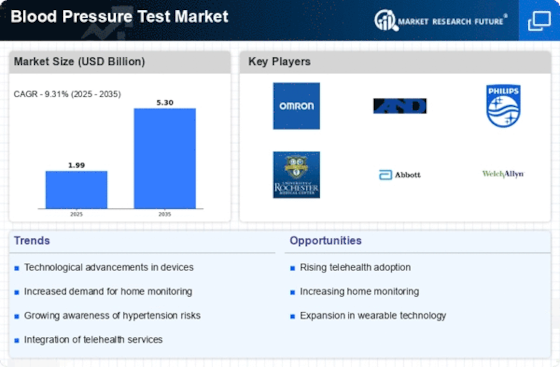
As per Market Research Future analysis, the Blood Pressure Test Market Size was estimated at 1.99 USD Billion in 2024. The Blood Pressure Test industry is projected to grow from 2.175 USD Billion in 2025 to 5.298 USD Billion by 2035, exhibiting a compound annual growth rate (CAGR) of 9.31% during the forecast period 2025 - 2035

Key Market Trends & Highlights

The Blood Pressure Test Market is experiencing a transformative shift towards home monitoring and digital integration.

  • The rise of home monitoring devices is reshaping patient engagement and self-management of blood pressure. Integration of digital health solutions is enhancing data accessibility and real-time monitoring capabilities. The focus on personalized healthcare is driving tailored treatment approaches for hypertension and coronary heart disease. Increasing prevalence of hypertension and technological advancements in testing devices are key drivers propelling market growth.

Market Size & Forecast

2024 Market Size 1.99 (USD Billion)
2035 Market Size 5.298 (USD Billion)
CAGR (2025 - 2035) 9.31%
Largest Regional Market Share in 2024 Americas

Major Players

Omron Healthcare (JP), A&amp;D Company (JP), Philips (NL), Roche (CH), Abbott Laboratories (US), Welch Allyn (US), Microlife (CH), Schiller AG (CH), SunTech Medical (US)

Market Trends

The Blood Pressure Test Market is currently experiencing a notable evolution, driven by a confluence of technological advancements and an increasing awareness of cardiovascular health. The proliferation of home monitoring devices appears to be reshaping consumer behavior, as individuals seek more convenient and accessible methods for tracking their blood pressure. This trend is further supported by a growing emphasis on preventive healthcare, which encourages regular monitoring to mitigate the risks associated with hypertension. Additionally, the integration of digital health solutions, such as mobile applications and telemedicine, seems to enhance patient engagement and adherence to treatment protocols, thereby fostering a more proactive approach to managing blood pressure levels. Moreover, the Blood Pressure Test Market is witnessing a shift towards personalized healthcare solutions. This shift is characterized by the development of advanced diagnostic tools that cater to individual patient needs, potentially improving the accuracy of readings and the overall effectiveness of treatment plans. As healthcare providers increasingly adopt these innovative technologies, the market is likely to expand, reflecting a broader trend towards tailored medical interventions. In this dynamic landscape, stakeholders must remain vigilant to emerging trends and consumer preferences, as these factors will undoubtedly shape the future trajectory of the Blood Pressure Test Market.

Rise of Home Monitoring Devices

The Blood Pressure Test Market is seeing a surge in the adoption of home monitoring devices. These tools offer convenience and empower individuals to take charge of their health by regularly checking their blood pressure in a familiar environment. This trend aligns with the growing preference for self-management in healthcare.

Integration of Digital Health Solutions

Digital health solutions are becoming increasingly prevalent within the Blood Pressure Test Market. The incorporation of mobile applications and telehealth services facilitates better patient engagement and adherence to treatment regimens. This integration may lead to improved health outcomes and a more informed patient population.

Focus on Personalized Healthcare

There is a noticeable shift towards personalized healthcare within the Blood Pressure Test Market. Advanced diagnostic tools are being developed to cater to individual patient requirements, potentially enhancing the accuracy of blood pressure readings and treatment effectiveness. This trend reflects a broader movement towards tailored medical interventions.

Blood Pressure Test Market Market Drivers

Increasing Prevalence of Hypertension

The rising incidence of hypertension is a primary driver for the Blood Pressure Test Market. According to health statistics, nearly 1.13 billion people worldwide suffer from hypertension, with a significant portion remaining undiagnosed. This alarming trend necessitates regular blood pressure monitoring, thereby propelling demand for testing devices. As healthcare systems increasingly prioritize early detection and management of hypertension, the market for blood pressure testing is expected to expand. Furthermore, the World Health Organization emphasizes the importance of regular blood pressure checks, which could lead to a surge in the adoption of both home and clinical testing devices. Consequently, the Blood Pressure Test Market is likely to witness robust growth as awareness about hypertension and its complications continues to rise.

Regulatory Support and Health Policies

Regulatory support and favorable health policies are pivotal in shaping the Blood Pressure Test Market. Governments and health organizations are increasingly recognizing the importance of hypertension management, leading to the implementation of policies that promote regular blood pressure testing. Initiatives aimed at improving access to healthcare services, particularly in underserved areas, are likely to enhance the availability of blood pressure testing devices. Additionally, reimbursement policies for blood pressure monitoring services are becoming more favorable, encouraging both healthcare providers and patients to prioritize regular testing. This supportive regulatory environment is expected to stimulate growth in the Blood Pressure Test Market, as it aligns with broader public health goals of reducing the burden of hypertension and related diseases.

Growing Awareness of Preventive Healthcare

There is a notable shift towards preventive healthcare, which significantly influences the Blood Pressure Test Market. As individuals become more health-conscious, the demand for regular health screenings, including blood pressure tests, is on the rise. Educational campaigns by health organizations are fostering awareness about the risks associated with uncontrolled blood pressure, leading to increased testing. In fact, studies suggest that regular monitoring can reduce the risk of cardiovascular diseases by up to 30%. This growing emphasis on preventive measures is likely to drive the adoption of blood pressure testing devices, both in clinical settings and at home. Consequently, the Blood Pressure Test Market is poised for growth as more individuals seek proactive health management solutions.

Technological Advancements in Testing Devices

Technological innovations are transforming the Blood Pressure Test Market, enhancing the accuracy and convenience of blood pressure monitoring. Recent advancements include the development of wearable devices and smartphone applications that allow for continuous monitoring and data tracking. These innovations not only improve user experience but also facilitate timely interventions. The integration of artificial intelligence and machine learning in blood pressure monitors is also noteworthy, as it enables predictive analytics for better health outcomes. As these technologies become more accessible and affordable, they are expected to drive market growth. The increasing consumer preference for smart health solutions further indicates a shift towards more sophisticated blood pressure testing methods, thereby expanding the Blood Pressure Test Market.

Aging Population and Chronic Disease Management

The aging population is a significant factor contributing to the expansion of the Blood Pressure Test Market. As individuals age, the likelihood of developing hypertension and other chronic diseases increases. The World Health Organization projects that the number of people aged 60 years and older will reach 2 billion by 2050, creating a substantial demand for effective chronic disease management solutions. Blood pressure monitoring is a critical component of managing these conditions, leading to an increased need for testing devices. Healthcare providers are also focusing on tailored treatment plans for older adults, which often include regular blood pressure assessments. This demographic trend is expected to drive sustained growth in the Blood Pressure Test Market as healthcare systems adapt to meet the needs of an aging population.

Market Segment Insights

By Product: Sphygmomanometers (Largest) vs. Blood Pressure Transducers (Fastest-Growing)

The Blood Pressure Test Market is primarily segmented into sphygmomanometers, blood pressure transducers, blood pressure instrument accessories, and others. Among these, sphygmomanometers hold the largest market share due to their traditional usage and reliability in measuring blood pressure. Blood pressure transducers are gaining traction because of their precision and integration capabilities with electronic health records, thus catering to the evolving needs of healthcare providers. Growth trends in this segment indicate a shift towards automated and digital solutions, with increasing preferences for telehealth and remote monitoring services. This is driving the demand for blood pressure transducers, while sphygmomanometers remain essential for routine check-ups. The surge in chronic diseases and an aging population are further propelling the growth of both segment values, emphasizing the need for continuous monitoring of blood pressure levels.

Sphygmomanometers (Dominant) vs. Blood Pressure Transducers (Emerging)

Sphygmomanometers have long been the dominant choice in clinical settings, providing dependable and accurate blood pressure readings. They are available in both manual and electronic forms, catering to varied user preferences. Their widespread recognition and established presence in the market enhance their appeal among healthcare professionals. In contrast, blood pressure transducers are emerging as a significant player, particularly in hospital settings. These devices offer high accuracy and can quickly relay data to integrated healthcare systems, improving patient management. The versatility of transducers in various applications—from critical care monitoring to outpatient settings—coupled with advancements in wireless technology, positions them as a sought-after solution in modern healthcare.

By Indication: Hypertension (Largest) vs. Coronary Heart Disease (Fastest-Growing)

The Blood Pressure Test Market is primarily segmented into hypertension, coronary heart disease, and other indications. Among these, hypertension holds the largest market share, driven by the high prevalence of this condition globally. The growing awareness of hypertension screening and diagnosis contributes significantly to its dominant position. Meanwhile, coronary heart disease is emerging as the fastest-growing segment, reflecting increasing awareness and prevalence, linked to lifestyle changes and an aging population.

Hypertension (Dominant) vs. Coronary Heart Disease (Emerging)

Hypertension is the dominant segment within the Blood Pressure Test Market, representing a critical focus area due to its widespread impact on public health. This condition necessitates regular monitoring, leading to higher demand for various blood pressure testing devices. In contrast, coronary heart disease is emerging as a significant and rapidly growing segment, as awareness about heart health continues to rise. It is characterized by a complex interplay of factors including dietary habits, physical inactivity, and genetic predispositions, creating a strong need for frequent blood pressure assessment in this population, thereby contributing to its fast growth.

By End User: Hospitals & Clinics (Largest) vs. Home Care (Fastest-Growing)

The Blood Pressure Test Market is primarily segmented into hospitals &amp; clinics, diagnostic centers, home care, and others. Hospitals and clinics dominate this sector, capturing the largest share as they are the primary institutions for patient care and regular monitoring of blood pressure. Diagnostic centers also hold a significant portion, as they provide specialized testing services. In contrast, the home care segment is witnessing a rapid increase in adoption due to the growing trend of remote monitoring and patient self-management, allowing individuals to monitor their health in the comfort of their home.

Hospitals &amp; Clinics (Dominant) vs. Home Care (Emerging)

Hospitals and clinics stand as the dominant players in the Blood Pressure Test Market, characterized by their extensive infrastructure, skilled personnel, and availability of advanced diagnostic equipment. They conduct significant volumes of blood pressure tests and often have established protocols for patient assessment and follow-up. On the other hand, the home care segment is emerging rapidly, driven by technological advancements in portable devices and increasing awareness of hypertension management. Consumers are increasingly looking for convenience and affordability, making home monitoring devices appealing. This trend is further accelerated by the COVID-19 pandemic, which has emphasized the importance of home healthcare solutions.

Get more detailed insights about Blood Pressure Test Market Research Report - Forecast till 2035

Regional Insights

North America : Healthcare Innovation Leader

North America is the largest market for blood pressure testing, holding approximately 40% of the global share. The region's growth is driven by increasing prevalence of hypertension, technological advancements in monitoring devices, and supportive healthcare policies. Regulatory bodies like the FDA are actively promoting innovations in medical devices, enhancing market dynamics. The United States leads the market, followed by Canada, with a strong presence of key players such as Omron Healthcare and Abbott Laboratories. The competitive landscape is characterized by continuous product innovations and strategic partnerships among leading companies, ensuring a robust supply chain and distribution network.

Europe : Regulatory Framework Strength

Europe is the second-largest market for blood pressure testing, accounting for around 30% of the global market share. The region's growth is fueled by an aging population, rising awareness of cardiovascular diseases, and stringent regulations that ensure high-quality medical devices. The European Medicines Agency (EMA) plays a crucial role in regulating these devices, fostering innovation while ensuring safety. Leading countries include Germany, France, and the UK, where companies like Philips and Roche are prominent. The competitive landscape is marked by a mix of established players and emerging startups, focusing on advanced technologies such as telemedicine and digital health solutions to enhance patient monitoring and care.

Asia-Pacific : Emerging Market Potential

Asia-Pacific is witnessing rapid growth in the blood pressure testing market, driven by increasing healthcare expenditure, rising awareness of hypertension, and a growing elderly population. The region holds approximately 25% of the global market share, with countries like China and India leading the charge. Government initiatives aimed at improving healthcare infrastructure are further propelling market growth. China is the largest market in the region, followed by Japan and India, where key players like A&D Company and Microlife are expanding their presence. The competitive landscape is evolving, with local manufacturers emerging alongside global giants, focusing on affordability and accessibility of blood pressure monitoring devices.

Middle East and Africa : Untapped Market Opportunities

The Middle East and Africa region is gradually emerging in the blood pressure testing market, holding about 5% of the global share. Growth is driven by increasing healthcare initiatives, rising awareness of hypertension, and government investments in healthcare infrastructure. Countries like South Africa and the UAE are leading the market, supported by regulatory frameworks that encourage the adoption of advanced medical technologies. South Africa is the largest market in the region, with a growing number of healthcare facilities adopting modern blood pressure monitoring solutions. The competitive landscape is characterized by a mix of local and international players, focusing on improving access to quality healthcare and innovative monitoring solutions.

Key Players and Competitive Insights

The Blood Pressure Test Market is currently characterized by a dynamic competitive landscape, driven by increasing awareness of hypertension and the growing prevalence of cardiovascular diseases globally. Key players such as Omron Healthcare (Japan), Philips (Netherlands), and Abbott Laboratories (US) are strategically positioned to leverage innovation and technological advancements. Omron Healthcare (Japan) focuses on integrating digital health solutions into its product offerings, enhancing user engagement and data analytics capabilities. Meanwhile, Philips (Netherlands) emphasizes its commitment to health technology, aiming to provide comprehensive solutions that encompass both hardware and software, thereby creating a holistic approach to blood pressure management. Abbott Laboratories (US) is also making strides in this arena, particularly through its focus on remote patient monitoring and telehealth solutions, which are increasingly relevant in today's healthcare environment.

The market structure appears moderately fragmented, with a mix of established players and emerging companies vying for market share. Key business tactics such as localizing manufacturing and optimizing supply chains are becoming increasingly prevalent among these companies. For instance, many firms are investing in regional production facilities to reduce lead times and enhance responsiveness to local market demands. This strategy not only mitigates supply chain risks but also allows for better alignment with regulatory requirements across different regions.

In August 2025, Omron Healthcare (Japan) launched a new line of advanced blood pressure monitors that incorporate AI-driven analytics to provide personalized health insights. This strategic move is significant as it positions Omron at the forefront of the digital health revolution, catering to a growing consumer demand for smart health devices that offer more than just basic monitoring capabilities. The integration of AI is likely to enhance user experience and improve health outcomes, thereby solidifying Omron's competitive edge.

In September 2025, Philips (Netherlands) announced a partnership with a leading telehealth platform to enhance its blood pressure monitoring solutions. This collaboration aims to integrate Philips' devices with telehealth services, allowing for seamless data sharing between patients and healthcare providers. The strategic importance of this partnership lies in its potential to improve patient engagement and adherence to treatment plans, which is crucial in managing chronic conditions like hypertension. By aligning with telehealth services, Philips is not only expanding its market reach but also reinforcing its commitment to innovative healthcare solutions.

In July 2025, Abbott Laboratories (US) introduced a new blood pressure monitoring device that features cloud connectivity and real-time data sharing capabilities. This development is particularly noteworthy as it reflects Abbott's strategic focus on enhancing patient monitoring through technology. The ability to share data in real-time with healthcare professionals could lead to more timely interventions and better management of hypertension, thereby addressing a critical need in the healthcare system.

As of October 2025, the competitive trends in the Blood Pressure Test Market are increasingly defined by digitalization, sustainability, and the integration of artificial intelligence. Strategic alliances are playing a pivotal role in shaping the current landscape, enabling companies to pool resources and expertise to drive innovation. Looking ahead, it appears that competitive differentiation will increasingly hinge on technological advancements and supply chain reliability, rather than solely on price. Companies that prioritize innovation and adaptability are likely to emerge as leaders in this evolving market.

Key Companies in the Blood Pressure Test Market include

Industry Developments

New Product Launches and Approvals

In January 2024, Movano Health had released outcomes of its blood tension clinical study sanctioned by the Institutional Review Board (IRB). The company’s prototype with integrated System-on-Chip (SoC) has reached the accuracy level required by the Food and Drug Administration (FDA) for blood pressure monitoring devices.

Valencell announced plans to introduce a line of branded products under the digital health category during its announcement in January 2023, justifying it as an innovative way to bring reverse solutions for chronic diseases. Valencell will also be the first cuff-less, calibration-free blood pressure monitor that can fit on a fingertip on Earth. This solution may be applied independently as a BP monitor. However, when used together with an app, this device is anticipated to have significant importance in HTN control.

For example, InBody introduced the new automatic BP monitor BP170 allowing self-recording and tracking of key health measurements at home during February 2022. Similarly, increasing adoption of home care health monitoring along with an increased focus on early diagnosis of hypertension & cardiac diseases is further expected to push up growth in the market.

In February 2020, Hillrom announced the commercial release of a new device called Welch Allyn Spot Vital Signs 4400, which is an easy-to-use next-generation vital signs monitor used to enhance hypertension detection in ambulatory & emergency department settings.

Strategic Collaborations and Acquisitions

In August 2023, Spacelabs Healthcare took part in the AHA’s Hypertension Scientific Sessions 2023. The firm stated how vital 24-hour ambulatory blood pressure monitoring is to managing hypertension better than any other method as it enables more accurate prediction of heart and vascular diseases, morbidity as well as mortality rates.

Hillrom acquired contact-free continuous monitoring technology from EarlySense at a sum of $30 million dollars, according to the company’s announcement last year around February. Consequently, this acquisition will enable Hillrom to develop next-gen AI-based sensing technologies specifically designed for remote patient care business.

Biobeat launched wearable chest-mounted continuous ABPM systems this May 1.

Blood Pressure Test Market Trends

The blood pressure test market is driven by rising prevalence of chronic diseases such as cardiovascular diseases, hypertension, diabetes, and others. Furthermore, changing lifestyle, and increasing demand for diagnostic devices for cardiovascular diseases is facilitating the market growth.

However, a limited number of trained personnel has restrained the growth of the market. However, the high cost of diagnosis and treatment of cardiovascular diseases restrains the growth of the market.

According to the WHO, about 59% of the mortality is due to chronic diseases, and almost 35 million people die of chronic diseases in the world. Cardiovascular diseases and diabetes are increasing the economic burden of various developing and developed nations across the globe.

Intended Audience

  • Medical Device Manufacturers
  • Medical Device Suppliers
  • Medical Research Laboratories
  • Research and Development (R&D) Companies
  • Market Research and Consulting Service Providers
  • Potential Investors

Blood Pressure Test Market Segment Insights

The blood pressure test market is segmented on the basis of product, indication, and end user.

Future Outlook

Blood Pressure Test Market Future Outlook

The Blood Pressure Test Market is projected to grow at a 9.31% CAGR from 2025 to 2035, driven by technological advancements, increasing health awareness, and rising prevalence of hypertension.

New opportunities lie in:

  • <p>Development of AI-driven remote monitoring solutions Expansion of home-based blood pressure testing devices Integration of blood pressure tests with telehealth platforms</p>

By 2035, the market is expected to be robust, reflecting substantial growth and innovation.

Market Segmentation

Blood Pressure Test Market Product Outlook

  • sphygmomanometers
  • blood pressure transducers
  • blood pressure instrument accessories
  • others

Blood Pressure Test Market End User Outlook

  • hospitals & clinics
  • diagnostic centers
  • home care
  • others

Blood Pressure Test Market Indication Outlook

  • hypertension
  • coronary heart disease
  • others

Report Scope

MARKET SIZE 2024 1.99(USD Billion)
MARKET SIZE 2025 2.175(USD Billion)
MARKET SIZE 2035 5.298(USD Billion)
COMPOUND ANNUAL GROWTH RATE (CAGR) 9.31% (2025 - 2035)
REPORT COVERAGE Revenue Forecast, Competitive Landscape, Growth Factors, and Trends
BASE YEAR 2024
Market Forecast Period 2025 - 2035
Historical Data 2019 - 2024
Market Forecast Units USD Billion
Key Companies Profiled Omron Healthcare (JP), A&D Company (JP), Philips (NL), Roche (CH), Abbott Laboratories (US), Welch Allyn (US), Microlife (CH), Schiller AG (CH), SunTech Medical (US)
Segments Covered Market segmentation analysis in progress
Key Market Opportunities Integration of telehealth solutions enhances accessibility in the Blood Pressure Test Market.
Key Market Dynamics Rising consumer awareness and technological advancements drive innovation in the Blood Pressure Test Market.
Countries Covered North America, Europe, APAC, South America, MEA

FAQs

What is the projected market valuation of the Blood Pressure Test Market by 2035?

<p>The Blood Pressure Test Market is projected to reach a valuation of 5.298 USD Billion by 2035.</p>

What was the market valuation of the Blood Pressure Test Market in 2024?

<p>In 2024, the Blood Pressure Test Market was valued at 1.99 USD Billion.</p>

What is the expected CAGR for the Blood Pressure Test Market during the forecast period 2025 - 2035?

<p>The expected CAGR for the Blood Pressure Test Market during the forecast period 2025 - 2035 is 9.31%.</p>

Which product segment is anticipated to have the highest growth in the Blood Pressure Test Market?

<p>The sphygmomanometers segment is anticipated to grow from 0.9 USD Billion in 2024 to 2.4 USD Billion by 2035.</p>

What are the key indications driving the Blood Pressure Test Market?

<p>Hypertension is a key indication, projected to grow from 0.99 USD Billion in 2024 to 2.64 USD Billion by 2035.</p>

Which end-user segment is expected to dominate the Blood Pressure Test Market?

The hospitals &amp; clinics segment is expected to dominate, growing from 0.8 USD Billion in 2024 to 1.8 USD Billion by 2035.

Who are the leading players in the Blood Pressure Test Market?

Key players in the Blood Pressure Test Market include Omron Healthcare, A&amp;D Company, Philips, and Roche.

What is the growth potential for blood pressure instrument accessories in the market?

Blood pressure instrument accessories are projected to grow from 0.4 USD Billion in 2024 to 1.1 USD Billion by 2035.

How does the market for blood pressure transducers compare to other segments?

The blood pressure transducers segment is expected to grow from 0.5 USD Billion in 2024 to 1.3 USD Billion by 2035, indicating robust growth.

What is the growth outlook for home care as an end-user segment in the Blood Pressure Test Market?

The home care segment is projected to grow from 0.4 USD Billion in 2024 to 1.0 USD Billion by 2035, reflecting increasing demand.

  1. SECTION I: EXECUTIVE SUMMARY AND KEY HIGHLIGHTS
    1. | 1.1 EXECUTIVE SUMMARY
    2. | | 1.1.1 Market Overview
    3. | | 1.1.2 Key Findings
    4. | | 1.1.3 Market Segmentation
    5. | | 1.1.4 Competitive Landscape
    6. | | 1.1.5 Challenges and Opportunities
    7. | | 1.1.6 Future Outlook
  2. SECTION II: SCOPING, METHODOLOGY AND MARKET STRUCTURE
    1. | 2.1 MARKET INTRODUCTION
    2. | | 2.1.1 Definition
    3. | | 2.1.2 Scope of the study
    4. | | | 2.1.2.1 Research Objective
    5. | | | 2.1.2.2 Assumption
    6. | | | 2.1.2.3 Limitations
    7. | 2.2 RESEARCH METHODOLOGY
    8. | | 2.2.1 Overview
    9. | | 2.2.2 Data Mining
    10. | | 2.2.3 Secondary Research
    11. | | 2.2.4 Primary Research
    12. | | | 2.2.4.1 Primary Interviews and Information Gathering Process
    13. | | | 2.2.4.2 Breakdown of Primary Respondents
    14. | | 2.2.5 Forecasting Model
    15. | | 2.2.6 Market Size Estimation
    16. | | | 2.2.6.1 Bottom-Up Approach
    17. | | | 2.2.6.2 Top-Down Approach
    18. | | 2.2.7 Data Triangulation
    19. | | 2.2.8 Validation
  3. SECTION III: QUALITATIVE ANALYSIS
    1. | 3.1 MARKET DYNAMICS
    2. | | 3.1.1 Overview
    3. | | 3.1.2 Drivers
    4. | | 3.1.3 Restraints
    5. | | 3.1.4 Opportunities
    6. | 3.2 MARKET FACTOR ANALYSIS
    7. | | 3.2.1 Value chain Analysis
    8. | | 3.2.2 Porter's Five Forces Analysis
    9. | | | 3.2.2.1 Bargaining Power of Suppliers
    10. | | | 3.2.2.2 Bargaining Power of Buyers
    11. | | | 3.2.2.3 Threat of New Entrants
    12. | | | 3.2.2.4 Threat of Substitutes
    13. | | | 3.2.2.5 Intensity of Rivalry
    14. | | 3.2.3 COVID-19 Impact Analysis
    15. | | | 3.2.3.1 Market Impact Analysis
    16. | | | 3.2.3.2 Regional Impact
    17. | | | 3.2.3.3 Opportunity and Threat Analysis
  4. SECTION IV: QUANTITATIVE ANALYSIS
    1. | 4.1 Healthcare, BY Product (USD Billion)
    2. | | 4.1.1 sphygmomanometers
    3. | | 4.1.2 blood pressure transducers
    4. | | 4.1.3 blood pressure instrument accessories
    5. | | 4.1.4 others
    6. | 4.2 Healthcare, BY Indication (USD Billion)
    7. | | 4.2.1 hypertension
    8. | | 4.2.2 coronary heart disease
    9. | | 4.2.3 others
    10. | 4.3 Healthcare, BY End User (USD Billion)
    11. | | 4.3.1 hospitals & clinics
    12. | | 4.3.2 diagnostic centers
    13. | | 4.3.3 home care
    14. | | 4.3.4 others
    15. | 4.4 Healthcare, BY Region (USD Billion)
    16. | | 4.4.1 North America
    17. | | | 4.4.1.1 US
    18. | | | 4.4.1.2 Canada
    19. | | 4.4.2 Europe
    20. | | | 4.4.2.1 Germany
    21. | | | 4.4.2.2 UK
    22. | | | 4.4.2.3 France
    23. | | | 4.4.2.4 Russia
    24. | | | 4.4.2.5 Italy
    25. | | | 4.4.2.6 Spain
    26. | | | 4.4.2.7 Rest of Europe
    27. | | 4.4.3 APAC
    28. | | | 4.4.3.1 China
    29. | | | 4.4.3.2 India
    30. | | | 4.4.3.3 Japan
    31. | | | 4.4.3.4 South Korea
    32. | | | 4.4.3.5 Malaysia
    33. | | | 4.4.3.6 Thailand
    34. | | | 4.4.3.7 Indonesia
    35. | | | 4.4.3.8 Rest of APAC
    36. | | 4.4.4 South America
    37. | | | 4.4.4.1 Brazil
    38. | | | 4.4.4.2 Mexico
    39. | | | 4.4.4.3 Argentina
    40. | | | 4.4.4.4 Rest of South America
    41. | | 4.4.5 MEA
    42. | | | 4.4.5.1 GCC Countries
    43. | | | 4.4.5.2 South Africa
    44. | | | 4.4.5.3 Rest of MEA
  5. SECTION V: COMPETITIVE ANALYSIS
    1. | 5.1 Competitive Landscape
    2. | | 5.1.1 Overview
    3. | | 5.1.2 Competitive Analysis
    4. | | 5.1.3 Market share Analysis
    5. | | 5.1.4 Major Growth Strategy in the Healthcare
    6. | | 5.1.5 Competitive Benchmarking
    7. | | 5.1.6 Leading Players in Terms of Number of Developments in the Healthcare
    8. | | 5.1.7 Key developments and growth strategies
    9. | | | 5.1.7.1 New Product Launch/Service Deployment
    10. | | | 5.1.7.2 Merger & Acquisitions
    11. | | | 5.1.7.3 Joint Ventures
    12. | | 5.1.8 Major Players Financial Matrix
    13. | | | 5.1.8.1 Sales and Operating Income
    14. | | | 5.1.8.2 Major Players R&D Expenditure. 2023
    15. | 5.2 Company Profiles
    16. | | 5.2.1 Omron Healthcare (JP)
    17. | | | 5.2.1.1 Financial Overview
    18. | | | 5.2.1.2 Products Offered
    19. | | | 5.2.1.3 Key Developments
    20. | | | 5.2.1.4 SWOT Analysis
    21. | | | 5.2.1.5 Key Strategies
    22. | | 5.2.2 A&D Company (JP)
    23. | | | 5.2.2.1 Financial Overview
    24. | | | 5.2.2.2 Products Offered
    25. | | | 5.2.2.3 Key Developments
    26. | | | 5.2.2.4 SWOT Analysis
    27. | | | 5.2.2.5 Key Strategies
    28. | | 5.2.3 Philips (NL)
    29. | | | 5.2.3.1 Financial Overview
    30. | | | 5.2.3.2 Products Offered
    31. | | | 5.2.3.3 Key Developments
    32. | | | 5.2.3.4 SWOT Analysis
    33. | | | 5.2.3.5 Key Strategies
    34. | | 5.2.4 Roche (CH)
    35. | | | 5.2.4.1 Financial Overview
    36. | | | 5.2.4.2 Products Offered
    37. | | | 5.2.4.3 Key Developments
    38. | | | 5.2.4.4 SWOT Analysis
    39. | | | 5.2.4.5 Key Strategies
    40. | | 5.2.5 Abbott Laboratories (US)
    41. | | | 5.2.5.1 Financial Overview
    42. | | | 5.2.5.2 Products Offered
    43. | | | 5.2.5.3 Key Developments
    44. | | | 5.2.5.4 SWOT Analysis
    45. | | | 5.2.5.5 Key Strategies
    46. | | 5.2.6 Welch Allyn (US)
    47. | | | 5.2.6.1 Financial Overview
    48. | | | 5.2.6.2 Products Offered
    49. | | | 5.2.6.3 Key Developments
    50. | | | 5.2.6.4 SWOT Analysis
    51. | | | 5.2.6.5 Key Strategies
    52. | | 5.2.7 Microlife (CH)
    53. | | | 5.2.7.1 Financial Overview
    54. | | | 5.2.7.2 Products Offered
    55. | | | 5.2.7.3 Key Developments
    56. | | | 5.2.7.4 SWOT Analysis
    57. | | | 5.2.7.5 Key Strategies
    58. | | 5.2.8 Schiller AG (CH)
    59. | | | 5.2.8.1 Financial Overview
    60. | | | 5.2.8.2 Products Offered
    61. | | | 5.2.8.3 Key Developments
    62. | | | 5.2.8.4 SWOT Analysis
    63. | | | 5.2.8.5 Key Strategies
    64. | | 5.2.9 SunTech Medical (US)
    65. | | | 5.2.9.1 Financial Overview
    66. | | | 5.2.9.2 Products Offered
    67. | | | 5.2.9.3 Key Developments
    68. | | | 5.2.9.4 SWOT Analysis
    69. | | | 5.2.9.5 Key Strategies
    70. | 5.3 Appendix
    71. | | 5.3.1 References
    72. | | 5.3.2 Related Reports
  6. LIST OF FIGURES
    1. | 6.1 MARKET SYNOPSIS
    2. | 6.2 NORTH AMERICA MARKET ANALYSIS
    3. | 6.3 US MARKET ANALYSIS BY PRODUCT
    4. | 6.4 US MARKET ANALYSIS BY INDICATION
    5. | 6.5 US MARKET ANALYSIS BY END USER
    6. | 6.6 CANADA MARKET ANALYSIS BY PRODUCT
    7. | 6.7 CANADA MARKET ANALYSIS BY INDICATION
    8. | 6.8 CANADA MARKET ANALYSIS BY END USER
    9. | 6.9 EUROPE MARKET ANALYSIS
    10. | 6.10 GERMANY MARKET ANALYSIS BY PRODUCT
    11. | 6.11 GERMANY MARKET ANALYSIS BY INDICATION
    12. | 6.12 GERMANY MARKET ANALYSIS BY END USER
    13. | 6.13 UK MARKET ANALYSIS BY PRODUCT
    14. | 6.14 UK MARKET ANALYSIS BY INDICATION
    15. | 6.15 UK MARKET ANALYSIS BY END USER
    16. | 6.16 FRANCE MARKET ANALYSIS BY PRODUCT
    17. | 6.17 FRANCE MARKET ANALYSIS BY INDICATION
    18. | 6.18 FRANCE MARKET ANALYSIS BY END USER
    19. | 6.19 RUSSIA MARKET ANALYSIS BY PRODUCT
    20. | 6.20 RUSSIA MARKET ANALYSIS BY INDICATION
    21. | 6.21 RUSSIA MARKET ANALYSIS BY END USER
    22. | 6.22 ITALY MARKET ANALYSIS BY PRODUCT
    23. | 6.23 ITALY MARKET ANALYSIS BY INDICATION
    24. | 6.24 ITALY MARKET ANALYSIS BY END USER
    25. | 6.25 SPAIN MARKET ANALYSIS BY PRODUCT
    26. | 6.26 SPAIN MARKET ANALYSIS BY INDICATION
    27. | 6.27 SPAIN MARKET ANALYSIS BY END USER
    28. | 6.28 REST OF EUROPE MARKET ANALYSIS BY PRODUCT
    29. | 6.29 REST OF EUROPE MARKET ANALYSIS BY INDICATION
    30. | 6.30 REST OF EUROPE MARKET ANALYSIS BY END USER
    31. | 6.31 APAC MARKET ANALYSIS
    32. | 6.32 CHINA MARKET ANALYSIS BY PRODUCT
    33. | 6.33 CHINA MARKET ANALYSIS BY INDICATION
    34. | 6.34 CHINA MARKET ANALYSIS BY END USER
    35. | 6.35 INDIA MARKET ANALYSIS BY PRODUCT
    36. | 6.36 INDIA MARKET ANALYSIS BY INDICATION
    37. | 6.37 INDIA MARKET ANALYSIS BY END USER
    38. | 6.38 JAPAN MARKET ANALYSIS BY PRODUCT
    39. | 6.39 JAPAN MARKET ANALYSIS BY INDICATION
    40. | 6.40 JAPAN MARKET ANALYSIS BY END USER
    41. | 6.41 SOUTH KOREA MARKET ANALYSIS BY PRODUCT
    42. | 6.42 SOUTH KOREA MARKET ANALYSIS BY INDICATION
    43. | 6.43 SOUTH KOREA MARKET ANALYSIS BY END USER
    44. | 6.44 MALAYSIA MARKET ANALYSIS BY PRODUCT
    45. | 6.45 MALAYSIA MARKET ANALYSIS BY INDICATION
    46. | 6.46 MALAYSIA MARKET ANALYSIS BY END USER
    47. | 6.47 THAILAND MARKET ANALYSIS BY PRODUCT
    48. | 6.48 THAILAND MARKET ANALYSIS BY INDICATION
    49. | 6.49 THAILAND MARKET ANALYSIS BY END USER
    50. | 6.50 INDONESIA MARKET ANALYSIS BY PRODUCT
    51. | 6.51 INDONESIA MARKET ANALYSIS BY INDICATION
    52. | 6.52 INDONESIA MARKET ANALYSIS BY END USER
    53. | 6.53 REST OF APAC MARKET ANALYSIS BY PRODUCT
    54. | 6.54 REST OF APAC MARKET ANALYSIS BY INDICATION
    55. | 6.55 REST OF APAC MARKET ANALYSIS BY END USER
    56. | 6.56 SOUTH AMERICA MARKET ANALYSIS
    57. | 6.57 BRAZIL MARKET ANALYSIS BY PRODUCT
    58. | 6.58 BRAZIL MARKET ANALYSIS BY INDICATION
    59. | 6.59 BRAZIL MARKET ANALYSIS BY END USER
    60. | 6.60 MEXICO MARKET ANALYSIS BY PRODUCT
    61. | 6.61 MEXICO MARKET ANALYSIS BY INDICATION
    62. | 6.62 MEXICO MARKET ANALYSIS BY END USER
    63. | 6.63 ARGENTINA MARKET ANALYSIS BY PRODUCT
    64. | 6.64 ARGENTINA MARKET ANALYSIS BY INDICATION
    65. | 6.65 ARGENTINA MARKET ANALYSIS BY END USER
    66. | 6.66 REST OF SOUTH AMERICA MARKET ANALYSIS BY PRODUCT
    67. | 6.67 REST OF SOUTH AMERICA MARKET ANALYSIS BY INDICATION
    68. | 6.68 REST OF SOUTH AMERICA MARKET ANALYSIS BY END USER
    69. | 6.69 MEA MARKET ANALYSIS
    70. | 6.70 GCC COUNTRIES MARKET ANALYSIS BY PRODUCT
    71. | 6.71 GCC COUNTRIES MARKET ANALYSIS BY INDICATION
    72. | 6.72 GCC COUNTRIES MARKET ANALYSIS BY END USER
    73. | 6.73 SOUTH AFRICA MARKET ANALYSIS BY PRODUCT
    74. | 6.74 SOUTH AFRICA MARKET ANALYSIS BY INDICATION
    75. | 6.75 SOUTH AFRICA MARKET ANALYSIS BY END USER
    76. | 6.76 REST OF MEA MARKET ANALYSIS BY PRODUCT
    77. | 6.77 REST OF MEA MARKET ANALYSIS BY INDICATION
    78. | 6.78 REST OF MEA MARKET ANALYSIS BY END USER
    79. | 6.79 KEY BUYING CRITERIA OF HEALTHCARE
    80. | 6.80 RESEARCH PROCESS OF MRFR
    81. | 6.81 DRO ANALYSIS OF HEALTHCARE
    82. | 6.82 DRIVERS IMPACT ANALYSIS: HEALTHCARE
    83. | 6.83 RESTRAINTS IMPACT ANALYSIS: HEALTHCARE
    84. | 6.84 SUPPLY / VALUE CHAIN: HEALTHCARE
    85. | 6.85 HEALTHCARE, BY PRODUCT, 2024 (% SHARE)
    86. | 6.86 HEALTHCARE, BY PRODUCT, 2024 TO 2035 (USD Billion)
    87. | 6.87 HEALTHCARE, BY INDICATION, 2024 (% SHARE)
    88. | 6.88 HEALTHCARE, BY INDICATION, 2024 TO 2035 (USD Billion)
    89. | 6.89 HEALTHCARE, BY END USER, 2024 (% SHARE)
    90. | 6.90 HEALTHCARE, BY END USER, 2024 TO 2035 (USD Billion)
    91. | 6.91 BENCHMARKING OF MAJOR COMPETITORS
  7. LIST OF TABLES
    1. | 7.1 LIST OF ASSUMPTIONS
    2. | | 7.1.1
    3. | 7.2 North America MARKET SIZE ESTIMATES; FORECAST
    4. | | 7.2.1 BY PRODUCT, 2025-2035 (USD Billion)
    5. | | 7.2.2 BY INDICATION, 2025-2035 (USD Billion)
    6. | | 7.2.3 BY END USER, 2025-2035 (USD Billion)
    7. | 7.3 US MARKET SIZE ESTIMATES; FORECAST
    8. | | 7.3.1 BY PRODUCT, 2025-2035 (USD Billion)
    9. | | 7.3.2 BY INDICATION, 2025-2035 (USD Billion)
    10. | | 7.3.3 BY END USER, 2025-2035 (USD Billion)
    11. | 7.4 Canada MARKET SIZE ESTIMATES; FORECAST
    12. | | 7.4.1 BY PRODUCT, 2025-2035 (USD Billion)
    13. | | 7.4.2 BY INDICATION, 2025-2035 (USD Billion)
    14. | | 7.4.3 BY END USER, 2025-2035 (USD Billion)
    15. | 7.5 Europe MARKET SIZE ESTIMATES; FORECAST
    16. | | 7.5.1 BY PRODUCT, 2025-2035 (USD Billion)
    17. | | 7.5.2 BY INDICATION, 2025-2035 (USD Billion)
    18. | | 7.5.3 BY END USER, 2025-2035 (USD Billion)
    19. | 7.6 Germany MARKET SIZE ESTIMATES; FORECAST
    20. | | 7.6.1 BY PRODUCT, 2025-2035 (USD Billion)
    21. | | 7.6.2 BY INDICATION, 2025-2035 (USD Billion)
    22. | | 7.6.3 BY END USER, 2025-2035 (USD Billion)
    23. | 7.7 UK MARKET SIZE ESTIMATES; FORECAST
    24. | | 7.7.1 BY PRODUCT, 2025-2035 (USD Billion)
    25. | | 7.7.2 BY INDICATION, 2025-2035 (USD Billion)
    26. | | 7.7.3 BY END USER, 2025-2035 (USD Billion)
    27. | 7.8 France MARKET SIZE ESTIMATES; FORECAST
    28. | | 7.8.1 BY PRODUCT, 2025-2035 (USD Billion)
    29. | | 7.8.2 BY INDICATION, 2025-2035 (USD Billion)
    30. | | 7.8.3 BY END USER, 2025-2035 (USD Billion)
    31. | 7.9 Russia MARKET SIZE ESTIMATES; FORECAST
    32. | | 7.9.1 BY PRODUCT, 2025-2035 (USD Billion)
    33. | | 7.9.2 BY INDICATION, 2025-2035 (USD Billion)
    34. | | 7.9.3 BY END USER, 2025-2035 (USD Billion)
    35. | 7.10 Italy MARKET SIZE ESTIMATES; FORECAST
    36. | | 7.10.1 BY PRODUCT, 2025-2035 (USD Billion)
    37. | | 7.10.2 BY INDICATION, 2025-2035 (USD Billion)
    38. | | 7.10.3 BY END USER, 2025-2035 (USD Billion)
    39. | 7.11 Spain MARKET SIZE ESTIMATES; FORECAST
    40. | | 7.11.1 BY PRODUCT, 2025-2035 (USD Billion)
    41. | | 7.11.2 BY INDICATION, 2025-2035 (USD Billion)
    42. | | 7.11.3 BY END USER, 2025-2035 (USD Billion)
    43. | 7.12 Rest of Europe MARKET SIZE ESTIMATES; FORECAST
    44. | | 7.12.1 BY PRODUCT, 2025-2035 (USD Billion)
    45. | | 7.12.2 BY INDICATION, 2025-2035 (USD Billion)
    46. | | 7.12.3 BY END USER, 2025-2035 (USD Billion)
    47. | 7.13 APAC MARKET SIZE ESTIMATES; FORECAST
    48. | | 7.13.1 BY PRODUCT, 2025-2035 (USD Billion)
    49. | | 7.13.2 BY INDICATION, 2025-2035 (USD Billion)
    50. | | 7.13.3 BY END USER, 2025-2035 (USD Billion)
    51. | 7.14 China MARKET SIZE ESTIMATES; FORECAST
    52. | | 7.14.1 BY PRODUCT, 2025-2035 (USD Billion)
    53. | | 7.14.2 BY INDICATION, 2025-2035 (USD Billion)
    54. | | 7.14.3 BY END USER, 2025-2035 (USD Billion)
    55. | 7.15 India MARKET SIZE ESTIMATES; FORECAST
    56. | | 7.15.1 BY PRODUCT, 2025-2035 (USD Billion)
    57. | | 7.15.2 BY INDICATION, 2025-2035 (USD Billion)
    58. | | 7.15.3 BY END USER, 2025-2035 (USD Billion)
    59. | 7.16 Japan MARKET SIZE ESTIMATES; FORECAST
    60. | | 7.16.1 BY PRODUCT, 2025-2035 (USD Billion)
    61. | | 7.16.2 BY INDICATION, 2025-2035 (USD Billion)
    62. | | 7.16.3 BY END USER, 2025-2035 (USD Billion)
    63. | 7.17 South Korea MARKET SIZE ESTIMATES; FORECAST
    64. | | 7.17.1 BY PRODUCT, 2025-2035 (USD Billion)
    65. | | 7.17.2 BY INDICATION, 2025-2035 (USD Billion)
    66. | | 7.17.3 BY END USER, 2025-2035 (USD Billion)
    67. | 7.18 Malaysia MARKET SIZE ESTIMATES; FORECAST
    68. | | 7.18.1 BY PRODUCT, 2025-2035 (USD Billion)
    69. | | 7.18.2 BY INDICATION, 2025-2035 (USD Billion)
    70. | | 7.18.3 BY END USER, 2025-2035 (USD Billion)
    71. | 7.19 Thailand MARKET SIZE ESTIMATES; FORECAST
    72. | | 7.19.1 BY PRODUCT, 2025-2035 (USD Billion)
    73. | | 7.19.2 BY INDICATION, 2025-2035 (USD Billion)
    74. | | 7.19.3 BY END USER, 2025-2035 (USD Billion)
    75. | 7.20 Indonesia MARKET SIZE ESTIMATES; FORECAST
    76. | | 7.20.1 BY PRODUCT, 2025-2035 (USD Billion)
    77. | | 7.20.2 BY INDICATION, 2025-2035 (USD Billion)
    78. | | 7.20.3 BY END USER, 2025-2035 (USD Billion)
    79. | 7.21 Rest of APAC MARKET SIZE ESTIMATES; FORECAST
    80. | | 7.21.1 BY PRODUCT, 2025-2035 (USD Billion)
    81. | | 7.21.2 BY INDICATION, 2025-2035 (USD Billion)
    82. | | 7.21.3 BY END USER, 2025-2035 (USD Billion)
    83. | 7.22 South America MARKET SIZE ESTIMATES; FORECAST
    84. | | 7.22.1 BY PRODUCT, 2025-2035 (USD Billion)
    85. | | 7.22.2 BY INDICATION, 2025-2035 (USD Billion)
    86. | | 7.22.3 BY END USER, 2025-2035 (USD Billion)
    87. | 7.23 Brazil MARKET SIZE ESTIMATES; FORECAST
    88. | | 7.23.1 BY PRODUCT, 2025-2035 (USD Billion)
    89. | | 7.23.2 BY INDICATION, 2025-2035 (USD Billion)
    90. | | 7.23.3 BY END USER, 2025-2035 (USD Billion)
    91. | 7.24 Mexico MARKET SIZE ESTIMATES; FORECAST
    92. | | 7.24.1 BY PRODUCT, 2025-2035 (USD Billion)
    93. | | 7.24.2 BY INDICATION, 2025-2035 (USD Billion)
    94. | | 7.24.3 BY END USER, 2025-2035 (USD Billion)
    95. | 7.25 Argentina MARKET SIZE ESTIMATES; FORECAST
    96. | | 7.25.1 BY PRODUCT, 2025-2035 (USD Billion)
    97. | | 7.25.2 BY INDICATION, 2025-2035 (USD Billion)
    98. | | 7.25.3 BY END USER, 2025-2035 (USD Billion)
    99. | 7.26 Rest of South America MARKET SIZE ESTIMATES; FORECAST
    100. | | 7.26.1 BY PRODUCT, 2025-2035 (USD Billion)
    101. | | 7.26.2 BY INDICATION, 2025-2035 (USD Billion)
    102. | | 7.26.3 BY END USER, 2025-2035 (USD Billion)
    103. | 7.27 MEA MARKET SIZE ESTIMATES; FORECAST
    104. | | 7.27.1 BY PRODUCT, 2025-2035 (USD Billion)
    105. | | 7.27.2 BY INDICATION, 2025-2035 (USD Billion)
    106. | | 7.27.3 BY END USER, 2025-2035 (USD Billion)
    107. | 7.28 GCC Countries MARKET SIZE ESTIMATES; FORECAST
    108. | | 7.28.1 BY PRODUCT, 2025-2035 (USD Billion)
    109. | | 7.28.2 BY INDICATION, 2025-2035 (USD Billion)
    110. | | 7.28.3 BY END USER, 2025-2035 (USD Billion)
    111. | 7.29 South Africa MARKET SIZE ESTIMATES; FORECAST
    112. | | 7.29.1 BY PRODUCT, 2025-2035 (USD Billion)
    113. | | 7.29.2 BY INDICATION, 2025-2035 (USD Billion)
    114. | | 7.29.3 BY END USER, 2025-2035 (USD Billion)
    115. | 7.30 Rest of MEA MARKET SIZE ESTIMATES; FORECAST
    116. | | 7.30.1 BY PRODUCT, 2025-2035 (USD Billion)
    117. | | 7.30.2 BY INDICATION, 2025-2035 (USD Billion)
    118. | | 7.30.3 BY END USER, 2025-2035 (USD Billion)
    119. | 7.31 PRODUCT LAUNCH/PRODUCT DEVELOPMENT/APPROVAL
    120. | | 7.31.1
    121. | 7.32 ACQUISITION/PARTNERSHIP
    122. | | 7.32.1

Healthcare Market Segmentation

Healthcare By Product (USD Billion, 2025-2035)

  • sphygmomanometers
  • blood pressure transducers
  • blood pressure instrument accessories
  • others

Healthcare By Indication (USD Billion, 2025-2035)

  • hypertension
  • coronary heart disease
  • others

Healthcare By End User (USD Billion, 2025-2035)

  • hospitals & clinics
  • diagnostic centers
  • home care
  • others
Infographic

Free Sample Request

Kindly complete the form below to receive a free sample of this Report

Get Free Sample

Customer Strories

Compare Licence

×
Features License Type
Single User Multiuser License Enterprise User
Price $4,950 $5,950 $7,250
Maximum User Access Limit 1 User Upto 10 Users Unrestricted Access Throughout the Organization
Free Customization
Direct Access to Analyst
Deliverable Format
Platform Access
Discount on Next Purchase 10% 15% 15%
Printable Versions