Request Free Sample ×

Kindly complete the form below to receive a free sample of this Report

* Please use a valid business email

Leading companies partner with us for data-driven Insights

clients tt-cursor
Hero Background
English
Chinese
French
Japanese
Korean
German
Spanish

Blockchain Technology Healthcare Market Analysis

ID: MRFR/HC/5013-HCR
200 Pages
Rahul Gotadki
Last Updated: April 06, 2026

Blockchain Technology in Healthcare Market Research Report: Size, Share, Trend Analysis By Applications (Clinical Trials, Supply Chain Management, Patient Medical Records, Claims Management, Drug Traceability), By End Use (Healthcare Providers, Pharmaceutical Companies, Insurance Companies, Research Institutions), By Network Type (Public Blockchain, Private Blockchain, Hybrid Blockchain), By Component (Software, Hardware, Services) and By Regional (North America, Europe, South America, Asia Pacific, Middle East and Africa) - Growth Outlook & Industry Forecast 2025 To 2035

Share:
Download PDF ×

We do not share your information with anyone. However, we may send you emails based on your report interest from time to time. You may contact us at any time to opt-out.

Blockchain Technology Healthcare Market Infographic
Purchase Options

Market Analysis

In-depth Analysis of Blockchain Technology Healthcare Market Industry Landscape

The critical relevance of data security and interoperability greatly influences the dynamics of blockchain technology in the healthcare industry. The decentralized and cryptographic characteristics of blockchain impact market trends by offering a safe and compatible platform for managing, storing, and exchanging healthcare data among many stakeholders, hence improving overall data integrity. The audibility and immutability of blockchain records constantly shape the market. The capacity to produce transparent, tamper-resistant records affects market decisions by resolving issues with fraud prevention, data tampering, and the facilitation of effective auditing procedures in healthcare transactions. The use of smart contracts in blockchain technology has a major impact on market dynamics. Automated, self-executing contracts influence market trends by improving operational efficiency by simplifying several healthcare operations, including invoicing, claims processing, and compliance standards observance. The industry is distinguished by using blockchain technology for medication tracking and supply chain management. Because it makes the pharmaceutical supply chain visible and traceable, blockchain affects market dynamics by lowering counterfeiting, guaranteeing product authenticity, and improving overall drug safety. The trend toward patient-centric ownership of health records greatly impacts market dynamics. Blockchain gives people ownership and control over their health data, influencing market trends by promoting data privacy, patient-centric initiatives, and easy data sharing with healthcare providers. The healthcare industry's combination of blockchain technology and the Internet of Things (IoT) is influencing the market. Improving data accuracy, creating creative healthcare applications, and facilitating real-time monitoring are some ways that improved connectivity and secure data exchange amongst IoT devices influence market dynamics. The application of blockchain to patient identification management is influencing the market. Because it reduces identity theft, enhances patient authentication procedures, and helps to build a strong and interoperable patient identity system, blockchain's decentralized and secure approach to identity verification affects market dynamics. Initiatives and training programs related to education greatly impact market dynamics. By encouraging comprehension, encouraging uptake, and influencing its integration into healthcare processes, initiatives to raise awareness and offer training on blockchain technology's applications in the healthcare industry impact market trends. The market is defined by integration and scalability issues with current healthcare systems. Resolving these issues affects market dynamics by promoting constant innovation, advancement, and the creation of solutions that smoothly incorporate blockchain into various healthcare.


Author
Author Profile
Rahul Gotadki
Research Manager

He holds an experience of about 9+ years in Market Research and Business Consulting, working under the spectrum of Life Sciences and Healthcare domains. Rahul conceptualizes and implements a scalable business strategy and provides strategic leadership to the clients. His expertise lies in market estimation, competitive intelligence, pipeline analysis, customer assessment, etc.

Leave a Comment

FAQs

What is the projected market valuation for Blockchain Technology in Healthcare by 2035?

<p>The projected market valuation for Blockchain Technology in Healthcare is 1677.81 USD Billion by 2035.</p>

What was the market valuation for Blockchain Technology in Healthcare in 2024?

<p>The market valuation for Blockchain Technology in Healthcare was 5.46 USD Billion in 2024.</p>

What is the expected CAGR for the Blockchain Technology in Healthcare Market from 2025 to 2035?

<p>The expected CAGR for the Blockchain Technology in Healthcare Market during the forecast period 2025 - 2035 is 68.32%.</p>

Which application segment had the highest valuation in 2024?

<p>In 2024, the Patient Medical Records application segment had the highest valuation at 1.64 USD Billion.</p>

What are the key players in the Blockchain Technology in Healthcare Market?

<p>Key players in the market include IBM, Microsoft, Chronicled, Guardtime, Modum, Solve.Care, Patientory, Doc.ai, and SimplyVital Health.</p>

Which end-use segment is projected to have the highest valuation by 2035?

<p>By 2035, the Healthcare Providers end-use segment is projected to have the highest valuation at 525.0 USD Billion.</p>

What is the valuation of the Services component in 2024?

<p>The valuation of the Services component in 2024 was 2.73 USD Billion.</p>

How does the valuation of Private Blockchain compare to Public Blockchain in 2024?

<p>In 2024, the valuation of Private Blockchain was 2.18 USD Billion, compared to 1.64 USD Billion for Public Blockchain.</p>

What is the projected valuation for Drug Traceability by 2035?

<p>The projected valuation for Drug Traceability is 53.03 USD Billion by 2035.</p>

Which network type is expected to grow the most during the forecast period?

<p>The Private Blockchain network type is expected to grow the most during the forecast period, with a valuation of 68.91 USD Billion by 2035.</p>

Market Summary

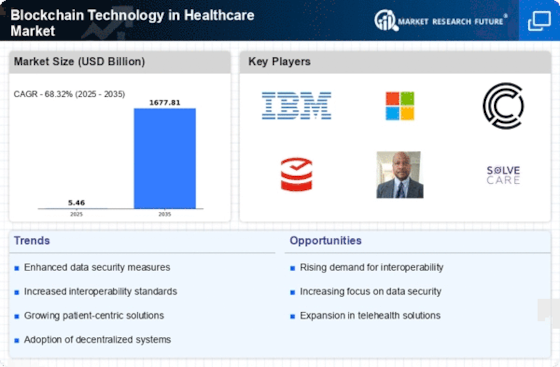
As per Market Research Future analysis, the Blockchain Technology in Healthcare Market was estimated at 5.46 USD Billion in 2024. The Blockchain Technology in Healthcare industry is projected to grow from 9.19 USD Billion in 2025 to 1677.81 USD Billion by 2035, exhibiting a compound annual growth rate (CAGR) of 68.32% during the forecast period 2025 - 2035

Key Market Trends & Highlights

The Blockchain Technology in Healthcare Market is poised for substantial growth driven by enhanced data security and patient empowerment.

  • North America remains the largest market for blockchain technology in healthcare, driven by increasing demand for enhanced data security. The Asia-Pacific region is emerging as the fastest-growing market, fueled by rapid digital transformation in healthcare systems. Patient medical records represent the largest segment, while clinical trials are witnessing the fastest growth due to their need for improved data integrity. Key market drivers include enhanced data integrity and streamlined supply chain management, which are crucial for regulatory compliance.

Market Size & Forecast

2024 Market Size 5.46 (USD Billion)
2035 Market Size 1677.81 (USD Billion)
CAGR (2025 - 2035) 68.32%
Largest Regional Market Share in 2024 North America

Major Players

<a href="https://www.ibm.com/products">IBM </a>(US), Microsoft (US), Chronicled (US), Guardtime (EE), Modum (CH), Solve.Care (US), Patientory (US), Doc.ai (US), SimplyVital Health (US)

Market Trends

The Blockchain Technology in Healthcare Market is currently experiencing a transformative phase, driven by the increasing need for secure and efficient data management solutions. This technology offers a decentralized approach to storing and sharing sensitive health information, which appears to enhance data integrity and patient privacy. As healthcare organizations seek to streamline operations and improve patient outcomes, the adoption of blockchain solutions seems to be gaining momentum. Furthermore, the potential for interoperability among various healthcare systems indicates a promising future for this market, as stakeholders recognize the value of seamless data exchange. In addition, regulatory bodies are beginning to acknowledge the benefits of blockchain technology, which may lead to more supportive policies and frameworks. This evolving landscape suggests that investment in blockchain applications could become a strategic priority for healthcare providers. As the market matures, collaboration among technology developers, healthcare institutions, and regulatory agencies is likely to foster innovation and drive further adoption. Overall, the Blockchain Technology in Healthcare Market appears poised for substantial growth, with numerous opportunities for enhancing the efficiency and security of healthcare delivery.

Enhanced Data Security

The integration of blockchain technology in healthcare is likely to bolster data security measures. By utilizing cryptographic techniques, patient information can be securely stored and accessed, reducing the risk of data breaches and unauthorized access.

Interoperability Solutions

Blockchain technology may facilitate improved interoperability among disparate healthcare systems. This capability could enable seamless data sharing, allowing healthcare providers to access comprehensive patient records, thereby enhancing care coordination.

Patient Empowerment

The adoption of blockchain solutions appears to empower patients by giving them greater control over their health data. Patients may have the ability to manage who accesses their information, fostering a more personalized and transparent healthcare experience.

Blockchain Technology Healthcare Market Market Drivers

Enhanced Data Integrity

The Blockchain Technology in Healthcare Market is increasingly recognized for its ability to enhance data integrity. By utilizing decentralized ledgers, healthcare organizations can ensure that patient records are immutable and tamper-proof. This characteristic is particularly crucial in an era where data breaches and unauthorized access pose significant risks. According to recent estimates, the healthcare sector experiences a data breach every 2-3 days, underscoring the need for robust security measures. Blockchain technology offers a solution by providing a transparent and secure method for storing and sharing sensitive health information. As a result, stakeholders are more likely to trust the data, which can lead to improved patient outcomes and more efficient healthcare delivery.

Improved Patient Engagement

The Blockchain Technology in Healthcare Market is fostering improved patient engagement through enhanced access to personal health data. Patients are increasingly seeking control over their health information, and blockchain technology enables secure sharing of medical records. This empowerment allows patients to make informed decisions regarding their healthcare, leading to better health outcomes. A recent survey indicated that over 70% of patients are interested in accessing their health data through secure platforms. By leveraging blockchain, healthcare providers can offer patients a user-friendly interface to manage their health information, thereby promoting active participation in their care.

Regulatory Compliance and Reporting

The Blockchain Technology in Healthcare Market is increasingly aligned with regulatory compliance requirements. As healthcare regulations become more stringent, organizations are seeking innovative solutions to streamline compliance processes. Blockchain technology can facilitate real-time reporting and auditing, thereby reducing the administrative burden associated with regulatory adherence. For instance, the Health Insurance Portability and Accountability Act (HIPAA) mandates strict data protection measures, and blockchain can provide a secure framework for managing patient information. By ensuring compliance through automated processes, healthcare organizations can minimize the risk of penalties and enhance their operational efficiency.

Streamlined Supply Chain Management

The Blockchain Technology in Healthcare Market is poised to revolutionize supply chain management within the healthcare sector. By implementing blockchain solutions, organizations can achieve greater transparency and traceability in the procurement of medical supplies and pharmaceuticals. This is particularly relevant given that the World Health Organization has reported that counterfeit medicines account for up to 10% of The Blockchain Technology in Healthcare. Blockchain technology can help mitigate this issue by providing a secure and verifiable record of each transaction, from manufacturer to end-user. Consequently, stakeholders can ensure the authenticity of products, reduce waste, and enhance overall efficiency in the supply chain.

Cost Reduction in Healthcare Operations

The Blockchain Technology in Healthcare Market is anticipated to contribute to significant cost reductions in healthcare operations. By automating processes such as claims management and patient verification, blockchain can minimize administrative costs and reduce the potential for fraud. The National Health Service has reported that administrative costs account for nearly 25% of total healthcare expenditures. By streamlining these processes through blockchain technology, organizations can allocate resources more effectively and improve overall financial performance. This cost efficiency is likely to attract more stakeholders to adopt blockchain solutions, further driving growth in the market.

Market Segment Insights

By Application: Patient Medical Records (Largest) vs. Clinical Trials (Fastest-Growing)

In the Blockchain Technology in Healthcare market, Patient Medical Records segment leads with the largest share, providing secure and tamper-proof systems for managing patient data. Following closely are segments such as Clinical Trials and Supply Chain Management, which have significant market interest, but their shares are relatively smaller when compared to the dominant Patient Medical Records segment. Drug Traceability and Claims Management also contribute to the diverse applications, showcasing the versatility of blockchain in enhancing healthcare operations.

Patient Medical Records (Dominant) vs. Clinical Trials (Emerging)

The Patient Medical Records segment is recognized as the dominant application in the blockchain healthcare space, offering a robust solution for storing and sharing sensitive patient data securely. This segment ensures interoperability and enhances patient privacy through decentralized data management. On the other hand, Clinical Trials represent an emerging segment that leverages blockchain for streamlining processes, ensuring data integrity, and improving transparency among stakeholders. While Patient Medical Records focus on patient-centric data storage, Clinical Trials aim at enhancing the efficiency of drug development processes. Both segments illustrate distinct functionalities that address key challenges in the healthcare system.

By End Use: Healthcare Providers (Largest) vs. Pharmaceutical Companies (Fastest-Growing)

The Blockchain Technology in Healthcare Market exhibits a diverse distribution among key end users, with Healthcare Providers commanding the largest share. This segment is characterized by a significant adoption of blockchain solutions to enhance patient data management, interoperability, and overall healthcare delivery. On the other hand, Pharmaceutical Companies are witnessing a rapid increase in the implementation of blockchain technology due to the need for transparent supply chains, drug traceability, and fraud prevention. The intersection of these segments highlights the growing reliance on blockchain to ensure efficient and secure operations in healthcare. Growth trends in the Blockchain Technology in Healthcare Market indicate that Healthcare Providers are continually increasing their investments in blockchain systems to improve data accuracy and security. Meanwhile, Pharmaceutical Companies are projected to experience the fastest growth, driven by regulatory pressures, the demand for clinical trial transparency, and enhanced data integrity. These trends suggest a dynamic shift where healthcare entities are progressively adopting blockchain to streamline operations and enhance trust in healthcare processes.

Healthcare Providers (Dominant) vs. Pharmaceutical Companies (Emerging)

The Healthcare Providers segment stands as the dominant force in the Blockchain Technology in Healthcare Market, as these entities leverage blockchain to revolutionize patient record management and enhance data sharing protocols. By implementing decentralized systems, Healthcare Providers are able to ensure <a href="https://www.marketresearchfuture.com/reports/healthcare-data-storage-market-8572">data </a>security, reduce administrative overhead, and comply with regulatory mandates more effectively. Conversely, the Pharmaceutical Companies segment is emerging rapidly, characterized by its focus on enhancing the drug supply chain and ensuring compliance through blockchain. The technology provides pharmaceutical firms with the tools needed to track drug shipments, monitor clinical trial data, and protect against counterfeit medications. This transformation underscores the growing recognition of blockchain's role in promoting transparency and efficiency in the healthcare landscape.

By Network Type: Private Blockchain (Largest) vs. Public Blockchain (Fastest-Growing)

In the Blockchain Technology in Healthcare Market, Private Blockchain holds the largest market share due to its enhanced security and privacy features, making it the preferred choice among healthcare providers. This segment allows for controlled access to patient data, ensuring compliance with regulations such as HIPAA. Public Blockchain, although smaller in market share, is experiencing rapid growth, driven by increasing demand for transparency and decentralization in healthcare processes. Both segment values play distinct yet crucial roles in the overall landscape of blockchain technology in healthcare.

Private Blockchain (Dominant) vs. Public Blockchain (Emerging)

Private Blockchain is characterized by its permissioned access, allowing only verified participants to access the network which ensures a higher level of privacy and security essential for sensitive healthcare data. Dominating the market, it appeals to hospitals and healthcare institutions looking to protect their data while maintaining compliance with industry regulations. On the other hand, Public Blockchain is emerging as a viable solution for sectors of the healthcare market that prioritize transparency and broader access to information. Its decentralized nature promotes trust among stakeholders, making it increasingly popular among supply chain management and research collaborations, thus presenting significant growth opportunities.

By Component: Software (Largest) vs. Services (Fastest-Growing)

In the Blockchain Technology in Healthcare Market, the component segment is primarily divided into Software, Hardware, and Services. Software holds the largest market share, spearheading the adoption and implementation of blockchain solutions across various healthcare applications. Meanwhile, Services are increasingly gaining momentum, with an expanding role in supporting healthcare organizations in managing blockchain infrastructures and consulting for optimal implementation.On the other hand, Hardware, while essential for blockchain operations, comprises a smaller portion of the overall market share. The dynamics between these components reflect the increasing reliance on digital solutions in healthcare, driven by the need for enhanced security, interoperability, and data integrity, which bolster the continuous growth of blockchain technologies.

Software (Dominant) vs. Services (Emerging)

In the context of Blockchain Technology in Healthcare, Software is the dominant component, significantly shaping the landscape with innovative solutions that facilitate secure health data transactions, maintain patient privacy, and ensure regulatory compliance. Key players in this segment are focusing on developing user-friendly platforms that integrate seamlessly with existing healthcare systems. On the other hand, Services represent an emerging aspect of this market, seeing rapid growth as healthcare institutions seek external expertise for blockchain implementation. These services encompass consulting, integration, and support, helping healthcare providers navigate the complexities of blockchain technology while fostering partnerships between technology vendors and healthcare organizations. The evolving needs of the healthcare sector are prompting increased investment in both segments, ensuring their critical roles in future developments.

Get more detailed insights about Blockchain Technology in Healthcare Market Research Report – Global Forecast till 2035

Regional Insights

The Blockchain Technology in Healthcare Market was on a path of significant growth across various regions. In this landscape, North America dominated with a valuation of 1.01 USD Billion in 2024 and is expected to rise to 15.0 USD Billion by 2035, largely due to high technological adoption rates and investments in digital health initiatives.

Europe followed, with a market value of 0.6 USD Billion in 2024 expanding to 8.5 USD Billion by 2035, driven by regulatory support for digital transformation in healthcare. The APAC region is set to grow from 0.45 USD Billion in 2024 to 4.8 USD Billion in 2035, reflecting increased healthcare expenditure and a burgeoning start-up ecosystem focused on blockchain solutions.

In South America, the market valuation was 0.1 USD Billion in 2024 and projected to reach 1.2 USD Billion by 2035, presenting opportunities fueled by rising internet penetration and mobile health app usage. Finally, the MEA region displayed a similar trend with a valuation of 0.1 USD Billion in 2024, growing to 0.5 USD Billion by 2035, as countries in the region prioritize digital innovations in healthcare.

This diverse regional segmentation highlighted varying degrees of market potential and growth drivers, contributing to the overall expansion of the Blockchain Technology in Healthcare Market.

Key Players and Competitive Insights

The competitive landscape of the Blockchain Technology in Healthcare Market is rapidly evolving, driven by the increasing need for enhanced data security, interoperability, and efficiency in healthcare systems. As healthcare organizations adopt blockchain for managing patient data, supply chain transparency, and US clinical trials, various companies are striving to innovate and differentiate their offerings.The market features a mix of established tech giants and emerging startups, each bringing unique solutions to address complex healthcare challenges. Companies are also focusing on collaborations and partnerships to enhance their capabilities and expand their market reach, indicating a thriving ecosystem committed to harnessing blockchain technology's potential in healthcare.In this competitive arena, IBM stands out due to its robust market presence and a well-established reputation in IT solutions, particularly in blockchain technology. IBM's strengths lie in its comprehensive suite of blockchain solutions tailored for healthcare applications that tackle data integrity and transparency challenges.The company has made significant strides in utilizing blockchain for secure sharing of health records and pharmaceutical supply chain management. With a focus on interoperability, IBM collaborates with various stakeholders in the healthcare sector, including providers, payers, and technology partners. Its extensive research and development efforts, along with strategic partnerships for ecosystem building, contribute to its competitive edge, positioning IBM as a leader in the Blockchain Technology in Healthcare Market.Modum also plays a notable role in the Blockchain Technology in Healthcare Market, particularly with its focus on supply chain management and compliance solutions. Modum's key offerings include temperature-controlled shipping and monitoring solutions, which are vital for pharmaceuticals and biopharmaceuticals, ensuring product integrity and regulatory compliance.The company's unique services integrate IoT technology with blockchain to provide real-time data and transparency, appealing to logistics providers and healthcare organizations needing assurance in their supply chains. Modum's strengths include its innovative approach and ability to scale its solutions, addressing the growing demands of the global market.The company has engaged in strategic partnerships and collaborations that amplify its technological advancements and market footprint. Overall, Modum's commitment to improving healthcare supply chains through blockchain positions it as an emerging contender in the competitive landscape, equipped to address challenges faced by the sector globally.

Key Companies in the Blockchain Technology Healthcare Market include

Industry Developments

Recent developments in the Blockchain Technology in Healthcare Market highlight significant advancements and ongoing trends. In August 2023, IBM announced a partnership with various healthcare organizations to enhance data security through blockchain, focusing on patient consent management systems.

Meanwhile, Modum has been gaining traction for its temperature-controlled supply chain solutions leveraging blockchain, aimed at ensuring drug integrity. Everledger has continued to expand its blockchain platform for tracking diamonds and other precious assets, catering to the luxury health market's needs.

In January 2023, Patientory secured funding to scale its healthcare data management solutions that utilize blockchain for secure patient records. Guardtime announced its collaboration with the Estonian government for national health data security, showing government interest in blockchain applications.

Chronicled and Microsoft have been working together on a blockchain-based logistics solution to ensure the integrity of pharmaceutical supply chains as of February 2023.

The overall growth in market valuation is stimulated by increased investment and adoption of blockchain technology for enhancing data security, interoperability, and patient-centric solutions across the healthcare ecosystem. Trends observed in the last few years indicate a steady rise in the integration of blockchain in healthcare, with an emphasis on patient safety and data integrity.

Future Outlook

Blockchain Technology Healthcare Market Future Outlook

The Blockchain Technology in Healthcare Market is projected to grow at a 68.32% CAGR from 2025 to 2035, driven by enhanced data security, interoperability, and patient-centric solutions.

New opportunities lie in:

  • Decentralized patient data management platforms</p><p>Blockchain-based supply chain verification systems</p><p>Smart contracts for automated insurance claims processing

By 2035, the market is expected to be a cornerstone of healthcare innovation and efficiency.

Market Segmentation

Blockchain Technology Healthcare Market End Use Outlook

  • Healthcare Providers
  • Pharmaceutical Companies
  • Insurance Companies
  • Research Institutions

Blockchain Technology Healthcare Market Component Outlook

  • Software
  • Hardware
  • Services

Blockchain Technology Healthcare Market Application Outlook

  • Clinical Trials
  • Supply Chain Management
  • Patient Medical Records
  • Claims Management
  • Drug Traceability

Blockchain Technology Healthcare Market Network Type Outlook

  • Public Blockchain
  • Private Blockchain
  • Hybrid Blockchain

Report Scope

MARKET SIZE 2024 5.46(USD Billion)
MARKET SIZE 2025 9.19(USD Billion)
MARKET SIZE 2035 1677.81(USD Billion)
COMPOUND ANNUAL GROWTH RATE (CAGR) 68.32% (2025 - 2035)
REPORT COVERAGE Revenue Forecast, Competitive Landscape, Growth Factors, and Trends
BASE YEAR 2024
Market Forecast Period 2025 - 2035
Historical Data 2019 - 2024
Market Forecast Units USD Billion
Key Companies Profiled IBM (US), Microsoft (US), Chronicled (US), Guardtime (EE), Modum (CH), Solve.Care (US), Patientory (US), Doc.ai (US), SimplyVital Health (US)
Segments Covered Applications, End Use, Network Type, Component, Regional
Key Market Opportunities Integration of Blockchain Technology enhances data security and interoperability in the Healthcare Market.
Key Market Dynamics Rising adoption of blockchain technology enhances data security and interoperability in healthcare systems, driving market transformation.
Countries Covered North America, Europe, APAC, South America, MEA

FAQs

What is the projected market valuation for Blockchain Technology in Healthcare by 2035?

<p>The projected market valuation for Blockchain Technology in Healthcare is 1677.81 USD Billion by 2035.</p>

What was the market valuation for Blockchain Technology in Healthcare in 2024?

<p>The market valuation for Blockchain Technology in Healthcare was 5.46 USD Billion in 2024.</p>

What is the expected CAGR for the Blockchain Technology in Healthcare Market from 2025 to 2035?

<p>The expected CAGR for the Blockchain Technology in Healthcare Market during the forecast period 2025 - 2035 is 68.32%.</p>

Which application segment had the highest valuation in 2024?

<p>In 2024, the Patient Medical Records application segment had the highest valuation at 1.64 USD Billion.</p>

What are the key players in the Blockchain Technology in Healthcare Market?

<p>Key players in the market include IBM, Microsoft, Chronicled, Guardtime, Modum, Solve.Care, Patientory, Doc.ai, and SimplyVital Health.</p>

Which end-use segment is projected to have the highest valuation by 2035?

<p>By 2035, the Healthcare Providers end-use segment is projected to have the highest valuation at 525.0 USD Billion.</p>

What is the valuation of the Services component in 2024?

<p>The valuation of the Services component in 2024 was 2.73 USD Billion.</p>

How does the valuation of Private Blockchain compare to Public Blockchain in 2024?

<p>In 2024, the valuation of Private Blockchain was 2.18 USD Billion, compared to 1.64 USD Billion for Public Blockchain.</p>

What is the projected valuation for Drug Traceability by 2035?

<p>The projected valuation for Drug Traceability is 53.03 USD Billion by 2035.</p>

Which network type is expected to grow the most during the forecast period?

<p>The Private Blockchain network type is expected to grow the most during the forecast period, with a valuation of 68.91 USD Billion by 2035.</p>

  1. SECTION I: EXECUTIVE SUMMARY AND KEY HIGHLIGHTS
    1. | 1.1 EXECUTIVE SUMMARY
    2. | | 1.1.1 Market Overview
    3. | | 1.1.2 Key Findings
    4. | | 1.1.3 Market Segmentation
    5. | | 1.1.4 Competitive Landscape
    6. | | 1.1.5 Challenges and Opportunities
    7. | | 1.1.6 Future Outlook
  2. SECTION II: SCOPING, METHODOLOGY AND MARKET STRUCTURE
    1. | 2.1 MARKET INTRODUCTION
    2. | | 2.1.1 Definition
    3. | | 2.1.2 Scope of the study
    4. | | | 2.1.2.1 Research Objective
    5. | | | 2.1.2.2 Assumption
    6. | | | 2.1.2.3 Limitations
    7. | 2.2 RESEARCH METHODOLOGY
    8. | | 2.2.1 Overview
    9. | | 2.2.2 Data Mining
    10. | | 2.2.3 Secondary Research
    11. | | 2.2.4 Primary Research
    12. | | | 2.2.4.1 Primary Interviews and Information Gathering Process
    13. | | | 2.2.4.2 Breakdown of Primary Respondents
    14. | | 2.2.5 Forecasting Model
    15. | | 2.2.6 Market Size Estimation
    16. | | | 2.2.6.1 Bottom-Up Approach
    17. | | | 2.2.6.2 Top-Down Approach
    18. | | 2.2.7 Data Triangulation
    19. | | 2.2.8 Validation
  3. SECTION III: QUALITATIVE ANALYSIS
    1. | 3.1 MARKET DYNAMICS
    2. | | 3.1.1 Overview
    3. | | 3.1.2 Drivers
    4. | | 3.1.3 Restraints
    5. | | 3.1.4 Opportunities
    6. | 3.2 MARKET FACTOR ANALYSIS
    7. | | 3.2.1 Value chain Analysis
    8. | | 3.2.2 Porter's Five Forces Analysis
    9. | | | 3.2.2.1 Bargaining Power of Suppliers
    10. | | | 3.2.2.2 Bargaining Power of Buyers
    11. | | | 3.2.2.3 Threat of New Entrants
    12. | | | 3.2.2.4 Threat of Substitutes
    13. | | | 3.2.2.5 Intensity of Rivalry
    14. | | 3.2.3 COVID-19 Impact Analysis
    15. | | | 3.2.3.1 Market Impact Analysis
    16. | | | 3.2.3.2 Regional Impact
    17. | | | 3.2.3.3 Opportunity and Threat Analysis
  4. SECTION IV: QUANTITATIVE ANALYSIS
    1. | 4.1 Healthcare, BY Application (USD Billion)
    2. | | 4.1.1 Clinical Trials
    3. | | 4.1.2 Supply Chain Management
    4. | | 4.1.3 Patient Medical Records
    5. | | 4.1.4 Claims Management
    6. | | 4.1.5 Drug Traceability
    7. | 4.2 Healthcare, BY End Use (USD Billion)
    8. | | 4.2.1 Healthcare Providers
    9. | | 4.2.2 Pharmaceutical Companies
    10. | | 4.2.3 Insurance Companies
    11. | | 4.2.4 Research Institutions
    12. | 4.3 Healthcare, BY Network Type (USD Billion)
    13. | | 4.3.1 Public Blockchain
    14. | | 4.3.2 Private Blockchain
    15. | | 4.3.3 Hybrid Blockchain
    16. | 4.4 Healthcare, BY Component (USD Billion)
    17. | | 4.4.1 Software
    18. | | 4.4.2 Hardware
    19. | | 4.4.3 Services
    20. | 4.5 Healthcare, BY Region (USD Billion)
    21. | | 4.5.1 North America
    22. | | | 4.5.1.1 US
    23. | | | 4.5.1.2 Canada
    24. | | 4.5.2 Europe
    25. | | | 4.5.2.1 Germany
    26. | | | 4.5.2.2 UK
    27. | | | 4.5.2.3 France
    28. | | | 4.5.2.4 Russia
    29. | | | 4.5.2.5 Italy
    30. | | | 4.5.2.6 Spain
    31. | | | 4.5.2.7 Rest of Europe
    32. | | 4.5.3 APAC
    33. | | | 4.5.3.1 China
    34. | | | 4.5.3.2 India
    35. | | | 4.5.3.3 Japan
    36. | | | 4.5.3.4 South Korea
    37. | | | 4.5.3.5 Malaysia
    38. | | | 4.5.3.6 Thailand
    39. | | | 4.5.3.7 Indonesia
    40. | | | 4.5.3.8 Rest of APAC
    41. | | 4.5.4 South America
    42. | | | 4.5.4.1 Brazil
    43. | | | 4.5.4.2 Mexico
    44. | | | 4.5.4.3 Argentina
    45. | | | 4.5.4.4 Rest of South America
    46. | | 4.5.5 MEA
    47. | | | 4.5.5.1 GCC Countries
    48. | | | 4.5.5.2 South Africa
    49. | | | 4.5.5.3 Rest of MEA
  5. SECTION V: COMPETITIVE ANALYSIS
    1. | 5.1 Competitive Landscape
    2. | | 5.1.1 Overview
    3. | | 5.1.2 Competitive Analysis
    4. | | 5.1.3 Market share Analysis
    5. | | 5.1.4 Major Growth Strategy in the Healthcare
    6. | | 5.1.5 Competitive Benchmarking
    7. | | 5.1.6 Leading Players in Terms of Number of Developments in the Healthcare
    8. | | 5.1.7 Key developments and growth strategies
    9. | | | 5.1.7.1 New Product Launch/Service Deployment
    10. | | | 5.1.7.2 Merger & Acquisitions
    11. | | | 5.1.7.3 Joint Ventures
    12. | | 5.1.8 Major Players Financial Matrix
    13. | | | 5.1.8.1 Sales and Operating Income
    14. | | | 5.1.8.2 Major Players R&D Expenditure. 2023
    15. | 5.2 Company Profiles
    16. | | 5.2.1 IBM (US)
    17. | | | 5.2.1.1 Financial Overview
    18. | | | 5.2.1.2 Products Offered
    19. | | | 5.2.1.3 Key Developments
    20. | | | 5.2.1.4 SWOT Analysis
    21. | | | 5.2.1.5 Key Strategies
    22. | | 5.2.2 Microsoft (US)
    23. | | | 5.2.2.1 Financial Overview
    24. | | | 5.2.2.2 Products Offered
    25. | | | 5.2.2.3 Key Developments
    26. | | | 5.2.2.4 SWOT Analysis
    27. | | | 5.2.2.5 Key Strategies
    28. | | 5.2.3 Chronicled (US)
    29. | | | 5.2.3.1 Financial Overview
    30. | | | 5.2.3.2 Products Offered
    31. | | | 5.2.3.3 Key Developments
    32. | | | 5.2.3.4 SWOT Analysis
    33. | | | 5.2.3.5 Key Strategies
    34. | | 5.2.4 Guardtime (EE)
    35. | | | 5.2.4.1 Financial Overview
    36. | | | 5.2.4.2 Products Offered
    37. | | | 5.2.4.3 Key Developments
    38. | | | 5.2.4.4 SWOT Analysis
    39. | | | 5.2.4.5 Key Strategies
    40. | | 5.2.5 Modum (CH)
    41. | | | 5.2.5.1 Financial Overview
    42. | | | 5.2.5.2 Products Offered
    43. | | | 5.2.5.3 Key Developments
    44. | | | 5.2.5.4 SWOT Analysis
    45. | | | 5.2.5.5 Key Strategies
    46. | | 5.2.6 Solve.Care (US)
    47. | | | 5.2.6.1 Financial Overview
    48. | | | 5.2.6.2 Products Offered
    49. | | | 5.2.6.3 Key Developments
    50. | | | 5.2.6.4 SWOT Analysis
    51. | | | 5.2.6.5 Key Strategies
    52. | | 5.2.7 Patientory (US)
    53. | | | 5.2.7.1 Financial Overview
    54. | | | 5.2.7.2 Products Offered
    55. | | | 5.2.7.3 Key Developments
    56. | | | 5.2.7.4 SWOT Analysis
    57. | | | 5.2.7.5 Key Strategies
    58. | | 5.2.8 Doc.ai (US)
    59. | | | 5.2.8.1 Financial Overview
    60. | | | 5.2.8.2 Products Offered
    61. | | | 5.2.8.3 Key Developments
    62. | | | 5.2.8.4 SWOT Analysis
    63. | | | 5.2.8.5 Key Strategies
    64. | | 5.2.9 SimplyVital Health (US)
    65. | | | 5.2.9.1 Financial Overview
    66. | | | 5.2.9.2 Products Offered
    67. | | | 5.2.9.3 Key Developments
    68. | | | 5.2.9.4 SWOT Analysis
    69. | | | 5.2.9.5 Key Strategies
    70. | 5.3 Appendix
    71. | | 5.3.1 References
    72. | | 5.3.2 Related Reports
  6. LIST OF FIGURES
    1. | 6.1 MARKET SYNOPSIS
    2. | 6.2 NORTH AMERICA MARKET ANALYSIS
    3. | 6.3 US MARKET ANALYSIS BY APPLICATION
    4. | 6.4 US MARKET ANALYSIS BY END USE
    5. | 6.5 US MARKET ANALYSIS BY NETWORK TYPE
    6. | 6.6 US MARKET ANALYSIS BY COMPONENT
    7. | 6.7 CANADA MARKET ANALYSIS BY APPLICATION
    8. | 6.8 CANADA MARKET ANALYSIS BY END USE
    9. | 6.9 CANADA MARKET ANALYSIS BY NETWORK TYPE
    10. | 6.10 CANADA MARKET ANALYSIS BY COMPONENT
    11. | 6.11 EUROPE MARKET ANALYSIS
    12. | 6.12 GERMANY MARKET ANALYSIS BY APPLICATION
    13. | 6.13 GERMANY MARKET ANALYSIS BY END USE
    14. | 6.14 GERMANY MARKET ANALYSIS BY NETWORK TYPE
    15. | 6.15 GERMANY MARKET ANALYSIS BY COMPONENT
    16. | 6.16 UK MARKET ANALYSIS BY APPLICATION
    17. | 6.17 UK MARKET ANALYSIS BY END USE
    18. | 6.18 UK MARKET ANALYSIS BY NETWORK TYPE
    19. | 6.19 UK MARKET ANALYSIS BY COMPONENT
    20. | 6.20 FRANCE MARKET ANALYSIS BY APPLICATION
    21. | 6.21 FRANCE MARKET ANALYSIS BY END USE
    22. | 6.22 FRANCE MARKET ANALYSIS BY NETWORK TYPE
    23. | 6.23 FRANCE MARKET ANALYSIS BY COMPONENT
    24. | 6.24 RUSSIA MARKET ANALYSIS BY APPLICATION
    25. | 6.25 RUSSIA MARKET ANALYSIS BY END USE
    26. | 6.26 RUSSIA MARKET ANALYSIS BY NETWORK TYPE
    27. | 6.27 RUSSIA MARKET ANALYSIS BY COMPONENT
    28. | 6.28 ITALY MARKET ANALYSIS BY APPLICATION
    29. | 6.29 ITALY MARKET ANALYSIS BY END USE
    30. | 6.30 ITALY MARKET ANALYSIS BY NETWORK TYPE
    31. | 6.31 ITALY MARKET ANALYSIS BY COMPONENT
    32. | 6.32 SPAIN MARKET ANALYSIS BY APPLICATION
    33. | 6.33 SPAIN MARKET ANALYSIS BY END USE
    34. | 6.34 SPAIN MARKET ANALYSIS BY NETWORK TYPE
    35. | 6.35 SPAIN MARKET ANALYSIS BY COMPONENT
    36. | 6.36 REST OF EUROPE MARKET ANALYSIS BY APPLICATION
    37. | 6.37 REST OF EUROPE MARKET ANALYSIS BY END USE
    38. | 6.38 REST OF EUROPE MARKET ANALYSIS BY NETWORK TYPE
    39. | 6.39 REST OF EUROPE MARKET ANALYSIS BY COMPONENT
    40. | 6.40 APAC MARKET ANALYSIS
    41. | 6.41 CHINA MARKET ANALYSIS BY APPLICATION
    42. | 6.42 CHINA MARKET ANALYSIS BY END USE
    43. | 6.43 CHINA MARKET ANALYSIS BY NETWORK TYPE
    44. | 6.44 CHINA MARKET ANALYSIS BY COMPONENT
    45. | 6.45 INDIA MARKET ANALYSIS BY APPLICATION
    46. | 6.46 INDIA MARKET ANALYSIS BY END USE
    47. | 6.47 INDIA MARKET ANALYSIS BY NETWORK TYPE
    48. | 6.48 INDIA MARKET ANALYSIS BY COMPONENT
    49. | 6.49 JAPAN MARKET ANALYSIS BY APPLICATION
    50. | 6.50 JAPAN MARKET ANALYSIS BY END USE
    51. | 6.51 JAPAN MARKET ANALYSIS BY NETWORK TYPE
    52. | 6.52 JAPAN MARKET ANALYSIS BY COMPONENT
    53. | 6.53 SOUTH KOREA MARKET ANALYSIS BY APPLICATION
    54. | 6.54 SOUTH KOREA MARKET ANALYSIS BY END USE
    55. | 6.55 SOUTH KOREA MARKET ANALYSIS BY NETWORK TYPE
    56. | 6.56 SOUTH KOREA MARKET ANALYSIS BY COMPONENT
    57. | 6.57 MALAYSIA MARKET ANALYSIS BY APPLICATION
    58. | 6.58 MALAYSIA MARKET ANALYSIS BY END USE
    59. | 6.59 MALAYSIA MARKET ANALYSIS BY NETWORK TYPE
    60. | 6.60 MALAYSIA MARKET ANALYSIS BY COMPONENT
    61. | 6.61 THAILAND MARKET ANALYSIS BY APPLICATION
    62. | 6.62 THAILAND MARKET ANALYSIS BY END USE
    63. | 6.63 THAILAND MARKET ANALYSIS BY NETWORK TYPE
    64. | 6.64 THAILAND MARKET ANALYSIS BY COMPONENT
    65. | 6.65 INDONESIA MARKET ANALYSIS BY APPLICATION
    66. | 6.66 INDONESIA MARKET ANALYSIS BY END USE
    67. | 6.67 INDONESIA MARKET ANALYSIS BY NETWORK TYPE
    68. | 6.68 INDONESIA MARKET ANALYSIS BY COMPONENT
    69. | 6.69 REST OF APAC MARKET ANALYSIS BY APPLICATION
    70. | 6.70 REST OF APAC MARKET ANALYSIS BY END USE
    71. | 6.71 REST OF APAC MARKET ANALYSIS BY NETWORK TYPE
    72. | 6.72 REST OF APAC MARKET ANALYSIS BY COMPONENT
    73. | 6.73 SOUTH AMERICA MARKET ANALYSIS
    74. | 6.74 BRAZIL MARKET ANALYSIS BY APPLICATION
    75. | 6.75 BRAZIL MARKET ANALYSIS BY END USE
    76. | 6.76 BRAZIL MARKET ANALYSIS BY NETWORK TYPE
    77. | 6.77 BRAZIL MARKET ANALYSIS BY COMPONENT
    78. | 6.78 MEXICO MARKET ANALYSIS BY APPLICATION
    79. | 6.79 MEXICO MARKET ANALYSIS BY END USE
    80. | 6.80 MEXICO MARKET ANALYSIS BY NETWORK TYPE
    81. | 6.81 MEXICO MARKET ANALYSIS BY COMPONENT
    82. | 6.82 ARGENTINA MARKET ANALYSIS BY APPLICATION
    83. | 6.83 ARGENTINA MARKET ANALYSIS BY END USE
    84. | 6.84 ARGENTINA MARKET ANALYSIS BY NETWORK TYPE
    85. | 6.85 ARGENTINA MARKET ANALYSIS BY COMPONENT
    86. | 6.86 REST OF SOUTH AMERICA MARKET ANALYSIS BY APPLICATION
    87. | 6.87 REST OF SOUTH AMERICA MARKET ANALYSIS BY END USE
    88. | 6.88 REST OF SOUTH AMERICA MARKET ANALYSIS BY NETWORK TYPE
    89. | 6.89 REST OF SOUTH AMERICA MARKET ANALYSIS BY COMPONENT
    90. | 6.90 MEA MARKET ANALYSIS
    91. | 6.91 GCC COUNTRIES MARKET ANALYSIS BY APPLICATION
    92. | 6.92 GCC COUNTRIES MARKET ANALYSIS BY END USE
    93. | 6.93 GCC COUNTRIES MARKET ANALYSIS BY NETWORK TYPE
    94. | 6.94 GCC COUNTRIES MARKET ANALYSIS BY COMPONENT
    95. | 6.95 SOUTH AFRICA MARKET ANALYSIS BY APPLICATION
    96. | 6.96 SOUTH AFRICA MARKET ANALYSIS BY END USE
    97. | 6.97 SOUTH AFRICA MARKET ANALYSIS BY NETWORK TYPE
    98. | 6.98 SOUTH AFRICA MARKET ANALYSIS BY COMPONENT
    99. | 6.99 REST OF MEA MARKET ANALYSIS BY APPLICATION
    100. | 6.100 REST OF MEA MARKET ANALYSIS BY END USE
    101. | 6.101 REST OF MEA MARKET ANALYSIS BY NETWORK TYPE
    102. | 6.102 REST OF MEA MARKET ANALYSIS BY COMPONENT
    103. | 6.103 KEY BUYING CRITERIA OF HEALTHCARE
    104. | 6.104 RESEARCH PROCESS OF MRFR
    105. | 6.105 DRO ANALYSIS OF HEALTHCARE
    106. | 6.106 DRIVERS IMPACT ANALYSIS: HEALTHCARE
    107. | 6.107 RESTRAINTS IMPACT ANALYSIS: HEALTHCARE
    108. | 6.108 SUPPLY / VALUE CHAIN: HEALTHCARE
    109. | 6.109 HEALTHCARE, BY APPLICATION, 2024 (% SHARE)
    110. | 6.110 HEALTHCARE, BY APPLICATION, 2024 TO 2035 (USD Billion)
    111. | 6.111 HEALTHCARE, BY END USE, 2024 (% SHARE)
    112. | 6.112 HEALTHCARE, BY END USE, 2024 TO 2035 (USD Billion)
    113. | 6.113 HEALTHCARE, BY NETWORK TYPE, 2024 (% SHARE)
    114. | 6.114 HEALTHCARE, BY NETWORK TYPE, 2024 TO 2035 (USD Billion)
    115. | 6.115 HEALTHCARE, BY COMPONENT, 2024 (% SHARE)
    116. | 6.116 HEALTHCARE, BY COMPONENT, 2024 TO 2035 (USD Billion)
    117. | 6.117 BENCHMARKING OF MAJOR COMPETITORS
  7. LIST OF TABLES
    1. | 7.1 LIST OF ASSUMPTIONS
    2. | | 7.1.1
    3. | 7.2 North America MARKET SIZE ESTIMATES; FORECAST
    4. | | 7.2.1 BY APPLICATION, 2025-2035 (USD Billion)
    5. | | 7.2.2 BY END USE, 2025-2035 (USD Billion)
    6. | | 7.2.3 BY NETWORK TYPE, 2025-2035 (USD Billion)
    7. | | 7.2.4 BY COMPONENT, 2025-2035 (USD Billion)
    8. | 7.3 US MARKET SIZE ESTIMATES; FORECAST
    9. | | 7.3.1 BY APPLICATION, 2025-2035 (USD Billion)
    10. | | 7.3.2 BY END USE, 2025-2035 (USD Billion)
    11. | | 7.3.3 BY NETWORK TYPE, 2025-2035 (USD Billion)
    12. | | 7.3.4 BY COMPONENT, 2025-2035 (USD Billion)
    13. | 7.4 Canada MARKET SIZE ESTIMATES; FORECAST
    14. | | 7.4.1 BY APPLICATION, 2025-2035 (USD Billion)
    15. | | 7.4.2 BY END USE, 2025-2035 (USD Billion)
    16. | | 7.4.3 BY NETWORK TYPE, 2025-2035 (USD Billion)
    17. | | 7.4.4 BY COMPONENT, 2025-2035 (USD Billion)
    18. | 7.5 Europe MARKET SIZE ESTIMATES; FORECAST
    19. | | 7.5.1 BY APPLICATION, 2025-2035 (USD Billion)
    20. | | 7.5.2 BY END USE, 2025-2035 (USD Billion)
    21. | | 7.5.3 BY NETWORK TYPE, 2025-2035 (USD Billion)
    22. | | 7.5.4 BY COMPONENT, 2025-2035 (USD Billion)
    23. | 7.6 Germany MARKET SIZE ESTIMATES; FORECAST
    24. | | 7.6.1 BY APPLICATION, 2025-2035 (USD Billion)
    25. | | 7.6.2 BY END USE, 2025-2035 (USD Billion)
    26. | | 7.6.3 BY NETWORK TYPE, 2025-2035 (USD Billion)
    27. | | 7.6.4 BY COMPONENT, 2025-2035 (USD Billion)
    28. | 7.7 UK MARKET SIZE ESTIMATES; FORECAST
    29. | | 7.7.1 BY APPLICATION, 2025-2035 (USD Billion)
    30. | | 7.7.2 BY END USE, 2025-2035 (USD Billion)
    31. | | 7.7.3 BY NETWORK TYPE, 2025-2035 (USD Billion)
    32. | | 7.7.4 BY COMPONENT, 2025-2035 (USD Billion)
    33. | 7.8 France MARKET SIZE ESTIMATES; FORECAST
    34. | | 7.8.1 BY APPLICATION, 2025-2035 (USD Billion)
    35. | | 7.8.2 BY END USE, 2025-2035 (USD Billion)
    36. | | 7.8.3 BY NETWORK TYPE, 2025-2035 (USD Billion)
    37. | | 7.8.4 BY COMPONENT, 2025-2035 (USD Billion)
    38. | 7.9 Russia MARKET SIZE ESTIMATES; FORECAST
    39. | | 7.9.1 BY APPLICATION, 2025-2035 (USD Billion)
    40. | | 7.9.2 BY END USE, 2025-2035 (USD Billion)
    41. | | 7.9.3 BY NETWORK TYPE, 2025-2035 (USD Billion)
    42. | | 7.9.4 BY COMPONENT, 2025-2035 (USD Billion)
    43. | 7.10 Italy MARKET SIZE ESTIMATES; FORECAST
    44. | | 7.10.1 BY APPLICATION, 2025-2035 (USD Billion)
    45. | | 7.10.2 BY END USE, 2025-2035 (USD Billion)
    46. | | 7.10.3 BY NETWORK TYPE, 2025-2035 (USD Billion)
    47. | | 7.10.4 BY COMPONENT, 2025-2035 (USD Billion)
    48. | 7.11 Spain MARKET SIZE ESTIMATES; FORECAST
    49. | | 7.11.1 BY APPLICATION, 2025-2035 (USD Billion)
    50. | | 7.11.2 BY END USE, 2025-2035 (USD Billion)
    51. | | 7.11.3 BY NETWORK TYPE, 2025-2035 (USD Billion)
    52. | | 7.11.4 BY COMPONENT, 2025-2035 (USD Billion)
    53. | 7.12 Rest of Europe MARKET SIZE ESTIMATES; FORECAST
    54. | | 7.12.1 BY APPLICATION, 2025-2035 (USD Billion)
    55. | | 7.12.2 BY END USE, 2025-2035 (USD Billion)
    56. | | 7.12.3 BY NETWORK TYPE, 2025-2035 (USD Billion)
    57. | | 7.12.4 BY COMPONENT, 2025-2035 (USD Billion)
    58. | 7.13 APAC MARKET SIZE ESTIMATES; FORECAST
    59. | | 7.13.1 BY APPLICATION, 2025-2035 (USD Billion)
    60. | | 7.13.2 BY END USE, 2025-2035 (USD Billion)
    61. | | 7.13.3 BY NETWORK TYPE, 2025-2035 (USD Billion)
    62. | | 7.13.4 BY COMPONENT, 2025-2035 (USD Billion)
    63. | 7.14 China MARKET SIZE ESTIMATES; FORECAST
    64. | | 7.14.1 BY APPLICATION, 2025-2035 (USD Billion)
    65. | | 7.14.2 BY END USE, 2025-2035 (USD Billion)
    66. | | 7.14.3 BY NETWORK TYPE, 2025-2035 (USD Billion)
    67. | | 7.14.4 BY COMPONENT, 2025-2035 (USD Billion)
    68. | 7.15 India MARKET SIZE ESTIMATES; FORECAST
    69. | | 7.15.1 BY APPLICATION, 2025-2035 (USD Billion)
    70. | | 7.15.2 BY END USE, 2025-2035 (USD Billion)
    71. | | 7.15.3 BY NETWORK TYPE, 2025-2035 (USD Billion)
    72. | | 7.15.4 BY COMPONENT, 2025-2035 (USD Billion)
    73. | 7.16 Japan MARKET SIZE ESTIMATES; FORECAST
    74. | | 7.16.1 BY APPLICATION, 2025-2035 (USD Billion)
    75. | | 7.16.2 BY END USE, 2025-2035 (USD Billion)
    76. | | 7.16.3 BY NETWORK TYPE, 2025-2035 (USD Billion)
    77. | | 7.16.4 BY COMPONENT, 2025-2035 (USD Billion)
    78. | 7.17 South Korea MARKET SIZE ESTIMATES; FORECAST
    79. | | 7.17.1 BY APPLICATION, 2025-2035 (USD Billion)
    80. | | 7.17.2 BY END USE, 2025-2035 (USD Billion)
    81. | | 7.17.3 BY NETWORK TYPE, 2025-2035 (USD Billion)
    82. | | 7.17.4 BY COMPONENT, 2025-2035 (USD Billion)
    83. | 7.18 Malaysia MARKET SIZE ESTIMATES; FORECAST
    84. | | 7.18.1 BY APPLICATION, 2025-2035 (USD Billion)
    85. | | 7.18.2 BY END USE, 2025-2035 (USD Billion)
    86. | | 7.18.3 BY NETWORK TYPE, 2025-2035 (USD Billion)
    87. | | 7.18.4 BY COMPONENT, 2025-2035 (USD Billion)
    88. | 7.19 Thailand MARKET SIZE ESTIMATES; FORECAST
    89. | | 7.19.1 BY APPLICATION, 2025-2035 (USD Billion)
    90. | | 7.19.2 BY END USE, 2025-2035 (USD Billion)
    91. | | 7.19.3 BY NETWORK TYPE, 2025-2035 (USD Billion)
    92. | | 7.19.4 BY COMPONENT, 2025-2035 (USD Billion)
    93. | 7.20 Indonesia MARKET SIZE ESTIMATES; FORECAST
    94. | | 7.20.1 BY APPLICATION, 2025-2035 (USD Billion)
    95. | | 7.20.2 BY END USE, 2025-2035 (USD Billion)
    96. | | 7.20.3 BY NETWORK TYPE, 2025-2035 (USD Billion)
    97. | | 7.20.4 BY COMPONENT, 2025-2035 (USD Billion)
    98. | 7.21 Rest of APAC MARKET SIZE ESTIMATES; FORECAST
    99. | | 7.21.1 BY APPLICATION, 2025-2035 (USD Billion)
    100. | | 7.21.2 BY END USE, 2025-2035 (USD Billion)
    101. | | 7.21.3 BY NETWORK TYPE, 2025-2035 (USD Billion)
    102. | | 7.21.4 BY COMPONENT, 2025-2035 (USD Billion)
    103. | 7.22 South America MARKET SIZE ESTIMATES; FORECAST
    104. | | 7.22.1 BY APPLICATION, 2025-2035 (USD Billion)
    105. | | 7.22.2 BY END USE, 2025-2035 (USD Billion)
    106. | | 7.22.3 BY NETWORK TYPE, 2025-2035 (USD Billion)
    107. | | 7.22.4 BY COMPONENT, 2025-2035 (USD Billion)
    108. | 7.23 Brazil MARKET SIZE ESTIMATES; FORECAST
    109. | | 7.23.1 BY APPLICATION, 2025-2035 (USD Billion)
    110. | | 7.23.2 BY END USE, 2025-2035 (USD Billion)
    111. | | 7.23.3 BY NETWORK TYPE, 2025-2035 (USD Billion)
    112. | | 7.23.4 BY COMPONENT, 2025-2035 (USD Billion)
    113. | 7.24 Mexico MARKET SIZE ESTIMATES; FORECAST
    114. | | 7.24.1 BY APPLICATION, 2025-2035 (USD Billion)
    115. | | 7.24.2 BY END USE, 2025-2035 (USD Billion)
    116. | | 7.24.3 BY NETWORK TYPE, 2025-2035 (USD Billion)
    117. | | 7.24.4 BY COMPONENT, 2025-2035 (USD Billion)
    118. | 7.25 Argentina MARKET SIZE ESTIMATES; FORECAST
    119. | | 7.25.1 BY APPLICATION, 2025-2035 (USD Billion)
    120. | | 7.25.2 BY END USE, 2025-2035 (USD Billion)
    121. | | 7.25.3 BY NETWORK TYPE, 2025-2035 (USD Billion)
    122. | | 7.25.4 BY COMPONENT, 2025-2035 (USD Billion)
    123. | 7.26 Rest of South America MARKET SIZE ESTIMATES; FORECAST
    124. | | 7.26.1 BY APPLICATION, 2025-2035 (USD Billion)
    125. | | 7.26.2 BY END USE, 2025-2035 (USD Billion)
    126. | | 7.26.3 BY NETWORK TYPE, 2025-2035 (USD Billion)
    127. | | 7.26.4 BY COMPONENT, 2025-2035 (USD Billion)
    128. | 7.27 MEA MARKET SIZE ESTIMATES; FORECAST
    129. | | 7.27.1 BY APPLICATION, 2025-2035 (USD Billion)
    130. | | 7.27.2 BY END USE, 2025-2035 (USD Billion)
    131. | | 7.27.3 BY NETWORK TYPE, 2025-2035 (USD Billion)
    132. | | 7.27.4 BY COMPONENT, 2025-2035 (USD Billion)
    133. | 7.28 GCC Countries MARKET SIZE ESTIMATES; FORECAST
    134. | | 7.28.1 BY APPLICATION, 2025-2035 (USD Billion)
    135. | | 7.28.2 BY END USE, 2025-2035 (USD Billion)
    136. | | 7.28.3 BY NETWORK TYPE, 2025-2035 (USD Billion)
    137. | | 7.28.4 BY COMPONENT, 2025-2035 (USD Billion)
    138. | 7.29 South Africa MARKET SIZE ESTIMATES; FORECAST
    139. | | 7.29.1 BY APPLICATION, 2025-2035 (USD Billion)
    140. | | 7.29.2 BY END USE, 2025-2035 (USD Billion)
    141. | | 7.29.3 BY NETWORK TYPE, 2025-2035 (USD Billion)
    142. | | 7.29.4 BY COMPONENT, 2025-2035 (USD Billion)
    143. | 7.30 Rest of MEA MARKET SIZE ESTIMATES; FORECAST
    144. | | 7.30.1 BY APPLICATION, 2025-2035 (USD Billion)
    145. | | 7.30.2 BY END USE, 2025-2035 (USD Billion)
    146. | | 7.30.3 BY NETWORK TYPE, 2025-2035 (USD Billion)
    147. | | 7.30.4 BY COMPONENT, 2025-2035 (USD Billion)
    148. | 7.31 PRODUCT LAUNCH/PRODUCT DEVELOPMENT/APPROVAL
    149. | | 7.31.1
    150. | 7.32 ACQUISITION/PARTNERSHIP
    151. | | 7.32.1

Healthcare Market Segmentation

Healthcare By Application (USD Billion, 2025-2035)

  • Clinical Trials
  • Supply Chain Management
  • Patient Medical Records
  • Claims Management
  • Drug Traceability

Healthcare By End Use (USD Billion, 2025-2035)

  • Healthcare Providers
  • Pharmaceutical Companies
  • Insurance Companies
  • Research Institutions

Healthcare By Network Type (USD Billion, 2025-2035)

  • Public Blockchain
  • Private Blockchain
  • Hybrid Blockchain

Healthcare By Component (USD Billion, 2025-2035)

  • Software
  • Hardware
  • Services
Infographic

Free Sample Request

Kindly complete the form below to receive a free sample of this Report

Get Free Sample

Customer Strories

Compare Licence

×
Features License Type
Single User Multiuser License Enterprise User
Price $4,950 $5,950 $7,250
Maximum User Access Limit 1 User Upto 10 Users Unrestricted Access Throughout the Organization
Free Customization
Direct Access to Analyst
Deliverable Format
Platform Access
Discount on Next Purchase 10% 15% 15%
Printable Versions