Bismuth Market (2026 - 2035)

ID: MRFR/CnM/1835-HCR 135 Pages Anshula Mandaokar Last Updated: October 26, 2026
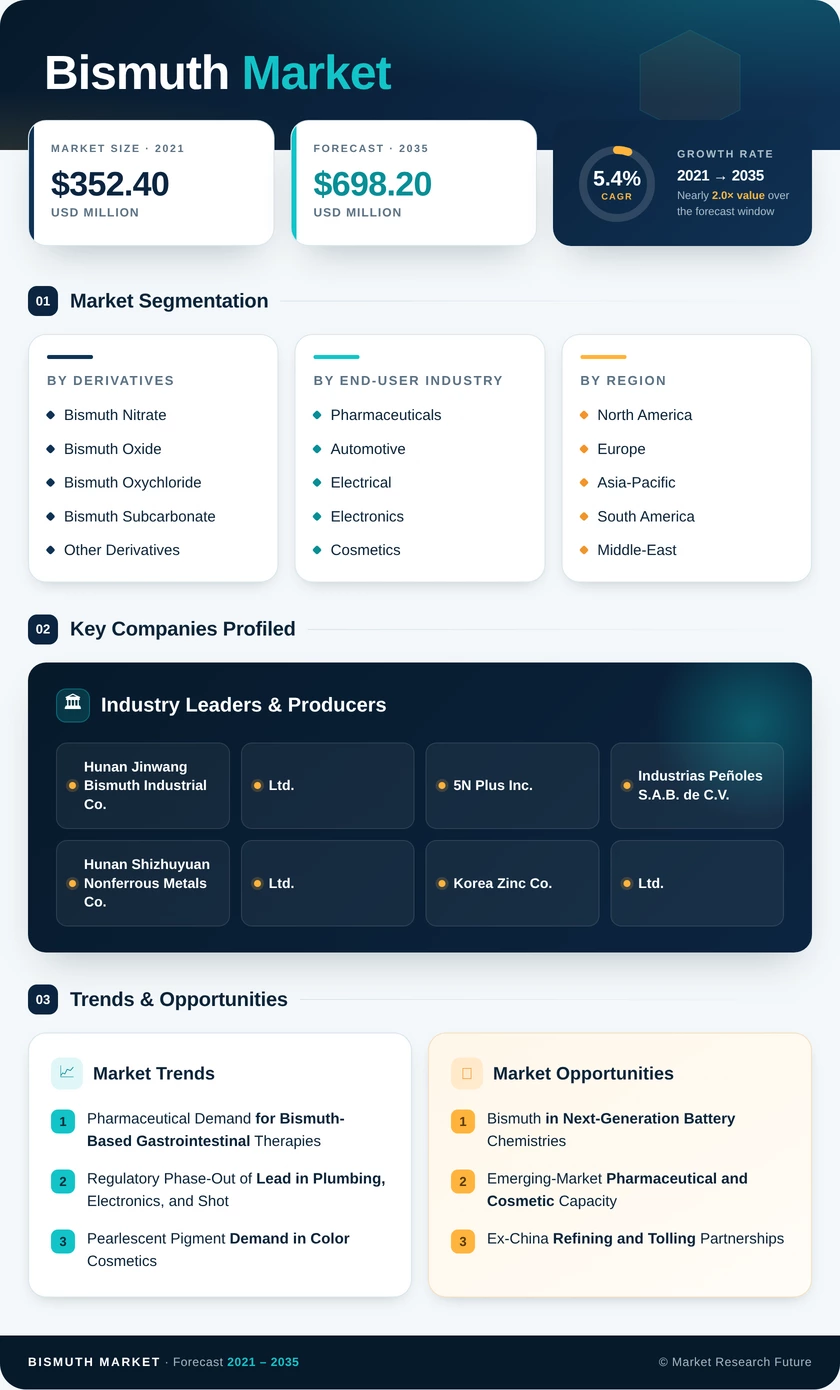
Bismuth Market Research Report Information By Derivatives (Bismuth Nitrate, Bismuth Oxide, Bismuth Oxychloride, Bismuth Subcarbonate, and Other Derivatives), By End-User Industry (Pharmaceuticals, Automotive, Electrical and Electronics, Cosmetics, and Other End-User Industries), And By Region (North America, Europe, Asia-Pacific, and Rest of the World) – Market Forecast Till 2035.
Bismuth Market
Market Size
Forecast Period2026-2035
CAGR (2026-2035)5.4%
2025 Market SizeUSD 412.6 Million
2035 Market SizeUSD 698.2 Million
Key Players
Hunan Jinwang Bismuth Industrial Co., Ltd.
5N Plus Inc.
Industrias Peñoles S.A.B. de C.V.
Hunan Shizhuyuan Nonferrous Metals Co., Ltd.
Korea Zinc Co., Ltd.
Vital Materials Co., Limited
Opportunities
  • Bismuth in Next-Generation Battery Chemistries
  • Emerging-Market Pharmaceutical and Cosmetic Capacity
  • Ex-China Refining and Tolling Partnerships
  1. 1 Market Summary | |
  2. 2 Key Report Takeaways | |
    1. 2.1 By Derivatives | |
    2. 2.2 By End-user Industry | |
    3. 2.3 By Region | |
  3. 3 Market Size and Forecast (2021–2035) | |
    1. 3.1 Historical Market Size (2021–2025) | |
    2. 3.2 Forecast Market Size (2026–2035) | |
    3. 3.3 Year-over-Year Growth Analysis | |
  4. 4 Driver Impact Analysis | |
    1. 4.1 Pharmaceutical Demand for Bismuth-Based Gastrointestinal Therapies | |
    2. 4.2 Regulatory Phase-Out of Lead in Plumbing, Electronics, and Shot | |
    3. 4.3 Pearlescent Pigment Demand in Color Cosmetics | |
    4. 4.4 Automotive Lead-Free Steels, Brakes, and Coatings | |
    5. 4.5 Low-Temperature Solders and Thermoelectric Devices | |
    6. 4.6 Critical Mineral Policies and Supply Localization | |
  5. 5 Restraints Impact Analysis | |
    1. 5.1 Toxicity Concerns and Dosage Limits | |
    2. 5.2 Competition From Lower-Cost Substitutes | |
    3. 5.3 By-Product Supply Concentration | |
    4. 5.4 Price Volatility and Export Controls | |
    5. 5.5 Low Recycling Rates From Dissipative Uses | |
  6. 6 Opportunities | |
    1. 6.1 Bismuth in Next-Generation Battery Chemistries | |
    2. 6.2 Emerging-Market Pharmaceutical and Cosmetic Capacity | |
    3. 6.3 Ex-China Refining and Tolling Partnerships | |
    4. 6.4 Traceability Data and Indexed Pricing Services | |
    5. 6.5 Lead-Free Radiation Shielding | |
  7. 7 Regional Market Share and Country-Level Analysis | |
    1. 7.1 North America | | |
      1. 7.1.1 United States | | |
      2. 7.1.2 Canada | | |
      3. 7.1.3 Mexico | |
    2. 7.2 Europe | | |
      1. 7.2.1 Germany | | |
      2. 7.2.2 United Kingdom | | |
      3. 7.2.3 Italy | | |
      4. 7.2.4 France | | |
      5. 7.2.5 Rest of Europe | |
    3. 7.3 Asia-Pacific | | |
      1. 7.3.1 China | | |
      2. 7.3.2 India | | |
      3. 7.3.3 Japan | | |
      4. 7.3.4 South Korea | | |
      5. 7.3.5 Rest of Asia-Pacific | |
    4. 7.4 South America | | |
      1. 7.4.1 Brazil | | |
      2. 7.4.2 Argentina | | |
      3. 7.4.3 Rest of South America | |
    5. 7.5 Middle-East and Africa | | |
      1. 7.5.1 Saudi Arabia | | |
      2. 7.5.2 South Africa | | |
      3. 7.5.3 Rest of Middle-East and Africa | |
  8. 8 Future Outlook (2026–2035) | |
    1. 8.1 Supply Security Reshapes Trade Flows | |
    2. 8.2 Electrification Drives Low-Temperature Electronics | |
    3. 8.3 Completing the Lead Phase-Out | |
    4. 8.4 Circularity and ESG Disclosure | |
  9. 9 Segmentation Analysis | |
    1. 9.1 By Derivatives | | |
      1. 9.1.1 Bismuth Nitrate | | |
      2. 9.1.2 Bismuth Oxide | | |
      3. 9.1.3 Bismuth Oxychloride | | |
      4. 9.1.4 Bismuth Subcarbonate | | |
      5. 9.1.5 Other Derivatives | |
    2. 9.2 By End-user Industry | | |
      1. 9.2.1 Pharmaceuticals | | |
      2. 9.2.2 Automotive | | |
      3. 9.2.3 Electrical and Electronics | | |
      4. 9.2.4 Cosmetics | | |
      5. 9.2.5 Other End-user Industries | |
  10. 10 Competitive Landscape | |
    1. 10.1 Market Concentration Analysis | |
    2. 10.2 Competitive Benchmarking Matrix | |
    3. 10.3 Company Profiles | | |
      1. 10.3.1 Hunan Jinwang Bismuth Industrial Co., Ltd. | | |
      2. 10.3.2 5N Plus Inc. | | |
      3. 10.3.3 Industrias Peñoles S.A.B. de C.V. | | |
      4. 10.3.4 Hunan Shizhuyuan Nonferrous Metals Co., Ltd. | | |
      5. 10.3.5 Korea Zinc Co., Ltd. | | |
      6. 10.3.6 Vital Materials Co., Limited | | |
      7. 10.3.7 Merck KGaA | | |
      8. 10.3.8 Jiangxi Copper Corporation | | |
      9. 10.3.9 Belmont Metals Inc. | | |
      10. 10.3.10 Nihon Kagaku Sangyo Co., Ltd. | |
  11. 11 Recent News & Developments | |
  12. 12 Report Scope and Methodology | |
  13. 13 Detailed Sources and Citations | |
  14. 14 Frequently Asked Questions (FAQs) | | LIST OF TABLES | |
  15. TABLE 1 Global Market Snapshot, 2025 and 2035 | |
  16. TABLE 2 Global Market Size & Forecast, by Revenue (USD Million), 2021–2035 | |
  17. TABLE 3 Driver Impact Analysis, 2026–2035 | |
  18. TABLE 4 Restraints Impact Analysis, 2026–2035 | |
  19. TABLE 5 Regional Summary, 2025 | |
  20. TABLE 6 North America Market, by Country, 2025 | |
  21. TABLE 7 Europe Market, by Country, 2025 | |
  22. TABLE 8 Asia-Pacific Market, by Country, 2025 | |
  23. TABLE 9 South America Market, by Country, 2025 | |
  24. TABLE 10 Middle-East and Africa Market, by Country, 2025 | |
  25. TABLE 11 Market Segmentation, by Derivatives, 2025 | |
  26. TABLE 12 Market Segmentation, by End-user Industry, 2025 | |
  27. TABLE 13 Competitive Benchmarking Matrix, 2025 | |
  28. TABLE 14 Report Scope and Methodology | |
  29. TABLE 15 Detailed Sources and Citations | |
  30. TABLE 16 Segmentation Quick Reference | | LIST OF FIGURES | |
  31. FIGURE 1 Market Dynamics Overview (Drivers, Restraints, Opportunities) | |
  32. FIGURE 2 Bismuth Value Chain, from By-Product Recovery to End Use | |
  33. FIGURE 3 Porter's Five Forces Analysis | |
  34. FIGURE 4 Global Market Size Trend, 2021–2035 (USD Million) | |
  35. FIGURE 5 Year-over-Year Growth Rate, 2021–2035 | |
  36. FIGURE 6 Market Share, by Derivatives, 2025 | |
  37. FIGURE 7 Market Share, by End-user Industry, 2025 | |
  38. FIGURE 8 Regional Market Share, 2025 | |
  39. FIGURE 9 Country-Level Share within Asia-Pacific, 2025 | |
  40. FIGURE 10 Regional CAGR Comparison, 2026–2035 | |
  41. FIGURE 11 Competitive Landscape: Estimated Revenue Share Ranges, 2025 | |
  42. FIGURE 12 Refining Concentration by Country, 2025

Segmentation Quick Reference

DimensionSub-SegmentsDominant SegmentFastest Growing Segment
By DerivativesBismuth Nitrate, Bismuth Oxide, Bismuth Oxychloride, Bismuth Subcarbonate, Other DerivativesBismuth Oxide (31.6% share)Bismuth Nitrate (6.2% CAGR)
By End-user IndustryPharmaceuticals, Automotive, Electrical and Electronics, Cosmetics, Other End-user IndustriesPharmaceuticals (34.2% share)Electrical and Electronics (6.6% CAGR)
By RegionNorth America, Europe, Asia-Pacific, South America, Middle-East and AfricaAsia-Pacific (62.4% share)Asia-Pacific (5.9% CAGR)

Market Segmentation Overview

By Derivatives

Sub-SegmentKey Trend
Bismuth NitrateRising use as a catalyst precursor and pharmaceutical intermediate
Bismuth OxideDemand for varistors, lead-free glass frits, and shielding composites
Bismuth OxychloridePearlescent effects in pressed powders and foundations
Bismuth SubcarbonateSteady pharmaceutical and radiopaque device demand
Other DerivativesBismuth vanadate replacing lead chromate yellows

Bismuth Oxide leads this dimension because varistor makers and glass-frit producers need a lead-free oxide with low melting behavior, and electronics volumes keep growing. Bismuth Nitrate grows fastest as chemical makers adopt bismuth catalysts that avoid heavier toxic metals in fine-chemical synthesis. Bismuth Oxychloride and Bismuth Subcarbonate supply stable volume to the cosmetics and pharmaceutical sectors.

By End-user Industry

Sub-SegmentKey Trend
PharmaceuticalsGuideline-backed bismuth quadruple therapy for H. pylori
AutomotiveLead-free machining steels as ELV exemptions narrow
Electrical and ElectronicsTin-bismuth low-temperature solder and Peltier modules
CosmeticsOxychloride effect pigments in color cosmetics
Other End-user IndustriesShotshells, bismuth brass, and fire-safety alloys

Pharmaceuticals lead because clinical guidelines lock bismuth into H. pylori treatment and OTC antidiarrheals have few direct substitutes. Electrical and Electronics grows fastest, since low-temperature tin-bismuth solders cut board warpage and energy use as RoHS-compliant assembly scales across Asia. Automotive demand rises more slowly, tied to the timing of lead exemption reviews in machining steels.


Download PDF ×

We do not share your information with anyone. However, we may send you emails based on your report interest from time to time. You may contact us at any time to opt-out.