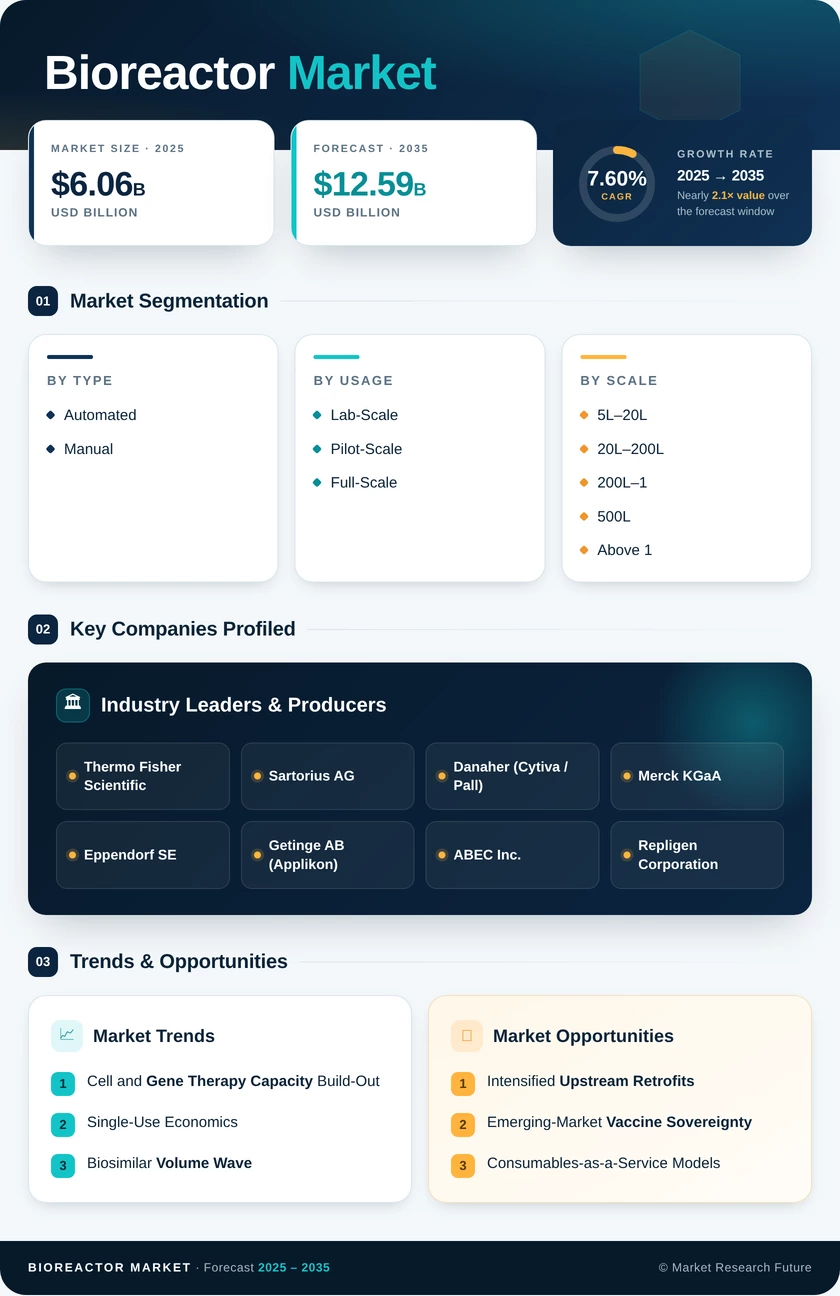
Bioreactor Market (2026 - 2035)

Bioreactor Market Research Report By Type (Stirred Tank Bioreactors, Fixed Bed Bioreactors, Sparged Bioreactors, Membrane Bioreactors), By Applications (Biopharmaceuticals, Food Beverages, Wastewater Treatment, Biofuels, Industrial Biotechnology), By Cell Type (Mammalian Cells, Microbial Cells, Plant Cells, Stem Cells), By Scale (Laboratory Scale, Pilot Scale, Industrial Scale) and By Regional (North America, Europe, South America, Asia Pacific, Middle East and Africa) - Growth & Industry Forecast 2025 To 2035

Forecast Period
2026-2035
CAGR
7.60%
2025 Market Size
USD 6.06 Billion
2035 Market Size
USD 12.59 Billion
Healthcare ● Updated August 2026 Report ID: MRFR/HC/41492-HCR | Pages: 128 | Author: Rahul Gotadki, Nidhi Mandole
  1. 1 Market Summary |
    1. 1.1 Study Assumptions & Market Definition |
    2. 1.2 Scope of the Study |
    3. 1.3 Research Methodology
  2. 2 Key Report Takeaways |
    1. 2.1 By Technology |
    2. 2.2 By Sector |
    3. 2.3 By Geography
  3. 3 Market Size & Forecast (2021–2035) |
    1. 3.1 Historical Market Size (2021–2025) |
    2. 3.2 Current & Forecast Market Size (2026–2035) |
    3. 3.3 Year-over-Year Growth Analysis
  4. 4 Driver Impact Analysis |
    1. 4.1 Cell and Gene Therapy Capacity Build-Out |
    2. 4.2 Single-Use Economics |
    3. 4.3 Biosimilar Volume Wave |
    4. 4.4 Digital Process Control
  5. 5 Restraints Impact Analysis |
    1. 5.1 Polymer Film Concentration Risk |
    2. 5.2 Talent Scarcity |
    3. 5.3 Qualification Overhead
  6. 6 Opportunities |
    1. 6.1 Intensified Upstream Retrofits |
    2. 6.2 Emerging-Market Vaccine Sovereignty |
    3. 6.3 Consumables-as-a-Service Models |
    4. 6.4 Process Data Monetisation |
    5. 6.5 Precision Fermentation Crossover
  7. 7 Regional Market Share & Country-Level Analysis |
    1. 7.1 North America | |
      1. 7.1.1 US | |
      2. 7.1.2 Canada | |
      3. 7.1.3 Mexico |
    2. 7.2 Europe | |
      1. 7.2.1 Germany | |
      2. 7.2.2 UK | |
      3. 7.2.3 France | |
      4. 7.2.4 Italy | |
      5. 7.2.5 Spain | |
      6. 7.2.6 Nordic Countries | |
      7. 7.2.7 Russia | |
      8. 7.2.8 Rest of Europe |
    3. 7.3 Asia-Pacific | |
      1. 7.3.1 China | |
      2. 7.3.2 India | |
      3. 7.3.3 Japan | |
      4. 7.3.4 South Korea | |
      5. 7.3.5 ASEAN | |
      6. 7.3.6 Rest of Asia-Pacific |
    4. 7.4 South America | |
      1. 7.4.1 Brazil | |
      2. 7.4.2 Argentina | |
      3. 7.4.3 Rest of South America |
    5. 7.5 Middle East & Africa | |
      1. 7.5.1 Saudi Arabia | |
      2. 7.5.2 UAE | |
      3. 7.5.3 South Africa | |
      4. 7.5.4 Egypt | |
      5. 7.5.5 Rest of Middle East & Africa
  8. 8 Future Outlook (2026–2035) |
    1. 8.1 Autonomous Bioprocessing |
    2. 8.2 Platform Economics & Ecosystem Lock-In |
    3. 8.3 Distributed & Point-of-Care Manufacturing |
    4. 8.4 Sustainability Accounting
  9. 9 Market Segmentation Analysis |
    1. 9.1 By Type | |
      1. 9.1.1 Glass | |
      2. 9.1.2 Stainless Steel | |
      3. 9.1.3 Single-Use |
    2. 9.2 By Usage | |
      1. 9.2.1 Lab-Scale | |
      2. 9.2.2 Pilot-Scale | |
      3. 9.2.3 Full-Scale |
    3. 9.3 By Scale | |
      1. 9.3.1 5L–20L | |
      2. 9.3.2 20L–200L | |
      3. 9.3.3 200L–1,500L | |
      4. 9.3.4 Above 1,500L |
    4. 9.4 By Control Type | |
      1. 9.4.1 Manual | |
      2. 9.4.2 Automated |
    5. 9.5 By Bioprocess | |
      1. 9.5.1 Batch | |
      2. 9.5.2 Fed-Batch | |
      3. 9.5.3 Continuous |
    6. 9.6 By Application | |
      1. 9.6.1 Pharmaceutical & Biopharmaceutical | |
      2. 9.6.2 Cell & Gene Therapy | |
      3. 9.6.3 Food & Beverage / Industrial | |
      4. 9.6.4 Academic Research |
    7. 9.7 By End User | |
      1. 9.7.1 Biopharmaceutical Companies | |
      2. 9.7.2 CDMOs / CMOs | |
      3. 9.7.3 Academic & Research Institutes | |
      4. 9.7.4 Others
  10. 10 Competitive Landscape |
    1. 10.1 Market Concentration Analysis (2026) |
    2. 10.2 Competitive Benchmarking Matrix |
    3. 10.3 Company Profiles | |
      1. 10.3.1 Thermo Fisher Scientific | |
      2. 10.3.2 Sartorius AG | |
      3. 10.3.3 Danaher (Cytiva / Pall) | |
      4. 10.3.4 Merck KGaA | |
      5. 10.3.5 Eppendorf SE | |
      6. 10.3.6 Getinge AB (Applikon) | |
      7. 10.3.7 ABEC Inc. | |
      8. 10.3.8 Repligen Corporation | |
      9. 10.3.9 PBS Biotech | |
      10. 10.3.10 Solaris Biotech (Donaldson)
  11. 11 Recent News & Developments
  12. 12 Report Scope & Methodology |
    1. 12.1 Study Period & Base Year |
    2. 12.2 Valuation Currency & Conventions |
    3. 12.3 Abbreviations
  13. 13 Detailed Sources & Citations
  14. 14 Frequently Asked Questions
  15. 15 LIST OF TABLES
  16. 16 LIST OF FIGURES
Share::
Request Free Sample

Segmentation Quick Reference

DimensionSub-SegmentsDominant SegmentFastest Growing Segment
By TypeGlass; Stainless Steel; Single-UseStainless SteelSingle-Use
By UsageLab-Scale; Pilot-Scale; Full-ScaleFull-ScalePilot-Scale
By Scale5L–20L; 20L–200L; 200L–1,500L; Above 1,500L200L–1,500LAbove 1,500L
By Control TypeManual; AutomatedAutomatedAutomated
By BioprocessBatch; Fed-Batch; ContinuousFed-BatchContinuous
By ApplicationPharmaceutical & Biopharmaceutical; Cell & Gene Therapy; Food & Beverage / Industrial; Academic ResearchPharmaceutical & BiopharmaceuticalCell & Gene Therapy
By End UserBiopharmaceutical Companies; CDMOs / CMOs; Academic & Research Institutes; OthersBiopharmaceutical CompaniesCDMOs / CMOs
By GeographyNorth America; Europe; Asia-Pacific; South America; Middle East & AfricaNorth AmericaAsia-Pacific


Market Segmentation Overview

By Type

Sub-SegmentKey Trend
GlassConfined to development benches; steady replacement demand tied to academic funding
Stainless SteelRetains commercial-scale economics above 5,000L; refresh cycles lengthening
Single-UseDefault choice for new clinical and multi-product facilities; consumables annuity model


Type mix is the clearest structural shift in the industry. Disposables displace steel at small and mid scale while steel defends the very large volume band, producing a barbell rather than a clean substitution.

By Usage

Sub-SegmentKey Trend
Lab-ScaleParallel mini systems replacing single-vessel benchtop units
Pilot-ScaleRising regulatory expectations for process characterisation packages
Full-ScaleUtilisation optimisation prioritised over new capacity in mature regions


Usage demand tracks pipeline stage distribution. As more molecules crowd early clinical phases, pilot and development capacity absorbs a growing share of equipment budgets.

By Scale

Sub-SegmentKey Trend
5L–20LCell therapy and screening workflows drive unit counts
20L–200LClinical supply and tech-transfer bridging volumes
200L–1,500LCommercial sweet spot as titres rise above 5 g/L
Above 1,500LPrecision fermentation and large-volume biologics


Scale preferences reflect productivity gains upstream. Higher titres let manufacturers meet the same demand from smaller vessels, redistributing volume toward mid-band capacity.

By Control Type

Sub-SegmentKey Trend
ManualPersisting only in budget-constrained academic settings
AutomatedData integrity mandates and model-predictive control adoption


Control automation has become a compliance requirement rather than a convenience, which effectively caps manual system growth across regulated environments.

By Bioprocess

Sub-SegmentKey Trend
BatchLegacy installations and microbial fermentation workflows
Fed-BatchIndustry standard for antibody production; incremental intensification
ContinuousFootprint and cost-per-gram advantages; validation complexity slows uptake


Bioprocess evolution is incremental. Most sponsors intensify fed-batch before attempting fully continuous operation, so transition revenue accrues to retrofit and cell-retention suppliers first.

By Application

Sub-SegmentKey Trend
Pharmaceutical & BiopharmaceuticalBiosimilar wave and reshoring underpin baseline demand
Cell & Gene TherapyParallel small-vessel architectures multiply unit orders
Food & Beverage / IndustrialPrecision fermentation scaling toward commodity volumes
Academic ResearchGrant-cycle dependent; steady replacement demand


Application mix determines vessel architecture more than any other dimension, since therapy modality dictates volume, closure requirements, and batch parallelism.

By End User

Sub-SegmentKey Trend
Biopharmaceutical CompaniesSelective in-house capacity for platform molecules
CDMOs / CMOsFastest expansion as emerging biotechs outsource commercial supply
Academic & Research InstitutesPublic funding cycles govern procurement timing
OthersIndustrial biotechnology and alternative protein producers


End-user composition is tilting toward contract manufacturers, which changes vendor sales motion from single-site projects to multi-year framework agreements.


You’ve used 75% of your weekly limit

Share::
Request Free Sample
Download PDF ×

We do not share your information with anyone. However, we may send you emails based on your report interest from time to time. You may contact us at any time to opt-out.