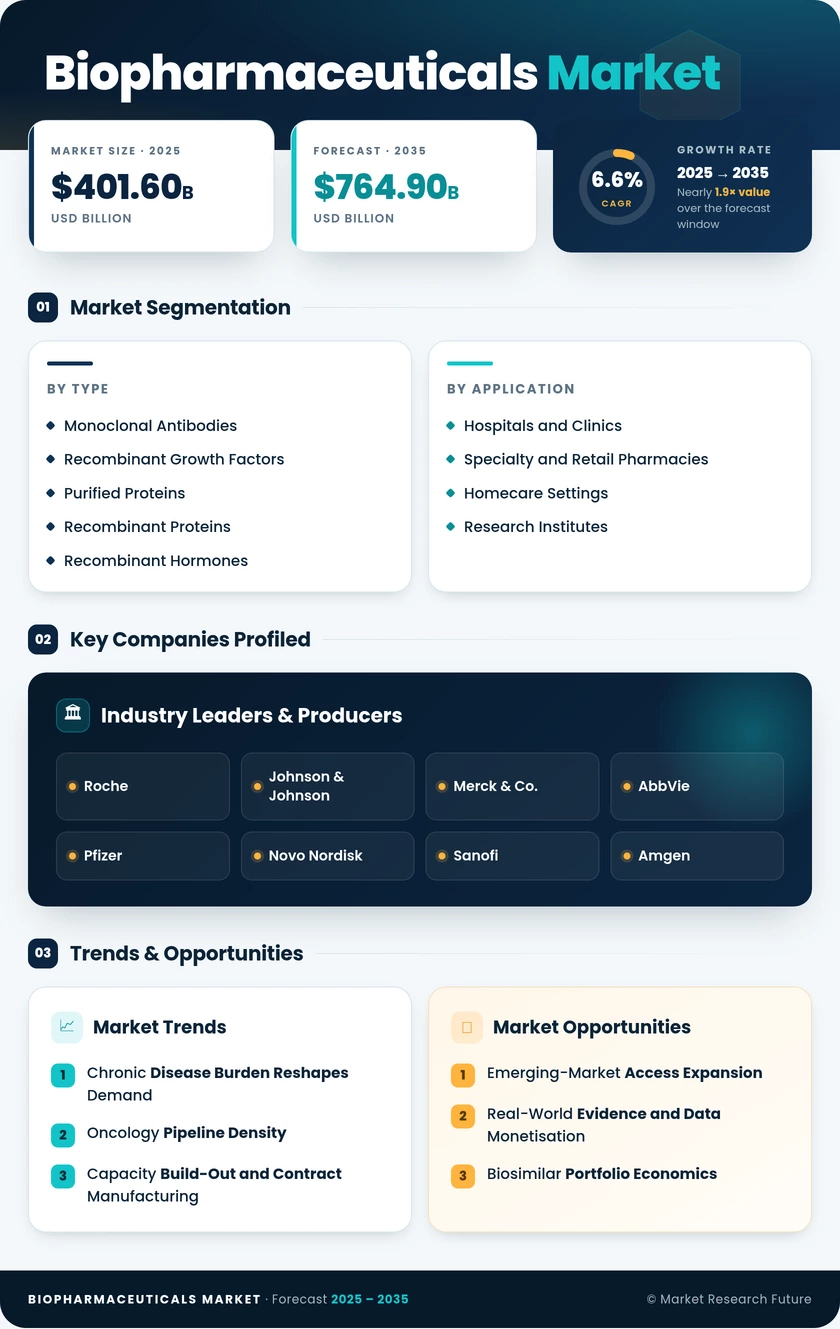
Segmentation Quick Reference
| Dimension | Sub-Segments | Dominant Segment | Fastest Growing Segment |
| By Product Type | Monoclonal Antibodies; Recombinant Growth Factors; Purified Proteins; Recombinant Proteins; Recombinant Hormones; Vaccines; Other Product Types | Monoclonal Antibodies | Recombinant Hormones |
| By Therapeutic Application | Oncology; Inflammatory and Infectious Diseases; Autoimmune Disorders; Metabolic Disorders; Hormonal Disorders; Other Applications | Oncology | Metabolic Disorders |
| By End User | Hospitals and Clinics; Specialty and Retail Pharmacies; Homecare Settings; Research Institutes | Hospitals and Clinics | Homecare Settings |
| By Geography | North America; Europe; Asia-Pacific; South America; Middle East & Africa | North America | Asia-Pacific |
Market Segmentation Overview
By Product Type
| Sub-Segment | Key Trend |
| Monoclonal Antibodies | Shift from naked antibodies toward conjugates and bispecific formats |
| Recombinant Growth Factors | Steady supportive-care demand with biosimilar price compression |
| Purified Proteins | Plasma collection constraints limit near-term supply growth. |
| Recombinant Proteins | Extended half-life engineering displaces first-generation products. |
| Recombinant Hormones | Incretin capacity expansion dominates capital allocation. |
| Vaccines | Adult immunisation schedules offset paediatric plateau. |
| Other Product Types | Cell and gene therapies move from approval to reimbursement phase. |
Product architecture is diverging. Established antibody formats are commoditising under biosimilar pressure while engineered constructs command innovation premiums, which pushes sponsors toward platforms that support multiple format outputs from shared upstream infrastructure.
By Therapeutic Application
| Sub-Segment | Key Trend |
| Oncology | Conjugate approvals broaden addressable tumour types |
| Inflammatory and Infectious Diseases | Long-acting antivirals reshape treatment cadence. |
| Autoimmune Disorders | Mechanism switching accelerates as IL-23 agents mature. |
| Metabolic Disorders | Obesity indications outpace manufacturing capacity. |
| Hormonal Disorders | Weekly formulations improve adherence economics. |
| Other Applications | Ophthalmology and neurology gain biologic entrants. |
Therapeutic mix is rebalancing toward chronic, high-prevalence conditions. That shift trades high per-patient pricing for volume durability, changing how sponsors model franchise value and how payers structure risk-sharing arrangements.
By End User
| Sub-Segment | Key Trend |
| Hospitals and Clinics | Infusion volume plateaus as subcutaneous conversion accelerates |
| Specialty and Retail Pharmacies | Channel share rises with self-administered formats. |
| Homecare Settings | Autoinjector and connected-device adoption expands access. |
| Research Institutes | Investigator-initiated biologic trials increase in academic centres. |
Channel economics now shape formulation strategy as much as clinical need. Sponsors design for the site of care they want to serve, and payers increasingly steer utilisation toward the lowest-cost administration setting available.


 Noah Malgeri
Co-Founder
Noah Malgeri
Co-Founder

 Peter Groot koerkamp
Account and Business Manager
Peter Groot koerkamp
Account and Business Manager

 Younghwan Choi
Senior Retail Manager
Younghwan Choi
Senior Retail Manager

 Mark Irwin
Management Consultant
Mark Irwin
Management Consultant

 Akif Moroglu
Strategy & Business Development Director
Akif Moroglu
Strategy & Business Development Director

 Guilherme Gomes Martins
Product Management Director
Guilherme Gomes Martins
Product Management Director

 Joseph Aguayo
Sales Operations & Pricing Manager
Joseph Aguayo
Sales Operations & Pricing Manager

 La Terria Dodd
Program Support Specialist
La Terria Dodd
Program Support Specialist

 Rob Kooiker
Group Product Manager HVAC & Fire Protection GMA
Rob Kooiker
Group Product Manager HVAC & Fire Protection GMA