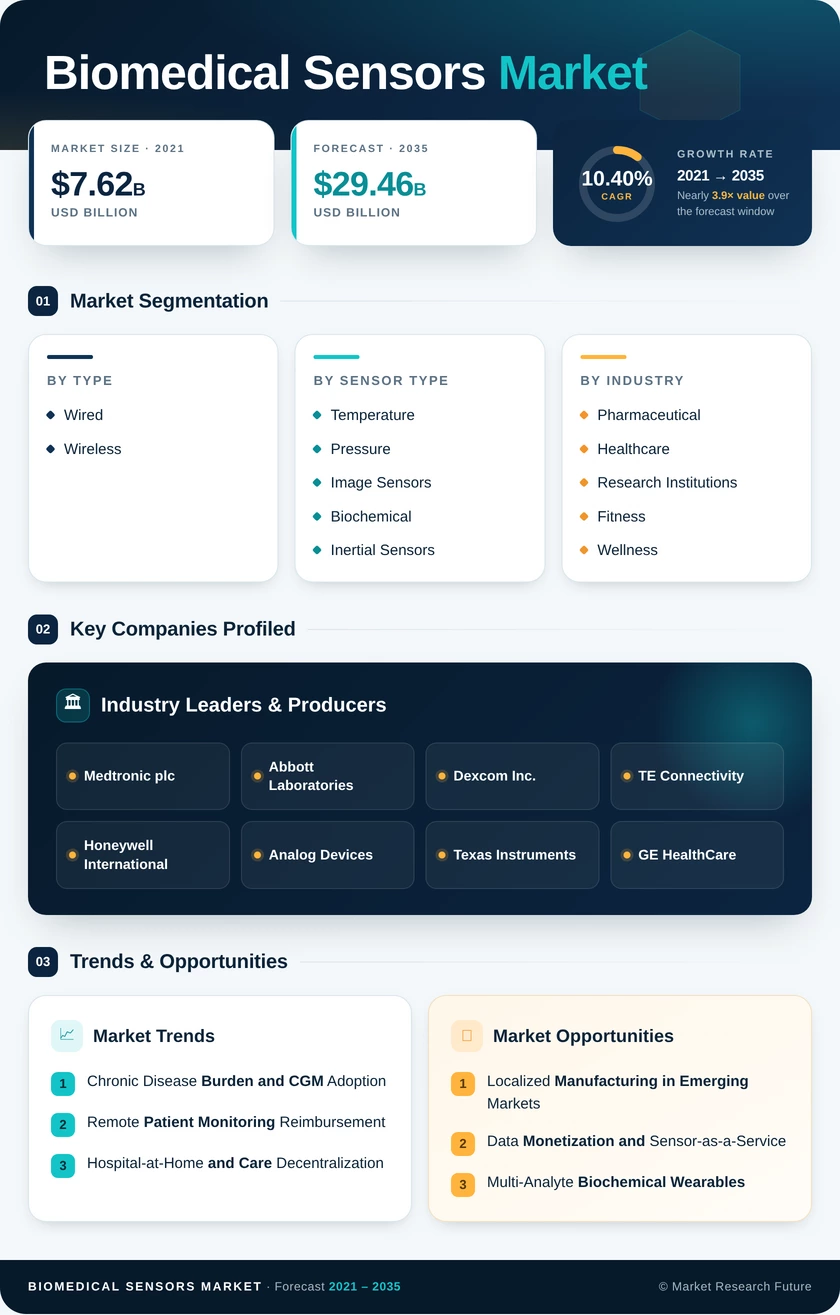
Segmentation Quick Reference
| Dimension | Sub-Segments | Dominant Segment | Fastest Growing Segment |
|---|---|---|---|
| By Type | Wired, Wireless | Wireless (67.5% share) | Wireless (67.5% share) |
| By Sensor Type | Temperature, Pressure, Image Sensors, Biochemical, Inertial Sensors, Motion Sensors, Electrocardiogram, Other Sensor Types | Temperature (31.6% share) | Biochemical (11.8% CAGR) |
| By Industry | Pharmaceutical, Healthcare, Research Institutions, Fitness and Wellness | Healthcare (59.4% share) | Fitness and Wellness (11.2% CAGR) |
| By Application | Diagnostics, Monitoring, Therapeutics, Imaging, Research and Development, Other Applications | Monitoring (43.8% share) | Therapeutics (11.5% CAGR) |
| By Region | North America, Europe, Asia Pacific, South America, Middle East and Africa | North America (38.6% share) | Asia Pacific (12.1% CAGR) |
Market Segmentation Overview
By Type
| Sub-Segment | Key Trend |
|---|---|
| Wired | Retained in ICU and closed-loop anesthesia for sub-10 ms latency |
| Wireless | Disposable BLE and body-area-network patches replacing tethered probes |
Wireless leads this dimension and also sets the growth pace, because disposable patches eliminate sterilization logistics and let general wards and home programs scale monitored beds cheaply. Wired holds its ground in intensive care, where electromagnetic interference tolerance and deterministic latency still outweigh cabling costs. Ultra-wideband trials could erode that last wired stronghold later in the forecast.
By Sensor Type
| Sub-Segment | Key Trend |
|---|---|
| Temperature | Continuous perioperative and fever monitoring |
| Pressure | MEMS commoditization compressing margins |
| Image Sensors | On-chip processing for 4K endoscopy |
| Biochemical | Multi-analyte glucose, lactate, and ketone sensing |
| Inertial Sensors | Gait analytics for neurological disease |
| Motion Sensors | Contactless time-of-flight arrays in neonatal wards |
| Electrocardiogram | Dry-electrode patches for 30-day recordings |
| Other Sensor Types | Respiratory flow and specialty sensing |
Temperature remains the largest sensor type thanks to its presence in nearly every monitoring workflow, but Biochemical grows fastest as electrochemical accuracy improvements unlock reimbursement for continuous glucose and ketone monitoring. Electrocardiogram and Inertial Sensors are gaining clinical relevance through long-duration arrhythmia detection and Parkinson's gait analytics, while Pressure faces pricing pressure from mature MEMS production.
By Industry
| Sub-Segment | Key Trend |
|---|---|
| Pharmaceutical | Sensor fleets for decentralized trials |
| Healthcare | Bedside, surgical, and remote monitoring programs |
| Research Institutions | Longitudinal biosignal and exposome studies |
| Fitness and Wellness | OTC glucose and lactate sensing for consumers |
Healthcare dominates because hospitals and health systems control reimbursed monitoring budgets and bedside equipment purchases. Fitness and Wellness is the fastest-growing industry since over-the-counter clearances let athletes and metabolic-health consumers self-fund continuous data. Pharmaceutical demand rises steadily as FDA guidance legitimizes sensor-derived endpoints in clinical trials.
By Application
| Sub-Segment | Key Trend |
|---|---|
| Diagnostics | Stable demand under bundled payments |
| Monitoring | Continuous vital-sign surveillance in wards and homes |
| Therapeutics | Closed-loop insulin delivery and neurostimulation |
| Imaging | AR overlays fusing sensor data with pre-operative scans |
| Research and Development | Digital biomarkers moving toward surrogate endpoints |
| Other Applications | Veterinary and occupational health adaptations |
Monitoring leads this dimension as hospital-at-home programs and remote monitoring reimbursement expand continuous surveillance. Therapeutics grows fastest because closed-loop systems attach sensors to reimbursed therapies, commanding premium pricing. Diagnostics stays steady, while Research and Development gains as regulators accept digital biomarkers in oncology and rare-disease trials.


 Noah Malgeri
Co-Founder

 Peter Groot koerkamp
Account and Business Manager

 Younghwan Choi
Senior Retail Manager

 Mark Irwin
Management Consultant

 Akif Moroglu
Strategy & Business Development Director

 Guilherme Gomes Martins
Product Management Director

 Joseph Aguayo
Sales Operations & Pricing Manager

 La Terria Dodd
Program Support Specialist

 Rob Kooiker
Group Product Manager HVAC & Fire Protection GMA