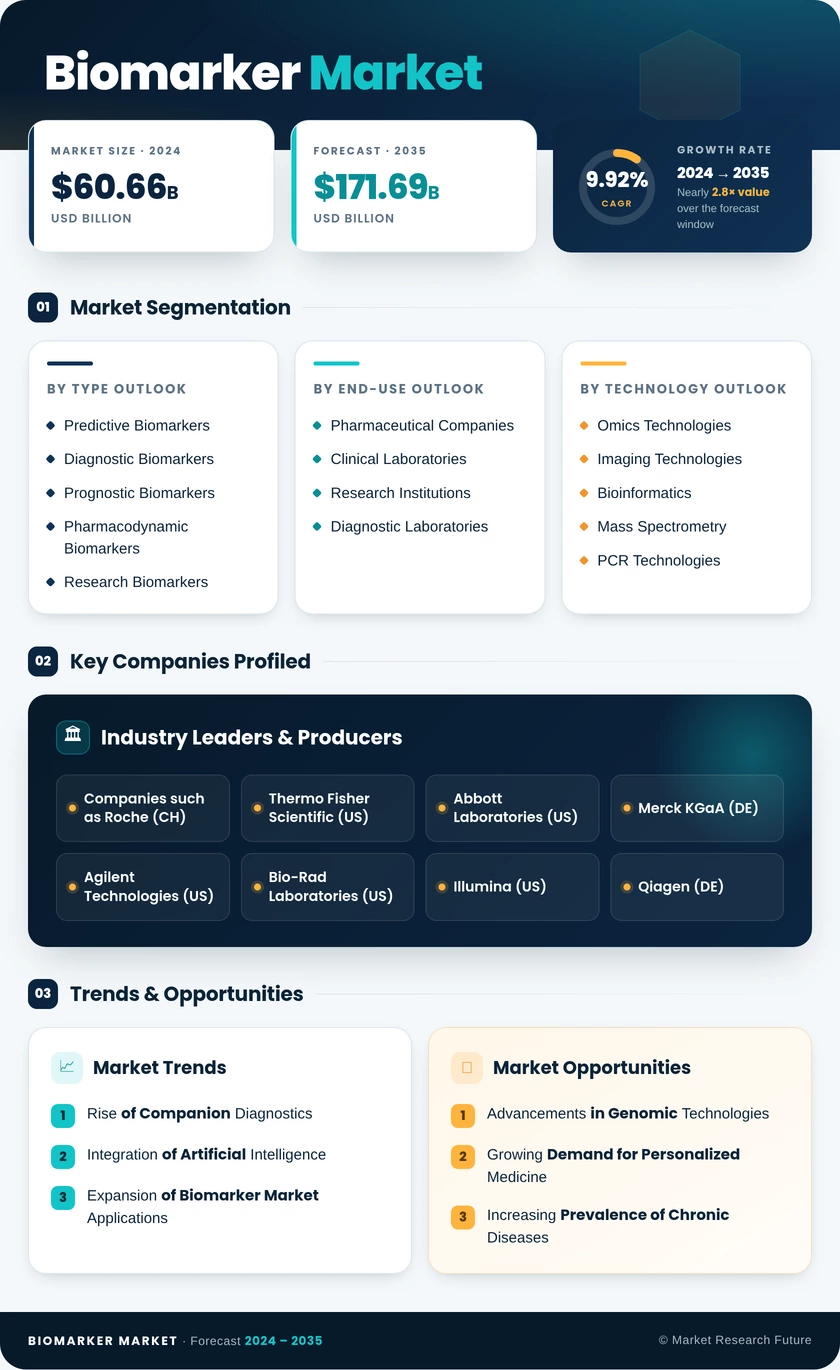
Segmentation Quick Reference
| Dimension | Sub-Segments | Dominant Segment | Fastest Growing Segment |
| By Disease | Cancer; Cardiovascular; Neurological; Immunological Disorders; Infectious Diseases; Other Diseases | Cancer (43.0% share, 2025) | Neurological (13.9% CAGR, 2026–2035) |
| By Type | Efficacy; Safety; Validation | Efficacy (54.0% share, 2025) | Safety (13.7% CAGR, 2026–2035) |
| By Mechanism | Genetic; Proteomic; Epigenetic; Metabolomic; Other Mechanisms | Genetic (43.8% share, 2025) | Epigenetic (14.8% CAGR, 2026–2035) |
| By Application | Clinical Diagnostics; Drug Discovery and Development; Personalised Medicine; Disease Risk Assessment; Other Applications | Clinical Diagnostics (55.2% share, 2025) | Personalised Medicine (15.0% CAGR, 2026–2035) |
| By Product | Consumables; Instruments; Services and Software | Consumables (50.2% share, 2025) | Services and Software (14.7% CAGR, 2026–2035) |
Market Segmentation Overview
By Disease
| Sub-Segment | Key Trend |
| Cancer | Serial plasma monitoring converting one-time tests into recurring surveillance |
| Cardiovascular | High-sensitivity troponin commoditising as generic immunoassays enter formularies |
| Neurological | Plasma p-tau181 and GFAP displacing amyloid PET for triage |
| Immunological Disorders | Multi-analyte cytokine panels guiding biologic dose adjustment |
| Infectious Diseases | Syndromic panels supporting antimicrobial stewardship mandates |
| Other Diseases | Expanded newborn screening panels for metabolic and rare conditions |
Cancer leads this dimension and will continue to set pricing benchmarks, because pharma-diagnostic co-development guarantees assay demand at drug launch and payer coverage of tumour mutational burden sequencing is already established. Neurological biomarkers grow fastest as blood-based dementia triage moves into primary care ahead of anti-amyloid therapy referral, with immunological disorders close behind on rheumatology panel adoption. Cardiovascular testing retains the largest unit volume but the weakest pricing power, since generic immunoassay competition has eroded margins across hospital formularies. Infectious disease panels remain essential in lower-income geographies where donor procurement, not reimbursement, sets demand.
By Type
| Sub-Segment | Key Trend |
| Efficacy | Predictive and pharmacodynamic markers embedded in registration pathways |
| Safety | Organ-toxicity panels becoming default Phase II protocol components |
| Validation | Sample-integrity markers enabling decentralised and remote trial designs |
Efficacy biomarkers hold the dominant position because prognostic, predictive, pharmacodynamic, and surrogate markers all sit on the regulatory critical path, and sponsors will not deprioritise spending that gates approval. Safety biomarkers expand fastest as regulators require cardiotoxicity and hepatotoxicity monitoring in oncology pipelines and payers push to minimise adverse-event costs. Validation biomarkers remain the smallest of the three but grow steadily with decentralised trial adoption, since remote collection sites cannot guarantee sample-handling fidelity without them.
By Mechanism
| Sub-Segment | Key Trend |
| Genetic | Established reimbursement codes sustaining next-generation sequencing volume |
| Proteomic | High-plex plasma profiling awaiting cross-platform reference standards |
| Epigenetic | Methylation signatures enabling multi-cancer detection from single draws |
| Metabolomic | Risk scoring extending into cardiometabolic and inborn error screening |
| Other Mechanisms | Digital pathology and imaging-derived signatures entering validation |
Genetic biomarkers dominate because clear FDA pathways and existing CPT codes give laboratories a billing certainty that no competing mechanism yet matches. Epigenetic assays grow fastest, since bisulfite-free methylation tests deliver early-stage sensitivity that sequencing cannot reach, though they depend on reimbursement channels still under construction. Proteomic platforms occupy the middle ground with enormous analytical breadth but persistent comparability gaps between affinity and mass-spectrometry methods, which harmonisation initiatives target for resolution by 2028.
By Application
| Sub-Segment | Key Trend |
| Clinical Diagnostics | Entrenched billing codes sustaining daily hospital and reference lab volume |
| Drug Discovery and Development | Cohort enrichment cutting Phase III trial size and cost |
| Personalised Medicine | Pharmacogenomic dosing reducing hospitalisation in anticoagulation and psychiatry |
| Disease Risk Assessment | Polygenic scoring opening employer wellness channels |
| Other Applications | Nutritional and physiological profiling in consumer-adjacent settings |
Clinical diagnostics dominate on sheer throughput, with troponin, HbA1c, and lipid panels running continuously across hospital and reference laboratory networks under long-established reimbursement. Personalised medicine advances fastest and is projected to close the gap materially by 2030 as payers accumulate evidence that genotype-guided prescribing lowers hospitalisation rates. Drug discovery applications generate less volume but far higher value per test, shrinking Phase III cohorts by roughly 30%, while disease risk assessment builds an employer-funded channel that bypasses traditional payers entirely.
By Product
| Sub-Segment | Key Trend |
| Consumables | Per-run reagent consumption locking in recurring manufacturer revenue |
| Instruments | Premium pricing sustained in spatial omics and mass spectrometry niches |
| Services and Software | Cloud interpretation subscriptions converting equipment users into recurring customers |
Consumables lead this dimension because every sequencing run and immunoassay consumes fresh reagents, giving manufacturers cash flow visibility that is independent of instrument replacement cycles. Services and software grow fastest as community hospitals without in-house bioinformatics outsource variant interpretation and shift spending from capital to operating budgets. Instruments face the slowest growth given extended replacement intervals, yet they retain pricing power in modalities such as spatial transcriptomics where no commoditised alternative has emerged.


 Noah Malgeri
Co-Founder

 Peter Groot koerkamp
Account and Business Manager

 Younghwan Choi
Senior Retail Manager

 Mark Irwin
Management Consultant

 Akif Moroglu
Strategy & Business Development Director

 Guilherme Gomes Martins
Product Management Director

 Joseph Aguayo
Sales Operations & Pricing Manager

 La Terria Dodd
Program Support Specialist

 Rob Kooiker
Group Product Manager HVAC & Fire Protection GMA