Request Free Sample ×

Kindly complete the form below to receive a free sample of this Report

* Please use a valid business email

Leading companies partner with us for data-driven Insights

clients tt-cursor
Hero Background
English
Chinese
French
Japanese
Korean
German
Spanish

Biofiltration Market Share

ID: MRFR/HC/10125-HCR
128 Pages
Rahul Gotadki
April 2026

Biofiltration Market Research Report Information By Type (Biological Aerated Biofilter System, Denitrification Biofilter Systems, Activated Carbon Biofilters, Fixed Films, and Fluidized Bed Filter), By Filter Media (Ceramic Rings, Bio Balls, Moving Bed Filter Media, and Others), By Application (VOC Treatment, Nitrification, Denitrification, Odor Abatement, and Others), By End User (Storm Water Management, Water & Wastewater Collection, Chemical Processing, Food & Beverage, Aquaculture, Biopharma Industry, and Others), and By Region (North America, Europe, Asia-Pacific, And Rest Of The World) –Market Forecast Till 2035

Share:
Download PDF ×

We do not share your information with anyone. However, we may send you emails based on your report interest from time to time. You may contact us at any time to opt-out.

Biofiltration Market Infographic
Purchase Options

Market Share

Biofiltration Market Share Analysis

The Pharmaceutical Biofiltration Market is experiencing strategic developments as businesses endeavor to seize a significant market share through advanced technologies of filtration. For pharmaceutical companies, product differentiation is one major strategy where they concentrate on biofiltration systems that are unique and innovative meant for use in pharmaceutical manufacturing processes. To distinguish themselves from other competitors on the market, pharma companies have to produce up-to-date bio-filtrations with improved effectiveness, scalability, or novel features that will draw pharmaceutical manufacturers and researchers who require advanced solutions for maintaining high standards of drug quality.

Another important approach in the Pharmaceutical Biofiltration Market is cost leadership. Companies are increasingly working towards optimizing production techniques, looking for low-cost inputs and making sure there is an effective biofiltration solution within their reach. Companies want this because they understand the economic implications of PR&D, especially in incorporating advanced technology. These companies aspire to be leaders in biofiltration technologies that are affordable hence capturing a huge part of the market and meeting broader needs of their customers who want enhance production.

Innovation has become a key driver in market share positioning within the Pharmaceutical Biofiltration Market. These companies spend heavily on research and development (R&D) so as to come up with new types of bio-filtrations which can effectively filter air or water used in processing drugs at various pharmaceutical facilities. With constant innovation then these firms can become leaders being trusted by both manufacturers and regulators too because they play a major role when it comes to developing newer treatments thus ensuring that our growing global population continues having access to good health care options while simultaneously lowering costs.

Strategic alliances and partnerships are increasingly becoming typical throughout the Pharmaceutical Biofiltration Market. In order to strengthen their knowledge pool as well as broaden their scope, businesses align with research institutes, environmental agencies and even drug makers for instance Collaborations also offer platforms for sharing information about biofiltrating products within pharmacy set ups alongside creating holistic approaches toward air and water purification. By forming collaborative networks companies can gain more market share and at the same time contribute to sustainable practices being observed in the drug industry.

In the Pharmaceutical Biofiltration Market, marketing and branding play a crucial role in market share. To inform manufacturers about biofiltration’s advantages in drug manufacturing processes, educate stakeholders and promote their respective solutions for bio-filtrations, corporations use targeted marketing strategies. Creating good reputation through a strong brand helps to foster trust among producers of pharmaceuticals that impact on decisions regarding biofiltration facilities adoption. The educational initiatives, industry conference presence or even digital marketing approaches are all meant for ensuring effective communications with consumers by raising awareness levels amongst them.

Pharmaceutical Biofiltration Market is becoming more customer centric as firms begin to acknowledge the importance of user experience. Satisfying specific needs of pharmaceutical enterprises through targeted offerings such as user-friendly interfaces along with encompassing support schemes facilitate positive user experiences based upon these guidelines. As long as these organizations place the general usability and contentment of professionals within this sector ahead then they should be able to build up long-term relationships leading loyalty and positive reviews which would greatly influence market shares in such an environmentally aware growing economy as well as social concerns over environmental health that need better air filtration technology for homes today than ever before has been recognized worldwide.


Author
Author Profile
Rahul Gotadki
Research Manager

He holds an experience of about 9+ years in Market Research and Business Consulting, working under the spectrum of Life Sciences and Healthcare domains. Rahul conceptualizes and implements a scalable business strategy and provides strategic leadership to the clients. His expertise lies in market estimation, competitive intelligence, pipeline analysis, customer assessment, etc.

Leave a Comment

FAQs

What is the projected market valuation of the Biofiltration Market by 2035?

<p>The Biofiltration Market is projected to reach a valuation of 7.678 USD Billion by 2035.</p>

What was the market valuation of the Biofiltration Market in 2024?

<p>In 2024, the Biofiltration Market was valued at 2.745 USD Billion.</p>

What is the expected CAGR for the Biofiltration Market during the forecast period 2025 - 2035?

<p>The expected CAGR for the Biofiltration Market during the forecast period 2025 - 2035 is 9.8%.</p>

Which companies are considered key players in the Biofiltration Market?

<p>Key players in the Biofiltration Market include Xylem Inc, Veolia Environnement, SUEZ, Ecolab Inc, Aquatech International, Biowater Technology, Aqua-Aerobic Systems, and H2O Innovation.</p>

What segment of the Biofiltration Market had the highest valuation in 2024?

<p>The Biological Aerated Biofilter System segment had the highest valuation at 0.823 USD Billion in 2024.</p>

What is the projected valuation for the Denitrification Biofilter Systems segment by 2035?

<p>The Denitrification Biofilter Systems segment is projected to reach a valuation of 1.563 USD Billion by 2035.</p>

How does the market for Activated Carbon Biofilters compare to Fixed Films in 2024?

In 2024, the Activated Carbon Biofilters segment was valued at 0.686 USD Billion, whereas Fixed Films were valued at 0.412 USD Billion.

What applications are driving growth in the Biofiltration Market?

Applications such as VOC Treatment and Nitrification are driving growth, with projected valuations of 2.305 USD Billion and 1.563 USD Billion respectively by 2035.

What is the expected growth for the Water & Wastewater Collection segment by 2035?

The Water &amp; Wastewater Collection segment is expected to grow to a valuation of 2.2 USD Billion by 2035.

What types of filter media are included in the Biofiltration Market, and what are their projected valuations?

Types of filter media include Ceramic Rings, Bio Balls, and Moving Bed Filter Media, with projected valuations of 2.325 USD Billion, 1.925 USD Billion, and 1.545 USD Billion respectively by 2035.

Market Summary

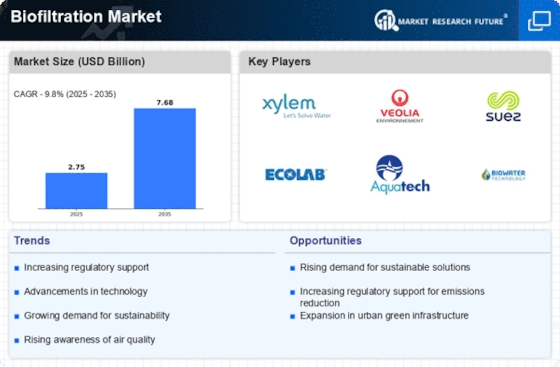
As per Market Research Future analysis, the Biofiltration Market Size was estimated at 2.745 USD Billion in 2024. The Biofiltration industry is projected to grow from 3.014 USD Billion in 2025 to 7.678 USD Billion by 2035, exhibiting a compound annual growth rate (CAGR) of 9.8% during the forecast period 2025 - 2035

Key Market Trends & Highlights

The Biofiltration Market is poised for substantial growth driven by technological advancements and increasing environmental awareness.

  • North America remains the largest market for biofiltration technologies, reflecting a strong commitment to environmental sustainability. Asia-Pacific is emerging as the fastest-growing region, propelled by rapid industrialization and urbanization. The Biological Aerated Biofilter System dominates the market, while Denitrification Biofilter Systems are witnessing the fastest growth due to their efficiency in nutrient removal. Key market drivers include increasing environmental regulations and rising awareness of sustainable practices, which are shaping the demand for innovative biofiltration solutions.

Market Size & Forecast

2024 Market Size 2.745 (USD Billion)
2035 Market Size 7.678 (USD Billion)
CAGR (2025 - 2035) 9.8%
Largest Regional Market Share in 2024 North America

Major Players

<a href="https://www.xylem.com/en-in/resources/articles/water-usage-optimization-in-biofiltration-odor-systems/">Xylem Inc </a>(US), Veolia Environnement (FR), SUEZ (FR), Ecolab Inc (US), Aquatech International (US), Biowater Technology (NO), Aqua-Aerobic Systems (US), H2O Innovation (CA)

Market Trends

The Biofiltration Market is currently experiencing a notable evolution, driven by increasing environmental concerns and the need for sustainable waste management solutions. This market encompasses various applications, including air and water treatment, where biological processes are employed to remove contaminants. The growing awareness of pollution and its adverse effects on health and ecosystems has led to a heightened demand for biofiltration technologies. As industries seek to comply with stringent regulations, the adoption of biofiltration systems appears to be gaining momentum, reflecting a shift towards greener practices. Moreover, advancements in technology are likely to enhance the efficiency and effectiveness of biofiltration systems. Innovations in microbial strains and biofilter design may improve the overall performance of these systems, making them more attractive to various sectors. The integration of biofiltration with other treatment methods could also emerge as a trend, providing comprehensive solutions for complex waste streams. As the Biofiltration Market continues to evolve, it seems poised to play a crucial role in addressing environmental challenges while promoting sustainable development.

Technological Advancements

Recent innovations in microbial technology and biofilter design are enhancing the performance of biofiltration systems. These advancements may lead to more efficient contaminant removal and broader application across various industries.

Regulatory Compliance

Increasingly stringent environmental regulations are driving industries to adopt biofiltration solutions. This trend suggests that companies are prioritizing sustainable practices to meet compliance requirements and reduce their ecological footprint.

Integration with Other Treatment Methods

The potential for integrating biofiltration with other waste treatment technologies is becoming more apparent. This trend indicates a move towards holistic approaches in managing complex waste streams, thereby improving overall treatment efficacy.

Biofiltration Market Market Drivers

Increasing Environmental Regulations

The Biofiltration Market is experiencing a surge in demand due to the tightening of environmental regulations across various sectors. Governments are implementing stricter guidelines to control air and water pollution, which necessitates the adoption of biofiltration technologies. For instance, industries such as wastewater treatment and air purification are increasingly required to meet specific emission standards. This regulatory pressure is driving investments in biofiltration systems, as companies seek to comply with environmental laws while minimizing their ecological footprint. The market is projected to grow as more organizations recognize the importance of sustainable practices and the role of biofiltration in achieving compliance. As a result, the Biofiltration Market is likely to see a significant uptick in both innovation and market penetration.

Growing Demand for Clean Water Solutions

The demand for clean water solutions is escalating, significantly impacting the Biofiltration Market. With increasing population and industrial activities, the pressure on water resources is intensifying, leading to a greater need for effective water treatment technologies. Biofiltration Market systems are recognized for their ability to remove contaminants and improve water quality, making them an attractive option for municipalities and industries alike. The market is projected to grow as more entities invest in biofiltration to ensure access to clean water. This trend underscores the critical role of biofiltration in addressing water scarcity and pollution challenges, positioning the Biofiltration Market for continued expansion.

Integration with Waste Management Systems

The integration of biofiltration technologies with existing waste management systems is becoming increasingly prevalent, thereby driving the Biofiltration Market. As municipalities and industries seek comprehensive solutions for waste treatment, biofiltration offers a viable option for enhancing the efficiency of these systems. By incorporating biofiltration into waste management strategies, organizations can achieve better pollutant removal and resource recovery. This trend is particularly evident in urban areas where waste management challenges are more pronounced. The Biofiltration Market is expected to benefit from this integration, as it provides a synergistic approach to waste treatment that aligns with modern sustainability goals.

Rising Awareness of Sustainable Practices

There is a growing awareness among industries and consumers regarding the importance of sustainable practices, which is positively influencing the Biofiltration Market. As environmental concerns become more prevalent, businesses are increasingly adopting eco-friendly technologies to enhance their sustainability profiles. Biofiltration Market systems, which utilize natural processes to treat pollutants, align well with these sustainability goals. The market is witnessing a shift as companies recognize that investing in biofiltration not only helps in waste management but also improves their brand image. This trend is expected to drive the Biofiltration Market forward, as more organizations seek to implement sustainable solutions that resonate with environmentally conscious consumers.

Technological Innovations in Biofiltration

Technological advancements are playing a crucial role in shaping the Biofiltration Market. Innovations in materials, design, and operational efficiency are enhancing the effectiveness of biofiltration systems. For example, the development of advanced biofilters that utilize specific microorganisms to target particular pollutants is gaining traction. These innovations not only improve the performance of biofiltration systems but also reduce operational costs, making them more attractive to industries. The market is likely to expand as these technologies become more accessible and affordable, allowing a wider range of applications. Consequently, the Biofiltration Market is poised for growth as technological breakthroughs continue to emerge.

Market Segment Insights

By Type: Biological Aerated Biofilter System (Largest) vs. Denitrification Biofilter Systems (Fastest-Growing)

The Biofiltration Market is characterized by a diverse array of technologies, with the Biological Aerated Biofilter System securing the largest market share. Its popularity can be attributed to its effective performance in a variety of wastewater treatment scenarios, making it a go-to choice for many municipalities. In contrast, Denitrification Biofilter Systems are quickly gaining traction as the fastest-growing segment, as environmental regulations increase the need for efficient nitrogen removal treatments across industries, thereby driving growth in this area. Growth trends indicate a promising trajectory for the Biofiltration Market, particularly for technologies that align with sustainable practices. The increasing emphasis on environmental compliance and wastewater management efficiency is propelling the demand for advanced biofiltration systems. Furthermore, innovations in technology, such as improved filtration media and system designs, are enhancing the effectiveness and cost-efficiency of these solutions, encouraging broader adoption in various sectors, including food and beverage, pharmaceuticals, and municipal water treatment.

Biological Aerated Biofilter Systems (Dominant) vs. Activated Carbon Biofilters (Emerging)

Biological Aerated Biofilter Systems are a dominant force in the Biofiltration Market, renowned for their robustness and efficiency in treating a wide range of contaminants in wastewater. This system utilizes biological processes enhanced with aeration, allowing for improved degradation of organic matter. Meanwhile, Activated Carbon Biofilters are emerging as a viable alternative, offering high adsorption capabilities for organic and inorganic pollutants. Their ability to target specific contaminants effectively makes them an attractive option for industries needing specialized treatment solutions. As these emerging technologies evolve, they present significant opportunities for market growth and diversification, appealing to environmentally-conscious sectors.

By Filter Media: Ceramic Rings (Largest) vs. Bio Balls (Fastest-Growing)

The Biofiltration Market is characterized by diverse filter media, with Ceramic Rings holding the largest market share due to their durability and effectiveness in various applications. Bio Balls also play a significant role, especially in aquaculture and water treatment systems, known for their high surface area which promotes biofilm growth. Moving Bed Filter Media, while important, remains a smaller segment, providing specialized solutions for wastewater treatment. Other media types add variety, catering to specific niche applications in biofiltration processes.

Ceramic Rings (Dominant) vs. Bio Balls (Emerging)

Ceramic Rings are a dominant player in the Biofiltration Market, recognized for their structural stability and efficacy in supporting microbial growth. They are widely used in both industrial and municipal applications due to their effectiveness in removing organic matter and pollutants from water. On the other hand, Bio Balls, considered an emerging segment, are gaining popularity for their lightweight and design that maximizes surface area, making them particularly suitable for aquarium filters and bioreactors. Their ability to foster a robust biological community allows for efficient filtration and nutrient cycling, positioning them as a competitive alternative to traditional media.

By Application: VOC Treatment (Largest) vs. Odor Abatement (Fastest-Growing)

The Biofiltration Market exhibits a diverse application range, with VOC Treatment currently occupying the largest share. This segment focuses on removing volatile organic compounds from air and wastewater, catering to various industries such as automotive, petrochemical, and food processing. Following VOC Treatment, Odor Abatement is gaining traction and expanding its footprint in the market, driven by increasing regulatory pressure and growing public awareness regarding air quality and environmental issues. The driving forces behind the growth of these segments are multifaceted. VOC Treatment is bolstered by stringent environmental regulations aimed at reducing emissions and improving air quality. Meanwhile, Odor Abatement is emerging rapidly, spurred by the necessity for industries to enhance their public image and comply with local ordinances. Other applications, such as Nitrification and Denitrification, are also experiencing steady demand, contributing to the overall growth of the Biofiltration Market.

VOC Treatment (Dominant) vs. Nitrification (Emerging)

VOC Treatment is recognized as the dominant application within the Biofiltration Market, characterized by its capability to effectively eliminate harmful volatile organic compounds. This segment is employed widely across various industries, showcasing its versatility and importance for maintaining compliance with health and safety regulations. In contrast, Nitrification is an emerging application gaining relevance, primarily in wastewater treatment processes where the conversion of ammonia into nitrates is essential for reducing nitrogen pollution. While VOC Treatment is driven by a well-established demand, Nitrification's growth is propelled by advancements in wastewater technologies and the increasing need for efficient nutrient removal processes.

By End User: Storm Water Management (Largest) vs. Water & Wastewater Collection (Fastest-Growing)

In the Biofiltration Market, the largest end-user segment is Storm Water Management, reflecting a growing emphasis on sustainable urban development and environmental protection. This segment captures a significant portion of market share, driven by increasing regulations and a global commitment to improving water quality. Conversely, the Water &amp; Wastewater Collection sector is the fastest-growing segment, highlighted by innovations in filtration technologies and the rising need for efficient wastewater treatment solutions. This growth is fueled by urbanization and the increasing population, necessitating advanced treatment methods.

Storm Water Management (Dominant) vs. Water &amp; Wastewater Collection (Emerging)

The Storm Water Management segment stands out as the dominant player in the Biofiltration Market, thanks to its critical role in managing runoff and mitigating pollution. Organizations are increasingly investing in biofiltration systems that harness natural processes to filter contaminants, enhancing environmental sustainability. On the other hand, the Water &amp; Wastewater Collection segment is emerging rapidly, driven by the need for modernized treatment solutions that cater to population growth. The integration of advanced technologies, including automated monitoring and smart systems, positions this segment for continued growth as municipalities and industries seek to improve water quality and compliance with stringent regulations.

Get more detailed insights about Biofiltration Market Research Report—Global Forecast till 2035

Regional Insights

North America : Innovation and Sustainability Leader

North America is the largest market for biofiltration, holding approximately 40% of the global share. The region's growth is driven by stringent environmental regulations, increasing demand for clean water, and advancements in biofiltration technologies. The U.S. and Canada are the primary contributors, with a focus on sustainable practices and innovative solutions to address water quality issues. Regulatory support further enhances market dynamics, fostering investment in biofiltration systems. The competitive landscape in North America features key players such as Xylem Inc, Ecolab Inc, and Aqua-Aerobic Systems. These companies are at the forefront of technological advancements, offering a range of biofiltration solutions tailored to various industries. The presence of established firms and ongoing research initiatives contribute to a robust market environment, ensuring continuous growth and innovation in biofiltration technologies.

Europe : Regulatory-Driven Market Growth

Europe is the second-largest market for biofiltration, accounting for approximately 30% of the global market share. The region's growth is propelled by stringent EU regulations aimed at improving water quality and sustainability. Countries like Germany and France are leading the charge, implementing policies that encourage the adoption of biofiltration technologies in wastewater treatment and industrial applications. The European Green Deal further supports this trend, promoting eco-friendly solutions. Leading countries in Europe include Germany, France, and the Netherlands, where companies like Veolia Environnement and SUEZ are prominent players. The competitive landscape is characterized by a mix of established firms and innovative startups, all striving to meet the increasing demand for efficient biofiltration systems. Collaborative efforts between public and private sectors enhance research and development, driving advancements in biofiltration technologies across the region.

Asia-Pacific : Emerging Market with High Potential

Asia-Pacific is witnessing rapid growth in the biofiltration market, holding approximately 20% of the global share. The region's expansion is driven by increasing industrialization, urbanization, and a growing awareness of environmental issues. Countries like China and India are at the forefront, implementing policies to improve water quality and manage wastewater effectively. Government initiatives and investments in infrastructure are key catalysts for market growth in this region. The competitive landscape in Asia-Pacific features a mix of local and international players, including Biowater Technology and H2O Innovation. The presence of these companies, along with increasing collaborations and partnerships, is enhancing the availability of advanced biofiltration solutions. As the region continues to prioritize sustainable practices, the demand for innovative biofiltration technologies is expected to rise significantly in the coming years.

Middle East and Africa : Resource Management and Innovation

The Middle East and Africa region is emerging as a significant player in the biofiltration market, accounting for approximately 10% of the global share. The growth is driven by the need for effective water management solutions in arid regions, coupled with increasing investments in infrastructure. Countries like South Africa and the UAE are leading the way, focusing on sustainable practices to address water scarcity and improve environmental conditions. Regulatory frameworks are evolving to support the adoption of biofiltration technologies. In this region, the competitive landscape is characterized by a mix of local firms and international players. Companies are increasingly collaborating with governments and NGOs to implement biofiltration systems that cater to local needs. The presence of innovative solutions and a growing emphasis on sustainability are expected to drive further growth in the biofiltration market across the Middle East and Africa.

Key Players and Competitive Insights

The Biofiltration Market is currently characterized by a dynamic competitive landscape, driven by increasing environmental regulations and a growing emphasis on sustainable water management solutions. Key players such as Xylem Inc (US), Veolia Environnement (FR), and Ecolab Inc (US) are strategically positioned to leverage their technological expertise and extensive service networks. Xylem Inc (US) focuses on innovation in water treatment technologies, while Veolia Environnement (FR) emphasizes its global reach and comprehensive service offerings. Ecolab Inc (US) is increasingly integrating digital solutions into its operations, enhancing its competitive edge. Collectively, these strategies foster a competitive environment that prioritizes technological advancement and sustainability, shaping the market's trajectory.In terms of business tactics, companies are increasingly localizing manufacturing and optimizing supply chains to enhance operational efficiency. The Biofiltration Market appears moderately fragmented, with a mix of established players and emerging companies vying for market share. The collective influence of these key players is significant, as they drive innovation and set industry standards, thereby influencing the overall market structure.

In August Xylem Inc (US) announced a partnership with a leading technology firm to develop advanced biofiltration systems aimed at improving wastewater treatment efficiency. This strategic move is likely to enhance Xylem's product offerings and strengthen its position in the market, as it aligns with the growing demand for innovative solutions in water management. The collaboration may also facilitate the integration of cutting-edge technologies, further differentiating Xylem from its competitors.

In September Veolia Environnement (FR) expanded its operations in Asia by acquiring a local biofiltration technology company. This acquisition is significant as it not only broadens Veolia's technological capabilities but also enhances its market presence in a rapidly growing region. The strategic expansion into Asia reflects Veolia's commitment to addressing regional water challenges and underscores its focus on sustainable solutions.

In July Ecolab Inc (US) launched a new digital platform designed to optimize biofiltration processes for industrial clients. This initiative is indicative of Ecolab's strategic emphasis on digital transformation, which is becoming increasingly vital in the competitive landscape. By leveraging data analytics and AI, Ecolab aims to provide tailored solutions that enhance operational efficiency and reduce environmental impact, thereby solidifying its market position.

As of October current competitive trends in the Biofiltration Market are heavily influenced by digitalization, sustainability, and the integration of artificial intelligence. Strategic alliances among key players are shaping the landscape, fostering innovation and collaboration. Looking ahead, it is anticipated that competitive differentiation will increasingly pivot from price-based strategies to a focus on technological innovation, reliability in supply chains, and sustainable practices. This evolution suggests a market that values not only cost-effectiveness but also the long-term viability of solutions offered.

Key Companies in the Biofiltration Market include

Industry Developments

Future Outlook

Biofiltration Market Future Outlook

The Biofiltration Market is projected to grow at a 9.8% CAGR from 2025 to 2035, driven by increasing environmental regulations, technological advancements, and rising demand for sustainable solutions.

New opportunities lie in:

  • Development of modular biofiltration systems for urban applications.</p><p>Integration of IoT for <a href="https://www.marketresearchfuture.com/reports/real-time-health-monitoring-devices-market-3564">real-time health monitoring</a> and optimization.</p><p>Expansion into emerging markets with tailored biofiltration solutions.

By 2035, the Biofiltration Market is expected to achieve substantial growth, reflecting its critical role in environmental sustainability.

Market Segmentation

Biofiltration Market Type Outlook

  • Biological Aerated Biofilter System
  • Denitrification Biofilter Systems
  • Activated Carbon Biofilters
  • Fixed Films
  • Fluidized Bed Filter

Biofiltration Market End User Outlook

  • Storm Water Management
  • Water & Wastewater Collection
  • Chemical Processing
  • Food & Beverage
  • Aquaculture
  • Biopharma Industry
  • Others

Biofiltration Market Application Outlook

  • VOC Treatment
  • Nitrification
  • Denitrification
  • Odor Abatement
  • Others

Biofiltration Market Filter Media Outlook

  • Ceramic Rings
  • Bio Balls
  • Moving Bed Filter Media
  • Others

Report Scope

MARKET SIZE 2024 2.745(USD Billion)
MARKET SIZE 2025 3.014(USD Billion)
MARKET SIZE 2035 7.678(USD Billion)
COMPOUND ANNUAL GROWTH RATE (CAGR) 9.8% (2025 - 2035)
REPORT COVERAGE Revenue Forecast, Competitive Landscape, Growth Factors, and Trends
BASE YEAR 2024
Market Forecast Period 2025 - 2035
Historical Data 2019 - 2024
Market Forecast Units USD Billion
Key Companies Profiled Xylem Inc (US), Veolia Environnement (FR), SUEZ (FR), Ecolab Inc (US), Aquatech International (US), Biowater Technology (NO), Aqua-Aerobic Systems (US), H2O Innovation (CA)
Segments Covered Type, Filter Media, Application, End User, Region
Key Market Opportunities Integration of advanced materials enhances efficiency in the Biofiltration Market.
Key Market Dynamics Rising regulatory pressures drive innovation and adoption of biofiltration technologies across various industries.
Countries Covered North America, Europe, APAC, South America, MEA

FAQs

What is the projected market valuation of the Biofiltration Market by 2035?

<p>The Biofiltration Market is projected to reach a valuation of 7.678 USD Billion by 2035.</p>

What was the market valuation of the Biofiltration Market in 2024?

<p>In 2024, the Biofiltration Market was valued at 2.745 USD Billion.</p>

What is the expected CAGR for the Biofiltration Market during the forecast period 2025 - 2035?

<p>The expected CAGR for the Biofiltration Market during the forecast period 2025 - 2035 is 9.8%.</p>

Which companies are considered key players in the Biofiltration Market?

<p>Key players in the Biofiltration Market include Xylem Inc, Veolia Environnement, SUEZ, Ecolab Inc, Aquatech International, Biowater Technology, Aqua-Aerobic Systems, and H2O Innovation.</p>

What segment of the Biofiltration Market had the highest valuation in 2024?

<p>The Biological Aerated Biofilter System segment had the highest valuation at 0.823 USD Billion in 2024.</p>

What is the projected valuation for the Denitrification Biofilter Systems segment by 2035?

<p>The Denitrification Biofilter Systems segment is projected to reach a valuation of 1.563 USD Billion by 2035.</p>

How does the market for Activated Carbon Biofilters compare to Fixed Films in 2024?

In 2024, the Activated Carbon Biofilters segment was valued at 0.686 USD Billion, whereas Fixed Films were valued at 0.412 USD Billion.

What applications are driving growth in the Biofiltration Market?

Applications such as VOC Treatment and Nitrification are driving growth, with projected valuations of 2.305 USD Billion and 1.563 USD Billion respectively by 2035.

What is the expected growth for the Water & Wastewater Collection segment by 2035?

The Water &amp; Wastewater Collection segment is expected to grow to a valuation of 2.2 USD Billion by 2035.

What types of filter media are included in the Biofiltration Market, and what are their projected valuations?

Types of filter media include Ceramic Rings, Bio Balls, and Moving Bed Filter Media, with projected valuations of 2.325 USD Billion, 1.925 USD Billion, and 1.545 USD Billion respectively by 2035.

  1. SECTION I: EXECUTIVE SUMMARY AND KEY HIGHLIGHTS
    1. | 1.1 EXECUTIVE SUMMARY
    2. | | 1.1.1 Market Overview
    3. | | 1.1.2 Key Findings
    4. | | 1.1.3 Market Segmentation
    5. | | 1.1.4 Competitive Landscape
    6. | | 1.1.5 Challenges and Opportunities
    7. | | 1.1.6 Future Outlook
  2. SECTION II: SCOPING, METHODOLOGY AND MARKET STRUCTURE
    1. | 2.1 MARKET INTRODUCTION
    2. | | 2.1.1 Definition
    3. | | 2.1.2 Scope of the study
    4. | | | 2.1.2.1 Research Objective
    5. | | | 2.1.2.2 Assumption
    6. | | | 2.1.2.3 Limitations
    7. | 2.2 RESEARCH METHODOLOGY
    8. | | 2.2.1 Overview
    9. | | 2.2.2 Data Mining
    10. | | 2.2.3 Secondary Research
    11. | | 2.2.4 Primary Research
    12. | | | 2.2.4.1 Primary Interviews and Information Gathering Process
    13. | | | 2.2.4.2 Breakdown of Primary Respondents
    14. | | 2.2.5 Forecasting Model
    15. | | 2.2.6 Market Size Estimation
    16. | | | 2.2.6.1 Bottom-Up Approach
    17. | | | 2.2.6.2 Top-Down Approach
    18. | | 2.2.7 Data Triangulation
    19. | | 2.2.8 Validation
  3. SECTION III: QUALITATIVE ANALYSIS
    1. | 3.1 MARKET DYNAMICS
    2. | | 3.1.1 Overview
    3. | | 3.1.2 Drivers
    4. | | 3.1.3 Restraints
    5. | | 3.1.4 Opportunities
    6. | 3.2 MARKET FACTOR ANALYSIS
    7. | | 3.2.1 Value chain Analysis
    8. | | 3.2.2 Porter's Five Forces Analysis
    9. | | | 3.2.2.1 Bargaining Power of Suppliers
    10. | | | 3.2.2.2 Bargaining Power of Buyers
    11. | | | 3.2.2.3 Threat of New Entrants
    12. | | | 3.2.2.4 Threat of Substitutes
    13. | | | 3.2.2.5 Intensity of Rivalry
    14. | | 3.2.3 COVID-19 Impact Analysis
    15. | | | 3.2.3.1 Market Impact Analysis
    16. | | | 3.2.3.2 Regional Impact
    17. | | | 3.2.3.3 Opportunity and Threat Analysis
  4. SECTION IV: QUANTITATIVE ANALYSIS
    1. | 4.1 Healthcare, BY Type (USD Billion)
    2. | | 4.1.1 Biological Aerated Biofilter System
    3. | | 4.1.2 Denitrification Biofilter Systems
    4. | | 4.1.3 Activated Carbon Biofilters
    5. | | 4.1.4 Fixed Films
    6. | | 4.1.5 Fluidized Bed Filter
    7. | 4.2 Healthcare, BY Filter Media (USD Billion)
    8. | | 4.2.1 Ceramic Rings
    9. | | 4.2.2 Bio Balls
    10. | | 4.2.3 Moving Bed Filter Media
    11. | | 4.2.4 Others
    12. | 4.3 Healthcare, BY Application (USD Billion)
    13. | | 4.3.1 VOC Treatment
    14. | | 4.3.2 Nitrification
    15. | | 4.3.3 Denitrification
    16. | | 4.3.4 Odor Abatement
    17. | | 4.3.5 Others
    18. | 4.4 Healthcare, BY End User (USD Billion)
    19. | | 4.4.1 Storm Water Management
    20. | | 4.4.2 Water & Wastewater Collection
    21. | | 4.4.3 Chemical Processing
    22. | | 4.4.4 Food & Beverage
    23. | | 4.4.5 Aquaculture
    24. | | 4.4.6 Biopharma Industry
    25. | | 4.4.7 Others
    26. | 4.5 Healthcare, BY Region (USD Billion)
    27. | | 4.5.1 North America
    28. | | | 4.5.1.1 US
    29. | | | 4.5.1.2 Canada
    30. | | 4.5.2 Europe
    31. | | | 4.5.2.1 Germany
    32. | | | 4.5.2.2 UK
    33. | | | 4.5.2.3 France
    34. | | | 4.5.2.4 Russia
    35. | | | 4.5.2.5 Italy
    36. | | | 4.5.2.6 Spain
    37. | | | 4.5.2.7 Rest of Europe
    38. | | 4.5.3 APAC
    39. | | | 4.5.3.1 China
    40. | | | 4.5.3.2 India
    41. | | | 4.5.3.3 Japan
    42. | | | 4.5.3.4 South Korea
    43. | | | 4.5.3.5 Malaysia
    44. | | | 4.5.3.6 Thailand
    45. | | | 4.5.3.7 Indonesia
    46. | | | 4.5.3.8 Rest of APAC
    47. | | 4.5.4 South America
    48. | | | 4.5.4.1 Brazil
    49. | | | 4.5.4.2 Mexico
    50. | | | 4.5.4.3 Argentina
    51. | | | 4.5.4.4 Rest of South America
    52. | | 4.5.5 MEA
    53. | | | 4.5.5.1 GCC Countries
    54. | | | 4.5.5.2 South Africa
    55. | | | 4.5.5.3 Rest of MEA
  5. SECTION V: COMPETITIVE ANALYSIS
    1. | 5.1 Competitive Landscape
    2. | | 5.1.1 Overview
    3. | | 5.1.2 Competitive Analysis
    4. | | 5.1.3 Market share Analysis
    5. | | 5.1.4 Major Growth Strategy in the Healthcare
    6. | | 5.1.5 Competitive Benchmarking
    7. | | 5.1.6 Leading Players in Terms of Number of Developments in the Healthcare
    8. | | 5.1.7 Key developments and growth strategies
    9. | | | 5.1.7.1 New Product Launch/Service Deployment
    10. | | | 5.1.7.2 Merger & Acquisitions
    11. | | | 5.1.7.3 Joint Ventures
    12. | | 5.1.8 Major Players Financial Matrix
    13. | | | 5.1.8.1 Sales and Operating Income
    14. | | | 5.1.8.2 Major Players R&D Expenditure. 2023
    15. | 5.2 Company Profiles
    16. | | 5.2.1 Xylem Inc (US)
    17. | | | 5.2.1.1 Financial Overview
    18. | | | 5.2.1.2 Products Offered
    19. | | | 5.2.1.3 Key Developments
    20. | | | 5.2.1.4 SWOT Analysis
    21. | | | 5.2.1.5 Key Strategies
    22. | | 5.2.2 Veolia Environnement (FR)
    23. | | | 5.2.2.1 Financial Overview
    24. | | | 5.2.2.2 Products Offered
    25. | | | 5.2.2.3 Key Developments
    26. | | | 5.2.2.4 SWOT Analysis
    27. | | | 5.2.2.5 Key Strategies
    28. | | 5.2.3 SUEZ (FR)
    29. | | | 5.2.3.1 Financial Overview
    30. | | | 5.2.3.2 Products Offered
    31. | | | 5.2.3.3 Key Developments
    32. | | | 5.2.3.4 SWOT Analysis
    33. | | | 5.2.3.5 Key Strategies
    34. | | 5.2.4 Ecolab Inc (US)
    35. | | | 5.2.4.1 Financial Overview
    36. | | | 5.2.4.2 Products Offered
    37. | | | 5.2.4.3 Key Developments
    38. | | | 5.2.4.4 SWOT Analysis
    39. | | | 5.2.4.5 Key Strategies
    40. | | 5.2.5 Aquatech International (US)
    41. | | | 5.2.5.1 Financial Overview
    42. | | | 5.2.5.2 Products Offered
    43. | | | 5.2.5.3 Key Developments
    44. | | | 5.2.5.4 SWOT Analysis
    45. | | | 5.2.5.5 Key Strategies
    46. | | 5.2.6 Biowater Technology (NO)
    47. | | | 5.2.6.1 Financial Overview
    48. | | | 5.2.6.2 Products Offered
    49. | | | 5.2.6.3 Key Developments
    50. | | | 5.2.6.4 SWOT Analysis
    51. | | | 5.2.6.5 Key Strategies
    52. | | 5.2.7 Aqua-Aerobic Systems (US)
    53. | | | 5.2.7.1 Financial Overview
    54. | | | 5.2.7.2 Products Offered
    55. | | | 5.2.7.3 Key Developments
    56. | | | 5.2.7.4 SWOT Analysis
    57. | | | 5.2.7.5 Key Strategies
    58. | | 5.2.8 H2O Innovation (CA)
    59. | | | 5.2.8.1 Financial Overview
    60. | | | 5.2.8.2 Products Offered
    61. | | | 5.2.8.3 Key Developments
    62. | | | 5.2.8.4 SWOT Analysis
    63. | | | 5.2.8.5 Key Strategies
    64. | 5.3 Appendix
    65. | | 5.3.1 References
    66. | | 5.3.2 Related Reports
  6. LIST OF FIGURES
    1. | 6.1 MARKET SYNOPSIS
    2. | 6.2 NORTH AMERICA MARKET ANALYSIS
    3. | 6.3 US MARKET ANALYSIS BY TYPE
    4. | 6.4 US MARKET ANALYSIS BY FILTER MEDIA
    5. | 6.5 US MARKET ANALYSIS BY APPLICATION
    6. | 6.6 US MARKET ANALYSIS BY END USER
    7. | 6.7 CANADA MARKET ANALYSIS BY TYPE
    8. | 6.8 CANADA MARKET ANALYSIS BY FILTER MEDIA
    9. | 6.9 CANADA MARKET ANALYSIS BY APPLICATION
    10. | 6.10 CANADA MARKET ANALYSIS BY END USER
    11. | 6.11 EUROPE MARKET ANALYSIS
    12. | 6.12 GERMANY MARKET ANALYSIS BY TYPE
    13. | 6.13 GERMANY MARKET ANALYSIS BY FILTER MEDIA
    14. | 6.14 GERMANY MARKET ANALYSIS BY APPLICATION
    15. | 6.15 GERMANY MARKET ANALYSIS BY END USER
    16. | 6.16 UK MARKET ANALYSIS BY TYPE
    17. | 6.17 UK MARKET ANALYSIS BY FILTER MEDIA
    18. | 6.18 UK MARKET ANALYSIS BY APPLICATION
    19. | 6.19 UK MARKET ANALYSIS BY END USER
    20. | 6.20 FRANCE MARKET ANALYSIS BY TYPE
    21. | 6.21 FRANCE MARKET ANALYSIS BY FILTER MEDIA
    22. | 6.22 FRANCE MARKET ANALYSIS BY APPLICATION
    23. | 6.23 FRANCE MARKET ANALYSIS BY END USER
    24. | 6.24 RUSSIA MARKET ANALYSIS BY TYPE
    25. | 6.25 RUSSIA MARKET ANALYSIS BY FILTER MEDIA
    26. | 6.26 RUSSIA MARKET ANALYSIS BY APPLICATION
    27. | 6.27 RUSSIA MARKET ANALYSIS BY END USER
    28. | 6.28 ITALY MARKET ANALYSIS BY TYPE
    29. | 6.29 ITALY MARKET ANALYSIS BY FILTER MEDIA
    30. | 6.30 ITALY MARKET ANALYSIS BY APPLICATION
    31. | 6.31 ITALY MARKET ANALYSIS BY END USER
    32. | 6.32 SPAIN MARKET ANALYSIS BY TYPE
    33. | 6.33 SPAIN MARKET ANALYSIS BY FILTER MEDIA
    34. | 6.34 SPAIN MARKET ANALYSIS BY APPLICATION
    35. | 6.35 SPAIN MARKET ANALYSIS BY END USER
    36. | 6.36 REST OF EUROPE MARKET ANALYSIS BY TYPE
    37. | 6.37 REST OF EUROPE MARKET ANALYSIS BY FILTER MEDIA
    38. | 6.38 REST OF EUROPE MARKET ANALYSIS BY APPLICATION
    39. | 6.39 REST OF EUROPE MARKET ANALYSIS BY END USER
    40. | 6.40 APAC MARKET ANALYSIS
    41. | 6.41 CHINA MARKET ANALYSIS BY TYPE
    42. | 6.42 CHINA MARKET ANALYSIS BY FILTER MEDIA
    43. | 6.43 CHINA MARKET ANALYSIS BY APPLICATION
    44. | 6.44 CHINA MARKET ANALYSIS BY END USER
    45. | 6.45 INDIA MARKET ANALYSIS BY TYPE
    46. | 6.46 INDIA MARKET ANALYSIS BY FILTER MEDIA
    47. | 6.47 INDIA MARKET ANALYSIS BY APPLICATION
    48. | 6.48 INDIA MARKET ANALYSIS BY END USER
    49. | 6.49 JAPAN MARKET ANALYSIS BY TYPE
    50. | 6.50 JAPAN MARKET ANALYSIS BY FILTER MEDIA
    51. | 6.51 JAPAN MARKET ANALYSIS BY APPLICATION
    52. | 6.52 JAPAN MARKET ANALYSIS BY END USER
    53. | 6.53 SOUTH KOREA MARKET ANALYSIS BY TYPE
    54. | 6.54 SOUTH KOREA MARKET ANALYSIS BY FILTER MEDIA
    55. | 6.55 SOUTH KOREA MARKET ANALYSIS BY APPLICATION
    56. | 6.56 SOUTH KOREA MARKET ANALYSIS BY END USER
    57. | 6.57 MALAYSIA MARKET ANALYSIS BY TYPE
    58. | 6.58 MALAYSIA MARKET ANALYSIS BY FILTER MEDIA
    59. | 6.59 MALAYSIA MARKET ANALYSIS BY APPLICATION
    60. | 6.60 MALAYSIA MARKET ANALYSIS BY END USER
    61. | 6.61 THAILAND MARKET ANALYSIS BY TYPE
    62. | 6.62 THAILAND MARKET ANALYSIS BY FILTER MEDIA
    63. | 6.63 THAILAND MARKET ANALYSIS BY APPLICATION
    64. | 6.64 THAILAND MARKET ANALYSIS BY END USER
    65. | 6.65 INDONESIA MARKET ANALYSIS BY TYPE
    66. | 6.66 INDONESIA MARKET ANALYSIS BY FILTER MEDIA
    67. | 6.67 INDONESIA MARKET ANALYSIS BY APPLICATION
    68. | 6.68 INDONESIA MARKET ANALYSIS BY END USER
    69. | 6.69 REST OF APAC MARKET ANALYSIS BY TYPE
    70. | 6.70 REST OF APAC MARKET ANALYSIS BY FILTER MEDIA
    71. | 6.71 REST OF APAC MARKET ANALYSIS BY APPLICATION
    72. | 6.72 REST OF APAC MARKET ANALYSIS BY END USER
    73. | 6.73 SOUTH AMERICA MARKET ANALYSIS
    74. | 6.74 BRAZIL MARKET ANALYSIS BY TYPE
    75. | 6.75 BRAZIL MARKET ANALYSIS BY FILTER MEDIA
    76. | 6.76 BRAZIL MARKET ANALYSIS BY APPLICATION
    77. | 6.77 BRAZIL MARKET ANALYSIS BY END USER
    78. | 6.78 MEXICO MARKET ANALYSIS BY TYPE
    79. | 6.79 MEXICO MARKET ANALYSIS BY FILTER MEDIA
    80. | 6.80 MEXICO MARKET ANALYSIS BY APPLICATION
    81. | 6.81 MEXICO MARKET ANALYSIS BY END USER
    82. | 6.82 ARGENTINA MARKET ANALYSIS BY TYPE
    83. | 6.83 ARGENTINA MARKET ANALYSIS BY FILTER MEDIA
    84. | 6.84 ARGENTINA MARKET ANALYSIS BY APPLICATION
    85. | 6.85 ARGENTINA MARKET ANALYSIS BY END USER
    86. | 6.86 REST OF SOUTH AMERICA MARKET ANALYSIS BY TYPE
    87. | 6.87 REST OF SOUTH AMERICA MARKET ANALYSIS BY FILTER MEDIA
    88. | 6.88 REST OF SOUTH AMERICA MARKET ANALYSIS BY APPLICATION
    89. | 6.89 REST OF SOUTH AMERICA MARKET ANALYSIS BY END USER
    90. | 6.90 MEA MARKET ANALYSIS
    91. | 6.91 GCC COUNTRIES MARKET ANALYSIS BY TYPE
    92. | 6.92 GCC COUNTRIES MARKET ANALYSIS BY FILTER MEDIA
    93. | 6.93 GCC COUNTRIES MARKET ANALYSIS BY APPLICATION
    94. | 6.94 GCC COUNTRIES MARKET ANALYSIS BY END USER
    95. | 6.95 SOUTH AFRICA MARKET ANALYSIS BY TYPE
    96. | 6.96 SOUTH AFRICA MARKET ANALYSIS BY FILTER MEDIA
    97. | 6.97 SOUTH AFRICA MARKET ANALYSIS BY APPLICATION
    98. | 6.98 SOUTH AFRICA MARKET ANALYSIS BY END USER
    99. | 6.99 REST OF MEA MARKET ANALYSIS BY TYPE
    100. | 6.100 REST OF MEA MARKET ANALYSIS BY FILTER MEDIA
    101. | 6.101 REST OF MEA MARKET ANALYSIS BY APPLICATION
    102. | 6.102 REST OF MEA MARKET ANALYSIS BY END USER
    103. | 6.103 KEY BUYING CRITERIA OF HEALTHCARE
    104. | 6.104 RESEARCH PROCESS OF MRFR
    105. | 6.105 DRO ANALYSIS OF HEALTHCARE
    106. | 6.106 DRIVERS IMPACT ANALYSIS: HEALTHCARE
    107. | 6.107 RESTRAINTS IMPACT ANALYSIS: HEALTHCARE
    108. | 6.108 SUPPLY / VALUE CHAIN: HEALTHCARE
    109. | 6.109 HEALTHCARE, BY TYPE, 2024 (% SHARE)
    110. | 6.110 HEALTHCARE, BY TYPE, 2024 TO 2035 (USD Billion)
    111. | 6.111 HEALTHCARE, BY FILTER MEDIA, 2024 (% SHARE)
    112. | 6.112 HEALTHCARE, BY FILTER MEDIA, 2024 TO 2035 (USD Billion)
    113. | 6.113 HEALTHCARE, BY APPLICATION, 2024 (% SHARE)
    114. | 6.114 HEALTHCARE, BY APPLICATION, 2024 TO 2035 (USD Billion)
    115. | 6.115 HEALTHCARE, BY END USER, 2024 (% SHARE)
    116. | 6.116 HEALTHCARE, BY END USER, 2024 TO 2035 (USD Billion)
    117. | 6.117 BENCHMARKING OF MAJOR COMPETITORS
  7. LIST OF TABLES
    1. | 7.1 LIST OF ASSUMPTIONS
    2. | | 7.1.1
    3. | 7.2 North America MARKET SIZE ESTIMATES; FORECAST
    4. | | 7.2.1 BY TYPE, 2025-2035 (USD Billion)
    5. | | 7.2.2 BY FILTER MEDIA, 2025-2035 (USD Billion)
    6. | | 7.2.3 BY APPLICATION, 2025-2035 (USD Billion)
    7. | | 7.2.4 BY END USER, 2025-2035 (USD Billion)
    8. | 7.3 US MARKET SIZE ESTIMATES; FORECAST
    9. | | 7.3.1 BY TYPE, 2025-2035 (USD Billion)
    10. | | 7.3.2 BY FILTER MEDIA, 2025-2035 (USD Billion)
    11. | | 7.3.3 BY APPLICATION, 2025-2035 (USD Billion)
    12. | | 7.3.4 BY END USER, 2025-2035 (USD Billion)
    13. | 7.4 Canada MARKET SIZE ESTIMATES; FORECAST
    14. | | 7.4.1 BY TYPE, 2025-2035 (USD Billion)
    15. | | 7.4.2 BY FILTER MEDIA, 2025-2035 (USD Billion)
    16. | | 7.4.3 BY APPLICATION, 2025-2035 (USD Billion)
    17. | | 7.4.4 BY END USER, 2025-2035 (USD Billion)
    18. | 7.5 Europe MARKET SIZE ESTIMATES; FORECAST
    19. | | 7.5.1 BY TYPE, 2025-2035 (USD Billion)
    20. | | 7.5.2 BY FILTER MEDIA, 2025-2035 (USD Billion)
    21. | | 7.5.3 BY APPLICATION, 2025-2035 (USD Billion)
    22. | | 7.5.4 BY END USER, 2025-2035 (USD Billion)
    23. | 7.6 Germany MARKET SIZE ESTIMATES; FORECAST
    24. | | 7.6.1 BY TYPE, 2025-2035 (USD Billion)
    25. | | 7.6.2 BY FILTER MEDIA, 2025-2035 (USD Billion)
    26. | | 7.6.3 BY APPLICATION, 2025-2035 (USD Billion)
    27. | | 7.6.4 BY END USER, 2025-2035 (USD Billion)
    28. | 7.7 UK MARKET SIZE ESTIMATES; FORECAST
    29. | | 7.7.1 BY TYPE, 2025-2035 (USD Billion)
    30. | | 7.7.2 BY FILTER MEDIA, 2025-2035 (USD Billion)
    31. | | 7.7.3 BY APPLICATION, 2025-2035 (USD Billion)
    32. | | 7.7.4 BY END USER, 2025-2035 (USD Billion)
    33. | 7.8 France MARKET SIZE ESTIMATES; FORECAST
    34. | | 7.8.1 BY TYPE, 2025-2035 (USD Billion)
    35. | | 7.8.2 BY FILTER MEDIA, 2025-2035 (USD Billion)
    36. | | 7.8.3 BY APPLICATION, 2025-2035 (USD Billion)
    37. | | 7.8.4 BY END USER, 2025-2035 (USD Billion)
    38. | 7.9 Russia MARKET SIZE ESTIMATES; FORECAST
    39. | | 7.9.1 BY TYPE, 2025-2035 (USD Billion)
    40. | | 7.9.2 BY FILTER MEDIA, 2025-2035 (USD Billion)
    41. | | 7.9.3 BY APPLICATION, 2025-2035 (USD Billion)
    42. | | 7.9.4 BY END USER, 2025-2035 (USD Billion)
    43. | 7.10 Italy MARKET SIZE ESTIMATES; FORECAST
    44. | | 7.10.1 BY TYPE, 2025-2035 (USD Billion)
    45. | | 7.10.2 BY FILTER MEDIA, 2025-2035 (USD Billion)
    46. | | 7.10.3 BY APPLICATION, 2025-2035 (USD Billion)
    47. | | 7.10.4 BY END USER, 2025-2035 (USD Billion)
    48. | 7.11 Spain MARKET SIZE ESTIMATES; FORECAST
    49. | | 7.11.1 BY TYPE, 2025-2035 (USD Billion)
    50. | | 7.11.2 BY FILTER MEDIA, 2025-2035 (USD Billion)
    51. | | 7.11.3 BY APPLICATION, 2025-2035 (USD Billion)
    52. | | 7.11.4 BY END USER, 2025-2035 (USD Billion)
    53. | 7.12 Rest of Europe MARKET SIZE ESTIMATES; FORECAST
    54. | | 7.12.1 BY TYPE, 2025-2035 (USD Billion)
    55. | | 7.12.2 BY FILTER MEDIA, 2025-2035 (USD Billion)
    56. | | 7.12.3 BY APPLICATION, 2025-2035 (USD Billion)
    57. | | 7.12.4 BY END USER, 2025-2035 (USD Billion)
    58. | 7.13 APAC MARKET SIZE ESTIMATES; FORECAST
    59. | | 7.13.1 BY TYPE, 2025-2035 (USD Billion)
    60. | | 7.13.2 BY FILTER MEDIA, 2025-2035 (USD Billion)
    61. | | 7.13.3 BY APPLICATION, 2025-2035 (USD Billion)
    62. | | 7.13.4 BY END USER, 2025-2035 (USD Billion)
    63. | 7.14 China MARKET SIZE ESTIMATES; FORECAST
    64. | | 7.14.1 BY TYPE, 2025-2035 (USD Billion)
    65. | | 7.14.2 BY FILTER MEDIA, 2025-2035 (USD Billion)
    66. | | 7.14.3 BY APPLICATION, 2025-2035 (USD Billion)
    67. | | 7.14.4 BY END USER, 2025-2035 (USD Billion)
    68. | 7.15 India MARKET SIZE ESTIMATES; FORECAST
    69. | | 7.15.1 BY TYPE, 2025-2035 (USD Billion)
    70. | | 7.15.2 BY FILTER MEDIA, 2025-2035 (USD Billion)
    71. | | 7.15.3 BY APPLICATION, 2025-2035 (USD Billion)
    72. | | 7.15.4 BY END USER, 2025-2035 (USD Billion)
    73. | 7.16 Japan MARKET SIZE ESTIMATES; FORECAST
    74. | | 7.16.1 BY TYPE, 2025-2035 (USD Billion)
    75. | | 7.16.2 BY FILTER MEDIA, 2025-2035 (USD Billion)
    76. | | 7.16.3 BY APPLICATION, 2025-2035 (USD Billion)
    77. | | 7.16.4 BY END USER, 2025-2035 (USD Billion)
    78. | 7.17 South Korea MARKET SIZE ESTIMATES; FORECAST
    79. | | 7.17.1 BY TYPE, 2025-2035 (USD Billion)
    80. | | 7.17.2 BY FILTER MEDIA, 2025-2035 (USD Billion)
    81. | | 7.17.3 BY APPLICATION, 2025-2035 (USD Billion)
    82. | | 7.17.4 BY END USER, 2025-2035 (USD Billion)
    83. | 7.18 Malaysia MARKET SIZE ESTIMATES; FORECAST
    84. | | 7.18.1 BY TYPE, 2025-2035 (USD Billion)
    85. | | 7.18.2 BY FILTER MEDIA, 2025-2035 (USD Billion)
    86. | | 7.18.3 BY APPLICATION, 2025-2035 (USD Billion)
    87. | | 7.18.4 BY END USER, 2025-2035 (USD Billion)
    88. | 7.19 Thailand MARKET SIZE ESTIMATES; FORECAST
    89. | | 7.19.1 BY TYPE, 2025-2035 (USD Billion)
    90. | | 7.19.2 BY FILTER MEDIA, 2025-2035 (USD Billion)
    91. | | 7.19.3 BY APPLICATION, 2025-2035 (USD Billion)
    92. | | 7.19.4 BY END USER, 2025-2035 (USD Billion)
    93. | 7.20 Indonesia MARKET SIZE ESTIMATES; FORECAST
    94. | | 7.20.1 BY TYPE, 2025-2035 (USD Billion)
    95. | | 7.20.2 BY FILTER MEDIA, 2025-2035 (USD Billion)
    96. | | 7.20.3 BY APPLICATION, 2025-2035 (USD Billion)
    97. | | 7.20.4 BY END USER, 2025-2035 (USD Billion)
    98. | 7.21 Rest of APAC MARKET SIZE ESTIMATES; FORECAST
    99. | | 7.21.1 BY TYPE, 2025-2035 (USD Billion)
    100. | | 7.21.2 BY FILTER MEDIA, 2025-2035 (USD Billion)
    101. | | 7.21.3 BY APPLICATION, 2025-2035 (USD Billion)
    102. | | 7.21.4 BY END USER, 2025-2035 (USD Billion)
    103. | 7.22 South America MARKET SIZE ESTIMATES; FORECAST
    104. | | 7.22.1 BY TYPE, 2025-2035 (USD Billion)
    105. | | 7.22.2 BY FILTER MEDIA, 2025-2035 (USD Billion)
    106. | | 7.22.3 BY APPLICATION, 2025-2035 (USD Billion)
    107. | | 7.22.4 BY END USER, 2025-2035 (USD Billion)
    108. | 7.23 Brazil MARKET SIZE ESTIMATES; FORECAST
    109. | | 7.23.1 BY TYPE, 2025-2035 (USD Billion)
    110. | | 7.23.2 BY FILTER MEDIA, 2025-2035 (USD Billion)
    111. | | 7.23.3 BY APPLICATION, 2025-2035 (USD Billion)
    112. | | 7.23.4 BY END USER, 2025-2035 (USD Billion)
    113. | 7.24 Mexico MARKET SIZE ESTIMATES; FORECAST
    114. | | 7.24.1 BY TYPE, 2025-2035 (USD Billion)
    115. | | 7.24.2 BY FILTER MEDIA, 2025-2035 (USD Billion)
    116. | | 7.24.3 BY APPLICATION, 2025-2035 (USD Billion)
    117. | | 7.24.4 BY END USER, 2025-2035 (USD Billion)
    118. | 7.25 Argentina MARKET SIZE ESTIMATES; FORECAST
    119. | | 7.25.1 BY TYPE, 2025-2035 (USD Billion)
    120. | | 7.25.2 BY FILTER MEDIA, 2025-2035 (USD Billion)
    121. | | 7.25.3 BY APPLICATION, 2025-2035 (USD Billion)
    122. | | 7.25.4 BY END USER, 2025-2035 (USD Billion)
    123. | 7.26 Rest of South America MARKET SIZE ESTIMATES; FORECAST
    124. | | 7.26.1 BY TYPE, 2025-2035 (USD Billion)
    125. | | 7.26.2 BY FILTER MEDIA, 2025-2035 (USD Billion)
    126. | | 7.26.3 BY APPLICATION, 2025-2035 (USD Billion)
    127. | | 7.26.4 BY END USER, 2025-2035 (USD Billion)
    128. | 7.27 MEA MARKET SIZE ESTIMATES; FORECAST
    129. | | 7.27.1 BY TYPE, 2025-2035 (USD Billion)
    130. | | 7.27.2 BY FILTER MEDIA, 2025-2035 (USD Billion)
    131. | | 7.27.3 BY APPLICATION, 2025-2035 (USD Billion)
    132. | | 7.27.4 BY END USER, 2025-2035 (USD Billion)
    133. | 7.28 GCC Countries MARKET SIZE ESTIMATES; FORECAST
    134. | | 7.28.1 BY TYPE, 2025-2035 (USD Billion)
    135. | | 7.28.2 BY FILTER MEDIA, 2025-2035 (USD Billion)
    136. | | 7.28.3 BY APPLICATION, 2025-2035 (USD Billion)
    137. | | 7.28.4 BY END USER, 2025-2035 (USD Billion)
    138. | 7.29 South Africa MARKET SIZE ESTIMATES; FORECAST
    139. | | 7.29.1 BY TYPE, 2025-2035 (USD Billion)
    140. | | 7.29.2 BY FILTER MEDIA, 2025-2035 (USD Billion)
    141. | | 7.29.3 BY APPLICATION, 2025-2035 (USD Billion)
    142. | | 7.29.4 BY END USER, 2025-2035 (USD Billion)
    143. | 7.30 Rest of MEA MARKET SIZE ESTIMATES; FORECAST
    144. | | 7.30.1 BY TYPE, 2025-2035 (USD Billion)
    145. | | 7.30.2 BY FILTER MEDIA, 2025-2035 (USD Billion)
    146. | | 7.30.3 BY APPLICATION, 2025-2035 (USD Billion)
    147. | | 7.30.4 BY END USER, 2025-2035 (USD Billion)
    148. | 7.31 PRODUCT LAUNCH/PRODUCT DEVELOPMENT/APPROVAL
    149. | | 7.31.1
    150. | 7.32 ACQUISITION/PARTNERSHIP
    151. | | 7.32.1

Healthcare Market Segmentation

Healthcare By Type (USD Billion, 2025-2035)

  • Biological Aerated Biofilter System
  • Denitrification Biofilter Systems
  • Activated Carbon Biofilters
  • Fixed Films
  • Fluidized Bed Filter

Healthcare By Filter Media (USD Billion, 2025-2035)

  • Ceramic Rings
  • Bio Balls
  • Moving Bed Filter Media
  • Others

Healthcare By Application (USD Billion, 2025-2035)

  • VOC Treatment
  • Nitrification
  • Denitrification
  • Odor Abatement
  • Others

Healthcare By End User (USD Billion, 2025-2035)

  • Storm Water Management
  • Water & Wastewater Collection
  • Chemical Processing
  • Food & Beverage
  • Aquaculture
  • Biopharma Industry
  • Others
Infographic

Free Sample Request

Kindly complete the form below to receive a free sample of this Report

Get Free Sample

Customer Strories

Compare Licence

×
Features License Type
Single User Multiuser License Enterprise User
Price $4,950 $5,950 $7,250
Maximum User Access Limit 1 User Upto 10 Users Unrestricted Access Throughout the Organization
Free Customization
Direct Access to Analyst
Deliverable Format
Platform Access
Discount on Next Purchase 10% 15% 15%
Printable Versions