Request Free Sample ×

Kindly complete the form below to receive a free sample of this Report

* Please use a valid business email

Leading companies partner with us for data-driven Insights

clients tt-cursor
Hero Background
English
Chinese
French
Japanese
Korean
German
Spanish

Bike Helmet Market Trends

ID: MRFR/CG/6550-CR
128 Pages
Pradeep Nandi
Last Updated: April 30, 2026

Bike Helmet Market Size, Share, Industry Trend & Analysis Research Report Information By Type (Road Helmet, Sports Helmet, and MTB Helmet), By Application (Daily Transportation and Sports/Adventure), and By Region (North America, Europe, Asia-Pacific, and Rest of The World) – Forecast Till 2035

Share:
Download PDF ×

We do not share your information with anyone. However, we may send you emails based on your report interest from time to time. You may contact us at any time to opt-out.

Bike Helmet Market Infographic
Purchase Options

Market Trends

Key Emerging Trends in the Bike Helmet Market

Bike helmets play a crucial role in enhancing safety for riders, prompting several governments worldwide to mandate their use as part of personal protective equipment while cycling on roads or road-related areas. The implementation of these regulations stems from a pressing need to mitigate the concerning statistics associated with bike-related injuries and fatalities. According to the Centers for Disease Control and Prevention (CDC), staggering figures reveal the severity of bicycle-related incidents in the US, with approximately 1,000 individuals losing their lives annually in bike crashes, and over half a million requiring emergency room treatment for injuries sustained while cycling. Alarmingly, around 6% of these emergency room-treated cases necessitate hospitalization, highlighting the gravity of these incidents. Notably, head injuries account for a significant portion of bicycle-related fatalities, emergency room visits, and hospital admissions in the US, underscoring the critical need for protective headgear like bike helmets.

The implementation of helmet laws varies across nations. In the US, 19 states and the District of Columbia enforce universal helmet laws, making it mandatory for all riders to wear protective helmets while operating or riding a bike. Similarly, Canada has differing laws across provinces, with some introducing legislation mandating helmets for specific age groups. Australia boasts stringent helmet laws, requiring all bicycle riders to wear approved helmets securely fitted and fastened while cycling. Across Europe, countries like Malta, Sweden, Slovenia, the Czech Republic, and Spain have instituted varying regulations, making helmets mandatory for specific age groups or in certain cycling contexts.

The market growth of bike helmets owes much to the introduction of these stringent laws regulating their use, especially in developed nations. These laws stand as pivotal catalysts in fostering safety consciousness and promoting the widespread adoption of protective gear among cyclists. The growing trend of professional cycle races worldwide further amplifies the significance of safety gear like high-performance helmets. Events like the Tour de France, Milan-San Remo, Amgen Tour of California, and Vuelta a España underscore the importance of safety gear provision for riders, further driving the sales of bike helmets.

Additionally, the rising instances of bike accidents, despite cycling being an increasingly popular mode of exercise and transportation, have prompted concerns about safety. Cyclists face a heightened risk of injuries requiring hospitalization compared to motorists, and the surge in the number of cyclists on roads has escalated the frequency of accidents. Government agencies such as the US National Highway Traffic Safety Administration (NHTSA) report concerning statistics, with 840 pedalcyclists killed in motor vehicle traffic crashes in the US in 2016. In response to these alarming figures, governments in major cycling nations have enforced stringent laws mandating helmet usage to ensure greater safety and protection for cyclists. The implementation of appropriate safety gear, including bike helmets, has demonstrated its efficacy in reducing the number of injuries, fostering a safer cycling environment, and is expected to drive market growth in the foreseeable future.


Author
Author Profile
Pradeep Nandi
Senior Research Analyst

I have a bachelor's degree in mechanical engineering and an MBA. I have more than two years of expertise in the retail, food, and beverage, chemical, and material industries, and hence have developed a sound cross-domain expertise. A firm believer in lifelong learning and sharing of knowledge. Having a proclivity for hatching ideas and trying to absorb as much information as possible in a short amount of time. Introducing corporates to the data and insight, which enables them to move from probability to possibility, has been my key areas of interest. 

Leave a Comment

FAQs

What is the current valuation of the Bike Helmet Market as of 2024?

<p>The overall market valuation of the Bike Helmet Market was 1052.38 USD Million in 2024.</p>

What is the projected market size for the Bike Helmet Market in 2035?

<p>The projected valuation for the Bike Helmet Market in 2035 is 1867.42 USD Million.</p>

What is the expected CAGR for the Bike Helmet Market during the forecast period 2025 - 2035?

<p>The expected CAGR for the Bike Helmet Market during the forecast period 2025 - 2035 is 5.35%.</p>

Which companies are considered key players in the Bike Helmet Market?

<p>Key players in the Bike Helmet Market include Bell, Giro, Specialized, Kask, Met, Scott, Troy Lee Designs, ABUS, and Lazer.</p>

What are the revenue ranges for the Recreational segment in the Bike Helmet Market?

<p>The Recreational segment generated revenues between 210.0 and 380.0 USD Million.</p>

How does the Commuting segment perform in terms of revenue?

<p>The Commuting segment achieved revenues ranging from 250.0 to 450.0 USD Million.</p>

What is the revenue range for the Mountain Biking segment?

The Mountain Biking segment recorded revenues between 180.0 and 320.0 USD Million.

What materials are predominantly used in the production of bike helmets?

The predominant materials used include Polycarbonate, Fiberglass, Carbon Fiber, Expanded Polystyrene, and Polypropylene.

What types of bike helmets are available in the market?

Available types of bike helmets include Full Face, Half Shell, Skull Cap, Aero, and BMX.

What demographic segments are represented in the Bike Helmet Market?

Demographic segments in the Bike Helmet Market include Adults, Children, Women, Men, and Seniors.

Market Summary

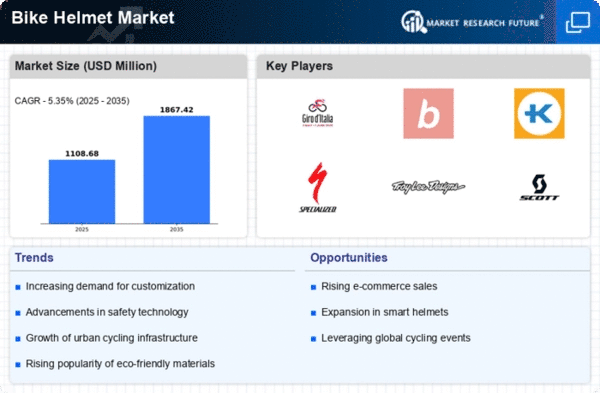
As per MRFR analysis, the Bike Helmet Market Size was estimated at 1052.38 USD Million in 2024. The Bike Helmet industry is projected to grow from 1108.7 USD Million in 2025 to 1867.42 USD Million by 2035, exhibiting a compound annual growth rate (CAGR) of 5.35% during the forecast period 2025 - 2035. North America holds the largest share of the global Bike Helmet Market at approximately 34%, driven by increasing safety awareness, a strong cycling culture, and government initiatives promoting helmet usage. The United States is the leading country within North America, capturing approximately 26% of the global Bike Helmet Market share, supported by high awareness of road safety standards, widespread adoption of advanced helmet technologies, and a growing cycling participation trend for recreation and commuting. Road Helmets dominate the Bike Helmet Market as the largest product type segment, accounting for an estimated 40% of the global market share, favored for their lightweight and aerodynamic designs that appeal primarily to cycling enthusiasts, professional riders, and urban commuters.

Key Market Trends & Highlights

The Bike Helmet Market is experiencing a dynamic shift towards sustainability and technological integration.

  • The North American market remains the largest, driven by heightened safety awareness and regulatory changes. In the Asia-Pacific region, the market is the fastest-growing, fueled by urbanization and cycling infrastructure development. The recreational segment dominates the market, while the commuting segment is witnessing rapid growth due to changing transportation preferences. Key market drivers include increased awareness of safety and government regulations promoting cycling as a sustainable transport option.

Market Size & Forecast

2024 Market Size 1052.38 (USD Million)
2035 Market Size 1867.42 (USD Million)
CAGR (2025 - 2035) 5.35%
Largest Regional Market Share in 2024 North America

Major Players

Giro (US), Bell (US), Kask (IT), Specialized (US), Troy Lee Designs (US), Scott Sports (CH), Nutcase (US), POC (SE), ABUS (DE)

Market Trends

The Bike Helmet Market is currently experiencing a dynamic evolution, driven by a confluence of factors that reflect changing consumer preferences and heightened safety awareness. As urban cycling gains traction, the demand for protective headgear is likely to increase, with manufacturers responding by innovating designs that blend functionality with aesthetics. This shift appears to be influenced by a growing emphasis on sustainable materials and eco-friendly production processes, which resonate with environmentally conscious consumers. Furthermore, the integration of technology into helmet designs, such as built-in lights and communication systems, suggests a potential transformation in how cyclists perceive safety and convenience. In addition, the regulatory landscape surrounding cycling safety is evolving, with various jurisdictions implementing stricter helmet laws. This trend may further bolster the Bike Helmet Market, as compliance becomes a priority for both manufacturers and consumers. Retail channels are also diversifying, with online platforms gaining prominence, allowing for broader accessibility and convenience. As the market continues to adapt to these multifaceted influences, it is poised for growth, reflecting a broader societal shift towards safer and more responsible cycling practices.

Sustainable Materials

The Bike Helmet Market is witnessing a notable shift towards the use of sustainable materials in helmet production. Manufacturers are increasingly exploring eco-friendly options, which not only appeal to environmentally conscious consumers but also align with global sustainability goals. This trend indicates a growing awareness of the environmental impact of manufacturing processes and a commitment to reducing carbon footprints.

Technological Integration

There is a rising trend of integrating advanced technology into bike helmets, enhancing both safety and user experience. Features such as built-in lights, Bluetooth connectivity, and smart sensors are becoming more prevalent. This technological evolution suggests that consumers are seeking helmets that offer more than just protection, but also convenience and connectivity.

Regulatory Changes

The regulatory environment surrounding cycling safety is evolving, with many regions implementing stricter helmet laws. This trend may drive increased demand for helmets, as compliance becomes essential for cyclists. As regulations tighten, manufacturers are likely to adapt their offerings to meet these new standards, further shaping the Bike Helmet Market.

Bike Helmet Market Market Drivers

Growth of E-Bike Market

The rapid growth of the e-bike market is significantly impacting the Global Bike Helmet Market Industry. As e-bikes become increasingly popular due to their convenience and efficiency, the demand for helmets specifically designed for e-bike riders is likely to rise. E-bike riders often travel at higher speeds than traditional cyclists, necessitating helmets that offer enhanced protection. This trend is further supported by the increasing number of e-bike users, which is expected to drive helmet sales. The intersection of these two markets suggests a robust growth trajectory for the helmet industry, aligning with the overall expansion of cycling-related products.

Market Growth Projections

The Global Bike Helmet Market Industry is poised for substantial growth, with projections indicating a market value of 1.05 USD Billion in 2024 and an anticipated increase to 1.87 USD Billion by 2035. This growth trajectory reflects a compound annual growth rate of 5.36% from 2025 to 2035. Factors contributing to this expansion include rising safety awareness, increased cycling participation, and technological innovations in helmet design. The market's evolution is likely to be influenced by changing consumer preferences and regulatory frameworks that prioritize cyclist safety. As these dynamics unfold, the industry is expected to adapt and thrive.

Rising Popularity of Cycling

The increasing popularity of cycling as a mode of transportation and recreation is significantly influencing the Global Bike Helmet Market Industry. Urban areas are witnessing a surge in cycling infrastructure, such as dedicated bike lanes and rental services, which encourages more people to cycle. This trend is further supported by environmental concerns and the push for sustainable transportation options. As cycling becomes more mainstream, the demand for bike helmets is anticipated to grow. By 2035, the market is projected to reach 1.87 USD Billion, reflecting the expanding cycling community and the associated need for protective gear.

Increasing Awareness of Safety

The growing awareness of safety among cyclists is a primary driver for the Global Bike Helmet Market Industry. As more individuals recognize the importance of wearing helmets to prevent head injuries, the demand for high-quality helmets is likely to rise. Educational campaigns and safety regulations implemented by various governments further reinforce this trend. For instance, countries with stringent helmet laws have reported increased helmet usage, which correlates with a decline in cycling-related injuries. This heightened focus on safety is expected to contribute to the market's growth, with projections indicating a market value of 1.05 USD Billion in 2024.

Government Regulations and Initiatives

Government regulations and initiatives aimed at promoting cycling safety are pivotal drivers of the Global Bike Helmet Market Industry. Many countries have enacted laws mandating helmet use for cyclists, particularly for children and young adults. These regulations are often accompanied by public awareness campaigns that emphasize the importance of helmet usage. Additionally, government-sponsored programs that provide subsidies or incentives for purchasing helmets can further stimulate market growth. As these initiatives gain traction, they are expected to bolster helmet sales, contributing to the projected market growth to 1.05 USD Billion in 2024.

Technological Advancements in Helmet Design

Technological advancements in helmet design are reshaping the Global Bike Helmet Market Industry. Innovations such as lightweight materials, improved ventilation systems, and enhanced impact resistance are making helmets more appealing to consumers. Manufacturers are increasingly focusing on integrating smart technologies, such as built-in lights and communication systems, which cater to the needs of modern cyclists. These advancements not only enhance safety but also improve comfort and usability. As a result, the market is likely to experience a compound annual growth rate of 5.36% from 2025 to 2035, driven by consumer demand for high-performance helmets.

Market Segment Insights

By Application: Recreational (Largest) vs. Sporting (Fastest-Growing)

The application segment of the bike helmet market is divided into several key categories including Recreational, Commuting, Sporting, Mountain Biking, and Road Cycling. Among these, Recreational helmets capture the largest share due to their broad appeal to casual cyclists. Sporting helmets, on the other hand, are gaining traction rapidly, driven by the increasing popularity of biking as a competitive sport and the growing number of cycling events.

Recreational: Dominant vs. Sporting: Emerging

Recreational bike helmets dominate the market due to their versatility and appeal to a wide audience, who use them for casual rides, family outings, and urban commuting. These helmets are designed to be comfortable, lighter, and stylish, catering to casual cyclists who prioritize safety without sacrificing aesthetics. In contrast, Sporting helmets are emerging as a vital segment, driven by the surge in competitive cycling and sporting events. These helmets are engineered for performance, featuring advanced aerodynamic designs and enhanced safety standards, meeting the demands of serious bikers and athletes.

By Material: Polycarbonate (Largest) vs. Carbon Fiber (Fastest-Growing)

Polycarbonate emerges as the largest segment in the Bike Helmet Market, dominating the material distribution due to its exceptional durability and impact resistance. This widely used material accounts for a significant share among various bike helmet offerings, appealing to both casual and professional cyclists. Following closely, Expanded Polystyrene serves as a robust alternative, while Fiberglass and Polypropylene maintain a niche market presence. Though Carbon Fiber holds a smaller share, its advanced properties cater to high-end segments, pushing its growth trajectory upward. The growth trends in the Bike Helmet Market are significantly influenced by increasing consumer awareness regarding safety and performance. As biking continues to gain popularity globally, the demand for high-quality, lightweight helmets made from advanced materials like Carbon Fiber is surging. Furthermore, technological advancements and enhanced design standards are promoting the development of helmets that offer superior protection without compromising comfort, thereby elevating the appeal of materials like Polycarbonate and Expanded Polystyrene. The shift towards sustainability is also sparking interest in Fiberglass and Polypropylene as manufacturers explore eco-friendly options, ensuring a bright future for these materials in the market.

Material: Polycarbonate (Dominant) vs. Carbon Fiber (Emerging)

Polycarbonate helmets are well-regarded for their strength and lightweight nature, making them the dominant choice among cycling enthusiasts and casual riders alike. These helmets offer excellent protection against impacts and are often more affordable than their counterparts, which aids in their widespread adoption. Additionally, the ease of manufacturing and ability to mold complex shapes allow for varied designs, enhancing the appeal of Polycarbonate. In contrast, Carbon Fiber helmets are gaining traction as an emerging option due to their superior strength-to-weight ratio. Highly favored among competitive riders, Carbon Fiber helmets showcase cutting-edge technology that prioritizes both safety and performance. As more cyclists seek advanced features in helmets, the Carbon Fiber segment is expected to witness robust growth, driven by innovation and a preference for high-performance equipment.

By Type: Full Face (Largest) vs. Half Shell (Fastest-Growing)

In the Bike Helmet Market, the distribution of market share among the different types of helmets reveals distinct preferences among consumers. The Full Face helmet segment stands out as the largest, as it is widely favored by off-road and motocross riders for its comprehensive protection and robust build. In contrast, the Half Shell helmets have seen a significant rise in popularity due to their lightweight design and increased ventilation, appealing especially to casual cyclists and commuters looking for comfort and style without sacrificing safety. The growth trends in the Bike Helmet Market are being driven by increasing awareness of safety among cyclists and a growing trend toward outdoor activities. As more individuals take up biking for fitness and commuting, the demand for various helmet types is on the rise. The Half Shell segment is particularly gaining traction among younger riders and urban commuters, motivated by the stylish and versatile options available. Meanwhile, Full Face helmets remain a staple for enthusiasts, highlighting the diverse needs within the market.

Full Face (Dominant) vs. Half Shell (Emerging)

The Full Face helmet segment dominates the Bike Helmet Market, characterized by its robust construction and superior safety features, making it a preferred choice for extreme sports athletes and motocross riders. These helmets provide comprehensive coverage, protecting the entire head, face, and jaw, which is crucial for high-risk activities. On the other hand, the Half Shell helmet segment is an emerging player within the market, appealing to urban commuters and casual riders due to its lightweight and sleek design. With its enhanced airflow and minimalistic style, this type of helmet has become increasingly popular among younger demographics, symbolizing a blend of safety and lifestyle preferences that resonate with modern cyclists.

By Safety Standard: CPSC (Largest) vs. EN 1078 (Fastest-Growing)

In the Bike Helmet Market, the distribution of market share among safety standards reflects a competitive landscape. The CPSC standard currently dominates the market, being a widely recognized benchmark in the United States, ensuring helmets meet rigorous safety requirements. In contrast, the EN 1078 standard, prevalent in Europe, is gaining traction due to increasing awareness among consumers regarding safety and technology advancements in helmet features. This shift signifies a diversification of safety standards being accepted and preferred by consumers. The growth trends within the Safety Standard segment are propelled by shifting consumer preferences towards safety, innovation, and regulatory changes that emphasize compliance with international standards. As biking activities increase globally, so does the demand for compliant helmets. Factors such as enhanced safety features, lightweight materials, and comfort are driving manufacturers to align their products with emerging standards like EN 1078, thus creating a competitive edge. This shift not only suggests a growth opportunity for the manufacturers but also highlights the overall advancement towards better safety in the bike helmet market.

CPSC (Dominant) vs. Snell B90 (Emerging)

The CPSC standard is considered the dominant safety standard in the bike helmet market, being recognized for its rigorous testing protocols that ensure high levels of protection for users. Manufacturers who comply with CPSC regulations often have a competitive advantage, as consumers trust their safety certifications. In contrast, the Snell B90 standard is an emerging standard that, while not as widely adopted, emphasizes advanced impact protections and is favored among serious cyclists. Helmets meeting the Snell B90 criteria often include enhanced padding and materials, making them more appealing to performance-focused users. As cycling continues to grow in popularity, the Snell B90 standard may start to capture a more significant share, especially among enthusiasts looking for premium safety performance.

By Demographics: Adults (Largest) vs. Children (Fastest-Growing)

In the Bike Helmet Market, the demographic segment insights reveal that adults comprise the largest share of the overall market, driven by their increased awareness regarding safety and the rising popularity of cycling as a form of transportation and recreation. Children, on the other hand, represent the fastest-growing segment, with a notable increase in emphasis on safety gear among parents and schools. This growth is further enhanced by initiatives promoting cycling among younger populations. The growth trends indicate a robust increase in demand for children’s helmets, fueled by the surge in cycling safety campaigns and the introduction of innovative helmet designs tailored to attract younger users. The adult segment, while the largest, is also evolving, with preferences shifting towards helmets that offer advanced protective features, stylish designs, and added comforts. Such dynamics reflect an overall trend towards brand loyalty and heightened safety consciousness across all demographics.

Adults: (Dominant) vs. Children (Emerging)

The adult demographic in the Bike Helmet Market is characterized by a high level of brand loyalty, with consumers gravitating towards helmets that combine safety with comfort and style. This segment prefers helmets that meet rigorous safety standards and offer features such as ventilation and customizable fittings. In contrast, the children's segment is emerging rapidly, attracting attention due to unique designs featuring popular characters and vibrant colors. Safety campaigns targeting this group emphasize the importance of helmet usage from a young age, encouraging manufacturers to innovate further. The characteristics of children's helmets are often tailored for play, with features catering to younger users' preferences, thus fostering growth driven by parental purchases for safety and compliance with school regulations.

Get more detailed insights about Bike Helmet Market Research Report - Forecast till 2035

Regional Insights

North America : Market Leader in Bike Helmets

North America is poised to maintain its leadership in the bike helmet market, holding a significant market share of 526.43 million in 2025. The growth is driven by increasing awareness of safety regulations and a rising trend in cycling as a recreational activity. Government initiatives promoting cycling infrastructure and safety standards are further catalyzing demand for high-quality helmets. The competitive landscape is robust, with key players like Giro, Bell, and Specialized leading the charge. The U.S. remains the largest market, supported by a strong consumer base and innovative product offerings. The presence of established brands ensures a diverse range of options for consumers, enhancing market dynamics and driving growth.

Europe : Emerging Market with Regulations

Europe's bike helmet market is experiencing significant growth, with a market size of 319.05 million in 2025. The region benefits from stringent safety regulations and a cultural shift towards sustainable transportation. Countries like Germany and the Netherlands are at the forefront, promoting cycling through infrastructure investments and public awareness campaigns. These factors are driving demand for innovative and compliant helmet designs. Leading countries in this market include Germany, France, and the Netherlands, where cycling is deeply integrated into daily life. Key players such as Kask and ABUS are capitalizing on this trend, offering advanced safety features and stylish designs. The competitive landscape is characterized by a mix of established brands and emerging startups, fostering innovation and consumer choice.

Asia-Pacific : Rapid Growth in Cycling Culture

The Asia-Pacific bike helmet market is on a growth trajectory, with a market size of 164.9 million in 2025. This growth is fueled by an increasing cycling culture, urbanization, and rising health consciousness among consumers. Countries like China and India are witnessing a surge in cycling as a preferred mode of transport, supported by government initiatives promoting eco-friendly practices. China leads the market, driven by a large population and growing interest in cycling. The competitive landscape features both international brands and local manufacturers, with companies like Scott Sports and POC expanding their presence. The region's diverse consumer base is pushing for a variety of helmet designs, enhancing market dynamics and encouraging innovation.

Middle East and Africa : Niche Market with Potential

The Middle East and Africa (MEA) bike helmet market, valued at 42.0 million in 2025, presents unique growth opportunities. The region is gradually embracing cycling as a recreational and commuting option, driven by urban development and health awareness. Governments are beginning to implement regulations to promote cycling safety, which is expected to boost helmet demand. Countries like South Africa and the UAE are leading the charge, with increasing investments in cycling infrastructure. The competitive landscape is still developing, with a mix of local and international brands vying for market share. As awareness of cycling safety grows, the demand for quality helmets is anticipated to rise, creating a favorable environment for market expansion.

Key Players and Competitive Insights

The Bike Helmet Market is currently characterized by a dynamic competitive landscape, driven by increasing safety awareness and a growing emphasis on cycling as a sustainable mode of transportation. Key players such as Giro (US), Bell (US), and Kask (IT) are strategically positioned to leverage innovation and technological advancements. Giro (US) focuses on integrating smart technology into their helmets, enhancing user experience and safety features. Bell (US) emphasizes partnerships with cycling organizations to promote helmet safety, while Kask (IT) is known for its premium offerings, targeting high-performance cyclists. Collectively, these strategies contribute to a competitive environment that prioritizes safety, innovation, and brand loyalty.In terms of business tactics, companies are increasingly localizing manufacturing to reduce lead times and optimize supply chains. The market structure appears moderately fragmented, with several players vying for market share. However, the influence of key players is substantial, as they set trends in design, technology, and marketing strategies. This fragmentation allows for niche players to emerge, yet the dominance of established brands remains a significant factor in shaping market dynamics.
In November Giro (US) announced the launch of a new line of helmets featuring integrated communication systems, allowing cyclists to connect with their devices seamlessly. This strategic move not only enhances the user experience but also positions Giro as a leader in the integration of technology within cycling safety gear. The introduction of such innovative features is likely to attract tech-savvy consumers and reinforce Giro's market position.
In October Bell (US) entered into a partnership with a prominent cycling advocacy group to promote helmet safety awareness through community events and educational campaigns. This initiative underscores Bell's commitment to safety and community engagement, potentially increasing brand loyalty among consumers who value corporate social responsibility. Such partnerships may also enhance Bell's visibility in the market, driving sales through increased consumer trust.
In September Kask (IT) unveiled a new eco-friendly helmet line made from sustainable materials, reflecting a growing trend towards sustainability in the cycling industry. This strategic decision not only aligns with consumer preferences for environmentally responsible products but also positions Kask as a forward-thinking brand in a competitive market. The emphasis on sustainability could attract a new segment of environmentally conscious consumers, further differentiating Kask from its competitors.
As of December the Bike Helmet Market is witnessing trends such as digitalization, sustainability, and the integration of artificial intelligence in product development. Strategic alliances among companies are increasingly shaping the competitive landscape, fostering innovation and enhancing product offerings. The shift from price-based competition to a focus on innovation, technology, and supply chain reliability is evident. Moving forward, competitive differentiation will likely hinge on the ability to innovate and adapt to changing consumer preferences, with a strong emphasis on safety and sustainability.

Key Companies in the Bike Helmet Market include

Industry Developments

For Instance, August 2020 Hexr announced the release of its new parmetric-designed Voronoi bicycle helmet.

For Instance, March 2019 Cycling helmets from Trek and Bontrager that feature the latest WaveCel technology have been announced.

Future Outlook

Bike Helmet Market Future Outlook

The Bike Helmet Market is projected to grow at a 5.35% CAGR from 2025 to 2035, driven by increasing safety awareness, regulatory mandates, and technological advancements.

New opportunities lie in:

  • <p>Expansion of smart helmet technology integrating IoT features. Development of eco-friendly materials for sustainable helmet production. Partnerships with cycling events for exclusive helmet branding opportunities.</p>

By 2035, the market is expected to be robust, reflecting strong growth and innovation.

Market Segmentation

Bike Helmet Market Type Outlook

  • Full Face
  • Half Shell
  • Skate
  • BMX
  • Mountain

Bike Helmet Market Material Outlook

  • Polycarbonate
  • Fiberglass
  • Carbon Fiber
  • Expanded Polystyrene
  • Polypropylene

Bike Helmet Market Application Outlook

  • Recreational
  • Commuting
  • Sporting
  • Mountain Biking
  • Road Cycling

Bike Helmet Market Demographics Outlook

  • Adults
  • Children
  • Teenagers
  • Women
  • Men

Bike Helmet Market Safety Standard Outlook

  • CPSC
  • EN 1078
  • ASTM F1952
  • Snell B90
  • AS/NZS 2063

Report Scope

MARKET SIZE 2024 1052.38(USD Million)
MARKET SIZE 2025 1108.7(USD Million)
MARKET SIZE 2035 1867.42(USD Million)
COMPOUND ANNUAL GROWTH RATE (CAGR) 5.35% (2025 - 2035)
REPORT COVERAGE Revenue Forecast, Competitive Landscape, Growth Factors, and Trends
BASE YEAR 2024
Market Forecast Period 2025 - 2035
Historical Data 2019 - 2024
Market Forecast Units USD Million
Key Companies Profiled Giro (US), Bell (US), Kask (IT), Specialized (US), Troy Lee Designs (US), Scott Sports (CH), Nutcase (US), POC (SE), ABUS (DE)
Segments Covered Application, Material, Type, Safety Standard, Demographics
Key Market Opportunities Integration of smart technology and enhanced safety features in the Bike Helmet Market.
Key Market Dynamics Rising consumer awareness of safety is driving innovation and competition in the bike helmet market.
Countries Covered North America, Europe, APAC, South America, MEA

FAQs

What is the current valuation of the Bike Helmet Market as of 2024?

<p>The overall market valuation of the Bike Helmet Market was 1052.38 USD Million in 2024.</p>

What is the projected market size for the Bike Helmet Market in 2035?

<p>The projected valuation for the Bike Helmet Market in 2035 is 1867.42 USD Million.</p>

What is the expected CAGR for the Bike Helmet Market during the forecast period 2025 - 2035?

<p>The expected CAGR for the Bike Helmet Market during the forecast period 2025 - 2035 is 5.35%.</p>

Which companies are considered key players in the Bike Helmet Market?

<p>Key players in the Bike Helmet Market include Bell, Giro, Specialized, Kask, Met, Scott, Troy Lee Designs, ABUS, and Lazer.</p>

What are the revenue ranges for the Recreational segment in the Bike Helmet Market?

<p>The Recreational segment generated revenues between 210.0 and 380.0 USD Million.</p>

How does the Commuting segment perform in terms of revenue?

<p>The Commuting segment achieved revenues ranging from 250.0 to 450.0 USD Million.</p>

What is the revenue range for the Mountain Biking segment?

The Mountain Biking segment recorded revenues between 180.0 and 320.0 USD Million.

What materials are predominantly used in the production of bike helmets?

The predominant materials used include Polycarbonate, Fiberglass, Carbon Fiber, Expanded Polystyrene, and Polypropylene.

What types of bike helmets are available in the market?

Available types of bike helmets include Full Face, Half Shell, Skull Cap, Aero, and BMX.

What demographic segments are represented in the Bike Helmet Market?

Demographic segments in the Bike Helmet Market include Adults, Children, Women, Men, and Seniors.

  1. SECTION I: EXECUTIVE SUMMARY AND KEY HIGHLIGHTS |
    1. EXECUTIVE SUMMARY | |
      1. Market Overview | |
      2. Key Findings | |
      3. Market Segmentation | |
      4. Competitive Landscape | |
      5. Challenges and Opportunities | |
      6. Future Outlook 2
  2. SECTION II: SCOPING, METHODOLOGY AND MARKET STRUCTURE |
    1. MARKET INTRODUCTION | |
      1. Definition | |
      2. Scope of the study | | |
    2. RESEARCH METHODOLOGY | |
      1. Overview | |
      2. Data Mining | |
      3. Secondary Research | |
      4. Primary Research | | |
      5. Forecasting Model | |
      6. Market Size Estimation | | |
      7. Data Triangulation | |
      8. Validation 3
  3. SECTION III: QUALITATIVE ANALYSIS |
    1. MARKET DYNAMICS | |
      1. Overview | |
      2. Drivers | |
      3. Restraints | |
      4. Opportunities |
    2. MARKET FACTOR ANALYSIS | |
      1. Value chain Analysis | |
      2. Porter's Five Forces Analysis | | |
      3. COVID-19 Impact Analysis | | |
  4. SECTION IV: QUANTITATIVE ANALYSIS |
    1. Consumer and Retail, BY Application (USD Million) | |
      1. Recreational | |
      2. Commuting | |
      3. Sporting | |
      4. Mountain Biking | |
      5. Road Cycling |
    2. Consumer and Retail, BY Material (USD Million) | |
      1. Polycarbonate | |
      2. Fiberglass | |
      3. Carbon Fiber | |
      4. Expanded Polystyrene | |
      5. Polypropylene |
    3. Consumer and Retail, BY Type (USD Million) | |
      1. Full Face | |
      2. Half Shell | |
      3. Skull Cap | |
      4. Aero | |
      5. BMX |
    4. Consumer and Retail, BY Safety Standard (USD Million) | |
      1. CPSC | |
      2. EN 1078 | |
      3. ASTM F1952 | |
      4. Snell B90 | |
      5. AS/NZS 2063 |
    5. Consumer and Retail, BY Demographics (USD Million) | |
      1. Adults | |
      2. Children | |
      3. Women | |
      4. Men | |
      5. Seniors |
    6. Consumer and Retail, BY Region (USD Million) | |
      1. North America | | |
      2. Europe | | |
      3. APAC | | |
      4. South America | | |
      5. MEA | | |
  5. SECTION V: COMPETITIVE ANALYSIS |
    1. Competitive Landscape | |
      1. Overview | |
      2. Competitive Analysis | |
      3. Market share Analysis | |
      4. Major Growth Strategy in the Consumer and Retail | |
      5. Competitive Benchmarking | |
      6. Leading Players in Terms of Number of Developments in the Consumer and Retail | |
      7. Key developments and growth strategies | | |
      8. Major Players Financial Matrix | | |
    2. Company Profiles | |
      1. Bell (US) | | |
      2. Giro (US) | | |
      3. Specialized (US) | | |
      4. Kask (IT) | | |
      5. Met (IT) | | |
      6. Scott (CH) | | |
      7. Troy Lee Designs (US) | | |
      8. ABUS (DE) | | |
      9. Lazer (BE) | | |
    3. Appendix | |
      1. References | |
      2. Related Reports 6 LIST OF FIGURES |
    4. MARKET SYNOPSIS |
    5. NORTH AMERICA MARKET ANALYSIS |
    6. US MARKET ANALYSIS BY APPLICATION |
    7. US MARKET ANALYSIS BY MATERIAL |
    8. US MARKET ANALYSIS BY TYPE |
    9. US MARKET ANALYSIS BY SAFETY STANDARD |
    10. US MARKET ANALYSIS BY DEMOGRAPHICS |
    11. CANADA MARKET ANALYSIS BY APPLICATION |
    12. CANADA MARKET ANALYSIS BY MATERIAL |
    13. CANADA MARKET ANALYSIS BY TYPE |
    14. CANADA MARKET ANALYSIS BY SAFETY STANDARD |
    15. CANADA MARKET ANALYSIS BY DEMOGRAPHICS |
    16. EUROPE MARKET ANALYSIS |
    17. GERMANY MARKET ANALYSIS BY APPLICATION |
    18. GERMANY MARKET ANALYSIS BY MATERIAL |
    19. GERMANY MARKET ANALYSIS BY TYPE |
    20. GERMANY MARKET ANALYSIS BY SAFETY STANDARD |
    21. GERMANY MARKET ANALYSIS BY DEMOGRAPHICS |
    22. UK MARKET ANALYSIS BY APPLICATION |
    23. UK MARKET ANALYSIS BY MATERIAL |
    24. UK MARKET ANALYSIS BY TYPE |
    25. UK MARKET ANALYSIS BY SAFETY STANDARD |
    26. UK MARKET ANALYSIS BY DEMOGRAPHICS |
    27. FRANCE MARKET ANALYSIS BY APPLICATION |
    28. FRANCE MARKET ANALYSIS BY MATERIAL |
    29. FRANCE MARKET ANALYSIS BY TYPE |
    30. FRANCE MARKET ANALYSIS BY SAFETY STANDARD |
    31. FRANCE MARKET ANALYSIS BY DEMOGRAPHICS |
    32. RUSSIA MARKET ANALYSIS BY APPLICATION |
    33. RUSSIA MARKET ANALYSIS BY MATERIAL |
    34. RUSSIA MARKET ANALYSIS BY TYPE |
    35. RUSSIA MARKET ANALYSIS BY SAFETY STANDARD |
    36. RUSSIA MARKET ANALYSIS BY DEMOGRAPHICS |
    37. ITALY MARKET ANALYSIS BY APPLICATION |
    38. ITALY MARKET ANALYSIS BY MATERIAL |
    39. ITALY MARKET ANALYSIS BY TYPE |
    40. ITALY MARKET ANALYSIS BY SAFETY STANDARD |
    41. ITALY MARKET ANALYSIS BY DEMOGRAPHICS |
    42. SPAIN MARKET ANALYSIS BY APPLICATION |
    43. SPAIN MARKET ANALYSIS BY MATERIAL |
    44. SPAIN MARKET ANALYSIS BY TYPE |
    45. SPAIN MARKET ANALYSIS BY SAFETY STANDARD |
    46. SPAIN MARKET ANALYSIS BY DEMOGRAPHICS |
    47. REST OF EUROPE MARKET ANALYSIS BY APPLICATION |
    48. REST OF EUROPE MARKET ANALYSIS BY MATERIAL |
    49. REST OF EUROPE MARKET ANALYSIS BY TYPE |
    50. REST OF EUROPE MARKET ANALYSIS BY SAFETY STANDARD |
    51. REST OF EUROPE MARKET ANALYSIS BY DEMOGRAPHICS |
    52. APAC MARKET ANALYSIS |
    53. CHINA MARKET ANALYSIS BY APPLICATION |
    54. CHINA MARKET ANALYSIS BY MATERIAL |
    55. CHINA MARKET ANALYSIS BY TYPE |
    56. CHINA MARKET ANALYSIS BY SAFETY STANDARD |
    57. CHINA MARKET ANALYSIS BY DEMOGRAPHICS |
    58. INDIA MARKET ANALYSIS BY APPLICATION |
    59. INDIA MARKET ANALYSIS BY MATERIAL |
    60. INDIA MARKET ANALYSIS BY TYPE |
    61. INDIA MARKET ANALYSIS BY SAFETY STANDARD |
    62. INDIA MARKET ANALYSIS BY DEMOGRAPHICS |
    63. JAPAN MARKET ANALYSIS BY APPLICATION |
    64. JAPAN MARKET ANALYSIS BY MATERIAL |
    65. JAPAN MARKET ANALYSIS BY TYPE |
    66. JAPAN MARKET ANALYSIS BY SAFETY STANDARD |
    67. JAPAN MARKET ANALYSIS BY DEMOGRAPHICS |
    68. SOUTH KOREA MARKET ANALYSIS BY APPLICATION |
    69. SOUTH KOREA MARKET ANALYSIS BY MATERIAL |
    70. SOUTH KOREA MARKET ANALYSIS BY TYPE |
    71. SOUTH KOREA MARKET ANALYSIS BY SAFETY STANDARD |
    72. SOUTH KOREA MARKET ANALYSIS BY DEMOGRAPHICS |
    73. MALAYSIA MARKET ANALYSIS BY APPLICATION |
    74. MALAYSIA MARKET ANALYSIS BY MATERIAL |
    75. MALAYSIA MARKET ANALYSIS BY TYPE |
    76. MALAYSIA MARKET ANALYSIS BY SAFETY STANDARD |
    77. MALAYSIA MARKET ANALYSIS BY DEMOGRAPHICS |
    78. THAILAND MARKET ANALYSIS BY APPLICATION |
    79. THAILAND MARKET ANALYSIS BY MATERIAL |
    80. THAILAND MARKET ANALYSIS BY TYPE |
    81. THAILAND MARKET ANALYSIS BY SAFETY STANDARD |
    82. THAILAND MARKET ANALYSIS BY DEMOGRAPHICS |
    83. INDONESIA MARKET ANALYSIS BY APPLICATION |
    84. INDONESIA MARKET ANALYSIS BY MATERIAL |
    85. INDONESIA MARKET ANALYSIS BY TYPE |
    86. INDONESIA MARKET ANALYSIS BY SAFETY STANDARD |
    87. INDONESIA MARKET ANALYSIS BY DEMOGRAPHICS |
    88. REST OF APAC MARKET ANALYSIS BY APPLICATION |
    89. REST OF APAC MARKET ANALYSIS BY MATERIAL |
    90. REST OF APAC MARKET ANALYSIS BY TYPE |
    91. REST OF APAC MARKET ANALYSIS BY SAFETY STANDARD |
    92. REST OF APAC MARKET ANALYSIS BY DEMOGRAPHICS |
    93. SOUTH AMERICA MARKET ANALYSIS |
    94. BRAZIL MARKET ANALYSIS BY APPLICATION |
    95. BRAZIL MARKET ANALYSIS BY MATERIAL |
    96. BRAZIL MARKET ANALYSIS BY TYPE |
    97. BRAZIL MARKET ANALYSIS BY SAFETY STANDARD |
    98. BRAZIL MARKET ANALYSIS BY DEMOGRAPHICS |
    99. MEXICO MARKET ANALYSIS BY APPLICATION |
    100. MEXICO MARKET ANALYSIS BY MATERIAL |
    101. MEXICO MARKET ANALYSIS BY TYPE |
    102. MEXICO MARKET ANALYSIS BY SAFETY STANDARD |
    103. MEXICO MARKET ANALYSIS BY DEMOGRAPHICS |
    104. ARGENTINA MARKET ANALYSIS BY APPLICATION |
    105. ARGENTINA MARKET ANALYSIS BY MATERIAL |
    106. ARGENTINA MARKET ANALYSIS BY TYPE |
    107. ARGENTINA MARKET ANALYSIS BY SAFETY STANDARD |
    108. ARGENTINA MARKET ANALYSIS BY DEMOGRAPHICS |
    109. REST OF SOUTH AMERICA MARKET ANALYSIS BY APPLICATION |
    110. REST OF SOUTH AMERICA MARKET ANALYSIS BY MATERIAL |
    111. REST OF SOUTH AMERICA MARKET ANALYSIS BY TYPE |
    112. REST OF SOUTH AMERICA MARKET ANALYSIS BY SAFETY STANDARD |
    113. REST OF SOUTH AMERICA MARKET ANALYSIS BY DEMOGRAPHICS |
    114. MEA MARKET ANALYSIS |
    115. GCC COUNTRIES MARKET ANALYSIS BY APPLICATION |
    116. GCC COUNTRIES MARKET ANALYSIS BY MATERIAL |
    117. GCC COUNTRIES MARKET ANALYSIS BY TYPE |
    118. GCC COUNTRIES MARKET ANALYSIS BY SAFETY STANDARD |
    119. GCC COUNTRIES MARKET ANALYSIS BY DEMOGRAPHICS |
    120. SOUTH AFRICA MARKET ANALYSIS BY APPLICATION |
    121. SOUTH AFRICA MARKET ANALYSIS BY MATERIAL |
    122. SOUTH AFRICA MARKET ANALYSIS BY TYPE |
    123. SOUTH AFRICA MARKET ANALYSIS BY SAFETY STANDARD |
    124. SOUTH AFRICA MARKET ANALYSIS BY DEMOGRAPHICS |
    125. REST OF MEA MARKET ANALYSIS BY APPLICATION |
    126. REST OF MEA MARKET ANALYSIS BY MATERIAL |
    127. REST OF MEA MARKET ANALYSIS BY TYPE |
    128. REST OF MEA MARKET ANALYSIS BY SAFETY STANDARD |
    129. REST OF MEA MARKET ANALYSIS BY DEMOGRAPHICS |
    130. KEY BUYING CRITERIA OF CONSUMER AND RETAIL |
    131. RESEARCH PROCESS OF MRFR |
    132. DRO ANALYSIS OF CONSUMER AND RETAIL |
    133. DRIVERS IMPACT ANALYSIS: CONSUMER AND RETAIL |
    134. RESTRAINTS IMPACT ANALYSIS: CONSUMER AND RETAIL |
    135. SUPPLY / VALUE CHAIN: CONSUMER AND RETAIL |
    136. CONSUMER AND RETAIL, BY APPLICATION, 2024 (% SHARE) |
    137. CONSUMER AND RETAIL, BY APPLICATION, 2024 TO 2035 (USD Million) |
    138. CONSUMER AND RETAIL, BY MATERIAL, 2024 (% SHARE) |
    139. CONSUMER AND RETAIL, BY MATERIAL, 2024 TO 2035 (USD Million) |
    140. CONSUMER AND RETAIL, BY TYPE, 2024 (% SHARE) |
    141. CONSUMER AND RETAIL, BY TYPE, 2024 TO 2035 (USD Million) |
    142. CONSUMER AND RETAIL, BY SAFETY STANDARD, 2024 (% SHARE) |
    143. CONSUMER AND RETAIL, BY SAFETY STANDARD, 2024 TO 2035 (USD Million) |
    144. CONSUMER AND RETAIL, BY DEMOGRAPHICS, 2024 (% SHARE) |
    145. CONSUMER AND RETAIL, BY DEMOGRAPHICS, 2024 TO 2035 (USD Million) |
    146. BENCHMARKING OF MAJOR COMPETITORS 7 LIST OF TABLES |
    147. LIST OF ASSUMPTIONS | |
      1. |
    148. North America MARKET SIZE ESTIMATES; FORECAST | |
      1. BY APPLICATION, 2025-2035 (USD Million) | |
      2. BY MATERIAL, 2025-2035 (USD Million) | |
      3. BY TYPE, 2025-2035 (USD Million) | |
      4. BY SAFETY STANDARD, 2025-2035 (USD Million) | |
      5. BY DEMOGRAPHICS, 2025-2035 (USD Million) |
    149. US MARKET SIZE ESTIMATES; FORECAST | |
      1. BY APPLICATION, 2025-2035 (USD Million) | |
      2. BY MATERIAL, 2025-2035 (USD Million) | |
      3. BY TYPE, 2025-2035 (USD Million) | |
      4. BY SAFETY STANDARD, 2025-2035 (USD Million) | |
      5. BY DEMOGRAPHICS, 2025-2035 (USD Million) |
    150. Canada MARKET SIZE ESTIMATES; FORECAST | |
      1. BY APPLICATION, 2025-2035 (USD Million) | |
      2. BY MATERIAL, 2025-2035 (USD Million) | |
      3. BY TYPE, 2025-2035 (USD Million) | |
      4. BY SAFETY STANDARD, 2025-2035 (USD Million) | |
      5. BY DEMOGRAPHICS, 2025-2035 (USD Million) |
    151. Europe MARKET SIZE ESTIMATES; FORECAST | |
      1. BY APPLICATION, 2025-2035 (USD Million) | |
      2. BY MATERIAL, 2025-2035 (USD Million) | |
      3. BY TYPE, 2025-2035 (USD Million) | |
      4. BY SAFETY STANDARD, 2025-2035 (USD Million) | |
      5. BY DEMOGRAPHICS, 2025-2035 (USD Million) |
    152. Germany MARKET SIZE ESTIMATES; FORECAST | |
      1. BY APPLICATION, 2025-2035 (USD Million) | |
      2. BY MATERIAL, 2025-2035 (USD Million) | |
      3. BY TYPE, 2025-2035 (USD Million) | |
      4. BY SAFETY STANDARD, 2025-2035 (USD Million) | |
      5. BY DEMOGRAPHICS, 2025-2035 (USD Million) |
    153. UK MARKET SIZE ESTIMATES; FORECAST | |
      1. BY APPLICATION, 2025-2035 (USD Million) | |
      2. BY MATERIAL, 2025-2035 (USD Million) | |
      3. BY TYPE, 2025-2035 (USD Million) | |
      4. BY SAFETY STANDARD, 2025-2035 (USD Million) | |
      5. BY DEMOGRAPHICS, 2025-2035 (USD Million) |
    154. France MARKET SIZE ESTIMATES; FORECAST | |
      1. BY APPLICATION, 2025-2035 (USD Million) | |
      2. BY MATERIAL, 2025-2035 (USD Million) | |
      3. BY TYPE, 2025-2035 (USD Million) | |
      4. BY SAFETY STANDARD, 2025-2035 (USD Million) | |
      5. BY DEMOGRAPHICS, 2025-2035 (USD Million) |
    155. Russia MARKET SIZE ESTIMATES; FORECAST | |
      1. BY APPLICATION, 2025-2035 (USD Million) | |
      2. BY MATERIAL, 2025-2035 (USD Million) | |
      3. BY TYPE, 2025-2035 (USD Million) | |
      4. BY SAFETY STANDARD, 2025-2035 (USD Million) | |
      5. BY DEMOGRAPHICS, 2025-2035 (USD Million) |
    156. Italy MARKET SIZE ESTIMATES; FORECAST | |
      1. BY APPLICATION, 2025-2035 (USD Million) | |
      2. BY MATERIAL, 2025-2035 (USD Million) | |
      3. BY TYPE, 2025-2035 (USD Million) | |
      4. BY SAFETY STANDARD, 2025-2035 (USD Million) | |
      5. BY DEMOGRAPHICS, 2025-2035 (USD Million) |
    157. Spain MARKET SIZE ESTIMATES; FORECAST | |
      1. BY APPLICATION, 2025-2035 (USD Million) | |
      2. BY MATERIAL, 2025-2035 (USD Million) | |
      3. BY TYPE, 2025-2035 (USD Million) | |
      4. BY SAFETY STANDARD, 2025-2035 (USD Million) | |
      5. BY DEMOGRAPHICS, 2025-2035 (USD Million) |
    158. Rest of Europe MARKET SIZE ESTIMATES; FORECAST | |
      1. BY APPLICATION, 2025-2035 (USD Million) | |
      2. BY MATERIAL, 2025-2035 (USD Million) | |
      3. BY TYPE, 2025-2035 (USD Million) | |
      4. BY SAFETY STANDARD, 2025-2035 (USD Million) | |
      5. BY DEMOGRAPHICS, 2025-2035 (USD Million) |
    159. APAC MARKET SIZE ESTIMATES; FORECAST | |
      1. BY APPLICATION, 2025-2035 (USD Million) | |
      2. BY MATERIAL, 2025-2035 (USD Million) | |
      3. BY TYPE, 2025-2035 (USD Million) | |
      4. BY SAFETY STANDARD, 2025-2035 (USD Million) | |
      5. BY DEMOGRAPHICS, 2025-2035 (USD Million) |
    160. China MARKET SIZE ESTIMATES; FORECAST | |
      1. BY APPLICATION, 2025-2035 (USD Million) | |
      2. BY MATERIAL, 2025-2035 (USD Million) | |
      3. BY TYPE, 2025-2035 (USD Million) | |
      4. BY SAFETY STANDARD, 2025-2035 (USD Million) | |
      5. BY DEMOGRAPHICS, 2025-2035 (USD Million) |
    161. India MARKET SIZE ESTIMATES; FORECAST | |
      1. BY APPLICATION, 2025-2035 (USD Million) | |
      2. BY MATERIAL, 2025-2035 (USD Million) | |
      3. BY TYPE, 2025-2035 (USD Million) | |
      4. BY SAFETY STANDARD, 2025-2035 (USD Million) | |
      5. BY DEMOGRAPHICS, 2025-2035 (USD Million) |
    162. Japan MARKET SIZE ESTIMATES; FORECAST | |
      1. BY APPLICATION, 2025-2035 (USD Million) | |
      2. BY MATERIAL, 2025-2035 (USD Million) | |
      3. BY TYPE, 2025-2035 (USD Million) | |
      4. BY SAFETY STANDARD, 2025-2035 (USD Million) | |
      5. BY DEMOGRAPHICS, 2025-2035 (USD Million) |
    163. South Korea MARKET SIZE ESTIMATES; FORECAST | |
      1. BY APPLICATION, 2025-2035 (USD Million) | |
      2. BY MATERIAL, 2025-2035 (USD Million) | |
      3. BY TYPE, 2025-2035 (USD Million) | |
      4. BY SAFETY STANDARD, 2025-2035 (USD Million) | |
      5. BY DEMOGRAPHICS, 2025-2035 (USD Million) |
    164. Malaysia MARKET SIZE ESTIMATES; FORECAST | |
      1. BY APPLICATION, 2025-2035 (USD Million) | |
      2. BY MATERIAL, 2025-2035 (USD Million) | |
      3. BY TYPE, 2025-2035 (USD Million) | |
      4. BY SAFETY STANDARD, 2025-2035 (USD Million) | |
      5. BY DEMOGRAPHICS, 2025-2035 (USD Million) |
    165. Thailand MARKET SIZE ESTIMATES; FORECAST | |
      1. BY APPLICATION, 2025-2035 (USD Million) | |
      2. BY MATERIAL, 2025-2035 (USD Million) | |
      3. BY TYPE, 2025-2035 (USD Million) | |
      4. BY SAFETY STANDARD, 2025-2035 (USD Million) | |
      5. BY DEMOGRAPHICS, 2025-2035 (USD Million) |
    166. Indonesia MARKET SIZE ESTIMATES; FORECAST | |
      1. BY APPLICATION, 2025-2035 (USD Million) | |
      2. BY MATERIAL, 2025-2035 (USD Million) | |
      3. BY TYPE, 2025-2035 (USD Million) | |
      4. BY SAFETY STANDARD, 2025-2035 (USD Million) | |
      5. BY DEMOGRAPHICS, 2025-2035 (USD Million) |
    167. Rest of APAC MARKET SIZE ESTIMATES; FORECAST | |
      1. BY APPLICATION, 2025-2035 (USD Million) | |
      2. BY MATERIAL, 2025-2035 (USD Million) | |
      3. BY TYPE, 2025-2035 (USD Million) | |
      4. BY SAFETY STANDARD, 2025-2035 (USD Million) | |
      5. BY DEMOGRAPHICS, 2025-2035 (USD Million) |
    168. South America MARKET SIZE ESTIMATES; FORECAST | |
      1. BY APPLICATION, 2025-2035 (USD Million) | |
      2. BY MATERIAL, 2025-2035 (USD Million) | |
      3. BY TYPE, 2025-2035 (USD Million) | |
      4. BY SAFETY STANDARD, 2025-2035 (USD Million) | |
      5. BY DEMOGRAPHICS, 2025-2035 (USD Million) |
    169. Brazil MARKET SIZE ESTIMATES; FORECAST | |
      1. BY APPLICATION, 2025-2035 (USD Million) | |
      2. BY MATERIAL, 2025-2035 (USD Million) | |
      3. BY TYPE, 2025-2035 (USD Million) | |
      4. BY SAFETY STANDARD, 2025-2035 (USD Million) | |
      5. BY DEMOGRAPHICS, 2025-2035 (USD Million) |
    170. Mexico MARKET SIZE ESTIMATES; FORECAST | |
      1. BY APPLICATION, 2025-2035 (USD Million) | |
      2. BY MATERIAL, 2025-2035 (USD Million) | |
      3. BY TYPE, 2025-2035 (USD Million) | |
      4. BY SAFETY STANDARD, 2025-2035 (USD Million) | |
      5. BY DEMOGRAPHICS, 2025-2035 (USD Million) |
    171. Argentina MARKET SIZE ESTIMATES; FORECAST | |
      1. BY APPLICATION, 2025-2035 (USD Million) | |
      2. BY MATERIAL, 2025-2035 (USD Million) | |
      3. BY TYPE, 2025-2035 (USD Million) | |
      4. BY SAFETY STANDARD, 2025-2035 (USD Million) | |
      5. BY DEMOGRAPHICS, 2025-2035 (USD Million) |
    172. Rest of South America MARKET SIZE ESTIMATES; FORECAST | |
      1. BY APPLICATION, 2025-2035 (USD Million) | |
      2. BY MATERIAL, 2025-2035 (USD Million) | |
      3. BY TYPE, 2025-2035 (USD Million) | |
      4. BY SAFETY STANDARD, 2025-2035 (USD Million) | |
      5. BY DEMOGRAPHICS, 2025-2035 (USD Million) |
    173. MEA MARKET SIZE ESTIMATES; FORECAST | |
      1. BY APPLICATION, 2025-2035 (USD Million) | |
      2. BY MATERIAL, 2025-2035 (USD Million) | |
      3. BY TYPE, 2025-2035 (USD Million) | |
      4. BY SAFETY STANDARD, 2025-2035 (USD Million) | |
      5. BY DEMOGRAPHICS, 2025-2035 (USD Million) |
    174. GCC Countries MARKET SIZE ESTIMATES; FORECAST | |
      1. BY APPLICATION, 2025-2035 (USD Million) | |
      2. BY MATERIAL, 2025-2035 (USD Million) | |
      3. BY TYPE, 2025-2035 (USD Million) | |
      4. BY SAFETY STANDARD, 2025-2035 (USD Million) | |
      5. BY DEMOGRAPHICS, 2025-2035 (USD Million) |
    175. South Africa MARKET SIZE ESTIMATES; FORECAST | |
      1. BY APPLICATION, 2025-2035 (USD Million) | |
      2. BY MATERIAL, 2025-2035 (USD Million) | |
      3. BY TYPE, 2025-2035 (USD Million) | |
      4. BY SAFETY STANDARD, 2025-2035 (USD Million) | |
      5. BY DEMOGRAPHICS, 2025-2035 (USD Million) |
    176. Rest of MEA MARKET SIZE ESTIMATES; FORECAST | |
      1. BY APPLICATION, 2025-2035 (USD Million) | |
      2. BY MATERIAL, 2025-2035 (USD Million) | |
      3. BY TYPE, 2025-2035 (USD Million) | |
      4. BY SAFETY STANDARD, 2025-2035 (USD Million) | |
      5. BY DEMOGRAPHICS, 2025-2035 (USD Million) |
    177. PRODUCT LAUNCH/PRODUCT DEVELOPMENT/APPROVAL | |
      1. |
    178. ACQUISITION/PARTNERSHIP | |

Consumer and Retail Market Segmentation

Consumer and Retail By Application (USD Million, 2025-2035)

  • Recreational
  • Commuting
  • Sporting
  • Mountain Biking
  • Road Cycling

Consumer and Retail By Material (USD Million, 2025-2035)

  • Polycarbonate
  • Fiberglass
  • Carbon Fiber
  • Expanded Polystyrene
  • Polypropylene

Consumer and Retail By Type (USD Million, 2025-2035)

  • Full Face
  • Half Shell
  • Skull Cap
  • Aero
  • BMX

Consumer and Retail By Safety Standard (USD Million, 2025-2035)

  • CPSC
  • EN 1078
  • ASTM F1952
  • Snell B90
  • AS/NZS 2063

Consumer and Retail By Demographics (USD Million, 2025-2035)

  • Adults
  • Children
  • Women
  • Men
  • Seniors
Infographic

Free Sample Request

Kindly complete the form below to receive a free sample of this Report

Get Free Sample

Customer Strories

Compare Licence

×
Features License Type
Single User Multiuser License Enterprise User
Price $4,950 $5,950 $7,250
Maximum User Access Limit 1 User Upto 10 Users Unrestricted Access Throughout the Organization
Free Customization
Direct Access to Analyst
Deliverable Format
Platform Access
Discount on Next Purchase 10% 15% 15%
Printable Versions