Request Free Sample ×

Kindly complete the form below to receive a free sample of this Report

* Please use a valid business email

Leading companies partner with us for data-driven Insights

clients tt-cursor
Hero Background
English
Chinese
French
Japanese
Korean
German
Spanish

Big data pharmaceutical advertising Market Size

ID: MRFR/HCIT/0508-CR
64 Pages
Nidhi Mandole
June 2017

Big Data Pharmaceutical Advertising Market Size, Trends and Growth Analysis by Channel (Product Website & E-Commerce, Social Media, Search Engine, Mobile Ads), by Application (Product & Service Targeting, Customer Targeting, Branding) - Growth & Industry Forecast 2025 To 2035

Share:
Download PDF ×

We do not share your information with anyone. However, we may send you emails based on your report interest from time to time. You may contact us at any time to opt-out.

Big data pharmaceutical advertising Market Infographic
Purchase Options

Big Data Pharmaceutical Advertising Size

Big data pharmaceutical advertising Market Growth Projections and Opportunities

The Big Data Pharmaceutical Advertising Market is unequivocally affected by the shift towards data-driven dynamic in the pharmaceutical business. As organizations recognize the value of utilizing huge datasets, there is a developing interest for big data arrangements that give experiences into advertising techniques, interest group conduct, and in general mission viability. One of the key market factors is the emphasis on customized marketing efforts inside the pharmaceutical area. Big data empowers publicists to examine individual patient inclinations, healthcare patterns, and treatment results, considering the making of profoundly designated and customized advertising content. The rising predominance of computerized marketing channels inside the pharmaceutical business contributes fundamentally to the growth of the Big Data Pharmaceutical Advertising Market. As organizations distribute more assets to online stages, big data investigation becomes fundamental for improving computerized advertising procedures and guaranteeing a significant internet-based presence. Publicists look for stages that can dissect the exhibition of missions in real-time, giving fragments of knowledge into which systems are best and directing acclimatization to augment marketing return on initial capital investment. Real-world resistant, acquired from big data sources, is becoming progressively significant in pharmaceutical advertising. Promoters influence real-world data to show the reasonable effect of prescriptions, medicines, and healthcare mediations, upgrading the believability and significance of advertising messages. The Big Data Pharmaceutical Advertising Market is affected by the need to target healthcare experts. Big data examination empowers promoters to recognize and arrive at explicit healthcare experts, like doctors and drug specialists, with customized advertising content, guaranteeing that applicable data reaches the right crowd.

Big data pharmaceutical advertising Market Size Graph
Author
Author Profile
Nidhi Mandole
Senior Research Analyst

She is an extremely curious individual currently working in Healthcare and Medical Devices Domain. Nidhi is comfortably versed in data centric research backed by healthcare educational background. She leverages extensive data mining and analytics tools such as Primary and Secondary Research, Statistical Analysis, Machine Learning, Data Modelling. Her key role also involves Technical Sales Support, Client Interaction and Project management within the Healthcare team. Lastly, she showcases extensive affinity towards learning new skills and remain fascinated in implementing them.

Leave a Comment

FAQs

What is the projected market valuation of the Big Data Pharmaceutical Advertising Market by 2035?

<p>The projected market valuation for the Big Data Pharmaceutical Advertising Market is 3.177 USD Billion by 2035.</p>

What was the market valuation of the Big Data Pharmaceutical Advertising Market in 2024?

<p>The overall market valuation was 0.4 USD Billion in 2024.</p>

What is the expected CAGR for the Big Data Pharmaceutical Advertising Market during the forecast period 2025 - 2035?

<p>The expected CAGR for the Big Data Pharmaceutical Advertising Market during the forecast period 2025 - 2035 is 20.73%.</p>

Which companies are considered key players in the Big Data Pharmaceutical Advertising Market?

<p>Key players in the market include IQVIA, Optum, Cegedim, Syneos Health, WPP, Publicis Groupe, McCann Health, Havas Health & You, and Dentsu.</p>

How did the Solutions and Services segments perform in the Big Data Pharmaceutical Advertising Market?

<p>In 2024, the Solutions segment was valued at 1.588 USD Billion, while the Services segment was valued at 1.589 USD Billion.</p>

What are the main verticals contributing to the Big Data Pharmaceutical Advertising Market?

The main verticals include Search Engine, Product Website, Social Media, Mobile Advertisement, and E-commerce.

What was the valuation of the Customer Targeting application in 2024?

The valuation of the Customer Targeting application was 1.2 USD Billion in 2024.

How does the market for Social Media advertising in pharmaceuticals appear to be evolving?

The Social Media segment is projected to grow from 0.1 USD Billion in 2024 to 0.9 USD Billion by 2035.

What is the significance of the Branding application in the Big Data Pharmaceutical Advertising Market?

The Branding application was valued at 0.6 USD Billion in 2024, indicating its relevance in the market.

What trends are anticipated in the Big Data Pharmaceutical Advertising Market by 2035?

Trends suggest a substantial increase in market valuation, driven by advancements in data analytics and targeted advertising strategies.

Market Summary

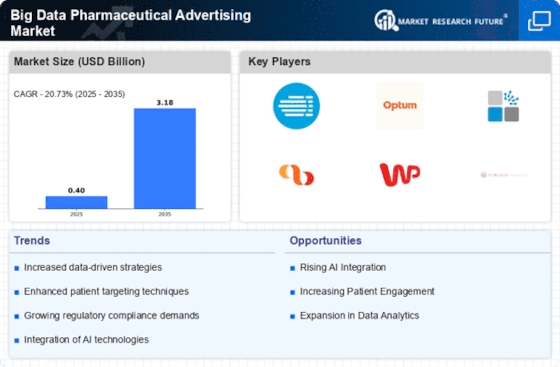
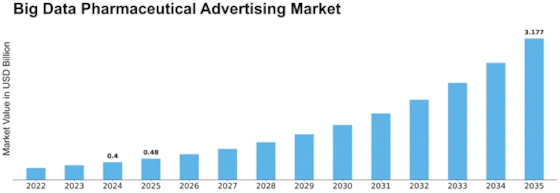
As per Market Research Future analysis, the Big Data Pharmaceutical Advertising Market was estimated at 0.4 USD Billion in 2024. The Big Data Pharmaceutical Advertising industry is projected to grow from USD 0.4829 Billion in 2025 to USD 3.177 Billion by 2035, exhibiting a compound annual growth rate (CAGR) of 20.73% during the forecast period 2025 - 2035

Key Market Trends & Highlights

The Big Data Pharmaceutical Advertising Market is experiencing a transformative shift towards personalized and data-driven strategies.

  • The market is witnessing a strong trend towards the personalization of marketing strategies to enhance patient engagement.
  • Integration of artificial intelligence is becoming increasingly prevalent, driving efficiency in advertising campaigns.
  • North America remains the largest market, while Asia-Pacific is emerging as the fastest-growing region in this sector.
  • Rising demand for targeted advertising and advancements in data analytics technologies are key drivers propelling market growth.

Market Size & Forecast

2024 Market Size 0.4 (USD Billion)
2035 Market Size 3.177 (USD Billion)
CAGR (2025 - 2035) 20.73%
Largest Regional Market Share in 2024 North America

Major Players

IQVIA (US), Optum (US), Cegedim (FR), Syneos Health (US), WPP (GB), Publicis Groupe (FR), McCann Health (US), Havas Health & You (US), Dentsu (JP)

Market Trends

The Big Data Pharmaceutical Advertising Market is currently experiencing a transformative phase, driven by advancements in technology and the increasing availability of vast datasets. This market appears to be evolving as pharmaceutical companies leverage big data analytics to enhance their advertising strategies. By utilizing sophisticated algorithms and machine learning techniques, these companies can gain deeper insights into consumer behavior, preferences, and trends. This shift towards data-driven decision-making seems to be reshaping how pharmaceutical products are marketed, allowing for more targeted and effective campaigns. Moreover, the integration of big data into advertising strategies may lead to improved patient engagement and better health outcomes. As companies harness the power of data, they are likely to create personalized marketing messages that resonate with specific demographics. This trend indicates a move away from traditional advertising methods, as the industry embraces innovative approaches to reach potential customers. The Big Data Pharmaceutical Advertising Market, therefore, stands at the intersection of technology and healthcare, suggesting a future where data plays a pivotal role in shaping marketing practices within the pharmaceutical sector.

Personalization of Marketing Strategies

The trend towards personalized marketing strategies is becoming increasingly prevalent in the Big Data Pharmaceutical Advertising Market. Companies are utilizing data analytics to tailor their advertising efforts to individual consumer preferences, thereby enhancing engagement and effectiveness.

Integration of Artificial Intelligence

The integration of artificial intelligence into advertising practices is gaining traction. AI technologies are being employed to analyze large datasets, enabling pharmaceutical companies to predict market trends and consumer behavior more accurately.

Emphasis on Regulatory Compliance

As the Big Data Pharmaceutical Advertising Market expands, there is a growing emphasis on regulatory compliance. Companies are focusing on ensuring that their advertising practices adhere to legal standards, which is crucial for maintaining trust and credibility.

Big data pharmaceutical advertising Market Market Drivers

Rising Demand for Targeted Advertising

The Big Data Pharmaceutical Advertising Market is experiencing a notable shift towards targeted advertising strategies. This trend is driven by the increasing demand for personalized marketing approaches that resonate with specific patient demographics. As pharmaceutical companies seek to optimize their advertising expenditures, the ability to analyze vast datasets allows for more precise targeting. Reports indicate that targeted advertising can yield conversion rates that are significantly higher than traditional methods, potentially increasing return on investment. Furthermore, the integration of big data analytics enables companies to identify emerging trends and patient needs, thereby enhancing the effectiveness of their campaigns. This focus on targeted advertising is likely to continue shaping the landscape of the Big Data Pharmaceutical Advertising Market.

Growing Importance of Patient Engagement

Patient engagement is becoming increasingly vital in the Big Data Pharmaceutical Advertising Market. As healthcare stakeholders recognize the value of involving patients in their treatment journeys, pharmaceutical companies are leveraging big data to enhance engagement strategies. By analyzing patient data, companies can develop targeted campaigns that resonate with patients' needs and preferences. This focus on engagement not only improves patient satisfaction but also fosters brand loyalty. Data indicates that companies prioritizing patient engagement in their advertising efforts are likely to see improved outcomes and higher retention rates. Thus, the emphasis on patient engagement is poised to be a significant driver in the evolution of the Big Data Pharmaceutical Advertising Market.

Increased Investment in Digital Marketing

The Big Data Pharmaceutical Advertising Market is witnessing a surge in investment directed towards digital marketing initiatives. As traditional advertising channels become less effective, pharmaceutical companies are reallocating budgets to digital platforms that offer greater reach and engagement. Data suggests that digital advertising expenditures in the pharmaceutical sector have been on the rise, with a significant portion now dedicated to online channels. This shift is largely attributed to the ability of digital marketing to leverage big data for targeted outreach and real-time performance tracking. The growing importance of online presence and engagement is likely to drive further investment in digital strategies, thereby shaping the future of the Big Data Pharmaceutical Advertising Market.

Advancements in Data Analytics Technologies

Technological advancements in data analytics are profoundly influencing the Big Data Pharmaceutical Advertising Market. The emergence of sophisticated analytics tools allows pharmaceutical companies to process and interpret large volumes of data with unprecedented speed and accuracy. These tools facilitate the extraction of actionable insights from complex datasets, enabling companies to refine their advertising strategies. For instance, predictive analytics can forecast patient behavior and preferences, which can be instrumental in crafting effective marketing campaigns. As the industry increasingly adopts these technologies, the potential for enhanced decision-making and improved campaign outcomes becomes apparent. Consequently, the growth of data analytics capabilities is expected to be a key driver in the evolution of the Big Data Pharmaceutical Advertising Market.

Regulatory Changes and Compliance Requirements

The evolving regulatory landscape is a critical factor influencing the Big Data Pharmaceutical Advertising Market. As governments and regulatory bodies implement stricter guidelines for pharmaceutical advertising, companies must adapt their strategies to ensure compliance. This necessity for adherence to regulations can drive innovation in data management and analytics, as firms seek to navigate complex legal frameworks while maximizing advertising effectiveness. The emphasis on transparency and ethical marketing practices is likely to lead to increased investment in compliance technologies and training. Consequently, the regulatory environment may serve as both a challenge and a catalyst for growth within the Big Data Pharmaceutical Advertising Market.


Market Segment Insights

By Component: Solutions (Largest) vs. Services (Fastest-Growing)

In the Big Data Pharmaceutical Advertising Market, the component segment is primarily dominated by Solutions, which holds the largest market share. This broad category includes various analytical tools and data management systems that pharmaceutical companies utilize to analyze market trends and patient data efficiently. Services, while trailing in market share, are gaining traction due to the increasing demand for tailored marketing strategies that leverage big data analytics. Modified consumer engagement techniques and innovative advertising models are shaping this component, leading to greater reliance on service-based offerings in the industry.

Solutions (Dominant) vs. Services (Emerging)

The Solutions segment is characterized by established analytics platforms and robust data management systems that allow pharmaceutical companies to harness extensive data pools effectively. These solutions play a crucial role in optimizing campaign efficiency and targeting precision, catering to a range of client needs. On the other hand, the Services segment is emerging rapidly, focusing on customized advertising strategies, consulting services, and support for the implementation of big data technologies. This shift is driven by the need for specialized expertise and the growing complexity of pharmaceuticals marketing in a data-rich landscape, positioning Services as a vital complement to existing Solutions.

By Vertical: Search Engine (Largest) vs. Social Media (Fastest-Growing)

In the Big Data Pharmaceutical Advertising Market, the distribution of market share across the vertical segment is distinctly marked by the dominance of Search Engine advertising. This sector captures a substantial portion of the market due to its widespread use and accessibility, enabling pharmaceutical companies to reach a broad audience efficiently. In contrast, sectors like Social Media are rapidly gaining traction, appealing to younger demographics and offering innovative engagement strategies that traditional media cannot match, which is reshaping the overall market landscape.

Search Engine: Dominant vs. Social Media: Emerging

Within the Big Data Pharmaceutical Advertising Market, Search Engine advertising stands out as the dominant force, leveraging its wide reach and data analytics capabilities to drive effective campaigns. Pharmaceutical companies utilize this platform to optimize their visibility and ensure targeted outreach, making it instrumental in patient engagement. On the other hand, Social Media has emerged as a vibrant and innovative channel. Its ability to foster community interaction and facilitate real-time feedback allows pharmaceutical brands to craft relatable content and enhance patient education. As these platforms evolve, their influence on advertising strategies continues to intensify, with digital engagement shaping the future of pharmaceutical marketing.

By Application: Product Targeting (Largest) vs. Branding (Fastest-Growing)

In the Big Data Pharmaceutical Advertising Market, the 'Application' segment is multifaceted, with various sub-segments vying for prominence. Product Targeting holds the largest market share, driven by pharmaceutical companies' efforts to deliver tailored messages to healthcare professionals, thereby ensuring high engagement and effective outreach. In contrast, Branding is emerging rapidly as pharmaceutical firms increasingly recognize the importance of building a strong brand presence to differentiate their products in a competitive landscape. As advertising methods evolve, growth drivers such as technological advancements in data analytics and increased consumer data accessibility are propelling the Branding segment forward. Firms are adopting innovative advertising strategies that leverage these data insights, leading to more effective branding campaigns. This trend points to a shifting focus in pharmaceutical advertising, where the integration of Big Data tools is becoming essential for establishing a robust brand identity and achieving competitive advantage.

Product Targeting: Dominant vs. Branding: Emerging

Product Targeting is characterized by its strategic focus on individual healthcare practitioners and specific peer groups, allowing pharmaceutical advertisers to customize their campaigns meticulously. This targeted approach enhances outreach effectiveness and efficiency, leading to higher conversion rates. Meanwhile, Branding is still an emerging tactic within the industry, leveraging Big Data analytics to form a cohesive brand story that resonates with healthcare professionals and patients alike. With a rapidly changing advertising environment, branding strategies are adapting to highlight the unique value propositions of pharmaceutical products. By combining insights gained from customer data and market trends, Branding is positioning itself as an essential pillar for long-term growth and consumer connection in pharmaceutical advertising.

Get more detailed insights about Big Data Pharmaceutical Advertising Market Research Report - Global Forecast to 2035

Regional Insights

North America : Leading Market Innovators

North America is the largest market for Big Data Pharmaceutical Advertising, holding approximately 45% of the global share. The region's growth is driven by advanced healthcare infrastructure, increasing adoption of digital marketing strategies, and stringent regulations that promote data privacy and security. The demand for personalized medicine and targeted advertising is also on the rise, further fueling market expansion. The United States is the primary contributor, with key players like IQVIA, Optum, and Syneos Health leading the charge. The competitive landscape is characterized by significant investments in technology and analytics, enabling companies to leverage big data for more effective advertising strategies. Canada also plays a vital role, contributing to the region's overall market strength.

Europe : Regulatory Frameworks Drive Growth

Europe is the second-largest market for Big Data Pharmaceutical Advertising, accounting for around 30% of the global market share. The region benefits from a robust regulatory framework that encourages transparency and ethical advertising practices. Increasing healthcare expenditure and the growing emphasis on patient-centric approaches are key drivers of market growth. Countries like Germany and France are at the forefront, with rising demand for data-driven marketing strategies. Germany leads the market, supported by a strong pharmaceutical sector and innovative advertising solutions. France follows closely, with companies like Cegedim and Publicis Groupe making significant contributions. The competitive landscape is marked by collaborations between pharmaceutical firms and advertising agencies, enhancing the effectiveness of campaigns. The European Medicines Agency emphasizes the importance of data integrity in advertising, ensuring compliance with regulations.

Asia-Pacific : Rapid Growth and Innovation

Asia-Pacific is witnessing rapid growth in the Big Data Pharmaceutical Advertising market, holding approximately 20% of the global share. The region's expansion is driven by increasing healthcare investments, a growing middle class, and the rising prevalence of chronic diseases. Countries like China and India are leading this growth, with a surge in digital marketing initiatives and a focus on personalized healthcare solutions. China is the largest market in the region, supported by a vast population and a booming pharmaceutical industry. India follows, with a growing number of startups focusing on innovative advertising solutions. The competitive landscape is evolving, with both local and international players vying for market share. The presence of companies like Dentsu highlights the region's potential for big data applications in advertising, making it a key area for future investments.

Middle East and Africa : Untapped Market Potential

The Middle East and Africa represent an emerging market for Big Data Pharmaceutical Advertising, accounting for about 5% of the global share. The region is characterized by increasing healthcare investments and a growing emphasis on digital transformation in the pharmaceutical sector. Regulatory bodies are beginning to recognize the importance of data-driven advertising, which is expected to catalyze market growth in the coming years. Countries like South Africa and the UAE are leading the charge, with a focus on improving healthcare access and leveraging technology for better patient engagement. The competitive landscape is still developing, with opportunities for both local and international players to establish a foothold. As the region continues to evolve, the presence of innovative advertising solutions will be crucial for capturing market share and enhancing patient outreach.

Key Players and Competitive Insights

The Big Data Pharmaceutical Advertising Market is currently characterized by a dynamic competitive landscape, driven by rapid technological advancements and an increasing emphasis on data-driven decision-making. Key players such as IQVIA (US), Optum (US), and Publicis Groupe (FR) are strategically positioned to leverage their extensive data analytics capabilities to enhance advertising effectiveness and patient engagement. These companies are focusing on innovation and digital transformation, which are critical in a market that demands agility and responsiveness to changing consumer behaviors and regulatory environments. Their collective strategies not only shape the competitive environment but also set benchmarks for operational excellence in the industry.

In terms of business tactics, companies are increasingly localizing their operations and optimizing supply chains to better serve diverse markets. The competitive structure of the Big Data Pharmaceutical Advertising Market appears moderately fragmented, with several players vying for market share. However, the influence of major companies like Syneos Health (US) and WPP (GB) is substantial, as they continue to expand their service offerings and enhance their technological capabilities, thereby reinforcing their market positions.

In September 2025, IQVIA (US) announced a partnership with a leading AI firm to develop advanced predictive analytics tools aimed at improving targeted advertising strategies for pharmaceutical clients. This strategic move is likely to enhance IQVIA's ability to deliver personalized marketing solutions, thereby increasing client satisfaction and retention. The integration of AI into their advertising strategies may also provide a competitive edge in a market that increasingly values data-driven insights.

In August 2025, Optum (US) launched a new data analytics platform designed to streamline the advertising process for pharmaceutical companies. This platform is expected to facilitate real-time data access and insights, allowing clients to make informed decisions quickly. The introduction of this platform indicates Optum's commitment to enhancing operational efficiency and underscores the growing importance of technology in pharmaceutical advertising.

In July 2025, Publicis Groupe (FR) expanded its digital capabilities by acquiring a tech startup specializing in machine learning applications for healthcare marketing. This acquisition is indicative of Publicis's strategy to bolster its technological prowess and enhance its service offerings. By integrating machine learning into its advertising solutions, Publicis aims to provide more effective and targeted campaigns, thereby positioning itself as a leader in the digital transformation of pharmaceutical advertising.

As of October 2025, current trends in the Big Data Pharmaceutical Advertising Market are heavily influenced by digitalization, sustainability, and the integration of artificial intelligence. Strategic alliances among key players are shaping the landscape, fostering innovation and collaboration. Looking ahead, competitive differentiation is likely to evolve from traditional price-based competition to a focus on innovation, technological advancements, and supply chain reliability. Companies that can effectively harness these trends will likely emerge as leaders in this rapidly changing market.

Key Companies in the Big data pharmaceutical advertising Market include

Industry Developments

Bright Bytes is a platform dealing in data management that was acquired by Microsoft in February 2019. the agenda behind this acquiring was to initiate the collection, integration, as well as, report of information across various online platforms related to both the applications and services, for the target audience. 

To increase its global footprint, IBM announced and launched IBM Cloud Multizone Region (MZR) in August 2019. This launch is expected to help the clients in adopting critical workloads prevalent in a hybrid cloud environment. 

The intelligent Planning suite solution of SAS Institute was infused with cloud capabilities, as well as, artificial intelligence, with a motive to increase and enhance the customer base and experience. 

The data literacy consultation and signature services are being offered by Qlick since January 2020. This is going to render the organizations to roar high on the data literacy rate, as well as, gain good customer confidence in the services being offered. 

Future Outlook

Big data pharmaceutical advertising Market Future Outlook

The Big Data Pharmaceutical Advertising Market is projected to grow at a 20.73% CAGR from 2025 to 2035, driven by technological advancements, data analytics, and personalized marketing strategies.

New opportunities lie in:

  • Integration of AI-driven analytics for targeted advertising campaigns.
  • Development of real-time data dashboards for performance tracking.
  • Expansion into emerging markets through localized advertising strategies.

By 2035, the market is expected to be robust, driven by innovation and strategic investments.

Market Segmentation

Big data pharmaceutical advertising Market Vertical Outlook

  • Search Engine
  • Product Website
  • Social Media
  • Mobile Advertisement
  • E-commerce

Big data pharmaceutical advertising Market Component Outlook

  • Solutions
  • Services

Big data pharmaceutical advertising Market Application Outlook

  • Product Targeting
  • Service Targeting
  • Customer Targeting
  • Branding

Report Scope

MARKET SIZE 2024 0.4(USD Billion)
MARKET SIZE 2025 0.4829(USD Billion)
MARKET SIZE 2035 3.177(USD Billion)
COMPOUND ANNUAL GROWTH RATE (CAGR) 20.73% (2025 - 2035)
REPORT COVERAGE Revenue Forecast, Competitive Landscape, Growth Factors, and Trends
BASE YEAR 2024
Market Forecast Period 2025 - 2035
Historical Data 2019 - 2024
Market Forecast Units USD Billion
Key Companies Profiled IQVIA (US), Optum (US), Cegedim (FR), Syneos Health (US), WPP (GB), Publicis Groupe (FR), McCann Health (US), Havas Health & You (US), Dentsu (JP)
Segments Covered Channel, Application
Key Market Opportunities Integration of artificial intelligence enhances targeting and personalization in the Big Data Pharmaceutical Advertising Market.

Key Market Dynamics Rising integration of artificial intelligence enhances targeting and personalization in pharmaceutical advertising strategies.
Countries Covered North America, Europe, APAC, South America, MEA

FAQs

What is the projected market valuation of the Big Data Pharmaceutical Advertising Market by 2035?

<p>The projected market valuation for the Big Data Pharmaceutical Advertising Market is 3.177 USD Billion by 2035.</p>

What was the market valuation of the Big Data Pharmaceutical Advertising Market in 2024?

<p>The overall market valuation was 0.4 USD Billion in 2024.</p>

What is the expected CAGR for the Big Data Pharmaceutical Advertising Market during the forecast period 2025 - 2035?

<p>The expected CAGR for the Big Data Pharmaceutical Advertising Market during the forecast period 2025 - 2035 is 20.73%.</p>

Which companies are considered key players in the Big Data Pharmaceutical Advertising Market?

<p>Key players in the market include IQVIA, Optum, Cegedim, Syneos Health, WPP, Publicis Groupe, McCann Health, Havas Health & You, and Dentsu.</p>

How did the Solutions and Services segments perform in the Big Data Pharmaceutical Advertising Market?

<p>In 2024, the Solutions segment was valued at 1.588 USD Billion, while the Services segment was valued at 1.589 USD Billion.</p>

What are the main verticals contributing to the Big Data Pharmaceutical Advertising Market?

The main verticals include Search Engine, Product Website, Social Media, Mobile Advertisement, and E-commerce.

What was the valuation of the Customer Targeting application in 2024?

The valuation of the Customer Targeting application was 1.2 USD Billion in 2024.

How does the market for Social Media advertising in pharmaceuticals appear to be evolving?

The Social Media segment is projected to grow from 0.1 USD Billion in 2024 to 0.9 USD Billion by 2035.

What is the significance of the Branding application in the Big Data Pharmaceutical Advertising Market?

The Branding application was valued at 0.6 USD Billion in 2024, indicating its relevance in the market.

What trends are anticipated in the Big Data Pharmaceutical Advertising Market by 2035?

Trends suggest a substantial increase in market valuation, driven by advancements in data analytics and targeted advertising strategies.

  1. SECTION I: EXECUTIVE SUMMARY AND KEY HIGHLIGHTS
    1. | 1.1 EXECUTIVE SUMMARY
    2. | | 1.1.1 Market Overview
    3. | | 1.1.2 Key Findings
    4. | | 1.1.3 Market Segmentation
    5. | | 1.1.4 Competitive Landscape
    6. | | 1.1.5 Challenges and Opportunities
    7. | | 1.1.6 Future Outlook
  2. SECTION II: SCOPING, METHODOLOGY AND MARKET STRUCTURE
    1. | 2.1 MARKET INTRODUCTION
    2. | | 2.1.1 Definition
    3. | | 2.1.2 Scope of the study
    4. | | | 2.1.2.1 Research Objective
    5. | | | 2.1.2.2 Assumption
    6. | | | 2.1.2.3 Limitations
    7. | 2.2 RESEARCH METHODOLOGY
    8. | | 2.2.1 Overview
    9. | | 2.2.2 Data Mining
    10. | | 2.2.3 Secondary Research
    11. | | 2.2.4 Primary Research
    12. | | | 2.2.4.1 Primary Interviews and Information Gathering Process
    13. | | | 2.2.4.2 Breakdown of Primary Respondents
    14. | | 2.2.5 Forecasting Model
    15. | | 2.2.6 Market Size Estimation
    16. | | | 2.2.6.1 Bottom-Up Approach
    17. | | | 2.2.6.2 Top-Down Approach
    18. | | 2.2.7 Data Triangulation
    19. | | 2.2.8 Validation
  3. SECTION III: QUALITATIVE ANALYSIS
    1. | 3.1 MARKET DYNAMICS
    2. | | 3.1.1 Overview
    3. | | 3.1.2 Drivers
    4. | | 3.1.3 Restraints
    5. | | 3.1.4 Opportunities
    6. | 3.2 MARKET FACTOR ANALYSIS
    7. | | 3.2.1 Value chain Analysis
    8. | | 3.2.2 Porter's Five Forces Analysis
    9. | | | 3.2.2.1 Bargaining Power of Suppliers
    10. | | | 3.2.2.2 Bargaining Power of Buyers
    11. | | | 3.2.2.3 Threat of New Entrants
    12. | | | 3.2.2.4 Threat of Substitutes
    13. | | | 3.2.2.5 Intensity of Rivalry
    14. | | 3.2.3 COVID-19 Impact Analysis
    15. | | | 3.2.3.1 Market Impact Analysis
    16. | | | 3.2.3.2 Regional Impact
    17. | | | 3.2.3.3 Opportunity and Threat Analysis
  4. SECTION IV: QUANTITATIVE ANALYSIS
    1. | 4.1 Healthcare, BY Component (USD Billion)
    2. | | 4.1.1 Solutions
    3. | | 4.1.2 Services
    4. | 4.2 Healthcare, BY Vertical (USD Billion)
    5. | | 4.2.1 Search Engine
    6. | | 4.2.2 Product Website
    7. | | 4.2.3 Social Media
    8. | | 4.2.4 Mobile Advertisement
    9. | | 4.2.5 E-commerce
    10. | 4.3 Healthcare, BY Application (USD Billion)
    11. | | 4.3.1 Product Targeting
    12. | | 4.3.2 Service Targeting
    13. | | 4.3.3 Customer Targeting
    14. | | 4.3.4 Branding
    15. | 4.4 Healthcare, BY Region (USD Billion)
    16. | | 4.4.1 North America
    17. | | | 4.4.1.1 US
    18. | | | 4.4.1.2 Canada
    19. | | 4.4.2 Europe
    20. | | | 4.4.2.1 Germany
    21. | | | 4.4.2.2 UK
    22. | | | 4.4.2.3 France
    23. | | | 4.4.2.4 Russia
    24. | | | 4.4.2.5 Italy
    25. | | | 4.4.2.6 Spain
    26. | | | 4.4.2.7 Rest of Europe
    27. | | 4.4.3 APAC
    28. | | | 4.4.3.1 China
    29. | | | 4.4.3.2 India
    30. | | | 4.4.3.3 Japan
    31. | | | 4.4.3.4 South Korea
    32. | | | 4.4.3.5 Malaysia
    33. | | | 4.4.3.6 Thailand
    34. | | | 4.4.3.7 Indonesia
    35. | | | 4.4.3.8 Rest of APAC
    36. | | 4.4.4 South America
    37. | | | 4.4.4.1 Brazil
    38. | | | 4.4.4.2 Mexico
    39. | | | 4.4.4.3 Argentina
    40. | | | 4.4.4.4 Rest of South America
    41. | | 4.4.5 MEA
    42. | | | 4.4.5.1 GCC Countries
    43. | | | 4.4.5.2 South Africa
    44. | | | 4.4.5.3 Rest of MEA
  5. SECTION V: COMPETITIVE ANALYSIS
    1. | 5.1 Competitive Landscape
    2. | | 5.1.1 Overview
    3. | | 5.1.2 Competitive Analysis
    4. | | 5.1.3 Market share Analysis
    5. | | 5.1.4 Major Growth Strategy in the Healthcare
    6. | | 5.1.5 Competitive Benchmarking
    7. | | 5.1.6 Leading Players in Terms of Number of Developments in the Healthcare
    8. | | 5.1.7 Key developments and growth strategies
    9. | | | 5.1.7.1 New Product Launch/Service Deployment
    10. | | | 5.1.7.2 Merger & Acquisitions
    11. | | | 5.1.7.3 Joint Ventures
    12. | | 5.1.8 Major Players Financial Matrix
    13. | | | 5.1.8.1 Sales and Operating Income
    14. | | | 5.1.8.2 Major Players R&D Expenditure. 2023
    15. | 5.2 Company Profiles
    16. | | 5.2.1 IQVIA (US)
    17. | | | 5.2.1.1 Financial Overview
    18. | | | 5.2.1.2 Products Offered
    19. | | | 5.2.1.3 Key Developments
    20. | | | 5.2.1.4 SWOT Analysis
    21. | | | 5.2.1.5 Key Strategies
    22. | | 5.2.2 Optum (US)
    23. | | | 5.2.2.1 Financial Overview
    24. | | | 5.2.2.2 Products Offered
    25. | | | 5.2.2.3 Key Developments
    26. | | | 5.2.2.4 SWOT Analysis
    27. | | | 5.2.2.5 Key Strategies
    28. | | 5.2.3 Cegedim (FR)
    29. | | | 5.2.3.1 Financial Overview
    30. | | | 5.2.3.2 Products Offered
    31. | | | 5.2.3.3 Key Developments
    32. | | | 5.2.3.4 SWOT Analysis
    33. | | | 5.2.3.5 Key Strategies
    34. | | 5.2.4 Syneos Health (US)
    35. | | | 5.2.4.1 Financial Overview
    36. | | | 5.2.4.2 Products Offered
    37. | | | 5.2.4.3 Key Developments
    38. | | | 5.2.4.4 SWOT Analysis
    39. | | | 5.2.4.5 Key Strategies
    40. | | 5.2.5 WPP (GB)
    41. | | | 5.2.5.1 Financial Overview
    42. | | | 5.2.5.2 Products Offered
    43. | | | 5.2.5.3 Key Developments
    44. | | | 5.2.5.4 SWOT Analysis
    45. | | | 5.2.5.5 Key Strategies
    46. | | 5.2.6 Publicis Groupe (FR)
    47. | | | 5.2.6.1 Financial Overview
    48. | | | 5.2.6.2 Products Offered
    49. | | | 5.2.6.3 Key Developments
    50. | | | 5.2.6.4 SWOT Analysis
    51. | | | 5.2.6.5 Key Strategies
    52. | | 5.2.7 McCann Health (US)
    53. | | | 5.2.7.1 Financial Overview
    54. | | | 5.2.7.2 Products Offered
    55. | | | 5.2.7.3 Key Developments
    56. | | | 5.2.7.4 SWOT Analysis
    57. | | | 5.2.7.5 Key Strategies
    58. | | 5.2.8 Havas Health & You (US)
    59. | | | 5.2.8.1 Financial Overview
    60. | | | 5.2.8.2 Products Offered
    61. | | | 5.2.8.3 Key Developments
    62. | | | 5.2.8.4 SWOT Analysis
    63. | | | 5.2.8.5 Key Strategies
    64. | | 5.2.9 Dentsu (JP)
    65. | | | 5.2.9.1 Financial Overview
    66. | | | 5.2.9.2 Products Offered
    67. | | | 5.2.9.3 Key Developments
    68. | | | 5.2.9.4 SWOT Analysis
    69. | | | 5.2.9.5 Key Strategies
    70. | 5.3 Appendix
    71. | | 5.3.1 References
    72. | | 5.3.2 Related Reports
  6. LIST OF FIGURES
    1. | 6.1 MARKET SYNOPSIS
    2. | 6.2 NORTH AMERICA MARKET ANALYSIS
    3. | 6.3 US MARKET ANALYSIS BY COMPONENT
    4. | 6.4 US MARKET ANALYSIS BY VERTICAL
    5. | 6.5 US MARKET ANALYSIS BY APPLICATION
    6. | 6.6 CANADA MARKET ANALYSIS BY COMPONENT
    7. | 6.7 CANADA MARKET ANALYSIS BY VERTICAL
    8. | 6.8 CANADA MARKET ANALYSIS BY APPLICATION
    9. | 6.9 EUROPE MARKET ANALYSIS
    10. | 6.10 GERMANY MARKET ANALYSIS BY COMPONENT
    11. | 6.11 GERMANY MARKET ANALYSIS BY VERTICAL
    12. | 6.12 GERMANY MARKET ANALYSIS BY APPLICATION
    13. | 6.13 UK MARKET ANALYSIS BY COMPONENT
    14. | 6.14 UK MARKET ANALYSIS BY VERTICAL
    15. | 6.15 UK MARKET ANALYSIS BY APPLICATION
    16. | 6.16 FRANCE MARKET ANALYSIS BY COMPONENT
    17. | 6.17 FRANCE MARKET ANALYSIS BY VERTICAL
    18. | 6.18 FRANCE MARKET ANALYSIS BY APPLICATION
    19. | 6.19 RUSSIA MARKET ANALYSIS BY COMPONENT
    20. | 6.20 RUSSIA MARKET ANALYSIS BY VERTICAL
    21. | 6.21 RUSSIA MARKET ANALYSIS BY APPLICATION
    22. | 6.22 ITALY MARKET ANALYSIS BY COMPONENT
    23. | 6.23 ITALY MARKET ANALYSIS BY VERTICAL
    24. | 6.24 ITALY MARKET ANALYSIS BY APPLICATION
    25. | 6.25 SPAIN MARKET ANALYSIS BY COMPONENT
    26. | 6.26 SPAIN MARKET ANALYSIS BY VERTICAL
    27. | 6.27 SPAIN MARKET ANALYSIS BY APPLICATION
    28. | 6.28 REST OF EUROPE MARKET ANALYSIS BY COMPONENT
    29. | 6.29 REST OF EUROPE MARKET ANALYSIS BY VERTICAL
    30. | 6.30 REST OF EUROPE MARKET ANALYSIS BY APPLICATION
    31. | 6.31 APAC MARKET ANALYSIS
    32. | 6.32 CHINA MARKET ANALYSIS BY COMPONENT
    33. | 6.33 CHINA MARKET ANALYSIS BY VERTICAL
    34. | 6.34 CHINA MARKET ANALYSIS BY APPLICATION
    35. | 6.35 INDIA MARKET ANALYSIS BY COMPONENT
    36. | 6.36 INDIA MARKET ANALYSIS BY VERTICAL
    37. | 6.37 INDIA MARKET ANALYSIS BY APPLICATION
    38. | 6.38 JAPAN MARKET ANALYSIS BY COMPONENT
    39. | 6.39 JAPAN MARKET ANALYSIS BY VERTICAL
    40. | 6.40 JAPAN MARKET ANALYSIS BY APPLICATION
    41. | 6.41 SOUTH KOREA MARKET ANALYSIS BY COMPONENT
    42. | 6.42 SOUTH KOREA MARKET ANALYSIS BY VERTICAL
    43. | 6.43 SOUTH KOREA MARKET ANALYSIS BY APPLICATION
    44. | 6.44 MALAYSIA MARKET ANALYSIS BY COMPONENT
    45. | 6.45 MALAYSIA MARKET ANALYSIS BY VERTICAL
    46. | 6.46 MALAYSIA MARKET ANALYSIS BY APPLICATION
    47. | 6.47 THAILAND MARKET ANALYSIS BY COMPONENT
    48. | 6.48 THAILAND MARKET ANALYSIS BY VERTICAL
    49. | 6.49 THAILAND MARKET ANALYSIS BY APPLICATION
    50. | 6.50 INDONESIA MARKET ANALYSIS BY COMPONENT
    51. | 6.51 INDONESIA MARKET ANALYSIS BY VERTICAL
    52. | 6.52 INDONESIA MARKET ANALYSIS BY APPLICATION
    53. | 6.53 REST OF APAC MARKET ANALYSIS BY COMPONENT
    54. | 6.54 REST OF APAC MARKET ANALYSIS BY VERTICAL
    55. | 6.55 REST OF APAC MARKET ANALYSIS BY APPLICATION
    56. | 6.56 SOUTH AMERICA MARKET ANALYSIS
    57. | 6.57 BRAZIL MARKET ANALYSIS BY COMPONENT
    58. | 6.58 BRAZIL MARKET ANALYSIS BY VERTICAL
    59. | 6.59 BRAZIL MARKET ANALYSIS BY APPLICATION
    60. | 6.60 MEXICO MARKET ANALYSIS BY COMPONENT
    61. | 6.61 MEXICO MARKET ANALYSIS BY VERTICAL
    62. | 6.62 MEXICO MARKET ANALYSIS BY APPLICATION
    63. | 6.63 ARGENTINA MARKET ANALYSIS BY COMPONENT
    64. | 6.64 ARGENTINA MARKET ANALYSIS BY VERTICAL
    65. | 6.65 ARGENTINA MARKET ANALYSIS BY APPLICATION
    66. | 6.66 REST OF SOUTH AMERICA MARKET ANALYSIS BY COMPONENT
    67. | 6.67 REST OF SOUTH AMERICA MARKET ANALYSIS BY VERTICAL
    68. | 6.68 REST OF SOUTH AMERICA MARKET ANALYSIS BY APPLICATION
    69. | 6.69 MEA MARKET ANALYSIS
    70. | 6.70 GCC COUNTRIES MARKET ANALYSIS BY COMPONENT
    71. | 6.71 GCC COUNTRIES MARKET ANALYSIS BY VERTICAL
    72. | 6.72 GCC COUNTRIES MARKET ANALYSIS BY APPLICATION
    73. | 6.73 SOUTH AFRICA MARKET ANALYSIS BY COMPONENT
    74. | 6.74 SOUTH AFRICA MARKET ANALYSIS BY VERTICAL
    75. | 6.75 SOUTH AFRICA MARKET ANALYSIS BY APPLICATION
    76. | 6.76 REST OF MEA MARKET ANALYSIS BY COMPONENT
    77. | 6.77 REST OF MEA MARKET ANALYSIS BY VERTICAL
    78. | 6.78 REST OF MEA MARKET ANALYSIS BY APPLICATION
    79. | 6.79 KEY BUYING CRITERIA OF HEALTHCARE
    80. | 6.80 RESEARCH PROCESS OF MRFR
    81. | 6.81 DRO ANALYSIS OF HEALTHCARE
    82. | 6.82 DRIVERS IMPACT ANALYSIS: HEALTHCARE
    83. | 6.83 RESTRAINTS IMPACT ANALYSIS: HEALTHCARE
    84. | 6.84 SUPPLY / VALUE CHAIN: HEALTHCARE
    85. | 6.85 HEALTHCARE, BY COMPONENT, 2024 (% SHARE)
    86. | 6.86 HEALTHCARE, BY COMPONENT, 2024 TO 2035 (USD Billion)
    87. | 6.87 HEALTHCARE, BY VERTICAL, 2024 (% SHARE)
    88. | 6.88 HEALTHCARE, BY VERTICAL, 2024 TO 2035 (USD Billion)
    89. | 6.89 HEALTHCARE, BY APPLICATION, 2024 (% SHARE)
    90. | 6.90 HEALTHCARE, BY APPLICATION, 2024 TO 2035 (USD Billion)
    91. | 6.91 BENCHMARKING OF MAJOR COMPETITORS
  7. LIST OF TABLES
    1. | 7.1 LIST OF ASSUMPTIONS
    2. | | 7.1.1
    3. | 7.2 North America MARKET SIZE ESTIMATES; FORECAST
    4. | | 7.2.1 BY COMPONENT, 2025-2035 (USD Billion)
    5. | | 7.2.2 BY VERTICAL, 2025-2035 (USD Billion)
    6. | | 7.2.3 BY APPLICATION, 2025-2035 (USD Billion)
    7. | 7.3 US MARKET SIZE ESTIMATES; FORECAST
    8. | | 7.3.1 BY COMPONENT, 2025-2035 (USD Billion)
    9. | | 7.3.2 BY VERTICAL, 2025-2035 (USD Billion)
    10. | | 7.3.3 BY APPLICATION, 2025-2035 (USD Billion)
    11. | 7.4 Canada MARKET SIZE ESTIMATES; FORECAST
    12. | | 7.4.1 BY COMPONENT, 2025-2035 (USD Billion)
    13. | | 7.4.2 BY VERTICAL, 2025-2035 (USD Billion)
    14. | | 7.4.3 BY APPLICATION, 2025-2035 (USD Billion)
    15. | 7.5 Europe MARKET SIZE ESTIMATES; FORECAST
    16. | | 7.5.1 BY COMPONENT, 2025-2035 (USD Billion)
    17. | | 7.5.2 BY VERTICAL, 2025-2035 (USD Billion)
    18. | | 7.5.3 BY APPLICATION, 2025-2035 (USD Billion)
    19. | 7.6 Germany MARKET SIZE ESTIMATES; FORECAST
    20. | | 7.6.1 BY COMPONENT, 2025-2035 (USD Billion)
    21. | | 7.6.2 BY VERTICAL, 2025-2035 (USD Billion)
    22. | | 7.6.3 BY APPLICATION, 2025-2035 (USD Billion)
    23. | 7.7 UK MARKET SIZE ESTIMATES; FORECAST
    24. | | 7.7.1 BY COMPONENT, 2025-2035 (USD Billion)
    25. | | 7.7.2 BY VERTICAL, 2025-2035 (USD Billion)
    26. | | 7.7.3 BY APPLICATION, 2025-2035 (USD Billion)
    27. | 7.8 France MARKET SIZE ESTIMATES; FORECAST
    28. | | 7.8.1 BY COMPONENT, 2025-2035 (USD Billion)
    29. | | 7.8.2 BY VERTICAL, 2025-2035 (USD Billion)
    30. | | 7.8.3 BY APPLICATION, 2025-2035 (USD Billion)
    31. | 7.9 Russia MARKET SIZE ESTIMATES; FORECAST
    32. | | 7.9.1 BY COMPONENT, 2025-2035 (USD Billion)
    33. | | 7.9.2 BY VERTICAL, 2025-2035 (USD Billion)
    34. | | 7.9.3 BY APPLICATION, 2025-2035 (USD Billion)
    35. | 7.10 Italy MARKET SIZE ESTIMATES; FORECAST
    36. | | 7.10.1 BY COMPONENT, 2025-2035 (USD Billion)
    37. | | 7.10.2 BY VERTICAL, 2025-2035 (USD Billion)
    38. | | 7.10.3 BY APPLICATION, 2025-2035 (USD Billion)
    39. | 7.11 Spain MARKET SIZE ESTIMATES; FORECAST
    40. | | 7.11.1 BY COMPONENT, 2025-2035 (USD Billion)
    41. | | 7.11.2 BY VERTICAL, 2025-2035 (USD Billion)
    42. | | 7.11.3 BY APPLICATION, 2025-2035 (USD Billion)
    43. | 7.12 Rest of Europe MARKET SIZE ESTIMATES; FORECAST
    44. | | 7.12.1 BY COMPONENT, 2025-2035 (USD Billion)
    45. | | 7.12.2 BY VERTICAL, 2025-2035 (USD Billion)
    46. | | 7.12.3 BY APPLICATION, 2025-2035 (USD Billion)
    47. | 7.13 APAC MARKET SIZE ESTIMATES; FORECAST
    48. | | 7.13.1 BY COMPONENT, 2025-2035 (USD Billion)
    49. | | 7.13.2 BY VERTICAL, 2025-2035 (USD Billion)
    50. | | 7.13.3 BY APPLICATION, 2025-2035 (USD Billion)
    51. | 7.14 China MARKET SIZE ESTIMATES; FORECAST
    52. | | 7.14.1 BY COMPONENT, 2025-2035 (USD Billion)
    53. | | 7.14.2 BY VERTICAL, 2025-2035 (USD Billion)
    54. | | 7.14.3 BY APPLICATION, 2025-2035 (USD Billion)
    55. | 7.15 India MARKET SIZE ESTIMATES; FORECAST
    56. | | 7.15.1 BY COMPONENT, 2025-2035 (USD Billion)
    57. | | 7.15.2 BY VERTICAL, 2025-2035 (USD Billion)
    58. | | 7.15.3 BY APPLICATION, 2025-2035 (USD Billion)
    59. | 7.16 Japan MARKET SIZE ESTIMATES; FORECAST
    60. | | 7.16.1 BY COMPONENT, 2025-2035 (USD Billion)
    61. | | 7.16.2 BY VERTICAL, 2025-2035 (USD Billion)
    62. | | 7.16.3 BY APPLICATION, 2025-2035 (USD Billion)
    63. | 7.17 South Korea MARKET SIZE ESTIMATES; FORECAST
    64. | | 7.17.1 BY COMPONENT, 2025-2035 (USD Billion)
    65. | | 7.17.2 BY VERTICAL, 2025-2035 (USD Billion)
    66. | | 7.17.3 BY APPLICATION, 2025-2035 (USD Billion)
    67. | 7.18 Malaysia MARKET SIZE ESTIMATES; FORECAST
    68. | | 7.18.1 BY COMPONENT, 2025-2035 (USD Billion)
    69. | | 7.18.2 BY VERTICAL, 2025-2035 (USD Billion)
    70. | | 7.18.3 BY APPLICATION, 2025-2035 (USD Billion)
    71. | 7.19 Thailand MARKET SIZE ESTIMATES; FORECAST
    72. | | 7.19.1 BY COMPONENT, 2025-2035 (USD Billion)
    73. | | 7.19.2 BY VERTICAL, 2025-2035 (USD Billion)
    74. | | 7.19.3 BY APPLICATION, 2025-2035 (USD Billion)
    75. | 7.20 Indonesia MARKET SIZE ESTIMATES; FORECAST
    76. | | 7.20.1 BY COMPONENT, 2025-2035 (USD Billion)
    77. | | 7.20.2 BY VERTICAL, 2025-2035 (USD Billion)
    78. | | 7.20.3 BY APPLICATION, 2025-2035 (USD Billion)
    79. | 7.21 Rest of APAC MARKET SIZE ESTIMATES; FORECAST
    80. | | 7.21.1 BY COMPONENT, 2025-2035 (USD Billion)
    81. | | 7.21.2 BY VERTICAL, 2025-2035 (USD Billion)
    82. | | 7.21.3 BY APPLICATION, 2025-2035 (USD Billion)
    83. | 7.22 South America MARKET SIZE ESTIMATES; FORECAST
    84. | | 7.22.1 BY COMPONENT, 2025-2035 (USD Billion)
    85. | | 7.22.2 BY VERTICAL, 2025-2035 (USD Billion)
    86. | | 7.22.3 BY APPLICATION, 2025-2035 (USD Billion)
    87. | 7.23 Brazil MARKET SIZE ESTIMATES; FORECAST
    88. | | 7.23.1 BY COMPONENT, 2025-2035 (USD Billion)
    89. | | 7.23.2 BY VERTICAL, 2025-2035 (USD Billion)
    90. | | 7.23.3 BY APPLICATION, 2025-2035 (USD Billion)
    91. | 7.24 Mexico MARKET SIZE ESTIMATES; FORECAST
    92. | | 7.24.1 BY COMPONENT, 2025-2035 (USD Billion)
    93. | | 7.24.2 BY VERTICAL, 2025-2035 (USD Billion)
    94. | | 7.24.3 BY APPLICATION, 2025-2035 (USD Billion)
    95. | 7.25 Argentina MARKET SIZE ESTIMATES; FORECAST
    96. | | 7.25.1 BY COMPONENT, 2025-2035 (USD Billion)
    97. | | 7.25.2 BY VERTICAL, 2025-2035 (USD Billion)
    98. | | 7.25.3 BY APPLICATION, 2025-2035 (USD Billion)
    99. | 7.26 Rest of South America MARKET SIZE ESTIMATES; FORECAST
    100. | | 7.26.1 BY COMPONENT, 2025-2035 (USD Billion)
    101. | | 7.26.2 BY VERTICAL, 2025-2035 (USD Billion)
    102. | | 7.26.3 BY APPLICATION, 2025-2035 (USD Billion)
    103. | 7.27 MEA MARKET SIZE ESTIMATES; FORECAST
    104. | | 7.27.1 BY COMPONENT, 2025-2035 (USD Billion)
    105. | | 7.27.2 BY VERTICAL, 2025-2035 (USD Billion)
    106. | | 7.27.3 BY APPLICATION, 2025-2035 (USD Billion)
    107. | 7.28 GCC Countries MARKET SIZE ESTIMATES; FORECAST
    108. | | 7.28.1 BY COMPONENT, 2025-2035 (USD Billion)
    109. | | 7.28.2 BY VERTICAL, 2025-2035 (USD Billion)
    110. | | 7.28.3 BY APPLICATION, 2025-2035 (USD Billion)
    111. | 7.29 South Africa MARKET SIZE ESTIMATES; FORECAST
    112. | | 7.29.1 BY COMPONENT, 2025-2035 (USD Billion)
    113. | | 7.29.2 BY VERTICAL, 2025-2035 (USD Billion)
    114. | | 7.29.3 BY APPLICATION, 2025-2035 (USD Billion)
    115. | 7.30 Rest of MEA MARKET SIZE ESTIMATES; FORECAST
    116. | | 7.30.1 BY COMPONENT, 2025-2035 (USD Billion)
    117. | | 7.30.2 BY VERTICAL, 2025-2035 (USD Billion)
    118. | | 7.30.3 BY APPLICATION, 2025-2035 (USD Billion)
    119. | 7.31 PRODUCT LAUNCH/PRODUCT DEVELOPMENT/APPROVAL
    120. | | 7.31.1
    121. | 7.32 ACQUISITION/PARTNERSHIP
    122. | | 7.32.1

Healthcare Market Segmentation

Healthcare By Component (USD Billion, 2025-2035)

  • Solutions
  • Services

Healthcare By Vertical (USD Billion, 2025-2035)

  • Search Engine
  • Product Website
  • Social Media
  • Mobile Advertisement
  • E-commerce

Healthcare By Application (USD Billion, 2025-2035)

  • Product Targeting
  • Service Targeting
  • Customer Targeting
  • Branding
Infographic

Free Sample Request

Kindly complete the form below to receive a free sample of this Report

Get Free Sample

Customer Strories

Compare Licence

×
Features License Type
Single User Multiuser License Enterprise User
Price $4,950 $5,950 $7,250
Maximum User Access Limit 1 User Upto 10 Users Unrestricted Access Throughout the Organization
Free Customization
Direct Access to Analyst
Deliverable Format
Platform Access
Discount on Next Purchase 10% 15% 15%
Printable Versions