Request Free Sample ×

Kindly complete the form below to receive a free sample of this Report

* Please use a valid business email

Leading companies partner with us for data-driven Insights

clients tt-cursor
Hero Background
English
Chinese
French
Japanese
Korean
German
Spanish

Benign Prostatic Hyperplasia Treatment Market Size

ID: MRFR/HC/10317-HCR
128 Pages
Vikita Thakur
April 2026

Benign Prostatic Hyperplasia Treatment Market Research Report: Size, Share, Trend Analysis By Therapeutic Class (Alpha Blockers, 5- Alpha Reductase Inhibitors, Phosphodiesterase-5 Inhibitors, Others), By Therapy (Mono Drug Therapy and Combination Drug Therapy), and By Region (North America, Europe, Asia-Pacific, and Rest Of The World) - Growth Outlook & Industry Forecast 2025 To 2035

Share:
Download PDF ×

We do not share your information with anyone. However, we may send you emails based on your report interest from time to time. You may contact us at any time to opt-out.

Benign Prostatic Hyperplasia Treatment Market Infographic
Purchase Options

Benign Prostatic Hyperplasia Treatment Size

Benign Prostatic Hyperplasia Treatment Market Growth Projections and Opportunities

The thriving commonness of benign prostatic hyperplasia (BPH), especially among maturing guys, and the requirement for viable treatment options are persuasive elements in the advancement of the BPH treatment market. A large number of remedial modalities, like negligibly obtrusive strategies, drugs, and careful intercessions, are accessible available to lighten side effects and work on the personal satisfaction for those impacted. The execution of automated helped mediations, laser treatment, transurethral microwave thermotherapy, and other mechanical advances in the treatment of BPH add to worked on quiet results, expanded market extension, and abbreviated recuperation periods. The market elements are significantly affected by the administrative climate, as thorough guidelines are set up to ensure the wellbeing, adequacy, and nature of treatment options for BPH. Guaranteeing consistence is critical with regards to entering the market and laying out certainty between medical services suppliers and patients. Reception of BPH medicines is impacted by repayment strategies, financial circumstances, and medical care foundation; subsequently, market members should fit their answers for address the particular difficulties of every medical care framework. Nonstop innovative work impels the market for BPH medicines, as organizations reliably foster novel meds and medicines to work on understanding cordial other options and keep a mechanical edge. The Coronavirus pandemic forestalled elective operations, which influenced the interest for BPH medicines. Flexibility of the medical care framework and affirmation of the market's basic nature, in any case, added to its recuperation and extension. Market advancement is impelled by associations among BPH treatment suppliers, drug organizations, and exploration associations. These coordinated efforts tackle different difficulties like the improvement of customized medicines, novel medication details, and careful procedures. The market for BPH medicines puts an exceptional on tolerant driven medical care, with an accentuation on diminished incidental effects, improved recuperation periods, and solace. This is reliable with the patient-focused worldview that supports contemporary medical care. The impact of cost-adequacy on the BPH market is developing significantly. There is tension on medical care frameworks overall to improve asset usage and decrease generally speaking therapy costs. Elective clinical methodologies, for example, negligibly obtrusive or short-term solutions for BPH, are appealing because of their expense adequacy in contrast with conventional careful techniques.
Benign Prostatic Hyperplasia Treatment Market Size Graph
Author
Author Profile
Vikita Thakur
Senior Research Analyst

She holds an experience of about 5+ years in market research and business consulting projects for sectors such as life sciences, medical devices, and healthcare IT. She possesses a robust background in data analysis, market estimation, competitive intelligence, pipeline analysis market trend identification, and consumer behavior insights. Her expertise lies in technical Sales support, client interaction and project management, designing and implementing market research studies, conducting competitive analysis, and synthesizing complex data into actionable recommendations that drive business growth.

Leave a Comment

FAQs

What is the current valuation of the Benign Prostatic Hyperplasia Treatment Market?

<p>The market valuation was 12.45 USD Billion in 2024.</p>

What is the projected market size for the market by 2035?

The market is projected to reach 22.44 USD Billion by 2035.

What is the expected CAGR for the market during the forecast period?

The expected CAGR for the market from 2025 to 2035 is 5.5%.

Which therapeutic classes are leading in the Benign Prostatic Hyperplasia Treatment Market?

<p>Alpha Blockers and 5-Alpha Reductase Inhibitors are leading therapeutic classes, with valuations of 6.73 and 4.52 USD Billion respectively by 2035.</p>

What are the projected revenues for Mono Drug Therapy and Combination Drug Therapy by 2035?

<p>Both Mono Drug Therapy and Combination Drug Therapy are projected to reach 11.22 USD Billion by 2035.</p>

Who are the key players in the market?

Key players include Astellas Pharma, Boehringer Ingelheim, Eli Lilly and Company, and others.

How do the revenues of Alpha Blockers compare to Phosphodiesterase-5 Inhibitors by 2035?

By 2035, Alpha Blockers are expected to generate 6.73 USD Billion, while Phosphodiesterase-5 Inhibitors are projected at 3.38 USD Billion.

What is the growth potential for the 'Others' segment in the market?

The 'Others' segment is projected to grow to 7.81 USD Billion by 2035.

What role do major pharmaceutical companies play in the market dynamics?

Companies like Merck &amp; Co. and Pfizer Inc. are likely to influence market dynamics through innovation and strategic partnerships.

How does the market's growth trajectory appear for the next decade?

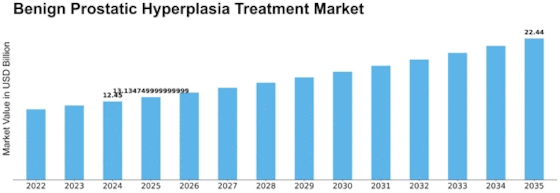
The market's growth trajectory appears robust, with a projected increase from 12.45 USD Billion in 2024 to 22.44 USD Billion by 2035.

Market Summary

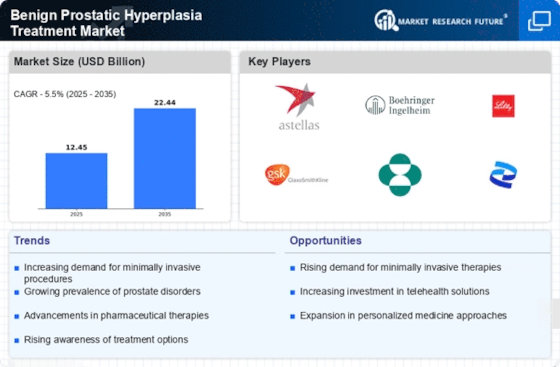
According to Market Research Future analysis, the Benign Prostatic Hyperplasia Treatment Market Size was valued at USD 12.45 Billion in 2024. The market is projected to grow from USD 13.13 Billion in 2025 to USD 22.44 Billion by 2035, registering a CAGR of 5.5% during the forecast period (2025–2035). North America led the market with over 44.98% share, generating around USD 5.6 billion in revenue.
 
The Benign Prostatic Hyperplasia Treatment Market is growing due to the rising aging male population and increasing prevalence of prostate-related disorders. Key trends include advancements in minimally invasive therapies, growing adoption of combination drug treatments, and increasing awareness of early diagnosis and management options improving patient outcomes in urology care globally.
 
According to the World Health Organization, the global population aged 60 years and older is expected to reach 2.1 billion by 2050, significantly increasing the prevalence of age-related conditions such as benign prostatic hyperplasia.

Key Market Trends & Highlights

The Benign Prostatic Hyperplasia Treatment Market is experiencing a transformative shift towards innovative and patient-centric solutions.

  • The market is witnessing a rise in minimally invasive techniques, enhancing patient recovery and satisfaction. North America remains the largest market, driven by advanced healthcare infrastructure and high treatment adoption rates. In the Asia-Pacific region, the market is growing rapidly, fueled by increasing awareness and healthcare access. Key market drivers include the aging population and advancements in treatment modalities, particularly in Alpha Blockers and Combination Drug Therapy segments.

Market Size & Forecast

2024 Market Size 12.45 (USD Billion)
2035 Market Size 22.44 (USD Billion)
CAGR (2025 - 2035) 5.5%
Largest Regional Market Share in 2024 North America

Major Players

Companies such as Astellas Pharma (JP), Boehringer Ingelheim (DE), Eli Lilly and Company (US), <a href="https://gskpro.com/en-xg/therapy-areas/urology/news-updates/updated_guidelines_for_the_management_and_treatment_of_patients_with_benign_prostatic_hyperplasia/">GlaxoSmithKline</a> (GB), Merck &amp; Co. (US), Pfizer Inc. (US), Sanofi (FR), Teva Pharmaceutical Industries (IL), AbbVie Inc. (US) are some of the major participants in the global market.

Market Trends

The Benign Prostatic Hyperplasia Treatment Market is currently experiencing notable transformations driven by advancements in medical technology and an increasing awareness of prostate health. As the global population ages, the prevalence of benign prostatic hyperplasia (BPH) rises, prompting a surge in demand for effective treatment options. This market encompasses a variety of therapeutic approaches, including pharmacological treatments, minimally invasive procedures, and surgical interventions.

The growing emphasis on patient-centered care is influencing the development of innovative therapies that prioritize safety and efficacy, thereby enhancing the overall treatment experience for individuals affected by BPH. Moreover, the landscape of the market is shaped by ongoing research and development efforts aimed at improving existing therapies and introducing novel solutions. 

Collaboration among pharmaceutical companies, healthcare providers, and research institutions appears to be fostering a dynamic environment conducive to innovation. 

Additionally, the integration of digital health technologies, such as telemedicine and mobile health applications, is likely to enhance patient engagement and adherence to treatment regimens. As the market evolves, stakeholders must remain attuned to emerging trends and shifts in patient preferences to effectively address the diverse needs of those living with benign prostatic hyperplasia.

Rise of Minimally Invasive Techniques

The trend towards minimally invasive techniques in the Benign Prostatic Hyperplasia Treatment Market is gaining traction. These methods, which include laser therapies and transurethral procedures, offer patients reduced recovery times and lower complication rates compared to traditional surgical options. As awareness of these benefits spreads, more patients are likely to opt for these alternatives, influencing market dynamics.

According to the Institute for Health Metrics and Evaluation, global demographic data shows that the population aged 65 years and above is increasing rapidly and is projected to exceed 1.6 billion by 2050, contributing to the rising prevalence of age-related urological disorders.

Increased Focus on Patient-Centric Solutions

There is a growing emphasis on patient-centric solutions within the market. Healthcare providers are increasingly prioritizing treatments that not only address the medical aspects of BPH but also consider the quality of life of patients.  Clinical management of benign prostatic hyperplasia with LUTS is increasingly focused on improving quality of life by reducing the frequency of nocturnal awakenings and urgency episodes.

The Centers for Disease Control and Prevention emphasizes that patient-centered care models significantly improve treatment adherence and health outcomes, particularly for chronic conditions. Furthermore, initiatives supported by the United Nations Population Fund highlight the importance of improving quality of life for aging male populations through accessible and patient-focused healthcare services.

Integration of Digital Health Technologies

The integration of digital health technologies is transforming the Benign Prostatic Hyperplasia Treatment Market. Telemedicine and mobile health applications are becoming essential tools for patient management, allowing for remote consultations and monitoring.

Within the field of lut urology, there is a significant move toward using advanced urodynamic testing and AI-driven imaging to differentiate between obstructive and irritative symptoms. According to the European Centre for Disease Prevention and Control, digital health technologies including remote monitoring and telehealth platforms are increasingly integrated into healthcare systems to strengthen disease management and clinical decision-making.

Collaborations among Companies

As more consumers choose to buy BPH medication via digital platforms, pharmaceutical companies are investing in tele-urology partnerships to ensure that prescriptions are supported by professional clinical oversight. The Gavi, the Vaccine Alliance emphasizes that public-private partnerships play a critical role in accelerating healthcare innovation and expanding access to medical technologies globally.

Benign Prostatic Hyperplasia Treatment Market Market Drivers

Rising Healthcare Expenditure

The increasing healthcare expenditure across various regions is significantly influencing the Benign Prostatic Hyperplasia Treatment Market. As governments and private sectors allocate more resources to healthcare, there is a corresponding rise in the availability of advanced treatment options for BPH.
 
This trend is particularly evident in developed economies, where healthcare budgets are expanding to accommodate innovative therapies and technologies. The willingness of patients to invest in their health, coupled with insurance coverage for BPH treatments, is likely to enhance market growth. Consequently, the market stands to benefit from this upward trajectory in healthcare spending, as more individuals seek timely and effective interventions.

Advancements in Treatment Modalities

Innovations in treatment modalities are playing a crucial role in shaping the Benign Prostatic Hyperplasia Treatment Market. The introduction of new pharmacological agents, such as alpha-blockers and 5-alpha-reductase inhibitors, has expanded the therapeutic options available for patients. Additionally, minimally invasive procedures, including laser therapy and transurethral resection of the prostate, are gaining traction due to their effectiveness and reduced recovery times.
 
The market is anticipated to benefit from ongoing research and development efforts aimed at enhancing treatment efficacy and patient outcomes. As these advancements continue to emerge, they are likely to attract more patients seeking effective solutions for BPH, thereby propelling the growth of the market.

Growing Awareness and Education Initiatives

The Benign Prostatic Hyperplasia Treatment Market is witnessing a surge in growth driven by increased awareness and education initiatives surrounding BPH. Healthcare organizations and advocacy groups are actively promoting information about the condition, its symptoms, and available treatment options. This heightened awareness is encouraging men to seek medical advice and treatment sooner, which is crucial for effective management of BPH.
 
Educational campaigns are also addressing the stigma associated with prostate health, leading to a more open dialogue about the condition. As awareness continues to rise, it is expected that more patients will engage with healthcare providers, thereby contributing to the expansion of the market.

Aging Population and Rising Incidence of BPH

The Benign Prostatic Hyperplasia Treatment Market is experiencing growth due to the increasing prevalence of BPH among the aging population. As men age, the likelihood of developing BPH rises significantly, with studies indicating that nearly 50% of men aged 50 and older may experience symptoms. This demographic shift is expected to drive demand for effective treatment options, including medications and surgical interventions.
 
The market is projected to expand as healthcare providers seek to address the needs of this growing patient population. Furthermore, the rising awareness of BPH and its impact on quality of life is likely to encourage more individuals to seek treatment, thereby contributing to the overall growth of the market.

Integration of Telemedicine in BPH Management

The integration of telemedicine into the management of BPH is emerging as a transformative factor in the Benign Prostatic Hyperplasia Treatment Market. Telehealth services are facilitating remote consultations, allowing patients to receive timely medical advice without the need for in-person visits. This is particularly beneficial for individuals in rural or underserved areas, where access to specialized care may be limited.
 
The convenience and efficiency of telemedicine are likely to encourage more patients to seek treatment for BPH, thus expanding the market. As healthcare systems continue to embrace digital solutions, the market is poised for growth, driven by the increasing adoption of telehealth technologies.

Market Segment Insights

By Therapeutic Class: Alpha Blockers (Largest) vs. 5-Alpha Reductase Inhibitors (Fastest-Growing)

Alpha Blockers emerge as the largest segment, commanding a significant portion of the Benign Prostatic Hyperplasia treatment market share. These medications work by relaxing the muscles in the prostate and bladder neck, facilitating easier urination, which makes them a preferred choice among healthcare providers. Conversely, 5-Alpha Reductase Inhibitors, while currently smaller in market share relative to Alpha Blockers, are witnessing accelerated growth due to their effectiveness in reducing prostate size and long-term treatment benefits. This growth is further fueled by increased awareness and diagnosis of BPH among the aging population. The growth trends in the therapeutic class for BPH treatment are driven by several factors, including advancements in treatment efficacy and the widening acceptance of newer medications. As patients and healthcare providers seek more effective long-term solutions, the demand for 5-Alpha Reductase Inhibitors is expected to rise significantly. Moreover, ongoing research and developments in drug formulations are likely to enhance the utility of these therapeutics, thereby positioning them as a robust option in BPH management. Increased focus on patient outcomes and satisfaction will continue to dictate the success of this segment in the coming years.

Alpha Blockers (Dominant) vs. 5-Alpha Reductase Inhibitors (Emerging)

Alpha Blockers currently hold a dominant position in the Benign Prostatic Hyperplasia treatment landscape, characterized by a broad acceptance among both patients and healthcare providers. These medications provide rapid relief of urinary symptoms, appealing to patients seeking immediate improvements. In contrast, 5-Alpha Reductase Inhibitors are emerging as a vital segment due to their long-term impact on prostate size and symptoms. Their slower onset acts to differentiate them from Alpha Blockers, but the therapeutic effectiveness in managing BPH long-term is becoming increasingly recognized. Both segments offer unique benefits, with Alpha Blockers leading in immediate relief while 5-Alpha Reductase Inhibitors are gaining traction for their sustained therapeutic benefits.

By Therapy: Mono Drug Therapy (Largest) vs. Combination Drug Therapy (Fastest-Growing)

Mono Drug Therapy stands out as the largest segment, capturing a significant share of the Benign Prostatic Hyperplasia treatment market. This approach, utilizing single-agent drugs, has been a traditional choice among healthcare providers, thereby establishing a strong foothold. The efficacy and simplicity of mono therapies contribute to their ongoing popularity, particularly for patients with mild to moderate BPH symptoms. On the other hand, Combination Drug Therapy is emerging as the fastest-growing segment within this market. The combination of different therapeutic agents allows for enhanced efficacy, particularly in more severe cases of BPH. As patient preferences shift towards personalized medicine, the demand for combination therapies is on the rise. Increased awareness of treatment options and the push for holistic patient care are significant drivers of this growth trend.

Therapy: Mono Drug (Dominant) vs. Combination Drug (Emerging)

Mono Drug Therapy is characterized by its straightforward approach, employing a single medication to alleviate the symptoms of BPH. This method is favored for its simplicity and controlled dosing, making it a reliable option for a substantial number of patients. Its dominance in the market is largely attributed to established treatments and a solid understanding of their mechanisms. However, Combination Drug Therapy is emerging strongly by addressing a broader range of symptoms more effectively than monotreatment. This segment combines multiple agents to tackle the complexity of BPH, thereby appealing to patients with varying severity levels and coexisting conditions. As clinicians seek to optimize therapeutic outcomes, this segment's tailored approach is expected to garner increasing acceptance, positioning it as a noteworthy competitor to mono therapies.

Get more detailed insights about Benign Prostatic Hyperplasia Treatment Market Research Report—Global Forecast till 2035

Regional Insights

North America : Leading Market for Treatments

North America leads in the Benign Prostatic Hyperplasia Treatment Market Size, accounting for over 44.98% of the global revenue in 2024. The region's growth is driven by an aging population, increasing prevalence of BPH, and advancements in treatment options. Regulatory support from agencies like the FDA further catalyzes market expansion, ensuring the availability of innovative therapies and medications.

The United States is the primary contributor to this market, with significant investments from key players such as Pfizer Inc., Merck & Co., and AbbVie Inc. The competitive landscape is characterized by a mix of established pharmaceutical companies and emerging biotech firms, all striving to capture market share through innovative solutions and effective marketing strategies. The presence of robust healthcare infrastructure also supports the growth of BPH treatments in this region.

Europe : Regulatory Support and Innovation

Europe Benign Prostatic Hyperplasia Treatment Market size was valued at USD 3.74 billion in 2024, making it the second-largest regional market with a 30% share. The region's growth is fueled by increasing awareness of BPH, a rising geriatric population, and favorable regulatory frameworks that encourage the development of new therapies.

The European Medicines Agency (EMA) plays a crucial role in ensuring the safety and efficacy of treatments, which boosts consumer confidence and market demand. Leading countries in this market include Germany, France, and the UK, where healthcare systems are increasingly adopting advanced treatment options.

Major players like Astellas Pharma and Boehringer Ingelheim are actively involved in research and development, contributing to a competitive landscape that fosters innovation. The presence of well-established healthcare networks further enhances the accessibility of BPH treatments across Europe.

Asia-Pacific : Emerging Market Potential

The Asia-Pacific region is witnessing significant growth in the Benign Prostatic Hyperplasia treatment market, accounting for approximately 15% of the global share. Factors such as increasing urbanization, rising healthcare expenditure, and a growing awareness of prostate health are driving demand. Additionally, government initiatives aimed at improving healthcare access and affordability are expected to further boost market growth in the coming years.

Countries like Japan, China, and India are leading the charge in this market, with a mix of local and international players vying for market share. Companies such as Eli Lilly and Teva Pharmaceutical Industries are focusing on expanding their presence through strategic partnerships and innovative product offerings. The competitive landscape is evolving, with an increasing number of generic medications entering the market, providing more options for patients.

Middle East and Africa : Untapped Market Opportunities

The Middle East and Africa region represents an emerging market for Benign Prostatic Hyperplasia treatments, holding about 10% of the global market share. The growth in this region is driven by increasing awareness of prostate health, rising healthcare investments, and a growing population of elderly men. However, challenges such as limited access to healthcare facilities and varying regulatory environments can hinder market expansion.

Countries like South Africa and the UAE are at the forefront of this market, with increasing healthcare initiatives aimed at improving access to treatments. Key players, including GlaxoSmithKline and Sanofi, are exploring opportunities to expand their footprint in this region. The competitive landscape is characterized by a mix of multinational corporations and local firms, all striving to meet the growing demand for effective BPH treatments.

Key Players and Competitive Insights

The Benign Prostatic Hyperplasia Treatment Market is characterized by a dynamic competitive landscape, driven by an increasing prevalence of BPH among aging populations and a growing demand for effective therapeutic options. Key players such as Astellas Pharma (Japan), Merck & Co. (US), and AbbVie Inc. (US) are strategically positioned to leverage innovation and partnerships to enhance their market presence. 
 
Astellas Pharma (Japan) focuses on developing novel therapies, while Merck & Co. (US) emphasizes expanding its product portfolio through strategic acquisitions. AbbVie Inc. (US) is actively pursuing collaborations to enhance its research capabilities, thereby shaping a competitive environment that prioritizes innovation and strategic alliances.The market structure appears moderately fragmented, with several players vying for market share.
 
Companies are increasingly localizing manufacturing and optimizing supply chains to enhance operational efficiency. This trend is indicative of a broader strategy among key players to respond to regional demands and regulatory requirements, thereby solidifying their competitive positions. The collective influence of these companies fosters a competitive atmosphere where innovation and operational excellence are paramount.
 
In August Astellas Pharma (Japan) announced the initiation of a Phase III clinical trial for its new BPH treatment, which aims to provide a more effective solution for patients. This strategic move underscores Astellas' commitment to innovation and its focus on addressing unmet medical needs in the BPH treatment landscape. The trial's outcomes could significantly impact the company's market positioning and contribute to its long-term growth strategy.
 
In September Merck & Co. (US) completed the acquisition of a biotechnology firm specializing in urology, which is expected to enhance its BPH treatment portfolio. This acquisition reflects Merck's strategy to bolster its research and development capabilities, allowing for the introduction of cutting-edge therapies. The integration of new technologies and expertise could potentially accelerate the development of innovative solutions for BPH, thereby strengthening Merck's competitive edge.
 
In July AbbVie Inc. (US) entered into a strategic partnership with a leading digital health company to develop a telehealth platform aimed at improving patient access to BPH treatments. This initiative highlights AbbVie's focus on digital transformation and patient-centric care, which are increasingly vital in today's healthcare landscape. By leveraging technology, AbbVie aims to enhance patient engagement and streamline treatment pathways, positioning itself favorably in a competitive market.
 
As of October the BPH treatment market is witnessing trends such as digitalization, sustainability, and the integration of artificial intelligence in therapeutic development. Strategic alliances are becoming increasingly important, as companies seek to combine resources and expertise to drive innovation. The competitive differentiation is likely to evolve from traditional price-based competition to a focus on technological advancements, innovative treatment options, and reliable supply chains. This shift suggests that companies prioritizing research and development, alongside strategic partnerships, will be better positioned to thrive in the evolving landscape.

Key Companies in the Benign Prostatic Hyperplasia Treatment Market include

Industry Developments

October 2020 A merger between Astellas Pharma Inc. and Takeda Pharmaceutical Company Limited was announced; it is anticipated to close in 2023. The goal of this merger is to establish a global leader in the creation and marketing of cutting-edge therapies for people with benign prostatic hyperplasia (BPH).

Future Outlook

Benign Prostatic Hyperplasia Treatment Market Future Outlook

The Benign Prostatic Hyperplasia Treatment Market size is projected to reach USD 22.44 billion by 2035, growing at a CAGR of 5.5%, driven by increasing prevalence and advancements in treatment options.

New opportunities lie in:

  • <p>Development of telehealth platforms for remote patient monitoring</p>
  • <p> </p>
  • <p>Investment in minimally invasive surgical technologies</p>
  • <p>Expansion of personalized medicine approaches for treatment optimization</p>

By 2035, the market is expected to be robust, reflecting significant advancements and increased patient access.

Market Segmentation

Benign Prostatic Hyperplasia Treatment Market Therapy Outlook

  • Mono Drug Therapy
  • Combination Drug Therapy

Benign Prostatic Hyperplasia Treatment Market Therapeutic Class Outlook

  • Alpha Blockers
  • 5- Alpha Reductase Inhibitors
  • Phosphodiesterase-5 Inhibitors
  • Others

Report Scope

MARKET SIZE 2024 12.45(USD Billion)
MARKET SIZE 2025 13.13(USD Billion)
MARKET SIZE 2035 22.44(USD Billion)
COMPOUND ANNUAL GROWTH RATE (CAGR) 5.5% (2025 - 2035)
REPORT COVERAGE Revenue Forecast, Competitive Landscape, Growth Factors, and Trends
BASE YEAR 2024
Market Forecast Period 2025 - 2035
Historical Data 2019 - 2024
Market Forecast Units USD Billion
Key Companies Profiled Astellas Pharma (JP), Boehringer Ingelheim (DE), Eli Lilly and Company (US), GlaxoSmithKline (GB), Merck & Co. (US), Pfizer Inc. (US), Sanofi (FR), Teva Pharmaceutical Industries (IL), AbbVie Inc. (US)
Segments Covered Therapeutic Class, Therapy, Region
Key Market Opportunities Emergence of minimally invasive therapies enhances patient compliance in the market.
Key Market Dynamics Rising demand for minimally invasive procedures drives innovation in Benign Prostatic Hyperplasia treatment options and technologies.
Countries Covered North America, Europe, APAC, South America, MEA

FAQs

What is the current valuation of the Benign Prostatic Hyperplasia Treatment Market?

<p>The market valuation was 12.45 USD Billion in 2024.</p>

What is the projected market size for the market by 2035?

The market is projected to reach 22.44 USD Billion by 2035.

What is the expected CAGR for the market during the forecast period?

The expected CAGR for the market from 2025 to 2035 is 5.5%.

Which therapeutic classes are leading in the Benign Prostatic Hyperplasia Treatment Market?

<p>Alpha Blockers and 5-Alpha Reductase Inhibitors are leading therapeutic classes, with valuations of 6.73 and 4.52 USD Billion respectively by 2035.</p>

What are the projected revenues for Mono Drug Therapy and Combination Drug Therapy by 2035?

<p>Both Mono Drug Therapy and Combination Drug Therapy are projected to reach 11.22 USD Billion by 2035.</p>

Who are the key players in the market?

Key players include Astellas Pharma, Boehringer Ingelheim, Eli Lilly and Company, and others.

How do the revenues of Alpha Blockers compare to Phosphodiesterase-5 Inhibitors by 2035?

By 2035, Alpha Blockers are expected to generate 6.73 USD Billion, while Phosphodiesterase-5 Inhibitors are projected at 3.38 USD Billion.

What is the growth potential for the 'Others' segment in the market?

The 'Others' segment is projected to grow to 7.81 USD Billion by 2035.

What role do major pharmaceutical companies play in the market dynamics?

Companies like Merck &amp; Co. and Pfizer Inc. are likely to influence market dynamics through innovation and strategic partnerships.

How does the market's growth trajectory appear for the next decade?

The market's growth trajectory appears robust, with a projected increase from 12.45 USD Billion in 2024 to 22.44 USD Billion by 2035.

  1. SECTION I: EXECUTIVE SUMMARY AND KEY HIGHLIGHTS
    1. | 1.1 EXECUTIVE SUMMARY
    2. | | 1.1.1 Market Overview
    3. | | 1.1.2 Key Findings
    4. | | 1.1.3 Market Segmentation
    5. | | 1.1.4 Competitive Landscape
    6. | | 1.1.5 Challenges and Opportunities
    7. | | 1.1.6 Future Outlook
  2. SECTION II: SCOPING, METHODOLOGY AND MARKET STRUCTURE
    1. | 2.1 MARKET INTRODUCTION
    2. | | 2.1.1 Definition
    3. | | 2.1.2 Scope of the study
    4. | | | 2.1.2.1 Research Objective
    5. | | | 2.1.2.2 Assumption
    6. | | | 2.1.2.3 Limitations
    7. | 2.2 RESEARCH METHODOLOGY
    8. | | 2.2.1 Overview
    9. | | 2.2.2 Data Mining
    10. | | 2.2.3 Secondary Research
    11. | | 2.2.4 Primary Research
    12. | | | 2.2.4.1 Primary Interviews and Information Gathering Process
    13. | | | 2.2.4.2 Breakdown of Primary Respondents
    14. | | 2.2.5 Forecasting Model
    15. | | 2.2.6 Market Size Estimation
    16. | | | 2.2.6.1 Bottom-Up Approach
    17. | | | 2.2.6.2 Top-Down Approach
    18. | | 2.2.7 Data Triangulation
    19. | | 2.2.8 Validation
  3. SECTION III: QUALITATIVE ANALYSIS
    1. | 3.1 MARKET DYNAMICS
    2. | | 3.1.1 Overview
    3. | | 3.1.2 Drivers
    4. | | 3.1.3 Restraints
    5. | | 3.1.4 Opportunities
    6. | 3.2 MARKET FACTOR ANALYSIS
    7. | | 3.2.1 Value chain Analysis
    8. | | 3.2.2 Porter's Five Forces Analysis
    9. | | | 3.2.2.1 Bargaining Power of Suppliers
    10. | | | 3.2.2.2 Bargaining Power of Buyers
    11. | | | 3.2.2.3 Threat of New Entrants
    12. | | | 3.2.2.4 Threat of Substitutes
    13. | | | 3.2.2.5 Intensity of Rivalry
    14. | | 3.2.3 COVID-19 Impact Analysis
    15. | | | 3.2.3.1 Market Impact Analysis
    16. | | | 3.2.3.2 Regional Impact
    17. | | | 3.2.3.3 Opportunity and Threat Analysis
  4. SECTION IV: QUANTITATIVE ANALYSIS
    1. | 4.1 Healthcare, BY Therapeutic Class (USD Billion)
    2. | | 4.1.1 Alpha Blockers
    3. | | 4.1.2 5- Alpha Reductase Inhibitors
    4. | | 4.1.3 Phosphodiesterase-5 Inhibitors
    5. | | 4.1.4 Others
    6. | 4.2 Healthcare, BY Therapy (USD Billion)
    7. | | 4.2.1 Mono Drug Therapy
    8. | | 4.2.2 Combination Drug Therapy
    9. | 4.3 Healthcare, BY Region (USD Billion)
    10. | | 4.3.1 North America
    11. | | | 4.3.1.1 US
    12. | | | 4.3.1.2 Canada
    13. | | 4.3.2 Europe
    14. | | | 4.3.2.1 Germany
    15. | | | 4.3.2.2 UK
    16. | | | 4.3.2.3 France
    17. | | | 4.3.2.4 Russia
    18. | | | 4.3.2.5 Italy
    19. | | | 4.3.2.6 Spain
    20. | | | 4.3.2.7 Rest of Europe
    21. | | 4.3.3 APAC
    22. | | | 4.3.3.1 China
    23. | | | 4.3.3.2 India
    24. | | | 4.3.3.3 Japan
    25. | | | 4.3.3.4 South Korea
    26. | | | 4.3.3.5 Malaysia
    27. | | | 4.3.3.6 Thailand
    28. | | | 4.3.3.7 Indonesia
    29. | | | 4.3.3.8 Rest of APAC
    30. | | 4.3.4 South America
    31. | | | 4.3.4.1 Brazil
    32. | | | 4.3.4.2 Mexico
    33. | | | 4.3.4.3 Argentina
    34. | | | 4.3.4.4 Rest of South America
    35. | | 4.3.5 MEA
    36. | | | 4.3.5.1 GCC Countries
    37. | | | 4.3.5.2 South Africa
    38. | | | 4.3.5.3 Rest of MEA
  5. SECTION V: COMPETITIVE ANALYSIS
    1. | 5.1 Competitive Landscape
    2. | | 5.1.1 Overview
    3. | | 5.1.2 Competitive Analysis
    4. | | 5.1.3 Market share Analysis
    5. | | 5.1.4 Major Growth Strategy in the Healthcare
    6. | | 5.1.5 Competitive Benchmarking
    7. | | 5.1.6 Leading Players in Terms of Number of Developments in the Healthcare
    8. | | 5.1.7 Key developments and growth strategies
    9. | | | 5.1.7.1 New Product Launch/Service Deployment
    10. | | | 5.1.7.2 Merger & Acquisitions
    11. | | | 5.1.7.3 Joint Ventures
    12. | | 5.1.8 Major Players Financial Matrix
    13. | | | 5.1.8.1 Sales and Operating Income
    14. | | | 5.1.8.2 Major Players R&D Expenditure. 2023
    15. | 5.2 Company Profiles
    16. | | 5.2.1 Astellas Pharma (JP)
    17. | | | 5.2.1.1 Financial Overview
    18. | | | 5.2.1.2 Products Offered
    19. | | | 5.2.1.3 Key Developments
    20. | | | 5.2.1.4 SWOT Analysis
    21. | | | 5.2.1.5 Key Strategies
    22. | | 5.2.2 Boehringer Ingelheim (DE)
    23. | | | 5.2.2.1 Financial Overview
    24. | | | 5.2.2.2 Products Offered
    25. | | | 5.2.2.3 Key Developments
    26. | | | 5.2.2.4 SWOT Analysis
    27. | | | 5.2.2.5 Key Strategies
    28. | | 5.2.3 Eli Lilly and Company (US)
    29. | | | 5.2.3.1 Financial Overview
    30. | | | 5.2.3.2 Products Offered
    31. | | | 5.2.3.3 Key Developments
    32. | | | 5.2.3.4 SWOT Analysis
    33. | | | 5.2.3.5 Key Strategies
    34. | | 5.2.4 GlaxoSmithKline (GB)
    35. | | | 5.2.4.1 Financial Overview
    36. | | | 5.2.4.2 Products Offered
    37. | | | 5.2.4.3 Key Developments
    38. | | | 5.2.4.4 SWOT Analysis
    39. | | | 5.2.4.5 Key Strategies
    40. | | 5.2.5 Merck & Co. (US)
    41. | | | 5.2.5.1 Financial Overview
    42. | | | 5.2.5.2 Products Offered
    43. | | | 5.2.5.3 Key Developments
    44. | | | 5.2.5.4 SWOT Analysis
    45. | | | 5.2.5.5 Key Strategies
    46. | | 5.2.6 Pfizer Inc. (US)
    47. | | | 5.2.6.1 Financial Overview
    48. | | | 5.2.6.2 Products Offered
    49. | | | 5.2.6.3 Key Developments
    50. | | | 5.2.6.4 SWOT Analysis
    51. | | | 5.2.6.5 Key Strategies
    52. | | 5.2.7 Sanofi (FR)
    53. | | | 5.2.7.1 Financial Overview
    54. | | | 5.2.7.2 Products Offered
    55. | | | 5.2.7.3 Key Developments
    56. | | | 5.2.7.4 SWOT Analysis
    57. | | | 5.2.7.5 Key Strategies
    58. | | 5.2.8 Teva Pharmaceutical Industries (IL)
    59. | | | 5.2.8.1 Financial Overview
    60. | | | 5.2.8.2 Products Offered
    61. | | | 5.2.8.3 Key Developments
    62. | | | 5.2.8.4 SWOT Analysis
    63. | | | 5.2.8.5 Key Strategies
    64. | | 5.2.9 AbbVie Inc. (US)
    65. | | | 5.2.9.1 Financial Overview
    66. | | | 5.2.9.2 Products Offered
    67. | | | 5.2.9.3 Key Developments
    68. | | | 5.2.9.4 SWOT Analysis
    69. | | | 5.2.9.5 Key Strategies
    70. | 5.3 Appendix
    71. | | 5.3.1 References
    72. | | 5.3.2 Related Reports
  6. LIST OF FIGURES
    1. | 6.1 MARKET SYNOPSIS
    2. | 6.2 NORTH AMERICA MARKET ANALYSIS
    3. | 6.3 US MARKET ANALYSIS BY THERAPEUTIC CLASS
    4. | 6.4 US MARKET ANALYSIS BY THERAPY
    5. | 6.5 CANADA MARKET ANALYSIS BY THERAPEUTIC CLASS
    6. | 6.6 CANADA MARKET ANALYSIS BY THERAPY
    7. | 6.7 EUROPE MARKET ANALYSIS
    8. | 6.8 GERMANY MARKET ANALYSIS BY THERAPEUTIC CLASS
    9. | 6.9 GERMANY MARKET ANALYSIS BY THERAPY
    10. | 6.10 UK MARKET ANALYSIS BY THERAPEUTIC CLASS
    11. | 6.11 UK MARKET ANALYSIS BY THERAPY
    12. | 6.12 FRANCE MARKET ANALYSIS BY THERAPEUTIC CLASS
    13. | 6.13 FRANCE MARKET ANALYSIS BY THERAPY
    14. | 6.14 RUSSIA MARKET ANALYSIS BY THERAPEUTIC CLASS
    15. | 6.15 RUSSIA MARKET ANALYSIS BY THERAPY
    16. | 6.16 ITALY MARKET ANALYSIS BY THERAPEUTIC CLASS
    17. | 6.17 ITALY MARKET ANALYSIS BY THERAPY
    18. | 6.18 SPAIN MARKET ANALYSIS BY THERAPEUTIC CLASS
    19. | 6.19 SPAIN MARKET ANALYSIS BY THERAPY
    20. | 6.20 REST OF EUROPE MARKET ANALYSIS BY THERAPEUTIC CLASS
    21. | 6.21 REST OF EUROPE MARKET ANALYSIS BY THERAPY
    22. | 6.22 APAC MARKET ANALYSIS
    23. | 6.23 CHINA MARKET ANALYSIS BY THERAPEUTIC CLASS
    24. | 6.24 CHINA MARKET ANALYSIS BY THERAPY
    25. | 6.25 INDIA MARKET ANALYSIS BY THERAPEUTIC CLASS
    26. | 6.26 INDIA MARKET ANALYSIS BY THERAPY
    27. | 6.27 JAPAN MARKET ANALYSIS BY THERAPEUTIC CLASS
    28. | 6.28 JAPAN MARKET ANALYSIS BY THERAPY
    29. | 6.29 SOUTH KOREA MARKET ANALYSIS BY THERAPEUTIC CLASS
    30. | 6.30 SOUTH KOREA MARKET ANALYSIS BY THERAPY
    31. | 6.31 MALAYSIA MARKET ANALYSIS BY THERAPEUTIC CLASS
    32. | 6.32 MALAYSIA MARKET ANALYSIS BY THERAPY
    33. | 6.33 THAILAND MARKET ANALYSIS BY THERAPEUTIC CLASS
    34. | 6.34 THAILAND MARKET ANALYSIS BY THERAPY
    35. | 6.35 INDONESIA MARKET ANALYSIS BY THERAPEUTIC CLASS
    36. | 6.36 INDONESIA MARKET ANALYSIS BY THERAPY
    37. | 6.37 REST OF APAC MARKET ANALYSIS BY THERAPEUTIC CLASS
    38. | 6.38 REST OF APAC MARKET ANALYSIS BY THERAPY
    39. | 6.39 SOUTH AMERICA MARKET ANALYSIS
    40. | 6.40 BRAZIL MARKET ANALYSIS BY THERAPEUTIC CLASS
    41. | 6.41 BRAZIL MARKET ANALYSIS BY THERAPY
    42. | 6.42 MEXICO MARKET ANALYSIS BY THERAPEUTIC CLASS
    43. | 6.43 MEXICO MARKET ANALYSIS BY THERAPY
    44. | 6.44 ARGENTINA MARKET ANALYSIS BY THERAPEUTIC CLASS
    45. | 6.45 ARGENTINA MARKET ANALYSIS BY THERAPY
    46. | 6.46 REST OF SOUTH AMERICA MARKET ANALYSIS BY THERAPEUTIC CLASS
    47. | 6.47 REST OF SOUTH AMERICA MARKET ANALYSIS BY THERAPY
    48. | 6.48 MEA MARKET ANALYSIS
    49. | 6.49 GCC COUNTRIES MARKET ANALYSIS BY THERAPEUTIC CLASS
    50. | 6.50 GCC COUNTRIES MARKET ANALYSIS BY THERAPY
    51. | 6.51 SOUTH AFRICA MARKET ANALYSIS BY THERAPEUTIC CLASS
    52. | 6.52 SOUTH AFRICA MARKET ANALYSIS BY THERAPY
    53. | 6.53 REST OF MEA MARKET ANALYSIS BY THERAPEUTIC CLASS
    54. | 6.54 REST OF MEA MARKET ANALYSIS BY THERAPY
    55. | 6.55 KEY BUYING CRITERIA OF HEALTHCARE
    56. | 6.56 RESEARCH PROCESS OF MRFR
    57. | 6.57 DRO ANALYSIS OF HEALTHCARE
    58. | 6.58 DRIVERS IMPACT ANALYSIS: HEALTHCARE
    59. | 6.59 RESTRAINTS IMPACT ANALYSIS: HEALTHCARE
    60. | 6.60 SUPPLY / VALUE CHAIN: HEALTHCARE
    61. | 6.61 HEALTHCARE, BY THERAPEUTIC CLASS, 2024 (% SHARE)
    62. | 6.62 HEALTHCARE, BY THERAPEUTIC CLASS, 2024 TO 2035 (USD Billion)
    63. | 6.63 HEALTHCARE, BY THERAPY, 2024 (% SHARE)
    64. | 6.64 HEALTHCARE, BY THERAPY, 2024 TO 2035 (USD Billion)
    65. | 6.65 BENCHMARKING OF MAJOR COMPETITORS
  7. LIST OF TABLES
    1. | 7.1 LIST OF ASSUMPTIONS
    2. | | 7.1.1
    3. | 7.2 North America MARKET SIZE ESTIMATES; FORECAST
    4. | | 7.2.1 BY THERAPEUTIC CLASS, 2025-2035 (USD Billion)
    5. | | 7.2.2 BY THERAPY, 2025-2035 (USD Billion)
    6. | 7.3 US MARKET SIZE ESTIMATES; FORECAST
    7. | | 7.3.1 BY THERAPEUTIC CLASS, 2025-2035 (USD Billion)
    8. | | 7.3.2 BY THERAPY, 2025-2035 (USD Billion)
    9. | 7.4 Canada MARKET SIZE ESTIMATES; FORECAST
    10. | | 7.4.1 BY THERAPEUTIC CLASS, 2025-2035 (USD Billion)
    11. | | 7.4.2 BY THERAPY, 2025-2035 (USD Billion)
    12. | 7.5 Europe MARKET SIZE ESTIMATES; FORECAST
    13. | | 7.5.1 BY THERAPEUTIC CLASS, 2025-2035 (USD Billion)
    14. | | 7.5.2 BY THERAPY, 2025-2035 (USD Billion)
    15. | 7.6 Germany MARKET SIZE ESTIMATES; FORECAST
    16. | | 7.6.1 BY THERAPEUTIC CLASS, 2025-2035 (USD Billion)
    17. | | 7.6.2 BY THERAPY, 2025-2035 (USD Billion)
    18. | 7.7 UK MARKET SIZE ESTIMATES; FORECAST
    19. | | 7.7.1 BY THERAPEUTIC CLASS, 2025-2035 (USD Billion)
    20. | | 7.7.2 BY THERAPY, 2025-2035 (USD Billion)
    21. | 7.8 France MARKET SIZE ESTIMATES; FORECAST
    22. | | 7.8.1 BY THERAPEUTIC CLASS, 2025-2035 (USD Billion)
    23. | | 7.8.2 BY THERAPY, 2025-2035 (USD Billion)
    24. | 7.9 Russia MARKET SIZE ESTIMATES; FORECAST
    25. | | 7.9.1 BY THERAPEUTIC CLASS, 2025-2035 (USD Billion)
    26. | | 7.9.2 BY THERAPY, 2025-2035 (USD Billion)
    27. | 7.10 Italy MARKET SIZE ESTIMATES; FORECAST
    28. | | 7.10.1 BY THERAPEUTIC CLASS, 2025-2035 (USD Billion)
    29. | | 7.10.2 BY THERAPY, 2025-2035 (USD Billion)
    30. | 7.11 Spain MARKET SIZE ESTIMATES; FORECAST
    31. | | 7.11.1 BY THERAPEUTIC CLASS, 2025-2035 (USD Billion)
    32. | | 7.11.2 BY THERAPY, 2025-2035 (USD Billion)
    33. | 7.12 Rest of Europe MARKET SIZE ESTIMATES; FORECAST
    34. | | 7.12.1 BY THERAPEUTIC CLASS, 2025-2035 (USD Billion)
    35. | | 7.12.2 BY THERAPY, 2025-2035 (USD Billion)
    36. | 7.13 APAC MARKET SIZE ESTIMATES; FORECAST
    37. | | 7.13.1 BY THERAPEUTIC CLASS, 2025-2035 (USD Billion)
    38. | | 7.13.2 BY THERAPY, 2025-2035 (USD Billion)
    39. | 7.14 China MARKET SIZE ESTIMATES; FORECAST
    40. | | 7.14.1 BY THERAPEUTIC CLASS, 2025-2035 (USD Billion)
    41. | | 7.14.2 BY THERAPY, 2025-2035 (USD Billion)
    42. | 7.15 India MARKET SIZE ESTIMATES; FORECAST
    43. | | 7.15.1 BY THERAPEUTIC CLASS, 2025-2035 (USD Billion)
    44. | | 7.15.2 BY THERAPY, 2025-2035 (USD Billion)
    45. | 7.16 Japan MARKET SIZE ESTIMATES; FORECAST
    46. | | 7.16.1 BY THERAPEUTIC CLASS, 2025-2035 (USD Billion)
    47. | | 7.16.2 BY THERAPY, 2025-2035 (USD Billion)
    48. | 7.17 South Korea MARKET SIZE ESTIMATES; FORECAST
    49. | | 7.17.1 BY THERAPEUTIC CLASS, 2025-2035 (USD Billion)
    50. | | 7.17.2 BY THERAPY, 2025-2035 (USD Billion)
    51. | 7.18 Malaysia MARKET SIZE ESTIMATES; FORECAST
    52. | | 7.18.1 BY THERAPEUTIC CLASS, 2025-2035 (USD Billion)
    53. | | 7.18.2 BY THERAPY, 2025-2035 (USD Billion)
    54. | 7.19 Thailand MARKET SIZE ESTIMATES; FORECAST
    55. | | 7.19.1 BY THERAPEUTIC CLASS, 2025-2035 (USD Billion)
    56. | | 7.19.2 BY THERAPY, 2025-2035 (USD Billion)
    57. | 7.20 Indonesia MARKET SIZE ESTIMATES; FORECAST
    58. | | 7.20.1 BY THERAPEUTIC CLASS, 2025-2035 (USD Billion)
    59. | | 7.20.2 BY THERAPY, 2025-2035 (USD Billion)
    60. | 7.21 Rest of APAC MARKET SIZE ESTIMATES; FORECAST
    61. | | 7.21.1 BY THERAPEUTIC CLASS, 2025-2035 (USD Billion)
    62. | | 7.21.2 BY THERAPY, 2025-2035 (USD Billion)
    63. | 7.22 South America MARKET SIZE ESTIMATES; FORECAST
    64. | | 7.22.1 BY THERAPEUTIC CLASS, 2025-2035 (USD Billion)
    65. | | 7.22.2 BY THERAPY, 2025-2035 (USD Billion)
    66. | 7.23 Brazil MARKET SIZE ESTIMATES; FORECAST
    67. | | 7.23.1 BY THERAPEUTIC CLASS, 2025-2035 (USD Billion)
    68. | | 7.23.2 BY THERAPY, 2025-2035 (USD Billion)
    69. | 7.24 Mexico MARKET SIZE ESTIMATES; FORECAST
    70. | | 7.24.1 BY THERAPEUTIC CLASS, 2025-2035 (USD Billion)
    71. | | 7.24.2 BY THERAPY, 2025-2035 (USD Billion)
    72. | 7.25 Argentina MARKET SIZE ESTIMATES; FORECAST
    73. | | 7.25.1 BY THERAPEUTIC CLASS, 2025-2035 (USD Billion)
    74. | | 7.25.2 BY THERAPY, 2025-2035 (USD Billion)
    75. | 7.26 Rest of South America MARKET SIZE ESTIMATES; FORECAST
    76. | | 7.26.1 BY THERAPEUTIC CLASS, 2025-2035 (USD Billion)
    77. | | 7.26.2 BY THERAPY, 2025-2035 (USD Billion)
    78. | 7.27 MEA MARKET SIZE ESTIMATES; FORECAST
    79. | | 7.27.1 BY THERAPEUTIC CLASS, 2025-2035 (USD Billion)
    80. | | 7.27.2 BY THERAPY, 2025-2035 (USD Billion)
    81. | 7.28 GCC Countries MARKET SIZE ESTIMATES; FORECAST
    82. | | 7.28.1 BY THERAPEUTIC CLASS, 2025-2035 (USD Billion)
    83. | | 7.28.2 BY THERAPY, 2025-2035 (USD Billion)
    84. | 7.29 South Africa MARKET SIZE ESTIMATES; FORECAST
    85. | | 7.29.1 BY THERAPEUTIC CLASS, 2025-2035 (USD Billion)
    86. | | 7.29.2 BY THERAPY, 2025-2035 (USD Billion)
    87. | 7.30 Rest of MEA MARKET SIZE ESTIMATES; FORECAST
    88. | | 7.30.1 BY THERAPEUTIC CLASS, 2025-2035 (USD Billion)
    89. | | 7.30.2 BY THERAPY, 2025-2035 (USD Billion)
    90. | 7.31 PRODUCT LAUNCH/PRODUCT DEVELOPMENT/APPROVAL
    91. | | 7.31.1
    92. | 7.32 ACQUISITION/PARTNERSHIP
    93. | | 7.32.1

Healthcare Market Segmentation

Healthcare By Therapeutic Class (USD Billion, 2025-2035)

  • Alpha Blockers
  • 5- Alpha Reductase Inhibitors
  • Phosphodiesterase-5 Inhibitors
  • Others

Healthcare By Therapy (USD Billion, 2025-2035)

  • Mono Drug Therapy
  • Combination Drug Therapy
Infographic

Free Sample Request

Kindly complete the form below to receive a free sample of this Report

Get Free Sample

Customer Strories

Compare Licence

×
Features License Type
Single User Multiuser License Enterprise User
Price $4,950 $5,950 $7,250
Maximum User Access Limit 1 User Upto 10 Users Unrestricted Access Throughout the Organization
Free Customization
Direct Access to Analyst
Deliverable Format
Platform Access
Discount on Next Purchase 10% 15% 15%
Printable Versions