
Request Free Sample ×

Kindly complete the form below to receive a free sample of this Report

* Please use a valid business email

Leading companies partner with us for data-driven Insights

clients tt-cursor
Hero Background
English
Chinese
French
Japanese
Korean
German
Spanish

Beam Bender Market Share

ID: MRFR/SEM/10910-HCR
128 Pages
Aarti Dhapte
Last Updated: April 06, 2026

Beam Bender Market Size, Share and Research Report By Type (Prism Type Beam Bender, and Mirror Beam Bender), By Distribution Channel (Optical Communication, Optical Scanning, Optical Imaging, Optical Projection, Optical Sensor, and Others) And By Region (North America, Europe, Asia-Pacific, And Rest Of The World) – Industry Forecast Till 2035

Share:
Download PDF ×

We do not share your information with anyone. However, we may send you emails based on your report interest from time to time. You may contact us at any time to opt-out.

Beam Bender Market Infographic
Purchase Options

Market Share

Beam Bender Market Share Analysis

In the highly competitive landscape of the Beam Bender market, market share positioning strategies are crucial for companies looking to establish a strong presence and gain a competitive edge. One fundamental approach is differentiation. Companies strive to set their beam benders apart from competitors by offering unique features, superior quality, or innovative technologies. This strategy not only attracts customers seeking specific functionalities but also helps build brand loyalty. By focusing on differentiation, companies can create a niche for their products in the market, potentially commanding higher prices and enjoying a loyal customer base.

Pricing strategies play a pivotal role in market share positioning within the Beam Bender market. Some companies opt for a cost leadership approach, aiming to provide beam bending solutions at lower prices than their competitors. This strategy targets cost-conscious customers and high-volume markets, enabling companies to capture a significant market share. On the other hand, premium pricing strategies focus on positioning beam benders as high-quality, technologically advanced solutions. While this may limit the customer base to those willing to pay a premium, it allows companies to compete in the upper echelons of the market, emphasizing quality and innovation.

Strategic partnerships and collaborations are another avenue for companies in the Beam Bender market to enhance their market share positioning. By forming alliances with other industry players, manufacturers can leverage complementary strengths, such as technology expertise or distribution networks. Strategic partnerships can also facilitate access to new markets or customer segments, broadening the company's reach and potentially increasing its market share.

Geographic expansion is a key strategy employed by companies aiming to increase their market share in the Beam Bender market. This involves entering new regional markets or expanding existing operations to reach a broader customer base. Understanding local market dynamics, regulations, and customer preferences is essential for successful geographic expansion. By strategically entering untapped markets, companies can gain a first-mover advantage, establishing their brand and capturing market share before competitors.

Customer-centric strategies are integral to effective market share positioning in the Beam Bender market. Understanding and addressing the specific needs of customers, including customization options, responsive customer support, and after-sales services, can significantly impact market share. Satisfied customers are more likely to become repeat buyers and advocates for a brand, contributing to its positive reputation and market share growth.

Investments in marketing and branding are essential components of market share positioning strategies. Companies that effectively communicate their value proposition, brand image, and product benefits can create strong brand awareness and recognition. Through targeted marketing campaigns, companies can influence customer perceptions and preferences, driving them to choose their beam benders over competitors. Consistent branding across various channels enhances brand recall and reinforces the company's market position.

Continuous innovation is a dynamic strategy for maintaining and expanding market share in the Beam Bender market. With rapidly evolving technologies and customer demands, companies must stay ahead by regularly introducing new features, materials, or manufacturing processes. Innovation not only attracts customers seeking cutting-edge solutions but also positions the company as a leader in the market, fostering a reputation for being at the forefront of industry advancements.


Author
Author Profile
Aarti Dhapte
AVP - Research

A consulting professional focused on helping businesses navigate complex markets through structured research and strategic insights. I partner with clients to solve high-impact business problems across market entry strategy, competitive intelligence, and opportunity assessment. Over the course of my experience, I have led and contributed to 100+ market research and consulting engagements, delivering insights across multiple industries and geographies, and supporting strategic decisions linked to $500M+ market opportunities. My core expertise lies in building robust market sizing, forecasting, and commercial models (top-down and bottom-up), alongside deep-dive competitive and industry analysis. I have played a key role in shaping go-to-market strategies, investment cases, and growth roadmaps, enabling clients to make confident, data-backed decisions in dynamic markets.

Leave a Comment

FAQs

What is the current valuation of the Beam Bender Market as of 2024?

<p>The Beam Bender Market was valued at 3.04 USD Billion in 2024.</p>

What is the projected market size for the Beam Bender Market in 2035?

<p>The market is projected to reach 11.8 USD Billion by 2035.</p>

What is the expected CAGR for the Beam Bender Market during the forecast period 2025 - 2035?

<p>The expected CAGR for the Beam Bender Market during 2025 - 2035 is 13.12%.</p>

Which companies are considered key players in the Beam Bender Market?

<p>Key players include Thorlabs Inc, Edmund Optics Inc, Newport Corporation, and Melles Griot.</p>

What are the main types of beam benders in the market?

<p>The main types of beam benders are Prism Type Beam Bender and Mirror Beam Bender.</p>

How did the Prism Type Beam Bender perform in terms of market valuation?

<p>The Prism Type Beam Bender segment was valued at 1.52 USD Billion in 2024 and is projected to grow significantly.</p>

What is the market valuation for the Mirror Beam Bender segment?

The Mirror Beam Bender segment was valued at 1.52 USD Billion in 2024 and is expected to increase.

Which applications are driving growth in the Beam Bender Market?

Key applications include Optical Communication, Optical Scanning, and Optical Imaging.

What was the market valuation for Optical Communication in 2024?

Optical Communication was valued at 0.76 USD Billion in 2024.

What is the projected growth for Optical Imaging by 2035?

Optical Imaging is projected to grow from 0.51 USD Billion in 2024 to 1.98 USD Billion by 2035.

Market Summary

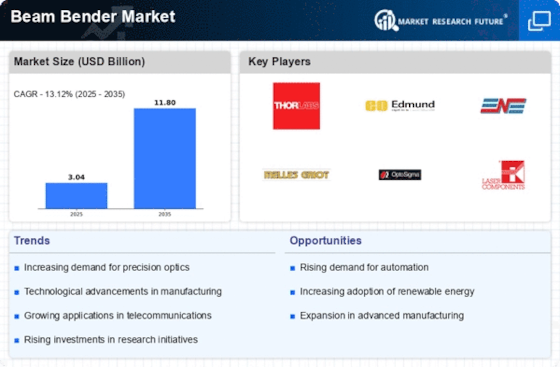
As per Market Research Future analysis, the Beam Bender Market Size was estimated at 3.04 USD Billion in 2024. The Beam Bender industry is projected to grow from 3.439 USD Billion in 2025 to 11.8 USD Billion by 2035, exhibiting a compound annual growth rate (CAGR) of 13.12% during the forecast period 2025 - 2035

Key Market Trends & Highlights

The Beam Bender Market is experiencing robust growth driven by technological advancements and increasing demand across various sectors.

  • Technological advancements are propelling the Beam Bender Market towards innovative applications and enhanced performance. North America remains the largest market, while Asia-Pacific is emerging as the fastest-growing region in this sector. Prism type beam benders dominate the market, whereas mirror beam benders are witnessing the fastest growth due to their versatility. Key market drivers include rising applications in diverse industries and a focus on energy efficiency, which are shaping the future of the market.

Market Size & Forecast

2024 Market Size 3.04 (USD Billion)
2035 Market Size 11.8 (USD Billion)
CAGR (2025 - 2035) 13.12%
Largest Regional Market Share in 2024 North America

Major Players

Thorlabs Inc (US), Edmund Optics Inc (US), Newport Corporation (US), Melles Griot (US), OptoSigma Corporation (JP), Laser Components GmbH (DE), Optical Surfaces Ltd (GB), Holo/Or Ltd (IL)

Market Trends

The Beam Bender Market is currently experiencing a dynamic evolution, driven by advancements in optical technologies and increasing applications across various sectors. Industries such as telecommunications, automotive, and consumer electronics are increasingly integrating beam bender systems to enhance performance and efficiency. This trend appears to be fueled by the growing demand for high-precision optical components, which are essential for improving signal quality and reducing losses in transmission. Furthermore, the emphasis on miniaturization and lightweight designs in modern devices is likely to propel innovation within this market, as manufacturers seek to create more compact and efficient solutions. In addition, the environmental considerations surrounding manufacturing processes and materials are becoming more pronounced. Companies are increasingly focusing on sustainable practices, which may influence the types of materials used in beam bender production. This shift towards eco-friendly solutions could reshape the competitive landscape, as firms that prioritize sustainability may gain a competitive edge. Overall, the Beam Bender Market appears poised for growth, with technological advancements and sustainability initiatives driving its trajectory into the future.

Technological Advancements

The Beam Bender Market is witnessing rapid technological advancements, particularly in the development of high-performance optical components. Innovations in materials and manufacturing techniques are enhancing the efficiency and effectiveness of beam benders, making them more appealing to various industries.

Sustainability Initiatives

There is a growing emphasis on sustainability within the Beam Bender Market, as companies strive to adopt eco-friendly practices. This trend may lead to the use of recyclable materials and energy-efficient production methods, aligning with global environmental goals.

Increased Demand in Emerging Markets

Emerging markets are showing a rising demand for beam bender technologies, driven by industrialization and technological adoption. This trend suggests that companies may need to tailor their offerings to meet the specific needs of these regions, potentially expanding their market reach.

Beam Bender Market Market Drivers

Focus on Energy Efficiency

The Beam Bender Market is increasingly focusing on energy efficiency as a key driver of growth. With rising energy costs and a global push towards sustainability, manufacturers are developing beam benders that consume less energy while maintaining high performance. This trend is particularly relevant in industries such as telecommunications, where energy-efficient beam benders can lead to substantial cost savings and reduced environmental impact. Furthermore, regulatory frameworks are encouraging the adoption of energy-efficient technologies, which is likely to propel the demand for advanced beam benders. As a result, the market is expected to see a shift towards products that not only meet performance standards but also align with energy conservation goals.

Emerging Markets and Economic Growth

The Beam Bender Market is poised for growth due to the economic development of emerging markets. As countries in Asia and Latin America continue to industrialize, the demand for advanced optical technologies, including beam benders, is increasing. This growth is driven by rising investments in infrastructure, telecommunications, and manufacturing sectors, which require high-performance optical components. Additionally, the expanding middle class in these regions is leading to increased consumer demand for advanced technologies. Market analysts predict that the expansion in these emerging markets could account for a significant portion of the overall market growth, with estimates indicating a potential increase of 25% in market share over the next five years.

Rising Applications in Diverse Industries

The Beam Bender Market is witnessing a notable increase in applications across diverse sectors, including aerospace, automotive, and healthcare. The demand for precision optics in these industries is driving the need for advanced beam benders that can manipulate light with high accuracy. For instance, in the aerospace sector, beam benders are essential for laser communication systems, which are becoming increasingly critical for satellite and space exploration. Similarly, in healthcare, the use of beam benders in diagnostic imaging systems is on the rise, enhancing the quality of medical imaging. This diversification of applications is expected to contribute significantly to market growth, with projections indicating a potential market size increase of over 20% in the next five years.

Growing Investment in Research and Development

The Beam Bender Market is benefiting from increased investment in research and development (R&D) activities. Companies are allocating significant resources to innovate and improve beam bending technologies, which is crucial for maintaining competitive advantage. This investment is fostering collaborations between academic institutions and industry players, leading to breakthroughs in optical engineering and materials. As a result, new products are being introduced that offer enhanced functionality and efficiency. The emphasis on R&D is likely to drive market expansion, with estimates suggesting that R&D expenditures in the beam bender sector could rise by 15% over the next few years, further stimulating innovation and growth.

Technological Innovations in Beam Bender Market

The Beam Bender Market is experiencing a surge in technological innovations that enhance product performance and efficiency. Advancements in materials science, particularly the development of high-quality optical materials, have led to improved beam bending capabilities. These innovations are not only increasing the precision of beam benders but also expanding their applications across various sectors, including telecommunications and medical devices. The integration of smart technologies, such as sensors and automation, is also becoming prevalent, allowing for real-time monitoring and adjustments. As a result, the market is projected to grow at a compound annual growth rate (CAGR) of approximately 6% over the next five years, driven by these technological advancements.

Market Segment Insights

By Type: Prism Type Beam Bender (Largest) vs. Mirror Beam Bender (Fastest-Growing)

<p>In the Beam Bender Market, the Prism Type Beam Bender holds the largest market share due to its well-established applications in various industries, including optical instruments and lighting solutions. This segment has benefited from a strong demand for precision and efficiency, contributing to its stable market presence. Meanwhile, the Mirror Beam Bender is gaining traction as it offers advantages such as increased flexibility and versatility. This segment is becoming more prominent, particularly in innovative applications and emerging technologies, indicating a shifting preference in the market landscape.</p>

<p>Prism Type Beam Bender (Dominant) vs. Mirror Beam Bender (Emerging)</p>

<p>The Prism Type Beam Bender is seen as a dominant force in the market, recognized for its reliability and widespread use in established sectors. Its design allows for superior light management, making it an essential component in high-precision optics and lighting systems. In contrast, the Mirror Beam Bender represents an emerging trend, appealing to industries seeking adaptable solutions. With advancements in manufacturing techniques and materials, this segment is increasingly preferred for its lightweight and customizable attributes, paving the way for novel applications in diverse fields, including telecommunications and automotive.</p>

By Application: Optical Communication (Largest) vs. Optical Scanning (Fastest-Growing)

The Beam Bender Market showcases a diverse distribution of applications, prominently led by Optical Communication. This segment dominates the market due to its widespread use in data transmission and telecommunications. Optical Scanning, although smaller in market share, is gaining significant traction, driven by advancements in scanning technologies and automation. Other segments like Optical Imaging, Projection, and Sensors also contribute to the market but remain secondary in comparison. Growth trends in the Beam Bender Market are propelled by escalating demands for high-speed data transfer and enhanced information processing capabilities. Technological innovations in Optical Scanning applications illustrate the rapid evolution of the sector, supported by the increasing adoption of automation across various industries. The rise of IoT and smart technologies further strengthens the position of <a href="https://www.marketresearchfuture.com/reports/optical-communications-market-4663">Optical Communication </a>and Scanning, suggesting a promising trajectory for these segments.

Optical Communication (Dominant) vs. Optical Scanning (Emerging)

Optical Communication has established itself as the dominant force within the Beam Bender Market, thanks to its critical role in facilitating high-speed data transmission for telecommunications and internet services. Its applications are integral to modern connectivity infrastructures, enabling efficiency and reliability. In contrast, Optical Scanning is an emerging participant that is quickly gaining attention for its innovative applications in automation and imaging technologies. This segment is characterized by rapid technological advancements, making it a focal point for industries seeking to enhance precision and operational efficiency. As the demand for automation continues to rise, Optical Scanning is poised for significant growth, creating exciting opportunities for further market development.

Get more detailed insights about Beam Bender Market Research Report – Forecast till 2035

Regional Insights

North America : Innovation and Market Leadership

North America is the largest market for beam benders, holding approximately 45% of the global market share. The region's growth is driven by advancements in optical technologies, increasing demand from the aerospace and defense sectors, and robust research and development activities. Regulatory support for innovation and technology adoption further catalyzes market expansion, making it a key player in the global landscape. The United States leads the North American market, with major companies like Thorlabs Inc, Edmund Optics Inc, and Newport Corporation driving competition. The presence of these key players fosters innovation and enhances product offerings. Canada also contributes to the market, albeit at a smaller scale, focusing on niche applications in optics and photonics. The competitive landscape is characterized by continuous technological advancements and strategic partnerships among leading firms.

Europe : Emerging Technologies and Standards

Europe is the second-largest market for beam benders, accounting for approximately 30% of the global market share. The region's growth is propelled by stringent regulatory standards and a strong emphasis on research and development in optical technologies. Countries like Germany and the UK are at the forefront, with increasing investments in photonics and optical components, which are essential for various industrial applications. Germany is the leading country in Europe, hosting key players such as Laser Components GmbH and Optical Surfaces Ltd. The UK follows closely, with a growing number of startups and established firms focusing on innovative optical solutions. The competitive landscape is marked by collaborations between academia and industry, fostering advancements in beam bending technologies. The European market is also influenced by EU regulations promoting sustainable practices in manufacturing.

Asia-Pacific : Rapid Growth and Adoption

Asia-Pacific is witnessing rapid growth in the beam bender market, holding approximately 20% of the global market share. The region's expansion is driven by increasing industrialization, rising demand for advanced optical components in electronics, and significant investments in research and development. Countries like Japan and China are leading this growth, supported by favorable government policies and initiatives aimed at boosting technological advancements. Japan is a key player in the market, with companies like OptoSigma Corporation leading the charge in innovation. China is also emerging as a significant market, with a focus on manufacturing and exporting optical components. The competitive landscape is characterized by a mix of established firms and new entrants, all vying for market share in this rapidly evolving sector. The region's growth potential is further enhanced by collaborations between industry and research institutions.

Middle East and Africa : Untapped Potential and Growth

The Middle East and Africa region is gradually emerging in the beam bender market, currently holding about 5% of the global market share. The growth is primarily driven by increasing investments in technology and infrastructure, particularly in countries like the UAE and South Africa. The region's focus on diversifying its economy and enhancing technological capabilities is creating new opportunities for optical component manufacturers. The UAE is leading the market in the Middle East, with a growing number of tech startups and initiatives aimed at fostering innovation in optics. South Africa is also making strides, focusing on research and development in photonics. The competitive landscape is still developing, with opportunities for both local and international players to establish a foothold in this emerging market. As the region continues to invest in technology, the demand for beam benders is expected to rise significantly.

Key Players and Competitive Insights

Leading market players are putting a lot of money on R&D to increase the number of products they offer, which will fuel the growth of the Beam Bender Market. Additionally, market participants are engaging in a range of strategic initiatives to increase their worldwide reach, with important market developments such as the introduction of new products, contracts, mergers and acquisitions, increased investments, and cooperation with other businesses. To grow and endure in an increasingly competitive and challenging market environment, Beam Bender industry must provide reasonably priced goods.
One of the main business strategies employed by manufacturers is to produce locally to reduce operational expenses in the global Beam Bender industry to develop market sector and benefit customers. In recent years, the Beam Bender industry has provided some of the most important benefits for automotive industry. Major players in the Beam Bender Market, including Thorlabs, Newport Corporation, Edmund Optics, ZYGO Corporation, Sill Optics, CVI Laser Optics, Shanghai Optics, Rainbow Research Optics, and Ross Optical Industries, and others, invest in operations for research and development in an effort to improve market demand.
Coherent, Inc., develops, produces, and offers support for laser equipment and related specialty components from its headquarters in Santa Clara, California. With five other individuals, physicist James Hobart started Coherent in May 1966. In 1970, it became public. Coherent developed its line of lasers over time to include those used in a variety of fields and applications. Its revenues increased from $400 million to roughly $2 billion between 2004 and 2021, thanks in part to a number of acquisitions. After acquiring Coherent, Inc. in 2022, II-VI Incorporated changed its name to Coherent Corp.
In July 2022, By combining their businesses through this transaction, II?VI and Coherent became a leader in materials, networking, and lasers. The acquisition combined Coherent's scale, where laser systems are used, with II-VI's scale at value chain levels where material expertise is required.
Zygo Corporation, or just Zygo, has its main office in Middlefield, Connecticut, and is focused on producing optical systems and tools. Coherence scanning interferometry-based 3D measuring microscopes, laser Fizeau interferometers for testing optical parts, laser displacement interferometers, and heterodyne optical coders for stage position metrology are some of the products in their metrology product lines. The optics division of Zygo produces both custom optics and optical assemblies for use in national laboratories and medical devices. Since the beginning of the Company, more than 750 patents have been granted.
In November 2022, Zygo® purchased Navitar, Inc., a top supplier of cutting-edge optical imaging systems, components, and specialized solutions for high precision applications.

Key Companies in the Beam Bender Market include

Industry Developments

December 2024, Edmund Optics and Sill Optics joined forces to develop more precise laser optics assemblies. This collaboration will broaden the scope of the Edmund Optics Marketplace, allowing customers from all over the Americas and the Middle East (excluding Israel) to procure a vast array of high-performance laser optics within a short period of time, avoiding the trouble of long solicitations or extended waiting times. This partnership is in line with Sill Optics' views to broaden its operational capacities worldwide in order to reach other customers in different markets, but this time starting with the Americas and Middle Eastern region.

Now relevant customers can easily get from the shelf Sill Optics components that include 15 f-theta lenses for commonly used laser wavelengths, 15 beam expanders with different magnifications and trapped ion lenses for sophisticated quantum applications, among others, at affordable prices.

October 2024, Infleqtion and Thorlabs announced a plan to work together to advance the development of quantum applications. It is worth noting, however, that such development will still depend on the reliability of core components. Today, substantial milestones have been achieved on that journey. Infleqtion and Thorlabs are pleased to announce a new agreement on the synergistic marketing of Infleqtion’s advanced embedded optical fiber collimation package. The fiber collimation package provides a linearly polarized collimated beam with a high extinction ratio and internal beam power monitoring capability.

This package is rugged, compact and designed to meet the demanding requirements of quantum technology applications by streamlining the design and enhancing the performance. These solutions are significantly increasing the commercial prospects of QT and increasing its business effects on many industries.

January 2024, Zygo has plans to introduce the Qualifier Laser Interferometer. One can say that Qualifire is an important addition to an already existing array of high-end interehronometer solutions. This instrument allows performing the most demanding metrology tasks for a wide variety of industries such as semiconductor, lithography, space imaging systems, high-end consumer electronics, and defense.

November 2021: TruLaser Weld 1000 is a novel new product from TRUMPF. It encourages small businesses to use automated laser welding, which is appropriate for electrical cabinets, sheet metal boxes, and coverings.

Future Outlook

Beam Bender Market Future Outlook

The Beam Bender Market is projected to grow at a 13.12% CAGR from 2025 to 2035, driven by technological advancements, increasing demand in various industries, and enhanced product applications.

New opportunities lie in:

  • Development of advanced beam bender materials for improved performance
  • Integration of smart technology in beam bender systems
  • Expansion into emerging markets with tailored solutions

By 2035, the Beam Bender Market is expected to achieve substantial growth and innovation.

Market Segmentation

Beam Bender Market Type Outlook

  • Prism Type Beam Bender
  • Mirror Beam Bender

Beam Bender Market Application Outlook

  • Optical Communication
  • Optical Scanning
  • Optical Imaging
  • Optical Projection
  • Optical Sensor
  • Others

Report Scope

MARKET SIZE 2024 3.04(USD Billion)
MARKET SIZE 2025 3.439(USD Billion)
MARKET SIZE 2035 11.8(USD Billion)
COMPOUND ANNUAL GROWTH RATE (CAGR) 13.12% (2025 - 2035)
REPORT COVERAGE Revenue Forecast, Competitive Landscape, Growth Factors, and Trends
BASE YEAR 2024
Market Forecast Period 2025 - 2035
Historical Data 2019 - 2024
Market Forecast Units USD Billion
Key Companies Profiled Thorlabs Inc (US), Edmund Optics Inc (US), Newport Corporation (US), Melles Griot (US), OptoSigma Corporation (JP), Laser Components GmbH (DE), Optical Surfaces Ltd (GB), Holo/Or Ltd (IL)
Segments Covered Type, Distribution Channel, Region
Key Market Opportunities Advancements in optical technologies drive demand for innovative solutions in the Beam Bender Market.
Key Market Dynamics Technological advancements and regulatory changes drive innovation and competition in the Beam Bender Market.
Countries Covered North America, Europe, APAC, South America, MEA

FAQs

What is the current valuation of the Beam Bender Market as of 2024?

<p>The Beam Bender Market was valued at 3.04 USD Billion in 2024.</p>

What is the projected market size for the Beam Bender Market in 2035?

<p>The market is projected to reach 11.8 USD Billion by 2035.</p>

What is the expected CAGR for the Beam Bender Market during the forecast period 2025 - 2035?

<p>The expected CAGR for the Beam Bender Market during 2025 - 2035 is 13.12%.</p>

Which companies are considered key players in the Beam Bender Market?

<p>Key players include Thorlabs Inc, Edmund Optics Inc, Newport Corporation, and Melles Griot.</p>

What are the main types of beam benders in the market?

<p>The main types of beam benders are Prism Type Beam Bender and Mirror Beam Bender.</p>

How did the Prism Type Beam Bender perform in terms of market valuation?

<p>The Prism Type Beam Bender segment was valued at 1.52 USD Billion in 2024 and is projected to grow significantly.</p>

What is the market valuation for the Mirror Beam Bender segment?

The Mirror Beam Bender segment was valued at 1.52 USD Billion in 2024 and is expected to increase.

Which applications are driving growth in the Beam Bender Market?

Key applications include Optical Communication, Optical Scanning, and Optical Imaging.

What was the market valuation for Optical Communication in 2024?

Optical Communication was valued at 0.76 USD Billion in 2024.

What is the projected growth for Optical Imaging by 2035?

Optical Imaging is projected to grow from 0.51 USD Billion in 2024 to 1.98 USD Billion by 2035.

  1. SECTION I: EXECUTIVE SUMMARY AND KEY HIGHLIGHTS
    1. | 1.1 EXECUTIVE SUMMARY
    2. | | 1.1.1 Market Overview
    3. | | 1.1.2 Key Findings
    4. | | 1.1.3 Market Segmentation
    5. | | 1.1.4 Competitive Landscape
    6. | | 1.1.5 Challenges and Opportunities
    7. | | 1.1.6 Future Outlook
  2. SECTION II: SCOPING, METHODOLOGY AND MARKET STRUCTURE
    1. | 2.1 MARKET INTRODUCTION
    2. | | 2.1.1 Definition
    3. | | 2.1.2 Scope of the study
    4. | | | 2.1.2.1 Research Objective
    5. | | | 2.1.2.2 Assumption
    6. | | | 2.1.2.3 Limitations
    7. | 2.2 RESEARCH METHODOLOGY
    8. | | 2.2.1 Overview
    9. | | 2.2.2 Data Mining
    10. | | 2.2.3 Secondary Research
    11. | | 2.2.4 Primary Research
    12. | | | 2.2.4.1 Primary Interviews and Information Gathering Process
    13. | | | 2.2.4.2 Breakdown of Primary Respondents
    14. | | 2.2.5 Forecasting Model
    15. | | 2.2.6 Market Size Estimation
    16. | | | 2.2.6.1 Bottom-Up Approach
    17. | | | 2.2.6.2 Top-Down Approach
    18. | | 2.2.7 Data Triangulation
    19. | | 2.2.8 Validation
  3. SECTION III: QUALITATIVE ANALYSIS
    1. | 3.1 MARKET DYNAMICS
    2. | | 3.1.1 Overview
    3. | | 3.1.2 Drivers
    4. | | 3.1.3 Restraints
    5. | | 3.1.4 Opportunities
    6. | 3.2 MARKET FACTOR ANALYSIS
    7. | | 3.2.1 Value chain Analysis
    8. | | 3.2.2 Porter's Five Forces Analysis
    9. | | | 3.2.2.1 Bargaining Power of Suppliers
    10. | | | 3.2.2.2 Bargaining Power of Buyers
    11. | | | 3.2.2.3 Threat of New Entrants
    12. | | | 3.2.2.4 Threat of Substitutes
    13. | | | 3.2.2.5 Intensity of Rivalry
    14. | | 3.2.3 COVID-19 Impact Analysis
    15. | | | 3.2.3.1 Market Impact Analysis
    16. | | | 3.2.3.2 Regional Impact
    17. | | | 3.2.3.3 Opportunity and Threat Analysis
  4. SECTION IV: QUANTITATIVE ANALYSIS
    1. | 4.1 Semiconductor & Electronics, BY Type (USD Billion)
    2. | | 4.1.1 Prism Type Beam Bender
    3. | | 4.1.2 Mirror Beam Bender
    4. | 4.2 Semiconductor & Electronics, BY Application (USD Billion)
    5. | | 4.2.1 Optical Communication
    6. | | 4.2.2 Optical Scanning
    7. | | 4.2.3 Optical Imaging
    8. | | 4.2.4 Optical Projection
    9. | | 4.2.5 Optical Sensor
    10. | | 4.2.6 Others
    11. | 4.3 Semiconductor & Electronics, BY Region (USD Billion)
    12. | | 4.3.1 North America
    13. | | | 4.3.1.1 US
    14. | | | 4.3.1.2 Canada
    15. | | 4.3.2 Europe
    16. | | | 4.3.2.1 Germany
    17. | | | 4.3.2.2 UK
    18. | | | 4.3.2.3 France
    19. | | | 4.3.2.4 Russia
    20. | | | 4.3.2.5 Italy
    21. | | | 4.3.2.6 Spain
    22. | | | 4.3.2.7 Rest of Europe
    23. | | 4.3.3 APAC
    24. | | | 4.3.3.1 China
    25. | | | 4.3.3.2 India
    26. | | | 4.3.3.3 Japan
    27. | | | 4.3.3.4 South Korea
    28. | | | 4.3.3.5 Malaysia
    29. | | | 4.3.3.6 Thailand
    30. | | | 4.3.3.7 Indonesia
    31. | | | 4.3.3.8 Rest of APAC
    32. | | 4.3.4 South America
    33. | | | 4.3.4.1 Brazil
    34. | | | 4.3.4.2 Mexico
    35. | | | 4.3.4.3 Argentina
    36. | | | 4.3.4.4 Rest of South America
    37. | | 4.3.5 MEA
    38. | | | 4.3.5.1 GCC Countries
    39. | | | 4.3.5.2 South Africa
    40. | | | 4.3.5.3 Rest of MEA
  5. SECTION V: COMPETITIVE ANALYSIS
    1. | 5.1 Competitive Landscape
    2. | | 5.1.1 Overview
    3. | | 5.1.2 Competitive Analysis
    4. | | 5.1.3 Market share Analysis
    5. | | 5.1.4 Major Growth Strategy in the Semiconductor & Electronics
    6. | | 5.1.5 Competitive Benchmarking
    7. | | 5.1.6 Leading Players in Terms of Number of Developments in the Semiconductor & Electronics
    8. | | 5.1.7 Key developments and growth strategies
    9. | | | 5.1.7.1 New Product Launch/Service Deployment
    10. | | | 5.1.7.2 Merger & Acquisitions
    11. | | | 5.1.7.3 Joint Ventures
    12. | | 5.1.8 Major Players Financial Matrix
    13. | | | 5.1.8.1 Sales and Operating Income
    14. | | | 5.1.8.2 Major Players R&D Expenditure. 2023
    15. | 5.2 Company Profiles
    16. | | 5.2.1 Thorlabs Inc (US)
    17. | | | 5.2.1.1 Financial Overview
    18. | | | 5.2.1.2 Products Offered
    19. | | | 5.2.1.3 Key Developments
    20. | | | 5.2.1.4 SWOT Analysis
    21. | | | 5.2.1.5 Key Strategies
    22. | | 5.2.2 Edmund Optics Inc (US)
    23. | | | 5.2.2.1 Financial Overview
    24. | | | 5.2.2.2 Products Offered
    25. | | | 5.2.2.3 Key Developments
    26. | | | 5.2.2.4 SWOT Analysis
    27. | | | 5.2.2.5 Key Strategies
    28. | | 5.2.3 Newport Corporation (US)
    29. | | | 5.2.3.1 Financial Overview
    30. | | | 5.2.3.2 Products Offered
    31. | | | 5.2.3.3 Key Developments
    32. | | | 5.2.3.4 SWOT Analysis
    33. | | | 5.2.3.5 Key Strategies
    34. | | 5.2.4 Melles Griot (US)
    35. | | | 5.2.4.1 Financial Overview
    36. | | | 5.2.4.2 Products Offered
    37. | | | 5.2.4.3 Key Developments
    38. | | | 5.2.4.4 SWOT Analysis
    39. | | | 5.2.4.5 Key Strategies
    40. | | 5.2.5 OptoSigma Corporation (JP)
    41. | | | 5.2.5.1 Financial Overview
    42. | | | 5.2.5.2 Products Offered
    43. | | | 5.2.5.3 Key Developments
    44. | | | 5.2.5.4 SWOT Analysis
    45. | | | 5.2.5.5 Key Strategies
    46. | | 5.2.6 Laser Components GmbH (DE)
    47. | | | 5.2.6.1 Financial Overview
    48. | | | 5.2.6.2 Products Offered
    49. | | | 5.2.6.3 Key Developments
    50. | | | 5.2.6.4 SWOT Analysis
    51. | | | 5.2.6.5 Key Strategies
    52. | | 5.2.7 Optical Surfaces Ltd (GB)
    53. | | | 5.2.7.1 Financial Overview
    54. | | | 5.2.7.2 Products Offered
    55. | | | 5.2.7.3 Key Developments
    56. | | | 5.2.7.4 SWOT Analysis
    57. | | | 5.2.7.5 Key Strategies
    58. | | 5.2.8 Holo/Or Ltd (IL)
    59. | | | 5.2.8.1 Financial Overview
    60. | | | 5.2.8.2 Products Offered
    61. | | | 5.2.8.3 Key Developments
    62. | | | 5.2.8.4 SWOT Analysis
    63. | | | 5.2.8.5 Key Strategies
    64. | 5.3 Appendix
    65. | | 5.3.1 References
    66. | | 5.3.2 Related Reports
  6. LIST OF FIGURES
    1. | 6.1 MARKET SYNOPSIS
    2. | 6.2 NORTH AMERICA MARKET ANALYSIS
    3. | 6.3 US MARKET ANALYSIS BY TYPE
    4. | 6.4 US MARKET ANALYSIS BY APPLICATION
    5. | 6.5 CANADA MARKET ANALYSIS BY TYPE
    6. | 6.6 CANADA MARKET ANALYSIS BY APPLICATION
    7. | 6.7 EUROPE MARKET ANALYSIS
    8. | 6.8 GERMANY MARKET ANALYSIS BY TYPE
    9. | 6.9 GERMANY MARKET ANALYSIS BY APPLICATION
    10. | 6.10 UK MARKET ANALYSIS BY TYPE
    11. | 6.11 UK MARKET ANALYSIS BY APPLICATION
    12. | 6.12 FRANCE MARKET ANALYSIS BY TYPE
    13. | 6.13 FRANCE MARKET ANALYSIS BY APPLICATION
    14. | 6.14 RUSSIA MARKET ANALYSIS BY TYPE
    15. | 6.15 RUSSIA MARKET ANALYSIS BY APPLICATION
    16. | 6.16 ITALY MARKET ANALYSIS BY TYPE
    17. | 6.17 ITALY MARKET ANALYSIS BY APPLICATION
    18. | 6.18 SPAIN MARKET ANALYSIS BY TYPE
    19. | 6.19 SPAIN MARKET ANALYSIS BY APPLICATION
    20. | 6.20 REST OF EUROPE MARKET ANALYSIS BY TYPE
    21. | 6.21 REST OF EUROPE MARKET ANALYSIS BY APPLICATION
    22. | 6.22 APAC MARKET ANALYSIS
    23. | 6.23 CHINA MARKET ANALYSIS BY TYPE
    24. | 6.24 CHINA MARKET ANALYSIS BY APPLICATION
    25. | 6.25 INDIA MARKET ANALYSIS BY TYPE
    26. | 6.26 INDIA MARKET ANALYSIS BY APPLICATION
    27. | 6.27 JAPAN MARKET ANALYSIS BY TYPE
    28. | 6.28 JAPAN MARKET ANALYSIS BY APPLICATION
    29. | 6.29 SOUTH KOREA MARKET ANALYSIS BY TYPE
    30. | 6.30 SOUTH KOREA MARKET ANALYSIS BY APPLICATION
    31. | 6.31 MALAYSIA MARKET ANALYSIS BY TYPE
    32. | 6.32 MALAYSIA MARKET ANALYSIS BY APPLICATION
    33. | 6.33 THAILAND MARKET ANALYSIS BY TYPE
    34. | 6.34 THAILAND MARKET ANALYSIS BY APPLICATION
    35. | 6.35 INDONESIA MARKET ANALYSIS BY TYPE
    36. | 6.36 INDONESIA MARKET ANALYSIS BY APPLICATION
    37. | 6.37 REST OF APAC MARKET ANALYSIS BY TYPE
    38. | 6.38 REST OF APAC MARKET ANALYSIS BY APPLICATION
    39. | 6.39 SOUTH AMERICA MARKET ANALYSIS
    40. | 6.40 BRAZIL MARKET ANALYSIS BY TYPE
    41. | 6.41 BRAZIL MARKET ANALYSIS BY APPLICATION
    42. | 6.42 MEXICO MARKET ANALYSIS BY TYPE
    43. | 6.43 MEXICO MARKET ANALYSIS BY APPLICATION
    44. | 6.44 ARGENTINA MARKET ANALYSIS BY TYPE
    45. | 6.45 ARGENTINA MARKET ANALYSIS BY APPLICATION
    46. | 6.46 REST OF SOUTH AMERICA MARKET ANALYSIS BY TYPE
    47. | 6.47 REST OF SOUTH AMERICA MARKET ANALYSIS BY APPLICATION
    48. | 6.48 MEA MARKET ANALYSIS
    49. | 6.49 GCC COUNTRIES MARKET ANALYSIS BY TYPE
    50. | 6.50 GCC COUNTRIES MARKET ANALYSIS BY APPLICATION
    51. | 6.51 SOUTH AFRICA MARKET ANALYSIS BY TYPE
    52. | 6.52 SOUTH AFRICA MARKET ANALYSIS BY APPLICATION
    53. | 6.53 REST OF MEA MARKET ANALYSIS BY TYPE
    54. | 6.54 REST OF MEA MARKET ANALYSIS BY APPLICATION
    55. | 6.55 KEY BUYING CRITERIA OF SEMICONDUCTOR & ELECTRONICS
    56. | 6.56 RESEARCH PROCESS OF MRFR
    57. | 6.57 DRO ANALYSIS OF SEMICONDUCTOR & ELECTRONICS
    58. | 6.58 DRIVERS IMPACT ANALYSIS: SEMICONDUCTOR & ELECTRONICS
    59. | 6.59 RESTRAINTS IMPACT ANALYSIS: SEMICONDUCTOR & ELECTRONICS
    60. | 6.60 SUPPLY / VALUE CHAIN: SEMICONDUCTOR & ELECTRONICS
    61. | 6.61 SEMICONDUCTOR & ELECTRONICS, BY TYPE, 2024 (% SHARE)
    62. | 6.62 SEMICONDUCTOR & ELECTRONICS, BY TYPE, 2024 TO 2035 (USD Billion)
    63. | 6.63 SEMICONDUCTOR & ELECTRONICS, BY APPLICATION, 2024 (% SHARE)
    64. | 6.64 SEMICONDUCTOR & ELECTRONICS, BY APPLICATION, 2024 TO 2035 (USD Billion)
    65. | 6.65 BENCHMARKING OF MAJOR COMPETITORS
  7. LIST OF TABLES
    1. | 7.1 LIST OF ASSUMPTIONS
    2. | | 7.1.1
    3. | 7.2 North America MARKET SIZE ESTIMATES; FORECAST
    4. | | 7.2.1 BY TYPE, 2025-2035 (USD Billion)
    5. | | 7.2.2 BY APPLICATION, 2025-2035 (USD Billion)
    6. | 7.3 US MARKET SIZE ESTIMATES; FORECAST
    7. | | 7.3.1 BY TYPE, 2025-2035 (USD Billion)
    8. | | 7.3.2 BY APPLICATION, 2025-2035 (USD Billion)
    9. | 7.4 Canada MARKET SIZE ESTIMATES; FORECAST
    10. | | 7.4.1 BY TYPE, 2025-2035 (USD Billion)
    11. | | 7.4.2 BY APPLICATION, 2025-2035 (USD Billion)
    12. | 7.5 Europe MARKET SIZE ESTIMATES; FORECAST
    13. | | 7.5.1 BY TYPE, 2025-2035 (USD Billion)
    14. | | 7.5.2 BY APPLICATION, 2025-2035 (USD Billion)
    15. | 7.6 Germany MARKET SIZE ESTIMATES; FORECAST
    16. | | 7.6.1 BY TYPE, 2025-2035 (USD Billion)
    17. | | 7.6.2 BY APPLICATION, 2025-2035 (USD Billion)
    18. | 7.7 UK MARKET SIZE ESTIMATES; FORECAST
    19. | | 7.7.1 BY TYPE, 2025-2035 (USD Billion)
    20. | | 7.7.2 BY APPLICATION, 2025-2035 (USD Billion)
    21. | 7.8 France MARKET SIZE ESTIMATES; FORECAST
    22. | | 7.8.1 BY TYPE, 2025-2035 (USD Billion)
    23. | | 7.8.2 BY APPLICATION, 2025-2035 (USD Billion)
    24. | 7.9 Russia MARKET SIZE ESTIMATES; FORECAST
    25. | | 7.9.1 BY TYPE, 2025-2035 (USD Billion)
    26. | | 7.9.2 BY APPLICATION, 2025-2035 (USD Billion)
    27. | 7.10 Italy MARKET SIZE ESTIMATES; FORECAST
    28. | | 7.10.1 BY TYPE, 2025-2035 (USD Billion)
    29. | | 7.10.2 BY APPLICATION, 2025-2035 (USD Billion)
    30. | 7.11 Spain MARKET SIZE ESTIMATES; FORECAST
    31. | | 7.11.1 BY TYPE, 2025-2035 (USD Billion)
    32. | | 7.11.2 BY APPLICATION, 2025-2035 (USD Billion)
    33. | 7.12 Rest of Europe MARKET SIZE ESTIMATES; FORECAST
    34. | | 7.12.1 BY TYPE, 2025-2035 (USD Billion)
    35. | | 7.12.2 BY APPLICATION, 2025-2035 (USD Billion)
    36. | 7.13 APAC MARKET SIZE ESTIMATES; FORECAST
    37. | | 7.13.1 BY TYPE, 2025-2035 (USD Billion)
    38. | | 7.13.2 BY APPLICATION, 2025-2035 (USD Billion)
    39. | 7.14 China MARKET SIZE ESTIMATES; FORECAST
    40. | | 7.14.1 BY TYPE, 2025-2035 (USD Billion)
    41. | | 7.14.2 BY APPLICATION, 2025-2035 (USD Billion)
    42. | 7.15 India MARKET SIZE ESTIMATES; FORECAST
    43. | | 7.15.1 BY TYPE, 2025-2035 (USD Billion)
    44. | | 7.15.2 BY APPLICATION, 2025-2035 (USD Billion)
    45. | 7.16 Japan MARKET SIZE ESTIMATES; FORECAST
    46. | | 7.16.1 BY TYPE, 2025-2035 (USD Billion)
    47. | | 7.16.2 BY APPLICATION, 2025-2035 (USD Billion)
    48. | 7.17 South Korea MARKET SIZE ESTIMATES; FORECAST
    49. | | 7.17.1 BY TYPE, 2025-2035 (USD Billion)
    50. | | 7.17.2 BY APPLICATION, 2025-2035 (USD Billion)
    51. | 7.18 Malaysia MARKET SIZE ESTIMATES; FORECAST
    52. | | 7.18.1 BY TYPE, 2025-2035 (USD Billion)
    53. | | 7.18.2 BY APPLICATION, 2025-2035 (USD Billion)
    54. | 7.19 Thailand MARKET SIZE ESTIMATES; FORECAST
    55. | | 7.19.1 BY TYPE, 2025-2035 (USD Billion)
    56. | | 7.19.2 BY APPLICATION, 2025-2035 (USD Billion)
    57. | 7.20 Indonesia MARKET SIZE ESTIMATES; FORECAST
    58. | | 7.20.1 BY TYPE, 2025-2035 (USD Billion)
    59. | | 7.20.2 BY APPLICATION, 2025-2035 (USD Billion)
    60. | 7.21 Rest of APAC MARKET SIZE ESTIMATES; FORECAST
    61. | | 7.21.1 BY TYPE, 2025-2035 (USD Billion)
    62. | | 7.21.2 BY APPLICATION, 2025-2035 (USD Billion)
    63. | 7.22 South America MARKET SIZE ESTIMATES; FORECAST
    64. | | 7.22.1 BY TYPE, 2025-2035 (USD Billion)
    65. | | 7.22.2 BY APPLICATION, 2025-2035 (USD Billion)
    66. | 7.23 Brazil MARKET SIZE ESTIMATES; FORECAST
    67. | | 7.23.1 BY TYPE, 2025-2035 (USD Billion)
    68. | | 7.23.2 BY APPLICATION, 2025-2035 (USD Billion)
    69. | 7.24 Mexico MARKET SIZE ESTIMATES; FORECAST
    70. | | 7.24.1 BY TYPE, 2025-2035 (USD Billion)
    71. | | 7.24.2 BY APPLICATION, 2025-2035 (USD Billion)
    72. | 7.25 Argentina MARKET SIZE ESTIMATES; FORECAST
    73. | | 7.25.1 BY TYPE, 2025-2035 (USD Billion)
    74. | | 7.25.2 BY APPLICATION, 2025-2035 (USD Billion)
    75. | 7.26 Rest of South America MARKET SIZE ESTIMATES; FORECAST
    76. | | 7.26.1 BY TYPE, 2025-2035 (USD Billion)
    77. | | 7.26.2 BY APPLICATION, 2025-2035 (USD Billion)
    78. | 7.27 MEA MARKET SIZE ESTIMATES; FORECAST
    79. | | 7.27.1 BY TYPE, 2025-2035 (USD Billion)
    80. | | 7.27.2 BY APPLICATION, 2025-2035 (USD Billion)
    81. | 7.28 GCC Countries MARKET SIZE ESTIMATES; FORECAST
    82. | | 7.28.1 BY TYPE, 2025-2035 (USD Billion)
    83. | | 7.28.2 BY APPLICATION, 2025-2035 (USD Billion)
    84. | 7.29 South Africa MARKET SIZE ESTIMATES; FORECAST
    85. | | 7.29.1 BY TYPE, 2025-2035 (USD Billion)
    86. | | 7.29.2 BY APPLICATION, 2025-2035 (USD Billion)
    87. | 7.30 Rest of MEA MARKET SIZE ESTIMATES; FORECAST
    88. | | 7.30.1 BY TYPE, 2025-2035 (USD Billion)
    89. | | 7.30.2 BY APPLICATION, 2025-2035 (USD Billion)
    90. | 7.31 PRODUCT LAUNCH/PRODUCT DEVELOPMENT/APPROVAL
    91. | | 7.31.1
    92. | 7.32 ACQUISITION/PARTNERSHIP
    93. | | 7.32.1

Semiconductor & Electronics Market Segmentation

Semiconductor & Electronics By Type (USD Billion, 2025-2035)

  • Prism Type Beam Bender
  • Mirror Beam Bender

Semiconductor & Electronics By Application (USD Billion, 2025-2035)

  • Optical Communication
  • Optical Scanning
  • Optical Imaging
  • Optical Projection
  • Optical Sensor
  • Others
Infographic

Free Sample Request

Kindly complete the form below to receive a free sample of this Report

Get Free Sample

Customer Strories

Compare Licence

×
Features License Type
Single User Multiuser License Enterprise User
Price $4,950 $5,950 $7,250
Maximum User Access Limit 1 User Upto 10 Users Unrestricted Access Throughout the Organization
Free Customization
Direct Access to Analyst
Deliverable Format
Platform Access
Discount on Next Purchase 10% 15% 15%
Printable Versions