×
Hero Background
English
Chinese
French
Japanese
Korean
German
Spanish

Barotrauma Market Share

ID: MRFR/Pharma/4443-HCR
100 Pages
Rahul Gotadki
October 2025

Barotrauma Market Research Report Information by Type (Ear, Sinus, Pulmonary Barotrauma), Type (Otoscopy, Pulmonary Function Test, Lung Perfusion Scan, Pulse Oximetry), Treatment (Medications, Surgery), End-User -Forecast Till 2035

Share:
Download PDF ×

We do not share your information with anyone. However, we may send you emails based on your report interest from time to time. You may contact us at any time to opt-out.

Barotrauma Market Infographic
Purchase Options

Market Share

Barotrauma Market Share Analysis

The competitive market of Barotrauma market makes the companies in it to use various mechanisms to ensure the market share which they have or to increase that they have. In the area of differentiation, these firms stand out, as they are majorly occupied in the development of new specific drugs and medical devices that serve the conditions associated with barotrauma. This can include the invention of new fun drugs, meds or unique remedies which are not only different from traditional ones with respect to benefits and results but also give them a separate position advantage and set them apart from the other treatments being done.

Cost leadership remains to be one of the important strategies in the Barotrauma Market sphere necessitating companies to be viewed as the lowest cost providers. Doing that means optimizing production processes (including the negotiation of better price deals with suppliers) and designing the distribution systems in a way that better reduces the level of overall costs. Through offering competitive pricing firms could draw a wider range of customers' coverage, even more so in the case of healthcare that is often used for economical hospital allocation.

The market segments determine the location for standing up within the Barotrauma Market. Companies are nowadays classifying decompression illness in different subclasses or serving population groups with only limited needs. Personalizing treatments and gadgets to servicing specific needs of these groups ensure efficiency, compared to using generic products. In the end, adoption by clinicians and consumers becomes higher.

Partnerships and associations play a very big role in occupying the Barotrauma Market as a leading brand name. Often partnerships between companies are established with universities, health institutions or businesses from other industries to create pool of resources and exchange of knowledge for faster innovation. Through such collaborations, companies will be able to remain at the advanced end of the technology spectrum and even gain an upper hand in the context of barotrauma-related health care solutions as they are applied.

Market and promotional activities are invaluable if one wishes to occupy a certain position in the market for Barotrauma products. Businesses provide funds for educational examples to teach people how to avoid pressure injuries of the ear, their reasons, and possible treatment options. We implement targeted advertising, Medical conferences participation, and communication with medical practitioners which determines the trust of people and also the recognition of the enterprise which generally raises the visibility of our brand.

Regulatory strategies are forward with the complexity of Barotrauma marketplace regulation and thus should be devised and put into practice. Medical device and treatment manufactures go on working hard for their products approval in the market and assure the safety and efficiency standards through regulating their products.

PM surveillance and after investigation give us the significant basis on in what areas to include in our market share positioning for Barotrauma Market. The active performance by companies of the manufacturing products safety and effectiveness tracking at market level through post-studying in the long-run carries the message of the companies' commitment to continuous improvement.

Author
Rahul Gotadki
Assistant Manager

He holds an experience of about 7+ years in Market Research and Business Consulting, working under the spectrum of Life Sciences and Healthcare domains. Rahul conceptualizes and implements a scalable business strategy and provides strategic leadership to the clients. His expertise lies in market estimation, competitive intelligence, pipeline analysis, customer assessment, etc. In addition to the above, his other responsibility includes strategic tracking of high growth markets & advising clients on the potential areas of focus they could direct their business initiatives

Leave a Comment

FAQs

What is the projected market valuation of the Barotrauma Market by 2035?

The Barotrauma Market is projected to reach a valuation of 15.48 USD Billion by 2035.

What was the market valuation of the Barotrauma Market in 2024?

In 2024, the Barotrauma Market was valued at 6.701 USD Billion.

What is the expected CAGR for the Barotrauma Market during the forecast period 2025 - 2035?

The expected CAGR for the Barotrauma Market during the forecast period 2025 - 2035 is 7.91%.

Which companies are considered key players in the Barotrauma Market?

Key players in the Barotrauma Market include Smiths Medical, Medtronic, B. Braun Melsungen AG, and Teleflex Incorporated.

What are the main types of barotrauma and their market values?

The main types of barotrauma include ear barotrauma valued at 3.5 USD Billion, sinus barotrauma at 4.5 USD Billion, and pulmonary barotrauma at 7.5 USD Billion.

Market Summary

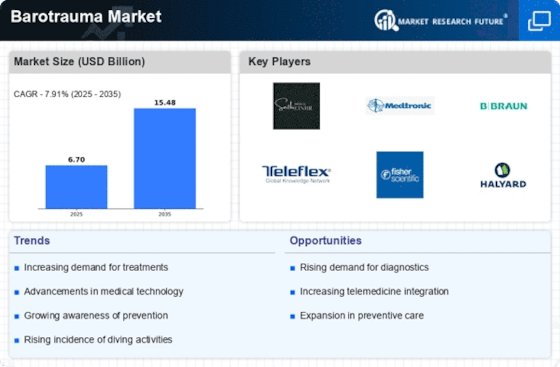
As per MRFR analysis, the Barotrauma Market Size was estimated at 6.701 USD Billion in 2024. The Barotrauma industry is projected to grow from 7.231 USD Billion in 2025 to 15.48 USD Billion by 2035, exhibiting a compound annual growth rate (CAGR) of 7.91 during the forecast period 2025 - 2035.

Key Market Trends & Highlights

The Barotrauma Market is experiencing notable growth driven by technological advancements and increased awareness.

  • Technological advancements in treatment are reshaping the Barotrauma Market, particularly in North America.
  • Increased awareness and education about barotrauma are contributing to a rise in preventive healthcare measures.
  • Research and development initiatives are gaining momentum, especially in the Asia-Pacific region, which is the fastest-growing market.
  • The rising incidence of barotrauma cases and technological innovations in medical devices are key drivers propelling market expansion.

Market Size & Forecast

2024 Market Size 6.701 (USD Billion)
2035 Market Size 15.48 (USD Billion)
CAGR (2025 - 2035) 7.91%
Largest Regional Market Share in 2024 Americas

Major Players

<p>Smiths Medical (US), Medtronic (US), B. Braun Melsungen AG (DE), Teleflex Incorporated (US), Fisher & Paykel Healthcare (NZ), Halyard Health (US), ConvaTec Group (GB), Parker Hannifin Corporation (US), Boston Scientific (US)</p>

Market Trends

The Barotrauma Market is currently experiencing notable developments driven by advancements in medical technology and an increasing awareness of pressure-related injuries. As healthcare professionals gain a deeper understanding of the physiological impacts of pressure changes, there is a growing emphasis on effective diagnosis and treatment options. This shift is likely to enhance patient outcomes and foster innovation in therapeutic approaches. Furthermore, the rising prevalence of conditions that predispose individuals to barotrauma, such as certain lung diseases, appears to be influencing market dynamics, prompting healthcare providers to seek more comprehensive solutions. In addition, the Barotrauma Market is witnessing a surge in research initiatives aimed at understanding the underlying mechanisms of pressure-related injuries. This research is expected to lead to the development of novel treatment modalities and preventive strategies. Collaboration between academic institutions and industry stakeholders may further accelerate the pace of innovation. As the market evolves, it seems poised to adapt to the changing needs of patients and healthcare systems, potentially resulting in enhanced therapeutic options and improved quality of care.

Technological Advancements in Treatment

Recent innovations in medical technology are transforming the landscape of the Barotrauma Market. New diagnostic tools and treatment modalities are emerging, enabling healthcare providers to address pressure-related injuries more effectively. These advancements may lead to improved patient outcomes and a more efficient healthcare delivery system.

Increased Awareness and Education

There is a growing recognition of the importance of understanding barotrauma among healthcare professionals and the general public. Educational initiatives aimed at raising awareness about the risks and symptoms of pressure-related injuries are likely to drive demand for preventive measures and treatment options in the Barotrauma Market.

Research and Development Initiatives

Ongoing research efforts focused on the mechanisms and effects of barotrauma are expected to yield new insights and therapeutic approaches. Collaborative projects between researchers and industry players may facilitate the introduction of innovative solutions, thereby shaping the future of the Barotrauma Market.

Barotrauma Market Market Drivers

Rising Incidence of Barotrauma Cases

The increasing incidence of barotrauma cases, particularly among divers and aviators, appears to be a primary driver for the Barotrauma Market. As more individuals engage in activities involving rapid pressure changes, the demand for effective treatment options rises. According to recent data, the number of reported cases has shown a steady increase, with estimates suggesting that approximately 10% of divers experience some form of barotrauma during their lifetime. This trend necessitates advancements in medical treatments and preventive measures, thereby propelling the market forward. Furthermore, the growing popularity of recreational diving and air travel contributes to this rise, indicating a potential for sustained growth in the Barotrauma Market as awareness and education about the condition expand.

Increased Focus on Preventive Healthcare

An increased focus on preventive healthcare is emerging as a significant driver for the Barotrauma Market. As healthcare systems worldwide emphasize prevention over treatment, there is a growing demand for educational programs and resources aimed at reducing the incidence of barotrauma. Initiatives that promote safe diving practices and awareness of pressure-related injuries are gaining traction. Data suggests that educational campaigns can lead to a reduction in barotrauma cases by up to 30%. This shift towards prevention not only benefits patients but also reduces healthcare costs associated with treatment. Consequently, the Barotrauma Market is likely to see growth as stakeholders invest in preventive measures and educational resources.

Technological Innovations in Medical Devices

Technological innovations in medical devices are significantly influencing the Barotrauma Market. The development of advanced diagnostic tools and treatment modalities, such as hyperbaric oxygen therapy systems, is enhancing the management of barotrauma. Recent advancements have led to the introduction of portable hyperbaric chambers, which allow for immediate treatment in various settings, including remote locations. This innovation not only improves patient outcomes but also increases accessibility to treatment options. Market data indicates that the medical device segment is expected to witness substantial growth, driven by these technological advancements. As healthcare providers adopt these new technologies, the Barotrauma Market is likely to expand, catering to the needs of a growing patient population.

Growing Investment in Research and Development

Growing investment in research and development (R&D) is a crucial driver for the Barotrauma Market. Increased funding from both public and private sectors is facilitating the exploration of new treatment options and preventive strategies for barotrauma. Recent reports indicate that R&D spending in the medical field has risen by over 15% in the past year, with a notable focus on pressure-related injuries. This investment is likely to lead to breakthroughs in understanding the pathophysiology of barotrauma and the development of innovative therapies. As research progresses, the Barotrauma Market is expected to evolve, offering new solutions that address the complexities of this condition.

Expansion of Sports and Recreational Activities

The expansion of sports and recreational activities, particularly those involving altitude changes and underwater exploration, is driving the Barotrauma Market. As more individuals participate in activities such as scuba diving, skydiving, and high-altitude sports, the risk of barotrauma increases. Market analysis indicates that the adventure tourism sector is experiencing rapid growth, with an annual increase of approximately 20%. This trend correlates with a higher incidence of pressure-related injuries, thereby creating a demand for effective treatment solutions. The Barotrauma Market is poised to benefit from this expansion, as healthcare providers and organizations develop targeted interventions to address the needs of this active population.

Market Segment Insights

By Type: Ear Barotrauma Market (Largest) vs. Pulmonary Barotrauma Market (Fastest-Growing)

<p>In the Barotrauma Market, ear barotrauma accounts for the largest share due to its prevalence among divers, flyers, and individuals in high altitude conditions. This type of barotrauma is more commonly recognized and diagnosed compared to other types, leading to its larger market presence. Conversely, pulmonary (lung) barotrauma, while smaller in share, is rapidly gaining attention as awareness of diving-related health risks increases, which could lead to more diagnoses and treatments in this area.</p>

<p>Ear Barotrauma Market (Dominant) vs. Pulmonary Barotrauma Market (Emerging)</p>

<p>Ear barotrauma remains the dominant segment in the Barotrauma Market, largely due to its widespread incidence in populations engaged in activities involving pressure changes, such as aviation and scuba diving. It is characterized by symptoms including ear pain, hearing loss, and dizziness, making it a significant health concern. Meanwhile, pulmonary barotrauma is emerging as a significant focus due to the increasing participation in deep diving activities and scuba diving education. It involves damage to lung tissues and can lead to serious complications, which is prompting heightened awareness and research into preventive measures. As safety protocols evolve, the growth potential for pulmonary barotrauma treatment and prevention strategies is substantial.</p>

By Diagnosis: Otoscopy (Largest) vs. CT Scan (Fastest-Growing)

<p>The Diagnosis segment in the Barotrauma Market is primarily characterized by a diverse range of diagnostic tools, with otoscopy commanding the largest share. Tools like X-ray and CT scans are also crucial, but their market presence is growing due to advancements in imaging technology and increased awareness of barotrauma. Other tests, such as pulmonary function tests and lung perfusion scans, contribute to a smaller yet noteworthy portion of the market, catering to specialized needs. In terms of growth trends, CT scans are emerging as the fastest-growing diagnostic modality in this segment, driven by technological advancements that enhance imaging clarity and diagnostic accuracy. The rising incidence of barotrauma, particularly among divers and aviation personnel, has increased the demand for rapid and reliable diagnostic techniques. This shift towards advanced imaging methods reflects a broader trend in the healthcare sector, emphasizing the importance of precise diagnosis for effective treatment.</p>

<p>Otoscopy (Dominant) vs. Pulse Oximetry (Emerging)</p>

<p>Otoscopy remains the dominant force in the Diagnosis segment of the Barotrauma Market due to its effectiveness in examining the external auditory canal and eardrum for injuries related to pressure changes. Its widespread use among healthcare professionals contributes to its leading market position. In contrast, pulse oximetry is an emerging diagnostic tool, gaining traction for its non-invasive nature and ability to provide immediate readings of oxygen saturation levels. As awareness of barotrauma's potential to affect respiratory function grows, the demand for innovative and quick diagnostic solutions like pulse oximetry is expected to rise, offering a complementary approach to traditional methods. Together, these tools illustrate the evolving landscape of barotrauma diagnostics.</p>

By Treatment: Pressure Relief (Largest) vs. Medications (Fastest-Growing)

<p>In the Barotrauma Market, the treatment segment is characterized by diverse methodologies, including pressure relief, medications, surgery, oxygen treatment, recompression therapy, and others. Among these, pressure relief emerges as the largest treatment option, commanding a significant market share, while medications have caught attention as the fastest-growing category due to increasing awareness and advancements in pharmaceutical interventions for Barotrauma Market. Other treatments also contribute, but at a comparatively lower share. Growth trends in the treatment segment reveal a strong emphasis on innovative therapies and a rise in procedures aimed at managing Barotrauma Market effectively. Factors such as an increase in diving activities and a heightened understanding of pressure-related injuries drive this growth. Furthermore, technological advancements in medical devices and increased access to healthcare facilities underscore the need for enhanced treatment options, making medications a critical focus area for market development.</p>

<p>Pressure Relief (Dominant) vs. Recompression Therapy (Emerging)</p>

<p>Pressure relief stands out as a dominant strategy in the Barotrauma Market, primarily utilized to manage and alleviate symptoms associated with pressure-related injuries. This approach is widely recognized for its effectiveness in immediate relief during Barotrauma Market incidents. In contrast, recompression therapy is an emerging treatment that is gaining traction in the market, owing to its systematic application in decompression sickness. While pressure relief is a well-established practice, recompression therapy is advancing with more refined techniques and technologies designed to enhance patient outcomes. Both strategies cater to the growing need for effective treatments, but they represent distinct approaches within the broader landscape of Barotrauma Market management.</p>

By End-User: Hospitals and Clinics (Largest) vs. Trauma Centers (Fastest-Growing)

<p>In the Barotrauma Market, the end-user segment is primarily dominated by hospitals and clinics, which comprise the largest share due to their extensive patient base and ongoing demand for treatment. Following closely, trauma centers are emerging as a crucial component of this market, driven by the increasing incidence of severe injuries and the need for specialized care. Other notable participants include pharmaceutical companies, medical device companies, and academic and research institutes, contributing to the diversified end-user landscape in this sector. Growth trends in the Barotrauma Market are primarily influenced by the rising prevalence of respiratory conditions and increased awareness of barotrauma-related risks among healthcare providers. Hospitals and clinics are investing in advanced treatment options, enhancing their service offerings. Meanwhile, trauma centers are witnessing significant growth as they capitalize on improving emergency response and recovery programs, alongside technological advancements that facilitate faster and more accurate diagnoses, thus driving the demand for barotrauma treatments.</p>

<p>Hospitals and Clinics (Dominant) vs. Academic and Research Institutes (Emerging)</p>

<p>Hospitals and clinics represent the dominant segment in the Barotrauma Market, characterized by their established infrastructure and comprehensive care protocols to manage various barotrauma cases. Their extensive clinical experience and access to sophisticated medical equipment place them at the forefront of delivering effective interventions. Conversely, academic and research institutes are emerging as a vital segment, driving innovation through research and development of new treatment methodologies for barotrauma. Their focus on advancing scientific understanding and clinical applications enables them to contribute significantly to improved treatment outcomes. Although they hold a smaller market share compared to hospitals and clinics, their role in shaping future practices through research positions them as an essential part of the market ecosystem.</p>

Get more detailed insights about Barotrauma Market Research Report – Forecast to 2035

Regional Insights

North America : Leading Innovation and Demand

North America is the largest market for barotrauma management, holding approximately 45% of the global market share. The region's growth is driven by increasing awareness of barotrauma conditions, advancements in medical technology, and a robust healthcare infrastructure. Regulatory support from agencies like the FDA further catalyzes market expansion, ensuring safety and efficacy in medical devices. The United States is the primary contributor, with significant investments from key players such as Smiths Medical and Medtronic. Canada also plays a vital role, focusing on improving healthcare access and quality. The competitive landscape is characterized by innovation, with companies striving to enhance product offerings and patient outcomes, making North America a hub for barotrauma solutions.

Europe : Emerging Regulatory Frameworks

Europe is witnessing significant growth in the barotrauma market, accounting for approximately 30% of the global share. The region benefits from stringent regulatory frameworks that ensure high standards for medical devices, fostering consumer trust and safety. Countries like Germany and the UK are leading this growth, driven by increasing healthcare expenditure and a rising prevalence of respiratory conditions. Germany stands out as a key player, with a strong presence of companies like B. Braun Melsungen AG and Teleflex. The competitive landscape is marked by innovation and collaboration among manufacturers, healthcare providers, and regulatory bodies. This synergy is crucial for developing advanced solutions for barotrauma management, positioning Europe as a vital market in the global landscape.

Asia-Pacific : Rapidly Expanding Healthcare Sector

Asia-Pacific is emerging as a significant player in the barotrauma market, holding around 20% of the global share. The region's growth is fueled by increasing healthcare investments, a rising population, and a growing awareness of respiratory health issues. Countries like China and India are at the forefront, with expanding healthcare infrastructure and government initiatives aimed at improving medical services. China is particularly noteworthy, with substantial investments from both domestic and international companies, including Fisher & Paykel Healthcare. The competitive landscape is evolving, with local manufacturers entering the market and established players enhancing their presence. This dynamic environment is expected to drive innovation and improve access to barotrauma management solutions across the region.

Middle East and Africa : Untapped Market Opportunities

The Middle East and Africa region is in the early stages of developing its barotrauma market, currently holding about 5% of the global share. The growth is driven by increasing healthcare investments and a rising prevalence of respiratory diseases. Countries like South Africa and the UAE are focusing on enhancing healthcare infrastructure, which is crucial for improving access to medical devices and treatments. South Africa is leading the market, with efforts to improve healthcare access and quality. The competitive landscape is characterized by a mix of local and international players, with opportunities for growth as awareness of barotrauma conditions increases. This region presents significant potential for market expansion as healthcare systems evolve and adapt to meet patient needs.

Key Companies in the Barotrauma Market market include

Industry Developments

Future Outlook

Barotrauma Market Future Outlook

<p>The Barotrauma Market is projected to grow at 7.91% CAGR from 2024 to 2035, driven by advancements in medical technology and increasing awareness of decompression sickness.</p>

New opportunities lie in:

  • <p>Development of portable hyperbaric oxygen therapy devices.</p>
  • <p>Expansion of telemedicine services for remote diagnosis.</p>
  • <p>Investment in training programs for healthcare professionals on barotrauma management.</p>

<p>By 2035, the Barotrauma Market is expected to achieve substantial growth, reflecting enhanced treatment options and increased market penetration.</p>

Market Segmentation

Barotrauma Market Type Outlook

  • ear barotrauma
  • sinus barotrauma
  • pulmonary (lung) barotrauma

Barotrauma Market End-User Outlook

  • hospitals and clinics
  • trauma centers
  • pharmaceutical companies
  • medical device companies
  • academic and research institutes
  • others

Barotrauma Market Diagnosis Outlook

  • otoscopy
  • X-ray
  • Computed Tomography (CT) scan
  • pulmonary function test
  • lung perfusion scan
  • Magnetic Resonance Imaging (MRI)
  • pulse oximetry
  • others

Barotrauma Market Treatment Outlook

  • pressure relief
  • medications
  • surgery
  • oxygen treatment
  • recompression therapy
  • others

Report Scope

MARKET SIZE 20246.701(USD Billion)
MARKET SIZE 20257.231(USD Billion)
MARKET SIZE 203515.48(USD Billion)
COMPOUND ANNUAL GROWTH RATE (CAGR)7.91% (2024 - 2035)
REPORT COVERAGERevenue Forecast, Competitive Landscape, Growth Factors, and Trends
BASE YEAR2024
Market Forecast Period2025 - 2035
Historical Data2019 - 2024
Market Forecast UnitsUSD Billion
Key Companies ProfiledMarket analysis in progress
Segments CoveredMarket segmentation analysis in progress
Key Market OpportunitiesAdvancements in diagnostic technologies enhance early detection and treatment options in the Barotrauma Market.
Key Market DynamicsRising demand for advanced diagnostic tools drives innovation and competition in the Barotrauma Market.
Countries CoveredNorth America, Europe, APAC, South America, MEA

FAQs

What is the projected market valuation of the Barotrauma Market by 2035?

The Barotrauma Market is projected to reach a valuation of 15.48 USD Billion by 2035.

What was the market valuation of the Barotrauma Market in 2024?

In 2024, the Barotrauma Market was valued at 6.701 USD Billion.

What is the expected CAGR for the Barotrauma Market during the forecast period 2025 - 2035?

The expected CAGR for the Barotrauma Market during the forecast period 2025 - 2035 is 7.91%.

Which companies are considered key players in the Barotrauma Market?

Key players in the Barotrauma Market include Smiths Medical, Medtronic, B. Braun Melsungen AG, and Teleflex Incorporated.

What are the main types of barotrauma and their market values?

The main types of barotrauma include ear barotrauma valued at 3.5 USD Billion, sinus barotrauma at 4.5 USD Billion, and pulmonary barotrauma at 7.5 USD Billion.

  1. SECTION I: EXECUTIVE SUMMARY AND KEY HIGHLIGHTS
    1. EXECUTIVE SUMMARY
      1. Market Overview
      2. Key Findings
      3. Market Segmentation
      4. Competitive Landscape
      5. Challenges and Opportunities
      6. Future Outlook
  2. SECTION II: SCOPING, METHODOLOGY AND MARKET STRUCTURE
    1. MARKET INTRODUCTION
      1. Definition
      2. Scope of the study
    2. RESEARCH METHODOLOGY
      1. Overview
      2. Data Mining
      3. Secondary Research
      4. Primary Research
      5. Forecasting Model
      6. Market Size Estimation
      7. Data Triangulation
      8. Validation
  3. SECTION III: QUALITATIVE ANALYSIS
    1. MARKET DYNAMICS
      1. Overview
      2. Drivers
      3. Restraints
      4. Opportunities
    2. MARKET FACTOR ANALYSIS
      1. Value chain Analysis
      2. Porter's Five Forces Analysis
      3. COVID-19 Impact Analysis
  4. SECTION IV: QUANTITATIVE ANALYSIS
    1. Healthcare, BY Type (USD Billion)
      1. ear barotrauma
      2. sinus barotrauma
      3. pulmonary (lung) barotrauma
    2. Healthcare, BY Diagnosis (USD Billion)
      1. otoscopy
      2. X-ray
      3. Computed Tomography (CT) scan
      4. pulmonary function test
      5. lung perfusion scan
      6. Magnetic Resonance Imaging (MRI)
      7. pulse oximetry
      8. others
    3. Healthcare, BY Treatment (USD Billion)
      1. pressure relief
      2. medications
      3. surgery
      4. oxygen treatment
      5. recompression therapy
      6. others
    4. Healthcare, BY End-User (USD Billion)
      1. hospitals and clinics
      2. trauma centers
      3. pharmaceutical companies
      4. medical device companies
      5. academic and research institutes
      6. others
    5. Healthcare, BY Region (USD Billion)
      1. North America
      2. Europe
      3. APAC
      4. South America
      5. MEA
  5. SECTION V: COMPETITIVE ANALYSIS
    1. Competitive Landscape
      1. Overview
      2. Competitive Analysis
      3. Market share Analysis
      4. Major Growth Strategy in the Healthcare
      5. Competitive Benchmarking
      6. Leading Players in Terms of Number of Developments in the Healthcare
      7. Key developments and growth strategies
      8. Major Players Financial Matrix
    2. Company Profiles
      1. Smiths Medical (US)
      2. Medtronic (US)
      3. B. Braun Melsungen AG (DE)
      4. Teleflex Incorporated (US)
      5. Fisher & Paykel Healthcare (NZ)
      6. Halyard Health (US)
      7. ConvaTec Group (GB)
      8. Parker Hannifin Corporation (US)
      9. Boston Scientific (US)
    3. Appendix
      1. References
      2. Related Reports
  6. LIST OF FIGURES
    1. MARKET SYNOPSIS
    2. NORTH AMERICA MARKET ANALYSIS
    3. US MARKET ANALYSIS BY TYPE
    4. US MARKET ANALYSIS BY DIAGNOSIS
    5. US MARKET ANALYSIS BY TREATMENT
    6. US MARKET ANALYSIS BY END-USER
    7. CANADA MARKET ANALYSIS BY TYPE
    8. CANADA MARKET ANALYSIS BY DIAGNOSIS
    9. CANADA MARKET ANALYSIS BY TREATMENT
    10. CANADA MARKET ANALYSIS BY END-USER
    11. EUROPE MARKET ANALYSIS
    12. GERMANY MARKET ANALYSIS BY TYPE
    13. GERMANY MARKET ANALYSIS BY DIAGNOSIS
    14. GERMANY MARKET ANALYSIS BY TREATMENT
    15. GERMANY MARKET ANALYSIS BY END-USER
    16. UK MARKET ANALYSIS BY TYPE
    17. UK MARKET ANALYSIS BY DIAGNOSIS
    18. UK MARKET ANALYSIS BY TREATMENT
    19. UK MARKET ANALYSIS BY END-USER
    20. FRANCE MARKET ANALYSIS BY TYPE
    21. FRANCE MARKET ANALYSIS BY DIAGNOSIS
    22. FRANCE MARKET ANALYSIS BY TREATMENT
    23. FRANCE MARKET ANALYSIS BY END-USER
    24. RUSSIA MARKET ANALYSIS BY TYPE
    25. RUSSIA MARKET ANALYSIS BY DIAGNOSIS
    26. RUSSIA MARKET ANALYSIS BY TREATMENT
    27. RUSSIA MARKET ANALYSIS BY END-USER
    28. ITALY MARKET ANALYSIS BY TYPE
    29. ITALY MARKET ANALYSIS BY DIAGNOSIS
    30. ITALY MARKET ANALYSIS BY TREATMENT
    31. ITALY MARKET ANALYSIS BY END-USER
    32. SPAIN MARKET ANALYSIS BY TYPE
    33. SPAIN MARKET ANALYSIS BY DIAGNOSIS
    34. SPAIN MARKET ANALYSIS BY TREATMENT
    35. SPAIN MARKET ANALYSIS BY END-USER
    36. REST OF EUROPE MARKET ANALYSIS BY TYPE
    37. REST OF EUROPE MARKET ANALYSIS BY DIAGNOSIS
    38. REST OF EUROPE MARKET ANALYSIS BY TREATMENT
    39. REST OF EUROPE MARKET ANALYSIS BY END-USER
    40. APAC MARKET ANALYSIS
    41. CHINA MARKET ANALYSIS BY TYPE
    42. CHINA MARKET ANALYSIS BY DIAGNOSIS
    43. CHINA MARKET ANALYSIS BY TREATMENT
    44. CHINA MARKET ANALYSIS BY END-USER
    45. INDIA MARKET ANALYSIS BY TYPE
    46. INDIA MARKET ANALYSIS BY DIAGNOSIS
    47. INDIA MARKET ANALYSIS BY TREATMENT
    48. INDIA MARKET ANALYSIS BY END-USER
    49. JAPAN MARKET ANALYSIS BY TYPE
    50. JAPAN MARKET ANALYSIS BY DIAGNOSIS
    51. JAPAN MARKET ANALYSIS BY TREATMENT
    52. JAPAN MARKET ANALYSIS BY END-USER
    53. SOUTH KOREA MARKET ANALYSIS BY TYPE
    54. SOUTH KOREA MARKET ANALYSIS BY DIAGNOSIS
    55. SOUTH KOREA MARKET ANALYSIS BY TREATMENT
    56. SOUTH KOREA MARKET ANALYSIS BY END-USER
    57. MALAYSIA MARKET ANALYSIS BY TYPE
    58. MALAYSIA MARKET ANALYSIS BY DIAGNOSIS
    59. MALAYSIA MARKET ANALYSIS BY TREATMENT
    60. MALAYSIA MARKET ANALYSIS BY END-USER
    61. THAILAND MARKET ANALYSIS BY TYPE
    62. THAILAND MARKET ANALYSIS BY DIAGNOSIS
    63. THAILAND MARKET ANALYSIS BY TREATMENT
    64. THAILAND MARKET ANALYSIS BY END-USER
    65. INDONESIA MARKET ANALYSIS BY TYPE
    66. INDONESIA MARKET ANALYSIS BY DIAGNOSIS
    67. INDONESIA MARKET ANALYSIS BY TREATMENT
    68. INDONESIA MARKET ANALYSIS BY END-USER
    69. REST OF APAC MARKET ANALYSIS BY TYPE
    70. REST OF APAC MARKET ANALYSIS BY DIAGNOSIS
    71. REST OF APAC MARKET ANALYSIS BY TREATMENT
    72. REST OF APAC MARKET ANALYSIS BY END-USER
    73. SOUTH AMERICA MARKET ANALYSIS
    74. BRAZIL MARKET ANALYSIS BY TYPE
    75. BRAZIL MARKET ANALYSIS BY DIAGNOSIS
    76. BRAZIL MARKET ANALYSIS BY TREATMENT
    77. BRAZIL MARKET ANALYSIS BY END-USER
    78. MEXICO MARKET ANALYSIS BY TYPE
    79. MEXICO MARKET ANALYSIS BY DIAGNOSIS
    80. MEXICO MARKET ANALYSIS BY TREATMENT
    81. MEXICO MARKET ANALYSIS BY END-USER
    82. ARGENTINA MARKET ANALYSIS BY TYPE
    83. ARGENTINA MARKET ANALYSIS BY DIAGNOSIS
    84. ARGENTINA MARKET ANALYSIS BY TREATMENT
    85. ARGENTINA MARKET ANALYSIS BY END-USER
    86. REST OF SOUTH AMERICA MARKET ANALYSIS BY TYPE
    87. REST OF SOUTH AMERICA MARKET ANALYSIS BY DIAGNOSIS
    88. REST OF SOUTH AMERICA MARKET ANALYSIS BY TREATMENT
    89. REST OF SOUTH AMERICA MARKET ANALYSIS BY END-USER
    90. MEA MARKET ANALYSIS
    91. GCC COUNTRIES MARKET ANALYSIS BY TYPE
    92. GCC COUNTRIES MARKET ANALYSIS BY DIAGNOSIS
    93. GCC COUNTRIES MARKET ANALYSIS BY TREATMENT
    94. GCC COUNTRIES MARKET ANALYSIS BY END-USER
    95. SOUTH AFRICA MARKET ANALYSIS BY TYPE
    96. SOUTH AFRICA MARKET ANALYSIS BY DIAGNOSIS
    97. SOUTH AFRICA MARKET ANALYSIS BY TREATMENT
    98. SOUTH AFRICA MARKET ANALYSIS BY END-USER
    99. REST OF MEA MARKET ANALYSIS BY TYPE
    100. REST OF MEA MARKET ANALYSIS BY DIAGNOSIS
    101. REST OF MEA MARKET ANALYSIS BY TREATMENT
    102. REST OF MEA MARKET ANALYSIS BY END-USER
    103. KEY BUYING CRITERIA OF HEALTHCARE
    104. RESEARCH PROCESS OF MRFR
    105. DRO ANALYSIS OF HEALTHCARE
    106. DRIVERS IMPACT ANALYSIS: HEALTHCARE
    107. RESTRAINTS IMPACT ANALYSIS: HEALTHCARE
    108. SUPPLY / VALUE CHAIN: HEALTHCARE
    109. HEALTHCARE, BY TYPE, 2024 (% SHARE)
    110. HEALTHCARE, BY TYPE, 2024 TO 2035 (USD Billion)
    111. HEALTHCARE, BY DIAGNOSIS, 2024 (% SHARE)
    112. HEALTHCARE, BY DIAGNOSIS, 2024 TO 2035 (USD Billion)
    113. HEALTHCARE, BY TREATMENT, 2024 (% SHARE)
    114. HEALTHCARE, BY TREATMENT, 2024 TO 2035 (USD Billion)
    115. HEALTHCARE, BY END-USER, 2024 (% SHARE)
    116. HEALTHCARE, BY END-USER, 2024 TO 2035 (USD Billion)
    117. BENCHMARKING OF MAJOR COMPETITORS
  7. LIST OF TABLES
    1. LIST OF ASSUMPTIONS
    2. North America MARKET SIZE ESTIMATES; FORECAST
      1. BY TYPE, 2025-2035 (USD Billion)
      2. BY DIAGNOSIS, 2025-2035 (USD Billion)
      3. BY TREATMENT, 2025-2035 (USD Billion)
      4. BY END-USER, 2025-2035 (USD Billion)
    3. US MARKET SIZE ESTIMATES; FORECAST
      1. BY TYPE, 2025-2035 (USD Billion)
      2. BY DIAGNOSIS, 2025-2035 (USD Billion)
      3. BY TREATMENT, 2025-2035 (USD Billion)
      4. BY END-USER, 2025-2035 (USD Billion)
    4. Canada MARKET SIZE ESTIMATES; FORECAST
      1. BY TYPE, 2025-2035 (USD Billion)
      2. BY DIAGNOSIS, 2025-2035 (USD Billion)
      3. BY TREATMENT, 2025-2035 (USD Billion)
      4. BY END-USER, 2025-2035 (USD Billion)
    5. Europe MARKET SIZE ESTIMATES; FORECAST
      1. BY TYPE, 2025-2035 (USD Billion)
      2. BY DIAGNOSIS, 2025-2035 (USD Billion)
      3. BY TREATMENT, 2025-2035 (USD Billion)
      4. BY END-USER, 2025-2035 (USD Billion)
    6. Germany MARKET SIZE ESTIMATES; FORECAST
      1. BY TYPE, 2025-2035 (USD Billion)
      2. BY DIAGNOSIS, 2025-2035 (USD Billion)
      3. BY TREATMENT, 2025-2035 (USD Billion)
      4. BY END-USER, 2025-2035 (USD Billion)
    7. UK MARKET SIZE ESTIMATES; FORECAST
      1. BY TYPE, 2025-2035 (USD Billion)
      2. BY DIAGNOSIS, 2025-2035 (USD Billion)
      3. BY TREATMENT, 2025-2035 (USD Billion)
      4. BY END-USER, 2025-2035 (USD Billion)
    8. France MARKET SIZE ESTIMATES; FORECAST
      1. BY TYPE, 2025-2035 (USD Billion)
      2. BY DIAGNOSIS, 2025-2035 (USD Billion)
      3. BY TREATMENT, 2025-2035 (USD Billion)
      4. BY END-USER, 2025-2035 (USD Billion)
    9. Russia MARKET SIZE ESTIMATES; FORECAST
      1. BY TYPE, 2025-2035 (USD Billion)
      2. BY DIAGNOSIS, 2025-2035 (USD Billion)
      3. BY TREATMENT, 2025-2035 (USD Billion)
      4. BY END-USER, 2025-2035 (USD Billion)
    10. Italy MARKET SIZE ESTIMATES; FORECAST
      1. BY TYPE, 2025-2035 (USD Billion)
      2. BY DIAGNOSIS, 2025-2035 (USD Billion)
      3. BY TREATMENT, 2025-2035 (USD Billion)
      4. BY END-USER, 2025-2035 (USD Billion)
    11. Spain MARKET SIZE ESTIMATES; FORECAST
      1. BY TYPE, 2025-2035 (USD Billion)
      2. BY DIAGNOSIS, 2025-2035 (USD Billion)
      3. BY TREATMENT, 2025-2035 (USD Billion)
      4. BY END-USER, 2025-2035 (USD Billion)
    12. Rest of Europe MARKET SIZE ESTIMATES; FORECAST
      1. BY TYPE, 2025-2035 (USD Billion)
      2. BY DIAGNOSIS, 2025-2035 (USD Billion)
      3. BY TREATMENT, 2025-2035 (USD Billion)
      4. BY END-USER, 2025-2035 (USD Billion)
    13. APAC MARKET SIZE ESTIMATES; FORECAST
      1. BY TYPE, 2025-2035 (USD Billion)
      2. BY DIAGNOSIS, 2025-2035 (USD Billion)
      3. BY TREATMENT, 2025-2035 (USD Billion)
      4. BY END-USER, 2025-2035 (USD Billion)
    14. China MARKET SIZE ESTIMATES; FORECAST
      1. BY TYPE, 2025-2035 (USD Billion)
      2. BY DIAGNOSIS, 2025-2035 (USD Billion)
      3. BY TREATMENT, 2025-2035 (USD Billion)
      4. BY END-USER, 2025-2035 (USD Billion)
    15. India MARKET SIZE ESTIMATES; FORECAST
      1. BY TYPE, 2025-2035 (USD Billion)
      2. BY DIAGNOSIS, 2025-2035 (USD Billion)
      3. BY TREATMENT, 2025-2035 (USD Billion)
      4. BY END-USER, 2025-2035 (USD Billion)
    16. Japan MARKET SIZE ESTIMATES; FORECAST
      1. BY TYPE, 2025-2035 (USD Billion)
      2. BY DIAGNOSIS, 2025-2035 (USD Billion)
      3. BY TREATMENT, 2025-2035 (USD Billion)
      4. BY END-USER, 2025-2035 (USD Billion)
    17. South Korea MARKET SIZE ESTIMATES; FORECAST
      1. BY TYPE, 2025-2035 (USD Billion)
      2. BY DIAGNOSIS, 2025-2035 (USD Billion)
      3. BY TREATMENT, 2025-2035 (USD Billion)
      4. BY END-USER, 2025-2035 (USD Billion)
    18. Malaysia MARKET SIZE ESTIMATES; FORECAST
      1. BY TYPE, 2025-2035 (USD Billion)
      2. BY DIAGNOSIS, 2025-2035 (USD Billion)
      3. BY TREATMENT, 2025-2035 (USD Billion)
      4. BY END-USER, 2025-2035 (USD Billion)
    19. Thailand MARKET SIZE ESTIMATES; FORECAST
      1. BY TYPE, 2025-2035 (USD Billion)
      2. BY DIAGNOSIS, 2025-2035 (USD Billion)
      3. BY TREATMENT, 2025-2035 (USD Billion)
      4. BY END-USER, 2025-2035 (USD Billion)
    20. Indonesia MARKET SIZE ESTIMATES; FORECAST
      1. BY TYPE, 2025-2035 (USD Billion)
      2. BY DIAGNOSIS, 2025-2035 (USD Billion)
      3. BY TREATMENT, 2025-2035 (USD Billion)
      4. BY END-USER, 2025-2035 (USD Billion)
    21. Rest of APAC MARKET SIZE ESTIMATES; FORECAST
      1. BY TYPE, 2025-2035 (USD Billion)
      2. BY DIAGNOSIS, 2025-2035 (USD Billion)
      3. BY TREATMENT, 2025-2035 (USD Billion)
      4. BY END-USER, 2025-2035 (USD Billion)
    22. South America MARKET SIZE ESTIMATES; FORECAST
      1. BY TYPE, 2025-2035 (USD Billion)
      2. BY DIAGNOSIS, 2025-2035 (USD Billion)
      3. BY TREATMENT, 2025-2035 (USD Billion)
      4. BY END-USER, 2025-2035 (USD Billion)
    23. Brazil MARKET SIZE ESTIMATES; FORECAST
      1. BY TYPE, 2025-2035 (USD Billion)
      2. BY DIAGNOSIS, 2025-2035 (USD Billion)
      3. BY TREATMENT, 2025-2035 (USD Billion)
      4. BY END-USER, 2025-2035 (USD Billion)
    24. Mexico MARKET SIZE ESTIMATES; FORECAST
      1. BY TYPE, 2025-2035 (USD Billion)
      2. BY DIAGNOSIS, 2025-2035 (USD Billion)
      3. BY TREATMENT, 2025-2035 (USD Billion)
      4. BY END-USER, 2025-2035 (USD Billion)
    25. Argentina MARKET SIZE ESTIMATES; FORECAST
      1. BY TYPE, 2025-2035 (USD Billion)
      2. BY DIAGNOSIS, 2025-2035 (USD Billion)
      3. BY TREATMENT, 2025-2035 (USD Billion)
      4. BY END-USER, 2025-2035 (USD Billion)
    26. Rest of South America MARKET SIZE ESTIMATES; FORECAST
      1. BY TYPE, 2025-2035 (USD Billion)
      2. BY DIAGNOSIS, 2025-2035 (USD Billion)
      3. BY TREATMENT, 2025-2035 (USD Billion)
      4. BY END-USER, 2025-2035 (USD Billion)
    27. MEA MARKET SIZE ESTIMATES; FORECAST
      1. BY TYPE, 2025-2035 (USD Billion)
      2. BY DIAGNOSIS, 2025-2035 (USD Billion)
      3. BY TREATMENT, 2025-2035 (USD Billion)
      4. BY END-USER, 2025-2035 (USD Billion)
    28. GCC Countries MARKET SIZE ESTIMATES; FORECAST
      1. BY TYPE, 2025-2035 (USD Billion)
      2. BY DIAGNOSIS, 2025-2035 (USD Billion)
      3. BY TREATMENT, 2025-2035 (USD Billion)
      4. BY END-USER, 2025-2035 (USD Billion)
    29. South Africa MARKET SIZE ESTIMATES; FORECAST
      1. BY TYPE, 2025-2035 (USD Billion)
      2. BY DIAGNOSIS, 2025-2035 (USD Billion)
      3. BY TREATMENT, 2025-2035 (USD Billion)
      4. BY END-USER, 2025-2035 (USD Billion)
    30. Rest of MEA MARKET SIZE ESTIMATES; FORECAST
      1. BY TYPE, 2025-2035 (USD Billion)
      2. BY DIAGNOSIS, 2025-2035 (USD Billion)
      3. BY TREATMENT, 2025-2035 (USD Billion)
      4. BY END-USER, 2025-2035 (USD Billion)
    31. PRODUCT LAUNCH/PRODUCT DEVELOPMENT/APPROVAL
    32. ACQUISITION/PARTNERSHIP

Barotrauma Market Segmentation

Market Segmentation Overview

  • Detailed segmentation data will be available in the full report
  • Comprehensive analysis by multiple parameters
  • Regional and country-level breakdowns
  • Market size forecasts by segment
Infographic

Free Sample Request

Kindly complete the form below to receive a free sample of this Report

Get Free Sample

Customer Strories

Compare Licence

×
Features License Type
Single User Multiuser License Enterprise User
Price $4,950 $5,950 $7,250
Maximum User Access Limit 1 User Upto 10 Users Unrestricted Access Throughout the Organization
Free Customization
Direct Access to Analyst
Deliverable Format
Platform Access
Discount on Next Purchase 10% 15% 15%
Printable Versions