Banknote Market (2026 - 2035)

ID: MRFR/BS/22336-HCR 200 Pages Nirmit Biswas Last Updated: November 13, 2026

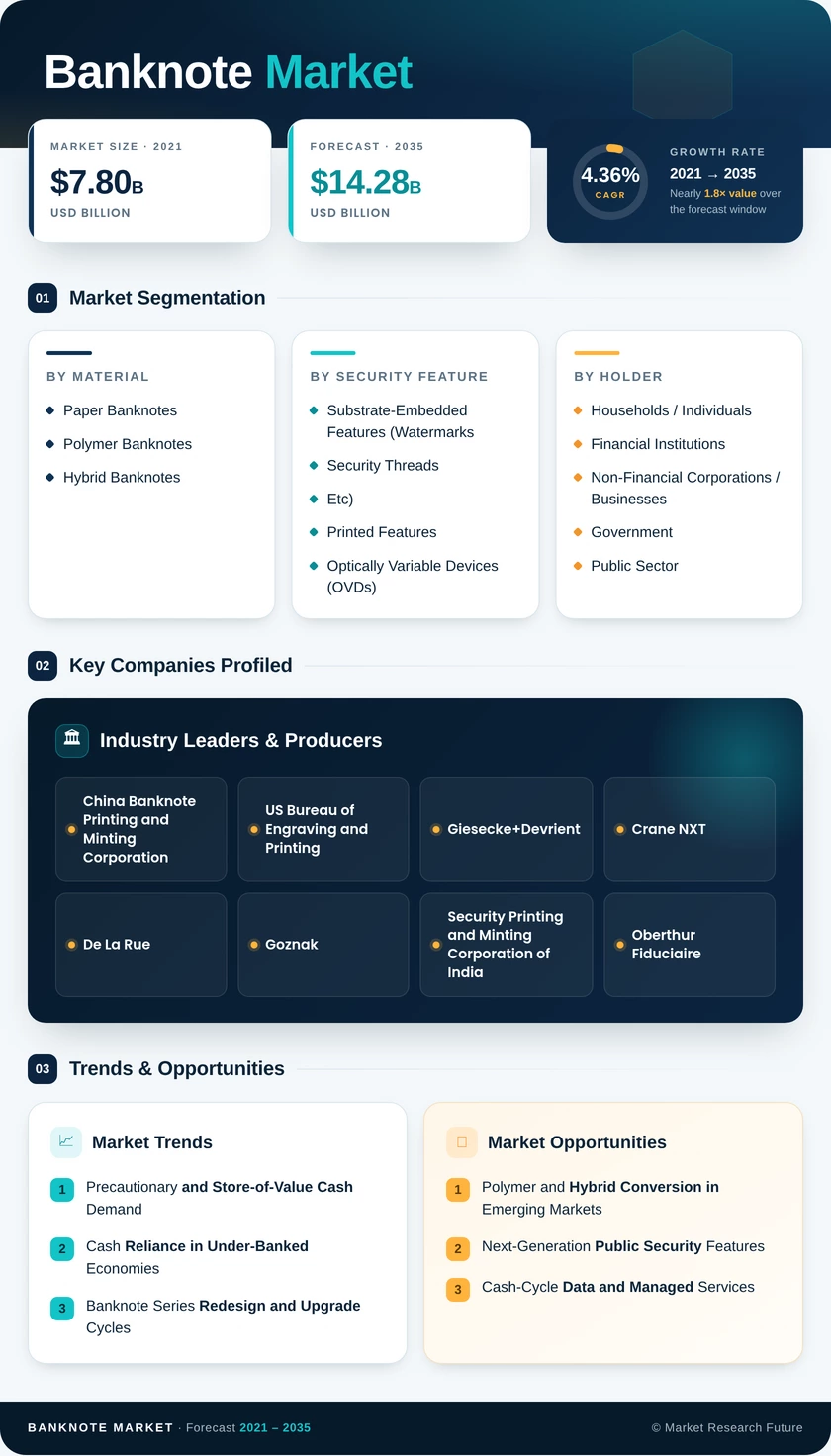
Banknote Market Size, Share and Research Report By Material (Paper Banknotes, Polymer Banknotes, and Hybrid Banknotes), By Security Feature (Substrate-Embedded Features (Watermarks, Security Threads, Etc.), Printed Features, Optically Variable Devices (OVDs), and Machine-Readable Features), By Holder (Households / Individuals, Financial Institutions, Non-Financial Corporations / Businesses, and Government and Public Sector) And By Region (North America, Europe, Asia-Pacific, And Rest Of The World) –Industry Forecast Till 2035

Banknote Market
Market Size
Forecast Period2026-2035
CAGR (2026-2035)4.36%
2025 Market SizeUSD 9.32 Trillion
2035 Market SizeUSD 14.28 Trillion
Key Players
China Banknote Printing and Minting Corporation
US Bureau of Engraving and Printing
Giesecke+Devrient
Crane NXT
De La Rue
Goznak
Opportunities
  • Polymer and Hybrid Conversion in Emerging Markets
  • Next-Generation Public Security Features
  • Cash-Cycle Data and Managed Services
  1. 1 Market Summary | |
  2. 2 Key Report Takeaways | |
    1. 2.1 By Material | |
    2. 2.2 By Security Feature | |
    3. 2.3 By Holder | |
    4. 2.4 By Region | |
  3. 3 Market Size and Forecast (2021–2035) | |
  4. 4 Driver Impact Analysis | |
    1. 4.1 Precautionary and Store-of-Value Cash Demand | |
    2. 4.2 Cash Reliance in Under-Banked Economies | |
    3. 4.3 Banknote Series Redesign and Upgrade Cycles | |
    4. 4.4 Polymer Adoption by Issuing Authorities | |
    5. 4.5 Inflation and Higher-Denomination Issuance | |
    6. 4.6 Counterfeit Deterrence and Feature Upgrades | |
    7. 4.7 Legal Tender and Cash-Access Legislation | |
  5. 5 Restraints Impact Analysis | |
    1. 5.1 Growth of Instant and Mobile Payment Rails | |
    2. 5.2 Declining Cash Use at the Point of Sale | |
    3. 5.3 Exchange-Rate Translation Effects | |
    4. 5.4 Central Bank Digital Currency Development | |
    5. 5.5 Substrate Transition Costs and Procurement Inertia | |
  6. 6 Opportunities | |
    1. 6.1 Polymer and Hybrid Conversion in Emerging Markets | |
    2. 6.2 Next-Generation Public Security Features | |
    3. 6.3 Cash-Cycle Data and Managed Services | |
    4. 6.4 Sustainability and Circular Lifecycle Programs | |
    5. 6.5 Cash Resilience Infrastructure in Mature Markets | |
  7. 7 Regional Market Share and Country-Level Analysis | |
    1. 7.1 North America | | |
      1. 7.1.1 US | | |
      2. 7.1.2 Canada | | |
      3. 7.1.3 Mexico | |
    2. 7.2 Europe | | |
      1. 7.2.1 Germany | | |
      2. 7.2.2 UK | | |
      3. 7.2.3 France | | |
      4. 7.2.4 Italy | | |
      5. 7.2.5 Spain | | |
      6. 7.2.6 Nordic Countries | | |
      7. 7.2.7 Russia | | |
      8. 7.2.8 Rest of Europe | |
    3. 7.3 Asia-Pacific | | |
      1. 7.3.1 China | | |
      2. 7.3.2 India | | |
      3. 7.3.3 Japan | | |
      4. 7.3.4 South Korea | | |
      5. 7.3.5 ASEAN | | |
      6. 7.3.6 Rest of Asia-Pacific | |
    4. 7.4 South America | | |
      1. 7.4.1 Brazil | | |
      2. 7.4.2 Argentina | | |
      3. 7.4.3 Rest of South America | |
    5. 7.5 Middle East & Africa | | |
      1. 7.5.1 Saudi Arabia | | |
      2. 7.5.2 UAE | | |
      3. 7.5.3 South Africa | | |
      4. 7.5.4 Egypt | | |
      5. 7.5.5 Rest of MEA | |
  8. 8 Future Outlook (2026–2035) | |
    1. 8.1 Coexistence of Cash, CBDCs and Instant Payments | |
    2. 8.2 Machine Authentication and AI-Enabled Detection | |
    3. 8.3 Sustainability and Lifecycle Accountability | |
    4. 8.4 Supply-Chain Consolidation and Sovereign Capacity | |
  9. 9 Segmentation Analysis | |
    1. 9.1 By Material | | |
      1. 9.1.1 Paper Banknotes | | |
      2. 9.1.2 Polymer Banknotes | | |
      3. 9.1.3 Hybrid Banknotes | |
    2. 9.2 By Security Feature | | |
      1. 9.2.1 Substrate-Embedded Features (Watermarks, Security Threads, Etc) | | |
      2. 9.2.2 Printed Features | | |
      3. 9.2.3 Optically Variable Devices (OVDs) | | |
      4. 9.2.4 Machine-Readable Features | |
    3. 9.3 By Holder | | |
      1. 9.3.1 Households / Individuals | | |
      2. 9.3.2 Financial Institutions | | |
      3. 9.3.3 Non-Financial Corporations / Businesses | | |
      4. 9.3.4 Government and Public Sector | |
  10. 10 Competitive Landscape | |
  11. 11 Recent News & Developments | |
  12. 12 Report Scope and Methodology | |
  13. 13 Detailed Sources and Citations | |
  14. 14 Frequently Asked Questions (FAQs) | | LIST OF TABLES | |
  15. TABLE 1 Global Market Size and Forecast, by Value (USD Trillion), 2021–2035 | |
  16. TABLE 2 Driver Impact Analysis | |
  17. TABLE 3 Restraints Impact Analysis | |
  18. TABLE 4 Regional Summary, 2025 | |
  19. TABLE 5 North America, by Country, 2025 | |
  20. TABLE 6 Europe, by Country, 2025 | |
  21. TABLE 7 Asia-Pacific, by Country, 2025 | |
  22. TABLE 8 South America, by Country, 2025 | |
  23. TABLE 9 Middle East & Africa, by Country, 2025 | |
  24. TABLE 10 Segmentation by Material, 2025 | |
  25. TABLE 11 Segmentation by Security Feature, 2025 | |
  26. TABLE 12 Segmentation by Holder, 2025 | |
  27. TABLE 13 Competitive Benchmarking Matrix | |
  28. TABLE 14 Report Scope and Methodology | |
  29. TABLE 15 Detailed Sources and Citations | | LIST OF FIGURES | |
  30. FIGURE 1 Market Dynamics Overview (Drivers, Restraints, Opportunities) | |
  31. FIGURE 2 Value Chain Analysis: Substrate, Security Features, Printing, Distribution, Destruction | |
  32. FIGURE 3 Porter's Five Forces Analysis | |
  33. FIGURE 4 Market Size Trend, 2021–2035 (USD Trillion) | |
  34. FIGURE 5 Share by Material, 2025 | |
  35. FIGURE 6 Share by Security Feature, 2025 | |
  36. FIGURE 7 Share by Holder, 2025 | |
  37. FIGURE 8 Regional Share, 2025 | |
  38. FIGURE 9 Competitive Landscape: Estimated Revenue Share Ranges

Segmentation Quick Reference

DimensionSub-SegmentsDominant SegmentFastest Growing Segment
By MaterialPaper Banknotes; Polymer Banknotes; Hybrid BanknotesPaper Banknotes (81.6% share)Polymer Banknotes (13.0% CAGR)
By Security FeatureSubstrate-Embedded Features (Watermarks, Security Threads, Etc); Printed Features; Optically Variable Devices (OVDs); Machine-Readable FeaturesSubstrate-Embedded Features (Watermarks, Security Threads, Etc) (43.8% share)Optically Variable Devices (OVDs) (8.2% CAGR)
By HolderHouseholds / Individuals; Financial Institutions; Non-Financial Corporations / Businesses; Government and Public SectorHouseholds / Individuals (35.5% share)Non-Financial Corporations / Businesses (6.1% CAGR)
By RegionNorth America; Europe; Asia-Pacific; South America; Middle East & AfricaNorth America (36.4% share)Asia-Pacific (5.6% CAGR)

Market Segmentation Overview

By Material

Sub-SegmentKey Trend
Paper BanknotesRetains scale through installed cotton-fibre presses
Polymer BanknotesSecond-wave adoption across Asia, Africa and South America
Hybrid BanknotesBridge format for phased substrate transitions

Paper Banknotes lead on the strength of existing cotton-fibre capacity and long procurement contracts, which make rapid conversion costly. Polymer Banknotes grow fastest because issuers now have proven full-series rollouts to copy and can bank lower replacement costs over a longer note life. Hybrid Banknotes let central banks test durability gains without retooling every line.

By Security Feature

Sub-SegmentKey Trend
Substrate-Embedded Features (Watermarks, Security Threads, Etc)Locked in through multi-year sovereign contracts
Printed FeaturesTactile intaglio supports accessibility
Optically Variable Devices (OVDs)Nano-optic and plasmonic devices for public checks
Machine-Readable FeaturesCovert layers for sorter and recycler authentication

Substrate-Embedded Features (Watermarks, Security Threads, Etc) lead because they are part of the substrate and specified for the life of a series. Optically Variable Devices (OVDs) grow fastest as issuers prioritise features the public can verify in seconds on high denominations. Machine-Readable Features gain relevance as recyclers and retail sorters take on more authentication work.

By Holder

Sub-SegmentKey Trend
Households / IndividualsPrecautionary reserves during disruptions
Financial InstitutionsATM and branch inventories under cash-access rules
Non-Financial Corporations / BusinessesCash-heavy retail and agriculture in emerging economies
Government and Public SectorStable agency and reserve holdings

Households / Individuals hold the largest share because consumers keep cash as a resilient reserve against outages and crises. Non-Financial Corporations / Businesses grow fastest, driven by cash-intensive retail, hospitality and farming in emerging markets where digital acceptance lags. Financial Institutions' inventories track ATM networks and the cash-access rules now protecting them.


Download PDF ×

We do not share your information with anyone. However, we may send you emails based on your report interest from time to time. You may contact us at any time to opt-out.