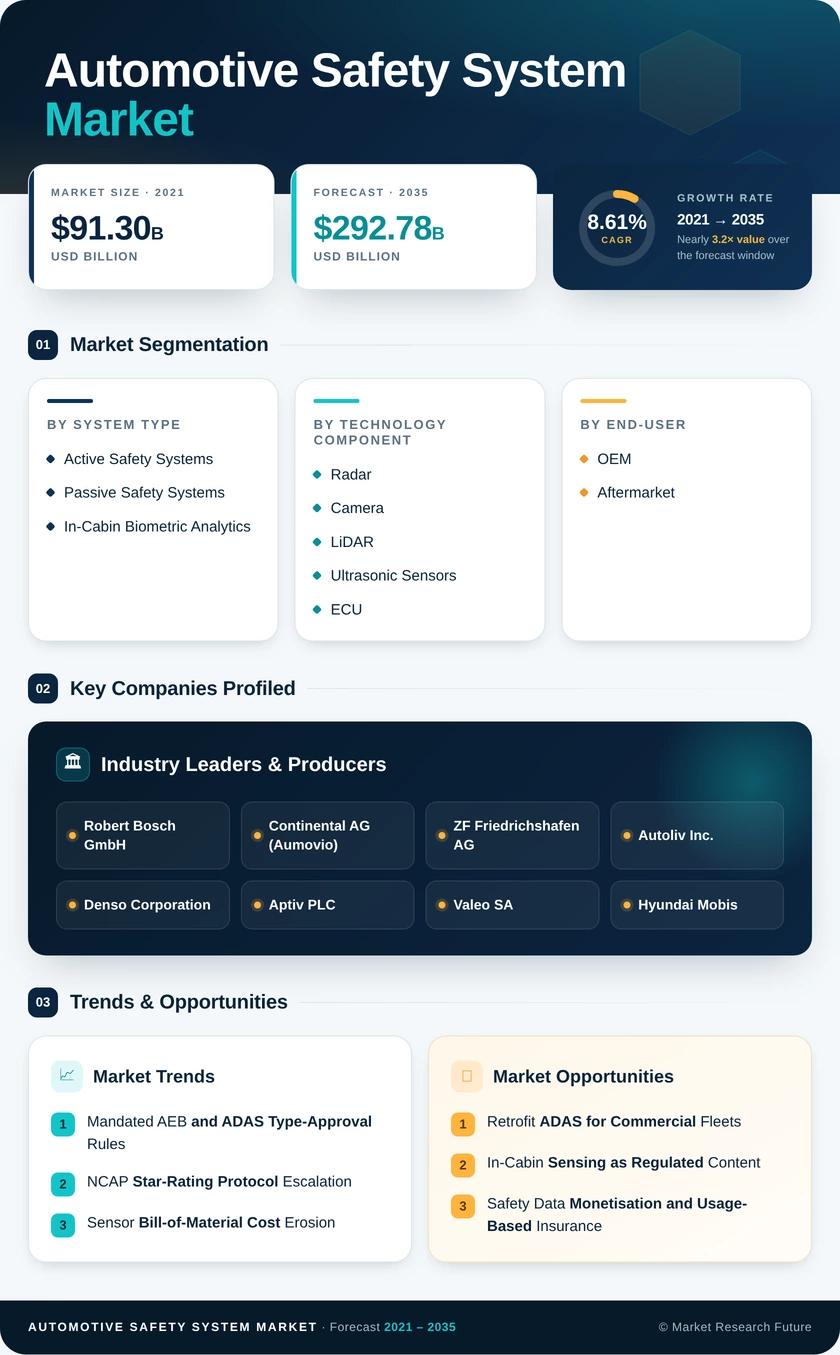
Segmentation Quick Reference
| Dimension | Sub-Segments | Dominant Segment | Fastest Growing Segment |
| By System Type | Active Safety Systems; Passive Safety Systems; In-Cabin Biometric Analytics | Active Safety Systems | In-Cabin Biometric Analytics |
| By Technology Component | Radar; Camera; LiDAR; Ultrasonic Sensors; ECU and Domain Controllers; Software and Sensor Fusion Stack | Radar | LiDAR |
| By End-User | OEM; Aftermarket | OEM | Aftermarket |
| By Vehicle Type | Passenger Cars; Light Commercial Vehicles; Heavy Commercial Vehicles | Passenger Cars | Heavy Commercial Vehicles |
| By Propulsion | Internal Combustion Engine; Battery Electric Vehicle; Hybrid and Plug-In Hybrid | Internal Combustion Engine | Battery Electric Vehicle |
| By Region | North America; Europe; Asia-Pacific; South America; Middle East & Africa | Asia-Pacific | South America |
Market Segmentation Overview
By System Type
| Sub-Segment | Key Trend |
| Active Safety Systems | Type-approval rules specify function, pushing camera-plus-radar fitment toward universal coverage |
| Passive Safety Systems | Airbag count escalation in India, Brazil, and ASEAN sustains volume despite mature developed markets |
| In-Cabin Biometric Analytics | Child presence detection and impairment monitoring move from optional to protocol-scored content |
Active systems absorb most incremental spend because regulators write performance requirements rather than hardware specifications, and meeting those requirements demands sensing. Restraint hardware remains a durable business anchored in emerging-market content growth. Interior sensing is the segment to watch: two assessment cycles converted it from a flagship feature into a standard specification.
By Technology Component
| Sub-Segment | Key Trend |
| Radar | 77 GHz CMOS integration erodes module cost without sacrificing all-weather performance |
| Camera | Pedestrian classification requirements drive higher resolution and wider dynamic range |
| LiDAR | Concentrated adoption in Level 3 highway-pilot programs rather than broad fitment |
| Ultrasonic Sensors | Stable low-speed manoeuvring role with limited price headroom |
| ECU and Domain Controllers | Zonal consolidation shifts value from discrete modules to centralised compute |
| Software and Sensor Fusion Stack | Perception licensing and maintained update pipelines create recurring revenue |
Component economics are diverging. Sensing hardware faces continuous price compression while compute and software capture an expanding share of content value. Suppliers that own both the sensor and the fusion layer defend margin more effectively than pure hardware vendors, which explains the pace of divisional restructuring across the Tier-1 base.
By End-User
| Sub-Segment | Key Trend |
| OEM | Factory fitment locked by type-approval; sourcing decisions precede launch by 24–36 months |
| Aftermarket | Fleet retrofit funded by insurance premium reduction rather than regulation |
By Vehicle Type
| Sub-Segment | Key Trend |
| Passenger Cars | Star-rating sensitivity at retail pulls content ahead of legal minimums |
| Light Commercial Vehicles | Last-mile delivery growth expands the addressable fleet |
| Heavy Commercial Vehicles | Direct-vision and blind-spot requirements raise per-unit content sharply |
Passenger vehicles supply scale, but the steepest content increases are occurring on trucks, where a single regulatory change can add several sensing positions per unit. Light commercial demand tracks logistics volume rather than safety policy, giving it a different cyclical profile from the other two segments.
By Propulsion
| Sub-Segment | Key Trend |
| Internal Combustion Engine | Largest installed production base; content growth driven by mandates rather than architecture |
| Battery Electric Vehicle | Centralised electrical architecture lowers integration cost for advanced sensing |
| Hybrid and Plug-In Hybrid | Transitional platforms carry combustion packaging plus high-voltage monitoring |
Propulsion choice increasingly determines how cheaply safety functions can be integrated. Electric platforms designed around zonal computing accommodate additional sensors without wiring redesign, while legacy combustion architectures absorb the same functions at higher engineering cost. Hybrids sit awkwardly between the two, carrying obligations from both.


 Noah Malgeri
Co-Founder

 Peter Groot koerkamp
Account and Business Manager

 Younghwan Choi
Senior Retail Manager

 Mark Irwin
Management Consultant

 Akif Moroglu
Strategy & Business Development Director

 Guilherme Gomes Martins
Product Management Director

 Joseph Aguayo
Sales Operations & Pricing Manager

 La Terria Dodd
Program Support Specialist

 Rob Kooiker
Group Product Manager HVAC & Fire Protection GMA