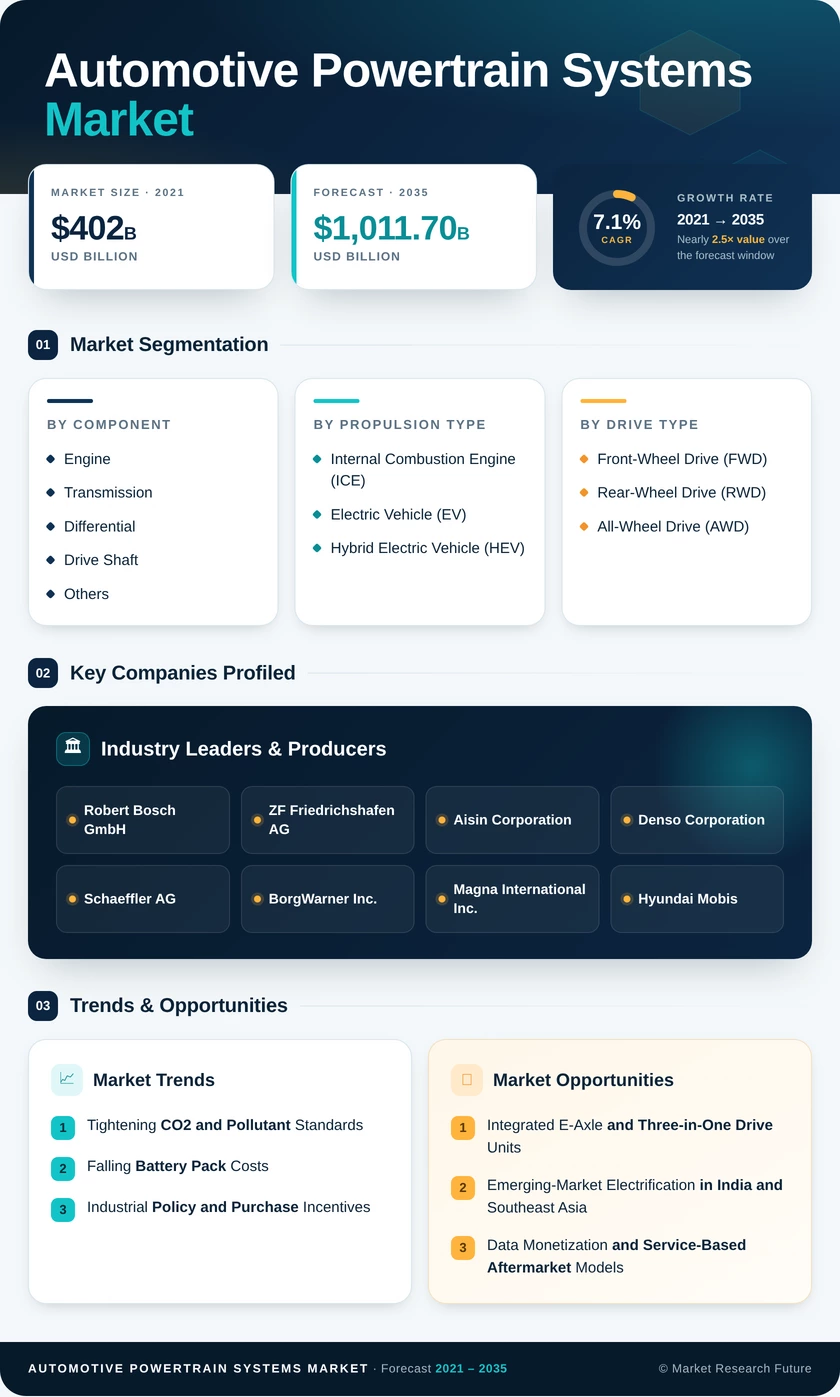
Segmentation Quick Reference
| Dimension | Sub-Segments | Dominant Segment | Fastest Growing Segment |
|---|---|---|---|
| By Component | Engine, Transmission, Differential, Drive Shaft, Others | Engine (44.5% share) | Others (8.8% CAGR) |
| By Propulsion Type | Internal Combustion Engine (ICE), Electric Vehicle (EV), Hybrid Electric Vehicle (HEV) | Internal Combustion Engine (ICE) (73.2% share) | Electric Vehicle (EV) (10.9% CAGR) |
| By Drive Type | Front-Wheel Drive (FWD), Rear-Wheel Drive (RWD), All-Wheel Drive (AWD) | Front-Wheel Drive (FWD) (50.1% share) | All-Wheel Drive (AWD) (7.7% CAGR) |
| By Vehicle Type | Passenger Vehicles, Commercial Vehicles | Passenger Vehicles (75.6% share) | Commercial Vehicles (9.2% CAGR) |
| By Sales Channel | OEM, Aftermarket | OEM (82.5% share) | Aftermarket (9.4% CAGR) |
| By Region | North America, Europe, Asia-Pacific, South America, Middle East & Africa | Asia-Pacific (48.6% share) | Asia-Pacific (48.6% share) |
Market Segmentation Overview
By Component
| Sub-Segment | Key Trend |
|---|---|
| Engine | Few new engine families; focus on hybrid-optimized designs |
| Transmission | Dedicated hybrid and multi-speed heavy-truck gearboxes |
| Differential | Shift to electronic torque-vectoring modules |
| Drive Shaft | Lightweight composites with embedded sensors |
| Others | Compact e-drive units and integrated final drives |
Engine keeps the lead at 44.5% share because combustion and hybrid vehicles still make up most global production. Others grow fastest at an 8.8% CAGR, as integrated motor-inverter-gear packages replace separate mechanical parts. Transmission and differential suppliers retain relevance by moving into hybrid gearboxes and software-controlled torque distribution.
By Propulsion Type
| Sub-Segment | Key Trend |
|---|---|
| Internal Combustion Engine (ICE) | Efficiency upgrades for emerging-market platforms |
| Electric Vehicle (EV) | Falling pack costs and higher-voltage architectures |
| Hybrid Electric Vehicle (HEV) | Bridge solution where charging networks lag |
Internal Combustion Engine (ICE) leads with 73.2% share, sustained by affordable platforms in India and Southeast Asia. Electric Vehicle (EV) grows fastest at a 10.9% CAGR because cheaper battery packs and emissions penalties improve its economics. Hybrid Electric Vehicle (HEV) systems fill the gap in markets where public charging density remains low.
By Drive Type
| Sub-Segment | Key Trend |
|---|---|
| Front-Wheel Drive (FWD) | Cost-efficient compact and mid-size platforms |
| Rear-Wheel Drive (RWD) | Revival in premium and skateboard EV layouts |
| All-Wheel Drive (AWD) | Dual-motor designs with software torque vectoring |
Front-Wheel Drive (FWD) dominates with 50.1% share thanks to its low cost and packaging efficiency in small cars. All-Wheel Drive (AWD) grows fastest at a 7.7% CAGR because adding a second electric motor delivers traction without heavy transfer cases. Rear-Wheel Drive (RWD) benefits from battery-electric skateboard platforms that free the front axle.
By Vehicle Type
| Sub-Segment | Key Trend |
|---|---|
| Passenger Vehicles | Wide price range and diversified propulsion options |
| Commercial Vehicles | Fleet electrification driven by operating-cost savings |
Passenger Vehicles hold a 75.6% share, reflecting their scale in global unit sales across every region. Commercial Vehicles grow fastest at a 9.2% CAGR, as bus and delivery-van operators adopt electric powertrains to cut fuel costs and meet urban emissions rules. Heavy-duty CO2 standards in Europe add a long-term pipeline for high-torque electric axles.
By Sales Channel
| Sub-Segment | Key Trend |
|---|---|
| OEM | Factory-installed powertrains under long-term contracts |
| Aftermarket | Data-driven diagnostics and battery-health services |
OEM channels lead with 82.5% share because nearly all powertrain hardware ships as factory-installed equipment. Aftermarket grows fastest at a 9.4% CAGR, as connected vehicles let independent garages and fleets use predictive diagnostics and battery-health services. Replacement demand for battery-electric powertrains centers on thermal components and software rather than traditional fluid servicing.


 Noah Malgeri
Co-Founder

 Peter Groot koerkamp
Account and Business Manager

 Younghwan Choi
Senior Retail Manager

 Mark Irwin
Management Consultant

 Akif Moroglu
Strategy & Business Development Director

 Guilherme Gomes Martins
Product Management Director

 Joseph Aguayo
Sales Operations & Pricing Manager

 La Terria Dodd
Program Support Specialist

 Rob Kooiker
Group Product Manager HVAC & Fire Protection GMA