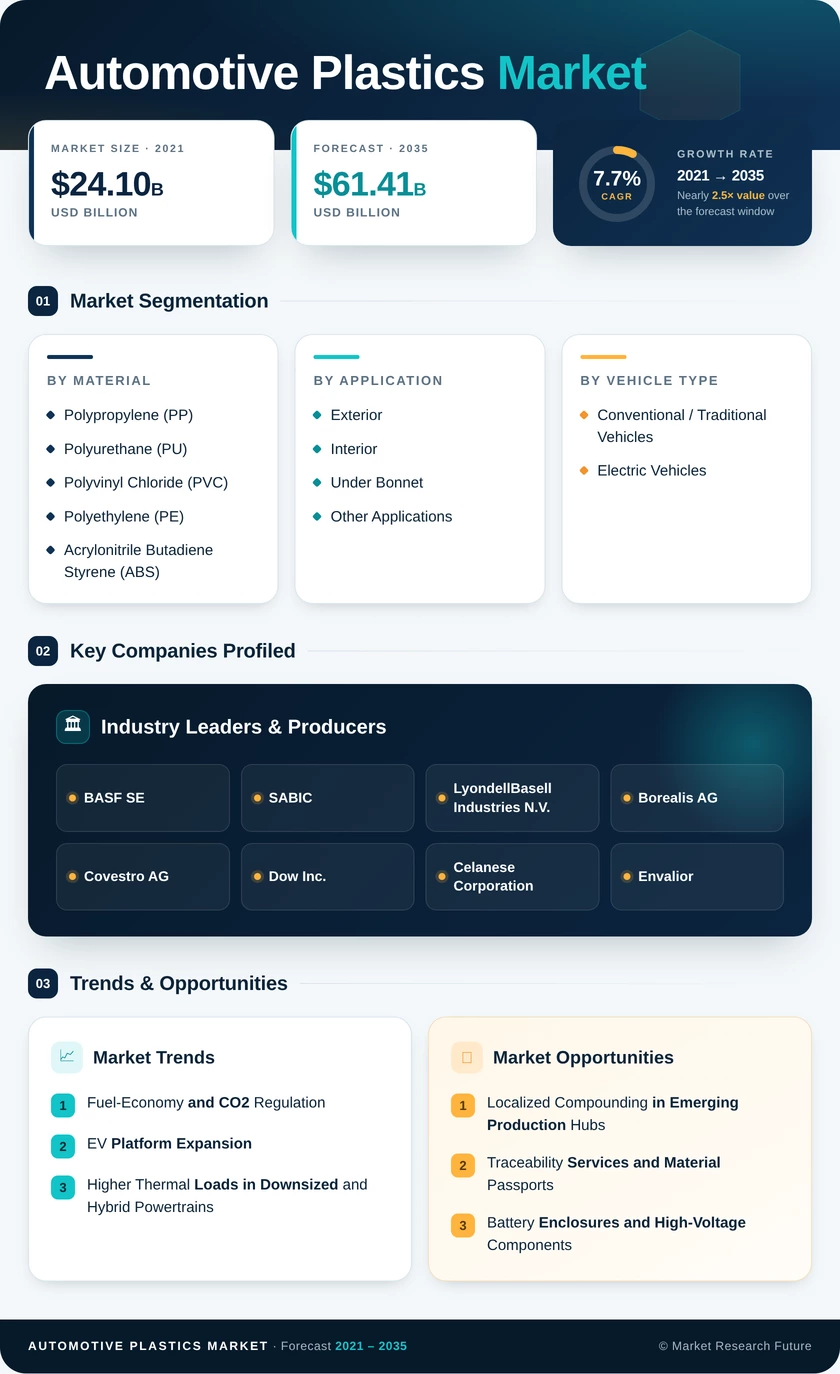
Automotive Plastics Market (2026 - 2035)

ID: MRFR/CnM/2168-CR 111 Pages Chitranshi Jaiswal Last Updated: October 26, 2026
Automotive Plastics Market Research Report Information By Material (Polypropylene (PP), Polyurethane (PU), Polyvinyl Chloride (PVC), Polyethylene (PE), Acrylonitrile Butadiene Styrene (ABS), Polyamides (PA), Polycarbonate (PC), and Other Materials), By Application (Exterior, Interior, Under Bonnet, and Other Applications), By Vehicle Type (Conventional/Traditional Vehicles and Electric Vehicles), By Source (Virgin Plastic, Recycled Plastic, and Bio-Based Plastic), And By Region (North America, Europe, Asia-Pacific, and Rest of the World) – Market Forecast Till 2035.
Automotive Plastics Market
Market Size
Forecast Period2026-2035
CAGR (2026-2035)7.7%
2025 Market SizeUSD 29.25 Billion
2035 Market SizeUSD 61.41 Billion
Key Players
BASF SE
SABIC
LyondellBasell Industries N.V.
Borealis AG
Covestro AG
Dow Inc.
Opportunities
  • Localized Compounding in Emerging Production Hubs
  • Traceability Services and Material Passports
  • Battery Enclosures and High-Voltage Components
  1. 1 Market Summary | |
  2. 2 Key Report Takeaways | |
    1. 2.1 By Material | |
    2. 2.2 By Application | |
    3. 2.3 By Vehicle Type | |
    4. 2.4 By Source | |
    5. 2.5 By Region | |
  3. 3 Market Size and Forecast (2021–2035) | |
  4. 4 Driver Impact Analysis | |
    1. 4.1 Fuel-Economy and CO2 Regulation | |
    2. 4.2 EV Platform Expansion | |
    3. 4.3 Higher Thermal Loads in Downsized and Hybrid Powertrains | |
    4. 4.4 Recycled-Content and Circularity Mandates | |
    5. 4.5 Production Growth in Emerging Hubs | |
    6. 4.6 Lighting, Glazing and Sensor Integration | |
  5. 5 Restraints Impact Analysis | |
    1. 5.1 Crude-Linked Resin Price Volatility | |
    2. 5.2 Recycled Resin Cost Premium and Quality Gaps | |
    3. 5.3 Fragmented End-of-Life Dismantling | |
    4. 5.4 Metal Re-Substitution Through Large Castings | |
    5. 5.5 Chemical-Compliance Burden | |
  6. 6 Opportunities | |
    1. 6.1 Localized Compounding in Emerging Production Hubs | |
    2. 6.2 Traceability Services and Material Passports | |
    3. 6.3 Battery Enclosures and High-Voltage Components | |
    4. 6.4 Bio-Based Polyamides and Polypropylene | |
    5. 6.5 Radar-Transparent Exterior Modules | |
  7. 7 Regional Market Share and Country-Level Analysis | |
    1. 7.1 Asia-Pacific | | |
      1. 7.1.1 China | | |
      2. 7.1.2 Japan | | |
      3. 7.1.3 India | | |
      4. 7.1.4 South Korea | | |
      5. 7.1.5 Rest of Asia-Pacific | |
    2. 7.2 North America | | |
      1. 7.2.1 United States | | |
      2. 7.2.2 Canada | | |
      3. 7.2.3 Mexico | |
    3. 7.3 Europe | | |
      1. 7.3.1 Germany | | |
      2. 7.3.2 United Kingdom | | |
      3. 7.3.3 France | | |
      4. 7.3.4 Italy | | |
      5. 7.3.5 Rest of Europe | |
    4. 7.4 South America | | |
      1. 7.4.1 Brazil | | |
      2. 7.4.2 Argentina | | |
      3. 7.4.3 Rest of South America | |
    5. 7.5 Middle East and Africa | | |
      1. 7.5.1 Saudi Arabia | | |
      2. 7.5.2 South Africa | | |
      3. 7.5.3 Rest of Middle East and Africa | |
  8. 8 Future Outlook (2026–2035) | |
    1. 8.1 The Polymer-Intensive EV Architecture | |
    2. 8.2 Regulated Circularity | |
    3. 8.3 Sensor-Dense, Software-Defined Vehicles | |
    4. 8.4 Supply-Chain Realignment and Carbon Accounting | |
  9. 9 Segmentation Analysis | |
    1. 9.1 By Material | | |
      1. 9.1.1 Polypropylene (PP) | | |
      2. 9.1.2 Polyurethane (PU) | | |
      3. 9.1.3 Polyvinyl Chloride (PVC) | | |
      4. 9.1.4 Polyethylene (PE) | | |
      5. 9.1.5 Acrylonitrile Butadiene Styrene (ABS) | | |
      6. 9.1.6 Polyamides (PA) | | |
      7. 9.1.7 Polycarbonate (PC) | | |
      8. 9.1.8 Other Materials | |
    2. 9.2 By Application | | |
      1. 9.2.1 Exterior | | |
      2. 9.2.2 Interior | | |
      3. 9.2.3 Under Bonnet | | |
      4. 9.2.4 Other Applications | |
    3. 9.3 By Vehicle Type | | |
      1. 9.3.1 Conventional / Traditional Vehicles | | |
      2. 9.3.2 Electric Vehicles | |
    4. 9.4 By Source | | |
      1. 9.4.1 Virgin Plastic | | |
      2. 9.4.2 Recycled Plastic | | |
      3. 9.4.3 Bio-based Plastic | |
  10. 10 Competitive Landscape | |
    1. 10.1 Market Concentration Analysis | |
    2. 10.2 Competitive Benchmarking Matrix | |
    3. 10.3 Company Profiles | | |
      1. 10.3.1 BASF SE | | |
      2. 10.3.2 SABIC | | |
      3. 10.3.3 LyondellBasell Industries N.V. | | |
      4. 10.3.4 Borealis AG | | |
      5. 10.3.5 Covestro AG | | |
      6. 10.3.6 Dow Inc. | | |
      7. 10.3.7 Celanese Corporation | | |
      8. 10.3.8 Envalior | | |
      9. 10.3.9 LG Chem Ltd. | | |
      10. 10.3.10 Mitsubishi Chemical Group | | |
      11. 10.3.11 Evonik Industries AG | | |
      12. 10.3.12 Syensqo | |
  11. 11 Recent News & Developments | |
  12. 12 Report Scope and Methodology | |
  13. 13 Detailed Sources and Citations | |
  14. 14 Frequently Asked Questions (FAQs) | | LIST OF TABLES | |
  15. TABLE 1 Global Automotive Plastics Revenue & Forecast, 2021–2035 (USD Billion) | |
  16. TABLE 2 Driver Impact Analysis | |
  17. TABLE 3 Restraints Impact Analysis | |
  18. TABLE 4 Global Revenue Share, by Region, 2025 | |
  19. TABLE 5 Asia-Pacific Revenue, by Country, 2025 | |
  20. TABLE 6 North America Revenue, by Country, 2025 | |
  21. TABLE 7 Europe Revenue, by Country, 2025 | |
  22. TABLE 8 South America Revenue, by Country, 2025 | |
  23. TABLE 9 Middle East and Africa Revenue, by Country, 2025 | |
  24. TABLE 10 Global Revenue, by Material, 2025 | |
  25. TABLE 11 Global Revenue, by Application, 2025 | |
  26. TABLE 12 Global Revenue, by Vehicle Type, 2025 | |
  27. TABLE 13 Global Revenue, by Source, 2025 | |
  28. TABLE 14 Competitive Benchmarking Matrix | |
  29. TABLE 15 Report Scope and Methodology | |
  30. TABLE 16 Detailed Sources and Citations | | LIST OF FIGURES | |
  31. FIGURE 1 Market Dynamics Overview – Drivers, Restraints and Opportunities | |
  32. FIGURE 2 Industry Value Chain Analysis | |
  33. FIGURE 3 Porter's Five Forces Analysis | |
  34. FIGURE 4 Global Revenue Trend, 2021–2035 (USD Billion) | |
  35. FIGURE 5 Revenue Share, by Material, 2025 | |
  36. FIGURE 6 Revenue Share, by Application, 2025 | |
  37. FIGURE 7 Revenue Share, by Vehicle Type, 2025 | |
  38. FIGURE 8 Revenue Share, by Source, 2025 | |
  39. FIGURE 9 Revenue Share, by Region, 2025 | |
  40. FIGURE 10 Competitive Landscape – Supplier Share Ranges, 2025

Segmentation Quick Reference

DimensionSub-SegmentsDominant SegmentFastest Growing Segment
By MaterialPolypropylene (PP); Polyurethane (PU); Polyvinyl Chloride (PVC); Polyethylene (PE); Acrylonitrile Butadiene Styrene (ABS); Polyamides (PA); Polycarbonate (PC); Other MaterialsPolypropylene (PP) (31.9% share)Polyamides (PA) (8.3% CAGR)
By ApplicationExterior; Interior; Under Bonnet; Other ApplicationsInterior (30.9% share)Under Bonnet (8.4% CAGR)
By Vehicle TypeConventional / Traditional Vehicles; Electric VehiclesConventional / Traditional Vehicles (76.6% share)Electric Vehicles (10.2% CAGR)
By SourceVirgin Plastic; Recycled Plastic; Bio-based PlasticVirgin Plastic (73.6% share)Bio-based Plastic (10.1% CAGR)
By RegionAsia-Pacific; North America; Europe; South America; Middle-East and AfricaAsia-Pacific (47.6%)Asia-Pacific (47.6%)

Market Segmentation Overview

By Material

Sub-SegmentKey Trend
Polypropylene (PP)Long-fiber grades replace metal in carriers and door modules
Polyurethane (PU)Thinner, lighter foams for seating and NVH
Polyvinyl Chloride (PVC)Displaced by phthalate-free TPO in interiors
Polyethylene (PE)Multilayer HDPE tanks with EVOH barriers
Acrylonitrile Butadiene Styrene (ABS)Retained for glossy, paintable trim
Polyamides (PA)High-heat and flame-retardant grades for EVs
Polycarbonate (PC)Panoramic roofs and LED lighting lenses
Other MaterialsPBT and PPA in sensor housings and busbars

Polypropylene (PP) leads by volume because its low density and cost suit large bumpers and interior carriers. Polyamides (PA) grow fastest as turbocharged engines and 800-volt battery systems exceed polypropylene's heat limits. Polycarbonate (PC) gains share in glazing, while Polyvinyl Chloride (PVC) cedes interior applications to phthalate-free alternatives.

By Application

Sub-SegmentKey Trend
ExteriorRadar-transparent fascias and lighter body panels
InteriorPremium surfaces with lower-weight substrates
Under BonnetGlass-filled PA66 manifolds and PPA end tanks
Other ApplicationsHigh-voltage connectors and fluid reservoirs

Interior leads revenue on the breadth of dashboards, consoles and seating parts in every vehicle. Under Bonnet grows fastest because downsized turbo engines and hybrid cooling loops raise temperatures, pushing OEMs toward premium high-heat resins. Exterior growth depends on balancing weight savings against repair costs.

By Vehicle Type

Sub-SegmentKey Trend
Conventional / Traditional VehiclesHybrids sustain combustion-era under-bonnet demand
Electric VehiclesBattery covers and floor modules raise polymer content

Conventional / Traditional Vehicles dominate because the global fleet is still largely combustion-based, with hybrids extending that demand. Electric Vehicles grow fastest since battery enclosures, high-voltage connectors and flat floor modules lift polymer content per unit. Cost-driven redesigns may temper EV polymer intensity after 2030.

By Source

Sub-SegmentKey Trend
Virgin PlasticPreferred for consistent safety-critical properties
Recycled PlasticDriven by proposed EU recycled-content quotas
Bio-based PlasticPA10.10 and sugarcane-based PP gain approvals

Virgin Plastic dominates because OEMs require consistent properties for safety-critical and visible parts. Bio-based Plastic grows fastest as automakers chase Scope 3 targets and hedge crude exposure with castor- and sugarcane-derived grades. Recycled Plastic rises with EU quotas but faces cost premiums and color-stability limits.


Download PDF ×

We do not share your information with anyone. However, we may send you emails based on your report interest from time to time. You may contact us at any time to opt-out.