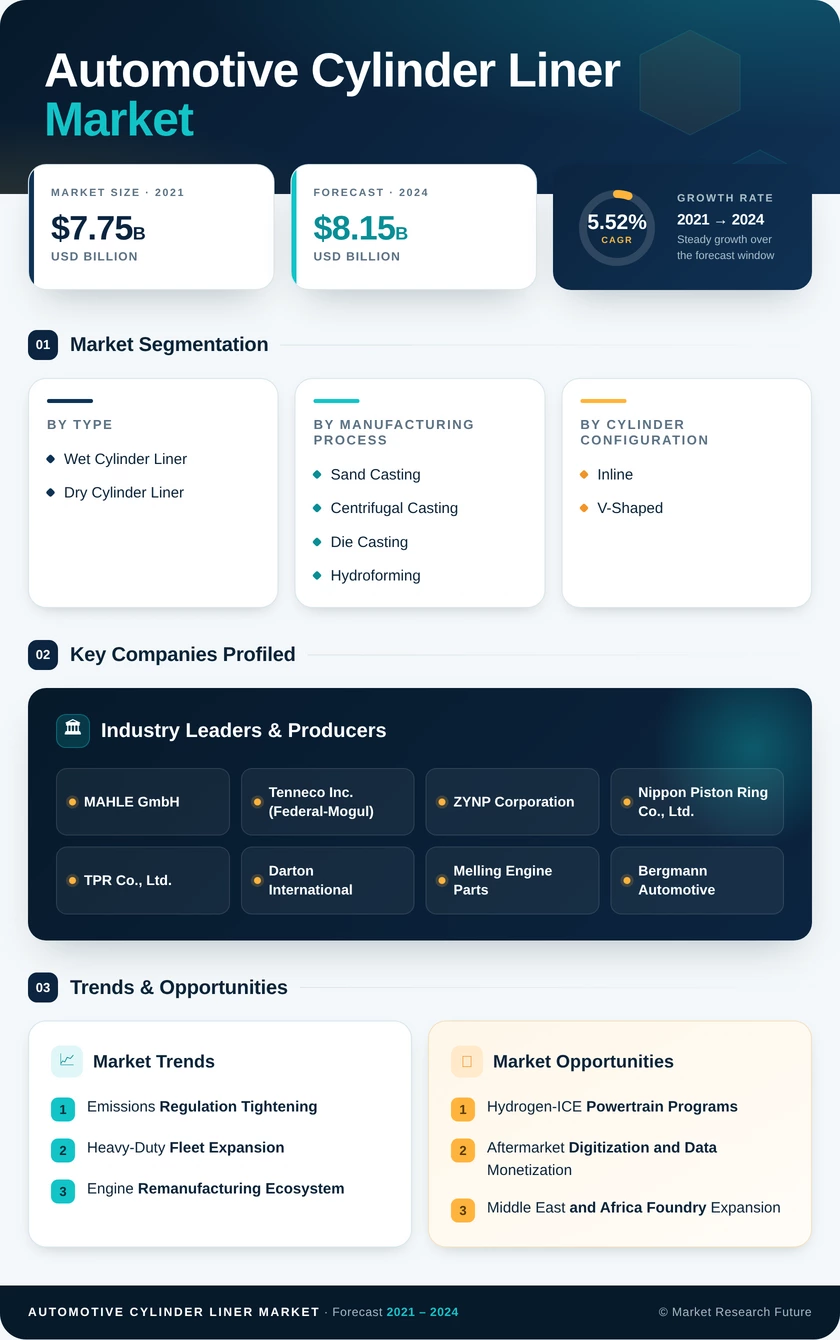
Segmentation Quick Reference
| Dimension | Sub-Segments | Dominant Segment | Fastest Growing Segment |
| Material Type | Cast Iron, Composite, Steel, Others | Cast Iron | Composite |
| Manufacturing Process | Sand Casting, Centrifugal Casting, Die Casting, Hydroforming | Sand Casting | Hydroforming |
| Cylinder Configuration | Inline, V-Shaped | Inline | V-Shaped |
| Application Type | Passenger Vehicles, Light Commercial Vehicles, Medium- & Heavy-Duty Vehicles, Off-Highway Equipment | Passenger Vehicles | Medium- & Heavy-Duty Vehicles |
| Surface Treatment | Honed, Nitrided, Uncoated, Coated (Other) | Honed | Nitrided |
| Fuel Type | Diesel, Gasoline, Alternative Fuel (CNG/LNG/H₂) | Diesel | Alternative Fuel |
| Contact Type | Wet Cylinder Liner, Dry Cylinder Liner | Wet Cylinder Liner | Dry Cylinder Liner |
Market Segmentation Overview
By Material Type
| Sub-Segment | Key Trend |
| Cast Iron | Continued dominance in cost-sensitive commercial platforms; ductile-iron grades gaining share over grey iron |
| Composite | Rapid adoption in European and Japanese premium engines targeting weight and thermal efficiency |
| Steel | Niche use in high-performance and marine-diesel applications requiring extreme bore pressures |
| Others | Specialty alloys for motorsport and defense; small but innovation-intensive segment |
Cast iron's entrenched position reflects decades of proven reliability across diesel and gasoline platforms. Composite liners represent the primary disruption vector, with OEMs increasingly specifying aluminum-matrix or bimetallic constructions for next-generation passenger-car engines.
By Manufacturing Process
| Sub-Segment | Key Trend |
| Sand Casting | High-volume standard for passenger and light-commercial liners |
| Centrifugal Casting | Preferred for heavy-duty diesel requiring superior metallurgical density |
| Die Casting | Growing in thin-wall, high-precision passenger-car applications |
| Hydroforming | Emerging process for complex V-engine geometries and multi-material liners |
Sand casting's tooling flexibility makes it the default for programs exceeding 100,000 units per year. Hydroforming is carving out a niche in low-volume, high-complexity applications where conventional casting cannot achieve the required wall-thickness uniformity.
By Cylinder Configuration
| Sub-Segment | Key Trend |
| Inline | Volume anchor for four- and six-cylinder passenger and commercial engines |
| V-Shaped | Growing in premium vehicles and heavy-duty trucks requiring high power density |
Inline configurations dominate due to lower manufacturing complexity and broad applicability across vehicle classes. V-shaped layouts command premium liner specifications, often requiring tighter bore tolerances and custom-machined geometries.
By Application Type
| Sub-Segment | Key Trend |
| Passenger Vehicles | Largest volume segment; facing electrification headwinds in Europe and China |
| Light Commercial Vehicles | Steady growth driven by e-commerce logistics fleet expansion |
| Medium- & Heavy-Duty Vehicles | Fastest growing; freight demand sustains diesel-liner consumption. |
| Off-Highway Equipment | Mining and agriculture ensure durable demand independent of road-vehicle electrification. |
Passenger vehicles generate the highest unit volumes but face structural BEV substitution. Medium- and heavy-duty vehicles represent the segment where liner demand is most resilient against electrification trends.
By Surface Treatment
| Sub-Segment | Key Trend |
| Honed | Industry-standard cross-hatch finish for oil retention |
| Nitrided | Fastest growing; extends liner life in high-stress diesel and hydrogen-ICE applications. |
| Uncoated | Budget aftermarket replacement segment |
| Coated (Other) | Thermal-barrier and diamond-like carbon coatings for premium engines |
Honing remains the baseline specification, while nitrided surfaces are gaining rapid traction among fleet operators prioritizing extended service intervals and reduced total cost of ownership.
By Fuel Type
| Sub-Segment | Key Trend |
| Diesel | Dominant fuel type; commercial vehicles and off-highway equipment |
| Gasoline | Large installed base in passenger cars; gradual decline with hybridization |
| Alternative Fuel (CNG/LNG/H₂) | Fastest growing; hydrogen-ICE programs driving new liner-material R&D |
Diesel engines remain the backbone of liner demand due to their prevalence in freight and industrial applications. Alternative-fuel engines — particularly hydrogen-ICE — are emerging as the next growth vector.
By Contact Type
| Sub-Segment | Key Trend |
| Wet Cylinder Liner | Preferred for heavy-duty diesel; superior cooling and individual-cylinder serviceability |
| Dry Cylinder Liner | Standard in passenger cars; lighter weight and simpler block design |
Wet liners offer unmatched cooling performance for high-output engines, while dry liners suit the compact packaging requirements of modern passenger-car powertrains.


 Noah Malgeri
Co-Founder

 Peter Groot koerkamp
Account and Business Manager

 Younghwan Choi
Senior Retail Manager

 Mark Irwin
Management Consultant

 Akif Moroglu
Strategy & Business Development Director

 Guilherme Gomes Martins
Product Management Director

 Joseph Aguayo
Sales Operations & Pricing Manager

 La Terria Dodd
Program Support Specialist

 Rob Kooiker
Group Product Manager HVAC & Fire Protection GMA