Automotive Airbag Fabric Market (2026 - 2035)

ID: MRFR/AT/8948-CR 188 Pages Triveni Bhoyar Last Updated: October 17, 2026
Automotive Airbag Fabric Market Research Report By Airbag Type (Front Airbags, Side Airbags, Curtain Airbags, Knee Airbags, External Airbags), By Yarn Type (Polyamide, Polyester), By Coating Type (Coated, Uncoated), By Vehicle Type (Passenger Cars, Light Commercial Vehicles, Medium and Heavy-Duty Trucks, Buses and Coaches) - Forecast to 2035
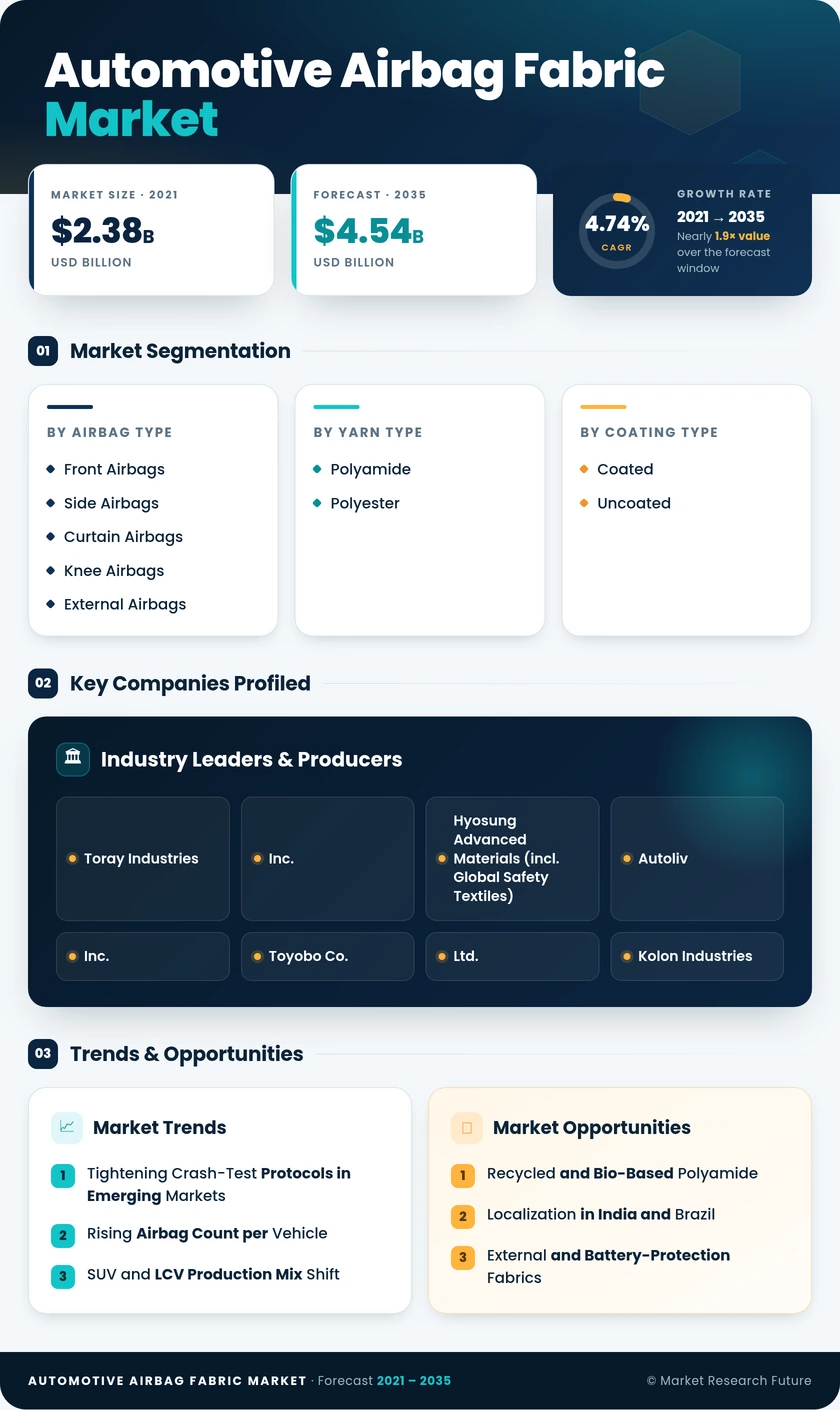
Automotive Airbag Fabric Market
Market Size
Forecast Period2026-2035
CAGR (2026-2035)4.74%
2025 Market SizeUSD 2.86 Billion
2035 Market SizeUSD 4.54 billion
Key Players
Toray Industries, Inc.
Hyosung Advanced Materials
Autoliv, Inc.
Toyobo Co., Ltd.
Kolon Industries, Inc.
Asahi Kasei Corporation
Opportunities
  • Recycled and Bio-Based Polyamide
  • Localization in India and Brazil
  • External and Battery-Protection Fabrics
  1. 1 Market Summary | |
  2. 2 Key Report Takeaways | |
    1. 2.1 By Airbag Type | |
    2. 2.2 By Yarn Type | |
    3. 2.3 By Coating Type | |
    4. 2.4 By Vehicle Type | |
    5. 2.5 By Region | |
  3. 3 Market Size and Forecast (2021–2035) | |
  4. 4 Driver Impact Analysis | |
    1. 4.1 Tightening Crash-Test Protocols in Emerging Markets | |
    2. 4.2 Rising Airbag Count per Vehicle | |
    3. 4.3 SUV and LCV Production Mix Shift | |
    4. 4.4 Electric Vehicle Platform Proliferation | |
    5. 4.5 Lightweighting and One-Piece Woven Adoption | |
    6. 4.6 Pedestrian Protection and External Airbags | |
    7. 4.7 Recall-Driven Requalification and Replacement | |
  5. 5 Restraints Impact Analysis | |
    1. 5.1 Nylon 66 Raw Material Price Volatility | |
    2. 5.2 Cyclical Light-Vehicle Production | |
    3. 5.3 OEM Cost-Down Pressure | |
    4. 5.4 PFAS and Chemical Regulation Compliance | |
    5. 5.5 Lengthy Qualification Cycles | |
  6. 6 Opportunities | |
    1. 6.1 Recycled and Bio-Based Polyamide | |
    2. 6.2 Localization in India and Brazil | |
    3. 6.3 External and Battery-Protection Fabrics | |
    4. 6.4 Traceability Data and Digital Product Passports | |
    5. 6.5 Licensing Fluorine-Free Coating Platforms | |
  7. 7 Regional Market Share and Country-Level Analysis | |
    1. 7.1 North America | | |
      1. 7.1.1 US | | |
      2. 7.1.2 Canada | | |
      3. 7.1.3 Mexico | |
    2. 7.2 Europe | | |
      1. 7.2.1 Germany | | |
      2. 7.2.2 UK | | |
      3. 7.2.3 France | | |
      4. 7.2.4 Italy | | |
      5. 7.2.5 Spain | | |
      6. 7.2.6 Nordic Countries | | |
      7. 7.2.7 Russia | | |
      8. 7.2.8 Rest of Europe | |
    3. 7.3 Asia-Pacific | | |
      1. 7.3.1 China | | |
      2. 7.3.2 India | | |
      3. 7.3.3 Japan | | |
      4. 7.3.4 South Korea | | |
      5. 7.3.5 ASEAN | | |
      6. 7.3.6 Rest of Asia-Pacific | |
    4. 7.4 South America | | |
      1. 7.4.1 Brazil | | |
      2. 7.4.2 Argentina | | |
      3. 7.4.3 Rest of South America | |
    5. 7.5 Middle East & Africa | | |
      1. 7.5.1 Saudi Arabia | | |
      2. 7.5.2 UAE | | |
      3. 7.5.3 South Africa | | |
      4. 7.5.4 Egypt | | |
      5. 7.5.5 Rest of MEA | |
  8. 8 Future Outlook (2026–2035) | |
    1. 8.1 Autonomous Driving and Reconfigurable Cabins | |
    2. 8.2 Electrification and New Architectures | |
    3. 8.3 Circularity and Emissions Reporting | |
    4. 8.4 Digital Weaving and Quality Analytics | |
  9. 9 Segmentation Analysis | |
    1. 9.1 By Airbag Type | | |
      1. 9.1.1 Front Airbags | | |
      2. 9.1.2 Side Airbags | | |
      3. 9.1.3 Curtain Airbags | | |
      4. 9.1.4 Knee Airbags | | |
      5. 9.1.5 External Airbags | |
    2. 9.2 By Yarn Type | | |
      1. 9.2.1 Polyamide | | |
      2. 9.2.2 Polyester | |
    3. 9.3 By Coating Type | | |
      1. 9.3.1 Coated | | |
      2. 9.3.2 Uncoated | |
    4. 9.4 By Vehicle Type | | |
      1. 9.4.1 Passenger Cars | | |
      2. 9.4.2 Light Commercial Vehicles | | |
      3. 9.4.3 Medium and Heavy-Duty Trucks | | |
      4. 9.4.4 Buses and Coaches | |
  10. 10 Competitive Landscape | |
    1. 10.1 Market Concentration Analysis | |
    2. 10.2 Competitive Benchmarking Matrix | |
  11. 11 Recent News & Developments | |
  12. 12 Report Scope and Methodology | |
  13. 13 Detailed Sources and Citations | |
  14. 14 Frequently Asked Questions (FAQs) | | LIST OF TABLES | |
  15. TABLE 1 Report Snapshot – Key Market Parameters, 2025–2035 | |
  16. TABLE 2 Global Market Size & Forecast, 2021–2035 (USD Billion) | |
  17. TABLE 3 Driver Impact Analysis, 2026–2035 | |
  18. TABLE 4 Restraints Impact Analysis, 2026–2035 | |
  19. TABLE 5 Regional Summary, 2025 | |
  20. TABLE 6 North America – Country-Level Analysis | |
  21. TABLE 7 Europe – Country-Level Analysis | |
  22. TABLE 8 Asia-Pacific – Country-Level Analysis | |
  23. TABLE 9 South America – Country-Level Analysis | |
  24. TABLE 10 Middle East & Africa – Country-Level Analysis | |
  25. TABLE 11 Segmentation by Airbag Type | |
  26. TABLE 12 Segmentation by Yarn Type | |
  27. TABLE 13 Segmentation by Coating Type | |
  28. TABLE 14 Segmentation by Vehicle Type | |
  29. TABLE 15 Competitive Benchmarking Matrix, 2025 | |
  30. TABLE 16 Report Scope and Methodology | |
  31. TABLE 17 Detailed Sources and Citations | |
  32. TABLE 18 Segmentation Quick Reference | |
  33. TABLE 19 Market Segmentation Overview – By Airbag Type | |
  34. TABLE 20 Market Segmentation Overview – By Yarn Type | |
  35. TABLE 21 Market Segmentation Overview – By Coating Type | |
  36. TABLE 22 Market Segmentation Overview – By Vehicle Type | | LIST OF FIGURES | |
  37. FIGURE 1 Market Dynamics Overview – Drivers, Restraints and Opportunities | |
  38. FIGURE 2 Industry Value Chain – Yarn, Weaving, Coating, Cushion Sewing, Module Assembly | |
  39. FIGURE 3 Porter's Five Forces Analysis | |
  40. FIGURE 4 Market Size Trend, 2021–2035 (USD Billion) | |
  41. FIGURE 5 Share by Airbag Type, 2025 | |
  42. FIGURE 6 Share by Yarn Type, 2025 | |
  43. FIGURE 7 Share by Coating Type, 2025 | |
  44. FIGURE 8 Share by Vehicle Type, 2025 | |
  45. FIGURE 9 Regional Share, 2025 | |
  46. FIGURE 10 Country Share within Asia-Pacific, 2025 | |
  47. FIGURE 11 Competitive Positioning Matrix | |
  48. FIGURE 12 Estimated Revenue Share Ranges of Key Players, 2025

Segmentation Quick Reference

DimensionSub-SegmentsDominant SegmentFastest Growing Segment
By Airbag TypeFront Airbags, Side Airbags, Curtain Airbags, Knee Airbags, External AirbagsFront Airbags (39.7% share)Curtain Airbags (4.76% CAGR)
By Yarn TypePolyamide, PolyesterPolyamide (67.5% share)Polyester (4.81% CAGR)
By Coating TypeCoated, UncoatedCoated (77.2% share)Uncoated (4.84% CAGR)
By Vehicle TypePassenger Cars, Light Commercial Vehicles, Medium and Heavy-Duty Trucks, Buses and CoachesPassenger Cars (69.6% share)Light Commercial Vehicles (4.78% CAGR)
By RegionNorth America, Europe, Asia-Pacific, South America, Middle East & AfricaAsia-Pacific (41.8% share)South America (4.75% CAGR)


Market Segmentation Overview

By Airbag Type

Sub-SegmentKey Trend
Front AirbagsCost-down pressure and lean, statistically controlled production
Side AirbagsSteady demand from side-impact and pole tests, including thorax cushions
Curtain AirbagsLonger OPW panels for rollover and far-side protection
Knee AirbagsLower-extremity protection rewarded in NCAP scoring
External AirbagsUV- and weather-resistant dual-coated fabrics for pedestrian protection


Front Airbags lead because every vehicle carries driver and passenger cushions, yet their price sensitivity keeps margins thin. Curtain Airbags grow fastest since ejection-mitigation and far-side test requirements demand long, gas-tight panels that consume more fabric per vehicle. External Airbags are the next premium niche as pedestrian scoring gains weight.

By Yarn Type

Sub-SegmentKey Trend
PolyamideRecycled and PFAS-free nylon 66 grades entering qualification
PolyesterAdoption in cost-constrained LCV and front cushions


Polyamide leads on heat resistance and elongation at break, which rollover curtains and external shields still require. Polyester grows fastest because its lower density and carbon footprint support automaker lightweighting and emissions goals. Blended warps are being trialed to balance cost and thermal performance.

By Coating Type

Sub-SegmentKey Trend
CoatedThinner water-borne silicone layers with inline thickness control
UncoatedLow-permeability weaves for short-deployment front cushions


Coated fabric leads because curtains and side cushions must hold pressure for several seconds during rollovers. Uncoated grades grow fastest in front airbags, where short deployment lets tight weaves replace silicone and cut cost. PFAS restrictions are pushing both types toward fluorine-free finishing chemistry.

By Vehicle Type

Sub-SegmentKey Trend
Passenger CarsHigher airbag counts driven by NCAP ratings
Light Commercial VehiclesElectric vans adding battery shields and curtains
Medium and Heavy-Duty TrucksSide and rollover curtains specified by fleet buyers
Buses and CoachesPassenger head-protection curtains in public transport


Passenger Cars lead on volume and rating-driven fitment across all major regions. Light Commercial Vehicles grow fastest as Bharat NCAP extends coverage to pickups and electric vans add battery-protection cushions. Medium and Heavy-Duty Trucks and Buses and Coaches reuse SUV-derived high-tenacity weaves, opening incremental demand at modest volumes.




Download PDF ×

We do not share your information with anyone. However, we may send you emails based on your report interest from time to time. You may contact us at any time to opt-out.