Automotive Advanced Shifter System Market (2026 - 2035)

ID: MRFR/AT/4796-HCR 100 Pages Triveni Bhoyar Last Updated: October 16, 2026
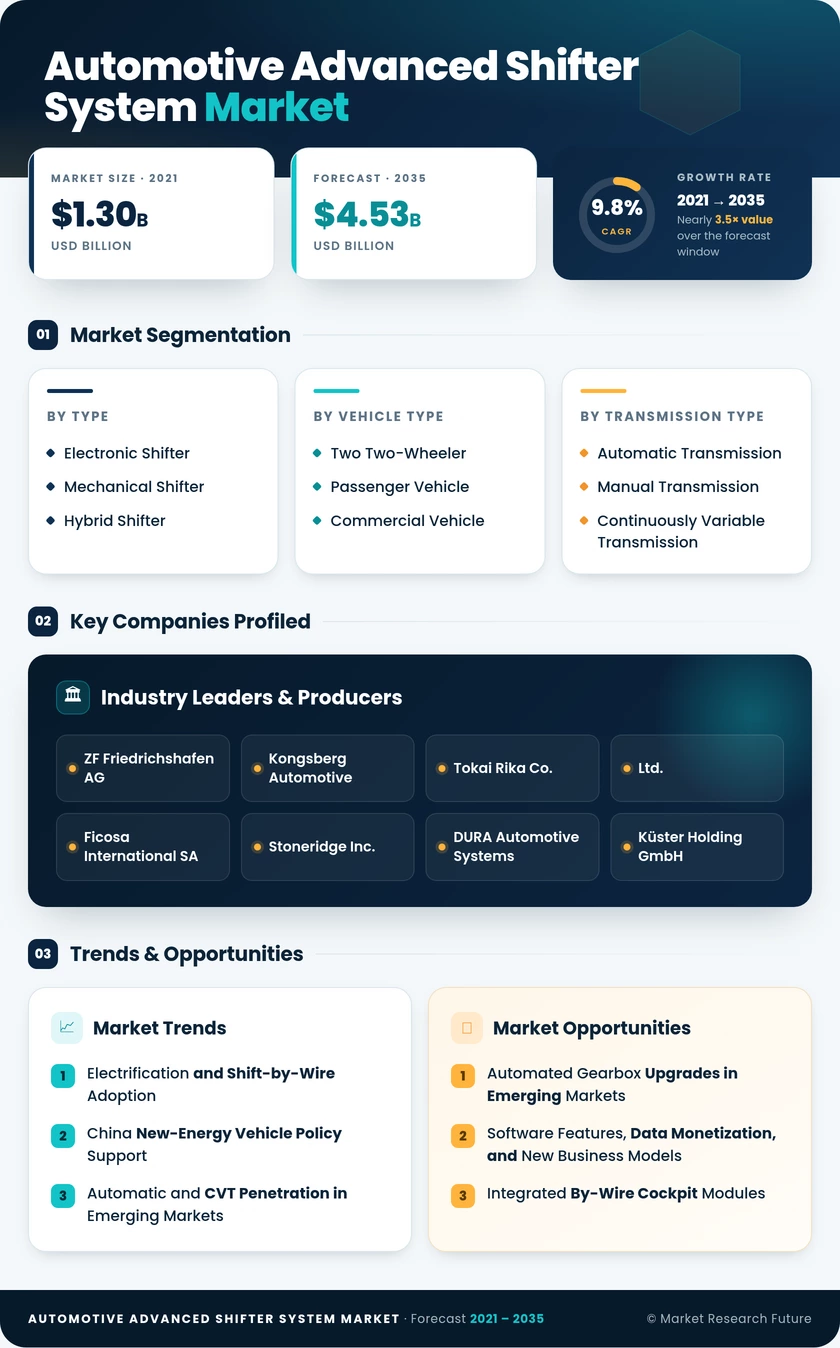
Automotive Advanced Shifter System Market Research Report By Type (Electronic Shifter, Mechanical Shifter, Hybrid Shifter), By Vehicle Type (Two-Wheeler, Passenger Vehicle, Commercial Vehicle), By Transmission Type (Automatic Transmission, Manual Transmission, Continuously Variable Transmission), By Driving Mechanism (Internal Combustion Engine, Electric Vehicle, Hybrid Electric Vehicle) - Forecast to 2035
Automotive Advanced Shifter System Market
Market Size
Forecast Period2026-2035
CAGR (2026-2035)9.8%
2025 Market SizeUSD 1.78 Billion
2035 Market SizeUSD 4.53 Billion
Key Players
ZF Friedrichshafen AG
Kongsberg Automotive
Tokai Rika Co., Ltd.
Ficosa International SA
Stoneridge Inc.
DURA Automotive Systems
Opportunities
  • Automated Gearbox Upgrades in Emerging Markets
  • Software Features, Data Monetization, and New Business Models
  • Integrated By-Wire Cockpit Modules
  1. 1 Market Summary | |
  2. 2 Key Report Takeaways | |
    1. 2.1 By Type | |
    2. 2.2 By Vehicle Type | |
    3. 2.3 By Transmission Type | |
    4. 2.4 By Driving Mechanism | |
    5. 2.5 By Region | |
  3. 3 Market Size and Forecast (2021–2035) | |
  4. 4 Driver Impact Analysis | |
    1. 4.1 Electrification and Shift-by-Wire Adoption | |
    2. 4.2 China New-Energy Vehicle Policy Support | |
    3. 4.3 Automatic and CVT Penetration in Emerging Markets | |
    4. 4.4 Light-Duty Emissions Regulation | |
    5. 4.5 Heavy-Duty CO2 Rules and Fleet Automation | |
    6. 4.6 ADAS and Automated Parking Integration | |
  5. 5 Restraints Impact Analysis | |
    1. 5.1 Cost Premium over Cable Shifters | |
    2. 5.2 Functional Safety and Cybersecurity Compliance Burden | |
    3. 5.3 Semiconductor Supply Volatility | |
    4. 5.4 Driver Interface Confusion and Recall Exposure | |
    5. 5.5 Selector Content Erosion in Single-Speed EVs | |
  6. 6 Opportunities | |
    1. 6.1 Automated Gearbox Upgrades in Emerging Markets | |
    2. 6.2 Software Features, Data Monetization, and New Business Models | |
    3. 6.3 Integrated By-Wire Cockpit Modules | |
    4. 6.4 Electronic Clutch and Shift Systems for Two-Wheelers | |
    5. 6.5 Commercial Vehicle Retrofit and Aftermarket Services | |
  7. 7 Regional Market Share and Country-Level Analysis | |
    1. 7.1 North America | | |
      1. 7.1.1 US | | |
      2. 7.1.2 Canada | | |
      3. 7.1.3 Mexico | |
    2. 7.2 Europe | | |
      1. 7.2.1 Germany | | |
      2. 7.2.2 UK | | |
      3. 7.2.3 France | | |
      4. 7.2.4 Italy | | |
      5. 7.2.5 Spain | | |
      6. 7.2.6 Nordic Countries | | |
      7. 7.2.7 Russia | | |
      8. 7.2.8 Rest of Europe | |
    3. 7.3 Asia-Pacific | | |
      1. 7.3.1 China | | |
      2. 7.3.2 India | | |
      3. 7.3.3 Japan | | |
      4. 7.3.4 South Korea | | |
      5. 7.3.5 ASEAN | | |
      6. 7.3.6 Rest of Asia-Pacific | |
    4. 7.4 South America | | |
      1. 7.4.1 Brazil | | |
      2. 7.4.2 Argentina | | |
      3. 7.4.3 Rest of South America | |
    5. 7.5 Middle East & Africa | | |
      1. 7.5.1 Saudi Arabia | | |
      2. 7.5.2 UAE | | |
      3. 7.5.3 South Africa | | |
      4. 7.5.4 Egypt | | |
      5. 7.5.5 Rest of MEA | |
  8. 8 Future Outlook (2026–2035) | |
    1. 8.1 Software-Defined Vehicles and Centralized Compute | |
    2. 8.2 Electrification Supercycle | |
    3. 8.3 Autonomy and Interior Reconfiguration | |
    4. 8.4 Sustainability and Circular Design | |
  9. 9 Segmentation Analysis | |
    1. 9.1 By Type | | |
      1. 9.1.1 Electronic Shifter | | |
      2. 9.1.2 Mechanical Shifter | | |
      3. 9.1.3 Hybrid Shifter | |
    2. 9.2 By Vehicle Type | | |
      1. 9.2.1 Two-Wheeler | | |
      2. 9.2.2 Passenger Vehicle | | |
      3. 9.2.3 Commercial Vehicle | |
    3. 9.3 By Transmission Type | | |
      1. 9.3.1 Automatic Transmission | | |
      2. 9.3.2 Manual Transmission | | |
      3. 9.3.3 Continuously Variable Transmission | |
    4. 9.4 By Driving Mechanism | | |
      1. 9.4.1 Internal Combustion Engine | | |
      2. 9.4.2 Electric Vehicle | | |
      3. 9.4.3 Hybrid Electric Vehicle | |
  10. 10 Competitive Landscape | |
    1. 10.1 Market Concentration Overview | |
    2. 10.2 Competitive Benchmarking Matrix | |
    3. 10.3 Company Profiles | | |
      1. 10.3.1 ZF Friedrichshafen AG | | |
      2. 10.3.2 Kongsberg Automotive | | |
      3. 10.3.3 Tokai Rika Co., Ltd. | | |
      4. 10.3.4 Ficosa International SA | | |
      5. 10.3.5 Stoneridge Inc. | | |
      6. 10.3.6 DURA Automotive Systems | | |
      7. 10.3.7 Küster Holding GmbH | | |
      8. 10.3.8 GHSP | | |
      9. 10.3.9 SL Corporation | | |
      10. 10.3.10 Eissmann Group Automotive | |
  11. 11 Recent News & Developments | |
  12. 12 Report Scope and Methodology | |
  13. 13 Detailed Sources and Citations | |
  14. 14 Frequently Asked Questions (FAQs) | | LIST OF TABLES | |
  15. TABLE 1 Global Market Snapshot – Key Metrics, 2025–2035 | |
  16. TABLE 2 Global Market Size & Forecast, by Revenue (USD Billion), 2021–2035 | |
  17. TABLE 3 Driver Impact Analysis on CAGR, 2026–2035 | |
  18. TABLE 4 Restraints Impact Analysis on CAGR, 2026–2035 | |
  19. TABLE 5 Regional Summary, 2025 | |
  20. TABLE 6 North America – Country-Level Analysis | |
  21. TABLE 7 Europe – Country-Level Analysis | |
  22. TABLE 8 Asia-Pacific – Country-Level Analysis | |
  23. TABLE 9 South America – Country-Level Analysis | |
  24. TABLE 10 Middle East & Africa – Country-Level Analysis | |
  25. TABLE 11 Segmentation by Type | |
  26. TABLE 12 Segmentation by Vehicle Type | |
  27. TABLE 13 Segmentation by Transmission Type | |
  28. TABLE 14 Segmentation by Driving Mechanism | |
  29. TABLE 15 Competitive Benchmarking Matrix, 2025 | |
  30. TABLE 16 Report Scope and Methodology | |
  31. TABLE 17 Detailed Sources and Citations | |
  32. TABLE 18 Segmentation Quick Reference | |
  33. TABLE 19 Market Segmentation Overview – Key Trends by Sub-Segment | | LIST OF FIGURES | |
  34. FIGURE 1 Market Dynamics – Drivers, Restraints and Opportunities | |
  35. FIGURE 2 Industry Value Chain Analysis | |
  36. FIGURE 3 Porter's Five Forces Analysis | |
  37. FIGURE 4 Global Market Size Trend (USD Billion), 2021–2035 | |
  38. FIGURE 5 Market Share by Type, 2025 | |
  39. FIGURE 6 Market Share by Vehicle Type, 2025 | |
  40. FIGURE 7 Market Share by Transmission Type, 2025 | |
  41. FIGURE 8 Market Share by Driving Mechanism, 2025 | |
  42. FIGURE 9 Regional Market Share, 2025 | |
  43. FIGURE 10 Country-Level Share within Asia-Pacific, 2025 | |
  44. FIGURE 11 Competitive Landscape – Estimated Revenue Share Ranges, 2025 | |
  45. FIGURE 12 Competitive Positioning Matrix

Segmentation Quick Reference

DimensionSub-SegmentsDominant SegmentFastest Growing Segment
By TypeElectronic Shifter, Mechanical Shifter, Hybrid ShifterElectronic Shifter (67.3% share)Electronic Shifter (67.3% share)
By Vehicle TypeTwo-Wheeler, Passenger Vehicle, Commercial VehiclePassenger Vehicle (65.4% share)Commercial Vehicle (9.9% CAGR)
By Transmission TypeAutomatic Transmission, Manual Transmission, Continuously Variable TransmissionAutomatic Transmission (70.6% share)Continuously Variable Transmission (10.0% CAGR)
By Driving MechanismInternal Combustion Engine, Battery Electric Vehicle, Hybrid Electric VehicleInternal Combustion Engine (69.5% share)Battery Electric Vehicle (9.9% CAGR)
By RegionNorth America, Europe, Asia-Pacific, South America, Middle East & AfricaAsia-Pacific (44.8% share)Asia-Pacific (44.8% share)


Market Segmentation Overview

By Type

Sub-SegmentKey Trend
Electronic ShifterIntegration with EV domain controllers and over-the-air updates
Mechanical ShifterRetained in off-road pickups and budget vans
Hybrid ShifterMechanical fallback beneath electronic actuation for redundancy


Electronic Shifter leads with a 67.3% share and is also the fastest-growing type, since electric drivetrains have no mechanical gearbox linkage to operate. Mechanical Shifter demand survives in utility vehicles where cable durability and low cost outweigh digital features. Hybrid Shifter designs serve OEMs that want electronic functions with a mechanical safety backup.

By Vehicle Type

Sub-SegmentKey Trend
Two WheelerElectronic clutch systems and electric scooter selectors
Passenger VehicleRotary dials and column stalks in SUVs and EVs
Commercial VehicleTelematics-linked shifting for fleet efficiency


Passenger Vehicle applications lead with a 65.4% share, driven by near-universal automatic fitment in SUVs and crossovers. Commercial Vehicle grows fastest at a 9.9% CAGR because fleet operators use shift data for predictive maintenance and must meet heavy-duty CO2 limits. Two -wheeler volumes remain small but benefit from new electronic clutch technology.

By Transmission Type

Sub-SegmentKey Trend
Automatic TransmissionSelf-shifting convenience across global SUV fleets
Manual TransmissionRev-matching and hill-start electronics in enthusiast models
Continuously Variable TransmissionSimulated stepped shifts via electronic selectors


Automatic Transmission dominates with a 70.6% share, reflecting consumer preference for two-pedal driving. Continuously Variable Transmission grows fastest at a 10.0% CAGR, as OEMs pair it with small turbocharged engines and hybrid systems to meet fuel-economy targets. Manual Transmission continues to lose share, though it is gaining electronic assist functions.

By Driving Mechanism

Sub-SegmentKey Trend
Internal Combustion EngineLarge production base with rising automatic content
Battery Electric VehicleSelectors evolve into multi-modal drive controllers.
Hybrid Electric VehicleCoordinating engine and motor states through electronic actuation


Internal Combustion Engine platforms lead with a 69.5% share because of their installed manufacturing scale. Battery Electric Vehicle applications grow fastest at a 9.9% CAGR, with selectors managing regeneration levels and one-pedal driving rather than gears. Hybrid Electric Vehicle systems add validation complexity, which reinforces reliance on shift-by-wire.




Download PDF ×

We do not share your information with anyone. However, we may send you emails based on your report interest from time to time. You may contact us at any time to opt-out.