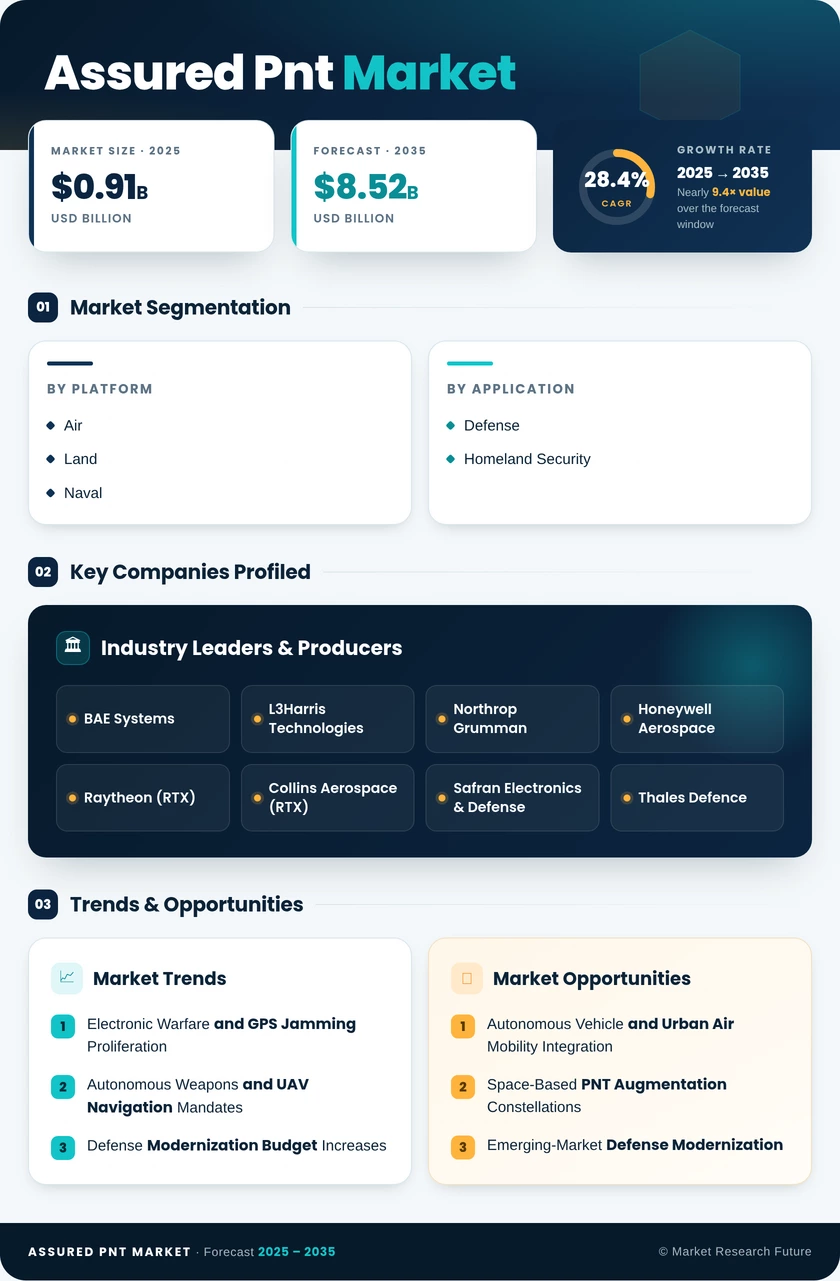
Assured PNT Market

ID: MRFR/AD/12483-HCR
200 Pages
Abbas Raut
Last Updated: June 03, 2026
Assured PNT Market Size, Share, Industry Trend & Analysis Research Report By Platform (Air, Land, Naval), By End User (Defense, Homeland Security), By Geography (North America, Europe, Asia-Pacific, South America, Middle East & Africa) -Forecast to 2035
Download PDF ×

We do not share your information with anyone. However, we may send you emails based on your report interest from time to time. You may contact us at any time to opt-out.

Assured PNT Market

Market Size

Forecast Period2026-2035
CAGR (2026-2035)28.4%
2025 Market SizeUSD 0.91 Billion
2035 Market SizeUSD 8.52 Billion

Key Players

BAE Systems
L3Harris Technologies
Northrop Grumman
Honeywell Aerospace
Raytheon
Collins Aerospace
Opportunities
  • Autonomous Vehicle and Urban Air Mobility Integration
  • Space-Based PNT Augmentation Constellations
  • Emerging-Market Defense Modernization
  1. 1 Market Overview |
    1. 1.1 Study Assumptions & Market Definition |
    2. 1.2 Scope of the Study |
    3. 1.3 Research Methodology
  2. 2 Market Summary & Key Takeaways
  3. 3 Market Dynamics |
    1. 3.1 Market Drivers Analysis | |
      1. 3.1.1 Electronic Warfare & GPS Jamming Proliferation | |
      2. 3.1.2 Autonomous Weapons & UAV Navigation Mandates | |
      3. 3.1.3 Defense Modernization Budget Increases | |
      4. 3.1.4 Critical Infrastructure Timing Resilience Regulations | |
      5. 3.1.5 Missile Guidance Precision Requirements | |
      6. 3.1.6 Miniaturization of Inertial and Atomic-Clock Sensors | |
      7. 3.1.7 Space-Based PNT Augmentation Constellations |
    2. 3.2 Market Restraints Analysis | |
      1. 3.2.1 High Development and Integration Costs | |
      2. 3.2.2 Absence of Unified Performance Standards | |
      3. 3.2.3 Export Control and ITAR Restrictions | |
      4. 3.2.4 Limited Commercial Return on Investment | |
      5. 3.2.5 Technology Maturity Gaps in Non-GNSS Sensors |
    3. 3.3 Market Opportunity Analysis | |
      1. 3.3.1 Autonomous Vehicle and Urban Air Mobility Integration | |
      2. 3.3.2 Space-Based PNT Augmentation Constellations | |
      3. 3.3.3 Emerging-Market Defense Modernization | |
      4. 3.3.4 PNT-as-a-Service and Data Monetization | |
      5. 3.3.5 Counter-Spoofing Software and Cybersecurity Overlay |
    4. 3.4 Industry Value Chain Analysis |
    5. 3.5 Porter's Five Forces Analysis
  4. 4 Global Assured PNT Market Size & Forecast (2021–2035) |
    1. 4.1 Historical Market Size (2021–2025) |
    2. 4.2 Current & Forecast Market Size (2026–2035) |
    3. 4.3 Market Size by Revenue (USD Billion) |
    4. 4.4 Year-over-Year Growth Analysis
  5. 5 Segmentation Analysis |
    1. 5.1 By Platform | |
      1. 5.1.1 Air | |
      2. 5.1.2 Land | |
      3. 5.1.3 Naval |
    2. 5.2 By End User | |
      1. 5.2.1 Defense | |
      2. 5.2.2 Homeland Security
  6. 6 Regional Analysis |
    1. 6.1 North America | |
      1. 6.1.1 United States | |
      2. 6.1.2 Canada | |
      3. 6.1.3 Mexico |
    2. 6.2 Europe | |
      1. 6.2.1 Germany | |
      2. 6.2.2 United Kingdom | |
      3. 6.2.3 France | |
      4. 6.2.4 Italy | |
      5. 6.2.5 Spain | |
      6. 6.2.6 Nordic Countries | |
      7. 6.2.7 Russia | |
      8. 6.2.8 Rest of Europe |
    3. 6.3 Asia-Pacific | |
      1. 6.3.1 China | |
      2. 6.3.2 India | |
      3. 6.3.3 Japan | |
      4. 6.3.4 South Korea | |
      5. 6.3.5 ASEAN | |
      6. 6.3.6 Rest of Asia-Pacific |
    4. 6.4 South America | |
      1. 6.4.1 Brazil | |
      2. 6.4.2 Argentina | |
      3. 6.4.3 Rest of South America |
    5. 6.5 Middle East & Africa | |
      1. 6.5.1 Saudi Arabia | |
      2. 6.5.2 UAE | |
      3. 6.5.3 South Africa | |
      4. 6.5.4 Egypt | |
      5. 6.5.5 Rest of MEA
  7. 7 Competitive Landscape |
    1. 7.1 Market Share Analysis (2025) |
    2. 7.2 Competitive Benchmarking Matrix |
    3. 7.3 Company Profiles | |
      1. 7.3.1 BAE Systems | |
      2. 7.3.2 L3Harris Technologies | |
      3. 7.3.3 Northrop Grumman | |
      4. 7.3.4 Honeywell Aerospace | |
      5. 7.3.5 Raytheon (RTX) | |
      6. 7.3.6 Collins Aerospace (RTX) | |
      7. 7.3.7 Safran Electronics & Defense | |
      8. 7.3.8 Thales Defence | |
      9. 7.3.9 Orolia (Safran) | |
      10. 7.3.10 General Dynamics Mission Systems
  8. 8 Future Outlook & Strategic Recommendations (2026–2035) |
    1. 8.1 AI-Enabled Autonomous Navigation |
    2. 8.2 LEO PNT Constellation Economics |
    3. 8.3 Quantum Sensing and Next-Generation Inertial Systems |
    4. 8.4 Cybersecurity and Signal Authentication Frameworks
  9. 9 Recent Developments & News
  10. 10 Frequently Asked Questions (FAQs)
  11. 11 Report Scope & Methodology |
    1. 11.1 Study Period & Base Year |
    2. 11.2 Data Sources & Citations |
    3. 11.3 Abbreviations
  12. 12 LIST OF TABLES |
  13. TABLE 1 Global Assured PNT Market Size & Forecast, by Revenue (USD Billion), 2021–2035 |
  14. TABLE 2 Global Assured PNT Market – Year-over-Year Growth Analysis, 2021–2035 |
  15. TABLE 3 Global Assured PNT Market – Driver Impact Analysis, 2026–2035 |
  16. TABLE 4 Global Assured PNT Market – Restraint Impact Analysis, 2026–2035 |
  17. TABLE 5 Global Assured PNT Market Size, by Platform, 2021–2035 (USD Billion) |
  18. TABLE 6 Global Assured PNT Market Size, by End User, 2021–2035 (USD Billion) |
  19. TABLE 7 Global Assured PNT Market Size, by Region, 2021–2035 (USD Billion) |
  20. TABLE 8 North America Assured PNT Market Size, by Country, 2021–2035 (USD Billion) |
  21. TABLE 9 Europe Assured PNT Market Size, by Country, 2021–2035 (USD Billion) |
  22. TABLE 10 Asia-Pacific Assured PNT Market Size, by Country, 2021–2035 (USD Billion) |
  23. TABLE 11 South America Assured PNT Market Size, by Country, 2021–2035 (USD Billion) |
  24. TABLE 12 Middle East & Africa Assured PNT Market Size, by Country, 2021–2035 (USD Billion) |
  25. TABLE 13 Competitive Benchmarking Matrix – Global Assured PNT Market, 2025 |
  26. TABLE 14 Company Profiles – Key Players, Global Assured PNT Market |
  27. TABLE 15 Recent Developments & Strategic Announcements, 2023–2025 |
  28. TABLE 16 Report Scope & Methodology Summary |
  29. TABLE 17 Detailed Sources and Citations |
  30. TABLE 18 North America Assured PNT Market Size, by Platform, 2021–2035 (USD Billion) |
  31. TABLE 19 North America Assured PNT Market Size, by End User, 2021–2035 (USD Billion) |
  32. TABLE 20 Europe Assured PNT Market Size, by Platform, 2021–2035 (USD Billion) |
  33. TABLE 21 Europe Assured PNT Market Size, by End User, 2021–2035 (USD Billion) |
  34. TABLE 22 Asia-Pacific Assured PNT Market Size, by Platform, 2021–2035 (USD Billion) |
  35. TABLE 23 Asia-Pacific Assured PNT Market Size, by End User, 2021–2035 (USD Billion) |
  36. TABLE 24 South America Assured PNT Market Size, by Platform, 2021–2035 (USD Billion) |
  37. TABLE 25 South America Assured PNT Market Size, by End User, 2021–2035 (USD Billion) |
  38. TABLE 26 Middle East & Africa Assured PNT Market Size, by Platform, 2021–2035 (USD Billion) |
  39. TABLE 27 Middle East & Africa Assured PNT Market Size, by End User, 2021–2035 (USD Billion)
  40. 13 LIST OF FIGURES |
  41. FIGURE 1 Global Assured PNT Market Dynamics (Drivers, Restraints, Opportunities) |
  42. FIGURE 2 Industry Value Chain Analysis – Assured PNT Market |
  43. FIGURE 3 Porter's Five Forces Analysis – Assured PNT Market |
  44. FIGURE 4 Global Assured PNT Market Size Trend & Forecast, 2021–2035 (USD Billion) |
  45. FIGURE 5 Global Assured PNT Market Share, by Platform, 2025 (%) |
  46. FIGURE 6 Global Assured PNT Market Share, by End User, 2025 (%) |
  47. FIGURE 7 Global Assured PNT Market Share, by Region, 2025 (%) |
  48. FIGURE 8 North America Assured PNT Market Size, 2021–2035 (USD Billion) |
  49. FIGURE 9 Europe Assured PNT Market Size, 2021–2035 (USD Billion) |
  50. FIGURE 10 Asia-Pacific Assured PNT Market Size, 2021–2035 (USD Billion) |
  51. FIGURE 11 South America Assured PNT Market Size, 2021–2035 (USD Billion) |
  52. FIGURE 12 Middle East & Africa Assured PNT Market Size, 2021–2035 (USD Billion) |
  53. FIGURE 13 Competitive Landscape – Market Share Analysis, 2025 |
  54. FIGURE 14 Competitive Benchmarking Radar Chart – Top 10 Players

Segmentation Quick Reference

DimensionSub-SegmentsDominant SegmentFastest Growing Segment
By PlatformAir, Land, NavalAirLand
By End UserDefense, Homeland SecurityDefenseHomeland Security
By GeographyNorth America, Europe, Asia-Pacific, South America, Middle East & AfricaNorth AmericaAsia-Pacific


Market Segmentation Overview

By Platform

Sub-SegmentKey Trend
AirFifth-gen fighter and UAV integration mandates driving anti-jam GNSS receiver adoption.
LandArmy vehicle modernization programs (MAPS, Scorpion) are embedding multi-source PNT.
NavalSubmarine and surface combatant demand for GPS-independent navigation


The platform segmentation reflects the domain-specific vulnerabilities that drive assured PNT adoption. Airborne platforms face the highest jamming exposure at altitude, while land forces prioritize dismounted and mounted soldier solutions. Naval platforms require long-duration GPS-free positioning for undersea operations.

By End User

Sub-SegmentKey Trend
DefenseMulti-domain integration across strategic missiles, tactical communications, and autonomous systems
Homeland SecurityCritical infrastructure timing, resilience and border surveillance positioning needs


Defense remains the primary revenue source, but homeland security adoption is accelerating as civilian infrastructure operators recognize their dependence on vulnerable GPS timing. Regulatory mandates in the U.S. and Europe are creating new procurement pathways for assured PNT solutions beyond traditional military channels.

By Geography

Sub-SegmentKey Trend
North AmericaMAPS production, NDAA PNT line items, eLoran backup infrastructure
EuropeGalileo PRS rollout, NATO interoperability investments, UK PNT Strategy 2030
Asia-PacificBeiDou-3 hardening, NavIC expansion, South Korean counter-jamming programs
South AmericaSIVAM border surveillance, Amazon jungle operations navigation
Middle East & AfricaVision 2030 defense localization, counter-drone timing, and missile guidance systems


Geographic demand patterns reflect the intersection of regional threat environments and defense budget trajectories. North America leads on absolute spend, while Asia-Pacific's growth rate outpaces all other regions, driven by indigenous constellation investments and military modernization across China, India, Japan, and South Korea.