Asphalt Pavers Market (2026 - 2035)

ID: MRFR/Equip/40132-CR 200 Pages Snehal Singh Last Updated: October 16, 2026
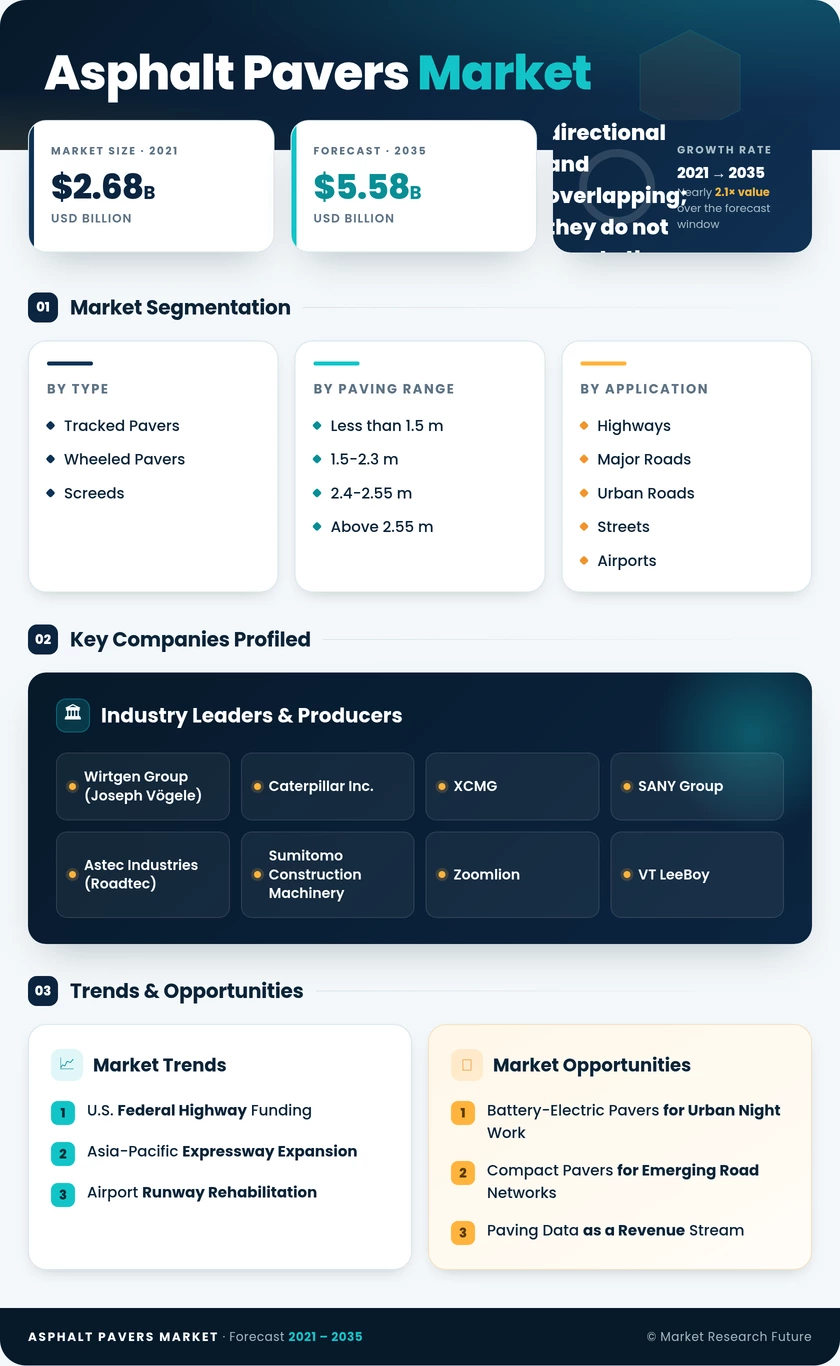
Asphalt Pavers Market Research Report By Type (Tracked Pavers, Wheeled Pavers, Screeds), By Paving Range (Less than 1.5 m, 1.5-2.3 m, 2.4-2.55 m, Above 2.55 m), By Application (Highways and Major Roads, Urban Roads and Streets, Airports, Others, Parking Lots and Driveways), By End-User (Government and Public Agencies, Private Construction Contractors, Rental Companies) - Forecast to 2035
Asphalt Pavers Market
Market Size
Forecast Period2026-2035
CAGR (2026-2035)5.48%
2025 Market SizeUSD 3.27 Billion
2035 Market SizeUSD 5.58 Billion
Key Players
Wirtgen Group
Caterpillar Inc.
XCMG
SANY Group
Astec Industries
Sumitomo Construction Machinery
Opportunities
  • Battery-Electric Pavers for Urban Night Work
  • Compact Pavers for Emerging Road Networks
  • Paving Data as a Revenue Stream
  1. 1 Market Summary | |
  2. 2 Key Report Takeaways | |
    1. 2.1 By Type | |
    2. 2.2 By Paving Range | |
    3. 2.3 By Application | |
    4. 2.4 By End-User | |
    5. 2.5 By Region | |
  3. 3 Market Size and Forecast (2021–2035) | |
  4. 4 Driver Impact Analysis | |
    1. 4.1 U.S. Federal Highway Funding | |
    2. 4.2 Asia-Pacific Expressway Expansion | |
    3. 4.3 Airport Runway Rehabilitation | |
    4. 4.4 Gulf and African Road Programs | |
    5. 4.5 Pavement Preservation Spending | |
    6. 4.6 Digital Paving Specifications | |
    7. 4.7 Rental Fleet Expansion | |
  5. 5 Restraints Impact Analysis | |
    1. 5.1 High Acquisition and Financing Costs | |
    2. 5.2 Skilled Operator Shortage | |
    3. 5.3 Emissions Compliance Costs | |
    4. 5.4 Binder Price Volatility | |
    5. 5.5 Used-Equipment Competition | |
  6. 6 Opportunities | |
    1. 6.1 Battery-Electric Pavers for Urban Night Work | |
    2. 6.2 Compact Pavers for Emerging Road Networks | |
    3. 6.3 Paving Data as a Revenue Stream | |
    4. 6.4 Subscription and Fleet-Package Models | |
    5. 6.5 Low-Carbon Mix Compatibility | |
  7. 7 Regional Market Share and Country-Level Analysis | |
    1. 7.1 North America | | |
      1. 7.1.1 United States | |
  8. 8 Future Outlook (2026–2035) | |
    1. 8.1 Automation and 3D Machine Control | |
    2. 8.2 Electrification of Paving Fleets | |
    3. 8.3 Service-Led Business Models | |
    4. 8.4 Low-Carbon Pavement Reporting | |
  9. 9 Segmentation Analysis | |
    1. 9.1 By Type | | |
      1. 9.1.1 Tracked Pavers | | |
      2. 9.1.2 Wheeled Pavers | | |
      3. 9.1.3 Screeds | |
    2. 9.2 By Paving Range | | |
      1. 9.2.1 Less than
    3. 1.5 m | | |
      1. 9.2.2 Above
    4. 1.5-2.3 m | | |
    5. 2.4-2.55 m | | |
    6. 2.55 m | |
    7. 9.3 By Application | | |
      1. 9.3.1 Highways and Major Roads | | |
      2. 9.3.2 Urban Roads and Streets | | |
      3. 9.3.3 Airports | | |
      4. 9.3.4 Others | | |
      5. 9.3.5 Parking Lots and Driveways | |
    8. 9.4 By End-User | | |
      1. 9.4.1 Government and Public Agencies | | |
      2. 9.4.2 Private Construction Contractors | | |
      3. 9.4.3 Rental Companies | |
  10. 10 Competitive Landscape | |
  11. 11 Recent News & Developments | |
  12. 12 Report Scope and Methodology | |
  13. 13 Detailed Sources and Citations | |
  14. 14 Frequently Asked Questions (FAQs) | | LIST OF TABLES | |
  15. TABLE 1 Global Market Snapshot – Study Period, Market Size, CAGR, and Regional Leaders | |
  16. TABLE 2 Global Market Size & Forecast, by Revenue (USD Billion), 2021–2035 | |
  17. TABLE 3 Driver Impact Analysis, 2026–2035 | |
  18. TABLE 4 Restraints Impact Analysis, 2026–2035 | |
  19. TABLE 5 Regional Summary, by Region, 2025 | |
  20. TABLE 6 North America Market, by Country, 2025 | |
  21. TABLE 7 Market Segmentation, by Type, 2025–2035 | |
  22. TABLE 8 Market Segmentation, by Paving Range, 2025–2035 | |
  23. TABLE 9 Market Segmentation, by Application, 2025–2035 | |
  24. TABLE 10 Market Segmentation, by End-User, 2025–2035 | |
  25. TABLE 11 Competitive Benchmarking Matrix, 2025 | |
  26. TABLE 12 Report Scope and Methodology | |
  27. TABLE 13 Detailed Sources and Citations | |
  28. TABLE 14 Segmentation Quick Reference | | LIST OF FIGURES | |
  29. FIGURE 1 Market Dynamics – Drivers, Restraints, and Opportunities | |
  30. FIGURE 2 Industry Value Chain Analysis | |
  31. FIGURE 3 Porter's Five Forces Analysis | |
  32. FIGURE 4 Global Market Size Trend (USD Billion), 2021–2035 | |
  33. FIGURE 5 Market Share, by Type, 2025 | |
  34. FIGURE 6 Market Share, by Paving Range, 2025 | |
  35. FIGURE 7 Market Share, by Application, 2025 | |
  36. FIGURE 8 Market Share, by End-User, 2025 | |
  37. FIGURE 9 Regional Market Share, 2025 | |
  38. FIGURE 10 North America Market Share, by Country, 2025 | |
  39. FIGURE 11 Competitive Landscape – Estimated Revenue Share Ranges, 2025

Segmentation Quick Reference

DimensionSub-SegmentsDominant SegmentFastest Growing Segment
By TypeTracked Pavers; Wheeled Pavers; ScreedsTracked Pavers (60.2% share)Screeds (7.35% CAGR)
By Paving RangeLess than 1.5 m; 1.5-2.3 m; 2.4-2.55 m; Above 2.55 m2.4-2.55 m (38.3% share)Above 2.55 m (8.10% CAGR)
By ApplicationHighways and Major Roads; Urban Roads and Streets; Airports; OthersHighways and Major Roads (49.3% share)Airports (8.54% CAGR)
By End-UserGovernment and Public Agencies; Private Construction Contractors; Rental CompaniesGovernment and Public Agencies (54.8% share)Rental Companies (6.60% CAGR)
By RegionNorth America; Europe; Asia-Pacific; South America; Middle East & AfricaAsia-Pacific (41.5% share)Middle East & Africa (7.1% CAGR)


Market Segmentation Overview

By Type

Sub-SegmentKey Trend
Tracked PaversHigher travel-speed modes and first battery-electric models
Wheeled PaversTighter turning radii and semi-autonomous steering
ScreedsSensor-equipped extendable screeds for thin overlays


Tracked Pavers lead because their traction on soft bases and grades makes them the default for highway output, and faster travel modes are reducing the relocation advantage of Wheeled Pavers. Screeds grow fastest because preservation programs favor extendable units that automatically adjust tamper settings and record mat temperature for agency audits.

By Paving Range

Sub-SegmentKey Trend
Less than 1.5 mLightweight rubber-track units for narrow urban streets
1.5-2.3 mSteady municipal and collector-road replacement demand
2.4-2.55 mStandard single-lane highway specification
Above 2.55 mWide screeds for runways and multi-lane expressways


The 2.4-2.55 m class leads because it matches the single-lane highway widths specified by most agencies. Machines above 2.55 m grow fastest as runway owners and expressway builders pay for fewer passes and fewer cold joints, while the Less than 1.5 m range benefits from expanding pedestrian and cycling infrastructure.

By Application

Sub-SegmentKey Trend
Highways and Major RoadsIntelligent compaction and thermal profiling mandates
Urban Roads and StreetsLow-noise night paving with compact and electric units
Airports24/7 runway windows with laser-guided wide screeds
OthersCommercial parking and industrial-yard paving


Highways and Major Roads dominate because national and federal budgets fund most surface-transport paving, and instrumented pavers are becoming standard on these contracts. Airports grow fastest because runway closure penalties justify premium, high-throughput machines, while Urban Roads and Streets keep compact-unit demand steady.

By End-User

Sub-SegmentKey Trend
Government and Public AgenciesDirect ownership and tightly specified public contracts
Private Construction ContractorsShift from ownership toward leasing
Rental CompaniesRental-optimized configurations and fleet packages


Government and Public Agencies lead through sovereign infrastructure mandates and specification control over publicly funded paving. Rental Companies grow fastest because Private Construction Contractors are moving depreciation and maintenance risk to rental fleets, prompting OEMs to design quick-swap screeds and telematics-heavy configurations for multi-customer use.




Download PDF ×

We do not share your information with anyone. However, we may send you emails based on your report interest from time to time. You may contact us at any time to opt-out.