Request Free Sample ×

Kindly complete the form below to receive a free sample of this Report

* Please use a valid business email

Leading companies partner with us for data-driven Insights

clients tt-cursor
Hero Background
English
Chinese
French
Japanese
Korean
German
Spanish

Asia Pacific Cancer Immunotherapy Market Analysis

ID: MRFR/Pharma/0196-HCR
50 Pages
Rahul Gotadki
Last Updated: April 06, 2026

Asia-Pacific Cancer Immunotherapy Market Research Report: Information By Type (Monoclonal Antibodies, Cancer Vaccines, and Immunomodulators), By Application (Lung Cancer, Blood Cancer, Melanoma, and Breast Cancer), By End User (Hospitals, Research Laboratories, and Cancer Institutes), And by Region (Asia-Pacific) –Market Forecast Till 2035

Share:
Download PDF ×

We do not share your information with anyone. However, we may send you emails based on your report interest from time to time. You may contact us at any time to opt-out.

Asia Pacific Cancer Immunotherapy Market Infographic
Purchase Options

Market Analysis

In-depth Analysis of Asia Pacific Cancer Immunotherapy Market Industry Landscape

Cancer immunotherapy is benefiting from Asia Pacific's rising cancer diagnosis rate. The prevalence of senior people, lifestyle changes, and the environment are contributing to a rise in some cancers in the area. Immunotherapy for cancer is new in Asia-Pacific. Using the immune system to fight cancer is a growing industrial trend. It appears like a potential alternative to traditional cancer immunotherapy.

Immunotherapy has a lot of untapped potential, and Asia-Pacific countries are spending money to find new ways to use it. It is now possible to treat cancer better thanks to the work of the government and groups that are not with either of them.

Many of the companies in the Asia-Pacific area that make cancer vaccines work in the science and drug industries. They make and sell the most cutting edge immunotherapeutic drugs on the market right now, which makes them a lot of money.

People with cancer can get help at a lot of study sites and clinical studies in this area. Different groups such as drug companies, schools, and study groups are working together to find out more about immunotherapeutics and how they can be used on people. This is a project for a group.

Inside the Asia-Pacific area, there are a lot more patient support groups and events that teach people about health services. To help more people learn about cancer immunotherapy, these groups want to make it easy to get more information about it. They also want to promote early cancer diagnosis and treatment so that many patients can have better results.

A "checkpoint inhibitor" is a type of immunity drug that is becoming better known in the Asia-Pacific room. These medical treatments are meant to get rid of chemicals that weaken and hurt the immune system. When these things get into the body, they help the immune system find and kill cancer cells.

The market is hurt by the fact that healthcare systems in Asia and the Pacific can't talk to each other. Possible that rich countries spend more on health care than less developed countries because their processes are better developed. Anyhow, countries that aren't as well developed might have trouble with things like cost and access. Medical professionals, academic groups, and drug companies are talking to each other more these days. People can share tools and knowledge through these relationships. This will speed up the process of making immunotherapies for cancer in the long run.

What makes this possible is the price difference between biosimilars and real biologics. The market gets used to them every once in a while. Biologics are being used more and more as Asian and Pacific health care systems try to find the best mix of how well they work and how much they cost.

Each country in the Asia-Pacific area has its own rules about how to give and keep track of immunotherapeutic drugs. People from that country are the only ones who can follow these rules. So that new drugs can be used quickly and correctly, the government needs to make its processes clearer and more uniform.

There are changes in the drugs used to treat cancer in Asia and the Pacific because more and more people are getting personalized care. Biomarker study is becoming more popular because it helps doctors figure out what makes each patient special and pick the best drugs for them. The medicine works better this way, and it can be changed to fit the person.


Author
Author Profile
Rahul Gotadki
Research Manager

He holds an experience of about 9+ years in Market Research and Business Consulting, working under the spectrum of Life Sciences and Healthcare domains. Rahul conceptualizes and implements a scalable business strategy and provides strategic leadership to the clients. His expertise lies in market estimation, competitive intelligence, pipeline analysis, customer assessment, etc.

Leave a Comment

FAQs

What is the projected market valuation of the Asia-Pacific Cancer Immunotherapy Market by 2035?

<p>The market is projected to reach approximately 463.26 USD Billion by 2035.</p>

What was the market valuation of the Asia-Pacific Cancer Immunotherapy Market in 2024?

<p>In 2024, the market valuation stood at 130.18 USD Billion.</p>

What is the expected CAGR for the Asia-Pacific Cancer Immunotherapy Market during the forecast period 2025 - 2035?

<p>The expected CAGR for the market during this period is 12.23%.</p>

Which segment of the Asia-Pacific Cancer Immunotherapy Market had the highest valuation in 2024?

<p>Monoclonal Antibodies had the highest valuation at 52.09 USD Billion in 2024.</p>

What are the key applications driving the Asia-Pacific Cancer Immunotherapy Market?

<p>Key applications include Lung Cancer, Blood Cancer, Melanoma, and Breast Cancer.</p>

Which company is a leading player in the Asia-Pacific Cancer Immunotherapy Market?

Roche is among the leading players in the Asia-Pacific Cancer Immunotherapy Market.

What is the projected valuation for the Breast Cancer segment by 2035?

The Breast Cancer segment is projected to reach approximately 154.26 USD Billion by 2035.

How much is the Immunomodulators segment expected to grow by 2035?

The Immunomodulators segment is expected to grow to 172.26 USD Billion by 2035.

What is the expected market size for Research Laboratories in the Asia-Pacific Cancer Immunotherapy Market by 2035?

Research Laboratories are projected to reach a market size of 139.0 USD Billion by 2035.

Which end-use segment had the highest valuation in 2024?

In 2024, the Hospitals segment had the highest valuation at 52.09 USD Billion.

Market Summary

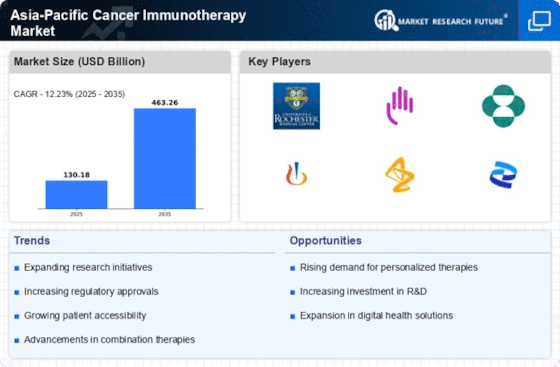
As per Market Research Future analysis, the Asia-Pacific Cancer Immunotherapy Market was estimated at 130.18 USD Billion in 2024. The cancer immunotherapy industry is projected to grow from 146.1 USD Billion in 2025 to 463.26 USD Billion by 2035, exhibiting a compound annual growth rate (CAGR) of 12.23% during the forecast period 2025 - 2035

Key Market Trends & Highlights

The Asia-Pacific Cancer Immunotherapy Market is poised for robust growth driven by innovative therapies and increasing patient demand.

  • The market is witnessing a surge in personalized medicine adoption, enhancing treatment efficacy for patients. Collaborative research initiatives are fostering innovation and accelerating the development of new immunotherapy options. Regulatory advancements are streamlining approval processes, thereby facilitating quicker market entry for novel therapies. Rising cancer incidence and increasing healthcare expenditure are key drivers propelling the growth of the market, particularly in the monoclonal antibodies and lung cancer segments.

Market Size & Forecast

2024 Market Size 130.18 (USD Billion)
2035 Market Size 463.26 (USD Billion)
CAGR (2025 - 2035) 12.23%
Largest Regional Market Share in 2024 Asia Pacific

Major Players

Roche (CH), Bristol-Myers Squibb (US), Merck &amp; Co. (US), Novartis (CH), AstraZeneca (GB), Pfizer (US), Gilead Sciences (US), Eli Lilly and Company (US), Amgen (US)

Market Trends

The Asia-Pacific Cancer Immunotherapy Market is currently experiencing a transformative phase, characterized by rapid advancements in treatment modalities and an increasing focus on personalized medicine. This region is witnessing a surge in research and development activities, driven by a growing understanding of the immune system's role in combating cancer. As healthcare systems evolve, there is a notable shift towards integrating immunotherapy into standard treatment protocols, which appears to enhance patient outcomes. Furthermore, collaborations between pharmaceutical companies and research institutions are fostering innovation, leading to the emergence of novel therapies that could redefine cancer care in the region. In addition, the Asia-Pacific Cancer Immunotherapy Market is influenced by rising healthcare expenditures and an expanding patient population. Governments are increasingly investing in healthcare infrastructure, which may facilitate broader access to advanced therapies. The regulatory landscape is also evolving, with authorities streamlining approval processes for new treatments, thereby potentially accelerating the availability of innovative immunotherapeutic options. As the market continues to mature, it seems poised for sustained growth, driven by ongoing scientific discoveries and a commitment to improving cancer treatment paradigms.

Personalized Medicine Adoption

The trend towards personalized medicine is gaining momentum within the Asia-Pacific Cancer Immunotherapy Market. Tailoring treatments to individual patient profiles appears to enhance efficacy and minimize adverse effects, leading to improved patient satisfaction and outcomes.

Collaborative Research Initiatives

Collaborative efforts between academic institutions and pharmaceutical companies are becoming increasingly prevalent. These partnerships may accelerate the development of novel immunotherapies, fostering innovation and enhancing the overall therapeutic landscape.

Regulatory Advancements

Regulatory bodies in the Asia-Pacific region are streamlining approval processes for immunotherapeutic agents. This trend could lead to faster market entry for new treatments, thereby expanding patient access to cutting-edge therapies.

Asia Pacific Cancer Immunotherapy Market Market Drivers

Rising Cancer Incidence

The Asia-Pacific Cancer Immunotherapy Market is experiencing a surge in demand due to the increasing incidence of cancer across the region. According to recent statistics, cancer cases in Asia-Pacific are projected to rise significantly, with estimates suggesting that by 2025, the number of new cancer cases could exceed 5 million annually. This alarming trend is driving healthcare systems to seek innovative treatment options, including immunotherapy, which has shown promising results in various cancer types. The growing awareness of cancer prevention and treatment options is further propelling the market, as patients and healthcare providers alike are increasingly inclined to explore advanced therapies that offer improved outcomes. As a result, the Asia-Pacific Cancer Immunotherapy Market is poised for substantial growth, reflecting the urgent need for effective cancer management solutions.

Increasing Healthcare Expenditure

The Asia-Pacific Cancer Immunotherapy Market is benefiting from rising healthcare expenditure across various countries in the region. Governments and private sectors are increasingly allocating funds to enhance healthcare infrastructure and improve access to advanced treatment options. For instance, countries like Japan and Australia have reported significant increases in healthcare budgets, with projections indicating a growth rate of 5% annually through 2025. This financial commitment is facilitating the adoption of cutting-edge therapies, including immunotherapy, which often require substantial investment. As healthcare systems strive to provide better cancer care, the Asia-Pacific Cancer Immunotherapy Market is likely to experience accelerated growth, driven by enhanced funding and resource allocation for innovative treatment modalities.

Regulatory Support for Immunotherapy

Regulatory bodies in the Asia-Pacific region are increasingly supportive of the development and approval of immunotherapy treatments, which is a key driver for the Asia-Pacific Cancer Immunotherapy Market. Streamlined approval processes and favorable regulatory frameworks are facilitating quicker access to innovative therapies. For example, the recent introduction of expedited review pathways for breakthrough therapies has significantly reduced the time required for new immunotherapeutic agents to reach the market. This regulatory environment not only encourages pharmaceutical companies to invest in research and development but also enhances patient access to potentially life-saving treatments. As regulatory support continues to strengthen, the Asia-Pacific Cancer Immunotherapy Market is expected to expand, reflecting the growing commitment to advancing cancer care.

Growing Patient Awareness and Advocacy

Patient awareness and advocacy are crucial drivers of the Asia-Pacific Cancer Immunotherapy Market. As more individuals become informed about cancer treatment options, there is a noticeable shift towards seeking advanced therapies like immunotherapy. Advocacy groups are playing a significant role in educating patients about the benefits and availability of these treatments, leading to increased demand. Surveys indicate that over 60% of patients are now aware of immunotherapy as a viable treatment option, compared to just 30% five years ago. This heightened awareness is encouraging healthcare providers to incorporate immunotherapy into treatment plans, thereby expanding the market. The Asia-Pacific Cancer Immunotherapy Market is likely to thrive as patient engagement continues to rise, fostering a more informed patient population.

Technological Advancements in Immunotherapy

Technological innovations are playing a pivotal role in shaping the Asia-Pacific Cancer Immunotherapy Market. The development of novel immunotherapeutic agents, such as monoclonal antibodies and CAR T-cell therapies, has revolutionized cancer treatment paradigms. Recent advancements in biomarker identification and genomic profiling are enabling more precise targeting of therapies, enhancing their efficacy and safety. The market is witnessing a notable increase in research and development investments, with funding for immunotherapy projects reaching approximately USD 10 billion in 2025. These technological breakthroughs not only improve patient outcomes but also expand the range of treatable cancers, thereby driving the growth of the Asia-Pacific Cancer Immunotherapy Market. As these innovations continue to evolve, they are likely to attract further interest from both investors and healthcare providers.

Market Segment Insights

By Type: Monoclonal Antibodies (Largest) vs. Cancer Vaccines (Fastest-Growing)

In the Asia-Pacific Cancer Immunotherapy Market, the segment is dominated by Monoclonal Antibodies, which have established a firm grip due to their effectiveness in targeting specific cancer cells and their widespread acceptance among oncologists. On the other hand, Cancer Vaccines are gaining traction, with significant investments in research and development aimed at enhancing their efficacy and availability. Meanwhile, Immunomodulators represent a growing yet smaller share of the market, gradually increasing their presence as more therapies are developed and introduced.

Monoclonal Antibodies (Dominant) vs. Immunomodulators (Emerging)

Monoclonal Antibodies have become a cornerstone in oncology treatment within the Asia-Pacific region, due to their ability to be tailored for individual patients and their proven track record in treating various cancers. This segment is characterized by established players leading in innovation and regulatory approvals, creating a robust foundation for ongoing advancements. In contrast, Immunomodulators are emerging as a potential game-changer in immunotherapy, focusing on modifying the immune response rather than directly targeting tumors. This segment is witnessing growing interest from pharmaceutical companies, driven by the potential to offer new treatment avenues and to combine with existing therapies for enhanced efficacy.

By Application: Lung Cancer (Largest) vs. Melanoma (Fastest-Growing)

In the Asia-Pacific Cancer Immunotherapy Market, the application segment is primarily dominated by lung cancer therapies, which command a substantial market share due to the high prevalence of lung cancer across several regions. Blood cancer and <a href="https://www.marketresearchfuture.com/reports/global-breast-cancer-market-1379">breast cancer</a> also hold significant shares but are comparatively smaller in scale. Melanoma, while not the largest segment, is gaining traction due to increasing awareness and advancements in treatment protocols, broadening its market footprint. The growth trends within this segment are largely driven by factors such as rising cancer incidences, better diagnostics, and the approval of novel immunotherapeutic agents. The Asia-Pacific region experiences high demand for innovative treatment options, particularly for lung cancer and melanoma, leading to increased research investments and the rapid introduction of new therapies. Government initiatives and healthcare reforms further catalyze the growth in this sector, fostering a favorable environment for immunotherapy advancements.

Lung Cancer (Dominant) vs. Melanoma (Emerging)

Lung cancer remains the dominant application in the Asia-Pacific Cancer Immunotherapy Market, characterized by extensive research and development focused on targeted therapies and checkpoint inhibitors. With a significant patient population and a growing understanding of lung cancer biology, numerous pharmaceutical companies are investing heavily in this area. On the other hand, melanoma is emerging as a key segment due to its accelerated incidence rates and the development of cutting-edge treatments like PD-1 and CTLA-4 inhibitors which are proving effective in this cancer type. The evolving landscape of melanoma therapies is marked by significant innovation, leading to improved patient outcomes and enhancing market opportunities. Both segments are expected to evolve further, reflecting the broader trends toward personalized medicine and immunotherapeutic advancements.

By End-Use: Hospitals (Largest) vs. Research Laboratories (Fastest-Growing)

In the Asia-Pacific Cancer Immunotherapy Market, the distribution of market share among the end-use segments reveals that hospitals occupy the largest share. This is primarily due to the increasing number of cancer cases and the establishment of advanced healthcare facilities that provide comprehensive treatment options. On the other hand, research laboratories have been gaining significant traction, reflecting their growing role in the development and testing of innovative immunotherapy treatments.

Hospitals (Dominant) vs. Research Laboratories (Emerging)

Hospitals are at the forefront of the Asia-Pacific cancer immunotherapy market, serving as the primary settings for administering treatment to patients. They are equipped with specialized departments and skilled healthcare professionals to manage complex cancer cases effectively. In contrast, research laboratories play a crucial emerging role by focusing on groundbreaking research and clinical trials that pave the way for new immunotherapeutic options. The synergy between hospitals' practical application of treatment and research laboratories' innovative approaches creates a dynamic environment that fosters advancements in cancer care.

Get more detailed insights about Asia Pacific Cancer Immunotherapy Market Research Report- Forecast till 2035

Regional Insights

North America : Innovation and Leadership Hub

North America is the largest market for cancer immunotherapy, accounting for approximately 45% of the global market share. The region benefits from advanced healthcare infrastructure, significant R&D investments, and a strong presence of leading pharmaceutical companies. Regulatory support from agencies like the FDA accelerates the approval of innovative therapies, driving demand for immunotherapy treatments. The United States is the primary contributor, with key players such as Merck & Co., Bristol-Myers Squibb, and Pfizer leading the market. The competitive landscape is characterized by continuous innovation and strategic partnerships among companies. The presence of numerous clinical trials further enhances the region's position as a leader in cancer immunotherapy.

Europe : Growing Market with Regulations

Europe is the second-largest market for cancer immunotherapy, holding around 30% of the global market share. The region's growth is driven by increasing cancer prevalence, advancements in biotechnology, and supportive regulatory frameworks. The European Medicines Agency (EMA) plays a crucial role in expediting the approval process for new therapies, thereby enhancing market accessibility. Leading countries include Germany, France, and the UK, which are home to major pharmaceutical companies like Roche and AstraZeneca. The competitive landscape is marked by a mix of established players and emerging biotech firms. Collaborative efforts in research and development are fostering innovation, making Europe a significant player in The Asia-Pacific Cancer Immunotherapy.

Asia-Pacific : Emerging Powerhouse in Healthcare

The Asia-Pacific region is witnessing rapid growth in the cancer immunotherapy market, currently holding about 20% of the global market share. Key drivers include rising cancer incidence, increasing healthcare expenditure, and a growing focus on personalized medicine. Countries like China and Japan are leading the market, supported by favorable government initiatives and investments in healthcare infrastructure. China is emerging as a significant player, with a surge in clinical trials and collaborations with global pharmaceutical companies. The competitive landscape features both local and international firms, including Gilead Sciences and Novartis. The region's diverse patient population and evolving regulatory environment present unique opportunities for growth in cancer immunotherapy.

Middle East and Africa : Resource-Rich Frontier for Innovation

The Middle East and Africa (MEA) region is gradually emerging in the cancer immunotherapy market, currently holding about 5% of the global market share. The growth is driven by increasing awareness of cancer treatments, rising healthcare investments, and collaborations with international organizations. Countries like South Africa and the UAE are at the forefront, focusing on improving healthcare access and regulatory frameworks. The competitive landscape is still developing, with a mix of local and international players entering the market. Key players are beginning to establish a presence, and government initiatives are aimed at enhancing research and development in cancer therapies. The region's potential for growth is significant, given the increasing burden of cancer and the need for innovative treatment options.

Key Players and Competitive Insights

Leading market players invested heavily in research and Development (R&D) to scale up their manufacturing units and develop technologically advanced solutions, which will help the Asia-Pacific Cancer Immunotherapy market grow worldwide. Market participants are also undertaking various organic or inorganic strategic approaches to strengthen and expand their global footprint, with significant market developments including new Type portfolios, contractual deals, mergers and acquisitions, capital expenditure, higher investments, and strategic alliances with other organizations. Businesses are also coming up with marketing strategies such as digital marketing, social media influencing, and content marketing to increase their scope of profit earnings.
The Asia-Pacific Cancer Immunotherapy industry must offer cost-effective and sustainable options to survive in a highly fragmented and dynamic market climate.
Manufacturing locally to minimize operational expenses and offer aftermarket services to customers is one of the critical business strategies organizations use in the Asia-Pacific Cancer Immunotherapy industry to benefit customers and capture untapped market share and revenue. The Asia-Pacific Cancer Immunotherapy industry has recently offered the Advanced Materials industry significant advantages. Moreover, more industry participants are utilizing and adopting cutting-edge technology has grown substantially. Major players in the Asia-Pacific Cancer Immunotherapy market, including Amgen, Inc. (US), Bristol-Myers Squibb Company (US), Eli Lilly and Company (US), and AstraZeneca Plc. (UK), GlaxoSmithKline Plc. (UK), Bayer AG (Germany), F.
Hoffmann-La Roche Ltd. (Switzerland), Pfizer, Inc. (US), Merck & Co., Inc. (US), Novartis AG (Switzerland), Spectrum Pharmaceuticals Inc. (US), Janssen Biotech Inc. (US), Sanofi (France), AbbVie Inc. (US), Takeda Pharmaceuticals (Japan), Oncomed Pharmaceuticals (US) and Immunomedics (US) are attempting to expand market share and demand by investing in R&D operations to produce sustainable and affordable solutions.
Roche has become one of the biggest worldwide biotech firms, an established manufacturer of in-vitro tests, and a global developer of transformational new solutions in significant disease areas. Roche Holding AG is a healthcare research firm. It works in two categories: diagnostics and pharma.
In May Roche Pharma launched PHESGO, which was the initial fixed-dose oncology creation that combines a pair of monoclonal antibodies, Perjeta along with Herceptin, with hyaluronidase, given by injection under the skin alongside intravenous chemotherapy, for the therapy of early-stage and metastatic HER2-positive breast cancer.
AstraZeneca Plc is a pharmaceutical holding company that conducts research, development, and manufacturing. Its pipeline is utilized for Cancer, cardiovascular, renal, metabolic, and respiratory therapies. The firm was created on June 17, 1992, and is based in Cambridge, England.
In July they said its immunotherapy medication Imfinzi had won regulatory clearance in Japan for novel applications of two major cancer treatments.

Key Companies in the Asia Pacific Cancer Immunotherapy Market include

Industry Developments

February 2022:Roche Pharma launched PHESGO, which was the initial fixed-dose oncology creation that combines a pair of monoclonal antibodies, Perjeta along with Herceptin, with hyaluronidase, given by injection under the skin alongside intravenous chemotherapy, for the therapy of early-stage and metastatic HER2-positive breast cancer.

February 2022:Opdivo (nivolumab) Intravenous Infusion ("Opdivo"), a humanized anti-human PD-1 monoclonal antibody, obtained approval from the MFD in South Korea in February for two adjuvant therapies and three combination treatments for various cancers.

July 2018:AstraZeneca Plc. (UK), a global pharmaceutical and biopharmaceutical firm said that its immunotherapy medication Imfinzi had won regulatory clearance in Japan for novel applications of two major cancer treatments.

Future Outlook

Asia Pacific Cancer Immunotherapy Market Future Outlook

The Asia-Pacific Cancer Immunotherapy Market is projected to grow at a 12.23% CAGR from 2025 to 2035, driven by technological advancements, increasing cancer prevalence, and rising healthcare investments.

New opportunities lie in:

  • <p>Development of personalized immunotherapy solutions for diverse cancer types. Expansion of telehealth platforms for remote patient monitoring and consultations. Strategic partnerships with biotech firms for innovative drug development.</p>

By 2035, the market is expected to be robust, driven by innovation and strategic collaborations.

Market Segmentation

Asia Pacific Cancer Immunotherapy Market Type Outlook

  • Monoclonal Antibodies
  • Cancer Vaccines
  • Immunomodulators

Asia Pacific Cancer Immunotherapy Market End-Use Outlook

  • Hospitals
  • Research Laboratories
  • Cancer Institutes

Asia Pacific Cancer Immunotherapy Market Application Outlook

  • Lung Cancer
  • Blood Cancer
  • Melanoma
  • Breast Cancer

Report Scope

MARKET SIZE 2024 130.18(USD Billion)
MARKET SIZE 2025 146.1(USD Billion)
MARKET SIZE 2035 463.26(USD Billion)
COMPOUND ANNUAL GROWTH RATE (CAGR) 12.23% (2025 - 2035)
REPORT COVERAGE Revenue Forecast, Competitive Landscape, Growth Factors, and Trends
BASE YEAR 2024
Market Forecast Period 2025 - 2035
Historical Data 2019 - 2024
Market Forecast Units USD Billion
Key Companies Profiled Roche (CH), Bristol-Myers Squibb (US), Merck & Co. (US), Novartis (CH), AstraZeneca (GB), Pfizer (US), Gilead Sciences (US), Eli Lilly and Company (US), Amgen (US)
Segments Covered Type, Application, End User, Region
Key Market Opportunities Emergence of personalized therapies and advanced biomarker identification in the Asia-Pacific Cancer Immunotherapy Market.
Key Market Dynamics Rising investment in Research and Development drives innovation in the Asia-Pacific Cancer Immunotherapy Market.
Countries Covered North America, Europe, APAC, South America, MEA

FAQs

What is the projected market valuation of the Asia-Pacific Cancer Immunotherapy Market by 2035?

<p>The market is projected to reach approximately 463.26 USD Billion by 2035.</p>

What was the market valuation of the Asia-Pacific Cancer Immunotherapy Market in 2024?

<p>In 2024, the market valuation stood at 130.18 USD Billion.</p>

What is the expected CAGR for the Asia-Pacific Cancer Immunotherapy Market during the forecast period 2025 - 2035?

<p>The expected CAGR for the market during this period is 12.23%.</p>

Which segment of the Asia-Pacific Cancer Immunotherapy Market had the highest valuation in 2024?

<p>Monoclonal Antibodies had the highest valuation at 52.09 USD Billion in 2024.</p>

What are the key applications driving the Asia-Pacific Cancer Immunotherapy Market?

<p>Key applications include Lung Cancer, Blood Cancer, Melanoma, and Breast Cancer.</p>

Which company is a leading player in the Asia-Pacific Cancer Immunotherapy Market?

Roche is among the leading players in the Asia-Pacific Cancer Immunotherapy Market.

What is the projected valuation for the Breast Cancer segment by 2035?

The Breast Cancer segment is projected to reach approximately 154.26 USD Billion by 2035.

How much is the Immunomodulators segment expected to grow by 2035?

The Immunomodulators segment is expected to grow to 172.26 USD Billion by 2035.

What is the expected market size for Research Laboratories in the Asia-Pacific Cancer Immunotherapy Market by 2035?

Research Laboratories are projected to reach a market size of 139.0 USD Billion by 2035.

Which end-use segment had the highest valuation in 2024?

In 2024, the Hospitals segment had the highest valuation at 52.09 USD Billion.

  1. SECTION I: EXECUTIVE SUMMARY AND KEY HIGHLIGHTS
    1. | 1.1 EXECUTIVE SUMMARY
    2. | | 1.1.1 Market Overview
    3. | | 1.1.2 Key Findings
    4. | | 1.1.3 Market Segmentation
    5. | | 1.1.4 Competitive Landscape
    6. | | 1.1.5 Challenges and Opportunities
    7. | | 1.1.6 Future Outlook
  2. SECTION II: SCOPING, METHODOLOGY AND MARKET STRUCTURE
    1. | 2.1 MARKET INTRODUCTION
    2. | | 2.1.1 Definition
    3. | | 2.1.2 Scope of the study
    4. | | | 2.1.2.1 Research Objective
    5. | | | 2.1.2.2 Assumption
    6. | | | 2.1.2.3 Limitations
    7. | 2.2 RESEARCH METHODOLOGY
    8. | | 2.2.1 Overview
    9. | | 2.2.2 Data Mining
    10. | | 2.2.3 Secondary Research
    11. | | 2.2.4 Primary Research
    12. | | | 2.2.4.1 Primary Interviews and Information Gathering Process
    13. | | | 2.2.4.2 Breakdown of Primary Respondents
    14. | | 2.2.5 Forecasting Model
    15. | | 2.2.6 Market Size Estimation
    16. | | | 2.2.6.1 Bottom-Up Approach
    17. | | | 2.2.6.2 Top-Down Approach
    18. | | 2.2.7 Data Triangulation
    19. | | 2.2.8 Validation
  3. SECTION III: QUALITATIVE ANALYSIS
    1. | 3.1 MARKET DYNAMICS
    2. | | 3.1.1 Overview
    3. | | 3.1.2 Drivers
    4. | | 3.1.3 Restraints
    5. | | 3.1.4 Opportunities
    6. | 3.2 MARKET FACTOR ANALYSIS
    7. | | 3.2.1 Value chain Analysis
    8. | | 3.2.2 Porter's Five Forces Analysis
    9. | | | 3.2.2.1 Bargaining Power of Suppliers
    10. | | | 3.2.2.2 Bargaining Power of Buyers
    11. | | | 3.2.2.3 Threat of New Entrants
    12. | | | 3.2.2.4 Threat of Substitutes
    13. | | | 3.2.2.5 Intensity of Rivalry
    14. | | 3.2.3 COVID-19 Impact Analysis
    15. | | | 3.2.3.1 Market Impact Analysis
    16. | | | 3.2.3.2 Regional Impact
    17. | | | 3.2.3.3 Opportunity and Threat Analysis
  4. SECTION IV: QUANTITATIVE ANALYSIS
    1. | 4.1 Healthcare, BY Type (USD Billion)
    2. | | 4.1.1 Monoclonal Antibodies
    3. | | 4.1.2 Cancer Vaccines
    4. | | 4.1.3 Immunomodulators
    5. | 4.2 Healthcare, BY Application (USD Billion)
    6. | | 4.2.1 Lung Cancer
    7. | | 4.2.2 Blood Cancer
    8. | | 4.2.3 Melanoma
    9. | | 4.2.4 Breast Cancer
    10. | 4.3 Healthcare, BY End-Use (USD Billion)
    11. | | 4.3.1 Hospitals
    12. | | 4.3.2 Research Laboratories
    13. | | 4.3.3 Cancer Institutes
    14. | 4.4 Healthcare, BY Region (USD Billion)
    15. | | 4.4.1 North America
    16. | | | 4.4.1.1 US
    17. | | | 4.4.1.2 Canada
    18. | | 4.4.2 Europe
    19. | | | 4.4.2.1 Germany
    20. | | | 4.4.2.2 UK
    21. | | | 4.4.2.3 France
    22. | | | 4.4.2.4 Russia
    23. | | | 4.4.2.5 Italy
    24. | | | 4.4.2.6 Spain
    25. | | | 4.4.2.7 Rest of Europe
    26. | | 4.4.3 APAC
    27. | | | 4.4.3.1 China
    28. | | | 4.4.3.2 India
    29. | | | 4.4.3.3 Japan
    30. | | | 4.4.3.4 South Korea
    31. | | | 4.4.3.5 Malaysia
    32. | | | 4.4.3.6 Thailand
    33. | | | 4.4.3.7 Indonesia
    34. | | | 4.4.3.8 Rest of APAC
    35. | | 4.4.4 South America
    36. | | | 4.4.4.1 Brazil
    37. | | | 4.4.4.2 Mexico
    38. | | | 4.4.4.3 Argentina
    39. | | | 4.4.4.4 Rest of South America
    40. | | 4.4.5 MEA
    41. | | | 4.4.5.1 GCC Countries
    42. | | | 4.4.5.2 South Africa
    43. | | | 4.4.5.3 Rest of MEA
  5. SECTION V: COMPETITIVE ANALYSIS
    1. | 5.1 Competitive Landscape
    2. | | 5.1.1 Overview
    3. | | 5.1.2 Competitive Analysis
    4. | | 5.1.3 Market share Analysis
    5. | | 5.1.4 Major Growth Strategy in the Healthcare
    6. | | 5.1.5 Competitive Benchmarking
    7. | | 5.1.6 Leading Players in Terms of Number of Developments in the Healthcare
    8. | | 5.1.7 Key developments and growth strategies
    9. | | | 5.1.7.1 New Product Launch/Service Deployment
    10. | | | 5.1.7.2 Merger & Acquisitions
    11. | | | 5.1.7.3 Joint Ventures
    12. | | 5.1.8 Major Players Financial Matrix
    13. | | | 5.1.8.1 Sales and Operating Income
    14. | | | 5.1.8.2 Major Players R&D Expenditure. 2023
    15. | 5.2 Company Profiles
    16. | | 5.2.1 Roche (CH)
    17. | | | 5.2.1.1 Financial Overview
    18. | | | 5.2.1.2 Products Offered
    19. | | | 5.2.1.3 Key Developments
    20. | | | 5.2.1.4 SWOT Analysis
    21. | | | 5.2.1.5 Key Strategies
    22. | | 5.2.2 Bristol-Myers Squibb (US)
    23. | | | 5.2.2.1 Financial Overview
    24. | | | 5.2.2.2 Products Offered
    25. | | | 5.2.2.3 Key Developments
    26. | | | 5.2.2.4 SWOT Analysis
    27. | | | 5.2.2.5 Key Strategies
    28. | | 5.2.3 Merck & Co. (US)
    29. | | | 5.2.3.1 Financial Overview
    30. | | | 5.2.3.2 Products Offered
    31. | | | 5.2.3.3 Key Developments
    32. | | | 5.2.3.4 SWOT Analysis
    33. | | | 5.2.3.5 Key Strategies
    34. | | 5.2.4 Novartis (CH)
    35. | | | 5.2.4.1 Financial Overview
    36. | | | 5.2.4.2 Products Offered
    37. | | | 5.2.4.3 Key Developments
    38. | | | 5.2.4.4 SWOT Analysis
    39. | | | 5.2.4.5 Key Strategies
    40. | | 5.2.5 AstraZeneca (GB)
    41. | | | 5.2.5.1 Financial Overview
    42. | | | 5.2.5.2 Products Offered
    43. | | | 5.2.5.3 Key Developments
    44. | | | 5.2.5.4 SWOT Analysis
    45. | | | 5.2.5.5 Key Strategies
    46. | | 5.2.6 Pfizer (US)
    47. | | | 5.2.6.1 Financial Overview
    48. | | | 5.2.6.2 Products Offered
    49. | | | 5.2.6.3 Key Developments
    50. | | | 5.2.6.4 SWOT Analysis
    51. | | | 5.2.6.5 Key Strategies
    52. | | 5.2.7 Gilead Sciences (US)
    53. | | | 5.2.7.1 Financial Overview
    54. | | | 5.2.7.2 Products Offered
    55. | | | 5.2.7.3 Key Developments
    56. | | | 5.2.7.4 SWOT Analysis
    57. | | | 5.2.7.5 Key Strategies
    58. | | 5.2.8 Eli Lilly and Company (US)
    59. | | | 5.2.8.1 Financial Overview
    60. | | | 5.2.8.2 Products Offered
    61. | | | 5.2.8.3 Key Developments
    62. | | | 5.2.8.4 SWOT Analysis
    63. | | | 5.2.8.5 Key Strategies
    64. | | 5.2.9 Amgen (US)
    65. | | | 5.2.9.1 Financial Overview
    66. | | | 5.2.9.2 Products Offered
    67. | | | 5.2.9.3 Key Developments
    68. | | | 5.2.9.4 SWOT Analysis
    69. | | | 5.2.9.5 Key Strategies
    70. | 5.3 Appendix
    71. | | 5.3.1 References
    72. | | 5.3.2 Related Reports
  6. LIST OF FIGURES
    1. | 6.1 MARKET SYNOPSIS
    2. | 6.2 NORTH AMERICA MARKET ANALYSIS
    3. | 6.3 US MARKET ANALYSIS BY TYPE
    4. | 6.4 US MARKET ANALYSIS BY APPLICATION
    5. | 6.5 US MARKET ANALYSIS BY END-USE
    6. | 6.6 CANADA MARKET ANALYSIS BY TYPE
    7. | 6.7 CANADA MARKET ANALYSIS BY APPLICATION
    8. | 6.8 CANADA MARKET ANALYSIS BY END-USE
    9. | 6.9 EUROPE MARKET ANALYSIS
    10. | 6.10 GERMANY MARKET ANALYSIS BY TYPE
    11. | 6.11 GERMANY MARKET ANALYSIS BY APPLICATION
    12. | 6.12 GERMANY MARKET ANALYSIS BY END-USE
    13. | 6.13 UK MARKET ANALYSIS BY TYPE
    14. | 6.14 UK MARKET ANALYSIS BY APPLICATION
    15. | 6.15 UK MARKET ANALYSIS BY END-USE
    16. | 6.16 FRANCE MARKET ANALYSIS BY TYPE
    17. | 6.17 FRANCE MARKET ANALYSIS BY APPLICATION
    18. | 6.18 FRANCE MARKET ANALYSIS BY END-USE
    19. | 6.19 RUSSIA MARKET ANALYSIS BY TYPE
    20. | 6.20 RUSSIA MARKET ANALYSIS BY APPLICATION
    21. | 6.21 RUSSIA MARKET ANALYSIS BY END-USE
    22. | 6.22 ITALY MARKET ANALYSIS BY TYPE
    23. | 6.23 ITALY MARKET ANALYSIS BY APPLICATION
    24. | 6.24 ITALY MARKET ANALYSIS BY END-USE
    25. | 6.25 SPAIN MARKET ANALYSIS BY TYPE
    26. | 6.26 SPAIN MARKET ANALYSIS BY APPLICATION
    27. | 6.27 SPAIN MARKET ANALYSIS BY END-USE
    28. | 6.28 REST OF EUROPE MARKET ANALYSIS BY TYPE
    29. | 6.29 REST OF EUROPE MARKET ANALYSIS BY APPLICATION
    30. | 6.30 REST OF EUROPE MARKET ANALYSIS BY END-USE
    31. | 6.31 APAC MARKET ANALYSIS
    32. | 6.32 CHINA MARKET ANALYSIS BY TYPE
    33. | 6.33 CHINA MARKET ANALYSIS BY APPLICATION
    34. | 6.34 CHINA MARKET ANALYSIS BY END-USE
    35. | 6.35 INDIA MARKET ANALYSIS BY TYPE
    36. | 6.36 INDIA MARKET ANALYSIS BY APPLICATION
    37. | 6.37 INDIA MARKET ANALYSIS BY END-USE
    38. | 6.38 JAPAN MARKET ANALYSIS BY TYPE
    39. | 6.39 JAPAN MARKET ANALYSIS BY APPLICATION
    40. | 6.40 JAPAN MARKET ANALYSIS BY END-USE
    41. | 6.41 SOUTH KOREA MARKET ANALYSIS BY TYPE
    42. | 6.42 SOUTH KOREA MARKET ANALYSIS BY APPLICATION
    43. | 6.43 SOUTH KOREA MARKET ANALYSIS BY END-USE
    44. | 6.44 MALAYSIA MARKET ANALYSIS BY TYPE
    45. | 6.45 MALAYSIA MARKET ANALYSIS BY APPLICATION
    46. | 6.46 MALAYSIA MARKET ANALYSIS BY END-USE
    47. | 6.47 THAILAND MARKET ANALYSIS BY TYPE
    48. | 6.48 THAILAND MARKET ANALYSIS BY APPLICATION
    49. | 6.49 THAILAND MARKET ANALYSIS BY END-USE
    50. | 6.50 INDONESIA MARKET ANALYSIS BY TYPE
    51. | 6.51 INDONESIA MARKET ANALYSIS BY APPLICATION
    52. | 6.52 INDONESIA MARKET ANALYSIS BY END-USE
    53. | 6.53 REST OF APAC MARKET ANALYSIS BY TYPE
    54. | 6.54 REST OF APAC MARKET ANALYSIS BY APPLICATION
    55. | 6.55 REST OF APAC MARKET ANALYSIS BY END-USE
    56. | 6.56 SOUTH AMERICA MARKET ANALYSIS
    57. | 6.57 BRAZIL MARKET ANALYSIS BY TYPE
    58. | 6.58 BRAZIL MARKET ANALYSIS BY APPLICATION
    59. | 6.59 BRAZIL MARKET ANALYSIS BY END-USE
    60. | 6.60 MEXICO MARKET ANALYSIS BY TYPE
    61. | 6.61 MEXICO MARKET ANALYSIS BY APPLICATION
    62. | 6.62 MEXICO MARKET ANALYSIS BY END-USE
    63. | 6.63 ARGENTINA MARKET ANALYSIS BY TYPE
    64. | 6.64 ARGENTINA MARKET ANALYSIS BY APPLICATION
    65. | 6.65 ARGENTINA MARKET ANALYSIS BY END-USE
    66. | 6.66 REST OF SOUTH AMERICA MARKET ANALYSIS BY TYPE
    67. | 6.67 REST OF SOUTH AMERICA MARKET ANALYSIS BY APPLICATION
    68. | 6.68 REST OF SOUTH AMERICA MARKET ANALYSIS BY END-USE
    69. | 6.69 MEA MARKET ANALYSIS
    70. | 6.70 GCC COUNTRIES MARKET ANALYSIS BY TYPE
    71. | 6.71 GCC COUNTRIES MARKET ANALYSIS BY APPLICATION
    72. | 6.72 GCC COUNTRIES MARKET ANALYSIS BY END-USE
    73. | 6.73 SOUTH AFRICA MARKET ANALYSIS BY TYPE
    74. | 6.74 SOUTH AFRICA MARKET ANALYSIS BY APPLICATION
    75. | 6.75 SOUTH AFRICA MARKET ANALYSIS BY END-USE
    76. | 6.76 REST OF MEA MARKET ANALYSIS BY TYPE
    77. | 6.77 REST OF MEA MARKET ANALYSIS BY APPLICATION
    78. | 6.78 REST OF MEA MARKET ANALYSIS BY END-USE
    79. | 6.79 KEY BUYING CRITERIA OF HEALTHCARE
    80. | 6.80 RESEARCH PROCESS OF MRFR
    81. | 6.81 DRO ANALYSIS OF HEALTHCARE
    82. | 6.82 DRIVERS IMPACT ANALYSIS: HEALTHCARE
    83. | 6.83 RESTRAINTS IMPACT ANALYSIS: HEALTHCARE
    84. | 6.84 SUPPLY / VALUE CHAIN: HEALTHCARE
    85. | 6.85 HEALTHCARE, BY TYPE, 2024 (% SHARE)
    86. | 6.86 HEALTHCARE, BY TYPE, 2024 TO 2035 (USD Billion)
    87. | 6.87 HEALTHCARE, BY APPLICATION, 2024 (% SHARE)
    88. | 6.88 HEALTHCARE, BY APPLICATION, 2024 TO 2035 (USD Billion)
    89. | 6.89 HEALTHCARE, BY END-USE, 2024 (% SHARE)
    90. | 6.90 HEALTHCARE, BY END-USE, 2024 TO 2035 (USD Billion)
    91. | 6.91 BENCHMARKING OF MAJOR COMPETITORS
  7. LIST OF TABLES
    1. | 7.1 LIST OF ASSUMPTIONS
    2. | | 7.1.1
    3. | 7.2 North America MARKET SIZE ESTIMATES; FORECAST
    4. | | 7.2.1 BY TYPE, 2025-2035 (USD Billion)
    5. | | 7.2.2 BY APPLICATION, 2025-2035 (USD Billion)
    6. | | 7.2.3 BY END-USE, 2025-2035 (USD Billion)
    7. | 7.3 US MARKET SIZE ESTIMATES; FORECAST
    8. | | 7.3.1 BY TYPE, 2025-2035 (USD Billion)
    9. | | 7.3.2 BY APPLICATION, 2025-2035 (USD Billion)
    10. | | 7.3.3 BY END-USE, 2025-2035 (USD Billion)
    11. | 7.4 Canada MARKET SIZE ESTIMATES; FORECAST
    12. | | 7.4.1 BY TYPE, 2025-2035 (USD Billion)
    13. | | 7.4.2 BY APPLICATION, 2025-2035 (USD Billion)
    14. | | 7.4.3 BY END-USE, 2025-2035 (USD Billion)
    15. | 7.5 Europe MARKET SIZE ESTIMATES; FORECAST
    16. | | 7.5.1 BY TYPE, 2025-2035 (USD Billion)
    17. | | 7.5.2 BY APPLICATION, 2025-2035 (USD Billion)
    18. | | 7.5.3 BY END-USE, 2025-2035 (USD Billion)
    19. | 7.6 Germany MARKET SIZE ESTIMATES; FORECAST
    20. | | 7.6.1 BY TYPE, 2025-2035 (USD Billion)
    21. | | 7.6.2 BY APPLICATION, 2025-2035 (USD Billion)
    22. | | 7.6.3 BY END-USE, 2025-2035 (USD Billion)
    23. | 7.7 UK MARKET SIZE ESTIMATES; FORECAST
    24. | | 7.7.1 BY TYPE, 2025-2035 (USD Billion)
    25. | | 7.7.2 BY APPLICATION, 2025-2035 (USD Billion)
    26. | | 7.7.3 BY END-USE, 2025-2035 (USD Billion)
    27. | 7.8 France MARKET SIZE ESTIMATES; FORECAST
    28. | | 7.8.1 BY TYPE, 2025-2035 (USD Billion)
    29. | | 7.8.2 BY APPLICATION, 2025-2035 (USD Billion)
    30. | | 7.8.3 BY END-USE, 2025-2035 (USD Billion)
    31. | 7.9 Russia MARKET SIZE ESTIMATES; FORECAST
    32. | | 7.9.1 BY TYPE, 2025-2035 (USD Billion)
    33. | | 7.9.2 BY APPLICATION, 2025-2035 (USD Billion)
    34. | | 7.9.3 BY END-USE, 2025-2035 (USD Billion)
    35. | 7.10 Italy MARKET SIZE ESTIMATES; FORECAST
    36. | | 7.10.1 BY TYPE, 2025-2035 (USD Billion)
    37. | | 7.10.2 BY APPLICATION, 2025-2035 (USD Billion)
    38. | | 7.10.3 BY END-USE, 2025-2035 (USD Billion)
    39. | 7.11 Spain MARKET SIZE ESTIMATES; FORECAST
    40. | | 7.11.1 BY TYPE, 2025-2035 (USD Billion)
    41. | | 7.11.2 BY APPLICATION, 2025-2035 (USD Billion)
    42. | | 7.11.3 BY END-USE, 2025-2035 (USD Billion)
    43. | 7.12 Rest of Europe MARKET SIZE ESTIMATES; FORECAST
    44. | | 7.12.1 BY TYPE, 2025-2035 (USD Billion)
    45. | | 7.12.2 BY APPLICATION, 2025-2035 (USD Billion)
    46. | | 7.12.3 BY END-USE, 2025-2035 (USD Billion)
    47. | 7.13 APAC MARKET SIZE ESTIMATES; FORECAST
    48. | | 7.13.1 BY TYPE, 2025-2035 (USD Billion)
    49. | | 7.13.2 BY APPLICATION, 2025-2035 (USD Billion)
    50. | | 7.13.3 BY END-USE, 2025-2035 (USD Billion)
    51. | 7.14 China MARKET SIZE ESTIMATES; FORECAST
    52. | | 7.14.1 BY TYPE, 2025-2035 (USD Billion)
    53. | | 7.14.2 BY APPLICATION, 2025-2035 (USD Billion)
    54. | | 7.14.3 BY END-USE, 2025-2035 (USD Billion)
    55. | 7.15 India MARKET SIZE ESTIMATES; FORECAST
    56. | | 7.15.1 BY TYPE, 2025-2035 (USD Billion)
    57. | | 7.15.2 BY APPLICATION, 2025-2035 (USD Billion)
    58. | | 7.15.3 BY END-USE, 2025-2035 (USD Billion)
    59. | 7.16 Japan MARKET SIZE ESTIMATES; FORECAST
    60. | | 7.16.1 BY TYPE, 2025-2035 (USD Billion)
    61. | | 7.16.2 BY APPLICATION, 2025-2035 (USD Billion)
    62. | | 7.16.3 BY END-USE, 2025-2035 (USD Billion)
    63. | 7.17 South Korea MARKET SIZE ESTIMATES; FORECAST
    64. | | 7.17.1 BY TYPE, 2025-2035 (USD Billion)
    65. | | 7.17.2 BY APPLICATION, 2025-2035 (USD Billion)
    66. | | 7.17.3 BY END-USE, 2025-2035 (USD Billion)
    67. | 7.18 Malaysia MARKET SIZE ESTIMATES; FORECAST
    68. | | 7.18.1 BY TYPE, 2025-2035 (USD Billion)
    69. | | 7.18.2 BY APPLICATION, 2025-2035 (USD Billion)
    70. | | 7.18.3 BY END-USE, 2025-2035 (USD Billion)
    71. | 7.19 Thailand MARKET SIZE ESTIMATES; FORECAST
    72. | | 7.19.1 BY TYPE, 2025-2035 (USD Billion)
    73. | | 7.19.2 BY APPLICATION, 2025-2035 (USD Billion)
    74. | | 7.19.3 BY END-USE, 2025-2035 (USD Billion)
    75. | 7.20 Indonesia MARKET SIZE ESTIMATES; FORECAST
    76. | | 7.20.1 BY TYPE, 2025-2035 (USD Billion)
    77. | | 7.20.2 BY APPLICATION, 2025-2035 (USD Billion)
    78. | | 7.20.3 BY END-USE, 2025-2035 (USD Billion)
    79. | 7.21 Rest of APAC MARKET SIZE ESTIMATES; FORECAST
    80. | | 7.21.1 BY TYPE, 2025-2035 (USD Billion)
    81. | | 7.21.2 BY APPLICATION, 2025-2035 (USD Billion)
    82. | | 7.21.3 BY END-USE, 2025-2035 (USD Billion)
    83. | 7.22 South America MARKET SIZE ESTIMATES; FORECAST
    84. | | 7.22.1 BY TYPE, 2025-2035 (USD Billion)
    85. | | 7.22.2 BY APPLICATION, 2025-2035 (USD Billion)
    86. | | 7.22.3 BY END-USE, 2025-2035 (USD Billion)
    87. | 7.23 Brazil MARKET SIZE ESTIMATES; FORECAST
    88. | | 7.23.1 BY TYPE, 2025-2035 (USD Billion)
    89. | | 7.23.2 BY APPLICATION, 2025-2035 (USD Billion)
    90. | | 7.23.3 BY END-USE, 2025-2035 (USD Billion)
    91. | 7.24 Mexico MARKET SIZE ESTIMATES; FORECAST
    92. | | 7.24.1 BY TYPE, 2025-2035 (USD Billion)
    93. | | 7.24.2 BY APPLICATION, 2025-2035 (USD Billion)
    94. | | 7.24.3 BY END-USE, 2025-2035 (USD Billion)
    95. | 7.25 Argentina MARKET SIZE ESTIMATES; FORECAST
    96. | | 7.25.1 BY TYPE, 2025-2035 (USD Billion)
    97. | | 7.25.2 BY APPLICATION, 2025-2035 (USD Billion)
    98. | | 7.25.3 BY END-USE, 2025-2035 (USD Billion)
    99. | 7.26 Rest of South America MARKET SIZE ESTIMATES; FORECAST
    100. | | 7.26.1 BY TYPE, 2025-2035 (USD Billion)
    101. | | 7.26.2 BY APPLICATION, 2025-2035 (USD Billion)
    102. | | 7.26.3 BY END-USE, 2025-2035 (USD Billion)
    103. | 7.27 MEA MARKET SIZE ESTIMATES; FORECAST
    104. | | 7.27.1 BY TYPE, 2025-2035 (USD Billion)
    105. | | 7.27.2 BY APPLICATION, 2025-2035 (USD Billion)
    106. | | 7.27.3 BY END-USE, 2025-2035 (USD Billion)
    107. | 7.28 GCC Countries MARKET SIZE ESTIMATES; FORECAST
    108. | | 7.28.1 BY TYPE, 2025-2035 (USD Billion)
    109. | | 7.28.2 BY APPLICATION, 2025-2035 (USD Billion)
    110. | | 7.28.3 BY END-USE, 2025-2035 (USD Billion)
    111. | 7.29 South Africa MARKET SIZE ESTIMATES; FORECAST
    112. | | 7.29.1 BY TYPE, 2025-2035 (USD Billion)
    113. | | 7.29.2 BY APPLICATION, 2025-2035 (USD Billion)
    114. | | 7.29.3 BY END-USE, 2025-2035 (USD Billion)
    115. | 7.30 Rest of MEA MARKET SIZE ESTIMATES; FORECAST
    116. | | 7.30.1 BY TYPE, 2025-2035 (USD Billion)
    117. | | 7.30.2 BY APPLICATION, 2025-2035 (USD Billion)
    118. | | 7.30.3 BY END-USE, 2025-2035 (USD Billion)
    119. | 7.31 PRODUCT LAUNCH/PRODUCT DEVELOPMENT/APPROVAL
    120. | | 7.31.1
    121. | 7.32 ACQUISITION/PARTNERSHIP
    122. | | 7.32.1

Healthcare Market Segmentation

Healthcare By Type (USD Billion, 2025-2035)

  • Monoclonal Antibodies
  • Cancer Vaccines
  • Immunomodulators

Healthcare By Application (USD Billion, 2025-2035)

  • Lung Cancer
  • Blood Cancer
  • Melanoma
  • Breast Cancer

Healthcare By End-Use (USD Billion, 2025-2035)

  • Hospitals
  • Research Laboratories
  • Cancer Institutes
Infographic

Free Sample Request

Kindly complete the form below to receive a free sample of this Report

Get Free Sample

Customer Strories

Compare Licence

×
Features License Type
Single User Multiuser License Enterprise User
Price $4,950 $5,950 $7,250
Maximum User Access Limit 1 User Upto 10 Users Unrestricted Access Throughout the Organization
Free Customization
Direct Access to Analyst
Deliverable Format
Platform Access
Discount on Next Purchase 10% 15% 15%
Printable Versions