Architectural Coatings Market (2026 - 2035)

ID: MRFR/CnM/3330-HCR 200 Pages Chitranshi Jaiswal Last Updated: October 27, 2026
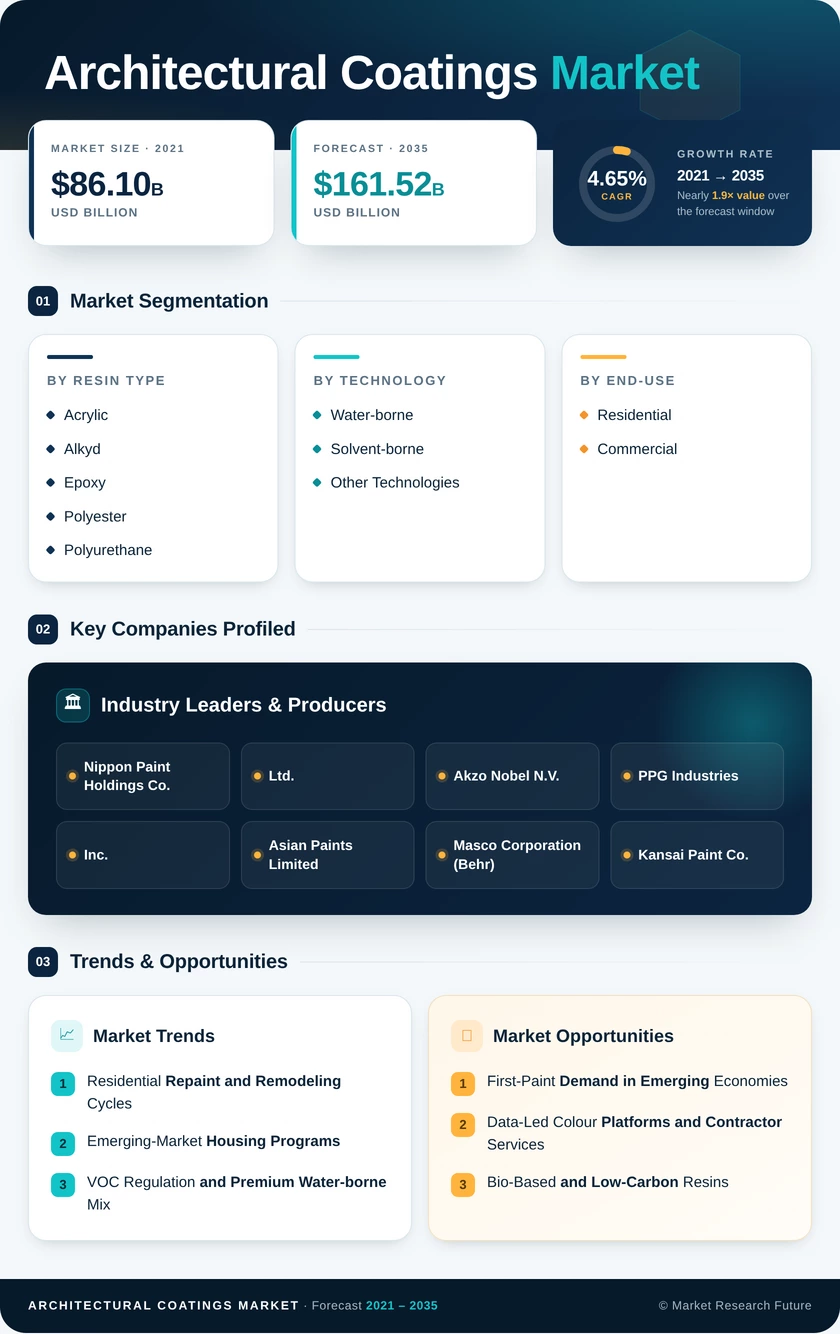
Architectural Coatings Market Research Report Information By Resin Type (Acrylic, Alkyd, Epoxy, Polyester, Polyurethane, and Other Resin Types), By Technology (Water-Borne, Solvent-Borne, and Other Technologies), By End-Use (Residential and Commercial), And By Region (North America, Europe, Asia-Pacific, and Rest of the World) – Market Forecast Till 2035.
Architectural Coatings Market
Market Size
Forecast Period2026-2035
CAGR (2026-2035)4.65%
2025 Market SizeUSD 102.85 Billion
2035 Market SizeUSD 161.52 Billion
Key Players
Nippon Paint Holdings Co., Ltd.
Akzo Nobel N.V.
PPG Industries, Inc.
Asian Paints Limited
Masco Corporation
Kansai Paint Co., Ltd.
Opportunities
  • First-Paint Demand in Emerging Economies
  • Data-Led Colour Platforms and Contractor Services
  • Bio-Based and Low-Carbon Resins
  1. 1 Market Summary | |
  2. 2 Key Report Takeaways | |
    1. 2.1 By Resin Type | |
    2. 2.2 By Technology | |
    3. 2.3 By End-use | |
    4. 2.4 By Region | |
  3. 3 Market Size and Forecast (2021–2035) | |
    1. 3.1 Historical Market Size (2021–2025) | |
    2. 3.2 Forecast Market Size (2026–2035) | |
    3. 3.3 Year-over-Year Growth Analysis | |
  4. 4 Driver Impact Analysis | |
    1. 4.1 Residential Repaint and Remodeling Cycles | |
    2. 4.2 Emerging-Market Housing Programs | |
    3. 4.3 VOC Regulation and Premium Water-borne Mix | |
    4. 4.4 Green Building Certification | |
    5. 4.5 Energy-Efficiency Retrofit Mandates | |
    6. 4.6 Premiumization and Functional Finishes | |
  5. 5 Restraints Impact Analysis | |
    1. 5.1 Raw Material Price Volatility | |
    2. 5.2 China Property Downturn | |
    3. 5.3 Reformulation and Compliance Costs | |
    4. 5.4 Skilled Painting Labor Shortages | |
    5. 5.5 Price Competition from New Entrants | |
  6. 6 Opportunities | |
    1. 6.1 First-Paint Demand in Emerging Economies | |
    2. 6.2 Data-Led Colour Platforms and Contractor Services | |
    3. 6.3 Bio-Based and Low-Carbon Resins | |
    4. 6.4 Heat-Reflective Exterior Coatings | |
    5. 6.5 Façade Retrofit Systems in Europe | |
  7. 7 Regional Market Share and Country-Level Analysis | |
    1. 7.1 Asia-Pacific | | |
      1. 7.1.1 China | | |
      2. 7.1.2 India | | |
      3. 7.1.3 Japan | | |
      4. 7.1.4 South Korea | | |
      5. 7.1.5 Indonesia | | |
      6. 7.1.6 Vietnam | | |
      7. 7.1.7 Thailand | | |
      8. 7.1.8 Philippines | | |
      9. 7.1.9 Singapore | | |
      10. 7.1.10 Rest of Asia-Pacific | |
    2. 7.2 North America | | |
      1. 7.2.1 United States | | |
      2. 7.2.2 Canada | | |
      3. 7.2.3 Mexico | |
    3. 7.3 Europe | | |
      1. 7.3.1 Germany | | |
      2. 7.3.2 United Kingdom | | |
      3. 7.3.3 France | | |
      4. 7.3.4 Italy | | |
      5. 7.3.5 Spain | | |
      6. 7.3.6 Poland | | |
      7. 7.3.7 NORDIC Countries | | |
      8. 7.3.8 Russia | | |
      9. 7.3.9 Rest of Europe | |
    4. 7.4 South America | | |
      1. 7.4.1 Brazil | | |
      2. 7.4.2 Argentina | | |
      3. 7.4.3 Rest of South America | |
    5. 7.5 Middle-East and Africa | | |
      1. 7.5.1 Saudi Arabia | | |
      2. 7.5.2 South Africa | | |
      3. 7.5.3 Rest of Middle-East and Africa | |
  8. 8 Future Outlook (2026–2035) | |
    1. 8.1 Low-Carbon Chemistry and Supply-Chain Disclosure | |
    2. 8.2 Digital Colour Selection and Data-Led Retail | |
    3. 8.3 Climate-Adaptive and Functional Coatings | |
    4. 8.4 Urbanisation in the Global South | |
  9. 9 Segmentation Analysis | |
    1. 9.1 By Resin Type | | |
      1. 9.1.1 Acrylic | | |
      2. 9.1.2 Alkyd | | |
      3. 9.1.3 Epoxy | | |
      4. 9.1.4 Polyester | | |
      5. 9.1.5 Polyurethane | | |
      6. 9.1.6 Other Resin Types | |
    2. 9.2 By Technology | | |
      1. 9.2.1 Water-borne | | |
      2. 9.2.2 Solvent-borne | | |
      3. 9.2.3 Other Technologies | |
    3. 9.3 By End-use | | |
      1. 9.3.1 Residential | | |
      2. 9.3.2 Commercial | |
  10. 10 Competitive Landscape | |
    1. 10.1 Market Concentration and Share Analysis | |
    2. 10.2 Competitive Benchmarking Matrix | |
    3. 10.3 Company Profiles | | |
      1. 10.3.1 The Sherwin-Williams Company | | |
      2. 10.3.2 Nippon Paint Holdings Co., Ltd. | | |
      3. 10.3.3 Akzo Nobel N.V. | | |
      4. 10.3.4 PPG Industries, Inc. | | |
      5. 10.3.5 Asian Paints Limited | | |
      6. 10.3.6 Masco Corporation (Behr) | | |
      7. 10.3.7 Kansai Paint Co., Ltd. | | |
      8. 10.3.8 RPM International Inc. | | |
      9. 10.3.9 Jotun A/S | | |
      10. 10.3.10 Berger Paints India Limited | |
  11. 11 Recent News & Developments | |
  12. 12 Report Scope and Methodology | |
  13. 13 Detailed Sources and Citations | |
  14. 14 Frequently Asked Questions (FAQs) | | LIST OF TABLES | |
  15. TABLE 1 Global Market Size & Forecast, by Revenue (USD Billion), 2021–2035 | |
  16. TABLE 2 Year-over-Year Growth Analysis, 2021–2035 | |
  17. TABLE 3 Driver Impact Analysis | |
  18. TABLE 4 Restraints Impact Analysis | |
  19. TABLE 5 Regional Summary, 2025 | |
  20. TABLE 6 Asia-Pacific Market, by Country, 2025 | |
  21. TABLE 7 North America Market, by Country, 2025 | |
  22. TABLE 8 Europe Market, by Country, 2025 | |
  23. TABLE 9 South America Market, by Country, 2025 | |
  24. TABLE 10 Middle-East and Africa Market, by Country, 2025 | |
  25. TABLE 11 Global Market, by Resin Type, 2025 | |
  26. TABLE 12 Global Market, by Technology, 2025 | |
  27. TABLE 13 Global Market, by End-use, 2025 | |
  28. TABLE 14 Competitive Benchmarking Matrix | |
  29. TABLE 15 Report Scope and Methodology | |
  30. TABLE 16 Detailed Sources and Citations | | LIST OF FIGURES | |
  31. FIGURE 1 Market Dynamics Overview — Drivers, Restraints and Opportunities | |
  32. FIGURE 2 Industry Value Chain Analysis | |
  33. FIGURE 3 Porter's Five Forces Analysis | |
  34. FIGURE 4 Global Market Size Trend (USD Billion), 2021–2035 | |
  35. FIGURE 5 Market Share by Resin Type, 2025 | |
  36. FIGURE 6 Market Share by Technology, 2025 | |
  37. FIGURE 7 Market Share by End-use, 2025 | |
  38. FIGURE 8 Regional Market Share, 2025 | |
  39. FIGURE 9 Country-Level Market Share Within Regions, 2025 | |
  40. FIGURE 10 Competitive Landscape — Estimated Revenue Share Ranges of Key Players

Segmentation Quick Reference

DimensionSub-SegmentsDominant SegmentFastest Growing Segment
By Resin TypeAcrylic, Alkyd, Epoxy, Polyester, Polyurethane, Other Resin TypesAcrylic (57.9% share)Other Resin Types (5.7% CAGR)
By TechnologyWater-borne, Solvent-borne, Other TechnologiesWater-borne (55.8% share)Other Technologies (5.9% CAGR)
By End-useResidential, CommercialResidential (63.4% share)Commercial (4.9% CAGR)
By RegionAsia-Pacific, North America, Europe, South America, Middle-East and AfricaAsia-Pacific (46.8% share)Asia-Pacific (5.4% CAGR)

Market Segmentation Overview

By Resin Type

Sub-SegmentKey Trend
AcrylicReformulated low-VOC grades replacing solvent systems on walls and masonry
AlkydShrinking to compliant trim and metal enamel niches
EpoxySteady use on abrasion-heavy institutional floors despite UV limits
PolyesterPowder finishes on factory-coated aluminium and steel framing
PolyurethaneGloss retention for coastal exteriors and high-traffic floors
Other Resin TypesBio-based hybrids and silicate binders backed by sustainability labels

Acrylic leads because it is the only resin family that meets the strictest VOC ceilings while delivering colour retention on exterior walls, which keeps it at a 57.9% share. Other Resin Types grow fastest at 5.7% CAGR as bio-based hybrids and silicate binders win specification on projects that track embodied carbon. Alkyd continues to lose ground to both, retreating to trim and metal enamels where compliant versions still perform.

By Technology

Sub-SegmentKey Trend
Water-borneDefault chemistry under tightening VOC rules and indoor-air expectations
Solvent-borneRetained for cold, humid and porous-substrate applications
Other TechnologiesPowder, high-solids and UV-cured lines scaling with prefabrication

Water-borne systems dominate with a 55.8% share because regulators in the US, EU and China have made them the compliant baseline for interior and most exterior work. Other Technologies expand fastest at 5.9% CAGR as more doors, windows, cabinetry and metal framing arrive factory-finished, where powder and UV-cure lines deliver near-total transfer efficiency. Solvent-borne coatings remain relevant on job sites where cold or humidity prevents water-borne films from curing properly.

By End-use

Sub-SegmentKey Trend
ResidentialRepaint cycles in mature markets and subsidised first-paint demand in emerging ones
CommercialHospitality, healthcare and certified institutional projects specifying premium interiors

Residential use leads with a 63.4% share, driven by short repaint intervals in ageing North American and European housing and by state housing programs in India and Brazil. Commercial demand grows faster at 4.9% CAGR because hotel, hospital and school owners specify antimicrobial, washable and certified low-emission systems that carry higher prices per litre. Office repainting remains the weak spot within commercial demand as hybrid work keeps occupancy below pre-2020 levels.


Download PDF ×

We do not share your information with anyone. However, we may send you emails based on your report interest from time to time. You may contact us at any time to opt-out.