
Request Free Sample ×

Kindly complete the form below to receive a free sample of this Report

* Please use a valid business email

Leading companies partner with us for data-driven Insights

clients tt-cursor
Hero Background
English
Chinese
French
Japanese
Korean
German
Spanish

Air Ambulance Services Market Analysis

ID: MRFR/AD/5801-CR
200 Pages
Shubham Munde
June 2025

Air Ambulance Services Market Size, Share, Industry Trend & Analysis Research Report By Service Type (Rotary Wing, Fixed Wing, Commercial), By End-use (Hospital, Patient Transport, Emergency Response), By Patient Condition (Trauma, Medical Emergencies, Transplant), By Operation Model (Government Services, Private Services, Non-Profit Services), and By Regional (North America, Europe, South America, Asia Pacific, Middle East and Africa)-Forecast to 2035

Share:
Download PDF ×

We do not share your information with anyone. However, we may send you emails based on your report interest from time to time. You may contact us at any time to opt-out.

Air Ambulance Services Market Infographic
Purchase Options

Market Analysis

In-depth Analysis of Air Ambulance Services Market Industry Landscape

Air ambulance manufacturers are undergoing a significant transformation by heavily investing in advanced technologies with the dual objectives of cost reduction and improvement in turnaround time. Among the innovative technologies shaping this evolution, 3D printing stands out as a game-changer in the design and manufacturing of aircraft structures and components. This revolutionary technology is fundamentally altering the traditional constraints that engineers encounter in the fabrication process. One of the key advantages of 3D printing is its ability to diminish design limitations inherent in conventional fabrication techniques. Engineers can now explore more intricate and sophisticated designs, leading to improved efficiency and performance of air ambulances. The capability to fabricate functional electronics directly into complex structures using 3D printing offers a remarkable advantage, allowing manufacturers to produce air ambulances that can operate effectively in adverse conditions such as inclement weather, tsunamis, droughts, and cyclones. Furthermore, the utilization of lightweight 3D printed components in the manufacturing of air ambulances has a cascading effect on the aircraft's performance. The incorporation of such components enhances maneuverability and fuel efficiency, critical factors in emergency medical response scenarios where time and agility are of the essence. The ongoing research and development efforts within the air ambulance sector are poised to further revolutionize the industry. The focus is not only on enhancing technological capabilities but also on improving accessibility and efficiency. This concerted effort towards innovation is expected to provide market players with a significant competitive edge. The integration of advanced technologies in air ambulance architecture is not merely a technological upgrade but a strategic move to address the evolving demands of emergency medical services. The continuous pursuit of excellence through technological advancements aligns with the broader goal of improving patient outcomes and optimizing the overall efficiency of air ambulance operations. The investment in advanced technologies, particularly the revolutionary impact of 3D printing, marks a pivotal shift in the manufacturing landscape of air ambulances. This transformative approach not only addresses longstanding design constraints but also opens up new possibilities for enhanced performance in challenging conditions. The lightweight and intricate components enabled by 3D printing contribute to improved maneuverability and fuel efficiency. As research and development efforts persist, the trajectory of air ambulance architecture is set to witness even more profound advancements, providing a competitive advantage to market players committed to staying at the forefront of innovation in the vital field of air ambulance services.


Author
Author Profile
Shubham Munde
Team Lead - Research

Shubham brings over 7 years of expertise in Market Intelligence and Strategic Consulting, with a strong focus on the Automotive, Aerospace, and Defense sectors. Backed by a solid foundation in semiconductors, electronics, and software, he has successfully delivered high-impact syndicated and custom research on a global scale. His core strengths include market sizing, forecasting, competitive intelligence, consumer insights, and supply chain mapping. Widely recognized for developing scalable growth strategies, Shubham empowers clients to navigate complex markets and achieve a lasting competitive edge. Trusted by start-ups and Fortune 500 companies alike, he consistently converts challenges into strategic opportunities that drive sustainable growth.

Leave a Comment

FAQs

What is the current valuation of the Air Ambulance Services Market as of 2024?

<p>The Air Ambulance Services Market was valued at 7.32 USD Billion in 2024.</p>

What is the projected market valuation for the Air Ambulance Services Market in 2035?

The market is projected to reach 17.17 USD Billion by 2035.

What is the expected CAGR for the Air Ambulance Services Market during the forecast period 2025 - 2035?

The expected CAGR for the Air Ambulance Services Market during 2025 - 2035 is 8.06%.

Which companies are considered key players in the Air Ambulance Services Market?

Key players in the market include Air Methods, Falck, PHI Air Medical, and Global Medical Response.

What are the primary applications of air ambulance services and their market values?

The primary applications include Emergency Medical Services valued at 6.93 USD Billion and Inter-facility Transport valued at 5.2 USD Billion.

How do the service types of air ambulance services break down in terms of market valuation?

Rotary Wing Services are valued at 5.2 USD Billion, while Fixed Wing Services are valued at 7.0 USD Billion.

What is the market valuation for different patient types in the Air Ambulance Services Market?

Trauma Patients are valued at 4.25 USD Billion, and Geriatric Patients are valued at 5.12 USD Billion.

What transport methods are utilized in the Air Ambulance Services Market and their respective valuations?

Air Transport is valued at 7.0 USD Billion, while Hybrid Transport is valued at 5.17 USD Billion.

What regulatory compliance factors influence the Air Ambulance Services Market?

Key regulatory compliance factors include Federal Aviation Administration Regulations valued at 4.5 USD Billion.

How does the market for air ambulance services appear to be evolving in the coming years?

The market appears to be expanding rapidly, with a projected increase in valuation and a robust growth rate during 2025 - 2035.

Market Summary

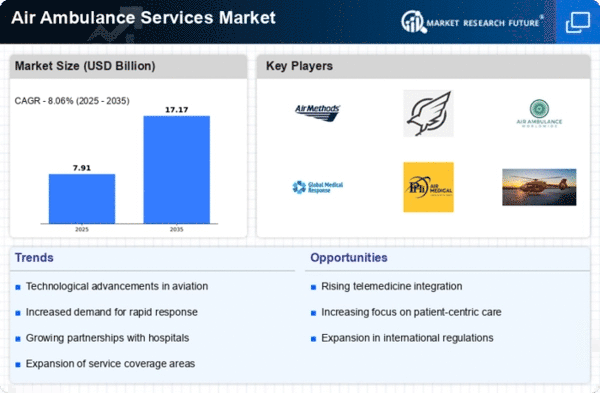
As per MRFR analysis, the Air Ambulance Services Market was estimated at 7.32 USD Billion in 2024. The Air Ambulance Services industry is projected to grow from 7.91 USD Billion in 2025 to 17.17 USD Billion by 2035, exhibiting a compound annual growth rate (CAGR) of 8.06% during the forecast period 2025 - 2035.

Key Market Trends & Highlights

The Air Ambulance Services Market is experiencing robust growth driven by technological advancements and increasing demand for emergency services.

  • North America remains the largest market for air ambulance services, driven by advanced healthcare infrastructure.
  • The Asia-Pacific region is emerging as the fastest-growing market, fueled by rising healthcare expenditures and awareness.
  • Emergency Medical Services represent the largest segment, while Inter-facility Transfers are witnessing the fastest growth in demand.
  • Technological advancements and regulatory changes are key drivers propelling the market forward.

Market Size & Forecast

2024 Market Size 7.32 (USD Billion)
2035 Market Size 17.17 (USD Billion)
CAGR (2025 - 2035) 8.06%
Largest Regional Market Share in 2024 North America

Major Players

Air Methods (US), Falck (DK), Air Ambulance Worldwide (US), Global Medical Response (US), PHI Air Medical (US), Air Rescue (AU), Lifeguard Air Ambulance (US), Air Ambulance Service (GB)

Market Trends

Air Ambulance Services

Air Ambulance Services Market Market Drivers

Increasing Demand for Emergency Medical Services

The Global air ambulance services Industry experiences a notable surge in demand for emergency medical services. This trend is largely driven by the rising incidence of medical emergencies and the need for rapid patient transport. As healthcare systems evolve, the integration of air ambulance services into emergency response frameworks becomes increasingly vital. In 2024, the market is projected to reach 6.43 USD Billion, reflecting a growing recognition of the importance of timely medical intervention. The ability to provide critical care during transport enhances patient outcomes, thereby solidifying the role of air ambulances in modern healthcare.

Market Segment Insights

By Application: Emergency Medical Services (Largest) vs. Medical Evacuations (Fastest-Growing)

<p>In the Air Ambulance Services Market, the application segment is dominated by Emergency Medical Services, which commands a significant share due to its critical role in immediate and life-saving interventions. Following closely, Inter-facility Transport serves as a vital conduit for patients requiring specialized medical attention across different institutions. Disaster Response and Medical Evacuations, while essential, make up a smaller portion of the overall market but are gaining traction as the demand for efficient emergency care rises.</p>

<p>Emergency Medical Services (Dominant) vs. Medical Evacuations (Emerging)</p>

<p>Emergency Medical Services is the dominant application in the Air Ambulance Services Market, characterized by its focus on rapid response to emergencies such as accidents or sudden medical conditions. This segment benefits from a well-established network of helicopters and planes equipped for critical care. In contrast, Medical Evacuations are emerging as a significant market player, driven by an increase in both public and private sector investments. These services cater to long-distance transportation needs, particularly in remote areas, and capitalize on evolving healthcare policies and increasing awareness among patients regarding the availability of air transport services for medical needs.</p>

By Service Type: Rotary Wing Services (Largest) vs. Fixed Wing Services (Fastest-Growing)

The Air Ambulance Services Market is characterized by a diverse range of service types, with Rotary Wing Services holding the largest market share due to their ability to access remote locations swiftly. Their popularity stems from the immediacy they provide in emergencies, allowing for quicker patient transfers compared to other modes. Conversely, Fixed Wing Services are emerging rapidly, leveraging advancements in aviation technology and offering longer-range transport capabilities, thus appealing to a broader geographic coverage for non-emergency and emergency medical transfers.

Rotary Wing Services (Dominant) vs. Medical Escort Services (Emerging)

Rotary Wing Services dominate the Air Ambulance Services Market, primarily due to their versatile operational capabilities and swift response times, which are essential in critical medical emergencies. These services allow for quick vertical takeoffs and landings, making them ideal for accessing hard-to-reach areas. On the other hand, Medical Escort Services are on the rise, providing a more personalized approach by offering specialized medical professionals to accompany patients during air travel. This segment is increasingly attractive to the growing affluent population seeking tailored medical transport solutions. As hospitals and healthcare providers understand the importance of patient-centric care, the demand for Medical Escort Services is expected to increase, complementing the more traditional air ambulance modalities.

By Patient Type: Trauma Patients (Largest) vs. Critical Care Patients (Fastest-Growing)

<p>In the Air Ambulance Services Market, the segment of Trauma Patients holds the largest market share, driven by the high incidence of accidents and natural disasters requiring immediate medical attention. This category encompasses victims of road traffic collisions, falls, and other acute injuries, which necessitate quick transportation to hospitals. Following closely are Critical Care Patients, whose need for rapid medical intervention in life-threatening situations is growing. This group's accessibility to air transportation is increasing due to better service availability and technological advancements. Growth trends in the Air Ambulance Services Market reflect a notable rise in the demand for air transport services among Critical Care Patients. Factors contributing to this growth include an increase in severe medical emergencies, advancements in airborne medical technology, and the expansion of healthcare networks. Furthermore, the aging population and the surge in remote areas requesting advanced medical services are driving growth in this segment, especially for Critical Care Patients who often require specialized care during transport.</p>

<p>Trauma Patients (Dominant) vs. Pediatric Patients (Emerging)</p>

<p>The Trauma Patients segment is currently dominant in the Air Ambulance Services Market due to the frequent occurrence of accidents and the urgency associated with their treatment. This segment is characterized by the need for immediate transportation, which is crucial not only for patient survival but also for minimizing long-term recovery costs. On the other hand, the Pediatric Patients segment is emerging, reflecting a growing recognition of the unique medical needs of children. Pediatric air ambulance services are becoming essential, especially for transferring critically ill children to specialized care facilities. This duality in the market showcases the importance of tailored air services that cater to diverse patient requirements, ensuring both immediate and ongoing medical care.</p>

By Transport Method: Air Transport (Largest) vs. Ground Transport (Fastest-Growing)

<p>The Air Ambulance Services Market is characterized by a dynamic distribution of market share across different transport methods. Air Transport dominates the segment, accounting for the largest share due to its speed, efficiency, and ability to reach remote locations quickly. Ground Transport, while currently smaller in share, is showing promise with an increasing preference in urban areas where accessibility and rapid deployment are critical. Hybrid Transport, combining both methods, offers unique advantages but remains less prevalent compared to its counterparts.</p>

<p>Air Transport (Dominant) vs. Ground Transport (Emerging)</p>

<p>Air Transport in the Air Ambulance Services Market is recognized for its unparalleled speed and ability to cover vast distances, making it the dominant method for emergency medical situations. It is favored in rural and remote areas where immediate access to medical facilities is crucial. Conversely, Ground Transport is emerging rapidly due to advancements in technology and increasing availability of ambulatory services. It is often preferred in urban settings, where traffic conditions may allow for quick, efficient patient transfers. The adaptability of Ground Transport continues to gain traction, promoting enhanced patient care and operational efficiency.</p>

By Regulatory Compliance: Health Insurance Portability and Accountability Act Compliance (Largest) vs. Federal Aviation Administration Regulations (Fastest-Growing)

<p>In the Air Ambulance Services Market, regulatory compliance is crucial for maintaining operational standards and ensuring patient safety. Among the segment values, Health Insurance Portability and Accountability Act (HIPAA) compliance holds the largest market share, given its pivotal role in protecting patient information and enhancing trust in air ambulance services. Federal Aviation Administration (FAA) regulations are emerging as the fastest-growing segment due to increasing air traffic and advancements in aviation technology that necessitate updated compliance measures. National Fire Protection Association (NFPA) standards play a significant supporting role, ensuring safety protocols during operations. The growth trends in regulatory compliance for air ambulance services can be attributed to heightened scrutiny in the healthcare sector, driving companies to invest in compliance measures. Notably, HIPAA compliance remains a top priority, with healthcare providers seeking to enhance data security and patient confidentiality. Meanwhile, FAA regulations are rapidly evolving to accommodate new technologies and operational protocols, fostering innovation while ensuring safety. NFPA standards are also becoming more relevant as the industry prioritizes safety measures during emergencies, contributing to better overall service outcomes.</p>

<p>HIPAA Compliance (Dominant) vs. FAA Regulations (Emerging)</p>

<p>HIPAA compliance is a dominant force in the Air Ambulance Services Market, ensuring that patient data is handled with the utmost confidentiality and security. This regulatory framework not only facilitates smoother operations but also enhances trust between service providers and patients. Air ambulance services must adhere to stringent HIPAA standards, which often dictate operational protocols ranging from data management to patient information safeguarding. Conversely, FAA regulations are emerging as a critical aspect of the industry, evolving rapidly to keep pace with technological advancements and increased aerial traffic. These regulations are essential for ensuring operational safety and efficiency. As air ambulance services navigate a competitive landscape, adherence to FAA regulations is becoming increasingly vital, driving innovation while ensuring compliance with national safety guidelines.</p>

Get more detailed insights about Air Ambulance Services Market Research Report - Forecast till 2035

Regional Insights

North America : Market Leader in Air Services

North America continues to lead the air ambulance services market, holding a significant share of 4.0 in 2024. The growth is driven by increasing demand for rapid medical response, advancements in aviation technology, and supportive regulatory frameworks. The region's robust healthcare infrastructure and high disposable income further fuel the market's expansion, making air ambulance services a critical component of emergency medical care. The competitive landscape is characterized by key players such as Air Methods, Global Medical Response, and PHI Air Medical, which dominate the market. The U.S. remains the largest contributor, with a well-established network of air ambulance services. The presence of advanced medical facilities and a high incidence of medical emergencies necessitate efficient air transport solutions, ensuring the continued growth of this sector.

Europe : Emerging Market with Growth Potential

Europe's air ambulance services market is on the rise, with a market size of 1.8. The growth is propelled by increasing healthcare expenditures, a growing aging population, and the need for timely medical interventions. Regulatory support from the European Union and national governments enhances operational efficiency and safety standards, contributing to market expansion. The demand for air ambulance services is expected to grow as healthcare systems evolve to meet the needs of diverse populations. Leading countries in this region include Germany, the UK, and France, where the presence of established air ambulance providers like Falck and Air Ambulance Service enhances competition. The market is characterized by partnerships between private and public sectors, ensuring comprehensive coverage. As the region invests in healthcare infrastructure, the air ambulance sector is poised for significant growth, addressing the urgent medical needs of its citizens.

Asia-Pacific : Rapidly Growing Market Segment

The Asia-Pacific air ambulance services market is witnessing rapid growth, with a market size of 1.2. Factors such as increasing urbanization, rising healthcare awareness, and the need for efficient emergency medical services drive this growth. Governments are increasingly recognizing the importance of air ambulance services, leading to favorable regulations and investments in infrastructure. The region's diverse geography necessitates air transport solutions to reach remote areas effectively. Countries like Australia and India are at the forefront, with key players such as Air Rescue and Lifeguard Air Ambulance expanding their operations. The competitive landscape is evolving, with new entrants and partnerships enhancing service delivery. As healthcare systems in the region continue to develop, the demand for air ambulance services is expected to rise, ensuring timely medical assistance for those in need.

Middle East and Africa : Emerging Market with Challenges

The Middle East and Africa air ambulance services market is emerging, with a market size of 0.32. The growth is driven by increasing healthcare investments, rising awareness of emergency medical services, and the need for rapid response in conflict zones. However, challenges such as regulatory hurdles and limited infrastructure in certain areas can impede growth. Governments are beginning to recognize the importance of air ambulance services, leading to gradual improvements in regulations and operational frameworks. Countries like South Africa and the UAE are leading the market, with key players establishing a presence to cater to the growing demand. The competitive landscape is characterized by collaborations between private companies and government entities, aiming to enhance service delivery. As the region continues to develop its healthcare infrastructure, the air ambulance sector is expected to grow, addressing urgent medical needs effectively.

Key Players and Competitive Insights

The Air Ambulance Services Market is characterized by a competitive landscape that is increasingly shaped by technological advancements and strategic partnerships. Key growth drivers include the rising demand for rapid medical transport, advancements in aircraft technology, and an increasing focus on patient-centric care. Major players such as Air Methods (US), Global Medical Response (US), and Falck (DK) are strategically positioned to leverage these trends. Air Methods (US) emphasizes innovation through the integration of advanced medical equipment in its fleet, while Global Medical Response (US) focuses on expanding its service offerings through strategic acquisitions and partnerships. Falck (DK) appears to be enhancing its operational efficiency by investing in digital transformation initiatives, which collectively influence the competitive dynamics of the market.The business tactics employed by these companies reflect a nuanced understanding of the market's structure, which is moderately fragmented. Localizing operations and optimizing supply chains are common strategies that enhance service delivery and reduce operational costs. The collective influence of these key players fosters a competitive environment where agility and responsiveness to market demands are paramount. As companies strive to differentiate themselves, the focus on localized service provision and operational excellence becomes increasingly critical.

In November Air Methods (US) announced a partnership with a leading telemedicine provider to enhance its patient care capabilities during transport. This strategic move is likely to improve patient outcomes by enabling real-time medical consultations, thereby reinforcing Air Methods' commitment to innovation and quality service. Such partnerships may also serve to attract new clients who prioritize advanced medical care during emergencies.

In October Global Medical Response (US) expanded its operations into new regions by acquiring a regional air ambulance service. This acquisition not only broadens its geographical footprint but also enhances its service capabilities, allowing for a more comprehensive response to medical emergencies. The strategic importance of this move lies in the potential to capture a larger market share and improve response times in underserved areas.

In September Falck (DK) launched a new digital platform aimed at streamlining operations and improving customer engagement. This initiative reflects a broader trend towards digitalization within the industry, as companies seek to enhance operational efficiency and customer satisfaction. By investing in technology, Falck positions itself as a forward-thinking leader in the air ambulance sector, likely attracting tech-savvy clients who value seamless service experiences.

As of December current competitive trends indicate a strong emphasis on digitalization, sustainability, and the integration of AI technologies within the Air Ambulance Services Market. Strategic alliances are increasingly shaping the landscape, enabling companies to pool resources and expertise to enhance service delivery. The shift from price-based competition to a focus on innovation, technology, and supply chain reliability is evident, suggesting that future competitive differentiation will hinge on the ability to adapt to these evolving trends.

Key Companies in the Air Ambulance Services Market include

Industry Developments

Recent developments in the Air Ambulance Services Market reflect significant growth and increasing demand for advanced emergency medical services. Companies such as Global Medical Response and Air Methods Corporation are expanding their operations, emphasizing enhanced service capabilities and technological integration.

In September 2023, Air Rescue Worldwide announced a partnership to broaden its reach in underserved areas, aligning with the growing need for accessible air ambulance services. Additionally, Falck A/S has been working on integrating innovative fleet management technologies to optimize their operations and response times.

The market has witnessed activity in mergers and acquisitions, with PHI Health acquiring Lifeguard Air Ambulance in August 2023, a move aimed at expanding its service coverage. Moreover, the valuation of companies within this sector has surged, with impact stemming from a rising demand for rapid transport services in rural and remote regions.

Over the past two years, the Air Ambulance Services Market has consistently demonstrated resilience, adapting to challenges such as the COVID-19 pandemic while maintaining growth trajectories, further accelerating investments in safety and operational efficiency within the sector. Such developments underscore the critical role of air ambulance services in emergency healthcare around the globe.

Future Outlook

Air Ambulance Services Market Future Outlook

The Air Ambulance Services Market is projected to grow at 8.06% CAGR from 2025 to 2035, driven by technological advancements, increasing healthcare demands, and expanding service networks.

New opportunities lie in:

  • Development of telemedicine integration for remote patient monitoring
  • Expansion of partnerships with hospitals for streamlined patient transfers
  • Investment in eco-friendly aircraft to reduce operational costs

By 2035, the market is expected to be robust, reflecting substantial growth and innovation.

Market Segmentation

Air Ambulance Services Market Application Outlook

  • Emergency Medical Services
  • Inter-facility Transfers
  • Disaster Response
  • Search and Rescue

Air Ambulance Services Market Patient Type Outlook

  • Trauma Patients
  • Cardiac Patients
  • Pediatric Patients
  • Geriatric Patients

Air Ambulance Services Market Service Type Outlook

  • Rotary Wing Services
  • Fixed Wing Services
  • Medical Escort Services
  • Air Ambulance Charter Services

Air Ambulance Services Market Transport Method Outlook

  • Helicopter Transport
  • Airplane Transport
  • Hybrid Transport

Report Scope

MARKET SIZE 2024 7.32(USD Billion)
MARKET SIZE 2025 7.91(USD Billion)
MARKET SIZE 2035 17.17(USD Billion)
COMPOUND ANNUAL GROWTH RATE (CAGR) 8.06% (2025 - 2035)
REPORT COVERAGE Revenue Forecast, Competitive Landscape, Growth Factors, and Trends
BASE YEAR 2024
Market Forecast Period 2025 - 2035
Historical Data 2019 - 2024
Market Forecast Units USD Billion
Key Companies Profiled Air Methods (US), Falck (DK), Air Ambulance Worldwide (US), Global Medical Response (US), PHI Air Medical (US), Air Rescue (AU), Lifeguard Air Ambulance (US), Air Ambulance Service (GB)
Segments Covered Application, Service Type, Patient Type, Transport Method
Key Market Opportunities Integration of advanced telemedicine technologies enhances patient care in the Air Ambulance Services Market.
Key Market Dynamics Rising demand for rapid medical transport drives innovation and competition in the air ambulance services sector.
Countries Covered North America, Europe, APAC, South America, MEA

FAQs

What is the current valuation of the Air Ambulance Services Market as of 2024?

<p>The Air Ambulance Services Market was valued at 7.32 USD Billion in 2024.</p>

What is the projected market valuation for the Air Ambulance Services Market in 2035?

The market is projected to reach 17.17 USD Billion by 2035.

What is the expected CAGR for the Air Ambulance Services Market during the forecast period 2025 - 2035?

The expected CAGR for the Air Ambulance Services Market during 2025 - 2035 is 8.06%.

Which companies are considered key players in the Air Ambulance Services Market?

Key players in the market include Air Methods, Falck, PHI Air Medical, and Global Medical Response.

What are the primary applications of air ambulance services and their market values?

The primary applications include Emergency Medical Services valued at 6.93 USD Billion and Inter-facility Transport valued at 5.2 USD Billion.

How do the service types of air ambulance services break down in terms of market valuation?

Rotary Wing Services are valued at 5.2 USD Billion, while Fixed Wing Services are valued at 7.0 USD Billion.

What is the market valuation for different patient types in the Air Ambulance Services Market?

Trauma Patients are valued at 4.25 USD Billion, and Geriatric Patients are valued at 5.12 USD Billion.

What transport methods are utilized in the Air Ambulance Services Market and their respective valuations?

Air Transport is valued at 7.0 USD Billion, while Hybrid Transport is valued at 5.17 USD Billion.

What regulatory compliance factors influence the Air Ambulance Services Market?

Key regulatory compliance factors include Federal Aviation Administration Regulations valued at 4.5 USD Billion.

How does the market for air ambulance services appear to be evolving in the coming years?

The market appears to be expanding rapidly, with a projected increase in valuation and a robust growth rate during 2025 - 2035.

  1. SECTION I: EXECUTIVE SUMMARY AND KEY HIGHLIGHTS
    1. | 1.1 EXECUTIVE SUMMARY
    2. | | 1.1.1 Market Overview
    3. | | 1.1.2 Key Findings
    4. | | 1.1.3 Market Segmentation
    5. | | 1.1.4 Competitive Landscape
    6. | | 1.1.5 Challenges and Opportunities
    7. | | 1.1.6 Future Outlook
  2. SECTION II: SCOPING, METHODOLOGY AND MARKET STRUCTURE
    1. | 2.1 MARKET INTRODUCTION
    2. | | 2.1.1 Definition
    3. | | 2.1.2 Scope of the study
    4. | | | 2.1.2.1 Research Objective
    5. | | | 2.1.2.2 Assumption
    6. | | | 2.1.2.3 Limitations
    7. | 2.2 RESEARCH METHODOLOGY
    8. | | 2.2.1 Overview
    9. | | 2.2.2 Data Mining
    10. | | 2.2.3 Secondary Research
    11. | | 2.2.4 Primary Research
    12. | | | 2.2.4.1 Primary Interviews and Information Gathering Process
    13. | | | 2.2.4.2 Breakdown of Primary Respondents
    14. | | 2.2.5 Forecasting Model
    15. | | 2.2.6 Market Size Estimation
    16. | | | 2.2.6.1 Bottom-Up Approach
    17. | | | 2.2.6.2 Top-Down Approach
    18. | | 2.2.7 Data Triangulation
    19. | | 2.2.8 Validation
  3. SECTION III: QUALITATIVE ANALYSIS
    1. | 3.1 MARKET DYNAMICS
    2. | | 3.1.1 Overview
    3. | | 3.1.2 Drivers
    4. | | 3.1.3 Restraints
    5. | | 3.1.4 Opportunities
    6. | 3.2 MARKET FACTOR ANALYSIS
    7. | | 3.2.1 Value chain Analysis
    8. | | 3.2.2 Porter's Five Forces Analysis
    9. | | | 3.2.2.1 Bargaining Power of Suppliers
    10. | | | 3.2.2.2 Bargaining Power of Buyers
    11. | | | 3.2.2.3 Threat of New Entrants
    12. | | | 3.2.2.4 Threat of Substitutes
    13. | | | 3.2.2.5 Intensity of Rivalry
    14. | | 3.2.3 COVID-19 Impact Analysis
    15. | | | 3.2.3.1 Market Impact Analysis
    16. | | | 3.2.3.2 Regional Impact
    17. | | | 3.2.3.3 Opportunity and Threat Analysis
  4. SECTION IV: QUANTITATIVE ANALYSIS
    1. | 4.1 Aerospace & Defense, BY Application (USD Billion)
    2. | | 4.1.1 Emergency Medical Services
    3. | | 4.1.2 Inter-facility Transport
    4. | | 4.1.3 Disaster Response
    5. | | 4.1.4 Medical Evacuations
    6. | 4.2 Aerospace & Defense, BY Service Type (USD Billion)
    7. | | 4.2.1 Rotary Wing Services
    8. | | 4.2.2 Fixed Wing Services
    9. | | 4.2.3 Ground Ambulance Integration
    10. | 4.3 Aerospace & Defense, BY Patient Type (USD Billion)
    11. | | 4.3.1 Trauma Patients
    12. | | 4.3.2 Critical Care Patients
    13. | | 4.3.3 Pediatric Patients
    14. | | 4.3.4 Geriatric Patients
    15. | 4.4 Aerospace & Defense, BY Transport Method (USD Billion)
    16. | | 4.4.1 Air Transport
    17. | | 4.4.2 Ground Transport
    18. | | 4.4.3 Hybrid Transport
    19. | 4.5 Aerospace & Defense, BY Regulatory Compliance (USD Billion)
    20. | | 4.5.1 Federal Aviation Administration Regulations
    21. | | 4.5.2 Health Insurance Portability and Accountability Act Compliance
    22. | | 4.5.3 National Fire Protection Association Standards
    23. | 4.6 Aerospace & Defense, BY Region (USD Billion)
    24. | | 4.6.1 North America
    25. | | | 4.6.1.1 US
    26. | | | 4.6.1.2 Canada
    27. | | 4.6.2 Europe
    28. | | | 4.6.2.1 Germany
    29. | | | 4.6.2.2 UK
    30. | | | 4.6.2.3 France
    31. | | | 4.6.2.4 Russia
    32. | | | 4.6.2.5 Italy
    33. | | | 4.6.2.6 Spain
    34. | | | 4.6.2.7 Rest of Europe
    35. | | 4.6.3 APAC
    36. | | | 4.6.3.1 China
    37. | | | 4.6.3.2 India
    38. | | | 4.6.3.3 Japan
    39. | | | 4.6.3.4 South Korea
    40. | | | 4.6.3.5 Malaysia
    41. | | | 4.6.3.6 Thailand
    42. | | | 4.6.3.7 Indonesia
    43. | | | 4.6.3.8 Rest of APAC
    44. | | 4.6.4 South America
    45. | | | 4.6.4.1 Brazil
    46. | | | 4.6.4.2 Mexico
    47. | | | 4.6.4.3 Argentina
    48. | | | 4.6.4.4 Rest of South America
    49. | | 4.6.5 MEA
    50. | | | 4.6.5.1 GCC Countries
    51. | | | 4.6.5.2 South Africa
    52. | | | 4.6.5.3 Rest of MEA
  5. SECTION V: COMPETITIVE ANALYSIS
    1. | 5.1 Competitive Landscape
    2. | | 5.1.1 Overview
    3. | | 5.1.2 Competitive Analysis
    4. | | 5.1.3 Market share Analysis
    5. | | 5.1.4 Major Growth Strategy in the Aerospace & Defense
    6. | | 5.1.5 Competitive Benchmarking
    7. | | 5.1.6 Leading Players in Terms of Number of Developments in the Aerospace & Defense
    8. | | 5.1.7 Key developments and growth strategies
    9. | | | 5.1.7.1 New Product Launch/Service Deployment
    10. | | | 5.1.7.2 Merger & Acquisitions
    11. | | | 5.1.7.3 Joint Ventures
    12. | | 5.1.8 Major Players Financial Matrix
    13. | | | 5.1.8.1 Sales and Operating Income
    14. | | | 5.1.8.2 Major Players R&D Expenditure. 2023
    15. | 5.2 Company Profiles
    16. | | 5.2.1 Air Methods (US)
    17. | | | 5.2.1.1 Financial Overview
    18. | | | 5.2.1.2 Products Offered
    19. | | | 5.2.1.3 Key Developments
    20. | | | 5.2.1.4 SWOT Analysis
    21. | | | 5.2.1.5 Key Strategies
    22. | | 5.2.2 Falck (DK)
    23. | | | 5.2.2.1 Financial Overview
    24. | | | 5.2.2.2 Products Offered
    25. | | | 5.2.2.3 Key Developments
    26. | | | 5.2.2.4 SWOT Analysis
    27. | | | 5.2.2.5 Key Strategies
    28. | | 5.2.3 PHI Air Medical (US)
    29. | | | 5.2.3.1 Financial Overview
    30. | | | 5.2.3.2 Products Offered
    31. | | | 5.2.3.3 Key Developments
    32. | | | 5.2.3.4 SWOT Analysis
    33. | | | 5.2.3.5 Key Strategies
    34. | | 5.2.4 Air Ambulance Worldwide (US)
    35. | | | 5.2.4.1 Financial Overview
    36. | | | 5.2.4.2 Products Offered
    37. | | | 5.2.4.3 Key Developments
    38. | | | 5.2.4.4 SWOT Analysis
    39. | | | 5.2.4.5 Key Strategies
    40. | | 5.2.5 Air Rescue (DE)
    41. | | | 5.2.5.1 Financial Overview
    42. | | | 5.2.5.2 Products Offered
    43. | | | 5.2.5.3 Key Developments
    44. | | | 5.2.5.4 SWOT Analysis
    45. | | | 5.2.5.5 Key Strategies
    46. | | 5.2.6 Global Medical Response (US)
    47. | | | 5.2.6.1 Financial Overview
    48. | | | 5.2.6.2 Products Offered
    49. | | | 5.2.6.3 Key Developments
    50. | | | 5.2.6.4 SWOT Analysis
    51. | | | 5.2.6.5 Key Strategies
    52. | | 5.2.7 Lifeguard Air Ambulance (US)
    53. | | | 5.2.7.1 Financial Overview
    54. | | | 5.2.7.2 Products Offered
    55. | | | 5.2.7.3 Key Developments
    56. | | | 5.2.7.4 SWOT Analysis
    57. | | | 5.2.7.5 Key Strategies
    58. | | 5.2.8 SkyHealth (US)
    59. | | | 5.2.8.1 Financial Overview
    60. | | | 5.2.8.2 Products Offered
    61. | | | 5.2.8.3 Key Developments
    62. | | | 5.2.8.4 SWOT Analysis
    63. | | | 5.2.8.5 Key Strategies
    64. | 5.3 Appendix
    65. | | 5.3.1 References
    66. | | 5.3.2 Related Reports
  6. LIST OF FIGURES
    1. | 6.1 MARKET SYNOPSIS
    2. | 6.2 NORTH AMERICA MARKET ANALYSIS
    3. | 6.3 US MARKET ANALYSIS BY APPLICATION
    4. | 6.4 US MARKET ANALYSIS BY SERVICE TYPE
    5. | 6.5 US MARKET ANALYSIS BY PATIENT TYPE
    6. | 6.6 US MARKET ANALYSIS BY TRANSPORT METHOD
    7. | 6.7 US MARKET ANALYSIS BY REGULATORY COMPLIANCE
    8. | 6.8 CANADA MARKET ANALYSIS BY APPLICATION
    9. | 6.9 CANADA MARKET ANALYSIS BY SERVICE TYPE
    10. | 6.10 CANADA MARKET ANALYSIS BY PATIENT TYPE
    11. | 6.11 CANADA MARKET ANALYSIS BY TRANSPORT METHOD
    12. | 6.12 CANADA MARKET ANALYSIS BY REGULATORY COMPLIANCE
    13. | 6.13 EUROPE MARKET ANALYSIS
    14. | 6.14 GERMANY MARKET ANALYSIS BY APPLICATION
    15. | 6.15 GERMANY MARKET ANALYSIS BY SERVICE TYPE
    16. | 6.16 GERMANY MARKET ANALYSIS BY PATIENT TYPE
    17. | 6.17 GERMANY MARKET ANALYSIS BY TRANSPORT METHOD
    18. | 6.18 GERMANY MARKET ANALYSIS BY REGULATORY COMPLIANCE
    19. | 6.19 UK MARKET ANALYSIS BY APPLICATION
    20. | 6.20 UK MARKET ANALYSIS BY SERVICE TYPE
    21. | 6.21 UK MARKET ANALYSIS BY PATIENT TYPE
    22. | 6.22 UK MARKET ANALYSIS BY TRANSPORT METHOD
    23. | 6.23 UK MARKET ANALYSIS BY REGULATORY COMPLIANCE
    24. | 6.24 FRANCE MARKET ANALYSIS BY APPLICATION
    25. | 6.25 FRANCE MARKET ANALYSIS BY SERVICE TYPE
    26. | 6.26 FRANCE MARKET ANALYSIS BY PATIENT TYPE
    27. | 6.27 FRANCE MARKET ANALYSIS BY TRANSPORT METHOD
    28. | 6.28 FRANCE MARKET ANALYSIS BY REGULATORY COMPLIANCE
    29. | 6.29 RUSSIA MARKET ANALYSIS BY APPLICATION
    30. | 6.30 RUSSIA MARKET ANALYSIS BY SERVICE TYPE
    31. | 6.31 RUSSIA MARKET ANALYSIS BY PATIENT TYPE
    32. | 6.32 RUSSIA MARKET ANALYSIS BY TRANSPORT METHOD
    33. | 6.33 RUSSIA MARKET ANALYSIS BY REGULATORY COMPLIANCE
    34. | 6.34 ITALY MARKET ANALYSIS BY APPLICATION
    35. | 6.35 ITALY MARKET ANALYSIS BY SERVICE TYPE
    36. | 6.36 ITALY MARKET ANALYSIS BY PATIENT TYPE
    37. | 6.37 ITALY MARKET ANALYSIS BY TRANSPORT METHOD
    38. | 6.38 ITALY MARKET ANALYSIS BY REGULATORY COMPLIANCE
    39. | 6.39 SPAIN MARKET ANALYSIS BY APPLICATION
    40. | 6.40 SPAIN MARKET ANALYSIS BY SERVICE TYPE
    41. | 6.41 SPAIN MARKET ANALYSIS BY PATIENT TYPE
    42. | 6.42 SPAIN MARKET ANALYSIS BY TRANSPORT METHOD
    43. | 6.43 SPAIN MARKET ANALYSIS BY REGULATORY COMPLIANCE
    44. | 6.44 REST OF EUROPE MARKET ANALYSIS BY APPLICATION
    45. | 6.45 REST OF EUROPE MARKET ANALYSIS BY SERVICE TYPE
    46. | 6.46 REST OF EUROPE MARKET ANALYSIS BY PATIENT TYPE
    47. | 6.47 REST OF EUROPE MARKET ANALYSIS BY TRANSPORT METHOD
    48. | 6.48 REST OF EUROPE MARKET ANALYSIS BY REGULATORY COMPLIANCE
    49. | 6.49 APAC MARKET ANALYSIS
    50. | 6.50 CHINA MARKET ANALYSIS BY APPLICATION
    51. | 6.51 CHINA MARKET ANALYSIS BY SERVICE TYPE
    52. | 6.52 CHINA MARKET ANALYSIS BY PATIENT TYPE
    53. | 6.53 CHINA MARKET ANALYSIS BY TRANSPORT METHOD
    54. | 6.54 CHINA MARKET ANALYSIS BY REGULATORY COMPLIANCE
    55. | 6.55 INDIA MARKET ANALYSIS BY APPLICATION
    56. | 6.56 INDIA MARKET ANALYSIS BY SERVICE TYPE
    57. | 6.57 INDIA MARKET ANALYSIS BY PATIENT TYPE
    58. | 6.58 INDIA MARKET ANALYSIS BY TRANSPORT METHOD
    59. | 6.59 INDIA MARKET ANALYSIS BY REGULATORY COMPLIANCE
    60. | 6.60 JAPAN MARKET ANALYSIS BY APPLICATION
    61. | 6.61 JAPAN MARKET ANALYSIS BY SERVICE TYPE
    62. | 6.62 JAPAN MARKET ANALYSIS BY PATIENT TYPE
    63. | 6.63 JAPAN MARKET ANALYSIS BY TRANSPORT METHOD
    64. | 6.64 JAPAN MARKET ANALYSIS BY REGULATORY COMPLIANCE
    65. | 6.65 SOUTH KOREA MARKET ANALYSIS BY APPLICATION
    66. | 6.66 SOUTH KOREA MARKET ANALYSIS BY SERVICE TYPE
    67. | 6.67 SOUTH KOREA MARKET ANALYSIS BY PATIENT TYPE
    68. | 6.68 SOUTH KOREA MARKET ANALYSIS BY TRANSPORT METHOD
    69. | 6.69 SOUTH KOREA MARKET ANALYSIS BY REGULATORY COMPLIANCE
    70. | 6.70 MALAYSIA MARKET ANALYSIS BY APPLICATION
    71. | 6.71 MALAYSIA MARKET ANALYSIS BY SERVICE TYPE
    72. | 6.72 MALAYSIA MARKET ANALYSIS BY PATIENT TYPE
    73. | 6.73 MALAYSIA MARKET ANALYSIS BY TRANSPORT METHOD
    74. | 6.74 MALAYSIA MARKET ANALYSIS BY REGULATORY COMPLIANCE
    75. | 6.75 THAILAND MARKET ANALYSIS BY APPLICATION
    76. | 6.76 THAILAND MARKET ANALYSIS BY SERVICE TYPE
    77. | 6.77 THAILAND MARKET ANALYSIS BY PATIENT TYPE
    78. | 6.78 THAILAND MARKET ANALYSIS BY TRANSPORT METHOD
    79. | 6.79 THAILAND MARKET ANALYSIS BY REGULATORY COMPLIANCE
    80. | 6.80 INDONESIA MARKET ANALYSIS BY APPLICATION
    81. | 6.81 INDONESIA MARKET ANALYSIS BY SERVICE TYPE
    82. | 6.82 INDONESIA MARKET ANALYSIS BY PATIENT TYPE
    83. | 6.83 INDONESIA MARKET ANALYSIS BY TRANSPORT METHOD
    84. | 6.84 INDONESIA MARKET ANALYSIS BY REGULATORY COMPLIANCE
    85. | 6.85 REST OF APAC MARKET ANALYSIS BY APPLICATION
    86. | 6.86 REST OF APAC MARKET ANALYSIS BY SERVICE TYPE
    87. | 6.87 REST OF APAC MARKET ANALYSIS BY PATIENT TYPE
    88. | 6.88 REST OF APAC MARKET ANALYSIS BY TRANSPORT METHOD
    89. | 6.89 REST OF APAC MARKET ANALYSIS BY REGULATORY COMPLIANCE
    90. | 6.90 SOUTH AMERICA MARKET ANALYSIS
    91. | 6.91 BRAZIL MARKET ANALYSIS BY APPLICATION
    92. | 6.92 BRAZIL MARKET ANALYSIS BY SERVICE TYPE
    93. | 6.93 BRAZIL MARKET ANALYSIS BY PATIENT TYPE
    94. | 6.94 BRAZIL MARKET ANALYSIS BY TRANSPORT METHOD
    95. | 6.95 BRAZIL MARKET ANALYSIS BY REGULATORY COMPLIANCE
    96. | 6.96 MEXICO MARKET ANALYSIS BY APPLICATION
    97. | 6.97 MEXICO MARKET ANALYSIS BY SERVICE TYPE
    98. | 6.98 MEXICO MARKET ANALYSIS BY PATIENT TYPE
    99. | 6.99 MEXICO MARKET ANALYSIS BY TRANSPORT METHOD
    100. | 6.100 MEXICO MARKET ANALYSIS BY REGULATORY COMPLIANCE
    101. | 6.101 ARGENTINA MARKET ANALYSIS BY APPLICATION
    102. | 6.102 ARGENTINA MARKET ANALYSIS BY SERVICE TYPE
    103. | 6.103 ARGENTINA MARKET ANALYSIS BY PATIENT TYPE
    104. | 6.104 ARGENTINA MARKET ANALYSIS BY TRANSPORT METHOD
    105. | 6.105 ARGENTINA MARKET ANALYSIS BY REGULATORY COMPLIANCE
    106. | 6.106 REST OF SOUTH AMERICA MARKET ANALYSIS BY APPLICATION
    107. | 6.107 REST OF SOUTH AMERICA MARKET ANALYSIS BY SERVICE TYPE
    108. | 6.108 REST OF SOUTH AMERICA MARKET ANALYSIS BY PATIENT TYPE
    109. | 6.109 REST OF SOUTH AMERICA MARKET ANALYSIS BY TRANSPORT METHOD
    110. | 6.110 REST OF SOUTH AMERICA MARKET ANALYSIS BY REGULATORY COMPLIANCE
    111. | 6.111 MEA MARKET ANALYSIS
    112. | 6.112 GCC COUNTRIES MARKET ANALYSIS BY APPLICATION
    113. | 6.113 GCC COUNTRIES MARKET ANALYSIS BY SERVICE TYPE
    114. | 6.114 GCC COUNTRIES MARKET ANALYSIS BY PATIENT TYPE
    115. | 6.115 GCC COUNTRIES MARKET ANALYSIS BY TRANSPORT METHOD
    116. | 6.116 GCC COUNTRIES MARKET ANALYSIS BY REGULATORY COMPLIANCE
    117. | 6.117 SOUTH AFRICA MARKET ANALYSIS BY APPLICATION
    118. | 6.118 SOUTH AFRICA MARKET ANALYSIS BY SERVICE TYPE
    119. | 6.119 SOUTH AFRICA MARKET ANALYSIS BY PATIENT TYPE
    120. | 6.120 SOUTH AFRICA MARKET ANALYSIS BY TRANSPORT METHOD
    121. | 6.121 SOUTH AFRICA MARKET ANALYSIS BY REGULATORY COMPLIANCE
    122. | 6.122 REST OF MEA MARKET ANALYSIS BY APPLICATION
    123. | 6.123 REST OF MEA MARKET ANALYSIS BY SERVICE TYPE
    124. | 6.124 REST OF MEA MARKET ANALYSIS BY PATIENT TYPE
    125. | 6.125 REST OF MEA MARKET ANALYSIS BY TRANSPORT METHOD
    126. | 6.126 REST OF MEA MARKET ANALYSIS BY REGULATORY COMPLIANCE
    127. | 6.127 KEY BUYING CRITERIA OF AEROSPACE & DEFENSE
    128. | 6.128 RESEARCH PROCESS OF MRFR
    129. | 6.129 DRO ANALYSIS OF AEROSPACE & DEFENSE
    130. | 6.130 DRIVERS IMPACT ANALYSIS: AEROSPACE & DEFENSE
    131. | 6.131 RESTRAINTS IMPACT ANALYSIS: AEROSPACE & DEFENSE
    132. | 6.132 SUPPLY / VALUE CHAIN: AEROSPACE & DEFENSE
    133. | 6.133 AEROSPACE & DEFENSE, BY APPLICATION, 2024 (% SHARE)
    134. | 6.134 AEROSPACE & DEFENSE, BY APPLICATION, 2024 TO 2035 (USD Billion)
    135. | 6.135 AEROSPACE & DEFENSE, BY SERVICE TYPE, 2024 (% SHARE)
    136. | 6.136 AEROSPACE & DEFENSE, BY SERVICE TYPE, 2024 TO 2035 (USD Billion)
    137. | 6.137 AEROSPACE & DEFENSE, BY PATIENT TYPE, 2024 (% SHARE)
    138. | 6.138 AEROSPACE & DEFENSE, BY PATIENT TYPE, 2024 TO 2035 (USD Billion)
    139. | 6.139 AEROSPACE & DEFENSE, BY TRANSPORT METHOD, 2024 (% SHARE)
    140. | 6.140 AEROSPACE & DEFENSE, BY TRANSPORT METHOD, 2024 TO 2035 (USD Billion)
    141. | 6.141 AEROSPACE & DEFENSE, BY REGULATORY COMPLIANCE, 2024 (% SHARE)
    142. | 6.142 AEROSPACE & DEFENSE, BY REGULATORY COMPLIANCE, 2024 TO 2035 (USD Billion)
    143. | 6.143 BENCHMARKING OF MAJOR COMPETITORS
  7. LIST OF TABLES
    1. | 7.1 LIST OF ASSUMPTIONS
    2. | | 7.1.1
    3. | 7.2 North America MARKET SIZE ESTIMATES; FORECAST
    4. | | 7.2.1 BY APPLICATION, 2025-2035 (USD Billion)
    5. | | 7.2.2 BY SERVICE TYPE, 2025-2035 (USD Billion)
    6. | | 7.2.3 BY PATIENT TYPE, 2025-2035 (USD Billion)
    7. | | 7.2.4 BY TRANSPORT METHOD, 2025-2035 (USD Billion)
    8. | | 7.2.5 BY REGULATORY COMPLIANCE, 2025-2035 (USD Billion)
    9. | 7.3 US MARKET SIZE ESTIMATES; FORECAST
    10. | | 7.3.1 BY APPLICATION, 2025-2035 (USD Billion)
    11. | | 7.3.2 BY SERVICE TYPE, 2025-2035 (USD Billion)
    12. | | 7.3.3 BY PATIENT TYPE, 2025-2035 (USD Billion)
    13. | | 7.3.4 BY TRANSPORT METHOD, 2025-2035 (USD Billion)
    14. | | 7.3.5 BY REGULATORY COMPLIANCE, 2025-2035 (USD Billion)
    15. | 7.4 Canada MARKET SIZE ESTIMATES; FORECAST
    16. | | 7.4.1 BY APPLICATION, 2025-2035 (USD Billion)
    17. | | 7.4.2 BY SERVICE TYPE, 2025-2035 (USD Billion)
    18. | | 7.4.3 BY PATIENT TYPE, 2025-2035 (USD Billion)
    19. | | 7.4.4 BY TRANSPORT METHOD, 2025-2035 (USD Billion)
    20. | | 7.4.5 BY REGULATORY COMPLIANCE, 2025-2035 (USD Billion)
    21. | 7.5 Europe MARKET SIZE ESTIMATES; FORECAST
    22. | | 7.5.1 BY APPLICATION, 2025-2035 (USD Billion)
    23. | | 7.5.2 BY SERVICE TYPE, 2025-2035 (USD Billion)
    24. | | 7.5.3 BY PATIENT TYPE, 2025-2035 (USD Billion)
    25. | | 7.5.4 BY TRANSPORT METHOD, 2025-2035 (USD Billion)
    26. | | 7.5.5 BY REGULATORY COMPLIANCE, 2025-2035 (USD Billion)
    27. | 7.6 Germany MARKET SIZE ESTIMATES; FORECAST
    28. | | 7.6.1 BY APPLICATION, 2025-2035 (USD Billion)
    29. | | 7.6.2 BY SERVICE TYPE, 2025-2035 (USD Billion)
    30. | | 7.6.3 BY PATIENT TYPE, 2025-2035 (USD Billion)
    31. | | 7.6.4 BY TRANSPORT METHOD, 2025-2035 (USD Billion)
    32. | | 7.6.5 BY REGULATORY COMPLIANCE, 2025-2035 (USD Billion)
    33. | 7.7 UK MARKET SIZE ESTIMATES; FORECAST
    34. | | 7.7.1 BY APPLICATION, 2025-2035 (USD Billion)
    35. | | 7.7.2 BY SERVICE TYPE, 2025-2035 (USD Billion)
    36. | | 7.7.3 BY PATIENT TYPE, 2025-2035 (USD Billion)
    37. | | 7.7.4 BY TRANSPORT METHOD, 2025-2035 (USD Billion)
    38. | | 7.7.5 BY REGULATORY COMPLIANCE, 2025-2035 (USD Billion)
    39. | 7.8 France MARKET SIZE ESTIMATES; FORECAST
    40. | | 7.8.1 BY APPLICATION, 2025-2035 (USD Billion)
    41. | | 7.8.2 BY SERVICE TYPE, 2025-2035 (USD Billion)
    42. | | 7.8.3 BY PATIENT TYPE, 2025-2035 (USD Billion)
    43. | | 7.8.4 BY TRANSPORT METHOD, 2025-2035 (USD Billion)
    44. | | 7.8.5 BY REGULATORY COMPLIANCE, 2025-2035 (USD Billion)
    45. | 7.9 Russia MARKET SIZE ESTIMATES; FORECAST
    46. | | 7.9.1 BY APPLICATION, 2025-2035 (USD Billion)
    47. | | 7.9.2 BY SERVICE TYPE, 2025-2035 (USD Billion)
    48. | | 7.9.3 BY PATIENT TYPE, 2025-2035 (USD Billion)
    49. | | 7.9.4 BY TRANSPORT METHOD, 2025-2035 (USD Billion)
    50. | | 7.9.5 BY REGULATORY COMPLIANCE, 2025-2035 (USD Billion)
    51. | 7.10 Italy MARKET SIZE ESTIMATES; FORECAST
    52. | | 7.10.1 BY APPLICATION, 2025-2035 (USD Billion)
    53. | | 7.10.2 BY SERVICE TYPE, 2025-2035 (USD Billion)
    54. | | 7.10.3 BY PATIENT TYPE, 2025-2035 (USD Billion)
    55. | | 7.10.4 BY TRANSPORT METHOD, 2025-2035 (USD Billion)
    56. | | 7.10.5 BY REGULATORY COMPLIANCE, 2025-2035 (USD Billion)
    57. | 7.11 Spain MARKET SIZE ESTIMATES; FORECAST
    58. | | 7.11.1 BY APPLICATION, 2025-2035 (USD Billion)
    59. | | 7.11.2 BY SERVICE TYPE, 2025-2035 (USD Billion)
    60. | | 7.11.3 BY PATIENT TYPE, 2025-2035 (USD Billion)
    61. | | 7.11.4 BY TRANSPORT METHOD, 2025-2035 (USD Billion)
    62. | | 7.11.5 BY REGULATORY COMPLIANCE, 2025-2035 (USD Billion)
    63. | 7.12 Rest of Europe MARKET SIZE ESTIMATES; FORECAST
    64. | | 7.12.1 BY APPLICATION, 2025-2035 (USD Billion)
    65. | | 7.12.2 BY SERVICE TYPE, 2025-2035 (USD Billion)
    66. | | 7.12.3 BY PATIENT TYPE, 2025-2035 (USD Billion)
    67. | | 7.12.4 BY TRANSPORT METHOD, 2025-2035 (USD Billion)
    68. | | 7.12.5 BY REGULATORY COMPLIANCE, 2025-2035 (USD Billion)
    69. | 7.13 APAC MARKET SIZE ESTIMATES; FORECAST
    70. | | 7.13.1 BY APPLICATION, 2025-2035 (USD Billion)
    71. | | 7.13.2 BY SERVICE TYPE, 2025-2035 (USD Billion)
    72. | | 7.13.3 BY PATIENT TYPE, 2025-2035 (USD Billion)
    73. | | 7.13.4 BY TRANSPORT METHOD, 2025-2035 (USD Billion)
    74. | | 7.13.5 BY REGULATORY COMPLIANCE, 2025-2035 (USD Billion)
    75. | 7.14 China MARKET SIZE ESTIMATES; FORECAST
    76. | | 7.14.1 BY APPLICATION, 2025-2035 (USD Billion)
    77. | | 7.14.2 BY SERVICE TYPE, 2025-2035 (USD Billion)
    78. | | 7.14.3 BY PATIENT TYPE, 2025-2035 (USD Billion)
    79. | | 7.14.4 BY TRANSPORT METHOD, 2025-2035 (USD Billion)
    80. | | 7.14.5 BY REGULATORY COMPLIANCE, 2025-2035 (USD Billion)
    81. | 7.15 India MARKET SIZE ESTIMATES; FORECAST
    82. | | 7.15.1 BY APPLICATION, 2025-2035 (USD Billion)
    83. | | 7.15.2 BY SERVICE TYPE, 2025-2035 (USD Billion)
    84. | | 7.15.3 BY PATIENT TYPE, 2025-2035 (USD Billion)
    85. | | 7.15.4 BY TRANSPORT METHOD, 2025-2035 (USD Billion)
    86. | | 7.15.5 BY REGULATORY COMPLIANCE, 2025-2035 (USD Billion)
    87. | 7.16 Japan MARKET SIZE ESTIMATES; FORECAST
    88. | | 7.16.1 BY APPLICATION, 2025-2035 (USD Billion)
    89. | | 7.16.2 BY SERVICE TYPE, 2025-2035 (USD Billion)
    90. | | 7.16.3 BY PATIENT TYPE, 2025-2035 (USD Billion)
    91. | | 7.16.4 BY TRANSPORT METHOD, 2025-2035 (USD Billion)
    92. | | 7.16.5 BY REGULATORY COMPLIANCE, 2025-2035 (USD Billion)
    93. | 7.17 South Korea MARKET SIZE ESTIMATES; FORECAST
    94. | | 7.17.1 BY APPLICATION, 2025-2035 (USD Billion)
    95. | | 7.17.2 BY SERVICE TYPE, 2025-2035 (USD Billion)
    96. | | 7.17.3 BY PATIENT TYPE, 2025-2035 (USD Billion)
    97. | | 7.17.4 BY TRANSPORT METHOD, 2025-2035 (USD Billion)
    98. | | 7.17.5 BY REGULATORY COMPLIANCE, 2025-2035 (USD Billion)
    99. | 7.18 Malaysia MARKET SIZE ESTIMATES; FORECAST
    100. | | 7.18.1 BY APPLICATION, 2025-2035 (USD Billion)
    101. | | 7.18.2 BY SERVICE TYPE, 2025-2035 (USD Billion)
    102. | | 7.18.3 BY PATIENT TYPE, 2025-2035 (USD Billion)
    103. | | 7.18.4 BY TRANSPORT METHOD, 2025-2035 (USD Billion)
    104. | | 7.18.5 BY REGULATORY COMPLIANCE, 2025-2035 (USD Billion)
    105. | 7.19 Thailand MARKET SIZE ESTIMATES; FORECAST
    106. | | 7.19.1 BY APPLICATION, 2025-2035 (USD Billion)
    107. | | 7.19.2 BY SERVICE TYPE, 2025-2035 (USD Billion)
    108. | | 7.19.3 BY PATIENT TYPE, 2025-2035 (USD Billion)
    109. | | 7.19.4 BY TRANSPORT METHOD, 2025-2035 (USD Billion)
    110. | | 7.19.5 BY REGULATORY COMPLIANCE, 2025-2035 (USD Billion)
    111. | 7.20 Indonesia MARKET SIZE ESTIMATES; FORECAST
    112. | | 7.20.1 BY APPLICATION, 2025-2035 (USD Billion)
    113. | | 7.20.2 BY SERVICE TYPE, 2025-2035 (USD Billion)
    114. | | 7.20.3 BY PATIENT TYPE, 2025-2035 (USD Billion)
    115. | | 7.20.4 BY TRANSPORT METHOD, 2025-2035 (USD Billion)
    116. | | 7.20.5 BY REGULATORY COMPLIANCE, 2025-2035 (USD Billion)
    117. | 7.21 Rest of APAC MARKET SIZE ESTIMATES; FORECAST
    118. | | 7.21.1 BY APPLICATION, 2025-2035 (USD Billion)
    119. | | 7.21.2 BY SERVICE TYPE, 2025-2035 (USD Billion)
    120. | | 7.21.3 BY PATIENT TYPE, 2025-2035 (USD Billion)
    121. | | 7.21.4 BY TRANSPORT METHOD, 2025-2035 (USD Billion)
    122. | | 7.21.5 BY REGULATORY COMPLIANCE, 2025-2035 (USD Billion)
    123. | 7.22 South America MARKET SIZE ESTIMATES; FORECAST
    124. | | 7.22.1 BY APPLICATION, 2025-2035 (USD Billion)
    125. | | 7.22.2 BY SERVICE TYPE, 2025-2035 (USD Billion)
    126. | | 7.22.3 BY PATIENT TYPE, 2025-2035 (USD Billion)
    127. | | 7.22.4 BY TRANSPORT METHOD, 2025-2035 (USD Billion)
    128. | | 7.22.5 BY REGULATORY COMPLIANCE, 2025-2035 (USD Billion)
    129. | 7.23 Brazil MARKET SIZE ESTIMATES; FORECAST
    130. | | 7.23.1 BY APPLICATION, 2025-2035 (USD Billion)
    131. | | 7.23.2 BY SERVICE TYPE, 2025-2035 (USD Billion)
    132. | | 7.23.3 BY PATIENT TYPE, 2025-2035 (USD Billion)
    133. | | 7.23.4 BY TRANSPORT METHOD, 2025-2035 (USD Billion)
    134. | | 7.23.5 BY REGULATORY COMPLIANCE, 2025-2035 (USD Billion)
    135. | 7.24 Mexico MARKET SIZE ESTIMATES; FORECAST
    136. | | 7.24.1 BY APPLICATION, 2025-2035 (USD Billion)
    137. | | 7.24.2 BY SERVICE TYPE, 2025-2035 (USD Billion)
    138. | | 7.24.3 BY PATIENT TYPE, 2025-2035 (USD Billion)
    139. | | 7.24.4 BY TRANSPORT METHOD, 2025-2035 (USD Billion)
    140. | | 7.24.5 BY REGULATORY COMPLIANCE, 2025-2035 (USD Billion)
    141. | 7.25 Argentina MARKET SIZE ESTIMATES; FORECAST
    142. | | 7.25.1 BY APPLICATION, 2025-2035 (USD Billion)
    143. | | 7.25.2 BY SERVICE TYPE, 2025-2035 (USD Billion)
    144. | | 7.25.3 BY PATIENT TYPE, 2025-2035 (USD Billion)
    145. | | 7.25.4 BY TRANSPORT METHOD, 2025-2035 (USD Billion)
    146. | | 7.25.5 BY REGULATORY COMPLIANCE, 2025-2035 (USD Billion)
    147. | 7.26 Rest of South America MARKET SIZE ESTIMATES; FORECAST
    148. | | 7.26.1 BY APPLICATION, 2025-2035 (USD Billion)
    149. | | 7.26.2 BY SERVICE TYPE, 2025-2035 (USD Billion)
    150. | | 7.26.3 BY PATIENT TYPE, 2025-2035 (USD Billion)
    151. | | 7.26.4 BY TRANSPORT METHOD, 2025-2035 (USD Billion)
    152. | | 7.26.5 BY REGULATORY COMPLIANCE, 2025-2035 (USD Billion)
    153. | 7.27 MEA MARKET SIZE ESTIMATES; FORECAST
    154. | | 7.27.1 BY APPLICATION, 2025-2035 (USD Billion)
    155. | | 7.27.2 BY SERVICE TYPE, 2025-2035 (USD Billion)
    156. | | 7.27.3 BY PATIENT TYPE, 2025-2035 (USD Billion)
    157. | | 7.27.4 BY TRANSPORT METHOD, 2025-2035 (USD Billion)
    158. | | 7.27.5 BY REGULATORY COMPLIANCE, 2025-2035 (USD Billion)
    159. | 7.28 GCC Countries MARKET SIZE ESTIMATES; FORECAST
    160. | | 7.28.1 BY APPLICATION, 2025-2035 (USD Billion)
    161. | | 7.28.2 BY SERVICE TYPE, 2025-2035 (USD Billion)
    162. | | 7.28.3 BY PATIENT TYPE, 2025-2035 (USD Billion)
    163. | | 7.28.4 BY TRANSPORT METHOD, 2025-2035 (USD Billion)
    164. | | 7.28.5 BY REGULATORY COMPLIANCE, 2025-2035 (USD Billion)
    165. | 7.29 South Africa MARKET SIZE ESTIMATES; FORECAST
    166. | | 7.29.1 BY APPLICATION, 2025-2035 (USD Billion)
    167. | | 7.29.2 BY SERVICE TYPE, 2025-2035 (USD Billion)
    168. | | 7.29.3 BY PATIENT TYPE, 2025-2035 (USD Billion)
    169. | | 7.29.4 BY TRANSPORT METHOD, 2025-2035 (USD Billion)
    170. | | 7.29.5 BY REGULATORY COMPLIANCE, 2025-2035 (USD Billion)
    171. | 7.30 Rest of MEA MARKET SIZE ESTIMATES; FORECAST
    172. | | 7.30.1 BY APPLICATION, 2025-2035 (USD Billion)
    173. | | 7.30.2 BY SERVICE TYPE, 2025-2035 (USD Billion)
    174. | | 7.30.3 BY PATIENT TYPE, 2025-2035 (USD Billion)
    175. | | 7.30.4 BY TRANSPORT METHOD, 2025-2035 (USD Billion)
    176. | | 7.30.5 BY REGULATORY COMPLIANCE, 2025-2035 (USD Billion)
    177. | 7.31 PRODUCT LAUNCH/PRODUCT DEVELOPMENT/APPROVAL
    178. | | 7.31.1
    179. | 7.32 ACQUISITION/PARTNERSHIP
    180. | | 7.32.1

Aerospace & Defense Market Segmentation

Aerospace & Defense By Application (USD Billion, 2025-2035)

  • Emergency Medical Services
  • Inter-facility Transport
  • Disaster Response
  • Medical Evacuations

Aerospace & Defense By Service Type (USD Billion, 2025-2035)

  • Rotary Wing Services
  • Fixed Wing Services
  • Ground Ambulance Integration

Aerospace & Defense By Patient Type (USD Billion, 2025-2035)

  • Trauma Patients
  • Critical Care Patients
  • Pediatric Patients
  • Geriatric Patients

Aerospace & Defense By Transport Method (USD Billion, 2025-2035)

  • Air Transport
  • Ground Transport
  • Hybrid Transport

Aerospace & Defense By Regulatory Compliance (USD Billion, 2025-2035)

  • Federal Aviation Administration Regulations
  • Health Insurance Portability and Accountability Act Compliance
  • National Fire Protection Association Standards
Infographic

Free Sample Request

Kindly complete the form below to receive a free sample of this Report

Get Free Sample

Customer Strories

Compare Licence

×
Features License Type
Single User Multiuser License Enterprise User
Price $4,950 $5,950 $7,250
Maximum User Access Limit 1 User Upto 10 Users Unrestricted Access Throughout the Organization
Free Customization
Direct Access to Analyst
Deliverable Format
Platform Access
Discount on Next Purchase 10% 15% 15%
Printable Versions