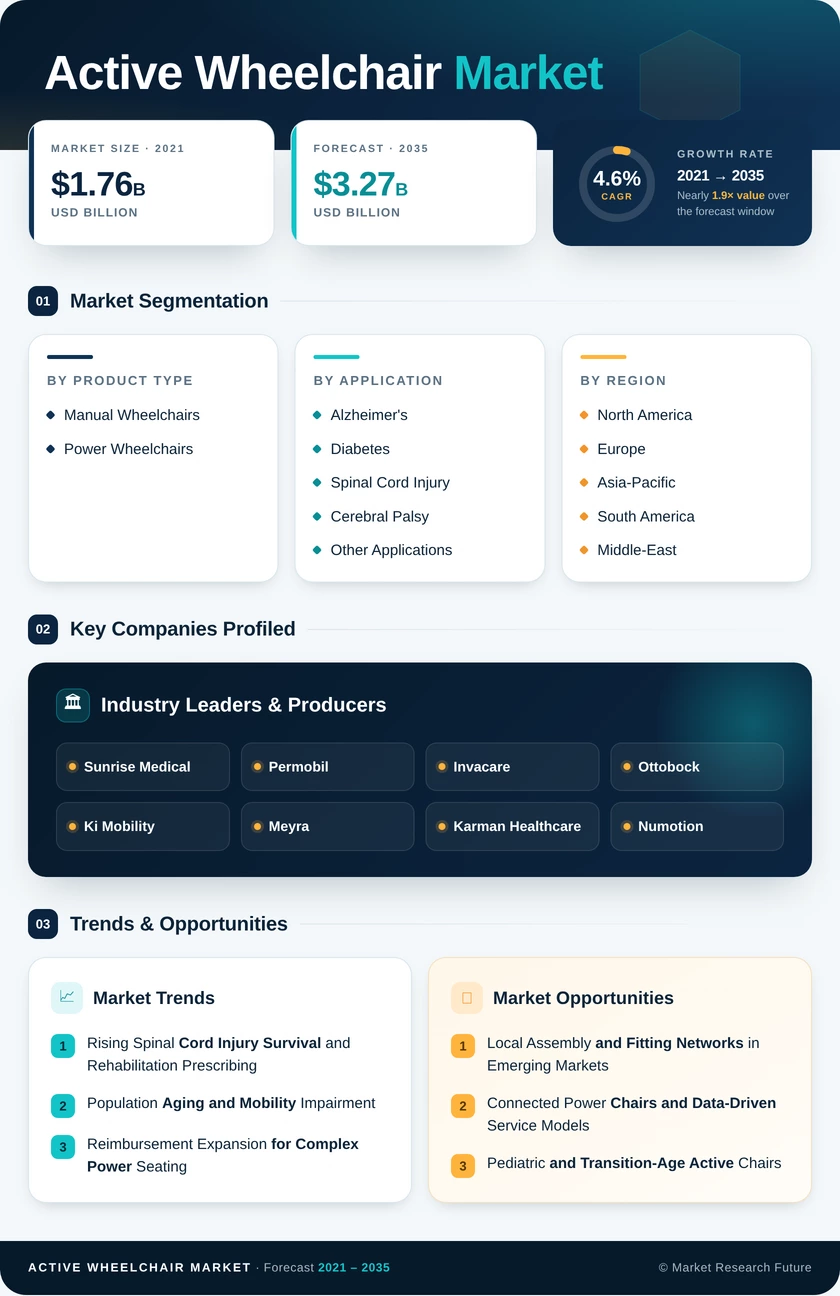
Segmentation Quick Reference
| Dimension | Sub-Segments | Dominant Segment | Fastest Growing Segment |
|---|---|---|---|
| By Product Type | Manual Wheelchairs; Power Wheelchairs | Manual Wheelchairs — 64.5% share | Power Wheelchairs — 6.1% CAGR |
| By Application | Alzheimer's; Diabetes; Spinal Cord Injury; Cerebral Palsy; Other Applications | Spinal Cord Injury — 38.0% share | Alzheimer's — 5.9% CAGR |
| By Region | North America; Europe; Asia-Pacific; South America; Middle-East and Africa | North America — 39.5% share | Asia-Pacific — 6.2% CAGR |
Market Segmentation Overview
By Product Type
| Sub-Segment | Key Trend |
|---|---|
| Manual Wheelchairs | Shift to rigid carbon and titanium frames with custom center-of-gravity setup. |
| Power Wheelchairs | Growth of seat elevation, tilt and connected controllers |
Manual Wheelchairs lead with a 64.5% share because spinal cord injury users propel themselves full time and replace rigid frames on a regular cycle. Power Wheelchairs grow fastest at a 6.1% CAGR. Medicare seat-elevation coverage and aging users with limited upper-body strength are raising both unit volumes and configured values. The two sub-segments are also converging as power-assist add-ons give manual users motorized help.
By Application
| Sub-Segment | Key Trend |
|---|---|
| Alzheimer's | Rising demand for easy-to-propel, adjustable frames for aging users |
| Diabetes | Chairs prescribed after amputation and for neuropathy-related mobility loss |
| Spinal Cord Injury | Early-life onset driving repeated replacement of rigid manual chairs. |
| Cerebral Palsy | Growth-adjustable pediatric frames and transition-age chairs |
| Other Applications | Multiple sclerosis, stroke and muscular dystrophy users needing progressive seating |
Spinal Cord Injury remains the leading application at a 38.0% share, because injuries often occur in early adulthood and users go through many chairs over their lifetimes. Alzheimer's grows fastest at a 5.9% CAGR, as rising dementia prevalence brings more older adults into supported but still active mobility. Cerebral Palsy, valued at USD 0.36 billion, depends on pediatric frames that can be resized as children grow.


 Noah Malgeri
Co-Founder

 Peter Groot koerkamp
Account and Business Manager

 Younghwan Choi
Senior Retail Manager

 Mark Irwin
Management Consultant

 Akif Moroglu
Strategy & Business Development Director

 Guilherme Gomes Martins
Product Management Director

 Joseph Aguayo
Sales Operations & Pricing Manager

 La Terria Dodd
Program Support Specialist

 Rob Kooiker
Group Product Manager HVAC & Fire Protection GMA