U.S. Industrial Output Rises Beyond Expectations
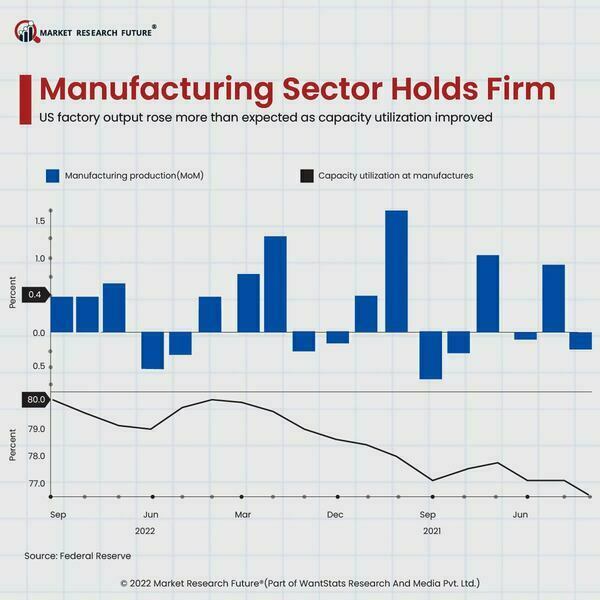
U.S. industrial production rose by 0.4 percent in September because of higher manufacturing output, especially in the auto industry, and the easing of supply-chain constraints. A report issued by the U.S. Federal Reserve revealed that the utility index decreased by 0.4 percent while the mining index increased by 0.6 percent.
Total industrial production in September increased by 5.3 percent from the same month last year, or 105.2% of its 2017 average. In September, capacity utilization increased by 0.2 percentage points to 80.3 percent, 0.7 percenta.ge points higher than the long-term (1972–2021) average.
According to the Federal Reserve, mining output increased by 0.6% thanks to increased oil and gas extraction. Manufacturing capacity utilization grew in September by 0.3 percentage points to 80.0 percent, which is 1.8 percentage points higher than the long-term average. The operating rate for utilities decreased by 0.4 percentage points to 72.8 percent, and the operating rate for mining increased by 0.4 points to 88.8 percent. It must be noted that the rate for utilities continued to be much below its long-run average; the rate for mining was 2.5 percentage points above it.
Amidst growing concerns of a recession, inflation, and rising interest rates, a shift in consumer spending to services, and a general downturn in the U.S. economy as well as in Europe and China, the factory sector in the United States is predicted to slow down in the upcoming months.