電動油圧ステアリング市場 概要
主要な市場動向とハイライト
市場規模と予測
| CAGR (2025 - 2035) | 4.77% |
| CAGR (2025 - 2035) | 4.77% |
The Electrically Powered Hydraulic Steering Market is currently experiencing a notable transformation, driven by advancements in technology and increasing consumer demand for enhanced vehicle performance. This market appears to be influenced by a growing emphasis on fuel efficiency and sustainability, as manufacturers seek to develop systems that reduce energy consumption while maintaining optimal steering response. Furthermore, the integration of electric steering systems into various vehicle types, including passenger cars and commercial vehicles, suggests a shift towards more versatile applications. As automakers continue to innovate, the Electrically Powered Hydraulic Steering Market is likely to expand, reflecting broader trends in the automotive industry. In addition, the rising awareness of safety features and driver assistance technologies may further propel the adoption of electrically powered steering systems. These systems are designed to provide improved handling and stability, which could enhance overall driving experiences. Moreover, the potential for customization and adaptability in steering systems indicates a promising future for this market. As the automotive landscape evolves, the Electrically Powered Hydraulic Steering Market seems poised for growth, driven by technological advancements and changing consumer preferences.
The Electrically Powered Hydraulic Steering Market is witnessing rapid technological innovations, which enhance system efficiency and performance. Manufacturers are increasingly focusing on integrating advanced sensors and control algorithms, leading to improved responsiveness and precision in steering. This trend indicates a shift towards more sophisticated steering solutions that cater to the evolving demands of modern vehicles.
There is a growing emphasis on sustainability within the Electrically Powered Hydraulic Steering Market, as consumers and manufacturers alike prioritize eco-friendly solutions. The development of energy-efficient steering systems aligns with global efforts to reduce carbon footprints, suggesting that future products will increasingly incorporate sustainable materials and technologies.
The integration of electrically powered hydraulic steering systems with autonomous driving technologies is becoming more prevalent. This trend indicates a potential for enhanced vehicle control and safety, as steering systems are designed to work seamlessly with automated driving features. As the market evolves, this integration may redefine steering functionalities, catering to the needs of future mobility.
The Electrically Powered Hydraulic Steering Market is increasingly influenced by sustainability initiatives and stringent environmental regulations. Governments are implementing policies aimed at reducing carbon emissions, which encourages the adoption of electric steering systems that are more energy-efficient compared to traditional hydraulic systems. This shift aligns with the automotive industry's broader commitment to sustainability, as electric steering systems can contribute to lower fuel consumption and reduced greenhouse gas emissions. As a result, the market is expected to expand, with a notable increase in the production of electric vehicles equipped with advanced steering technologies. The Electrically Powered Hydraulic Steering Market is thus positioned to benefit from these regulatory changes, fostering innovation and growth.
Cost efficiency is a critical driver in the Electrically Powered Hydraulic Steering Market, as manufacturers seek to optimize production processes and reduce costs. Innovations in manufacturing techniques, such as automation and advanced materials, are enabling companies to produce steering systems more efficiently. This not only lowers production costs but also enhances the quality and reliability of the final product. As competition intensifies, manufacturers are likely to invest in these innovations to maintain profitability while meeting the growing demand for electric steering systems. The Electrically Powered Hydraulic Steering Market is thus positioned for growth, as cost-effective solutions become increasingly important in a competitive landscape.
In the Electrically Powered Hydraulic Steering Market, the application segment is primarily dominated by passenger cars, which hold the largest share. This is driven by the increasing demand for fuel-efficient and responsive steering systems among consumers, leading automotive manufacturers to adopt electrically powered hydraulic steering systems in their models. Commercial vehicles and agricultural machinery also play significant roles, yet they lag in comparison to passenger cars in market presence. The heavy-duty vehicles segment is identified as the fastest-growing segment within this market due to rising construction and infrastructure development, especially in emerging economies. Enhanced vehicle performance and fuel efficiency requirements are key drivers, prompting manufacturers to invest in electrified steering technologies that cater to these heavy-duty applications.
In the Electrically Powered Hydraulic Steering Market, sedans hold the largest share due to their widespread acceptance and demand driven by consumer preferences for fuel efficiency and compact designs. This segment benefits from existing manufacturing frameworks, making it an attractive option for automotive producers looking to integrate advanced steering technologies into their vehicle lines. In contrast, SUVs, with their increasing popularity among consumers for both comfort and utility, are rapidly gaining traction in this market. Their versatility and larger sizes provide ample space for incorporating advanced technologies, making them a focal point for innovation in steering systems.
The Electrically Powered Hydraulic Steering Market is largely dominated by the Fleet Management segment, accounting for a significant portion of the overall market share. This segment is characterized by its extensive adoption among large-scale transportation services, contributing to its leadership position within the market. Conversely, the Personal Use segment is rapidly gaining traction, driven by increasing consumer interest in advanced steering technologies for personal vehicles, pushing it to emerge as a strong contender in the market landscape. Growth in the Fleet Management segment is propelled by the rising need for efficient vehicle control systems that enhance operational efficiency in commercial fleets. Additionally, technological advancements and regulatory push for greener transportation solutions are enhancing the adoption of electrically powered systems. Meanwhile, the Personal Use segment is benefiting from the growing trend of individual electric vehicles and increased consumer awareness regarding the benefits of advanced steering assistance systems. Together, these segments are shaping the dynamics of the Electrically Powered Hydraulic Steering Market.
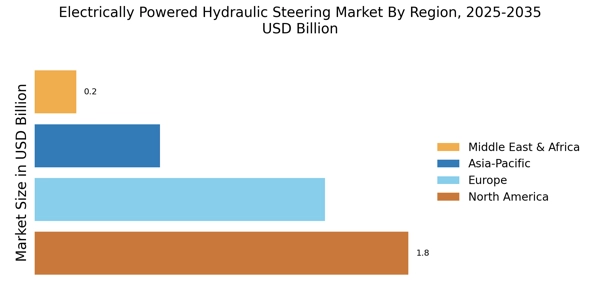
The Electrically Powered Hydraulic Steering Market (EPHS) market in North America is driven by increasing vehicle electrification and stringent fuel efficiency regulations. The region holds the largest market share at approximately 45%, with a growing demand for advanced steering technologies. Regulatory support for electric vehicles and sustainability initiatives further catalyze market growth. Leading countries in this region include the United States and Canada, with major automotive manufacturers investing heavily in EPHS technologies. Key players such as Nexteer Automotive and Robert Bosch GmbH are at the forefront, enhancing competitive dynamics. The presence of established automotive hubs and innovation centers contributes to a robust market landscape.
Europe is witnessing significant growth in the Electrically Powered Hydraulic Steering Market, driven by stringent EU regulations on emissions and a strong push towards electric vehicles. The region holds the second-largest market share at around 35%. Government incentives for electric mobility and sustainability initiatives are key growth catalysts, fostering innovation in steering technologies. Germany, France, and the UK are leading countries in this market, with major automotive manufacturers like ZF Friedrichshafen AG and Thyssenkrupp AG investing in advanced steering solutions. The competitive landscape is characterized by collaborations and partnerships among key players, enhancing technological advancements and market penetration.
The Asia-Pacific region is emerging as a significant player in the Electrically Powered Hydraulic Steering Market, driven by rapid urbanization and increasing vehicle production. The market share in this region is approximately 15%, with countries like China and Japan leading the charge. The demand for advanced steering systems is fueled by the growing automotive sector and government initiatives promoting electric vehicles. China is the largest market in the region, with major automotive manufacturers investing in EPHS technologies. Key players such as JTEKT Corporation and DENSO Corporation are enhancing their presence, contributing to a competitive landscape. The region's focus on innovation and technology adoption is expected to drive further growth in the coming years.
The Middle East and Africa region is gradually developing its Electrically Powered Hydraulic Steering Market, driven by increasing vehicle sales and a growing focus on sustainability. The market share is currently around 5%, with countries like South Africa and the UAE showing potential for growth. Government initiatives aimed at promoting electric vehicles are expected to catalyze market expansion. The competitive landscape is still evolving, with key players like Hyundai Mobis and Mando Corporation beginning to establish a foothold. The region's unique market dynamics, including resource availability and emerging automotive sectors, present opportunities for growth in EPHS technologies. Continued investment in infrastructure and technology will be crucial for future development.
The Electrically Powered Hydraulic Steering Market is currently characterized by a dynamic competitive landscape, driven by technological advancements and increasing demand for enhanced vehicle performance. Key players such as Robert Bosch GmbH (Germany), JTEKT Corporation (Japan), and ZF Friedrichshafen AG (Germany) are at the forefront, each adopting distinct strategies to solidify their market positions. Robert Bosch GmbH (Germany) emphasizes innovation in electric steering systems, focusing on integrating advanced driver-assistance systems (ADAS) to enhance safety and user experience. Meanwhile, JTEKT Corporation (Japan) is pursuing strategic partnerships with automotive manufacturers to expand its market reach and leverage synergies in product development. ZF Friedrichshafen AG (Germany) is actively investing in digital transformation initiatives, aiming to optimize its manufacturing processes and improve supply chain efficiency, thereby enhancing its competitive edge.The business tactics employed by these companies reflect a concerted effort to localize manufacturing and optimize supply chains, which is crucial in a moderately fragmented market. This competitive structure allows for a diverse range of offerings, catering to various consumer preferences and regulatory requirements across different regions. The collective influence of these key players shapes market dynamics, as they continuously adapt to evolving consumer demands and technological advancements.
In August ZF Friedrichshafen AG (Germany) announced a collaboration with a leading electric vehicle manufacturer to develop next-generation steering systems that integrate artificial intelligence for improved responsiveness. This strategic move not only positions ZF as a pioneer in AI-driven steering solutions but also aligns with the growing trend towards electrification in the automotive sector. The partnership is expected to enhance ZF's product portfolio and strengthen its foothold in the rapidly evolving electric vehicle market.
In September JTEKT Corporation (Japan) unveiled a new line of electrically powered hydraulic steering systems designed specifically for electric vehicles. This launch underscores JTEKT's commitment to sustainability and innovation, as it seeks to meet the increasing demand for eco-friendly automotive solutions. By focusing on electric vehicle applications, JTEKT is likely to capture a significant share of the market, positioning itself as a leader in the transition towards greener technologies.
In July Robert Bosch GmbH (Germany) expanded its production capabilities in North America by establishing a new manufacturing facility dedicated to electric steering systems. This strategic investment not only enhances Bosch's operational efficiency but also allows the company to better serve its North American clientele. The move is indicative of Bosch's proactive approach to scaling its operations in response to the growing demand for advanced steering technologies in the region.
As of October the Electrically Powered Hydraulic Steering Market is witnessing trends that emphasize digitalization, sustainability, and the integration of artificial intelligence. Strategic alliances among key players are increasingly shaping the competitive landscape, fostering innovation and collaboration. Looking ahead, it appears that competitive differentiation will evolve from traditional price-based competition to a focus on technological innovation, supply chain reliability, and the ability to deliver sustainable solutions. This shift is likely to redefine market dynamics, compelling companies to invest in R&D and forge strategic partnerships to maintain their competitive edge.

The overall growth in market valuation of these companies signals a positive outlook for advancements in the electrically powered hydraulic steering sector, fostering further competition and innovation in the industry.
電動油圧ステアリング市場は、2024年から2035年までの間に4.77%のCAGRで成長すると予測されており、自動車技術の進歩と燃費効率の向上に対する需要の増加がその要因です。
新しい機会は以下にあります:
2035年までに、市場は堅調な成長を遂げ、自動車ステアリングソリューションのリーダーとしての地位を確立することが期待されています。
| Parameter | Details |
|---|---|
| Market Scope | Global Electrically Powered Hydraulic Steering Market by vehicle type, component type, and region |
| Study Period | 2021–2035 (Historical: 2021–2024; Base Year: 2025; Forecast: 2026–2035) |
| CAGR | 7.3% (2026–2035) |
| Market Size Checkpoints | USD 4.62 Billion (2025); USD 4.96 Billion (2026); USD 6.57 Billion (2030); USD 9.35 Billion (2035) |
| Fastest Growing Segments | Commercial Vehicles (8.6% CAGR); Sensors (8.9% CAGR) |
| Companies Profiled | ZF Friedrichshafen AG, JTEKT Corporation, Robert Bosch GmbH, Nexteer Automotive, Hyundai Mobis, HL Mando, thyssenkrupp AG, Hitachi Astemo, NSK Ltd., China Automotive Systems, Inc. |
| Valuation Currency | USD (Billion/Million), constant 2025 exchange rates |
 Abbas Raut

 Sejal Akre
このレポートの無料サンプルを受け取るには、以下のフォームにご記入ください

“This is really good guys. Excellent work on a tight deadline. I will continue to use you going forward and recommend you to others. Nice job”
 Noah Malgeri
Co-Founder

“Thanks for sending the report it gives us a good global view of the Betaïne market.”
 Peter Groot koerkamp
Account and Business Manager

“We found the report very insightful! we found your research firm very helpful. I'm sending this email to secure our future business.”
 Younghwan Choi
Senior Retail Manager

“I am very pleased with how market segments have been defined in a relevant way for my purposes (such as "Portable Freezers & refrigerators" and "last-mile"). In general the report is well structured. Thanks very much for your efforts.”
 Mark Irwin
Management Consultant

“We got the report in time, we really thank you for your support in this process. I also thank to all of your team as they did a great job.”
 Akif Moroglu
Strategy & Business Development Director

“The Automotive 48V ECU Components Procurement Intelligence Study” was a complex project, but the Market Research Future (MRFR) team handled it with quality, agility, and customer-centricity. They delivered all requested data on time and within the agreed scope. The team, including Shubhendra Anand and Rahul Gotadki, was always readily available to clarify questions and swiftly implement necessary adjustments, driving the project to a successful conclusion within a very demanding timeframe.
I would also like to specifically commend Akshay Agarwal for his responsiveness and support at every stage—from our initial inquiry on May 6th through to final delivery on June 18th. His dedication made the entire process seamless.”
 Guilherme Gomes Martins
Product Management Director

“Thanks. It’s been a pleasure working with you, please use me as reference with any other Intel employees.”
 Joseph Aguayo
Sales Operations & Pricing Manager

“Thank you, this will be very helpful for OQS.”
 La Terria Dodd
Program Support Specialist

“I have been reading the first document or the study, ,the Global HVAC and FP market report 2021 till 2026. Must say, good info! I have not gone in depth at all parts, but got a good indication of the data inside!”
 Rob Kooiker
Group Product Manager HVAC & Fire Protection GMA



