綿種子処理市場 概要
主要な市場動向とハイライト
市場規模と予測
| CAGR (2025 - 2035) | 3.72% |
| CAGR (2025 - 2035) | 3.72% |
The Cotton Seed Treatment Market is currently experiencing a dynamic evolution, driven by various factors that influence agricultural practices and crop management strategies. The increasing emphasis on sustainable farming methods appears to be a significant catalyst, as farmers seek to enhance crop yields while minimizing environmental impact. Moreover, advancements in seed treatment technologies suggest a growing interest in innovative solutions that can effectively combat pests and diseases, thereby ensuring healthier cotton crops. This trend is likely to be further supported by regulatory frameworks that promote the use of eco-friendly products in agriculture. In addition, the rising global demand for cotton, fueled by its diverse applications in textiles and other industries, seems to be propelling investments in seed treatment solutions. As stakeholders in the Cotton Seed Treatment Market strive to meet this demand, there is a noticeable shift towards integrated pest management approaches that combine chemical and biological treatments. This multifaceted strategy not only addresses immediate agricultural challenges but also aligns with long-term sustainability goals. Overall, the Cotton Seed Treatment Market appears poised for growth, with a focus on innovation and environmental stewardship shaping its future trajectory.
The Cotton Seed Treatment Market is increasingly influenced by the adoption of sustainable agricultural practices. Farmers are prioritizing eco-friendly solutions that enhance crop resilience while reducing chemical usage. This shift reflects a broader trend towards environmental responsibility in farming.
Innovations in seed treatment technologies are transforming the Cotton Seed Treatment Market. New formulations and application methods are emerging, allowing for more effective pest and disease management. These advancements are likely to improve overall crop health and yield.
There is a growing trend towards integrated pest management strategies within the Cotton Seed Treatment Market. This approach combines various treatment methods, including biological and chemical solutions, to create a more holistic and effective pest control system.
The Cotton Seed Treatment Market is experiencing a surge in demand for cotton products, driven by the increasing consumption of cotton in textiles and apparel. As consumers become more environmentally conscious, the demand for sustainably produced cotton is likely to rise. This trend is reflected in the growing preference for organic cotton, which necessitates effective seed treatment solutions to ensure high-quality yields. In 2023, the cotton production reached approximately 25 million metric tons, indicating a robust market for cotton seed treatment solutions. The need for enhanced seed performance and disease resistance is becoming paramount, thereby propelling the growth of the Cotton Seed Treatment Market.
Chemical treatments remain dominant in the Cotton Seed Treatment Market, valued for their immediate efficacy against a wide range of pests and diseases. They comprise a significant portion of the treatments applied to cotton seeds, leveraging advanced formulations that enhance seed performance and yield outputs. However, insecticides, specifically tailored for insect management in cotton crops, are emerging as an important segment within this market. As integrated pest management practices gain traction, insecticides that are specifically designed to target pests while minimizing non-target effects are capturing growers' interest. The rise of precision agriculture technology also supports the development of targeted insecticide applications, further propelling this segment's growth.
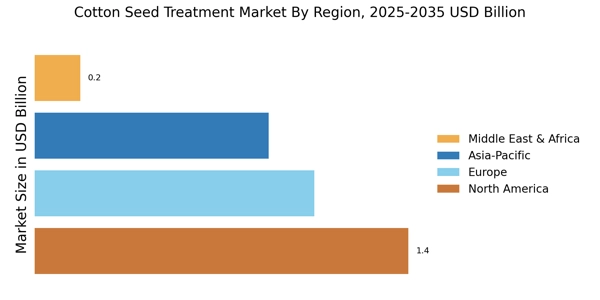
North America is the largest market for cotton seed treatment, holding approximately 40% of the global share. The region benefits from advanced agricultural practices, high demand for cotton, and stringent regulations promoting sustainable farming. The increasing adoption of integrated pest management (IPM) strategies and biopesticides is driving growth. Regulatory support for environmentally friendly products further enhances market potential. The United States is the leading country in this market, with significant contributions from Texas and California. Key players like Corteva Agriscience and Bayer AG dominate the landscape, focusing on innovative solutions to enhance crop yield and pest resistance. The competitive environment is characterized by ongoing research and development, with companies investing heavily in new technologies to meet evolving agricultural needs.
Europe is the second-largest market for cotton seed treatment, accounting for around 30% of the global share. The region's growth is driven by increasing demand for organic cotton and stringent EU regulations promoting sustainable agricultural practices. The European Green Deal and Farm to Fork Strategy are pivotal in shaping market dynamics, encouraging the use of eco-friendly treatments and reducing chemical inputs in agriculture. Leading countries include Spain and Greece, where cotton cultivation is significant. The competitive landscape features major players like BASF SE and Syngenta AG, who are actively developing innovative solutions to meet regulatory requirements. The presence of strong agricultural cooperatives and research institutions further enhances the market, fostering collaboration and innovation in cotton seed treatment technologies.
Asia-Pacific is witnessing rapid growth in the cotton seed treatment market, holding approximately 25% of the global share. The region's expansion is fueled by increasing cotton production, rising pest resistance issues, and the adoption of modern agricultural practices. Countries like India and China are leading the charge, supported by government initiatives aimed at enhancing agricultural productivity and sustainability. India is the largest market in this region, with significant contributions from states like Gujarat and Maharashtra. The competitive landscape is evolving, with local players like UPL Limited and Adama Agricultural Solutions Ltd. gaining traction. The presence of multinational corporations further intensifies competition, driving innovation and the introduction of advanced treatment solutions tailored to local needs.
The Middle East and Africa region is emerging as a significant player in the cotton seed treatment market, accounting for about 5% of the global share. The growth is driven by increasing cotton cultivation in countries like Egypt and South Africa, alongside rising awareness of pest management solutions. Government initiatives aimed at boosting agricultural productivity and food security are also contributing to market expansion. Egypt is a key player in this market, with a long history of cotton production. The competitive landscape includes both local and international companies, with players like FMC Corporation and Nufarm Limited actively participating. The region's unique challenges, such as water scarcity, are prompting innovations in seed treatment technologies to enhance crop resilience and yield.
The Cotton Seed Treatment Market is currently characterized by a dynamic competitive landscape, driven by increasing demand for high-yield and pest-resistant cotton varieties. Key players such as BASF SE (Germany), Syngenta AG (Switzerland), and Corteva Agriscience (United States) are actively shaping the market through strategic initiatives focused on innovation and sustainability. These companies are not only investing in research and development to enhance their product offerings but are also exploring mergers and acquisitions to consolidate their market positions. The collective strategies of these firms indicate a trend towards a more integrated approach to cotton seed treatment, emphasizing the importance of technological advancements and environmental stewardship in their operations.In terms of business tactics, companies are increasingly localizing manufacturing to reduce costs and improve supply chain efficiency. This approach appears to be particularly relevant in regions with high cotton production, where proximity to farmers can enhance responsiveness to market needs. The competitive structure of the Cotton Seed Treatment Market is moderately fragmented, with several players vying for market share. However, the influence of major companies like Bayer AG (Germany) and FMC Corporation (United States) is significant, as they leverage their extensive distribution networks and brand recognition to maintain competitive advantages.
In August Bayer AG (Germany) announced a strategic partnership with a leading agricultural technology firm to develop advanced seed treatment solutions that utilize AI for pest detection. This collaboration is expected to enhance Bayer's product efficacy and align with the growing trend towards precision agriculture. The integration of AI into seed treatment processes not only positions Bayer as a leader in innovation but also reflects a broader industry shift towards technology-driven solutions that improve crop yields and sustainability.Similarly, in September 2025, Corteva Agriscience (United States) launched a new line of bio-based seed treatments aimed at reducing chemical usage in cotton farming. This initiative underscores Corteva's commitment to sustainability and aligns with increasing regulatory pressures for environmentally friendly agricultural practices. By focusing on bio-based solutions, Corteva is likely to attract a segment of the market that prioritizes ecological considerations, thereby enhancing its competitive positioning.
In October Syngenta AG (Switzerland) expanded its product portfolio by acquiring a niche seed treatment company specializing in organic solutions. This acquisition not only diversifies Syngenta's offerings but also allows the company to tap into the growing organic cotton market. The strategic importance of this move lies in Syngenta's ability to cater to changing consumer preferences and regulatory landscapes, which increasingly favor organic and sustainable agricultural practices.
As of October the Cotton Seed Treatment Market is witnessing significant trends towards digitalization, sustainability, and the integration of artificial intelligence. These trends are reshaping competitive dynamics, as companies increasingly form strategic alliances to enhance their technological capabilities and market reach. The shift from price-based competition to a focus on innovation and supply chain reliability is becoming evident, suggesting that future competitive differentiation will hinge on the ability to deliver advanced, sustainable solutions that meet the evolving needs of cotton producers.



コットンシード処理市場は、2024年から2035年までの間に3.72%のCAGRで成長すると予測されており、害虫抵抗性の向上と持続可能な農業慣行がその推進要因です。
新しい機会は以下にあります:
2035年までに、市場は進化する農業ニーズを反映して堅調な成長を遂げると予想されています。
| MARKET SIZE 2024 | 3.482(USD Billion) |
| MARKET SIZE 2025 | 3.611(USD Billion) |
| MARKET SIZE 2035 | 5.204(USD Billion) |
| COMPOUND ANNUAL GROWTH RATE (CAGR) | 3.72% (2025 - 2035) |
| REPORT COVERAGE | Revenue Forecast, Competitive Landscape, Growth Factors, and Trends |
| BASE YEAR | 2024 |
| Market Forecast Period | 2025 - 2035 |
| Historical Data | 2019 - 2024 |
| Market Forecast Units | USD Billion |
| Key Companies Profiled | BASF SE (DE), Syngenta AG (CH), Bayer AG (DE), Corteva Agriscience (US), FMC Corporation (US), Nufarm Limited (AU), UPL Limited (IN), Adama Agricultural Solutions Ltd. (IL) |
| Segments Covered | Type, Application, Formulation, Distribution Channel, Regional |
| Key Market Opportunities | Adoption of biopesticides and sustainable practices in the Cotton Seed Treatment Market presents significant growth potential. |
| Key Market Dynamics | Rising demand for sustainable agriculture drives innovation in cotton seed treatment technologies and regulatory compliance. |
| Countries Covered | North America, Europe, APAC, South America, MEA |
 Snehal Singh


このレポートの無料サンプルを受け取るには、以下のフォームにご記入ください

“This is really good guys. Excellent work on a tight deadline. I will continue to use you going forward and recommend you to others. Nice job”
 Noah Malgeri
Co-Founder

“Thanks for sending the report it gives us a good global view of the Betaïne market.”
 Peter Groot koerkamp
Account and Business Manager

“We found the report very insightful! we found your research firm very helpful. I'm sending this email to secure our future business.”
 Younghwan Choi
Senior Retail Manager

“I am very pleased with how market segments have been defined in a relevant way for my purposes (such as "Portable Freezers & refrigerators" and "last-mile"). In general the report is well structured. Thanks very much for your efforts.”
 Mark Irwin
Management Consultant

“We got the report in time, we really thank you for your support in this process. I also thank to all of your team as they did a great job.”
 Akif Moroglu
Strategy & Business Development Director

“The Automotive 48V ECU Components Procurement Intelligence Study” was a complex project, but the Market Research Future (MRFR) team handled it with quality, agility, and customer-centricity. They delivered all requested data on time and within the agreed scope. The team, including Shubhendra Anand and Rahul Gotadki, was always readily available to clarify questions and swiftly implement necessary adjustments, driving the project to a successful conclusion within a very demanding timeframe.
I would also like to specifically commend Akshay Agarwal for his responsiveness and support at every stage—from our initial inquiry on May 6th through to final delivery on June 18th. His dedication made the entire process seamless.”
 Guilherme Gomes Martins
Product Management Director

“Thanks. It’s been a pleasure working with you, please use me as reference with any other Intel employees.”
 Joseph Aguayo
Sales Operations & Pricing Manager

“Thank you, this will be very helpful for OQS.”
 La Terria Dodd
Program Support Specialist

“I have been reading the first document or the study, ,the Global HVAC and FP market report 2021 till 2026. Must say, good info! I have not gone in depth at all parts, but got a good indication of the data inside!”
 Rob Kooiker
Group Product Manager HVAC & Fire Protection GMA


