
Request Free Sample ×

Kindly complete the form below to receive a free sample of this Report

* Please use a valid business email

Leading companies partner with us for data-driven Insights

clients tt-cursor
Hero Background

Dedicated Outdoor Air System Market

ID: MRFR/SEM/28268-CR
361 Pages
Apoorva Priyadarshi
Last Updated: May 14, 2026

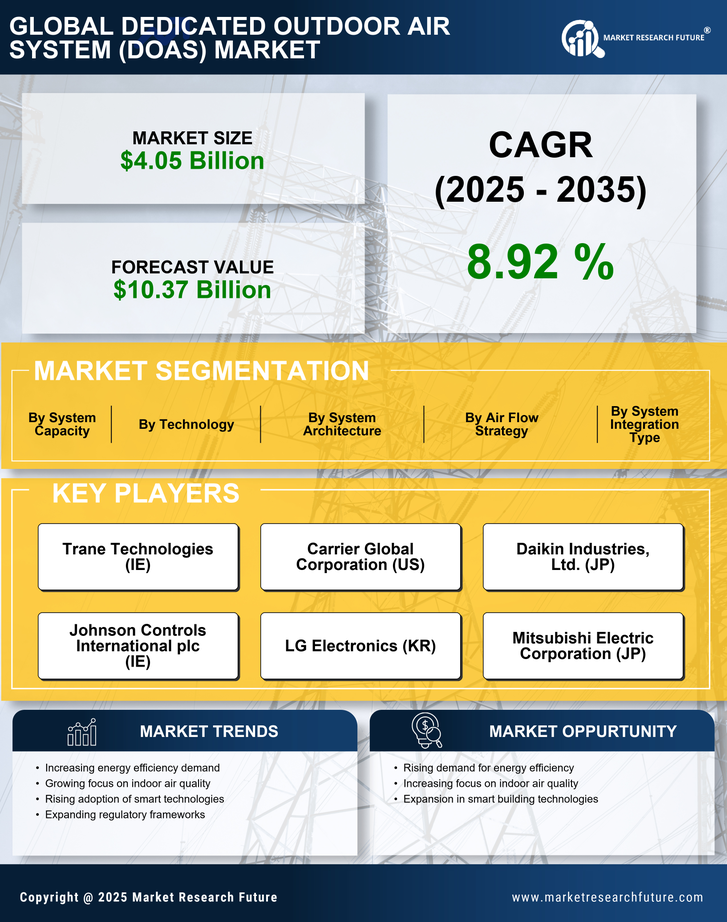
Taille, part et rapport de recherche du marché des systèmes d’air extérieur dédiés (DOAS) par technologie (systèmes DX (expansion directe), systèmes de ventilation à récupération d’énergie (ERV), roues à enthalpie et systèmes de ventilation à récupération de chaleur (HRV), par stratégie de flux d’air (volume d’air constant (CAV), volume d’air variable (VAV) et ventilation par déplacement (DV)), par type de caméra (DSLR, sans miroir, caméras argentiques, caméras d’action et caméras numériques compactes), par architecture système (Unités DOAS emballées, DOAS modulaires/personnalisées via des unités de traitement d'air (CTA) et systèmes intégrés avec des composants tiers), par capacité du système (en moins de 5 tonnes / 1,000 CFM, 5 à 15 tonnes/ 1,000 à 3,000 CFM, de 15 à 30 tonnes/de 3,000 à 6,000 CFM et plus de 30 tonnes/>6,000 CFM), par type d'intégration de système (systèmes assemblés par OEM (construits par le client) et par un intégrateur tiers), par application (Confort/Commercial Applications et processus/applications industrielles), et par région (Amérique du Nord, Europe, Asie-Pacifique, Amérique du Sud, Moyen-Orient et Afrique) – Prévisions de l'industrie jusqu'à 2035

Partager
Download PDF ×

We do not share your information with anyone. However, we may send you emails based on your report interest from time to time. You may contact us at any time to opt-out.

  1. 1 SECTION I: RÉSUMÉ ET PRINCIPAUX FAITS SAILLANTS
    1. 1.1 RÉSUMÉ EXÉCUTIF
  2. Aperçu du marché 1.1.1
    1. 1.1.2 Principales conclusions
  3. Segmentation du marché 1.1.3
    1. 1.1.4 Paysage concurrentiel
    2. 1.1.5 Défis et opportunités
    3. 1.1.6 Perspectives futures
  4. 2 SECTION II: CADRE, MÉTHODOLOGIE ET STRUCTURE DU MARCHÉ
    1. 2.1 INTRODUCTION AU MARCHÉ
  5. Définition 2.1.1
    1. 2.1.2 Portée de l'étude
  6. Objectif de recherche 2.1.2.1
  7. Hypothèse 2.1.2.2
  8. Limites de 2.1.2.3
    1. 2.2 MÉTHODOLOGIE DE RECHERCHE
      1. 2.2.1 Aperçu
      2. 2.2.2 Exploration de données
      3. 2.2.3 Recherche secondaire
      4. 2.2.4 Recherche primaire
        1. 2.2.4.1 Entretiens primaires et processus de collecte d'informations
        2. 2.2.4.2 Répartition des répondants principaux
  9. Modèle de prévision 2.2.5
    1. 2.2.6 Estimation de la taille du marché
      1. 2.2.6.1 Approche ascendante
      2. 2.2.6.2 Approche descendante
    2. 2.2.7 Triangulation des données
  10. Validation 2.2.8
  11. 3 SECTION III: ANALYSE QUALITATIVE
    1. 3.1 DYNAMIQUE DU MARCHÉ
      1. 3.1.1 Aperçu
  12. Pilotes 3.1.2
    1. 3.1.3 Contraintes
    2. 3.1.4 Opportunités
    3. 3.2 ANALYSE DES FACTEURS DE MARCHÉ
      1. 3.2.1 Analyse de la chaîne de valeur
      2. 3.2.2 Analyse des cinq forces de Porter
        1. 3.2.2.1 Pouvoir de négociation des fournisseurs
        2. 3.2.2.2 Pouvoir de négociation des acheteurs
        3. 3.2.2.3 Menace des nouveaux entrants
        4. 3.2.2.4 Menace de remplacement
        5. 3.2.2.5 Intensité de la rivalité
      3. 3.2.3 COVID-19 Analyse d'impact
        1. 3.2.3.1 Analyse d’impact sur le marché
        2. 3.2.3.2 Impact régional
        3. 3.2.3.3 Analyse des opportunités et des menaces
  13. 4 SECTION IV: ANALYSE QUANTITATIVE
    1. 4.1 Semi-conducteurs et électronique, technologie BY (USD milliards)
  14. Systèmes à expansion directe (DX) 4.1.1
  15. Systèmes de ventilation à récupération d'énergie (VRE) 4.1.2
  16. Roues d'enthalpie 4.1.3
  17. Systèmes de ventilation à récupération de chaleur (VRC) 4.1.4
    1. 4.2 Semi-conducteurs et électronique, par stratégie de flux d'air (USD milliards)
      1. 4.2.1 Volume d'air constant (CAV)
      2. 4.2.2 Volume d'air variable (VAV)
      3. 4.2.3 Ventilation par déplacement (DV)
    2. 4.3 Semi-conducteurs et électronique, BY System Architecture (USD milliards)
  18. Unités DOAS emballées 4.3.1
    1. 4.3.2 DOAS modulaire/personnalisé via des unités de traitement d'air (CTA)
    2. 4.3.3 Systèmes intégrés avec composants tiers
    3. 4.4 Semi-conducteurs et électronique, par capacité du système (USD milliards)
      1. 4.4.1 Moins de 5 Tonnes / 1,000 CFM
      2. 4.4.2 5 à 15 Tonnes / 1,000 à 3,000 CFM
      3. 4.4.3 15 à 30 Tonnes / 3,000 à 6,000 CFM
      4. 4.4.4 Plus de 30 Tonnes / >6,000 CFM
    4. 4.5 Semi-conducteurs et électronique, par type d'intégration système (USD milliards)
      1. 4.5.1 OEM intégré (construit par le client)
      2. 4.5.2 Systèmes assemblés par un intégrateur tiers
    5. 4.6 Semi-conducteurs et électronique, par application (USD milliards)
      1. 4.6.1 Applications commerciales/confort
      2. 4.6.2 Bâtiments commerciaux
      3. 4.6.3 Instituts d'enseignement
      4. 4.6.4 Espaces de vente au détail
      5. 4.6.5 Hôpitaux et établissements de santé
      6. 4.6.6 Processus/Applications industrielles
      7. 4.6.7 Installations industrielles
      8. 4.6.8 Salles blanches (produits pharmaceutiques, biotechnologies)
  19. Fabriques de semi-conducteurs 4.6.9
    1. 4.6.10 Installations de fabrication de batteries

    2. 4.7 Semi-conducteurs et électronique, par région (USD milliards)
      1. 4.7.1 Amérique du Nord
        1. 4.7.1.1 US
        2. 4.7.1.2 Canada
      2. 4.7.2 Europe
        1. 4.7.2.1 Allemagne
        2. 4.7.2.2 UK
        3. 4.7.2.3 France
        4. 4.7.2.4 Russie
        5. 4.7.2.5 Italie
        6. 4.7.2.6 Espagne
        7. 4.7.2.7 Reste de l'Europe
      3. 4.7.3 APAC
        1. 4.7.3.1 Chine
        2. 4.7.3.2 Inde
        3. 4.7.3.3 Japon
        4. 4.7.3.4 Corée du Sud
        5. 4.7.3.5 Malaisie
        6. 4.7.3.6 Thaïlande
        7. 4.7.3.7 Indonésie
        8. 4.7.3.8 Reste de APAC
      4. 4.7.4 Amérique du Sud
        1. 4.7.4.1 Brésil
        2. 4.7.4.2 Mexique
        3. 4.7.4.3 Argentine
        4. 4.7.4.4 Reste de l'Amérique du Sud
      5. 4.7.5 MEA
        1. 4.7.5.1 Pays du CCG
        2. 4.7.5.2 Afrique du Sud
        3. 4.7.5.3 Reste de MEA
  20. 5 SECTION V: ANALYSE CONCURRENTELLE
    1. 5.1 Paysage concurrentiel
      1. 5.1.1 Aperçu
  21. Analyse concurrentielle 5.1.2
  22. Analyse de la part de marché de 5.1.3
    1. 5.1.4 Stratégie de croissance majeure sur le secteur des semi-conducteurs et de l'électronique
    2. 5.1.5 Analyse comparative concurrentielle
    3. 5.1.6 Acteurs principaux in Termes de nombre de développements sur le semi-conducteur et l'électronique
    4. 5.1.7 Développements clés et stratégies de croissance
      1. 5.1.7.1 Lancement de nouveaux produits/déploiement de services
      2. 5.1.7.2 Fusion et Acquisitions
  23. Coentreprises 5.1.7.3
    1. 5.1.8 Matrice financière des principaux acteurs
      1. 5.1.8.1 Ventes et résultat opérationnel
      2. 5.1.8.2 Dépenses de R&D des principaux acteurs. 2023
    2. 5.2 Profils d'entreprise
      1. 5.2.1 Trane Technologies (IE)
        1. 5.2.1.1 Aperçu financier
        2. 5.2.1.2 Produits proposés
        3. 5.2.1.3 Développements clés
  24. Analyse SWOT 5.2.1.4
    1. 5.2.1.5 Stratégies clés
    2. 5.2.2 Carrier Global Corporation (US)
      1. 5.2.2.1 Aperçu financier
      2. 5.2.2.2 Produits proposés
      3. 5.2.2.3 Développements clés
  25. Analyse SWOT 5.2.2.4
    1. 5.2.2.5 Stratégies clés
    2. 5.2.3 Daikin Industries, Ltd.
      1. 5.2.3.1 Aperçu financier
      2. 5.2.3.2 Produits proposés
      3. 5.2.3.3 Développements clés
  26. Analyse SWOT 5.2.3.4
    1. 5.2.3.5 Stratégies clés
    2. 5.2.4 Johnson Controls International plc (IE)
      1. 5.2.4.1 Aperçu financier
      2. 5.2.4.2 Produits proposés
      3. 5.2.4.3 Développements clés
  27. Analyse SWOT 5.2.4.4
    1. 5.2.4.5 Stratégies clés
    2. 5.2.5 LG Electronics (KR)
      1. 5.2.5.1 Aperçu financier
      2. 5.2.5.2 Produits proposés
      3. 5.2.5.3 Développements clés
  28. Analyse SWOT 5.2.5.4
    1. 5.2.5.5 Stratégies clés
    2. 5.2.6 Mitsubishi Electric Corporation (JP)
      1. 5.2.6.1 Aperçu financier
      2. 5.2.6.2 Produits proposés
      3. 5.2.6.3 Développements clés
  29. Analyse SWOT 5.2.6.4
    1. 5.2.6.5 Stratégies clés
    2. 5.2.7 Entreprise de fabrication Rheem (US)
      1. 5.2.7.1 Aperçu financier
      2. 5.2.7.2 Produits proposés
      3. 5.2.7.3 Développements clés
  30. Analyse SWOT 5.2.7.4
    1. 5.2.7.5 Stratégies clés
    2. 5.2.8 York International Corporation (US)
      1. 5.2.8.1 Aperçu financier
      2. 5.2.8.2 Produits proposés
      3. 5.2.8.3 Développements clés
  31. Analyse SWOT 5.2.8.4
    1. 5.2.8.5 Stratégies clés
    2. 5.3 Annexe
      1. 5.3.1 Références
      2. 5.3.2 Rapports associés
  32. 6 LISTE DES FIGURES
    1. 6.1 SYNOPSIS DU MARCHÉ
    2. 6.2 ANALYSE DU MARCHÉ EN AMÉRIQUE DU NORD
    3. 6.3 US ANALYSE DU MARCHÉ PAR TECHNOLOGIE
    4. 6.4 US ANALYSE DE MARCHÉ PAR STRATÉGIE DE FLUX D'AIR
    5. 6.5 US ANALYSE DU MARCHÉ PAR ARCHITECTURE DU SYSTÈME
    6. 6.6 US ANALYSE DU MARCHÉ PAR CAPACITÉ DU SYSTÈME
    7. 6.7 US ANALYSE DU MARCHÉ PAR TYPE D'INTÉGRATION DE SYSTÈME
    8. 6.8 US ANALYSE DU MARCHÉ PAR APPLICATION
    9. 6.9 ANALYSE DU MARCHÉ CANADIEN PAR TECHNOLOGIE
    10. 6.10 ANALYSE DU MARCHÉ CANADA PAR STRATÉGIE DE FLUX AÉRIEN
    11. 6.11 ANALYSE DU MARCHÉ CANADA PAR ARCHITECTURE DU SYSTÈME
    12. 6.12 ANALYSE DU MARCHÉ CANADA PAR CAPACITÉ DU SYSTÈME
    13. 6.13 ANALYSE DU MARCHÉ CANADA PAR TYPE D'INTÉGRATION DE SYSTÈMES
    14. 6.14 ANALYSE DU MARCHÉ CANADIEN PAR APPLICATION
    15. 6.15 ANALYSE DU MARCHÉ EUROPE
    16. 6.16 ANALYSE DU MARCHÉ ALLEMAGNE PAR TECHNOLOGIE
    17. 6.17 ANALYSE DU MARCHÉ ALLEMAGNE PAR STRATÉGIE DE FLUX D'AIR
    18. 6.18 ANALYSE DU MARCHÉ ALLEMAGNE PAR ARCHITECTURE DU SYSTÈME
    19. 6.19 ANALYSE DU MARCHÉ ALLEMAGNE PAR CAPACITÉ DU SYSTÈME
    20. 6.20 ANALYSE DU MARCHÉ ALLEMAGNE PAR TYPE D'INTÉGRATION DE SYSTÈMES
    21. 6.21 ANALYSE DU MARCHÉ ALLEMAGNE PAR APPLICATION
    22. 6.22 UK ANALYSE DU MARCHÉ PAR TECHNOLOGIE
    23. 6.23 UK ANALYSE DE MARCHÉ PAR STRATÉGIE DE FLUX D'AIR
    24. 6.24 UK ANALYSE DU MARCHÉ PAR ARCHITECTURE DU SYSTÈME
    25. 6.25 UK ANALYSE DU MARCHÉ PAR CAPACITÉ DU SYSTÈME
    26. 6.26 UK ANALYSE DU MARCHÉ PAR TYPE D'INTÉGRATION DE SYSTÈME
    27. 6.27 UK ANALYSE DU MARCHÉ PAR APPLICATION
    28. 6.28 ANALYSE DU MARCHÉ FRANCE PAR TECHNOLOGIE
    29. 6.29 ANALYSE DU MARCHÉ FRANCE PAR STRATÉGIE DE FLUX D'AIR
    30. 6.30 ANALYSE DU MARCHÉ FRANCE PAR ARCHITECTURE SYSTÈME
    31. 6.31 ANALYSE DU MARCHÉ FRANCE PAR CAPACITÉ DU SYSTÈME
    32. 6.32 ANALYSE DU MARCHÉ FRANCE PAR TYPE D'INTÉGRATION DE SYSTÈMES
    33. 6.33 ANALYSE DU MARCHÉ FRANCE PAR APPLICATION
    34. 6.34 ANALYSE DU MARCHÉ RUSSE PAR TECHNOLOGIE
    35. 6.35 ANALYSE DU MARCHÉ RUSSE PAR STRATÉGIE DE FLUX D'AIR
    36. 6.36 ANALYSE DU MARCHÉ RUSSE PAR ARCHITECTURE DU SYSTÈME
    37. 6.37 ANALYSE DU MARCHÉ RUSSE PAR CAPACITÉ DU SYSTÈME
    38. 6.38 ANALYSE DU MARCHÉ RUSSE PAR TYPE D'INTÉGRATION DE SYSTÈME
    39. 6.39 ANALYSE DU MARCHÉ RUSSE PAR APPLICATION
    40. 6.40 ANALYSE DU MARCHÉ ITALIE PAR TECHNOLOGIE
    41. 6.41 ANALYSE DU MARCHÉ ITALIE PAR STRATÉGIE DE FLUX D'AIR
    42. 6.42 ANALYSE DU MARCHÉ ITALIE PAR ARCHITECTURE DU SYSTÈME
    43. 6.43 ANALYSE DU MARCHÉ ITALIE PAR CAPACITÉ DU SYSTÈME
    44. 6.44 ANALYSE DU MARCHÉ ITALIE PAR TYPE D'INTÉGRATION DE SYSTÈMES
    45. 6.45 ANALYSE DU MARCHÉ ITALIE PAR APPLICATION
    46. 6.46 ANALYSE DU MARCHÉ ESPAGNOL PAR TECHNOLOGIE
    47. 6.47 ANALYSE DU MARCHÉ ESPAGNOL PAR STRATÉGIE DE FLUX D'AIR
    48. 6.48 ANALYSE DU MARCHÉ ESPAGNOL PAR ARCHITECTURE DU SYSTÈME
    49. 6.49 ANALYSE DU MARCHÉ ESPAGNOL PAR CAPACITÉ DU SYSTÈME
    50. 6.50 ANALYSE DU MARCHÉ ESPAGNOL PAR TYPE D'INTÉGRATION DE SYSTÈMES
    51. 6.51 ANALYSE DU MARCHÉ ESPAGNOL PAR APPLICATION
    52. 6.52 ANALYSE DU MARCHÉ RESTE DE L'EUROPE PAR TECHNOLOGIE
    53. 6.53 ANALYSE DU MARCHÉ DU RESTE DE L'EUROPE PAR STRATÉGIE DE FLUX D'AIR
    54. 6.54 ANALYSE DU MARCHÉ DU RESTE DE L'EUROPE PAR ARCHITECTURE DU SYSTÈME
    55. 6.55 ANALYSE DU MARCHÉ DU RESTE DE L'EUROPE PAR CAPACITÉ DU SYSTÈME
    56. 6.56 REPOS ANALYSE DU MARCHÉ EUROPE PAR TYPE D'INTÉGRATION DE SYSTÈMES
    57. 6.57 ANALYSE DU MARCHÉ RESTE DE L’EUROPE PAR APPLICATION
    58. 6.58 APAC ANALYSE DE MARCHÉ
    59. 6.59 ANALYSE DU MARCHÉ CHINOISE PAR TECHNOLOGIE
    60. 6.60 ANALYSE DU MARCHÉ CHINOISE PAR STRATÉGIE DE FLUX D'AIR
    61. 6.61 ANALYSE DU MARCHÉ CHINOISE PAR ARCHITECTURE DU SYSTÈME
    62. 6.62 ANALYSE DU MARCHÉ CHINOISE PAR CAPACITÉ DU SYSTÈME
    63. 6.63 ANALYSE DU MARCHÉ CHINOISE PAR TYPE D'INTÉGRATION DE SYSTÈMES
    64. 6.64 ANALYSE DU MARCHÉ CHINOISE PAR APPLICATION
    65. 6.65 ANALYSE DU MARCHÉ INDE PAR TECHNOLOGIE
    66. 6.66 ANALYSE DU MARCHÉ INDE PAR STRATÉGIE DE FLUX D'AIR
    67. 6.67 ANALYSE DU MARCHÉ INDE PAR ARCHITECTURE DU SYSTÈME
    68. 6.68 ANALYSE DU MARCHÉ INDE PAR CAPACITÉ DU SYSTÈME
    69. 6.69 ANALYSE DU MARCHÉ INDE PAR TYPE D'INTÉGRATION DE SYSTÈMES
    70. 6.70 ANALYSE DU MARCHÉ INDE PAR APPLICATION
    71. 6.71 ANALYSE DU MARCHÉ JAPON PAR TECHNOLOGIE
    72. 6.72 ANALYSE DU MARCHÉ JAPON PAR STRATÉGIE DE FLUX D'AIR
    73. 6.73 ANALYSE DU MARCHÉ JAPON PAR ARCHITECTURE DU SYSTÈME
    74. 6.74 ANALYSE DU MARCHÉ JAPON PAR CAPACITÉ DU SYSTÈME
    75. 6.75 ANALYSE DU MARCHÉ JAPON PAR TYPE D'INTÉGRATION DE SYSTÈME
    76. 6.76 ANALYSE DU MARCHÉ JAPON PAR APPLICATION
    77. 6.77 ANALYSE DU MARCHÉ DE LA CORÉE DU SUD PAR TECHNOLOGIE
    78. 6.78 ANALYSE DU MARCHÉ DE LA CORÉE DU SUD PAR STRATÉGIE DE FLUX D'AIR
    79. 6.79 ANALYSE DU MARCHÉ DE LA CORÉE DU SUD PAR ARCHITECTURE DU SYSTÈME
    80. 6.80 ANALYSE DU MARCHÉ DE LA CORÉE DU SUD PAR CAPACITÉ DU SYSTÈME
    81. 6.81 ANALYSE DU MARCHÉ DE LA CORÉE DU SUD PAR TYPE D'INTÉGRATION DE SYSTÈMES
    82. 6.82 ANALYSE DU MARCHÉ DE LA CORÉE DU SUD PAR APPLICATION
    83. 6.83 ANALYSE DU MARCHÉ EN MALAISIE PAR TECHNOLOGIE
    84. 6.84 ANALYSE DU MARCHÉ EN MALAISIE PAR STRATÉGIE DE FLUX D'AIR
    85. 6.85 ANALYSE DU MARCHÉ DE LA MALAISIE PAR ARCHITECTURE DU SYSTÈME
    86. 6.86 ANALYSE DU MARCHÉ EN MALAISIE PAR CAPACITÉ DU SYSTÈME
    87. 6.87 ANALYSE DU MARCHÉ EN MALAISIE PAR TYPE D'INTÉGRATION DE SYSTÈME
    88. 6.88 ANALYSE DU MARCHÉ DE LA MALAISIE PAR APPLICATION
    89. 6.89 ANALYSE DU MARCHÉ THAÏLANDAIS PAR TECHNOLOGIE
    90. 6.90 ANALYSE DU MARCHÉ THAÏLANDAIS PAR STRATÉGIE DE FLUX D'AIR
    91. 6.91 ANALYSE DU MARCHÉ THAÏLANDAIS PAR SYSTÈME ARCHITECTURE
    92. 6.92 ANALYSE DU MARCHÉ THAÏLANDAIS PAR CAPACITÉ DU SYSTÈME
    93. 6.93 ANALYSE DU MARCHÉ THAÏLANDAIS PAR TYPE D'INTÉGRATION DE SYSTÈME
    94. 6.94 ANALYSE DU MARCHÉ THAÏLANDAIS PAR APPLICATION
    95. 6.95 ANALYSE DU MARCHÉ INDONÉSIEN PAR TECHNOLOGIE
    96. 6.96 ANALYSE DU MARCHÉ INDONÉSIEN PAR STRATÉGIE DE FLUX D'AIR
    97. 6.97 ANALYSE DU MARCHÉ INDONÉSIEN PAR ARCHITECTURE DU SYSTÈME
    98. 6.98 ANALYSE DU MARCHÉ INDONÉSIEN PAR CAPACITÉ DU SYSTÈME
    99. 6.99 ANALYSE DU MARCHÉ INDONÉSIEN PAR TYPE D'INTÉGRATION DE SYSTÈME
    100. 6.100 ANALYSE DU MARCHÉ INDONÉSIEN PAR APPLICATION
    101. 6.101 RESTE DE APAC ANALYSE DU MARCHÉ PAR TECHNOLOGIE
    102. 6.102 RESTE DE APAC ANALYSE DU MARCHÉ PAR STRATÉGIE DE FLUX D'AIR
    103. 6.103 RESTE DE APAC ANALYSE DU MARCHÉ PAR ARCHITECTURE DU SYSTÈME
    104. 6.104 RESTE DE APAC ANALYSE DU MARCHÉ PAR CAPACITÉ DU SYSTÈME
    105. 6.105 RESTE DE APAC ANALYSE DU MARCHÉ PAR TYPE D'INTÉGRATION DE SYSTÈME
    106. 6.106 RESTE DE APAC ANALYSE DU MARCHÉ PAR APPLICATION
    107. 6.107 ANALYSE DU MARCHÉ EN AMÉRIQUE DU SUD
    108. 6.108 ANALYSE DU MARCHÉ BRÉSIL PAR TECHNOLOGIE
    109. 6.109 ANALYSE DU MARCHÉ BRÉSIL PAR STRATÉGIE DE FLUX D'AIR
    110. 6.110 ANALYSE DU MARCHÉ BRÉSIL PAR ARCHITECTURE DU SYSTÈME
    111. 6.111 ANALYSE DU MARCHÉ BRÉSIL PAR CAPACITÉ DU SYSTÈME
    112. 6.112 ANALYSE DU MARCHÉ BRÉSIL PAR TYPE D'INTÉGRATION DE SYSTÈMES
    113. 6.113 ANALYSE DU MARCHÉ BRÉSIL PAR APPLICATION
    114. 6.114 ANALYSE DU MARCHÉ DU MEXIQUE PAR TECHNOLOGIE
    115. 6.115 ANALYSE DU MARCHÉ DU MEXIQUE PAR STRATÉGIE DE FLUX D'AIR
    116. 6.116 ANALYSE DU MARCHÉ DU MEXIQUE PAR ARCHITECTURE DU SYSTÈME
    117. 6.117 ANALYSE DU MARCHÉ DU MEXIQUE PAR CAPACITÉ DU SYSTÈME
    118. 6.118 ANALYSE DU MARCHÉ DU MEXIQUE PAR TYPE D'INTÉGRATION DE SYSTÈME
    119. 6.119 ANALYSE DU MARCHÉ DU MEXIQUE PAR APPLICATION
    120. 6.120 ANALYSE DU MARCHÉ ARGENTIN PAR TECHNOLOGIE
    121. 6.121 ANALYSE DU MARCHÉ ARGENTIN PAR STRATÉGIE DE FLUX D'AIR
    122. 6.122 ANALYSE DU MARCHÉ ARGENTIN PAR ARCHITECTURE DU SYSTÈME
    123. 6.123 ANALYSE DU MARCHÉ ARGENTIN PAR CAPACITÉ DU SYSTÈME
    124. 6.124 ANALYSE DU MARCHÉ ARGENTIN PAR TYPE D'INTÉGRATION DE SYSTÈMES
    125. 6.125 ANALYSE DU MARCHÉ ARGENTIN PAR DEMANDE
    126. 6.126 ANALYSE DU MARCHÉ DU RESTE DE L'AMÉRIQUE DU SUD PAR TECHNOLOGIE
    127. 6.127 ANALYSE DU MARCHÉ DU RESTE DE L'AMÉRIQUE DU SUD PAR STRATÉGIE DE FLUX D'AIR
    128. 6.128 ANALYSE DU MARCHÉ DU RESTE DE L'AMÉRIQUE DU SUD PAR ARCHITECTURE DU SYSTÈME
    129. 6.129 ANALYSE DU MARCHÉ DU RESTE DE L'AMÉRIQUE DU SUD PAR CAPACITÉ DU SYSTÈME
    130. 6.130 ANALYSE DU MARCHÉ DU RESTE DE L'AMÉRIQUE DU SUD PAR TYPE D'INTÉGRATION DE SYSTÈMES
    131. 6.131 ANALYSE DU MARCHÉ DU RESTE DE L'AMÉRIQUE DU SUD PAR APPLICATION
    132. 6.132 MEA ANALYSE DE MARCHÉ
    133. 6.133 ANALYSE DU MARCHÉ DES PAYS DU CCG PAR TECHNOLOGIE
    134. 6.134 ANALYSE DU MARCHÉ DES PAYS DU CCG PAR STRATÉGIE DE FLUX AÉRIEN
    135. 6.135 ANALYSE DU MARCHÉ DES PAYS DU CCG PAR ARCHITECTURE DU SYSTÈME
    136. 6.136 ANALYSE DU MARCHÉ DES PAYS DU CCG PAR CAPACITÉ DU SYSTÈME
    137. 6.137 ANALYSE DU MARCHÉ DES PAYS DU CCG PAR TYPE D'INTÉGRATION DE SYSTÈME
    138. 6.138 ANALYSE DU MARCHÉ DES PAYS DU CCG PAR APPLICATION
    139. 6.139 ANALYSE DU MARCHÉ SUD-AFRIQUE PAR TECHNOLOGIE
    140. 6.140 ANALYSE DU MARCHÉ DE L'AFRIQUE DU SUD PAR STRATÉGIE DE FLUX D'AIR
    141. 6.141 ANALYSE DU MARCHÉ SUD-AFRIQUE PAR ARCHITECTURE DU SYSTÈME
    142. 6.142 ANALYSE DU MARCHÉ SUD-AFRIQUE PAR CAPACITÉ DU SYSTÈME
    143. 6.143 ANALYSE DU MARCHÉ DE L'AFRIQUE DU SUD PAR TYPE D'INTÉGRATION DE SYSTÈMES
    144. 6.144 ANALYSE DU MARCHÉ SUD-AFRIQUE PAR APPLICATION
    145. 6.145 RESTE DE MEA ANALYSE DU MARCHÉ PAR TECHNOLOGIE
    146. 6.146 RESTE DE MEA ANALYSE DU MARCHÉ PAR STRATÉGIE DE FLUX D'AIR
    147. 6.147 RESTE DE MEA ANALYSE DU MARCHÉ PAR ARCHITECTURE DU SYSTÈME
    148. 6.148 RESTE DE MEA ANALYSE DU MARCHÉ PAR CAPACITÉ DU SYSTÈME
    149. 6.149 RESTE DE MEA ANALYSE DU MARCHÉ PAR TYPE D'INTÉGRATION DE SYSTÈME
    150. 6.150 RESTE DE MEA ANALYSE DU MARCHÉ PAR APPLICATION
    151. 6.151 CRITÈRES CLÉS D'ACHAT DE SEMI-CONDUCTEURS ET ÉLECTRONIQUE
    152. 6.152 PROCESSUS DE RECHERCHE DU MRFR
    153. 6.153 ANALYSE DRO DES SEMI-CONDUCTEURS ET DE L'ÉLECTRONIQUE
  33. ANALYSE D'IMPACT DES PILOTES 6.154: SEMI-CONDUCTEURS ET ÉLECTRONIQUE
    1. 6.155 ANALYSE D'IMPACT DES RETENUES: SEMI-CONDUCTEURS ET ÉLECTRONIQUE
    2. 6.156 CHAÎNE D’APPROVISIONNEMENT/VALEUR: SEMI-CONDUCTEUR ET ÉLECTRONIQUE
    3. 6.157 SEMI-CONDUCTEURS ET ÉLECTRONIQUE, PAR TECHNOLOGIE, 2024 (% DE PART)
    4. 6.158 SEMI-CONDUCTEURS ET ÉLECTRONIQUE, PAR TECHNOLOGIE, 2024 À 2035 (USD Billion)
    5. 6.159 SEMI-CONDUCTEURS ET ÉLECTRONIQUE, PAR STRATÉGIE DE FLUX D'AIR, 2024 (% DE PART)
    6. 6.160 SEMI-CONDUCTEURS ET ÉLECTRONIQUE, PAR STRATÉGIE DE FLUX D'AIR, 2024 À 2035 (USD Billion)
    7. 6.161 SEMI-CONDUCTEURS ET ÉLECTRONIQUE, PAR ARCHITECTURE DU SYSTÈME, 2024 (% DE PART)
    8. 6.162 SEMI-CONDUCTEURS ET ÉLECTRONIQUE, PAR ARCHITECTURE DU SYSTÈME, 2024 À 2035 (USD Billion)
    9. 6.163 SEMI-CONDUCTEURS ET ÉLECTRONIQUE, PAR CAPACITÉ DU SYSTÈME, 2024 (% DE PART)
    10. 6.164 SEMI-CONDUCTEURS ET ÉLECTRONIQUE, PAR CAPACITÉ DU SYSTÈME, 2024 À 2035 (USD Billion)
    11. 6.165 SEMI-CONDUCTEURS ET ÉLECTRONIQUE, PAR TYPE D'INTÉGRATION DE SYSTÈME, 2024 (% DE PART)
    12. 6.166 SEMI-CONDUCTEURS ET ÉLECTRONIQUE, PAR TYPE D'INTÉGRATION DE SYSTÈME, 2024 À 2035 (USD Billion)
    13. 6.167 SEMI-CONDUCTEURS ET ÉLECTRONIQUE, PAR APPLICATION, 2024 (% DE PART)
    14. 6.168 SEMI-CONDUCTEURS ET ÉLECTRONIQUE, PAR APPLICATION, 2024 À 2035 (USD Billion)
    15. 6.169 BENCHMARKING DES PRINCIPAUX CONCURRENTS
  34. 7 LISTE DES TABLEAUX
    1. 7.1 LISTE DES HYPOTHÈSES
      1. 7.1.1 | 7.2 ESTIMATIONS DE LA TAILLE DU MARCHÉ en Amérique du Nord; PRÉVISION
      2. 7.2.1 PAR TECHNOLOGIE, 2025-2035 (USD milliards)
      3. 7.2.2 PAR STRATÉGIE DE FLUX D'AIR, 2025-2035 (USD milliards)
      4. 7.2.3 PAR ARCHITECTURE DU SYSTÈME, 2025-2035 (USD milliards)
      5. 7.2.4 PAR CAPACITÉ DU SYSTÈME, 2025-2035 (USD milliards)
      6. 7.2.5 PAR TYPE D'INTÉGRATION DE SYSTÈME, 2025-2035 (USD milliards)
      7. 7.2.6 PAR APPLICATION, 2025-2035 (USD milliards)
    2. 7.3 US ESTIMATIONS DE LA TAILLE DU MARCHÉ; PRÉVISION
      1. 7.3.1 PAR TECHNOLOGIE, 2025-2035 (USD milliards)
      2. 7.3.2 PAR STRATÉGIE DE FLUX D'AIR, 2025-2035 (USD milliards)
      3. 7.3.3 PAR ARCHITECTURE DU SYSTÈME, 2025-2035 (USD milliards)
      4. 7.3.4 PAR CAPACITÉ DU SYSTÈME, 2025-2035 (USD milliards)
      5. 7.3.5 PAR TYPE D'INTÉGRATION DE SYSTÈME, 2025-2035 (USD milliards)
      6. 7.3.6 PAR APPLICATION, 2025-2035 (USD milliards)
    3. 7.4 ESTIMATIONS DE LA TAILLE DU MARCHÉ canadien; PRÉVISION
      1. 7.4.1 PAR TECHNOLOGIE, 2025-2035 (USD milliards)
      2. 7.4.2 PAR STRATÉGIE DE FLUX D'AIR, 2025-2035 (USD milliards)
      3. 7.4.3 PAR ARCHITECTURE DU SYSTÈME, 2025-2035 (USD milliards)
      4. 7.4.4 PAR CAPACITÉ DU SYSTÈME, 2025-2035 (USD milliards)
      5. 7.4.5 PAR TYPE D'INTÉGRATION DE SYSTÈME, 2025-2035 (USD milliards)
      6. 7.4.6 PAR APPLICATION, 2025-2035 (USD milliards)
    4. 7.5 ESTIMATIONS DE LA TAILLE DU MARCHÉ européen; PRÉVISION
      1. 7.5.1 PAR TECHNOLOGIE, 2025-2035 (USD milliards)
      2. 7.5.2 PAR STRATÉGIE DE FLUX D'AIR, 2025-2035 (USD milliards)
      3. 7.5.3 PAR ARCHITECTURE DU SYSTÈME, 2025-2035 (USD milliards)
      4. 7.5.4 PAR CAPACITÉ DU SYSTÈME, 2025-2035 (USD milliards)
      5. 7.5.5 PAR TYPE D'INTÉGRATION DE SYSTÈME, 2025-2035 (USD milliards)
      6. 7.5.6 PAR APPLICATION, 2025-2035 (USD milliards)
    5. 7.6 ESTIMATIONS DE LA TAILLE DU MARCHÉ allemand; PRÉVISION
      1. 7.6.1 PAR TECHNOLOGIE, 2025-2035 (USD milliards)
      2. 7.6.2 PAR STRATÉGIE DE FLUX D'AIR, 2025-2035 (USD milliards)
      3. 7.6.3 PAR ARCHITECTURE DU SYSTÈME, 2025-2035 (USD milliards)
      4. 7.6.4 PAR CAPACITÉ DU SYSTÈME, 2025-2035 (USD milliards)
      5. 7.6.5 PAR TYPE D'INTÉGRATION DE SYSTÈME, 2025-2035 (USD milliards)
      6. 7.6.6 PAR APPLICATION, 2025-2035 (USD milliards)
    6. 7.7 UK ESTIMATIONS DE LA TAILLE DU MARCHÉ; PRÉVISION
      1. 7.7.1 PAR TECHNOLOGIE, 2025-2035 (USD milliards)
      2. 7.7.2 PAR STRATÉGIE DE FLUX D'AIR, 2025-2035 (USD milliards)
      3. 7.7.3 PAR ARCHITECTURE DU SYSTÈME, 2025-2035 (USD milliards)
      4. 7.7.4 PAR CAPACITÉ DU SYSTÈME, 2025-2035 (USD milliards)
      5. 7.7.5 PAR TYPE D'INTÉGRATION DE SYSTÈME, 2025-2035 (USD milliards)
      6. 7.7.6 PAR APPLICATION, 2025-2035 (USD milliards)
    7. 7.8 ESTIMATIONS DE LA TAILLE DU MARCHÉ en France; PRÉVISION
      1. 7.8.1 PAR TECHNOLOGIE, 2025-2035 (USD milliards)
      2. 7.8.2 PAR STRATÉGIE DE FLUX D'AIR, 2025-2035 (USD milliards)
      3. 7.8.3 PAR ARCHITECTURE DU SYSTÈME, 2025-2035 (USD milliards)
      4. 7.8.4 PAR CAPACITÉ DU SYSTÈME, 2025-2035 (USD milliards)
      5. 7.8.5 PAR TYPE D'INTÉGRATION DE SYSTÈME, 2025-2035 (USD milliards)
      6. 7.8.6 PAR APPLICATION, 2025-2035 (USD milliards)
    8. 7.9 ESTIMATIONS DE LA TAILLE DU MARCHÉ en Russie; PRÉVISION
      1. 7.9.1 PAR TECHNOLOGIE, 2025-2035 (USD milliards)
      2. 7.9.2 PAR STRATÉGIE DE FLUX D'AIR, 2025-2035 (USD milliards)
      3. 7.9.3 PAR ARCHITECTURE DU SYSTÈME, 2025-2035 (USD milliards)
      4. 7.9.4 PAR CAPACITÉ DU SYSTÈME, 2025-2035 (USD milliards)
      5. 7.9.5 PAR TYPE D'INTÉGRATION DE SYSTÈME, 2025-2035 (USD milliards)
      6. 7.9.6 PAR APPLICATION, 2025-2035 (USD milliards)
    9. 7.10 ESTIMATIONS DE LA TAILLE DU MARCHÉ italien; PRÉVISION
      1. 7.10.1 PAR TECHNOLOGIE, 2025-2035 (USD milliards)
      2. 7.10.2 PAR STRATÉGIE DE FLUX D'AIR, 2025-2035 (USD milliards)
      3. 7.10.3 PAR ARCHITECTURE DU SYSTÈME, 2025-2035 (USD milliards)
      4. 7.10.4 PAR CAPACITÉ DU SYSTÈME, 2025-2035 (USD milliards)
      5. 7.10.5 PAR TYPE D'INTÉGRATION DE SYSTÈME, 2025-2035 (USD milliards)
      6. 7.10.6 PAR APPLICATION, 2025-2035 (USD milliards)
    10. 7.11 Espagne ESTIMATIONS DE LA TAILLE DU MARCHÉ; PRÉVISION
      1. 7.11.1 PAR TECHNOLOGIE, 2025-2035 (USD milliards)
      2. 7.11.2 PAR STRATÉGIE DE FLUX D'AIR, 2025-2035 (USD milliards)
      3. 7.11.3 PAR ARCHITECTURE DU SYSTÈME, 2025-2035 (USD milliards)
      4. 7.11.4 PAR CAPACITÉ DU SYSTÈME, 2025-2035 (USD milliards)
      5. 7.11.5 PAR TYPE D'INTÉGRATION DE SYSTÈME, 2025-2035 (USD milliards)
      6. 7.11.6 PAR APPLICATION, 2025-2035 (USD milliards)
    11. 7.12 ESTIMATIONS DE LA TAILLE DU MARCHÉ pour le reste de l’Europe; PRÉVISION
      1. 7.12.1 PAR TECHNOLOGIE, 2025-2035 (USD milliards)
      2. 7.12.2 PAR STRATÉGIE DE FLUX D'AIR, 2025-2035 (USD milliards)
      3. 7.12.3 PAR ARCHITECTURE DU SYSTÈME, 2025-2035 (USD milliards)
      4. 7.12.4 PAR CAPACITÉ DU SYSTÈME, 2025-2035 (USD milliards)
      5. 7.12.5 PAR TYPE D'INTÉGRATION DE SYSTÈME, 2025-2035 (USD milliards)
      6. 7.12.6 PAR APPLICATION, 2025-2035 (USD milliards)
    12. 7.13 APAC ESTIMATIONS DE LA TAILLE DU MARCHÉ; PRÉVISION
      1. 7.13.1 PAR TECHNOLOGIE, 2025-2035 (USD milliards)
      2. 7.13.2 PAR STRATÉGIE DE FLUX D'AIR, 2025-2035 (USD milliards)
      3. 7.13.3 PAR ARCHITECTURE DU SYSTÈME, 2025-2035 (USD milliards)
      4. 7.13.4 PAR CAPACITÉ DU SYSTÈME, 2025-2035 (USD milliards)
      5. 7.13.5 PAR TYPE D'INTÉGRATION DE SYSTÈME, 2025-2035 (USD milliards)
      6. 7.13.6 PAR APPLICATION, 2025-2035 (USD milliards)
    13. 7.14 ESTIMATIONS DE LA TAILLE DU MARCHÉ chinois; PRÉVISION
      1. 7.14.1 PAR TECHNOLOGIE, 2025-2035 (USD milliards)
      2. 7.14.2 PAR STRATÉGIE DE FLUX D'AIR, 2025-2035 (USD milliards)
      3. 7.14.3 PAR ARCHITECTURE DU SYSTÈME, 2025-2035 (USD milliards)
      4. 7.14.4 PAR CAPACITÉ DU SYSTÈME, 2025-2035 (USD milliards)
      5. 7.14.5 PAR TYPE D'INTÉGRATION DE SYSTÈME, 2025-2035 (USD milliards)
      6. 7.14.6 PAR APPLICATION, 2025-2035 (USD milliards)
    14. 7.15 ESTIMATIONS DE LA TAILLE DU MARCHÉ indien; PRÉVISION
      1. 7.15.1 PAR TECHNOLOGIE, 2025-2035 (USD milliards)
      2. 7.15.2 PAR STRATÉGIE DE FLUX D'AIR, 2025-2035 (USD milliards)
      3. 7.15.3 PAR ARCHITECTURE DU SYSTÈME, 2025-2035 (USD milliards)
      4. 7.15.4 PAR CAPACITÉ DU SYSTÈME, 2025-2035 (USD milliards)
      5. 7.15.5 PAR TYPE D'INTÉGRATION DE SYSTÈME, 2025-2035 (USD milliards)
      6. 7.15.6 PAR APPLICATION, 2025-2035 (USD milliards)
    15. 7.16 ESTIMATIONS DE LA TAILLE DU MARCHÉ japonais; PRÉVISION
      1. 7.16.1 PAR TECHNOLOGIE, 2025-2035 (USD milliards)
      2. 7.16.2 PAR STRATÉGIE DE FLUX D'AIR, 2025-2035 (USD milliards)
      3. 7.16.3 PAR ARCHITECTURE DU SYSTÈME, 2025-2035 (USD milliards)
      4. 7.16.4 PAR CAPACITÉ DU SYSTÈME, 2025-2035 (USD milliards)
      5. 7.16.5 PAR TYPE D'INTÉGRATION DE SYSTÈME, 2025-2035 (USD milliards)
      6. 7.16.6 PAR APPLICATION, 2025-2035 (USD milliards)
    16. 7.17 ESTIMATIONS DE LA TAILLE DU MARCHÉ en Corée du Sud; PRÉVISION
      1. 7.17.1 PAR TECHNOLOGIE, 2025-2035 (USD milliards)
      2. 7.17.2 PAR STRATÉGIE DE FLUX D'AIR, 2025-2035 (USD milliards)
      3. 7.17.3 PAR ARCHITECTURE DU SYSTÈME, 2025-2035 (USD milliards)
      4. 7.17.4 PAR CAPACITÉ DU SYSTÈME, 2025-2035 (USD milliards)
      5. 7.17.5 PAR TYPE D'INTÉGRATION DE SYSTÈME, 2025-2035 (USD milliards)
      6. 7.17.6 PAR APPLICATION, 2025-2035 (USD milliards)
    17. 7.18 ESTIMATIONS DE LA TAILLE DU MARCHÉ en Malaisie; PRÉVISION
      1. 7.18.1 PAR TECHNOLOGIE, 2025-2035 (USD milliards)
      2. 7.18.2 PAR STRATÉGIE DE FLUX D'AIR, 2025-2035 (USD milliards)
      3. 7.18.3 PAR ARCHITECTURE DU SYSTÈME, 2025-2035 (USD milliards)
      4. 7.18.4 PAR CAPACITÉ DU SYSTÈME, 2025-2035 (USD milliards)
      5. 7.18.5 PAR TYPE D'INTÉGRATION DE SYSTÈME, 2025-2035 (USD milliards)
      6. 7.18.6 PAR APPLICATION, 2025-2035 (USD milliards)
    18. 7.19 ESTIMATIONS DE LA TAILLE DU MARCHÉ thaïlandais; PRÉVISION
      1. 7.19.1 PAR TECHNOLOGIE, 2025-2035 (USD milliards)
      2. 7.19.2 PAR STRATÉGIE DE FLUX D'AIR, 2025-2035 (USD milliards)
      3. 7.19.3 PAR ARCHITECTURE DU SYSTÈME, 2025-2035 (USD milliards)
      4. 7.19.4 PAR CAPACITÉ DU SYSTÈME, 2025-2035 (USD milliards)
      5. 7.19.5 PAR TYPE D'INTÉGRATION DE SYSTÈME, 2025-2035 (USD milliards)
      6. 7.19.6 PAR APPLICATION, 2025-2035 (USD milliards)
    19. 7.20 ESTIMATIONS DE LA TAILLE DU MARCHÉ indonésien; PRÉVISION
      1. 7.20.1 PAR TECHNOLOGIE, 2025-2035 (USD milliards)
      2. 7.20.2 PAR STRATÉGIE DE FLUX D'AIR, 2025-2035 (USD milliards)
      3. 7.20.3 PAR ARCHITECTURE DU SYSTÈME, 2025-2035 (USD milliards)
      4. 7.20.4 PAR CAPACITÉ DU SYSTÈME, 2025-2035 (USD milliards)
      5. 7.20.5 PAR TYPE D'INTÉGRATION DE SYSTÈME, 2025-2035 (USD milliards)
      6. 7.20.6 PAR APPLICATION, 2025-2035 (USD milliards)
    20. 7.21 Reste des ESTIMATIONS DE LA TAILLE DU MARCHÉ APAC; PRÉVISION
      1. 7.21.1 PAR TECHNOLOGIE, 2025-2035 (USD milliards)
      2. 7.21.2 PAR STRATÉGIE DE FLUX D'AIR, 2025-2035 (USD milliards)
      3. 7.21.3 PAR ARCHITECTURE DU SYSTÈME, 2025-2035 (USD milliards)
      4. 7.21.4 PAR CAPACITÉ DU SYSTÈME, 2025-2035 (USD milliards)
      5. 7.21.5 PAR TYPE D'INTÉGRATION DE SYSTÈME, 2025-2035 (USD milliards)
      6. 7.21.6 PAR APPLICATION, 2025-2035 (USD milliards)
    21. 7.22 ESTIMATIONS DE LA TAILLE DU MARCHÉ en Amérique du Sud; PRÉVISION
      1. 7.22.1 PAR TECHNOLOGIE, 2025-2035 (USD milliards)
      2. 7.22.2 PAR STRATÉGIE DE FLUX D'AIR, 2025-2035 (USD milliards)
      3. 7.22.3 PAR ARCHITECTURE DU SYSTÈME, 2025-2035 (USD milliards)
      4. 7.22.4 PAR CAPACITÉ DU SYSTÈME, 2025-2035 (USD milliards)
      5. 7.22.5 PAR TYPE D'INTÉGRATION DE SYSTÈME, 2025-2035 (USD milliards)
      6. 7.22.6 PAR APPLICATION, 2025-2035 (USD milliards)
    22. 7.23 ESTIMATIONS DE LA TAILLE DU MARCHÉ du Brésil; PRÉVISION
      1. 7.23.1 PAR TECHNOLOGIE, 2025-2035 (USD milliards)
      2. 7.23.2 PAR STRATÉGIE DE FLUX D'AIR, 2025-2035 (USD milliards)
      3. 7.23.3 PAR ARCHITECTURE DU SYSTÈME, 2025-2035 (USD milliards)
      4. 7.23.4 PAR CAPACITÉ DU SYSTÈME, 2025-2035 (USD milliards)
      5. 7.23.5 PAR TYPE D'INTÉGRATION DE SYSTÈME, 2025-2035 (USD milliards)
      6. 7.23.6 PAR APPLICATION, 2025-2035 (USD milliards)
    23. 7.24 ESTIMATIONS DE LA TAILLE DU MARCHÉ DU Mexique; PRÉVISION
      1. 7.24.1 PAR TECHNOLOGIE, 2025-2035 (USD milliards)
      2. 7.24.2 PAR STRATÉGIE DE FLUX D'AIR, 2025-2035 (USD milliards)
      3. 7.24.3 PAR ARCHITECTURE DU SYSTÈME, 2025-2035 (USD milliards)
      4. 7.24.4 PAR CAPACITÉ DU SYSTÈME, 2025-2035 (USD milliards)
      5. 7.24.5 PAR TYPE D'INTÉGRATION DE SYSTÈME, 2025-2035 (USD milliards)
      6. 7.24.6 PAR APPLICATION, 2025-2035 (USD milliards)
    24. 7.25 ESTIMATIONS DE LA TAILLE DU MARCHÉ Argentine; PRÉVISION
      1. 7.25.1 PAR TECHNOLOGIE, 2025-2035 (USD milliards)
      2. 7.25.2 PAR STRATÉGIE DE FLUX D'AIR, 2025-2035 (USD milliards)
      3. 7.25.3 PAR ARCHITECTURE DU SYSTÈME, 2025-2035 (USD milliards)
      4. 7.25.4 PAR CAPACITÉ DU SYSTÈME, 2025-2035 (USD milliards)
      5. 7.25.5 PAR TYPE D'INTÉGRATION DE SYSTÈME, 2025-2035 (USD milliards)
      6. 7.25.6 PAR APPLICATION, 2025-2035 (USD milliards)
    25. 7.26 ESTIMATIONS DE LA TAILLE DU MARCHÉ pour le reste de l’Amérique du Sud; PRÉVISION
      1. 7.26.1 PAR TECHNOLOGIE, 2025-2035 (USD milliards)
      2. 7.26.2 PAR STRATÉGIE DE FLUX D'AIR, 2025-2035 (USD milliards)
      3. 7.26.3 PAR ARCHITECTURE DU SYSTÈME, 2025-2035 (USD milliards)
      4. 7.26.4 PAR CAPACITÉ DU SYSTÈME, 2025-2035 (USD milliards)
      5. 7.26.5 PAR TYPE D'INTÉGRATION DE SYSTÈME, 2025-2035 (USD milliards)
      6. 7.26.6 PAR APPLICATION, 2025-2035 (USD milliards)
    26. 7.27 MEA ESTIMATIONS DE LA TAILLE DU MARCHÉ; PRÉVISION
      1. 7.27.1 PAR TECHNOLOGIE, 2025-2035 (USD milliards)
      2. 7.27.2 PAR STRATÉGIE DE FLUX D'AIR, 2025-2035 (USD milliards)
      3. 7.27.3 PAR ARCHITECTURE DU SYSTÈME, 2025-2035 (USD milliards)
      4. 7.27.4 PAR CAPACITÉ DU SYSTÈME, 2025-2035 (USD milliards)
      5. 7.27.5 PAR TYPE D'INTÉGRATION DE SYSTÈME, 2025-2035 (USD milliards)
      6. 7.27.6 PAR APPLICATION, 2025-2035 (USD milliards)
    27. 7.28 ESTIMATIONS DE LA TAILLE DU MARCHÉ des pays du CCG; PRÉVISION
      1. 7.28.1 PAR TECHNOLOGIE, 2025-2035 (USD milliards)
      2. 7.28.2 PAR STRATÉGIE DE FLUX D'AIR, 2025-2035 (USD milliards)
      3. 7.28.3 PAR ARCHITECTURE DU SYSTÈME, 2025-2035 (USD milliards)
      4. 7.28.4 PAR CAPACITÉ DU SYSTÈME, 2025-2035 (USD milliards)
      5. 7.28.5 PAR TYPE D'INTÉGRATION DE SYSTÈME, 2025-2035 (USD milliards)
      6. 7.28.6 PAR APPLICATION, 2025-2035 (USD milliards)
    28. 7.29 ESTIMATIONS DE LA TAILLE DU MARCHÉ en Afrique du Sud; PRÉVISION
      1. 7.29.1 PAR TECHNOLOGIE, 2025-2035 (USD milliards)
      2. 7.29.2 PAR STRATÉGIE DE FLUX D'AIR, 2025-2035 (USD milliards)
      3. 7.29.3 PAR ARCHITECTURE DU SYSTÈME, 2025-2035 (USD milliards)
      4. 7.29.4 PAR CAPACITÉ DU SYSTÈME, 2025-2035 (USD milliards)
      5. 7.29.5 PAR TYPE D'INTÉGRATION DE SYSTÈME, 2025-2035 (USD milliards)
      6. 7.29.6 PAR APPLICATION, 2025-2035 (USD milliards)
    29. 7.30 Reste des ESTIMATIONS DE LA TAILLE DU MARCHÉ MEA; PRÉVISION
      1. 7.30.1 PAR TECHNOLOGIE, 2025-2035 (USD milliards)
      2. 7.30.2 PAR STRATÉGIE DE FLUX D'AIR, 2025-2035 (USD milliards)
      3. 7.30.3 PAR ARCHITECTURE DU SYSTÈME, 2025-2035 (USD milliards)
      4. 7.30.4 PAR CAPACITÉ DU SYSTÈME, 2025-2035 (USD milliards)
      5. 7.30.5 PAR TYPE D'INTÉGRATION DE SYSTÈME, 2025-2035 (USD milliards)
      6. 7.30.6 PAR APPLICATION, 2025-2035 (USD milliards)
    30. 7.31 LANCEMENT DE PRODUIT/DÉVELOPPEMENT DE PRODUIT/APPROBATION
      1. 7.31.1 | 7.32 ACQUISITION/PARTENARIAT
      2. 7.32.1 |

Segmentation du marché des semi-conducteurs et de l’électronique

Semi-conducteurs et électronique par technologie (Milliard USD, 2025-2035)

  • Systèmes à expansion directe (DX)
  • Systèmes de ventilation à récupération d'énergie (VRE)
  • Roues d'enthalpie
  • Systèmes de ventilation à récupération de chaleur (VRC)

Semi-conducteurs et électronique par stratégie de flux d'air (USD milliards, 2025-2035)

  • Volume d'air constant (CAV)
  • Volume d'air variable (VAV)
  • Ventilation par déplacement (VD)

Semi-conducteurs et électronique par architecture système (milliard USD, 2025-2035)

  • Unités DOAS emballées
  • DOAS modulaire/personnalisé via des unités de traitement d'air (CTA)
  • Systèmes intégrés avec composants tiers

Semi-conducteurs et électronique par capacité du système (milliards USD, 2025-2035)

  • Moins de tonnes 5 / 1,000 CFM
  • 5 à 15 Tonnes / 1,000 à 3,000 CFM
  • 15 à 30 Tonnes / 3,000 à 6,000 CFM
  • Plus de 30 tonnes / >6,000 CFM

Semi-conducteurs et électronique par type d'intégration système (USD milliards, 2025-2035)

  • Intégré OEM (construit par le client)
  • Systèmes assemblés par des intégrateurs tiers

Semi-conducteurs et électronique par application (milliard USD, 2025-2035)

  • Applications commerciales/confort
  • Bâtiments commerciaux
  • Instituts d'éducation
  • Espaces de vente au détail
  • Hôpitaux et établissements de santé
  • Applications de processus/industrielles
  • Installations industrielles
  • Salles blanches (produits pharmaceutiques, biotechnologies)
  • Fabriques de semi-conducteurs
  • Installations de fabrication de batteries

Compare Licence

×
Features License Type
Single User Multiuser License Enterprise User
Price $4,950 $5,950 $7,250
Maximum User Access Limit 1 User Upto 10 Users Unrestricted Access Throughout the Organization
Free Customization
Direct Access to Analyst
Deliverable Format
Platform Access
Discount on Next Purchase 10% 15% 15%
Printable Versions












