Marché des paiements mobiles des consommateurs Résumé
Principales tendances et faits saillants du marché
Taille du marché et prévisions
| CAGR (2025 - 2035) | 15.38% |
The Consumer Mobile Payment Market is currently experiencing a transformative phase, characterized by rapid technological advancements and evolving consumer preferences. As digital wallets and contactless payment solutions gain traction, consumers are increasingly inclined to adopt mobile payment methods for their convenience and efficiency. This shift is further fueled by the growing penetration of smartphones and the expansion of internet connectivity, which facilitate seamless transactions. Additionally, the integration of advanced security features, such as biometric authentication, appears to enhance consumer trust, thereby driving adoption rates. Moreover, the competitive landscape of the Consumer Mobile Payment Market is becoming increasingly dynamic, with numerous players vying for market share. Financial institutions, technology firms, and retail giants are investing heavily in innovative solutions to capture the attention of tech-savvy consumers. Partnerships and collaborations among these entities are likely to foster the development of new services, enhancing the overall user experience. As the market continues to evolve, it seems poised for sustained growth, with potential for further innovations that could redefine payment experiences in the near future.
The trend towards contactless payments is gaining momentum, as consumers seek faster and more convenient transaction methods. This shift is likely driven by the increasing availability of NFC-enabled devices and the growing acceptance of contactless technology across various retail sectors.
The incorporation of sophisticated security measures, such as biometric verification and encryption, is becoming more prevalent in the Consumer Mobile Payment Market. This trend suggests that enhancing security not only protects users but also builds trust, encouraging wider adoption.
Digital wallets are emerging as a preferred choice for consumers, offering a centralized platform for managing various payment methods. This trend indicates a shift towards more integrated financial solutions, as users appreciate the convenience of having multiple payment options in one application.
The emergence of fintech companies has transformed the Consumer Mobile Payment Market by introducing innovative solutions that cater to diverse consumer needs. These companies are leveraging technology to create user-friendly applications that simplify the payment process. As of 2025, the market is witnessing a surge in the number of fintech startups focusing on mobile payments, which is likely to drive competition and enhance service offerings. This innovation not only attracts tech-savvy consumers but also appeals to those seeking alternative payment methods. The Consumer Mobile Payment Market is thus positioned for growth as fintech innovations continue to reshape the landscape of financial transactions.
In the Consumer Mobile Payment Market, Mobile Wallets currently dominate the payment type segment due to their widespread acceptance and integration with various retail and online platforms. This segment holds a significant portion of the market share, primarily driven by consumer preference for convenience and security in transactions. Other notable payment types, such as NFC Payments and QR Code Payments, follow, yet they capture a smaller fraction of the overall market. Mobile Banking and P2P Transfers also contribute, but their presence remains more niche compared to the leading mobile wallets. Growth trends in the Consumer Mobile Payment Market indicate a robust increase across different payment types, particularly with NFC Payments which are rapidly gaining traction among consumers looking for swift, contactless transactions. This shift is driven by advancements in technology, increased smartphone penetration, and the ongoing push by retailers to adopt contactless payment methods. Additionally, the growing popularity of QR Code Payments in emerging markets demonstrates a significant development, as consumers increasingly appreciate the ease and efficiency of scanning codes for transactions.
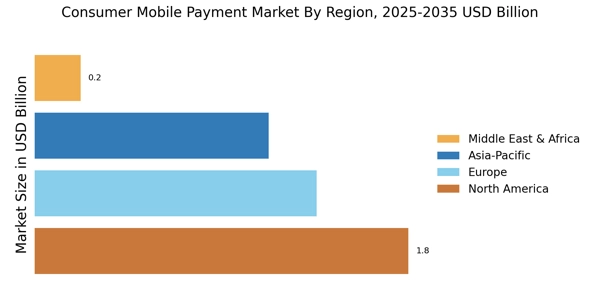
North America is the largest market for consumer mobile payments, holding approximately 40% of the global market share. The region's growth is driven by high smartphone penetration, increasing consumer preference for contactless payments, and supportive regulatory frameworks. The rise of fintech companies and digital wallets has further accelerated adoption, with a significant push from government initiatives promoting cashless transactions. The United States is the leading country in this region, with major players like Apple, Google, and PayPal dominating the landscape. The competitive environment is characterized by continuous innovation and partnerships between tech companies and financial institutions. Canada also plays a significant role, contributing to the overall growth with its own set of emerging mobile payment solutions.
Europe is the second-largest market for consumer mobile payments, accounting for around 30% of the global market share. The region's growth is fueled by increasing smartphone usage, a shift towards digital banking, and the implementation of the European Payment Services Directive (PSD2), which enhances competition and consumer protection. Countries like Germany and the UK are leading the charge, with a growing acceptance of mobile wallets and contactless payments. Germany and the UK are at the forefront of this market, with a competitive landscape featuring key players such as Samsung and various local fintech startups. The presence of established banks and innovative payment solutions has created a dynamic environment. The European market is characterized by a strong emphasis on security and regulatory compliance, which continues to shape consumer trust and adoption rates.
Asia-Pacific is witnessing explosive growth in the consumer mobile payment market, holding approximately 25% of the global market share. The region's rapid urbanization, high mobile penetration, and increasing internet access are key drivers. Countries like China and India are leading this growth, with a significant shift towards digital transactions spurred by government initiatives promoting cashless economies and the rise of e-commerce. China is the dominant player, with Alipay and WeChat Pay leading the market. India is also emerging as a strong contender, with a growing number of digital wallets and payment apps. The competitive landscape is vibrant, with both local and international players vying for market share. The region's unique blend of traditional and modern payment methods continues to shape consumer preferences and drive innovation.
The Middle East and Africa region is gradually emerging in the consumer mobile payment market, holding about 5% of the global market share. The growth is driven by increasing smartphone adoption, a young population, and government initiatives aimed at promoting financial inclusion. Countries like South Africa and Kenya are leading the way, with mobile payments becoming a vital part of the economy, especially in rural areas. South Africa is a key player, with various mobile payment solutions gaining traction. Kenya's M-Pesa has set a benchmark for mobile payments in the region, showcasing the potential for growth. The competitive landscape is evolving, with both local startups and international companies entering the market. The region's unique challenges and opportunities present a fertile ground for innovation in mobile payment solutions.
The Consumer Mobile Payment Market is currently characterized by a dynamic competitive landscape, driven by rapid technological advancements and evolving consumer preferences. Key players such as Apple (US), Google (US), and Alipay (CN) are at the forefront, each adopting distinct strategies to enhance their market positioning. Apple (US) continues to innovate with its Apple Pay platform, focusing on seamless integration with its ecosystem of devices, while Google (US) emphasizes its Google Pay service by leveraging its extensive data analytics capabilities to personalize user experiences. Alipay (CN), on the other hand, is expanding its reach beyond China, targeting international markets through strategic partnerships, thereby enhancing its global footprint. Collectively, these strategies not only intensify competition but also foster a landscape where innovation and user-centric solutions are paramount.In terms of business tactics, companies are increasingly localizing their services to cater to regional preferences, which appears to be a critical factor in their success. The market structure is moderately fragmented, with a mix of established players and emerging fintech startups. This fragmentation allows for diverse offerings, yet the influence of major players like PayPal (US) and Square (US) remains substantial, as they continue to set industry standards and drive consumer adoption through robust marketing and user engagement strategies.
In September PayPal (US) announced a strategic partnership with a leading e-commerce platform to enhance its mobile payment solutions, aiming to streamline the checkout process for users. This move is significant as it not only broadens PayPal's user base but also reinforces its commitment to providing frictionless payment experiences, which is increasingly vital in a competitive market. The partnership is likely to enhance customer loyalty and drive transaction volumes, positioning PayPal favorably against its competitors.
In August Google (US) launched a new feature within Google Pay that allows users to earn rewards for transactions made at local businesses. This initiative appears to be a strategic effort to bolster user engagement and support local economies, thereby creating a win-win scenario. By incentivizing users to transact with local merchants, Google (US) not only enhances its value proposition but also strengthens its community ties, which could lead to increased market penetration.
In July Alipay (CN) expanded its services to include cryptocurrency transactions, marking a significant pivot towards digital asset integration. This strategic move is indicative of the growing acceptance of cryptocurrencies in mainstream finance and positions Alipay (CN) as a forward-thinking player in the mobile payment space. By embracing this trend, Alipay (CN) could attract a new demographic of tech-savvy users, further solidifying its competitive edge.
As of October the competitive trends in the Consumer Mobile Payment Market are increasingly defined by digitalization, sustainability, and the integration of artificial intelligence. Strategic alliances are becoming more prevalent, as companies recognize the value of collaboration in enhancing service offerings and expanding market reach. Looking ahead, competitive differentiation is likely to evolve from traditional price-based strategies to a focus on innovation, technological advancements, and supply chain reliability. This shift underscores the necessity for companies to adapt and innovate continuously in order to maintain relevance in an ever-changing market.




Q3 2026: Apple (US): Apple Pay officially expanded into India in late September 2026 through partnerships with major card networks and domestic banking partners to enable contactless payments at point-of-sale terminals.
Q4 2026: Google (US): Google introduced enhanced Google Wallet features, including integrated AI benefits and allowance management tools, while upgrading Google Pay credit card rewards.
Q4 2026: Samsung (KR): Samsung partnered with Solana to natively deliver USDC stablecoin cross-border payment capabilities inside Samsung Wallet across 82 million U.S. Galaxy devices.
Le marché des paiements mobiles pour les consommateurs devrait croître à un taux de croissance annuel composé (CAGR) de 15,38 % entre 2024 et 2035, soutenu par les avancées technologiques, l'augmentation de la pénétration des smartphones et l'évolution des préférences des consommateurs.
De nouvelles opportunités résident dans :
D'ici 2035, le marché devrait être robuste, reflétant une croissance et une innovation substantielles.
| MARKET SIZE 2024 | 4.485(USD Billion) |
| MARKET SIZE 2025 | 5.175(USD Billion) |
| MARKET SIZE 2035 | 21.64(USD Billion) |
| COMPOUND ANNUAL GROWTH RATE (CAGR) | 15.38% (2025 - 2035) |
| REPORT COVERAGE | Revenue Forecast, Competitive Landscape, Growth Factors, and Trends |
| BASE YEAR | 2024 |
| Market Forecast Period | 2025 - 2035 |
| Historical Data | 2019 - 2024 |
| Market Forecast Units | USD Billion |
| Key Companies Profiled | Apple (US), Google (US), Samsung (KR), PayPal (US), Square (US), Alipay (CN), WeChat Pay (CN), Venmo (US), Zelle (US) |
| Segments Covered | Payment Type, End User, Device Type, Transaction Mode, Regional |
| Key Market Opportunities | Integration of biometric authentication enhances security in the Consumer Mobile Payment Market. |
| Key Market Dynamics | Rising consumer preference for contactless transactions drives innovation and competition in the mobile payment landscape. |
| Countries Covered | North America, Europe, APAC, South America, MEA |
 Aarti Dhapte

Veuillez remplir le formulaire ci-dessous pour recevoir un échantillon gratuit de ce rapport


“This is really good guys. Excellent work on a tight deadline. I will continue to use you going forward and recommend you to others. Nice job”
 Noah Malgeri
Co-Founder

“Thanks for sending the report it gives us a good global view of the Betaïne market.”
 Peter Groot koerkamp
Account and Business Manager

“We found the report very insightful! we found your research firm very helpful. I'm sending this email to secure our future business.”
 Younghwan Choi
Senior Retail Manager

“I am very pleased with how market segments have been defined in a relevant way for my purposes (such as "Portable Freezers & refrigerators" and "last-mile"). In general the report is well structured. Thanks very much for your efforts.”
 Mark Irwin
Management Consultant

“We got the report in time, we really thank you for your support in this process. I also thank to all of your team as they did a great job.”
 Akif Moroglu
Strategy & Business Development Director

“The Automotive 48V ECU Components Procurement Intelligence Study” was a complex project, but the Market Research Future (MRFR) team handled it with quality, agility, and customer-centricity. They delivered all requested data on time and within the agreed scope. The team, including Shubhendra Anand and Rahul Gotadki, was always readily available to clarify questions and swiftly implement necessary adjustments, driving the project to a successful conclusion within a very demanding timeframe.
I would also like to specifically commend Akshay Agarwal for his responsiveness and support at every stage—from our initial inquiry on May 6th through to final delivery on June 18th. His dedication made the entire process seamless.”
 Guilherme Gomes Martins
Product Management Director

“Thanks. It’s been a pleasure working with you, please use me as reference with any other Intel employees.”
 Joseph Aguayo
Sales Operations & Pricing Manager

“Thank you, this will be very helpful for OQS.”
 La Terria Dodd
Program Support Specialist

“I have been reading the first document or the study, ,the Global HVAC and FP market report 2021 till 2026. Must say, good info! I have not gone in depth at all parts, but got a good indication of the data inside!”
 Rob Kooiker
Group Product Manager HVAC & Fire Protection GMA