Marché des systèmes en aluminium Résumé
Principales tendances et faits saillants du marché
Taille du marché et prévisions
| CAGR (2025 - 2035) | 1.77% |
| CAGR (2025 - 2035) | 1.77% |
The Aluminum System Market is currently experiencing a dynamic evolution, driven by various factors that influence its growth trajectory. The increasing demand for lightweight materials in construction and automotive sectors appears to be a primary catalyst. As industries seek to enhance energy efficiency and reduce carbon footprints, aluminum systems are gaining traction due to their favorable properties, such as corrosion resistance and recyclability. Furthermore, advancements in manufacturing technologies are likely to enhance the performance and application range of aluminum systems, making them more appealing to a broader audience. In addition, The Aluminum System Market. Companies are increasingly focusing on eco-friendly solutions, which may lead to innovations in product design and material sourcing. This trend indicates a shift towards more responsible consumption patterns, where the lifecycle of aluminum products is carefully considered. As the market continues to adapt to these evolving demands, it is poised for substantial growth in the coming years, reflecting a broader commitment to sustainability and efficiency across various sectors.
The Aluminum System Market is witnessing a notable shift towards sustainability initiatives. Companies are increasingly prioritizing eco-friendly practices, which may involve the use of recycled materials and energy-efficient production methods. This trend reflects a growing awareness of environmental impacts and a commitment to reducing carbon footprints.
Technological advancements in manufacturing processes are significantly influencing the Aluminum System Market. Innovations such as improved extrusion techniques and enhanced surface treatments are likely to expand the application possibilities of aluminum systems. These developments may lead to higher performance products that cater to diverse industry needs.
The construction sector is driving a surge in demand for aluminum systems. As builders and architects seek lightweight yet durable materials, aluminum systems are becoming increasingly popular for structural applications. This trend suggests a broader acceptance of aluminum as a primary material in modern construction projects.
Les avancées technologiques jouent un rôle essentiel dans la formation du marché des systèmes en aluminium. Les innovations dans les processus de fabrication, tels que l'extrusion et la coulée, ont considérablement amélioré l'efficacité et la qualité des systèmes en aluminium. En 2025, le marché devrait s'étendre à mesure que de nouvelles technologies émergent, permettant la production de composants en aluminium plus légers et plus résistants. Ces avancées facilitent le développement de conceptions complexes, de plus en plus recherchées dans des secteurs comme l'automobile et l'aérospatiale. De plus, l'automatisation et la numérisation dans la fabrication rationalisent les opérations, réduisent les coûts et améliorent la cohérence des produits. En conséquence, le marché des systèmes en aluminium devrait connaître une transformation, les entreprises tirant parti de la technologie pour obtenir un avantage concurrentiel et répondre aux demandes évolutives des consommateurs.
La conformité réglementaire devient de plus en plus critique pour le marché des systèmes en aluminium. Les gouvernements du monde entier mettent en œuvre des réglementations strictes visant à réduire l'impact environnemental et à promouvoir des pratiques durables. Ces réglementations imposent souvent l'utilisation de matériaux recyclables, ce qui positionne favorablement les systèmes en aluminium sur le marché. En 2025, la conformité à ces réglementations devrait stimuler la demande de produits en aluminium, alors que les fabricants cherchent à s'aligner sur les exigences légales et les attentes des consommateurs. Les entreprises qui privilégient la conformité sont susceptibles de gagner un avantage concurrentiel, car elles peuvent commercialiser leurs produits comme étant respectueux de l'environnement. Cet accent mis sur le respect des réglementations améliore non seulement la réputation de la marque, mais favorise également l'innovation au sein du marché des systèmes en aluminium, alors que les entreprises développent de nouvelles solutions pour répondre aux normes en évolution.
Le marché des systèmes en aluminium est de plus en plus influencé par les initiatives de durabilité. Alors que les préoccupations environnementales augmentent, les industries adoptent des pratiques écologiques, entraînant une hausse de la demande pour les systèmes en aluminium. L'aluminium est hautement recyclable, ce qui s'aligne avec la poussée mondiale pour des matériaux durables. En 2025, le marché devrait connaître un taux de croissance d'environ 5 % en raison de ces initiatives. Les entreprises investissent dans des technologies et des processus verts, renforçant l'attrait des systèmes en aluminium. Cette tendance réduit non seulement les empreintes carbone, mais répond également aux exigences réglementaires, faisant des systèmes en aluminium un choix privilégié dans diverses applications. L'accent mis sur la durabilité devrait stimuler l'innovation au sein du marché des systèmes en aluminium, favorisant le développement de nouveaux produits qui répondent aux consommateurs soucieux de l'environnement.
Le secteur automobile adopte de plus en plus des systèmes en aluminium, ce qui a un impact significatif sur le marché des systèmes en aluminium. Alors que les fabricants s'efforcent d'améliorer l'efficacité énergétique et de réduire les émissions, les propriétés légères de l'aluminium en font un choix attrayant pour les composants de véhicule. En 2025, l'industrie automobile devrait contribuer de manière substantielle à la demande de systèmes en aluminium, en particulier dans la production de structures de carrosserie, de composants de moteur et de roues. Le passage aux véhicules électriques amplifie encore cette tendance, car l'aluminium est privilégié pour sa recyclabilité et ses caractéristiques de performance. Cette dépendance croissante à l'aluminium dans les applications automobiles devrait stimuler l'innovation et l'investissement au sein du marché des systèmes en aluminium, alors que les entreprises cherchent à développer des matériaux avancés qui répondent aux besoins évolutifs du secteur automobile.
Le secteur de la construction est un moteur majeur du marché des systèmes en aluminium. Avec l'urbanisation et le développement des infrastructures en hausse, la demande de systèmes en aluminium dans les applications de construction devrait croître de manière substantielle. En 2025, l'industrie de la construction devrait représenter une part significative du marché de l'aluminium, soutenue par la légèreté, la durabilité et l'attrait esthétique du matériau. Les systèmes en aluminium sont de plus en plus utilisés dans les façades, les fenêtres et les toitures, offrant efficacité énergétique et flexibilité de conception. La tendance vers des pratiques de construction durables renforce encore l'attrait de l'aluminium, car il contribue aux économies d'énergie et à la réduction de l'impact environnemental. Par conséquent, le marché des systèmes en aluminium est prêt pour une croissance robuste, alimentée par l'expansion continue du secteur de la construction.
The Aluminum System Market displays a diverse distribution of product types, with Extrusions commanding the largest share. This segment particularly thrives due to its extensive application in construction, automotive, and appliances, leveraging its lightweight and durable characteristics. Flat Rolled Products are increasingly significant, attributed to their versatility in packaging and consumer goods, making it a vital part of the market landscape. Currently, growth trends in the Aluminum System Market favor Flat Rolled Products as the fastest-growing segment, propelled by rising demand for lightweight materials and innovative production techniques. Extrusions benefit from solid investments, particularly in infrastructure projects and electric vehicles, which bolster demand and innovation. These dynamics indicate a competitive marketplace focusing on sustainability and technological advancements.
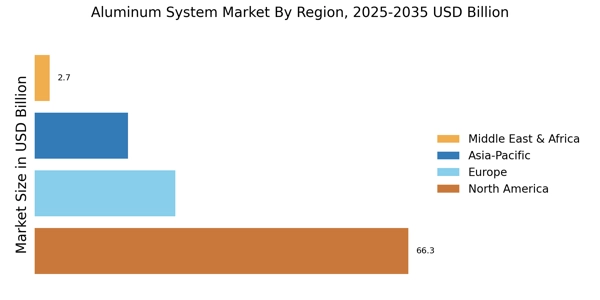
North America is witnessing robust growth in the aluminum system market, driven by increasing demand in automotive and construction sectors. The region is characterized by a strong focus on sustainability and innovation, with the U.S. and Canada being the largest and second-largest markets, holding approximately 60% and 25% of the market share, respectively. Regulatory support for green technologies further fuels this growth. The competitive landscape is dominated by key players such as Alcoa Corporation and Novelis Inc., which are investing heavily in advanced manufacturing technologies. The presence of established companies ensures a steady supply chain and innovation in product offerings. Additionally, the region benefits from a skilled workforce and strong research institutions, enhancing its competitive edge in the global market.
Europe is at the forefront of the aluminum system market, driven by stringent environmental regulations and a strong push towards a circular economy. The region is characterized by a high demand for recycled aluminum, with Germany and France being the largest markets, holding approximately 35% and 20% of the market share, respectively. Regulatory frameworks such as the European Green Deal are pivotal in shaping market dynamics and encouraging sustainable practices. Leading countries in Europe are investing in innovative technologies to enhance recycling processes and reduce carbon footprints. Key players like Constellium SE and Hydro Aluminium AS are actively involved in these initiatives, ensuring compliance with regulations while meeting market demands. The competitive landscape is marked by collaborations and partnerships aimed at advancing sustainability in aluminum production and usage.
The Asia-Pacific region is experiencing a significant surge in aluminum system demand, primarily driven by rapid industrialization and urbanization. China and Japan are the largest markets, accounting for approximately 70% and 15% of the market share, respectively. The region's growth is further supported by government initiatives aimed at boosting infrastructure development and manufacturing capabilities, making it a key player in The Aluminum System Market. China Hongqiao Group Limited and UACJ Corporation are among the leading players in this region, focusing on expanding production capacities and enhancing technological advancements. The competitive landscape is characterized by a mix of domestic and international companies, all vying for market share. As the region continues to invest in infrastructure and green technologies, the aluminum system market is poised for substantial growth in the coming years.
The Middle East and Africa region presents emerging opportunities in the aluminum system market, driven by increasing investments in infrastructure and construction projects. Countries like the UAE and South Africa are leading the market, holding approximately 40% and 20% of the market share, respectively. The region's growth is supported by government initiatives aimed at diversifying economies and enhancing industrial capabilities, making it an attractive market for aluminum systems. Key players such as Kaiser Aluminum Corporation and Aleris Corporation are expanding their presence in this region, focusing on local partnerships and supply chain enhancements. The competitive landscape is evolving, with new entrants and established companies collaborating to meet the growing demand. As the region continues to develop, the aluminum system market is expected to witness significant growth, driven by both local and international investments.
The Aluminum System Market is currently characterized by a dynamic competitive landscape, driven by increasing demand for lightweight materials across various industries, including automotive, aerospace, and construction. Key players such as Alcoa Corporation (US), Novelis Inc. (US), and China Hongqiao Group Limited (CN) are strategically positioning themselves through innovation and sustainability initiatives. Alcoa Corporation (US) has focused on enhancing its production capabilities while reducing carbon emissions, which aligns with the growing emphasis on environmental responsibility. Meanwhile, Novelis Inc. (US) has been investing in recycling technologies to bolster its circular economy approach, thereby enhancing its competitive edge in the market. Collectively, these strategies indicate a shift towards sustainable practices that are reshaping the competitive environment in the aluminum sector.In terms of business tactics, companies are increasingly localizing manufacturing to mitigate supply chain disruptions and optimize logistics. This trend is particularly evident in the Aluminum System Market, which appears to be moderately fragmented, with several key players exerting influence. The collective actions of these companies suggest a concerted effort to enhance operational efficiency and responsiveness to market demands, thereby fostering a more resilient market structure.
In August Alcoa Corporation (US) announced a partnership with a leading technology firm to develop advanced aluminum alloys aimed at the aerospace sector. This collaboration is expected to enhance Alcoa's product offerings and strengthen its position in a high-growth market segment. The strategic importance of this partnership lies in its potential to leverage cutting-edge technology, thereby improving product performance and sustainability.
In September Novelis Inc. (US) unveiled a new recycling facility in Europe, which is projected to increase its recycling capacity by 50%. This facility not only underscores Novelis's commitment to sustainability but also positions the company to meet the rising demand for recycled aluminum. The establishment of this facility is a significant strategic move that enhances Novelis's operational capabilities and aligns with global sustainability goals.
In July China Hongqiao Group Limited (CN) expanded its production capacity by launching a new smelting plant in Inner Mongolia. This expansion is indicative of the company's strategy to capitalize on the growing demand for aluminum products in both domestic and international markets. The strategic importance of this move lies in its potential to increase market share and improve supply chain efficiencies, thereby reinforcing China Hongqiao's competitive position.
As of October the Aluminum System Market is witnessing trends such as digitalization, sustainability, and the integration of artificial intelligence in production processes. These trends are reshaping competitive dynamics, with strategic alliances becoming increasingly vital for innovation and market responsiveness. The shift from price-based competition to a focus on technological advancement and supply chain reliability is likely to define the future landscape of the industry, suggesting that companies will need to differentiate themselves through innovation and sustainable practices to maintain a competitive edge.
September 2026: ALUMIL expands its architectural systems portfolio. ALUMIL introduced the SMARTIA MD61 thermally insulated entrance door system, reflecting continued product development focused on contemporary design and performance.
June 2026: AluK partners with AIS Glasxperts in India. The collaboration aims to strengthen the supply and execution of premium aluminium window, door and façade systems for residential and architectural projects across India.
May 2026: Kawneer launches MetroView 4-SSG. The new unitized window-wall system targets commercial buildings, including multifamily, office and institutional projects, with an emphasis on uninterrupted glass façades, thermal performance and acoustic capabilities.
February 2026: PROCURAL expands its Indian presence. The company reported opening an Indian experience centre and building a network of more than 25 fabricator channel partners, supporting wider access to its aluminium window and door systems.
Le marché des systèmes en aluminium devrait croître à un taux de croissance annuel composé (CAGR) de 1,77 % de 2024 à 2035, soutenu par une demande croissante de matériaux légers et de pratiques de construction durables.
De nouvelles opportunités résident dans :
D'ici 2035, le marché des systèmes en aluminium devrait connaître une forte croissance, reflétant l'évolution des demandes de l'industrie.
| MARKET SIZE 2024 | 110.44(USD Billion) |
| MARKET SIZE 2025 | 112.4(USD Billion) |
| MARKET SIZE 2035 | 133.98(USD Billion) |
| COMPOUND ANNUAL GROWTH RATE (CAGR) | 1.77% (2025 - 2035) |
| REPORT COVERAGE | Revenue Forecast, Competitive Landscape, Growth Factors, and Trends |
| BASE YEAR | 2024 |
| Market Forecast Period | 2025 - 2035 |
| Historical Data | 2019 - 2024 |
| Market Forecast Units | USD Billion |
| Key Companies Profiled | Alcoa Corporation (US), Rio Tinto Group (GB), Constellium SE (NL), Novelis Inc. (US), Hydro Aluminium AS (NO), Kaiser Aluminum Corporation (US), Aleris Corporation (US), China Hongqiao Group Limited (CN), UACJ Corporation (JP) |
| Segments Covered | Application, Product Type, End Use Industry, Form, Regional |
| Key Market Opportunities | Integration of advanced recycling technologies enhances sustainability in the Aluminum System Market. |
| Key Market Dynamics | Rising demand for lightweight materials drives innovation and competition in the Aluminum System Market. |
| Countries Covered | North America, Europe, APAC, South America, MEA |
 Chitranshi Jaiswal

Veuillez remplir le formulaire ci-dessous pour recevoir un échantillon gratuit de ce rapport


“This is really good guys. Excellent work on a tight deadline. I will continue to use you going forward and recommend you to others. Nice job”
 Noah Malgeri
Co-Founder

“Thanks for sending the report it gives us a good global view of the Betaïne market.”
 Peter Groot koerkamp
Account and Business Manager

“We found the report very insightful! we found your research firm very helpful. I'm sending this email to secure our future business.”
 Younghwan Choi
Senior Retail Manager

“I am very pleased with how market segments have been defined in a relevant way for my purposes (such as "Portable Freezers & refrigerators" and "last-mile"). In general the report is well structured. Thanks very much for your efforts.”
 Mark Irwin
Management Consultant

“We got the report in time, we really thank you for your support in this process. I also thank to all of your team as they did a great job.”
 Akif Moroglu
Strategy & Business Development Director

“The Automotive 48V ECU Components Procurement Intelligence Study” was a complex project, but the Market Research Future (MRFR) team handled it with quality, agility, and customer-centricity. They delivered all requested data on time and within the agreed scope. The team, including Shubhendra Anand and Rahul Gotadki, was always readily available to clarify questions and swiftly implement necessary adjustments, driving the project to a successful conclusion within a very demanding timeframe.
I would also like to specifically commend Akshay Agarwal for his responsiveness and support at every stage—from our initial inquiry on May 6th through to final delivery on June 18th. His dedication made the entire process seamless.”
 Guilherme Gomes Martins
Product Management Director

“Thanks. It’s been a pleasure working with you, please use me as reference with any other Intel employees.”
 Joseph Aguayo
Sales Operations & Pricing Manager

“Thank you, this will be very helpful for OQS.”
 La Terria Dodd
Program Support Specialist

“I have been reading the first document or the study, ,the Global HVAC and FP market report 2021 till 2026. Must say, good info! I have not gone in depth at all parts, but got a good indication of the data inside!”
 Rob Kooiker
Group Product Manager HVAC & Fire Protection GMA