Marché du matériel informatique AI Résumé
Principales tendances et faits saillants du marché
Taille du marché et prévisions
| CAGR (2025 - 2035) | 14.12% |
| CAGR (2025 - 2035) | 14.12% |
The AI Computing Hardware Market is currently experiencing a transformative phase, driven by advancements in artificial intelligence technologies and increasing demand for high-performance computing solutions. This market encompasses a wide array of hardware components, including graphics processing units, tensor processing units, and specialized chips designed for machine learning applications. As organizations across various sectors seek to harness the power of AI, the need for robust computing infrastructure becomes paramount. Consequently, manufacturers are focusing on innovation, striving to enhance processing capabilities while optimizing energy efficiency. Moreover, the competitive landscape of the AI Computing Hardware Market is evolving, with both established players and emerging startups vying for market share. Collaborations and partnerships are becoming more prevalent as companies aim to leverage complementary strengths and accelerate product development. The growing emphasis on edge computing also indicates a shift towards decentralized processing, allowing for real-time data analysis and decision-making. As the market continues to mature, it appears poised for sustained growth, driven by ongoing technological advancements and the increasing integration of AI into everyday applications.
The trend towards edge computing is reshaping the AI Computing Hardware Market. By processing data closer to the source, organizations can achieve lower latency and improved performance. This shift allows for real-time analytics and decision-making, which is particularly beneficial in sectors such as healthcare and autonomous vehicles.
As environmental concerns gain prominence, there is a growing emphasis on energy-efficient hardware solutions within the AI Computing Hardware Market. Manufacturers are exploring innovative designs and materials that reduce power consumption while maintaining high performance, aligning with sustainability goals.
The integration of AI capabilities into consumer electronics is becoming increasingly prevalent. Devices such as smart home appliances and personal assistants are leveraging AI computing hardware to enhance user experiences. This trend indicates a broader acceptance of AI technologies in everyday life, driving demand for specialized hardware.
The AI Computing Hardware Market is significantly influenced by advancements in machine learning algorithms, which require increasingly sophisticated hardware to function effectively. As algorithms evolve, they demand more computational power and memory, prompting hardware manufacturers to innovate and develop cutting-edge solutions. For instance, the introduction of tensor processing units (TPUs) and graphics processing units (GPUs) tailored for AI workloads has revolutionized the landscape. Market data suggests that the demand for GPUs alone is anticipated to grow at a compound annual growth rate of over 30% through 2025. This growth is indicative of the hardware's critical role in enabling faster training and deployment of machine learning models, thereby propelling the AI computing hardware market forward.
The AI computing hardware market is significantly driven by the demand for Graphics Processing Units (GPUs), which hold the largest market share due to their parallel processing capabilities, making them ideal for AI workloads. Application Specific Integrated Circuits (ASICs) are rapidly gaining traction, serving niche applications where efficiency and performance are paramount, thus carving out an important segment in the market.
In the AI Computing Hardware Market, the form factor segment is primarily dominated by Rack-Mounted Systems, which hold a significant share due to their scalability and efficiency in data centers. Blade Servers are also gaining traction, particularly in environments that require high-density computing and resource optimization. Workstations and Embedded Systems cater to niche markets but contribute notably to the overall functionality and adaptability of AI hardware solutions. Overall, the distribution highlights a strong preference for modular and efficient designs. Forecasts indicate that Blade Servers represent the fastest-growing segment in this category, attributed to the increasing demand for high-performance computing and energy efficiency. Rack-Mounted Systems continue to be the preferred choice for traditional data centers, while Workstations solidify their presence in AI research laboratories. Additionally, Embedded Systems, with their versatility, support the expansion of AI in various applications from IoT to edge computing solutions. Consequently, the market is evolving, reflecting a shift towards more tailored and efficient AI computing solutions.
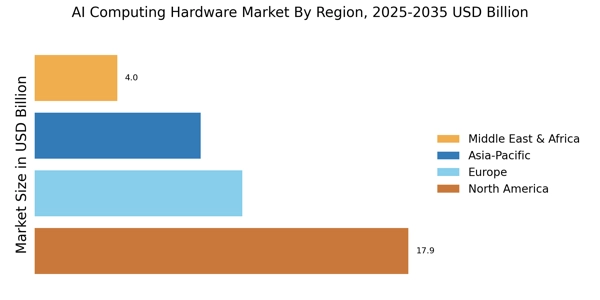
North America is the largest market for AI computing hardware, holding approximately 45% of the global share. The region benefits from robust investments in AI research and development, driven by major tech companies and government initiatives. Regulatory support, such as the National AI Initiative Act, fosters innovation and collaboration across sectors, enhancing demand for advanced computing solutions. The United States leads the market, with key players like NVIDIA, Intel, and Google driving technological advancements. The competitive landscape is characterized by rapid innovation cycles and significant R&D expenditures. Canada also plays a vital role, focusing on AI ethics and regulatory frameworks, further solidifying North America's position as a leader in AI hardware.
Europe is witnessing significant growth in the AI computing hardware market, accounting for approximately 25% of the global share. The region's demand is fueled by increasing investments in AI technologies across various sectors, including healthcare, automotive, and finance. Regulatory frameworks, such as the EU's AI Act, aim to create a balanced environment for innovation while ensuring ethical standards, thus driving market growth. Leading countries like Germany, France, and the UK are at the forefront of this transformation, with a strong presence of companies like Siemens and SAP. The competitive landscape is evolving, with both established firms and startups contributing to advancements in AI hardware. Collaborative initiatives between governments and private sectors are enhancing the region's capabilities in AI technology.
Asia-Pacific is emerging as a significant player in the AI computing hardware market, holding around 20% of the global share. The region's growth is driven by rapid digital transformation, increasing investments in AI research, and government initiatives aimed at enhancing technological capabilities. Countries like China and Japan are leading the charge, with substantial funding directed towards AI development and infrastructure. China, in particular, is home to major players like Huawei and Baidu, which are heavily investing in AI hardware solutions. The competitive landscape is marked by a mix of established companies and innovative startups, fostering a dynamic environment for growth. Additionally, collaborations between governments and private sectors are accelerating advancements in AI technologies across the region.
The Middle East and Africa region is gradually emerging in the AI computing hardware market, currently holding about 10% of the global share. The growth is primarily driven by increasing government investments in technology and digital transformation initiatives across various sectors. Countries like the UAE and South Africa are leading efforts to enhance their AI capabilities, supported by favorable regulatory environments that encourage innovation. The competitive landscape is still developing, with a mix of local and international players entering the market. Key initiatives, such as the UAE's National AI Strategy 2031, aim to position the region as a hub for AI innovation. As awareness and demand for AI technologies grow, the market is expected to expand significantly in the coming years.
The AI Computing Hardware Market is currently characterized by intense competition and rapid technological advancements, driven by the increasing demand for AI applications across various sectors. Major players such as NVIDIA (US), Intel (US), and AMD (US) are at the forefront, leveraging their strengths in innovation and strategic partnerships to enhance their market positions. NVIDIA (US) continues to dominate the GPU segment, focusing on high-performance computing and AI-driven solutions, while Intel (US) is pivoting towards integrating AI capabilities into its processors, aiming to capture a larger share of the market. AMD (US) is also making strides with its EPYC processors, which are increasingly being adopted in data centers for AI workloads, indicating a shift towards more efficient computing solutions.The competitive structure of the AI Computing Hardware Market appears moderately fragmented, with several key players vying for dominance. Companies are employing various business tactics, such as localizing manufacturing and optimizing supply chains, to enhance operational efficiency and reduce costs. This collective influence of major players not only shapes market dynamics but also fosters an environment where innovation is paramount, as companies strive to differentiate themselves through advanced technologies and superior performance.
In September NVIDIA (US) announced the launch of its latest AI-focused GPU architecture, which is designed to significantly enhance machine learning capabilities. This strategic move underscores NVIDIA's commitment to maintaining its leadership in the AI hardware space, as the new architecture promises to deliver unprecedented performance improvements for AI applications. Such advancements are likely to solidify NVIDIA's competitive edge and attract a broader customer base.
In August Intel (US) unveiled its new line of processors specifically optimized for AI workloads, which integrates advanced neural network processing capabilities. This initiative reflects Intel's strategic focus on AI integration within its core product offerings, aiming to cater to the growing demand for AI-driven solutions in enterprise environments. By enhancing its product portfolio, Intel positions itself as a formidable competitor in the AI computing landscape.
In July AMD (US) entered into a strategic partnership with a leading cloud service provider to deliver optimized AI solutions for enterprise clients. This collaboration is indicative of AMD's strategy to expand its market reach and enhance its product offerings in the AI domain. By aligning with a major cloud provider, AMD not only gains access to a broader customer base but also reinforces its commitment to delivering cutting-edge AI computing solutions.
As of October the competitive trends in the AI Computing Hardware Market are increasingly defined by digitalization, sustainability, and the integration of AI technologies. Strategic alliances among key players are shaping the landscape, fostering innovation and collaboration. Looking ahead, it is anticipated that competitive differentiation will evolve, with a pronounced shift from price-based competition to a focus on innovation, technological advancements, and supply chain reliability. Companies that can effectively navigate these trends are likely to emerge as leaders in the rapidly evolving AI computing ecosystem.



The AI Computing Hardware Market has witnessed significant movements recently, with major players like NVIDIA and AMD driving advancements in GPU technology to support enhanced AI applications. In addition, Intel has expanded its portfolio with new AI-focused chipsets aimed at data centers, highlighting its commitment to innovation. Companies like Google and Microsoft are also ramping up their capabilities; Google is enhancing its Tensor Processing Units (TPUs) for better performance in machine learning tasks, while Microsoft is investing heavily in AI infrastructure through partnerships and cloud services.
Mergers and acquisitions are shaping the landscape, with NVIDIA acquiring Arm Holdings to strengthen its position in the AI hardware space. Huawei continues to evolve through the development of AI chips optimized for telecommunications, further solidifying its market presence. Meanwhile, Micron Technology is focusing on memory solutions that enhance data processing speeds for AI tasks. The growing demand for AI computing hardware is reflected in market valuations, with many companies experiencing an upward trend, signifying strong investments in AI technologies and infrastructure. This indicates a robust competitive landscape where innovation and collaboration are crucial for growth.
Le marché du matériel informatique pour l'IA devrait croître à un TCAC de 14,12 % de 2024 à 2035, soutenu par les avancées des algorithmes d'IA, l'augmentation des besoins en traitement des données et l'expansion de l'informatique en nuage.
De nouvelles opportunités résident dans :
D'ici 2035, le marché du matériel informatique pour l'IA devrait être robuste, reflétant une croissance et une innovation substantielles.
| Parameter | Detail |
|---|---|
| Market Scope | Accelerator silicon, AI servers, rack-scale systems, accelerator cards and modules, and edge machine learning hardware, measured at vendor revenue |
| Study Period | 2021–2035 (Historical 2021–2024; Base Year 2025; Forecast 2026–2035) |
| CAGR | 11.05% (2026–2035) |
| Market Size Checkpoints | USD 45.70 Billion (2025); USD 50.75 Billion (2026); USD 130.26 Billion (2035) |
| Fastest Growing Segments | AI ASICs (11.3% CAGR); Integrated Rack-Scale Solutions (11.4% CAGR); Inference (12.0% CAGR); Automotive and Industrial (12.3% CAGR) |
| Companies Profiled | 12 suppliers spanning silicon design, system integration, and interconnect |
| Valuation Currency | USD, constant 2025 prices |
 Aarti Dhapte

Veuillez remplir le formulaire ci-dessous pour recevoir un échantillon gratuit de ce rapport


“This is really good guys. Excellent work on a tight deadline. I will continue to use you going forward and recommend you to others. Nice job”
 Noah Malgeri
Co-Founder

“Thanks for sending the report it gives us a good global view of the Betaïne market.”
 Peter Groot koerkamp
Account and Business Manager

“We found the report very insightful! we found your research firm very helpful. I'm sending this email to secure our future business.”
 Younghwan Choi
Senior Retail Manager

“I am very pleased with how market segments have been defined in a relevant way for my purposes (such as "Portable Freezers & refrigerators" and "last-mile"). In general the report is well structured. Thanks very much for your efforts.”
 Mark Irwin
Management Consultant

“We got the report in time, we really thank you for your support in this process. I also thank to all of your team as they did a great job.”
 Akif Moroglu
Strategy & Business Development Director

“The Automotive 48V ECU Components Procurement Intelligence Study” was a complex project, but the Market Research Future (MRFR) team handled it with quality, agility, and customer-centricity. They delivered all requested data on time and within the agreed scope. The team, including Shubhendra Anand and Rahul Gotadki, was always readily available to clarify questions and swiftly implement necessary adjustments, driving the project to a successful conclusion within a very demanding timeframe.
I would also like to specifically commend Akshay Agarwal for his responsiveness and support at every stage—from our initial inquiry on May 6th through to final delivery on June 18th. His dedication made the entire process seamless.”
 Guilherme Gomes Martins
Product Management Director

“Thanks. It’s been a pleasure working with you, please use me as reference with any other Intel employees.”
 Joseph Aguayo
Sales Operations & Pricing Manager

“Thank you, this will be very helpful for OQS.”
 La Terria Dodd
Program Support Specialist

“I have been reading the first document or the study, ,the Global HVAC and FP market report 2021 till 2026. Must say, good info! I have not gone in depth at all parts, but got a good indication of the data inside!”
 Rob Kooiker
Group Product Manager HVAC & Fire Protection GMA


