GPU als Dienstleistung Markt (2026 – 2035)

GPU as a Service Market Size, Share and Research Report By Application (Artificial Intelligence, High-Performance Computing, Cloud Gaming and Media Rendering, and Other Applications), By Enterprise Size (Small and Medium Enterprises, and Large Enterprises), By End-User Industry (IT and Telecommunications, BFSI, Automotive and Mobility, Healthcare and Life Sciences, Media and Entertainment, and Other End-User Industries), By Deployment Model (Public Cloud, Private Cloud, and Hybrid and Multi-Cloud), By Service Model (IaaS, PaaS, and SaaS) – Industry Forecast Till 2035
ID: MRFR/ICT/31099-HCR 100 Pages Aarti Dhapte Last Updated: October 08, 2026
GPU as a Service Market
Market Size
Forecast Period2026-2035
CAGR (2026-2035)26.7%
2025 Market SizeUSD 5.40 Billion
2035 Market SizeUSD 57.72 Billion
Key Players
Amazon Web Services
Microsoft Azure
Google Cloud
CoreWeave
Oracle Cloud Infrastructure
Alibaba Cloud
Opportunities
  • Sovereign AI Clouds in the Gulf
  • Inference Platforms and Data-Driven Business Models
  • Subsidised Compute in India and ASEAN

GPU als Dienstleistung Markt Zusammenfassung

Laut der Analyse von MRFR wurde die Marktgröße für GPU als Dienstleistung im Jahr 2024 auf 2,381 Milliarden USD geschätzt. Die Branche für GPU als Dienstleistung wird voraussichtlich von 2,856 Milliarden USD im Jahr 2025 auf 17,6 Milliarden USD bis 2035 wachsen, was einer durchschnittlichen jährlichen Wachstumsrate (CAGR) von 19,94 während des Prognosezeitraums 2025 - 2035 entspricht.

Wichtige Markttrends & Highlights

Der GPU-as-a-Service-Markt verzeichnet ein robustes Wachstum, das durch technologische Fortschritte und die steigende Nachfrage nach Hochleistungsrechnen vorangetrieben wird.

  • Die Nachfrage nach KI- und Machine-Learning-Anwendungen treibt den Markt für GPU-as-a-Service voran, insbesondere in Nordamerika.

Marktgröße & Prognose

2024 Market Size 2.381 (USD Milliarden)
2035 Market Size 17,6 (USD Milliarden)
CAGR (2025 - 2035) 19,94 %

Hauptakteure

NVIDIA (US), Amazon Web Services (US), Microsoft (US), Google Cloud (US), IBM (US), Oracle (US), Alibaba Cloud (CN), Tencent Cloud (CN), DigitalOcean (US)

GPU als Dienstleistung Markt Treiber

Emergence of Edge Computing

Rising Focus on Cost Efficiency

Growth of Data-Intensive Applications

The proliferation of data-intensive applications is a key driver for the GPU as a Service Market. As organizations increasingly rely on big data analytics, machine learning, and artificial intelligence, the demand for robust GPU resources has intensified. It is estimated that the global data volume is expected to reach 175 zettabytes by 2025, necessitating advanced processing capabilities. GPU as a Service Market solutions offer the flexibility and scalability required to manage these vast datasets effectively. By utilizing these services, companies can optimize their data processing tasks, reduce time-to-insight, and enhance overall productivity. This trend indicates a strong market potential for GPU as a Service Market providers, as they cater to the evolving needs of data-driven enterprises.

Advancements in Virtualization Technologies

Increasing Adoption of High-Performance Computing

Einblicke in Marktsegmente

In the GPU as a Service Market, the distribution of service models reveals Infrastructure as a Service (IaaS) as the dominant player, commanding a significant market share. This model provides users with access to GPU resources on demand, allowing businesses to scale their operations efficiently. Platform as a Service (PaaS) follows closely, enabling developers to create and manage applications without worrying about the underlying infrastructure. Software as a Service (SaaS), while smaller in market share, is gaining traction due to the increasing preference for cloud-based solutions that offer ease of use and flexibility. The growth trends in the GPU as a Service Market segment are largely driven by the rising demand for sophisticated computing power across various industries. Factors such as the increasing complexity of data analytics, machine learning, and artificial intelligence applications are propelling the adoption of SaaS models. These services offer cost-effective, scalable, and accessible GPU capabilities, making them attractive for businesses looking to innovate and stay competitive. Additionally, the shift towards remote work models has intensified the need for cloud-based resources, further fueling the growth of SaaS as a primary service model.

Infrastructure as a Service (IaaS) stands out as the dominant service model in the GPU as a Service Market, offering unparalleled flexibility and scalability to organizations. IaaS allows companies to rent GPU hardware, thereby minimizing capital expenses on physical infrastructure. This model is ideal for workloads that require intensive computing, such as machine learning and rendering tasks. Meanwhile, Platform as a Service (PaaS) is emerging as a vital solution for developers looking to build, deploy, and manage applications efficiently. PaaS enriches the development environment by providing tools and libraries necessary for GPU programming, which accelerates time to market for software products. As businesses increasingly rely on these solutions to enhance their operational capabilities, PaaS is set to carve out a more significant market share in the coming years.

The GPU as a Service Market (GaaS) market shows significant distribution among various deployment models. The Public Cloud model holds the largest share, as organizations increasingly adopt cloud services to leverage the extensive computing power and cost efficiency they offer. This deployment allows businesses of all sizes to access high-performance GPUs without the need for substantial upfront investment, making it highly appealing and widely used in numerous sectors.

The GPU as a Service Market is primarily driven by four key application segments: Gaming, Machine Learning, Data Analytics, and Rendering. Among these, Gaming holds the largest share, significantly influencing the overall market dynamics. This dominance can be attributed to the rising popularity of online and cloud gaming platforms. Machine Learning, on the other hand, showcases notable growth potential as more organizations adopt AI technologies to enhance operational efficiencies and drive innovations. As businesses increasingly embrace digital transformation, Machine Learning emerges as the fastest-growing segment in the GPU as a Service Market. The increasing demand for advanced analytics, natural language processing, and deep learning applications fuels this growth. Furthermore, Data Analytics and Rendering, while essential, are expanding at a slower pace compared to the rapid advancements seen in Machine Learning and Gaming, reflecting a diverse but competitive landscape.

Erhalten Sie detailliertere Einblicke zu GPU als Dienstleistung Markt

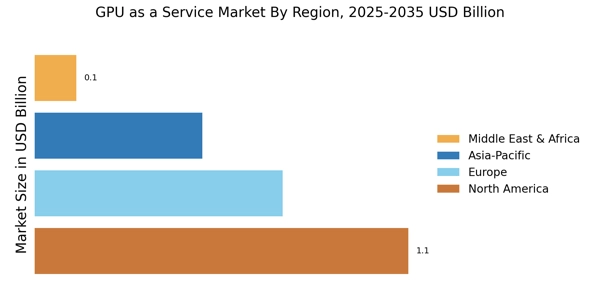
Regionale Einblicke

North America : Innovation and Leadership Hub

North America is the largest market for GPU as a Service Market, holding approximately 45% of the global share. The region's growth is driven by increasing demand for high-performance computing, advancements in AI, and cloud adoption. Regulatory support for tech innovation further fuels this growth, with initiatives aimed at enhancing digital infrastructure and cybersecurity. The United States leads the market, with major players like NVIDIA, Amazon Web Services, and Microsoft dominating the landscape. The competitive environment is characterized by rapid technological advancements and strategic partnerships. The presence of established tech giants ensures a robust ecosystem for GPU services, catering to diverse industries from gaming to healthcare.

Europe : Emerging Market with Potential

Europe is witnessing significant growth in the GPU as a Service Market, accounting for about 30% of the global share. The region's demand is driven by the increasing need for data processing capabilities and the rise of AI applications. Regulatory frameworks promoting digital transformation and sustainability initiatives are key catalysts for this growth, encouraging investments in cloud technologies. Leading countries include Germany, the UK, and France, where companies are increasingly adopting GPU services for various applications. The competitive landscape features both established players and emerging startups, fostering innovation. Key players like IBM and Oracle are enhancing their offerings, while local firms are also gaining traction in the market.

Asia-Pacific : Rapidly Growing Tech Landscape

Asia-Pacific is rapidly emerging as a significant player in the GPU as a Service Market, holding around 20% of the global share. The region's growth is fueled by increasing cloud adoption, a booming gaming industry, and advancements in AI and machine learning. Government initiatives aimed at enhancing digital infrastructure and promoting tech innovation are also contributing to market expansion. China and India are the leading countries in this region, with major players like Alibaba Cloud and Tencent Cloud driving competition. The market is characterized by a mix of global and local providers, creating a dynamic environment. The presence of a large consumer base and increasing investments in technology further bolster the region's growth prospects.

Middle East and Africa : Emerging Power with Opportunities

The Middle East and Africa region is gradually emerging in the GPU as a Service Market, holding approximately 5% of the global share. The growth is driven by increasing digital transformation initiatives and investments in cloud infrastructure. Governments are focusing on enhancing their digital economies, which is creating opportunities for GPU services to flourish. Countries like the UAE and South Africa are leading the charge, with a growing number of tech startups and established firms entering the market. The competitive landscape is evolving, with both local and international players vying for market share. The region's unique challenges and opportunities present a fertile ground for innovation in GPU services.

GPU als Dienstleistung Markt Regional Image

Hauptakteure und Wettbewerbseinblicke

The GPU as a Service Market is currently characterized by a dynamic competitive landscape, driven by rapid technological advancements and increasing demand for high-performance computing solutions. Major players such as NVIDIA (US), Amazon Web Services (US), and Microsoft (US) are at the forefront, each adopting distinct strategies to enhance their market positioning. NVIDIA (US) continues to focus on innovation, particularly in AI and machine learning applications, while Amazon Web Services (US) emphasizes its extensive cloud infrastructure to provide scalable GPU resources. Microsoft (US) is leveraging its Azure platform to integrate GPU capabilities, thereby enhancing its service offerings. Collectively, these strategies contribute to a competitive environment that is increasingly focused on technological differentiation and customer-centric solutions.In terms of business tactics, companies are increasingly localizing their operations to better serve regional markets and optimize supply chains. The GPU as a Service Market appears moderately fragmented, with a mix of established players and emerging startups. The collective influence of key players shapes the market structure, as they engage in strategic partnerships and collaborations to enhance their service capabilities and expand their geographical reach.
In August NVIDIA (US) announced a partnership with a leading AI research institute to develop next-generation GPU architectures tailored for deep learning applications. This strategic move underscores NVIDIA's commitment to maintaining its leadership in AI-driven GPU solutions, potentially setting new benchmarks for performance and efficiency in the industry. The collaboration is likely to enhance NVIDIA's product offerings and solidify its position as a preferred provider in the GPU as a Service Market segment.
In September Amazon Web Services (US) unveiled a new suite of GPU instances designed specifically for high-performance computing workloads. This launch reflects AWS's strategy to cater to the growing demand for computational power in sectors such as scientific research and financial modeling. By expanding its GPU offerings, AWS aims to attract a broader customer base, thereby reinforcing its competitive edge in the cloud services market.
In October Microsoft (US) announced the integration of advanced GPU capabilities into its Azure platform, focusing on enhancing user experience for developers and enterprises. This strategic enhancement is indicative of Microsoft's ongoing efforts to position Azure as a leading platform for GPU-based applications. By prioritizing user experience and performance, Microsoft is likely to strengthen its market share and appeal to a diverse range of industries seeking robust cloud solutions.
As of October the competitive trends in the GPU as a Service Market are increasingly defined by digitalization, sustainability, and the integration of artificial intelligence. Strategic alliances among key players are shaping the landscape, fostering innovation and collaboration. Looking ahead, it appears that competitive differentiation will evolve, shifting from traditional price-based competition to a focus on technological innovation, reliability in supply chains, and the ability to deliver tailored solutions that meet the specific needs of diverse customer segments.

Zu den wichtigsten Unternehmen im GPU als Dienstleistung Markt-Markt gehören

Recent Industry Developments

  • Q2 2024: Lambda raises $320M to build out GPU cloud for AI workloads Lambda, a provider of GPU cloud infrastructure, announced a $320 million Series C funding round to expand its GPU-as-a-service offerings for AI developers and enterprises.
  • Q2 2024: NVIDIA launches new cloud GPU service for AI developers NVIDIA unveiled a new GPU-as-a-service platform aimed at providing scalable, on-demand GPU resources for AI and machine learning workloads, targeting both startups and large enterprises.
  • Q2 2024: CoreWeave Announces Opening of New Data Center to Expand GPU Cloud Capacity CoreWeave, a specialized cloud provider, opened a new data center in the United States to increase its GPU-as-a-service capacity, supporting growing demand from AI and graphics customers.
  • Q3 2024: Microsoft and Oracle expand partnership to offer joint GPU cloud services Microsoft and Oracle announced an expanded partnership to deliver joint GPU-as-a-service solutions, integrating Oracle Cloud Infrastructure with Microsoft Azure for enterprise AI workloads.
  • Q3 2024: Amazon Web Services launches new high-performance GPU instances Amazon Web Services introduced new high-performance GPU instances for its cloud platform, enhancing its GPU-as-a-service offerings for machine learning, rendering, and scientific computing.
  • Q3 2024: Vast Data and CoreWeave Partner to Deliver AI-Optimized GPU Cloud Services Vast Data and CoreWeave announced a partnership to provide AI-optimized GPU cloud services, combining Vast Data's storage platform with CoreWeave's GPU infrastructure.
  • Q4 2024: NVIDIA and Google Cloud Announce Strategic Partnership for Next-Gen GPU Cloud Services NVIDIA and Google Cloud revealed a strategic partnership to deliver next-generation GPU-as-a-service solutions, leveraging NVIDIA's latest GPUs and Google Cloud's global infrastructure.
  • Q4 2024: RunPod secures $25M Series A to scale decentralized GPU cloud platform RunPod, a startup offering decentralized GPU-as-a-service, raised $25 million in Series A funding to expand its platform and meet rising demand from AI developers.
  • Q1 2025: Oracle opens new European GPU cloud region Oracle launched a new European cloud region dedicated to GPU-as-a-service, aiming to support AI and high-performance computing workloads for customers in the region.
  • Q1 2025: Lambda and Supermicro announce partnership to deliver enterprise GPU cloud solutions Lambda and Supermicro formed a partnership to provide enterprise-grade GPU-as-a-service solutions, combining Lambda's cloud platform with Supermicro's hardware expertise.
  • Q2 2025: AWS wins multi-year GPU cloud contract with major automotive manufacturer Amazon Web Services secured a multi-year contract to provide GPU-as-a-service for a leading automotive manufacturer, supporting advanced driver-assistance and AI research.
  • Q2 2025: NVIDIA acquires GPU cloud startup to bolster AI service offerings NVIDIA completed the acquisition of a GPU cloud startup to enhance its GPU-as-a-service capabilities, aiming to accelerate AI adoption across industries.

Zukunftsaussichten

GPU als Dienstleistung Markt Zukunftsaussichten

Der Markt für GPU als Dienstleistung wird voraussichtlich von 2024 bis 2035 mit einer durchschnittlichen jährlichen Wachstumsrate (CAGR) von 19,94 % wachsen, angetrieben durch die steigende Nachfrage nach KI-Anwendungen, Cloud-Gaming und Datenanalytik.

Neue Möglichkeiten liegen in:

  • Entwicklung spezialisierter GPU-Cloud-Plattformen für das AI-Training.

Bis 2035 wird der GPU-as-a-Service-Markt voraussichtlich ein entscheidendes Element der globalen Computerinfrastruktur sein.

Marktsegmentierung

GPU als Dienst Marktanwendungsprognose

  • Gaming
  • Maschinenlernen
  • Datenanalyse
  • Rendering

GPU als Dienst Markt Bereitstellungsmodell Ausblick

  • Öffentliche Cloud
  • Private Cloud
  • Hybride Cloud

GPU als Dienstleistungsmarkt Zielgruppenperspektive

  • Startups
  • Klein- und Mittelunternehmen (KMU)
  • Großunternehmen
  • Bildungseinrichtungen

Preismodellausblick für den GPU-as-a-Service-Markt

  • Bezahlung nach Nutzung
  • Abonnement-basiert
  • Reservierte Preisgestaltung

GPU als Dienstleistungsmarkt Service-Modell Ausblick

  • Infrastruktur als Dienstleistung (IaaS)
  • Plattform als Dienstleistung (PaaS)
  • Software als Dienstleistung (SaaS)

Berichtsumfang

Parameter Details
Market Scope GPU as a Service Market revenue from rented GPU capacity and GPU-backed managed services, segmented by Application, Enterprise Size, End-User Industry, Deployment Model, Service Model and region
Study Period 2021–2035 (Historical: 2021–2024; Base Year: 2025; Forecast: 2026–2035)
CAGR 26.7% (2026–2035)
Market Size Checkpoints USD 5.40 Billion (2025); USD 6.86 Billion (2026); USD 19.29 Billion (2030); USD 57.72 Billion (2035)
Fastest Growing Segments Cloud Gaming and Media Rendering; Small and Medium Enterprises; Media and Entertainment; Hybrid and Multi-Cloud; PaaS
Companies Profiled Amazon Web Services, Microsoft Azure, Google Cloud, CoreWeave, Oracle Cloud Infrastructure, Alibaba Cloud, Tencent Cloud, NVIDIA (DGX Cloud), IBM Cloud, Lambda, DigitalOcean (Paperspace), OVHcloud
Valuation Currency USD Billion

Frequently Asked Questions

Was ist die prognostizierte Marktbewertung für den GPU as a Service-Markt im Jahr 2035?
Der Markt für GPU als Dienstleistung wird voraussichtlich bis 2035 einen Wert von 17,6 USD Milliarden erreichen.
Wie hoch war die Marktbewertung für den GPU-as-a-Service-Markt im Jahr 2024?
Im Jahr 2024 hatte der GPU-as-a-Service-Markt eine Bewertung von 2,381 USD Milliarden.
Was ist die erwartete CAGR für den GPU-as-a-Service-Markt von 2025 bis 2035?
Die erwartete CAGR für den GPU-as-a-Service-Markt im Prognosezeitraum 2025 - 2035 beträgt 19,94 %.
Welche Unternehmen gelten als Schlüsselakteure im Markt für GPU as a Service?
Wichtige Akteure im Markt für GPU als Dienstleistung sind NVIDIA, Amazon Web Services, Microsoft, Google Cloud, IBM, Oracle, Alibaba Cloud, Tencent Cloud und DigitalOcean.
Was sind die Hauptdienstleistungsmodelle im GPU-as-a-Service-Markt?
Die Hauptdienstmodelle umfassen Infrastructure as a Service (IaaS), Platform as a Service (PaaS) und Software as a Service (SaaS), wobei IaaS im Jahr 2035 mit 5,5 Milliarden USD bewertet wird.
Wie ist die Segmentierung des Bereitstellungsmodells im GPU-as-a-Service-Markt?
Das Bereitstellungsmodell-Segment umfasst Public Cloud, Private Cloud und Hybrid Cloud, wobei die Public Cloud bis 2035 voraussichtlich 6,8 USD Milliarden erreichen wird.
Welche Anwendungen treiben das Wachstum im GPU-as-a-Service-Markt voran?
Wichtige Anwendungen, die das Wachstum antreiben, sind Gaming, Maschinelles Lernen, Datenanalyse und Rendering, wobei Rendering bis 2035 voraussichtlich 6,1 Milliarden USD erreichen wird.
Welche Zielgruppensegmente sind im GPU-as-a-Service-Markt am prominentesten?
Die wichtigsten Zielgruppensegmente umfassen Startups, kleine und mittlere Unternehmen (KMU), große Unternehmen und Bildungseinrichtungen, wobei große Unternehmen bis 2035 voraussichtlich 8,4 Milliarden USD erreichen werden.
Welche Preismodelle werden im GPU-as-a-Service-Markt verwendet?
Die Preismodelle im GPU-as-a-Service-Markt umfassen Pay-as-you-go, abonnementbasierte und reservierte Preisgestaltung, wobei erwartet wird, dass die abonnementbasierte Preisgestaltung bis 2035 7,0 Milliarden USD erreicht.
Wie vergleicht sich das Wachstum des GPU-as-a-Service-Marktes über verschiedene Segmente hinweg?
Der Markt für GPU als Dienstleistung zeigt ein unterschiedliches Wachstum in den Segmenten, wobei das Modell Infrastruktur als Dienstleistung voraussichtlich erheblich wachsen wird und bis 2035 5,5 Milliarden USD erreichen wird.
Autor
Author Author Profile Aarti Dhapte LinkedIn AVP - Research
A consulting professional focused on helping businesses navigate complex markets through structured research and strategic insights. I partner with clients to solve high-impact business problems across market entry strategy, competitive intelligence, and opportunity assessment. Over the course of my experience, I have led and contributed to 100+ market research and consulting engagements, delivering insights across multiple industries and geographies, and supporting strategic decisions linked to $500M+ market opportunities. My core expertise lies in building robust market sizing, forecasting, and commercial models (top-down and bottom-up), alongside deep-dive competitive and industry analysis. I have played a key role in shaping go-to-market strategies, investment cases, and growth roadmaps, enabling clients to make confident, data-backed decisions in dynamic markets.

Research Approach


Secondary Research

The secondary research process involved comprehensive analysis of regulatory databases, peer-reviewed technology journals, cloud computing publications, and authoritative technology organizations. Key sources included the National Institute of Standards and Technology (NIST) Cloud Computing Program, U.S. Department of Energy (DOE) Office of Science Advanced Scientific Computing Research (ASCR), European Commission Digital Strategy and EuroHPC Joint Undertaking, National Science Foundation (NSF) Office of Advanced Cyberinfrastructure, IEEE Computer Society and ACM Digital Library, International Data Corporation (MRFR) CloudTrack, MRFR Cloud Computing Research, Synergy Research Group Cloud Infrastructure Services, Cloud Native Computing Foundation (CNCF) Annual Surveys, Uptime Institute Global Data Center Survey, International Energy Agency (IEA) Data Centre Energy Efficiency Reports, Organization for Economic Co-operation and Development (OECD) Digital Economy Outlook, World Economic Forum (WEF) Future of Computing Initiatives, and national digital transformation reports from key markets including China's Ministry of Industry and Information Technology (MIIT), India's Ministry of Electronics and Information Technology (MeitY), and the UK Department for Science, Innovation and Technology. These sources were used to collect cloud infrastructure statistics, GPU deployment data, high-performance computing adoption trends, energy consumption metrics, pricing benchmarks, and competitive landscape analysis for Infrastructure as a Service (IaaS), Platform as a Service (PaaS), Software as a Service (SaaS), public cloud, private cloud, and hybrid cloud deployment models.


Primary Research

Qualitative and quantitative insights were obtained by interviewing supply-side and demand-side stakeholders during the primary research process. The supply-side sources consist of CEOs, CTOs, VPs of Cloud Infrastructure, leaders of GPU/AI product development, and commercial directors from hyperscale cloud providers, GPU hardware manufacturers, specialized GPU cloud startups, and colocation data center operators. The demand-side sources included chief data officers, AI/ML directors, research computing leads from enterprises in the gaming, financial services, healthcare, and automotive sectors, procurement heads from technology-intensive organizations, and IT directors from educational institutions and government research laboratories. The service model segmentation was validated, the product roadmap timelines were confirmed, and insights were garnered on workload migration patterns, pricing elasticity, security compliance requirements, and multi-cloud orchestration strategies through primary research.

Primary Respondent Breakdown:

By Designation: C-level Primaries (28%), Director Level (32%), Others (40%)

By Region: North America (38%), Europe (25%), Asia-Pacific (28%), Rest of World (9%)


Market Size Estimation

Global market valuation was derived through revenue mapping and GPU instance utilization analysis. The methodology included:

Identification of 50+ key service providers across North America, Europe, Asia-Pacific, and Latin America

Service mapping across Infrastructure as a Service (IaaS), Platform as a Service (PaaS), and Software as a Service (SaaS) delivery models

Deployment analysis across public cloud, private cloud, and hybrid cloud architectures

Application segmentation across gaming, machine learning, data analytics, and rendering workloads

Target audience analysis across startups, small and medium enterprises (SMEs), large enterprises, and educational institutions

Pricing model assessment across pay-as-you-go, subscription-based, and reserved pricing structures

Analysis of reported and modeled annual revenues specific to GPU-as-a-Service portfolios

Coverage of service providers representing 75-80% of global market share in 2024

Extrapolation using bottom-up (GPU instance hours × pricing tier by region) and top-down (provider revenue validation) approaches to derive segment-specific valuations

Kostenloses Muster herunterladen

Bitte füllen Sie das folgende Formular aus, um ein kostenloses Muster dieses Berichts zu erhalten

Download PDF ×

We do not share your information with anyone. However, we may send you emails based on your report interest from time to time. You may contact us at any time to opt-out.