Data Analytics: Shift from Traditional to Modern Technologies
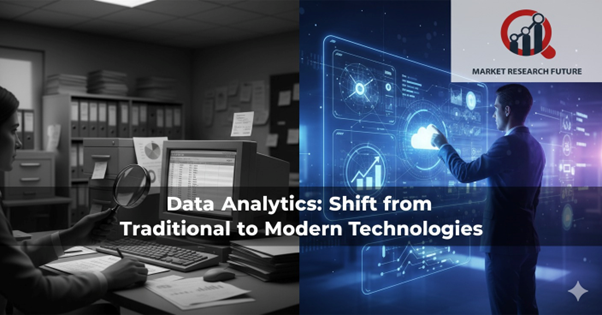
Overview of the Data Analytics Market
Technological innovation and upgradation have proven to be a boon for the global data analytics market, upholding the valuation of the sector to USD 41.3 billion in 2024. The future of the ecosystem, owing to the integration of AI, IoT, and ML, appears excellent, promising its value to reach USD 1026.2 billion by 2035, adhering to a CAGR of 27.6%.
Data analytics is a business process that analysts use to identify patterns and trends in large datasets. The goal of data analytics is to turn raw data into useful information.
Data can be collected from multiple sources, including sensors, databases, auxiliary systems, and social media sites. The term "data analytics" first appeared in the mid-1990s, according to some sources.
Analysis is a critical aspect of computer science, economics, and statistics; it also provides the informational basis for many systems, such as forecasts (e.g., weather forecasting), predictive models (e.g., Google's PageRank algorithm), credit scoring models (e.g., FICO), or assortative mating analysis in sociobiology and evolutionary psychology (e.g., the EEA).
Data analytics is used by a wide range of businesses, including banks, insurance companies, firms in the software industry, telecommunications, and biotechnology industries.
The term "data mining" is sometimes used synonymously with data analysis. In a broader sense, data mining can refer to activities related to the automated extraction of knowledge from large amounts of data or sources.
Traditional data mining is mainly concerned with text-based sources and usually employs statistical methods based on graph theory and network theory.
However, other kinds of information (such as images, video, and rich media) are increasingly being analyzed using new tools such as neural networks (i.e., artificial intelligence) and pattern recognition algorithms.
As the concept of data analytics gains traction, companies are realizing that it’s not just about having more data to work with. Companies need a new approach to analyzing and managing the information they’ve already accumulated to extract insights and recommendations.
A large part of decision-making in any industry, be it retail, healthcare, or finance, relies on insights derived from customer and user data collected through online channels or physical stores.
With consumers increasingly embracing mobile applications and services, it has become a necessity for companies to deploy solutions quickly in order to leverage their customer data for better marketing and business decision-making.
However, companies often face several challenges in managing customer data, including unstructured business information and a lack of standardization. Data analytics provides a promising solution by offering a standardized set of tools to analyze large amounts of data and extract important insights.
Top Use Cases of Data Analytics
Fraud Detection
A key benefit of data analytics is the ability to uncover hidden patterns within massive datasets. This allows companies to detect fraud more effectively and accurately, reducing losses for businesses and minimizing stress and wasted hours for customers.
For instance, data analytics can help detect fraudulent insurance claims while ensuring that genuine claimants are not affected. Companies can also use data analysis tools to detect credit card fraud, preventing financial loss for businesses handling credit card payments.
Customer Loyalty
Data analytics helps companies understand how well their products and services meet customer needs. By analyzing buying patterns or other relevant data, companies can identify trends and detect issues with products, allowing them to rectify problems promptly.
For example, customer loyalty programs, like airline miles, where customers accumulate points for different purchases, can be analyzed to determine the impact these points have on customer decisions regarding particular purchases.
Regional Analysis
With the elevated technological infrastructure in North America, the scope of the field of data analytics is extending, creating new prospects for leading players in the industry. As a result, the region is likely to lead the global data analytics market.
The emergence of new markets in countries like India, China, and many more is proving to be a boon for the realm of data analytics, especially in the Asia-Pacific region. With the increasing scope of innovation, various lucrative opportunities are being created in the field.
Related Report


Leave a Comment