
Top Industry Leaders in the Web scale IT Market
Competitive Landscape of the Web-Scale IT Market
The web-scale IT market, encompassing technologies that cater to the demands of large-scale internet operations, is experiencing rapid growth fueled by digital transformation and cloud adoption. This dynamic landscape is teeming with established giants and nimble upstarts, each vying for a slice of the burgeoning pie. Understanding the competitive dynamics, key players, and investment trends is crucial for anyone navigating this exciting market.
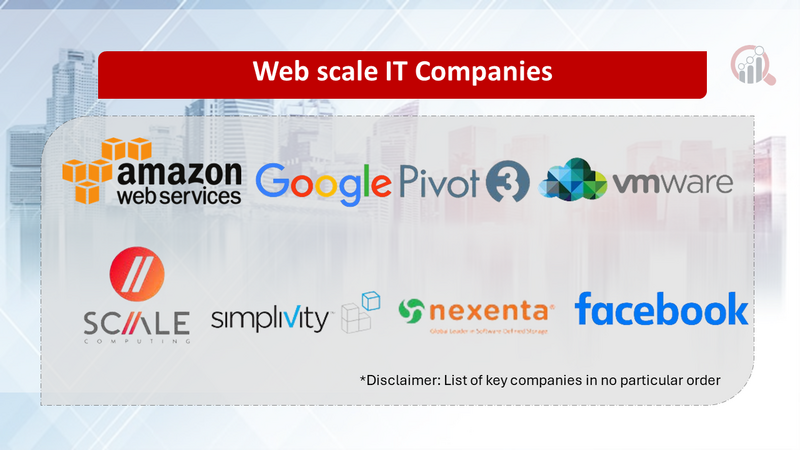
Key Players:
- VMware Inc. (U.S.)
- Nutanix Inc. (U.S.)
- Amazon Web Services Inc. (U.S.)
- Rackspace Inc. (U.S.)
- Google Inc. (U.S.)
- Scale Computing Inc. (U.S.)
- Nexenta Systems Inc. (U.S.)
- SimpliVity Corporation (U.S.)
- Pivot3 Inc. (U.S.)
- Facebook Inc. (U.S.)
Get In-Depth Insights on Key Web scale IT Companies
Strategies Adopted:
- Cloud-First Approach: Leading players are prioritizing cloud-based solutions, offering subscription models and managed services for easier adoption and scalability.
- Openness and Collaboration: Embracing open-source technologies and fostering collaboration with other vendors is becoming increasingly important to cater to diverse customer needs and build strong ecosystems.
- Focus on Automation and AI: Integrating automation and artificial intelligence into solutions is a key differentiator, enabling organizations to optimize operations, improve efficiency, and gain deeper insights.
- Security and Compliance: As data privacy regulations evolve, providing robust security features and compliance certifications is critical for gaining customer trust.
- Vertical Specialization: Tailoring solutions and services to specific industries like healthcare, finance, and retail can create competitive advantages.
Factors for Market Share Analysis:
- Revenue and Market Share: These metrics provide a quantitative understanding of a company's size and dominance.
- Customer Base and Adoption Rate: The number and size of customers, along with their rate of adoption, reflect a company's market traction and potential for future growth.
- Product Portfolio and Innovation: The breadth and depth of a company's offerings, coupled with its track record of innovation, indicate its ability to meet diverse customer needs and stay ahead of the curve.
- Brand Recognition and Reputation: A strong brand and positive reputation can attract new customers and drive loyalty.
- Pricing and Commercial Strategies: Pricing models, discounts, and partnerships can influence market share by making a company's offerings more attractive.
New and Emerging Companies:
- Startups focusing on niche areas: Companies like Databricks (cloud-based data platform) and Snowflake (cloud data warehouse) are addressing specific pain points in the web-scale market with innovative solutions.
- Security and compliance specialists: With increasing data privacy concerns, companies like Crowdstrike (cybersecurity) and Palo Alto Networks (security solutions) are gaining traction.
- Open-source software vendors: Rising adoption of open-source technologies is fueling the growth of companies like Elastic (search and analytics) and MongoDB (database).
Current Company Investment Trends:
- Hybrid and Multi-Cloud Solutions: Companies are investing in solutions that enable seamless management of workloads across different cloud platforms.
- Edge Computing: Investments are increasing in edge computing technologies to bring processing closer to data sources and reduce latency.
- Containerization and Serverless Computing: Companies are embracing containerization and serverless computing for increased agility and scalability.
- Artificial Intelligence and Machine Learning: Integration of AI and ML is becoming a top priority for optimizing operations, personalizing user experiences, and driving insights.
- Sustainability and Green IT: Companies are investing in sustainable solutions to reduce their carbon footprint and cater to environmentally conscious customers.
Technology Trends & Innovations:
- OpenStack celebrates 15th anniversary with focus on cloud-native advancements (Jan 24, 2024): The OpenStack open-source cloud computing platform marks its 15th year with renewed focus on cloud-native technologies and integration with containerization and microservices architectures.
- Edge computing takes center stage in 5G and IoT deployments (Jan 18, 2024): As 5G networks and IoT devices proliferate, the demand for edge computing solutions to process data closer to the source is skyrocketing, driving innovation in edge platforms and infrastructure.
- Serverless computing gains traction for event-driven and microservices applications (Jan 13, 2024): Serverless computing continues to disrupt traditional application development, offering scalability and cost-efficiency for event-driven and microservices-based architectures.

 Noah Malgeri
Co-Founder
Noah Malgeri
Co-Founder

 Peter Groot koerkamp
Account and Business Manager
Peter Groot koerkamp
Account and Business Manager

 Younghwan Choi
Senior Retail Manager
Younghwan Choi
Senior Retail Manager

 Mark Irwin
Management Consultant
Mark Irwin
Management Consultant

 Akif Moroglu
Strategy & Business Development Director
Akif Moroglu
Strategy & Business Development Director

 Guilherme Gomes Martins
Product Management Director
Guilherme Gomes Martins
Product Management Director

 Joseph Aguayo
Sales Operations & Pricing Manager
Joseph Aguayo
Sales Operations & Pricing Manager

 La Terria Dodd
Program Support Specialist
La Terria Dodd
Program Support Specialist

 Rob Kooiker
Group Product Manager HVAC & Fire Protection GMA
Rob Kooiker
Group Product Manager HVAC & Fire Protection GMA


