×
Request Free Sample ×

Kindly complete the form below to receive a free sample of this Report

* Please use a valid business email

Leading companies partner with us for data-driven Insights

clients tt-cursor
Hero Background

US Forklift Trucks Market

ID: MRFR/PCM/18947-HCR
111 Pages
Snehal Singh
February 2026

US Forklift Trucks Market Research Report By Technology (Electric Powered, Internal Combustion Engine Powered), By Capacity (Below 5 tons, Above 5 tons) and By Application (Manufacturing, Logistic, Retail & Wholesale, Others) - Forecast to 2035

Share:
Download PDF ×

We do not share your information with anyone. However, we may send you emails based on your report interest from time to time. You may contact us at any time to opt-out.

US Forklift Trucks Market Infographic
Purchase Options

US Forklift Trucks Market Summary

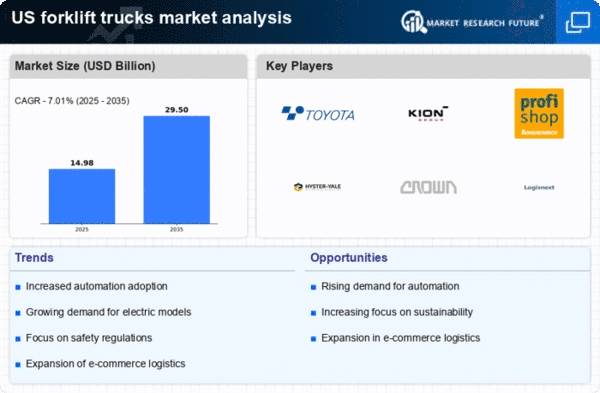
As per Market Research Future analysis, the US forklift trucks market size was estimated at 14.0 USD Billion in 2024.. The US forklift trucks market is projected to grow from 14.98 USD Billion in 2025 to 29.5 USD Billion by 2035, exhibiting a compound annual growth rate (CAGR) of 7.0% during the forecast period 2025 - 2035

Key Market Trends & Highlights

The US forklift trucks market is experiencing a transformative shift towards electric and smart technologies.

  • The rise of electric forklift trucks is reshaping the market landscape, driven by sustainability initiatives.
  • Integration of smart technologies is enhancing operational efficiency and safety in material handling.
  • the focus on safety and compliance is becoming critical as regulations evolve..
  • Increased demand for warehouse automation and expansion of e-commerce are key drivers propelling market growth.

Market Size & Forecast

2024 Market Size 14.0 (USD Billion)
2035 Market Size 29.5 (USD Billion)
CAGR (2025 - 2035) 7.01%

Major Players

Toyota Industries (JP), Kion Group (DE), Jungheinrich (DE), Hyster-Yale Materials Handling (US), Crown Equipment Corporation (US), Mitsubishi Logisnext (JP), Doosan Industrial Vehicle (KR), Clark Material Handling Company (US), Manitou Group (FR)

Our Impact
Enabled $4.3B Revenue Impact for Fortune 500 and Leading Multinationals
Partnering with 2000+ Global Organizations Each Year
30K+ Citations by Top-Tier Firms in the Industry

US Forklift Trucks Market Trends

The forklift trucks market is currently experiencing a dynamic phase. This phase is characterized by evolving technologies and shifting consumer preferences.. As industries increasingly prioritize efficiency and sustainability, the demand for advanced forklift solutions appears to be on the rise. Innovations such as electric-powered models and automated systems are gaining traction, reflecting a broader trend towards environmentally friendly operations. Furthermore, the integration of smart technologies, including IoT and AI, is likely to enhance operational efficiency and safety in material handling processes. This shift not only aligns with regulatory pressures but also meets the expectations of a more environmentally conscious workforce. In addition to technological advancements, the forklift trucks market is influenced by changing economic conditions and supply chain dynamics. The ongoing emphasis on logistics optimization and warehouse automation suggests that businesses are seeking to improve their operational capabilities. As a result, there is a growing interest in versatile and adaptable forklift solutions that can cater to diverse operational needs. This trend indicates a potential for increased investment in fleet modernization and maintenance, as companies strive to remain competitive in a rapidly evolving marketplace.

Rise of Electric Forklift Trucks

The transition towards electric forklift trucks is becoming increasingly prominent. This shift is driven by the need for reduced emissions and lower operational costs. Electric models offer advantages such as quieter operation and reduced maintenance requirements, making them appealing for indoor use. As businesses seek to enhance sustainability, the adoption of electric forklifts is likely to continue growing.

Integration of Smart Technologies

The incorporation of smart technologies into forklift operations is gaining momentum. Features such as telematics and automation are enhancing efficiency and safety. These technologies allow for real-time monitoring and data analysis, enabling companies to optimize their fleet management. As the industry embraces digital transformation, the demand for smart forklift solutions is expected to rise.

Focus on Safety and Compliance

Safety remains a critical concern within the forklift trucks market. Companies are increasingly prioritizing compliance with safety regulations and standards. This focus is driving the development of advanced safety features, such as collision avoidance systems and operator training programs. As organizations strive to minimize workplace accidents, the emphasis on safety is likely to shape future market trends.

US Forklift Trucks Market Drivers

Increased Demand for Warehouse Automation

The forklift trucks market is experiencing a notable surge in demand due to the increasing automation of warehouses across the United States. As companies strive to enhance operational efficiency, the integration of automated systems necessitates the use of advanced forklift trucks. According to recent data, the warehouse automation sector is projected to grow at a CAGR of approximately 15% over the next five years. This growth directly influences the forklift trucks market, as automated solutions often require specialized equipment. Furthermore, the shift towards e-commerce has intensified the need for efficient material handling solutions, further driving the demand for forklift trucks. Consequently, manufacturers are focusing on developing innovative models that cater to the specific needs of automated environments, thereby shaping the future landscape of the forklift trucks market.

Expansion of E-commerce and Retail Sectors

The rapid expansion of the e-commerce and retail sectors is significantly impacting the forklift trucks market. As online shopping continues to gain traction, warehouses and distribution centers are under pressure to optimize their operations. This trend has led to an increased need for efficient material handling equipment, including forklift trucks. Recent statistics indicate that e-commerce sales in the US have surged by over 30% in the past year, prompting retailers to invest in advanced logistics solutions. Forklift trucks play a crucial role in streamlining the supply chain, ensuring timely delivery of goods. As a result, manufacturers are likely to focus on producing versatile and high-capacity forklift trucks that can meet the demands of this growing sector, thereby influencing the overall dynamics of the forklift trucks market.

Rising Labor Costs and Workforce Challenges

Rising labor costs and workforce challenges are significantly influencing the forklift trucks market. As companies face increasing expenses related to labor, there is a growing emphasis on automation and mechanization to maintain profitability. The need for efficient material handling solutions, such as forklift trucks, becomes paramount in this context. Recent analyses indicate that labor costs in the US have risen by approximately 10% over the past year, prompting businesses to seek ways to reduce reliance on manual labor. Consequently, the forklift trucks market is likely to see an uptick in demand for models that can operate autonomously or with minimal human intervention. This trend may lead to a shift in product offerings, as manufacturers adapt to the evolving needs of the industry.

Technological Advancements in Forklift Design

Technological advancements are playing a pivotal role in transforming the forklift trucks market. Innovations such as telematics, advanced sensors, and automation are enhancing the functionality and safety of forklift trucks. These technologies enable real-time monitoring of equipment performance, leading to improved maintenance and reduced downtime. Recent reports indicate that the adoption of smart technologies in material handling is expected to increase by 25% in the coming years. As companies seek to optimize their operations, the demand for technologically advanced forklift trucks is likely to rise. Manufacturers are focusing on integrating these technologies into their designs, which not only improves efficiency but also enhances safety standards within the forklift trucks market.

Sustainability Initiatives in Material Handling

Sustainability initiatives are becoming increasingly prominent within the forklift trucks market, as companies seek to reduce their carbon footprint and enhance environmental responsibility. The push for greener operations has led to a growing interest in electric and hybrid forklift trucks, which offer lower emissions compared to traditional internal combustion models. Recent data suggests that the market for electric forklift trucks is expected to grow by approximately 20% over the next five years. This shift towards sustainable practices not only aligns with regulatory requirements but also appeals to environmentally conscious consumers. As businesses prioritize sustainability, manufacturers are likely to innovate and develop more eco-friendly forklift trucks, thereby reshaping the competitive landscape of the forklift trucks market.


Market Segment Insights

By Technology: Electric Powered (Largest) vs. Internal Combustion Engine Powered (Fastest-Growing)

In the US forklift trucks market, the Electric Powered segment holds the largest share, reflecting a significant shift towards sustainable solutions. Internal Combustion Engine Powered forklifts, while traditionally popular, face increasing competition from their electric counterparts. As companies seek to reduce emissions and operational costs, the market dynamics are favoring electric solutions, leading to a notable distribution of market share across these segments. The growth trends in this sector showcase a clear trajectory towards electrification. Factors driving this shift include advancements in battery technology, regulatory pressures for greener practices, and the growing awareness among businesses about the total cost of ownership. The Internal Combustion Engine Powered segment is not far behind, as it experiences rapid growth driven by industries that require heavy lifting and operational flexibility. This duality in growth highlights a transformation in preferences amid evolving market demands.

Technology: Electric Powered (Dominant) vs. Internal Combustion Engine Powered (Emerging)

Electric Powered forklifts are the dominant force in the market, known for their energy efficiency and lower environmental impact. They are favored in sectors where indoor usage and emission regulations are critical, offering reduced noise levels and maintenance costs. On the other hand, Internal Combustion Engine Powered forklifts are emerging with rapid growth, especially in outdoor applications where higher driving power is required. These forklifts benefit from established fuel supply chains and offer significant power and versatility. As the market evolves, both segments present unique advantages catering to varying operational needs.

By Capacity: Below 5 tons (Largest) vs. Above 5 tons (Fastest-Growing)

In the US forklift trucks market, the capacity segment is characterized by a significant distribution between two main categories: below 5 tons and above 5 tons. the below 5-ton segment holds the largest market share, as these smaller forklifts are widely utilized across various industries, including warehousing and retail.. On the other hand, the above 5 tons segment, while smaller in market share, is rapidly gaining traction, particularly in heavy-duty applications within construction and manufacturing sectors. Growth trends indicate that the above 5 tons category is emerging as the fastest-growing segment, driven by increased demand for robust forklifts capable of handling heavier loads. Factors such as the need for enhanced productivity, improved automation in warehouses, and the expansion of e-commerce are contributing to this growth. Additionally, technological advancements and sustainability initiatives are influencing purchase decisions, leading to an uptick in the adoption of larger capacity forklifts.

Capacity: Below 5 tons (Dominant) vs. Above 5 tons (Emerging)

the below 5-ton capacity segment is dominant in the US forklift trucks market, characterized by its versatility and adaptability across a wide range of applications.. These forklifts are preferred in settings like retail, small warehousing, and light manufacturing due to their ease of maneuverability and lower operational costs. In contrast, the above 5 tons segment is emerging and appeals to sectors that require heavy lifting capabilities, such as construction and logistics. This segment benefits from increased investments in infrastructure and industrial activities, leading to a demand for more powerful forklifts. Both segments exhibit unique characteristics that cater to different market needs, shaping the landscape of the US forklift trucks market.

By Application: Manufacturing (Largest) vs. Logistics (Fastest-Growing)

In the US forklift trucks market, the application segment is diverse, with manufacturing holding the largest share. This segment benefits from the continuous need for material handling solutions in production environments, ensuring a stable demand. Following closely, logistics has emerged as a critical sector, driven by e-commerce growth and the need for efficient transportation and storage solutions. Growth trends indicate that logistics is rapidly expanding as businesses increasingly integrate automation and advanced technologies to optimize operations. Factors such as the rise in online shopping and the demand for quick supply chain solutions are stimulating the fast-paced evolution of this segment. Manufacturing, while steady, may face challenges due to fluctuating economic conditions but continues to innovate with better equipment and practices.

Manufacturing: Traditional (Dominant) vs. Logistics: Automation (Emerging)

The manufacturing sector remains dominant in the US forklift trucks market, relying on traditional techniques and equipment to facilitate production processes. This segment benefits from established practices and a robust customer base, representing a crucial aspect of industrial operations. In contrast, logistics, particularly with a focus on automation, represents an emerging segment. Companies are increasingly adopting automated forklifts and advanced inventory management systems to enhance efficiency and reduce labor costs. This shift towards automation allows for greater flexibility and speed in logistics, positioning it as a key player for future growth in the market.

Get more detailed insights about US Forklift Trucks Market

Key Players and Competitive Insights

The forklift trucks market in the US is characterized by a competitive landscape that is both dynamic and multifaceted. Key growth drivers include the increasing demand for efficient material handling solutions across various industries, coupled with advancements in technology and automation. Major players such as Toyota Industries (Japan), Hyster-Yale Materials Handling (US), and Crown Equipment Corporation (US) are strategically positioned to leverage these trends. Toyota Industries (Japan) focuses on innovation and sustainability, emphasizing electric and hybrid forklift solutions, while Hyster-Yale Materials Handling (US) is enhancing its product offerings through strategic partnerships and acquisitions. Crown Equipment Corporation (US) is investing heavily in digital transformation, integrating IoT technologies into its equipment to improve operational efficiency. Collectively, these strategies shape a competitive environment that is increasingly focused on technological advancement and sustainability.Key business tactics within the market include localizing manufacturing and optimizing supply chains to enhance responsiveness to customer needs. The competitive structure appears moderately fragmented, with several key players holding substantial market shares. This fragmentation allows for a diverse range of offerings, yet the influence of major companies is significant, as they set benchmarks for innovation and service standards that smaller players often strive to meet.

In October Toyota Industries (Japan) announced the launch of a new line of electric forklifts designed to reduce energy consumption by up to 30%. This strategic move not only aligns with global sustainability goals but also positions the company as a leader in the transition towards greener material handling solutions. The introduction of these forklifts is likely to enhance Toyota's competitive edge, particularly in sectors where environmental considerations are paramount.

In September Hyster-Yale Materials Handling (US) expanded its partnership with a leading technology firm to develop advanced telematics solutions for its forklift fleet. This collaboration aims to provide customers with real-time data analytics, thereby improving fleet management and operational efficiency. Such initiatives indicate Hyster-Yale's commitment to integrating cutting-edge technology into its product offerings, which may enhance customer satisfaction and loyalty.

In August Crown Equipment Corporation (US) unveiled a new software platform that integrates AI capabilities into its forklift operations. This platform is designed to optimize route planning and reduce operational downtime. By embracing AI, Crown Equipment Corporation (US) is not only enhancing its product functionality but also setting a precedent for the industry, potentially reshaping how material handling operations are conducted.

As of November current competitive trends in the forklift trucks market are heavily influenced by digitalization, sustainability, and the integration of AI technologies. Strategic alliances are increasingly shaping the landscape, as companies recognize the value of collaboration in driving innovation. Looking ahead, competitive differentiation is likely to evolve from traditional price-based competition towards a focus on technological innovation, reliability in supply chains, and sustainable practices. This shift suggests that companies that prioritize these areas may gain a substantial advantage in the marketplace.

Key Companies in the US Forklift Trucks Market include

Industry Developments

The US Forklift Trucks Market has seen significant developments recently, with companies enhancing their technological offerings and focusing on sustainability. Toyota Material Handling has been investing in advanced automation solutions, while HysterYale Materials Handling has been expanding its electric forklift lineup in response to growing demand for eco-friendly options. Additionally, in September 2023, Mitsubishi Logisnext announced a strategic partnership aimed at bolstering its distribution network, reflecting a trend towards collaborative growth among major players. In the same month, Crown Equipment Corporation unveiled innovations in warehouse management technologies to streamline operations.

The market is also experiencing a steady growth trajectory, with a valuation increase driven by heightened e-commerce activities and supply chain demands. Over the past few years, firms such as Doosan Industrial Vehicles and UniCarriers Americas Corporation have pursued aggressive expansion strategies, including facility upgrades and workforce enhancements to meet increasing customer needs. In October 2022, Yale Materials Handling Corporation expanded its product portfolio with the launch of a new line of electric pallet trucks, reinforcing its position in the competitive landscape. The competitive environment has fostered an emphasis on Research and Development, reflecting the market's dynamic nature.

Future Outlook

US Forklift Trucks Market Future Outlook

The forklift trucks market is projected to grow at a 7.01% CAGR from 2025 to 2035, driven by automation, e-commerce growth, and sustainability initiatives.

New opportunities lie in:

  • Development of electric forklift models for eco-friendly operations.
  • Integration of IoT technology for real-time fleet management.
  • Expansion into e-commerce logistics with tailored forklift solutions.

By 2035, the market is expected to exhibit robust growth and innovation.

Market Segmentation

US Forklift Trucks Market Capacity Outlook

  • Below 5 tons
  • Above 5 tons

US Forklift Trucks Market Technology Outlook

  • Electric Powered
  • Internal Combustion Engine Powered

US Forklift Trucks Market Application Outlook

  • Manufacturing
  • Logistic
  • Retail & Wholesale
  • Others

Report Scope

MARKET SIZE 2024 14.0(USD Billion)
MARKET SIZE 2025 14.98(USD Billion)
MARKET SIZE 2035 29.5(USD Billion)
COMPOUND ANNUAL GROWTH RATE (CAGR) 7.01% (2025 - 2035)
REPORT COVERAGE Revenue Forecast, Competitive Landscape, Growth Factors, and Trends
BASE YEAR 2024
Market Forecast Period 2025 - 2035
Historical Data 2019 - 2024
Market Forecast Units USD Billion
Key Companies Profiled Toyota Industries (JP), Kion Group (DE), Jungheinrich (DE), Hyster-Yale Materials Handling (US), Crown Equipment Corporation (US), Mitsubishi Logisnext (JP), Doosan Industrial Vehicle (KR), Clark Material Handling Company (US), Manitou Group (FR)
Segments Covered Technology, Capacity, Application
Key Market Opportunities Integration of automation and electric technologies enhances efficiency in the forklift trucks market.

Key Market Dynamics Technological advancements drive efficiency and safety improvements in the forklift trucks market, reshaping competitive dynamics.
Countries Covered US
Leave a Comment

FAQs

What is the current market value of the US Forklift Trucks Market in 2024?

The US Forklift Trucks Market is expected to be valued at 10.6 billion USD in 2024.

What is the projected market value of the US Forklift Trucks Market by 2035?

By 2035, the US Forklift Trucks Market is projected to reach a value of 22.5 billion USD.

What is the expected CAGR for the US Forklift Trucks Market from 2025 to 2035?

The expected CAGR for the US Forklift Trucks Market from 2025 to 2035 is 7.082 percent.

Which technology segment is anticipated to have the largest market share in 2024?

In 2024, the Internal Combustion Engine Powered segment is anticipated to have the largest market share, valued at 6.6 billion USD.

What will be the market value of Electric Powered Forklift Trucks by 2035?

The market value of Electric Powered Forklift Trucks is expected to reach 8.5 billion USD by 2035.

Who are the key players in the US Forklift Trucks Market?

Major players in the US Forklift Trucks Market include Nissan Forklift Corporation, Crown Equipment Corporation, and Toyota Material Handling, among others.

What are the key applications driving the growth of the US Forklift Trucks Market?

Key applications driving growth include warehouse operations, construction, and manufacturing sectors.

What is the market growth rate for Electric Powered Forklift Trucks?

The Electric Powered Forklift Trucks segment is expected to grow significantly as part of the broader market growth during the forecast period.

How does the internal combustion segment compare to the electric segment in terms of market size?

In 2024, the Internal Combustion Engine Powered segment is valued at 6.6 billion USD, compared to 4.0 billion USD for the Electric Powered segment.

What are the emerging trends impacting the US Forklift Trucks Market?

Emerging trends include advancements in electric technology and increasing demand for warehouse automation.

Download Free Sample

Kindly complete the form below to receive a free sample of this Report

Compare Licence

×
Features License Type
Single User Multiuser License Enterprise User
Price $4,950 $5,950 $7,250
Maximum User Access Limit 1 User Upto 10 Users Unrestricted Access Throughout the Organization
Free Customization
Direct Access to Analyst
Deliverable Format
Platform Access
Discount on Next Purchase 10% 15% 15%
Printable Versions