×
Request Free Sample ×

Kindly complete the form below to receive a free sample of this Report

* Please use a valid business email

Leading companies partner with us for data-driven Insights

clients tt-cursor
Hero Background

US Biofuel Additives Market

ID: MRFR/CnM/12540-HCR
100 Pages
Chitranshi Jaiswal
February 2026

US Biofuel Additives Market Research Report: By Product Type (Antioxidants, Corrosion Inhibitors, Cold Flow Improvers, Detergents, Octane and Cetane Improvers, Dyes and Markers, Others) and By Application (Diesel Fuel Additives, Heavy Fuel Oil Additives, Aviation Fuel Additives, Gasoline Fuel Additives, Others) - Forecast to 2035

Share:
Download PDF ×

We do not share your information with anyone. However, we may send you emails based on your report interest from time to time. You may contact us at any time to opt-out.

US Biofuel Additives Market Infographic
Purchase Options

US Biofuel Additives Market Summary

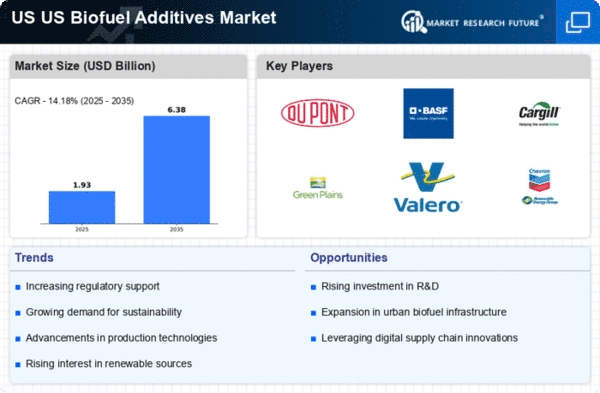
As per analysis, the US Biofuel Additives Market is projected to grow from USD 1.93 Billion in 2025 to USD 6.38 Billion by 2035, exhibiting a compound annual growth rate (CAGR) of 12.81% during the forecast period (2025 - 2035).

Key Market Trends & Highlights

The US Biofuel Additives Market is poised for growth driven by regulatory support and technological advancements.

  • The Transportation segment remains the largest contributor to the biofuel additives market, reflecting a robust demand for cleaner fuels.
  • Ester-based additives dominate the market, providing effective solutions for enhancing fuel performance and stability.
  • The Power Generation segment is emerging as the fastest-growing area, driven by increasing investments in renewable energy sources.
  • Regulatory incentives and rising environmental awareness are key drivers propelling the adoption of biofuel additives.

Market Size & Forecast

2024 Market Size 1.69 (USD Billion)
2035 Market Size 6.38 (USD Billion)
CAGR (2025 - 2035) 12.81%

Major Players

DuPont (US), BASF (US), Cargill (US), Green Plains Inc. (US), Valero Energy Corporation (US), Renewable Energy Group (US), ADM (US), Innospec (US)

Our Impact
Enabled $4.3B Revenue Impact for Fortune 500 and Leading Multinationals
Partnering with 2000+ Global Organizations Each Year
30K+ Citations by Top-Tier Firms in the Industry

US Biofuel Additives Market Trends

The US Biofuel Additives Market is currently experiencing a notable transformation, driven by a combination of regulatory frameworks and technological advancements. The increasing emphasis on reducing greenhouse gas emissions has prompted a shift towards cleaner fuel alternatives, thereby enhancing the demand for biofuel additives. These additives play a crucial role in improving the performance and stability of biofuels, which is essential for meeting stringent environmental standards. Furthermore, the growing awareness among consumers regarding sustainability is influencing manufacturers to innovate and develop more efficient biofuel solutions. As a result, the market is poised for growth, with stakeholders actively seeking to capitalize on emerging opportunities. In addition to regulatory influences, the US Biofuel Additives Market is also shaped by the evolving landscape of energy consumption. The transition towards renewable energy sources is becoming more pronounced, with biofuels being recognized as a viable alternative to traditional fossil fuels. This shift is likely to encourage investments in research and development, leading to the introduction of advanced biofuel additives that enhance fuel efficiency and reduce emissions. Overall, the market appears to be on a trajectory of expansion, driven by both environmental imperatives and technological innovations.

Regulatory Support for Biofuels

The US government has implemented various policies and incentives to promote the use of biofuels, which directly impacts the biofuel additives market. These regulations aim to reduce carbon emissions and enhance energy security, thereby fostering a favorable environment for biofuel production and consumption.

Technological Advancements in Additives

Innovations in biofuel additives are emerging, focusing on improving fuel performance and stability. Research into new formulations and production methods is likely to enhance the efficiency of biofuels, making them more competitive against conventional fuels.

Consumer Demand for Sustainable Solutions

There is a growing consumer preference for sustainable energy sources, which is influencing the US Biofuel Additives Market. As awareness of environmental issues increases, manufacturers are responding by developing biofuel additives that align with eco-friendly practices.

US Biofuel Additives Market Drivers

Economic Viability of Biofuels

The economic viability of biofuels is a crucial factor influencing the US Biofuel Additives Market. As crude oil prices fluctuate, biofuels are becoming an increasingly attractive alternative due to their potential for cost savings. In 2025, the price competitiveness of biofuels, bolstered by advancements in production technologies, is likely to enhance their market share. Additionally, the availability of feedstocks, such as agricultural residues and waste materials, contributes to the cost-effectiveness of biofuel production. This economic aspect not only encourages the adoption of biofuels but also stimulates the demand for biofuel additives, as manufacturers seek to optimize their formulations for better performance and lower costs.

Rising Environmental Awareness

The growing environmental consciousness among consumers and industries is a significant driver for the US Biofuel Additives Market. As awareness of climate change and environmental degradation increases, there is a marked shift towards sustainable energy solutions. In 2025, a considerable segment of the population actively seeks eco-friendly alternatives, which has led to a rise in the demand for biofuels and their additives. This trend is further supported by corporate sustainability initiatives, where companies are increasingly adopting biofuels to reduce their carbon footprint. The market is projected to expand as more consumers prioritize sustainability in their purchasing decisions, thereby creating a favorable environment for biofuel additives.

Regulatory Incentives and Policies

The US Biofuel Additives Market is significantly influenced by regulatory incentives and policies aimed at promoting renewable energy sources. The Renewable Fuel Standard (RFS) mandates a certain volume of renewable fuel to be blended into transportation fuel, thereby creating a robust demand for biofuel additives. In 2025, the Environmental Protection Agency (EPA) proposed an increase in the blending requirements, which could potentially elevate the market size. Furthermore, state-level initiatives, such as California's Low Carbon Fuel Standard, encourage the use of biofuels, thereby enhancing the market landscape. These regulations not only support the growth of biofuel additives but also align with national goals for reducing greenhouse gas emissions, indicating a favorable environment for market expansion.

Support from the Agricultural Sector

The US Biofuel Additives Market benefits from strong support from the agricultural sector, which plays a vital role in the production of biofuels. In 2025, the increasing availability of feedstocks, such as corn and soybeans, is expected to bolster the biofuel industry. This relationship between agriculture and biofuels creates a synergistic effect, where farmers are incentivized to produce crops for biofuel production, thereby ensuring a steady supply of raw materials. Furthermore, government programs that promote biofuel production from agricultural sources enhance the market landscape. This collaboration not only supports the growth of biofuels but also drives the demand for biofuel additives, as manufacturers seek to improve the efficiency and sustainability of their products.

Technological Innovations in Additives

Technological advancements play a pivotal role in shaping the US Biofuel Additives Market. Innovations in additive formulations enhance the performance and efficiency of biofuels, making them more competitive with traditional fossil fuels. For instance, the development of advanced emulsifiers and stabilizers has improved the stability and combustion characteristics of biofuels. In 2025, the market is witnessing a surge in research and development activities aimed at creating more efficient biofuel additives. This trend is likely to attract investments and foster collaborations between manufacturers and research institutions, thereby propelling market growth. Enhanced performance characteristics not only meet regulatory standards but also cater to the evolving preferences of consumers and industries alike.


Market Segment Insights

By Application: Transportation (Largest) vs. Power Generation (Fastest-Growing)

In the US Biofuel Additives Market, the application segment is predominantly driven by the transportation sector, which holds the largest market share. This segment leverages biofuel additives to enhance vehicle performance while reducing emissions, making it a crucial element in achieving environmental regulations. Following closely, the power generation sector is emerging rapidly, exploiting biofuels for cleaner energy solutions and gradually gaining traction among consumers and businesses alike. The growth trends for these segments illustrate a robust shift towards sustainable practices, especially in transportation, where regulatory pressures and a growing consumer demand for greener fuel alternatives are propelling market expansion. The power generation sector, as the fastest-growing segment, benefits from increasing investments in renewable energy technologies and incentives from government policies aimed at promoting biofuel usage, setting a strong foundation for future growth.

Transportation (Dominant) vs. Agriculture (Emerging)

The transportation segment remains the dominant player in the US Biofuel Additives Market, as it extensively utilizes biofuels to improve compliance with stringent emission standards while enhancing fuel efficiency. With advancements in technology and increased awareness of the environmental impact of traditional fuels, transportation is expected to continue leading the market. On the other hand, the agriculture sector is emerging, leveraging biofuels as part of sustainable farming practices. The agricultural use of biofuel additives signifies a shift towards renewable energy sources that reduce dependency on fossil fuels. As farmers integrate biofuels into their operations for powering machinery and equipment, this segment shows significant potential for growth, particularly with ongoing developments and supportive government policies.

By Type: Ester-based Additives (Largest) vs. Alcohol-based Additives (Fastest-Growing)

In the US Biofuel Additives Market, the segment is largely dominated by ester-based additives, which have established their strong presence due to their compatibility with both biodiesel and conventional diesel. These additions significantly enhance fuel properties, contributing to their robust market share. Following closely, alcohol-based additives, while currently smaller in market share, showcase a rapid surge in demand driven by their renewable nature and ability to improve combustion efficiency, making them appealing for future investments. Growth trends indicate that ester-based additives will continue to retain dominance; however, alcohol-based additives are emerging as a flexible alternative with significant appeal, particularly amid increasing environmental regulations. Market drivers include the push for sustainable fuel alternatives and the commitment to reduce greenhouse gas emissions. As the biofuel sector evolves, these additives will play a critical role in meeting regulatory standards and consumer preferences.

Ester-based Additives (Dominant) vs. Surfactants (Emerging)

Ester-based additives are recognized as the dominant players in the US Biofuel Additives Market. They are favored for their excellent lubricity, stability, and lower cloud points, which enhance operational efficiency in diverse climatic conditions. Their established integration into the biofuel industry and proven performance metrics underscore their market position. On the other hand, surfactants are emerging as a crucial segment due to their role in improving fuel quality by reducing surface tension and promoting better blend quality. While they are not as widely adopted as ester-based additives, their potential lies in enhancing the overall fuel efficiency and stability, marking them as a segment to watch in the evolving landscape of biofuel additives.

By End Use: Automotive (Largest) vs. Marine (Fastest-Growing)

In the US Biofuel Additives Market, the automotive segment holds the largest share, driven by the increasing adoption of biofuels within the transportation sector. This segment has established a strong presence due to the growing demand for sustainable and environmentally friendly solutions, leading to a significant focus on enhancing fuel quality and performance. The aviation, marine, and railway segments, while crucial, capture a comparatively smaller share, with marine applications showing promising growth due to regulatory changes and rising environmental concerns.

Aviation (Dominant) vs. Railway (Emerging)

Within the US Biofuel Additives Market, the aviation segment is considered dominant due to its extensive use of biofuels to meet stringent emissions regulations and its ongoing commitment to sustainability. This segment benefits from increasing demand for greener alternatives, positioning itself as a leader in the quest for sustainable aviation fuel. On the other hand, the railway segment is emerging, supported by initiatives to reduce carbon footprints and enhance fuel efficiency. With advancements in biofuel technology, the railway sector is slowly transitioning towards incorporating biofuels, although it still faces challenges like infrastructure readiness. Both segments play vital roles in fostering a sustainable future for transportation, each reflecting unique characteristics and market dynamics.

By Formulation: Blends (Largest) vs. Additive Packages (Fastest-Growing)

In the US biofuel additives market, the formulation segment is characterized by distinct values, primarily blends, additive packages, and concentrates. Blends command the largest market share, driven by their cost-effectiveness and compatibility with existing fuel infrastructure. This segment is well-established, making up a significant portion of the overall market dynamics. In contrast, additive packages, while smaller, are gaining traction due to advancements in technology and growing environmental regulations that necessitate cleaner-burning fuels.

Formulation: Blends (Dominant) vs. Additive Packages (Emerging)

Blends stand out as the dominant formulation in the US biofuel additives market, appealing largely due to their versatility and regulatory compliance. They are often blended with traditional fuels to improve performance while meeting stringent environmental standards. On the other hand, additive packages are emerging as a significant player, characterized by a mix of components that enhance fuel efficiency and reduce emissions. The growing trend towards sustainable solutions and the need for advanced formulations to meet evolving fuel standards position additive packages as a noteworthy competitor in the segment, marking them as essential to future market developments.

By Distribution Channel: Direct Sales (Largest) vs. Online Sales (Fastest-Growing)

In the US Biofuel Additives Market, the distribution channels play a crucial role in determining accessibility and growth. Direct sales currently hold the largest share, catering to key accounts that require a reliable and consistent supply of biofuel additives. Distributors play an essential role in bridging manufacturers with end-users, capturing a significant share of the market as they offer extensive networks. Online sales, while smaller in comparison, are rapidly gaining traction, driven by an increase in e-commerce adoption among consumers and businesses alike.

Direct Sales (Dominant) vs. Online Sales (Emerging)

Direct sales in the US Biofuel Additives Market serve as the dominant distribution channel, preferred by companies providing bulk orders and consistent supply commitments. This method fosters direct relationships and customized solutions, allowing for effective inventory management and shorter lead times. In contrast, online sales represent an emerging segment, driven by changing consumer behavior towards digital purchasing and increased convenience. This channel is particularly appealing for small-scale buyers and those seeking a broader range of products. The rise of e-commerce is prompting traditional distributors to adapt their strategies, integrating online platforms to better serve the evolving market.

Get more detailed insights about US Biofuel Additives Market

Key Players and Competitive Insights

The Biofuel Additives Market is currently characterized by a dynamic competitive landscape, driven by increasing demand for sustainable energy solutions and regulatory support for biofuels. Key players such as DuPont (US), BASF (US), and Renewable Energy Group (US) are actively shaping the market through strategic initiatives focused on innovation and sustainability. DuPont (US) emphasizes its commitment to developing advanced biofuel technologies, while BASF (US) leverages its extensive chemical expertise to enhance biofuel performance. Renewable Energy Group (US) is strategically positioned to expand its production capabilities, indicating a collective focus on enhancing product offerings and operational efficiencies, which collectively intensifies competition in the market.

In terms of business tactics, companies are increasingly localizing manufacturing and optimizing supply chains to enhance responsiveness to market demands. The competitive structure of the Biofuel Additives Market appears moderately fragmented, with several key players exerting influence. This fragmentation allows for niche players to emerge, while larger companies consolidate their market positions through strategic partnerships and acquisitions, thereby shaping the overall competitive dynamics.

In December 2025, DuPont (US) announced a partnership with a leading agricultural firm to develop next-generation biofuel additives aimed at improving engine efficiency. This collaboration is significant as it not only enhances DuPont's product portfolio but also aligns with the growing trend towards sustainable agricultural practices, potentially increasing market share in the biofuel sector.

In November 2025, BASF (US) launched a new line of biofuel additives designed to reduce emissions and improve fuel stability. This strategic move underscores BASF's commitment to sustainability and innovation, positioning the company as a leader in environmentally friendly solutions within the biofuel additives market. The introduction of these products is likely to attract environmentally conscious consumers and businesses, further solidifying BASF's competitive edge.

In October 2025, Renewable Energy Group (US) expanded its production facility in the Midwest, significantly increasing its capacity to produce biofuel additives. This expansion is crucial as it not only meets the rising demand for biofuels but also enhances the company's operational efficiency. By increasing production capabilities, Renewable Energy Group (US) is well-positioned to capitalize on market growth and strengthen its competitive position.

As of January 2026, the Biofuel Additives Market is witnessing trends such as digitalization, sustainability, and the integration of AI technologies. Strategic alliances among key players are increasingly shaping the competitive landscape, fostering innovation and collaboration. The shift from price-based competition to a focus on technological advancements and supply chain reliability is evident, suggesting that future competitive differentiation will hinge on the ability to innovate and adapt to evolving market demands.

Key Companies in the US Biofuel Additives Market include

Industry Developments

In recent months, the US Biofuel Additives Market has seen significant developments with a growing emphasis on renewable energy. In September 2023, Renewable Energy Group announced their acquisition of a leading biofuel production facility, enhancing their production capacity. Moreover, Valero Energy has invested in expanding their biofuel blend capabilities, consistent with the shift towards sustainable practices. Marathon Petroleum is reportedly enhancing their biofuel infrastructure to meet the increasing demand for low-carbon fuel alternatives, reflecting a broader trend among major players including BP and Shell, who are also making strategic investments in renewable technologies.

The market valuation for biofuel additives has experienced substantial growth, driven by heightened legislative support for biofuels, as well as the need to meet renewable fuel standards set by the US Environmental Protection Agency. Additionally, major companies like Cargill and POET are focusing on innovation to improve biofuel efficiency and sustainability. Over the past few years, the market has overcome challenges, with significant advancements made in biofuel technologies and established collaborations among companies like Abengoa Bioenergy and Cosan aimed at increasing production capabilities and optimizing supply chains.

Future Outlook

US Biofuel Additives Market Future Outlook

The US Biofuel Additives Market is projected to grow at a 12.81% CAGR from 2025 to 2035, driven by regulatory support, technological advancements, and increasing demand for sustainable fuels.

New opportunities lie in:

  • Development of advanced biofuel formulations for specific engine types.
  • Expansion of distribution networks for biofuel additives in rural areas.
  • Investment in R&D for innovative biofuel additive technologies.

By 2035, the market is expected to be robust, driven by innovation and increasing adoption of biofuels.

Market Segmentation

US Biofuel Additives Market Type Outlook

  • Ester-based Additives
  • Alcohol-based Additives
  • Biomass-based Additives
  • Surfactants

US Biofuel Additives Market End Use Outlook

  • Automotive
  • Aviation
  • Marine
  • Railway

US Biofuel Additives Market Application Outlook

  • Transportation
  • Power Generation
  • Industrial
  • Agriculture

US Biofuel Additives Market Formulation Outlook

  • Blends
  • Additive Packages
  • Concentrates

US Biofuel Additives Market Distribution Channel Outlook

  • Direct Sales
  • Distributors
  • Online Sales

Report Scope

MARKET SIZE 20241.69(USD Billion)
MARKET SIZE 20251.93(USD Billion)
MARKET SIZE 20356.38(USD Billion)
COMPOUND ANNUAL GROWTH RATE (CAGR)12.81% (2024 - 2035)
REPORT COVERAGERevenue Forecast, Competitive Landscape, Growth Factors, and Trends
BASE YEAR2024
Market Forecast Period2025 - 2035
Historical Data2019 - 2024
Market Forecast UnitsUSD Billion
Key Companies ProfiledDuPont (US), BASF (US), Cargill (US), Green Plains Inc. (US), Valero Energy Corporation (US), Renewable Energy Group (US), ADM (US), Innospec (US)
Segments CoveredApplication, Type, End Use, Formulation, Distribution Channel
Key Market OpportunitiesIncreasing demand for sustainable fuel solutions drives innovation in the US Biofuel Additives Market.
Key Market DynamicsRising regulatory pressures drive innovation and adoption of advanced biofuel additives in the US market.
Countries CoveredUS
Leave a Comment

FAQs

What is the current valuation of the US Biofuel Additives Market?

The US Biofuel Additives Market was valued at 1.69 USD Billion in 2024.

What is the projected market size for the US Biofuel Additives Market by 2035?

The market is projected to reach 6.38 USD Billion by 2035.

What is the expected CAGR for the US Biofuel Additives Market during the forecast period 2025 - 2035?

The expected CAGR for the market during 2025 - 2035 is 12.81%.

Which companies are considered key players in the US Biofuel Additives Market?

Key players include DuPont, BASF, Cargill, Green Plains Inc., Valero Energy Corporation, Renewable Energy Group, ADM, and Innospec.

What are the main applications of biofuel additives in the US market?

The main applications include Transportation, Power Generation, Industrial, and Agriculture.

How much is the Transportation segment of the US Biofuel Additives Market expected to grow?

The Transportation segment is expected to grow from 0.85 USD Billion to 3.2 USD Billion by 2035.

What types of biofuel additives are prevalent in the US market?

Prevalent types include Ester-based Additives, Alcohol-based Additives, Biomass-based Additives, and Surfactants.

What is the projected growth for Alcohol-based Additives in the US Biofuel Additives Market?

Alcohol-based Additives are projected to grow from 0.4 USD Billion to 1.5 USD Billion by 2035.

Which end-use sectors are driving the demand for biofuel additives?

The Automotive, Aviation, Marine, and Railway sectors are driving demand for biofuel additives.

What distribution channels are utilized for biofuel additives in the US market?

Distribution channels include Direct Sales, Distributors, and Online Sales.

Download Free Sample

Kindly complete the form below to receive a free sample of this Report

Compare Licence

×
Features License Type
Single User Multiuser License Enterprise User
Price $4,950 $5,950 $7,250
Maximum User Access Limit 1 User Upto 10 Users Unrestricted Access Throughout the Organization
Free Customization
Direct Access to Analyst
Deliverable Format
Platform Access
Discount on Next Purchase 10% 15% 15%
Printable Versions